


 by Tom Gurney
Tom Gurney BSc (Hons) is an art history expert with over 20 years experience
Published on June 19, 2020 / Updated on October 14, 2023
Email: tomgurney1@gmail.com / Phone: +44 7429 011000
The Holy Family with Saint Anne: Introduction
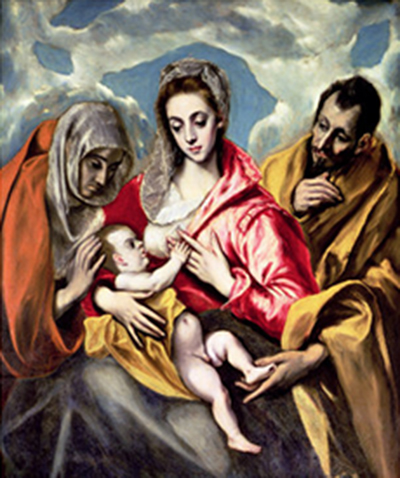
The infant Jesus lies diagonally across Mary’s lap. He reaches for her fingers as Saint Anne puts a hand to his head and Saint Joseph touches his foot. In El Greco’s The Holy Family with Saint Anne, the adults come together around the small movements of a child being fed. Their heads are set against an expanse of blue and white cloud, while their hands draw the eye from his head to his feet. The Fundación Casa Ducal de Medinaceli dates this four-figure painting at the Hospital de Tavera in Toledo to about 1595. [1]
At a Glance
- ArtistEl Greco (Doménikos Theotokópoulos)
- DateAbout 1595 [1]
- MediumOil on canvas
- Dimensions127 × 106 cm [2]
- CollectionFundación Casa Ducal de Medinaceli, Hospital de Tavera, Toledo
- Spanish titleLa Sagrada Familia con Santa Ana
This work across El Greco’s career
Martyrdom of Saint Maurice
1580–82The Burial of the Count of Orgaz
Commissioned 1586View of Toledo
c. 1599–1600Opening of the Fifth Seal
c. 1608–14View and Plan of Toledo
1610–14Contents
- The child across Mary’s lap
- At the child’s head and feet
- The face beneath the paint
- A gift recorded at Tavera
- Other Holy Families and other settings
The child across Mary’s lap
The cloth beneath Jesus is gathered into a series of gold folds. Mary’s right hand crosses it below the child’s ribs, with her fingers opened to support his weight. His head turns in the direction of her breast while his torso faces towards us. His legs take two different paths. One bends towards the hand Joseph offers, and the other extends down across the dark lap, ending in a small bare foot. Those changes of direction give the infant room to move within the close arrangement of the adults. In the middle of that movement, his right hand takes hold of the fingers of Mary’s left. [1]
Mary’s red garment falls into loose folds at the shoulder and bunches into tighter ones at her bent elbow. The sleeve is bright enough to lead the eye towards her hand, where the end of the child’s arm crosses the light on her chest. A pale veil frames the lowered face and reappears near her neckline. Lower down, her blue mantle spreads across her knees and fills much of the lower edge. The dark folds widen towards the base of the picture, giving the seated figure a firm footing within the composition. Above them the small turns of the veil and the sleeve break up the light around the face and hands. [1] [3]
The sky occupies the shallow space behind the figures. Above Mary the clouds part in an irregular arc, leaving blue behind the upper half of her head. The white and grey strokes reach down between Mary and Joseph, and a thinner band of sky opens behind Anne’s veil. The figures fill the canvas below those openings. Their robes crowd together at the edges and the folds beneath the child give the group a shared base. The foreground thus feels close enough for the viewer to follow the touch of a finger, while the variable edges of the clouds keep the upper part of the painting open. [1] [3]
At the child’s head and feet
Saint Anne, Mary’s mother, bends forward on the left. A pale veil casts her forehead into shadow and leaves the downward direction of her eyes visible. Her orange mantle sweeps down the edge of the picture, and a narrow space opens between her cheek and the child’s head. The hand she brings into that gap follows the curve of his scalp. El Greco puts her close to both Mary and Jesus, with one figure’s sleeve, veil or hand repeatedly entering the space of another. [1] [3]
On the right, Joseph looks into the group. His face turns down and inward and one hand bends towards his chest. Below it the broad yellow mantle opens around his other forearm. His left hand reaches across the dark fold below the infant’s legs. The extended fingers have just enough light on them to show where they meet the child’s foot. Joseph’s gesture is spread across more of the canvas than Anne’s, but the two converge on the same body. The Foundation connects the figure’s maturity and active care with the prominence given to Joseph as a protector in Catholic devotion of the period. [1] [3]
The Foundation also gives the painting the alternative title Virgen de la Buena Leche, referring to Mary nursing Jesus. In its interpretation for the 2023 exhibition, the Vatican’s Dicastery for Evangelization reads that act in relation to the Incarnation, the Christian belief that the Son of God took human flesh. The child’s need for nourishment gives that idea visible form. The same exhibition text sees a possible anticipation of the Passion in the hands at the child’s head and feet, recalling the care given to Christ’s body in scenes after the Crucifixion. In the painted moment those hands are occupied with a living child who reaches for his mother. [1] [3]
The face beneath the paint
Seen at close range, Mary’s face has small shifts of light around the eyes and nose, with a warmer touch on her cheek and at the lips. The shadows along the veil help set those marks within a single, downward turn. The finished face is the result of work at more than one level. The Foundation reports that an X-ray revealed an underlying drawing of the Virgin’s face. It interprets the earlier design as evidence that El Greco developed the features through successive adjustments, beginning from a model. The published account leaves the sequence of changes to particular features open. [1] [3]
Carmen Garrido reproduces a visible-light photograph and a radiograph of the Tavera painting together as figure 6 in her study of El Greco’s technique. She uses the example to show how forms can overlap as the painter builds the image. An X-ray records differences in how materials absorb radiation, so some underlying painted features can appear alongside the ones seen on the surface. Garrido notes in particular the contrast created by paints containing substantial amounts of lead white in El Greco’s work. The technical record makes it possible to recognise work below the surface of the Tavera canvas, while the finished face has its own hierarchy of edges. The eyelids are sharply marked and the transition from her cheek into the veil is much less abrupt. That difference gives the lowered gaze more definition than the outline surrounding it. [1] [4]
A gift recorded at Tavera
The Foundation identifies the hospital’s 1631 inventory as the earliest known record of the painting there. It lists the work as a gift from Teresa de Aguilera, widow of Alonso Capoche. The inventory gives the painting a documented place in Toledo by that year. Its earlier ownership and the date of the gift are less firmly established. The Foundation’s dating of about 1595 is an estimate of when El Greco painted the canvas. The Vatican’s 2023 exhibition gave the same work an earlier date of 1586–88. [1] [3]
Pedro Salazar de Mendoza, the hospital’s administrator, commissioned a wooden tabernacle from El Greco in 1595. That commission belongs to the history of the main chapel and has its own records. José Riello cites an appraisal and later documents concerning the tabernacle and the hospital’s altarpieces. The Holy Family’s presence at Tavera is documented through Aguilera’s gift. The hospital eventually held more than one kind of work by El Greco. The large Baptism of Christ belongs to the later altarpiece project associated with a contract of 1608 and gives an idea of the scale at which he worked for the chapel itself. [1] [5]
Other Holy Families and other settings
In the Prado’s Holy Family with Saint Anne and the Infant Saint John, P000826, El Greco placed another child in the group. The young Baptist appears beside Mary with a bowl of fruit and a finger near his mouth. The infant Jesus lies across Mary’s lap and looks towards Anne, who gathers a white cloth around him. In the Tavera picture the yellow cloth supports the child as he nurses, and Joseph’s hand comes directly into the foreground. The Prado catalogue dates P000826 to about 1600 and records its deposit at the Biblioteca Museu Víctor Balaguer. [1] [6]
The National Gallery of Art in Washington has a smaller painting of the five-figure group, The Holy Family with Saint Anne and the Infant John the Baptist, 1959.9.4. The gallery dates it to about 1595–1600. Its Christ Child sleeps, and the young John’s raised finger makes a more emphatic request for quiet. In the Prado’s five-figure painting, X-radiography showed earlier forms close to those in Washington, including an older, white-haired Joseph and the infant’s closed eyes. Those findings apply to the Prado variant. The X-ray of the four-figure Tavera painting gives evidence about the making of Mary’s face. [1] [6] [7]
Another Washington canvas, Madonna and Child with Saint Martina and Saint Agnes, 1942.9.26, was made for one of the side altars of the Chapel of San José in Toledo. El Greco sets Mary and Jesus high among the clouds and angels, with the two saints standing below. At the same chapel, Saint Joseph and the Christ Child makes Joseph the central figure and puts his protective hand beside an older child’s head. The Tavera picture places that care in another setting. The adults sit or incline around a single lap, and a hand near the foot of an infant carries much of Joseph’s part in the scene. [1] [8]
Browse the artworks
Browse the paintings covered in this collection and related works in museum catalogues. Some are by El Greco’s workshop or were formerly attributed to him.
| Name | Date | Medium |
|---|---|---|
| View of Toledo | Around 1599–1600 | Oil on canvas |
| Adoration of the Shepherds | 1612–14 | Oil on canvas |
| Laocoön | About 1610–14 | Oil on canvas |
| The Tears of Saint Peter | 1587–96, Museo del Greco dating | Oil on canvas |
| The Holy Family with Saint Anne | About 1595 | Oil on canvas |
| The Holy Trinity | 1577–79 | Oil on canvas |
| The Burial of the Count of Orgaz | 1586–88, the conventional range | Oil on canvas |
| Disrobing of Christ | 1577–79 | Oil on canvas |
| Opening of the Fifth Seal | About 1608–14 | Oil on canvas |
| Saint Martin and the Beggar | 1597–99 | Oil on canvas |
| Martyrdom of Saint Maurice | 1580–82 | Oil on canvas |
| Adoration of the Name of Jesus | 1577–79 | Oil on canvas |
| Saint Peter in Penitence (Bowes Museum) | 1580s | Oil on canvas |
| Christ Carrying the Cross | Around 1577–87 | Oil on canvas |
| Crucifixion | 1597–1600 | Oil on canvas |
| Resurrection | 1597–1600 | Oil on canvas |
| Immaculate Conception | About 1608–13 | Oil on canvas |
| Annunciation | 1597–1600 | Oil on canvas |
| Coronation of the Virgin | 1591–92 | Oil on canvas |
| Lady in a Fur Wrap | About 1580–88 | Oil on canvas |
| Baptism of Christ | Around 1608–14, with further work in the early 1620s according to Walter Liedtke. The foundation dates the painting to around 1614. | Oil on canvas |
| Portrait of an Old Man (Possible Self-Portrait) | About 1595–1600 | Oil on canvas |
| Adoration of the Kings | 1565–67, Benaki Museum dating | Tempera on wood |
| Mary Magdalene in Penitence | About 1585–90, tentatively dated by the Museu del Cau Ferrat | Oil on canvas |
| Saint Sebastian | About 1577 in the cathedral centenary catalogue | Oil on canvas |
| Portrait of Cardinal Fernando Nino de Guevara | About 1600 | Oil on canvas |
| Penitent Magdalene | About 1576–77 | Oil on canvas |
| The Nobleman with his Hand on his Chest | About 1580 | Oil on canvas |
| Saint Peter and Saint Paul | 1590–1600 | Oil on canvas |
| Pentecost | Circa 1600 | Oil on canvas |
| The Fable | About 1580 | Oil on canvas |
| Pietà | 1580–90 | Oil on canvas |
| View and Plan of Toledo | 1610–1614, according to the Museo del Greco | Oil on canvas |
| Assumption of the Virgin | 1577–79, with 1577 in the Greek inscription | Oil on canvas |
| The Annunciation (1609) | Late Tavera period. The owner dates the canvas to 1614. Factum gives 1608–1613 in its initial recording account. | Oil on canvas |
| The Agony in the Garden of Gethsemane | 1590s | Oil on canvas |
| Portrait of Jorge Manuel Theotocópuli | Circa 1600–05 | Oil on canvas |
| Dormition of the Virgin | About 1565–66, according to the National Gallery of Greece | Tempera on wood |
| Saint Louis | 1585–90 | Oil on canvas |
| Ecstasy of St Francis of Assisi (1580) | About 1577–80 in the Vatican Museums’ account. The Diocesan Museum gives 1575–80. | Oil on canvas |
| Saint Francis of Assisi in Ecstasy, after El Greco | Seventeenth century | Oil on canvas |
| Christ Driving the Money Changers from the Temple | Probably before 1570 | Oil on wood |
| The Entombment of Christ | Circa 1568–70, Venice | Mixed technique on wood |
| Nativity | 1603–05 | Oil on canvas |
| Portrait of a Gentleman | About 1586 | Oil on canvas |
| Coronation of the Virgin (Illescas) | 1603–05 | Oil on canvas |
| A Boy Blowing on an Ember to Light a Candle (El Soplón) | About 1570–72 | Oil on canvas |
| The Feast in the House of Simon | About 1608–14 | Oil on canvas |
| Concert of Angels | About 1608–14 | Oil on canvas |
| Healing of the Man Born Blind | Around 1570 in Dresden’s printed collection guide | Mixed technique on wood |
| Fray Hortensio Félix Paravicino | 1609 | Oil on canvas |
| Purification of the Temple | Circa 1600 | Oil on canvas |
| Portrait of Vincenzo Anastagi | Circa 1575 | Oil on canvas |
| Saint Paul (Almadrones) | 1608–14 | Oil on canvas |
| Head of Christ | About 1579–86 | Oil on canvas |
| Last Supper | About 1567–68, Venice | Tempera on wood |
| Saint John the Evangelist (Prado Museum, Madrid) | About 1605 | Oil on canvas |
| Disrobing of Christ (Lyon, Half Painting Version) | About 1581–86 | Oil on canvas |
| The Dream of Philip II | 1577–79 | Oil on canvas |
| Portrait of a Sculptor | About 1577–80, 2019 exhibition dating | Oil on canvas |
| Saint Bernard | 1577–79 | Oil on canvas |
| Saint Benedict | 1577–79 | Oil on canvas |
| Portrait of Jerónimo de Cevallos | 1613, as catalogued by the Prado | Oil on canvas |
| The Flight into Egypt | About 1570 | Oil on wood |
| Saint Anthony of Padua | About 1580 | Oil on canvas |
| Portrait of a Doctor | 1582–85 | Oil on canvas |
| The Veil of Saint Veronica | 1586–95 | Oil on canvas |
| An Elderly Gentleman | About 1587–1600 | Oil on canvas |
| Saints Andrew and Francis | About 1595 | Oil on canvas |
| The Holy Family with Saint Anne and the Infant Saint John | Around 1600 in the Prado catalogue. The Balaguer record gives 1595–1600. | Oil on canvas |
| The Virgin Mary | 1595–1600 | Oil on canvas |
| Portrait of a Gentleman (1600-1605) | About 1600–05 | Oil on canvas |
| Portrait of a Young Gentleman | 1600–05 | Oil on canvas |
| John the Baptist and Saint John the Evangelist | 1600–10 | Oil on canvas |
| Portrait of a Friar | 1600–50 | Oil on canvas |
| Saint Thomas (Almadrones) | 1608–14 | Oil on canvas |
| Christ the Saviour (Almadrones) | 1608–14 | Oil on canvas |
| An Apostle (Prado P000814) | 1608–14 | Oil on canvas |
| Saint James (Almadrones) | 1608–14 | Oil on canvas |
| Julián Romero and his Patron Saint | 1612–18 | Oil on canvas |
| Allegory of the Camaldolese Order | Around 1600, Instituto Valencia de Don Juan dating | Oil on canvas |
| Saint Joseph and the Christ Child | 1597–99 | Oil on canvas |
| Saint Ildefonsus | Around 1600 according to the Prado's proposal, 1603–05 in Hadjinicolaou and Ficonofue | Oil on canvas |
| Saint Augustine | About 1585–1602, as listed in the 2014 exhibition study | Oil on canvas |
| Portrait of Diego de Covarrubias y Leyva | Circa 1600 | Oil on canvas |
| Saint Bernardino of Siena | 1603 in the Prado catalogue. The Museo del Greco object page lists 1602. | Oil on canvas |
| Portrait of Cardinal Tavera | About 1609 in the foundation's account, circa 1610 in its image heading | Oil on canvas |
| Visitation | About 1610–14 | Oil on canvas |
| Portrait of Francisco de Pisa | Circa 1610–14 | Oil on canvas |
| Saint Lawrence's Vision of the Madonna and Child (Apparition of the Virgin to St. Lawrence) | 1578–80 in the 2021 heritage decree | Oil on canvas |
| Christ on the Cross | Probably 1570s, assigned to El Greco’s Italian period in the sale literature | Oil on canvas |
| Portrait of Charles de Guise | 1572, as dated in the painted book | Oil on canvas |
| Portrait of Giulio Clovio | 1571–72, according to Capodimonte | Oil on canvas |
| Mount Sinai | About 1570–72 | Mixed technique on wood |
| Modena Triptych | 1567–1568, as dated by the Galleria Estense and the national catalogue | Tempera on wood |
| Saint Luke Painting the Virgin | 1560–67, Benaki Museum dating | Mixed technique on wood |
| Saint Ildefonso (Washington) | 1603–14 | Oil on canvas |
| Saint Martin and the Beggar (smaller Washington version) | 1600–14 | Oil on canvas |
| The Holy Family with Saint Anne and the Infant John the Baptist (Washington) | About 1595–1600 | Oil on canvas |
| The Adoration of the Name of Jesus (London panel) | Late 1570s | Oil on wood |
| Christ Driving the Traders from the Temple (London) | About 1600 | Oil on canvas |
| Saint Francis Receiving the Stigmata (Baltimore) | 1585–90 | Oil on canvas |
| Saint Luke (Almadrones, Indianapolis) | About 1610–14 | Oil on canvas |
| Saint Matthew (Almadrones, Indianapolis) | About 1610–14 | Oil on canvas |
| Saint Simon (Almadrones, Indianapolis) | About 1610–14 | Oil on canvas |
| The Tears of Saint Peter (Hospital de Tavera) | About 1605 | Oil on canvas Catalogue. |
Discussion
Look again at the images and ideas explored in The Holy Family with Saint Anne. These editorial prompts invite your observations.
Reader Insights
Follow the three hands touching Mary and the Child. How does each contact direct your attention to a different figure?
Compare the Tavera Holy Family and Saint Joseph’s altarpiece. Where does the placement of the Child shape the whole group?
Join the Conversation
Share a detail, comparison or question about The Holy Family with Saint Anne below.
References
- Fundación Casa Ducal de Medinaceli, The Holy Family with Saint Anne, Hospital de Tavera View source.
- Miguel Cortés Arrese, El fuego griego. Memoria de El Greco en Castilla-La Mancha, caption to The Holy Family with Saint Anne View source.
- Dicastery for Evangelization, The Holy Family with Saint Anne, 2023 exhibition entry View source.
- Carmen Garrido, La técnica pictórica de El Greco, in Miradas a la pintura de época moderna entre España e Italia, 2017, pp. 72–74, fig. 6 View source.
- José Riello, From the Bodily Disease to the Resurrection of the Flesh, 2016, author’s version, pp. 2–5 View source.
- Leticia Ruiz Gómez, El Greco en el Museo Nacional del Prado, 2007, cat. 15, pp. 115–119 View source.
- National Gallery of Art, The Holy Family with Saint Anne and the Infant John the Baptist, 1959.9.4 View source.
- National Gallery of Art, Madonna and Child with Saint Martina and Saint Agnes, 1942.9.26 View source.







