

 by Tom Gurney
Tom Gurney BSc (Hons) is an art history expert with over 20 years experience
Published on June 19, 2020 / Updated on July 30, 2026
Email: tomgurney1@gmail.com / Phone: +44 7429 011000
Rogier van der Weyden: Introduction
Rogier van der Weyden was one of the most powerful painters of the fifteenth-century Netherlands. Active in Tournai and Brussels, he transformed sacred grief, portrait restraint and altarpiece design into some of the defining images of Early Netherlandish painting. The National Gallery, London describes him as one of the most profound and influential painters of his century, known for naturalistic detail and expressive pathos. [1]
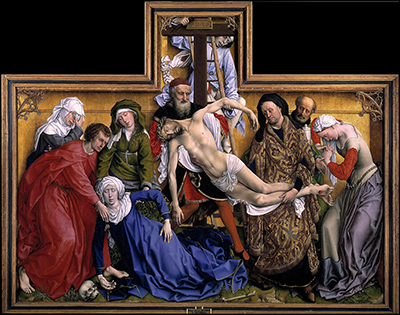
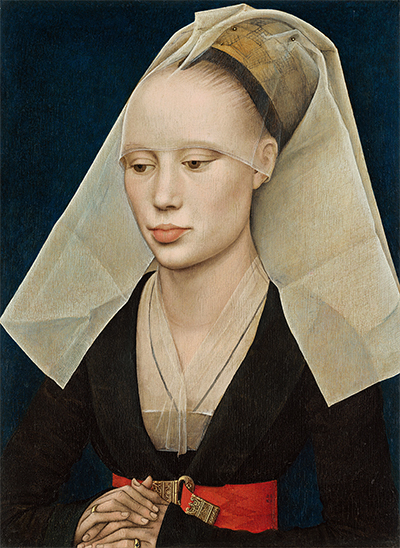
His art is unforgettable because emotion is never allowed to become chaos. In The Descent from the Cross, grief is arranged through the mirrored bodies of Christ and the Virgin. In Portrait of a Lady, inwardness is held inside veil, hands and posture. In The Magdalen Reading, devotion becomes the quiet concentration of a saint absorbed in a book. In the Saint Columba Altarpiece, sacred history unfolds across a sequence of carefully organised panels.
Rogier's surviving works are only part of the story. Some major commissions are lost. Some paintings survive as fragments. Some compositions were copied or reused through workshop practice.
At a Glance
- Full nameRogier van der Weyden
- Other nameRogier / Roger de la Pasture
- DatesAbout 1399/1400 to 1464
- Main centresTournai and Brussels
- Movement/contextEarly Netherlandish painting / Northern Renaissance
- Known forDevotional pathos, portrait psychology, altarpieces, workshop influence
- Top flagshipThe Descent from the Cross
- Important worksPortrait of a Lady, The Magdalen Reading, Saint Columba Altarpiece, Beaune Altarpiece, Seven Sacraments Altarpiece, Miraflores Altarpiece
Contents
- Introduction
- At a Glance
- Why Rogier van der Weyden Matters
- Famous Paintings
- Biography in Brief
- Style and Technique
- Workshop and Influence
- Where to Start
- Related Artists And Context
- Frequently Asked Questions
- Discussion
- References
Why Rogier van der Weyden Matters
Rogier matters because he made feeling structural. Many painters can show sadness, devotion or solemnity. Rogier made those emotions into the architecture of a painting. Bodies echo one another. Hands carry psychological weight. Faces remain controlled even when grief is overwhelming. Rooms, shrines and triptychs guide the viewer toward devotional attention.
The Prado's Descent from the Cross is the clearest example. The museum records it as painted before 1443 for the chapel of the Great Crossbowmen's guild in Leuven. [2] Its shallow gold-backed space resembles a painted shrine, and its mourners are arranged so tightly that compassion becomes unavoidable.
Rogier's importance is not limited to religious drama. Portrait of a Lady, in the National Gallery of Art, Washington, shows his gift for portrait restraint. The NGA dates it to about 1460 and notes the sitter's inward concentration, courtly dress and carefully controlled presentation. [3]
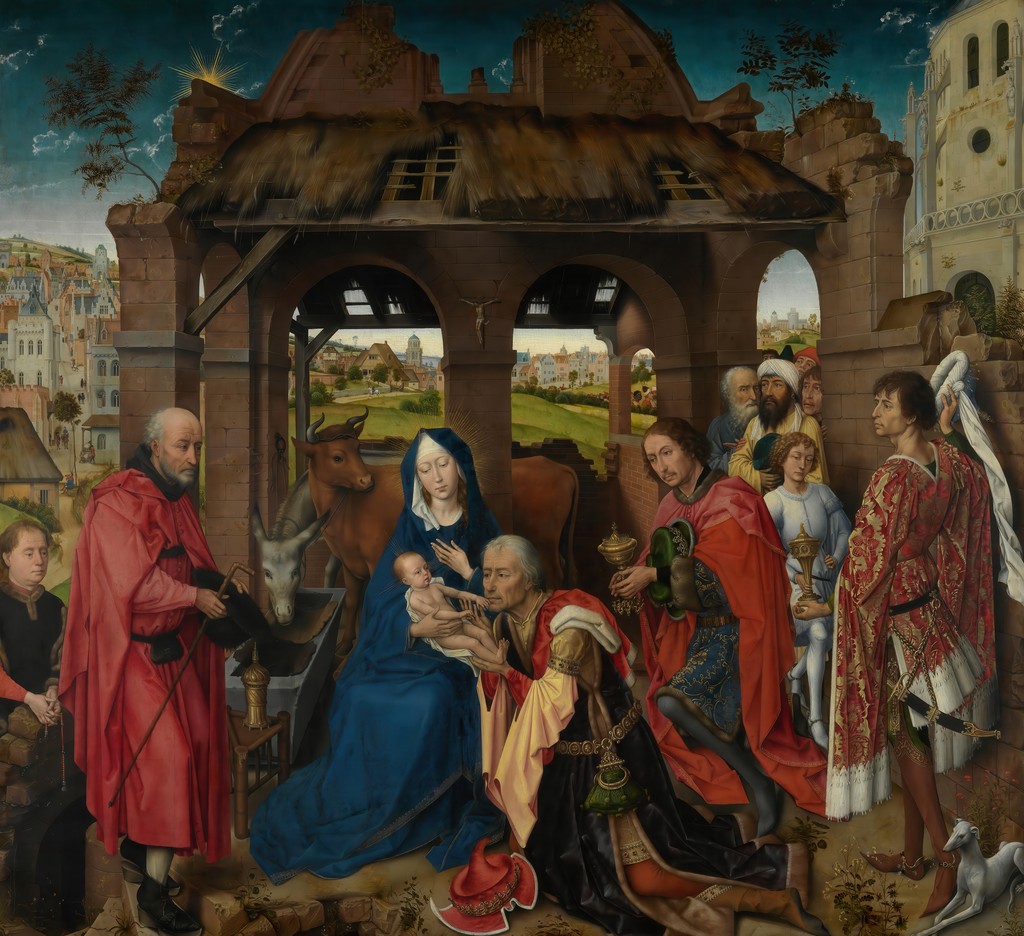
The same intelligence appears in fragments and altarpieces. The Magdalen Reading preserves part of a lost Brussels altarpiece and gives unusual evidence for Rogier's technique, underdrawing and workshop reuse. [4] The Saint Columba Altarpiece shows mature triptych design through the Annunciation, Adoration of the Kings and Presentation in the Temple, now recorded by the Pinakothek in Munich. [5] [6] [7]
Famous Paintings
The Descent from the Cross
The Descent from the Cross is the central work in this cluster. The Prado gives the essential object facts: before 1443, oil on panel, 204.5 x 259 cm, inventory P002825 and original context in the chapel of the Great Crossbowmen's guild in Leuven. [2]
The painting brings together sculptural illusion, emotional compression, guild patronage, Passion devotion and later influence, making it one of the clearest introductions to Rogier's authority.
The Magdalen Reading
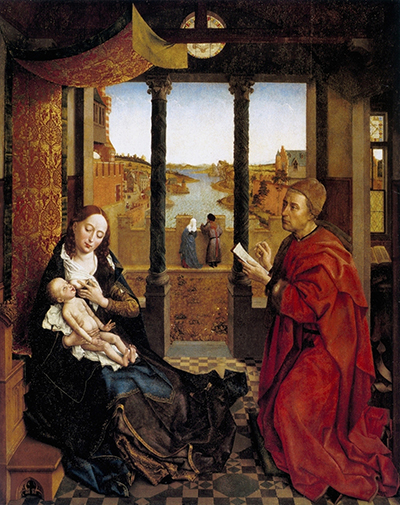
The Magdalen Reading is both beautiful and art-historically useful. It shows Mary Magdalene absorbed in a book, but it was originally the lower right corner of a much larger Virgin and Child with saints altarpiece. [4] It opens a route into fragments, reconstruction and workshop practice.
Saint Columba Altarpiece
Its three panels are recorded by the Pinakothek as around 1455, painted on oak and connected with the Marian chapel of St Columba in Cologne. [5] [6] [7]
Biography in Brief
Rogier was born around 1399 or 1400 and was also known as Rogier or Roger de la Pasture. The NGA lists both names and identifies him as Netherlandish, 1399/1400 to 1464. [8] His early career belongs to Tournai, where the National Gallery states that he was apprenticed to Robert Campin from March 1427 to August 1432. [1]
By the mid-1430s he was in Brussels, where he became painter to the city. [1] That move placed him in a major civic and Burgundian environment. He worked for city, church, Burgundian and foreign patrons, and his reputation travelled far beyond the Low Countries.
The possible journey to Rome in 1450 needs cautious handling. The National Gallery says he may have travelled there, but the stronger point is that his types and compositions were repeated widely across Europe. [1]
Rogier died in 1464. [8] By then he had helped define one of the central emotional languages of northern European art.
Style and Technique
Rogier's style is built on disciplined emotion. He often uses strong geometry: the mirrored bodies in the Descent, the rounded reading pose of Magdalene, the triangular order of Portrait of a Lady and the triptych architecture of Saint Columba Altarpiece.
His paintings are also technically refined. The National Gallery's Magdalen Reading record notes confident underdrawing, detailed book painting, wet-in-wet handling of lips and carefully worked fur texture. [4] Such details show that Rogier's realism was not only descriptive. It served devotion and psychological focus.
The Style and Technique page explains the visual patterns behind the individual works.
Workshop and Influence
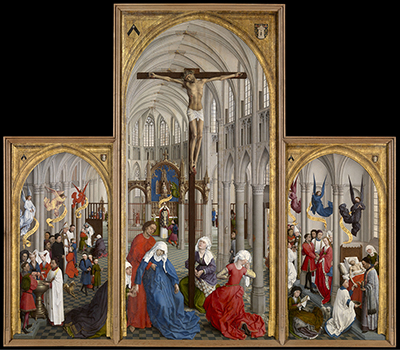
Rogier's art spread through workshop practice, copies, fragments, patterns and later admiration. The National Gallery notes the issue of workshop collaboration among smaller religious works, and the Magdalen Reading record shows that figures from its lost altarpiece were reused elsewhere, including a reversed Mary in the Seven Sacraments Altarpiece. [1] [4]
Rogier also belongs in the broader northern corridor. Later subject links to Rubens and Rembrandt are especially useful from the Descent from the Cross page.
Where to Start
Start with The Descent from the Cross for Rogier's emotional and devotional power. Move to Portrait of a Lady for his portrait psychology. Read The Magdalen Reading for fragments, reconstruction and contemplative detail.
Together they explain Rogier not only as a maker of famous images, but as a central figure in the way northern European painting learned to organise feeling.
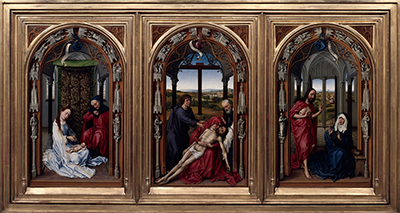
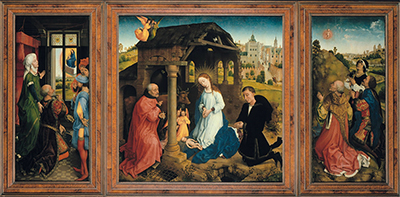
The next route is through the altarpieces: Saint Columba Altarpiece, Beaune Altarpiece, Seven Sacraments Altarpiece, Miraflores Altarpiece, Bladelin Altarpiece and Saint John Altarpiece. These pages show Rogier working across hospitals, churches, private devotion, ritual theology and narrative sequence.
The portrait route is different. Portrait of a Lady, Portrait of Philippe de Croy and Portrait of Francesco d'Este show how Rogier could turn stillness into psychological and social presence. Together, the routes make the homepage a map of the cluster rather than only a summary of the artist.
Related Artists And Context
Rogier belongs beside Robert Campin, Jan van Eyck, Petrus Christus, Hans Memling, Dirk Bouts and Hugo van der Goes. Some were predecessors or near contemporaries; others show how Early Netherlandish painting developed after him. The cluster should use those links carefully, as context rather than simple influence claims.
He also matters to later northern art. Copies after the Descent from the Cross, devotional formulas, portrait types and Passion compositions kept his inventions alive long after his death. That is why the workshop, drawings and copies pages are part of the main reading route, not only supporting material.
Frequently Asked Questions
Rogier van der Weyden was a major Early Netherlandish painter, active in Tournai and Brussels, known for religious paintings, portraits and altarpieces of great emotional force. [1]
Yes. Rogier or Roger de la Pasture is the French form associated with his Tournai background; Rogier van der Weyden is the Dutch form associated with his Brussels context. [8]
He is associated with Early Netherlandish painting and the Northern Renaissance. His style is known for naturalistic detail, expressive pathos, carefully structured figures and intense devotional emotion. [1]
Yes. Portrait of a Lady in Washington is one of his best-known portraits. [3]
Some major works were cut apart, damaged or lost. The Magdalen Reading survives as a fragment from a larger altarpiece, making it essential for understanding reconstruction and workshop practice. [4]
Discussion
What best explains Rogier's power: devotional emotion, portrait restraint, technical finish, workshop influence, or the way his paintings turn feeling into structure?
Reader Insights
Rogier often makes emotion architectural. Bodies, hands and sightlines are arranged so that grief or devotion becomes part of the painting's structure.
Move between the Descent, Portrait of a Lady and the Magdalen to see how he can expand emotion through a group or compress it into one absorbed figure.
The strongest route through this section begins with the flagship works, then opens into biography, workshop practice and later influence.
Join the Conversation
Have a thought or observation about Rogier van der Weyden? Share it below. Thoughtful responses may be added to this section as the Rogier van der Weyden cluster develops.
References
- The National Gallery, London, artist page for Rogier van der Weyden, accessed 2026-07-11. https://www.nationalgallery.org.uk/artists/rogier-van-der-weyden
- Museo Nacional del Prado, The Descent from the Cross, collection record for P002825, accessed 2026-07-11. https://www.museodelprado.es/en/the-collection/art-work/the-descent-from-the-cross/856d822a-dd22-4425-bebd-920a1d416aa7
- National Gallery of Art, Washington, Portrait of a Lady, collection record for 1937.1.44, accessed 2026-07-11. https://www.nga.gov/artworks/51-portrait-lady
- The National Gallery, London, The Magdalen Reading, collection record for NG654, accessed 2026-07-11. https://www.nationalgallery.org.uk/paintings/rogier-van-der-weyden-the-magdalen-reading
- Sammlung Pinakothek / Bayerische Staatsgemaeldesammlungen, Columba-Altar: Verkuendigung, WAF 1190, accessed 2026-07-11. https://www.sammlung.pinakothek.de/de/artwork/A0GOlar4dp
- Sammlung Pinakothek / Bayerische Staatsgemaeldesammlungen, Columba-Altar: Anbetung der Koenige, WAF 1189, accessed 2026-07-11. https://www.sammlung.pinakothek.de/de/artwork/jWLpO7nxKY
- Sammlung Pinakothek / Bayerische Staatsgemaeldesammlungen, Columba-Altar: Darbringung im Tempel, WAF 1191, accessed 2026-07-11. https://www.sammlung.pinakothek.de/de/artwork/53470Zmx9e
- National Gallery of Art, Washington, artist record for Rogier van der Weyden / Rogier de la Pasture, accessed 2026-07-11. https://www.nga.gov/collection/artist-info.1971.html
- Dirk de Vos, Rogier van der Weyden: The Complete Works, Harry N. Abrams, 2000.
- Lorne Campbell and Jan Van der Stock, eds., Rogier van der Weyden: 1400-1464. Master of Passions, Leuven, Davidsfonds, 2009.