

 by Tom Gurney
Tom Gurney BSc (Hons) is an art history expert with over 20 years experience
Published on June 19, 2020 / Updated on July 30, 2026
Email: tomgurney1@gmail.com / Phone: +44 7429 011000
Portrait of a Lady by Rogier van der Weyden: Introduction
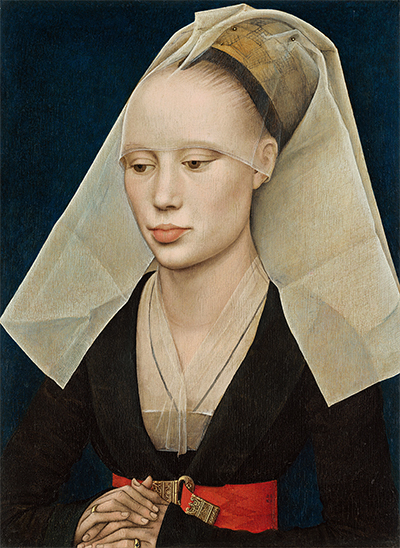
Rogier van der Weyden's Portrait of a Lady is one of the most concentrated portraits of the fifteenth-century Netherlands. The painting is small, restrained and almost severe, but it has a psychological charge that makes it feel larger than its dimensions. The sitter is unknown. She looks downward, her hands clasped at the lower edge of the panel, her pale face framed by a transparent white veil and a dark dress that nearly disappears into the background. Rogier removes almost everything that might distract from her presence. What remains is poise, inwardness and controlled intensity. [1]
The National Gallery of Art in Washington dates the painting to about 1460 and identifies it as oil on panel. The painted surface measures 34 x 25.5 cm, with the full panel measuring 37 x 27 cm. It entered the NGA in 1937 as part of the Andrew W. Mellon Collection, under accession number 1937.1.44.
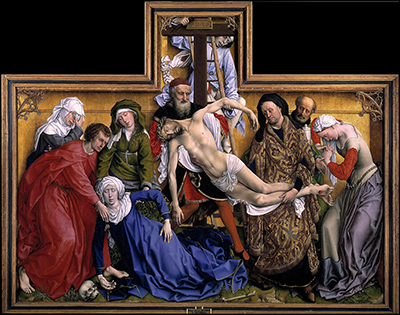
This portrait deserves flagship treatment because it shows a different side of Rogier from the great Passion altarpieces. In The Descent from the Cross, grief expands through a group of bodies. In Portrait of a Lady, emotion is compressed into posture, costume, geometry and the smallest signs of mental concentration.
At a Glance
- ArtistRogier van der Weyden
- TitlePortrait of a Lady
- Datec. 1460
- MediumOil on panel
- Painted surface34 x 25.5 cm
- Overall panel37 x 27 cm
- Current locationNational Gallery of Art, Washington
- Accession number1937.1.44
- Credit lineAndrew W. Mellon Collection
- Key themesNetherlandish portraiture, Burgundian court fashion, restraint, inwardness, geometry, late style
Contents
- Introduction
- At a Glance
- What the Portrait Shows
- Annotated Details
- The Unknown Sitter
- Geometry, Costume and Control
- Hands and Face
- Late Portrait Style
- Fashion and Burgundian Court Culture
- Condition and Technical Notes
- Provenance
- Rogier and Portraiture
- How to Look at the Painting
What the Portrait Shows
The painting shows a young woman from about the waist upward. She is placed close to the viewer, with her folded hands resting along the lower edge of the panel. This gives the impression that she sits just beyond the picture surface, almost as if the frame is a ledge between her world and ours. [1]
Her costume is formal and highly controlled. A transparent white veil covers her hair and falls in angular planes over her shoulders. A black ribbon draws the hair back from the high forehead, while the dark dress forms a deep V across the chest. The red belt and gold buckle introduce a small but important zone of colour and refinement. The NGA notes the contrast between the light skin and veiling, the red belt, the dark dress and the deep green background. [1]
The face is quiet but not empty. The sitter's eyes are lowered. Her lips are set firmly, without the social ease of a smile. Her fingers are tense and tightly arranged. Rogier does not give her an anecdote, a landscape setting, a family emblem or an obvious devotional object. Instead, he builds the portrait from a few controlled elements: face, hands, veil, dress, belt and background.
That spareness is the painting's strength. The sitter is not presented as an ornament or a social type alone. She appears alert, self-possessed and inwardly active. The viewer is invited to look carefully, but not to possess her identity. The unknown name becomes part of the work's power. Rogier gives us less biography and more presence.
Annotated Details from Portrait of a Lady
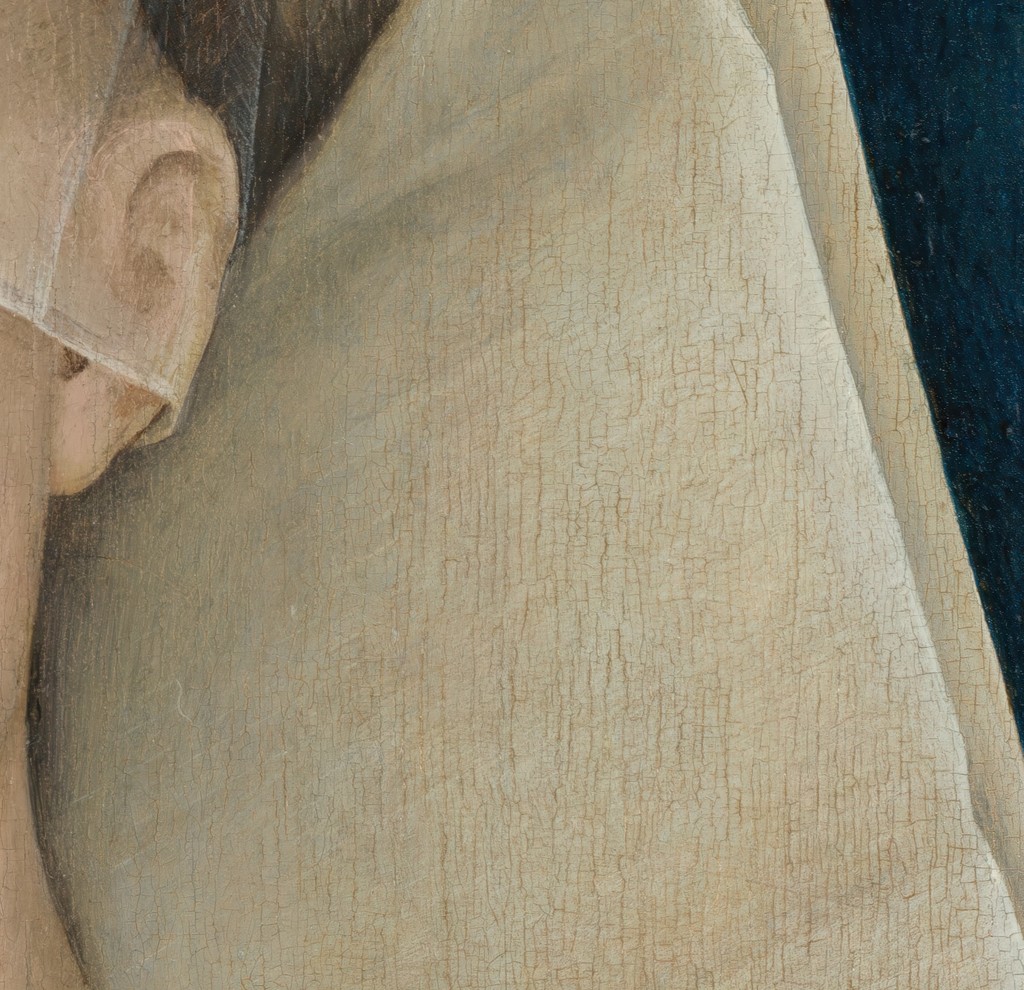
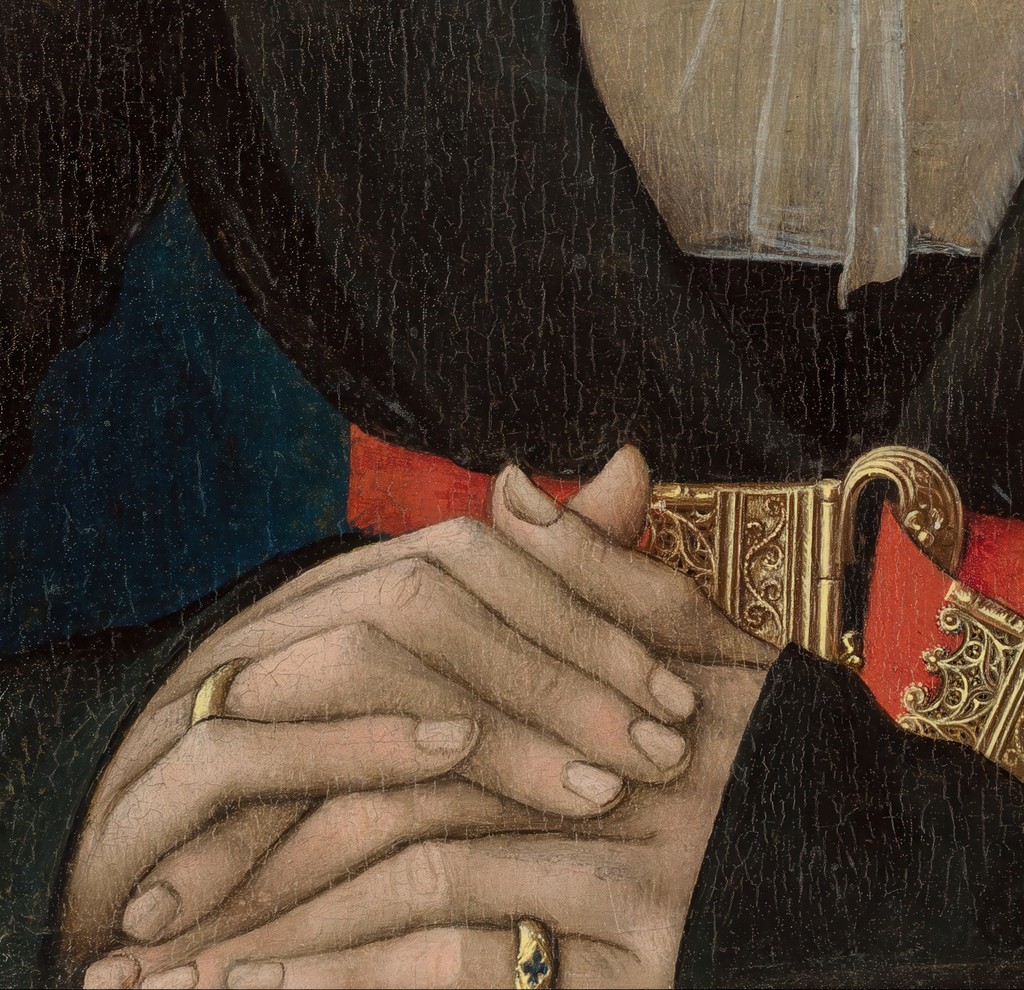
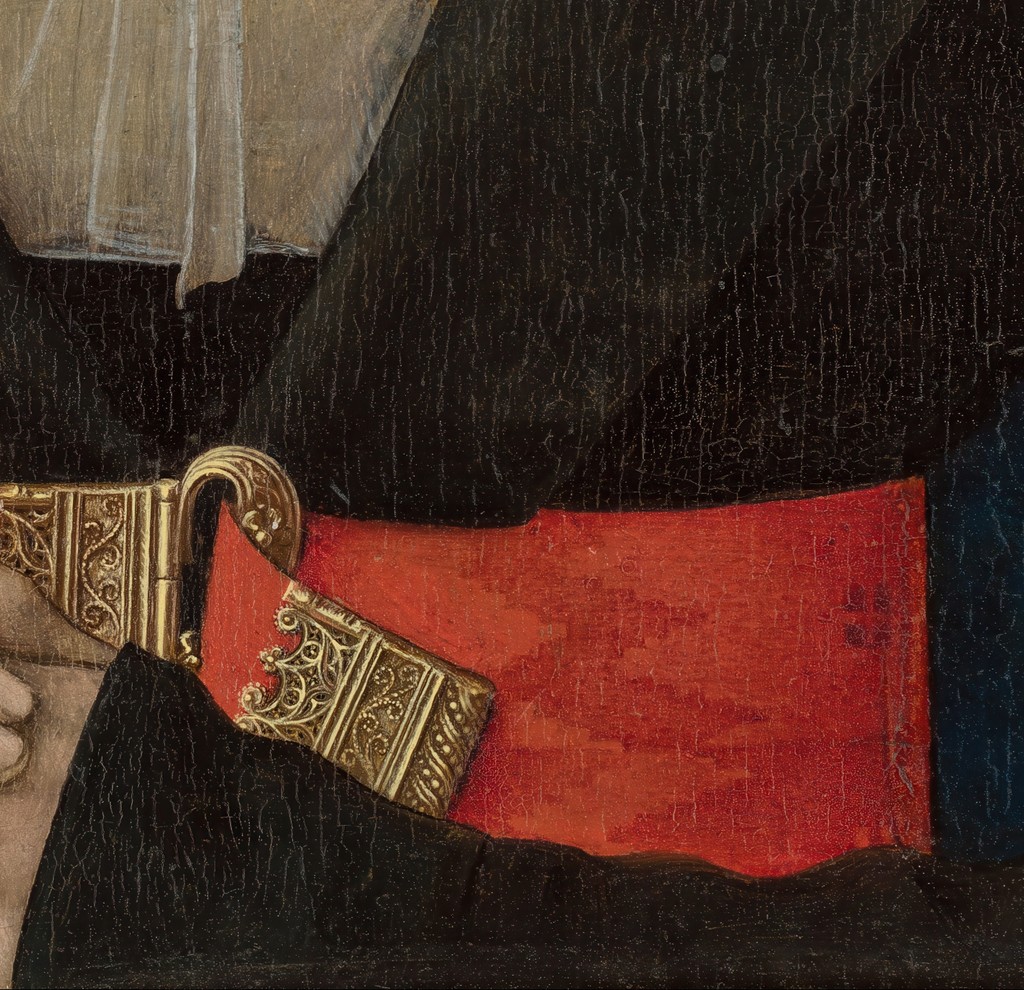
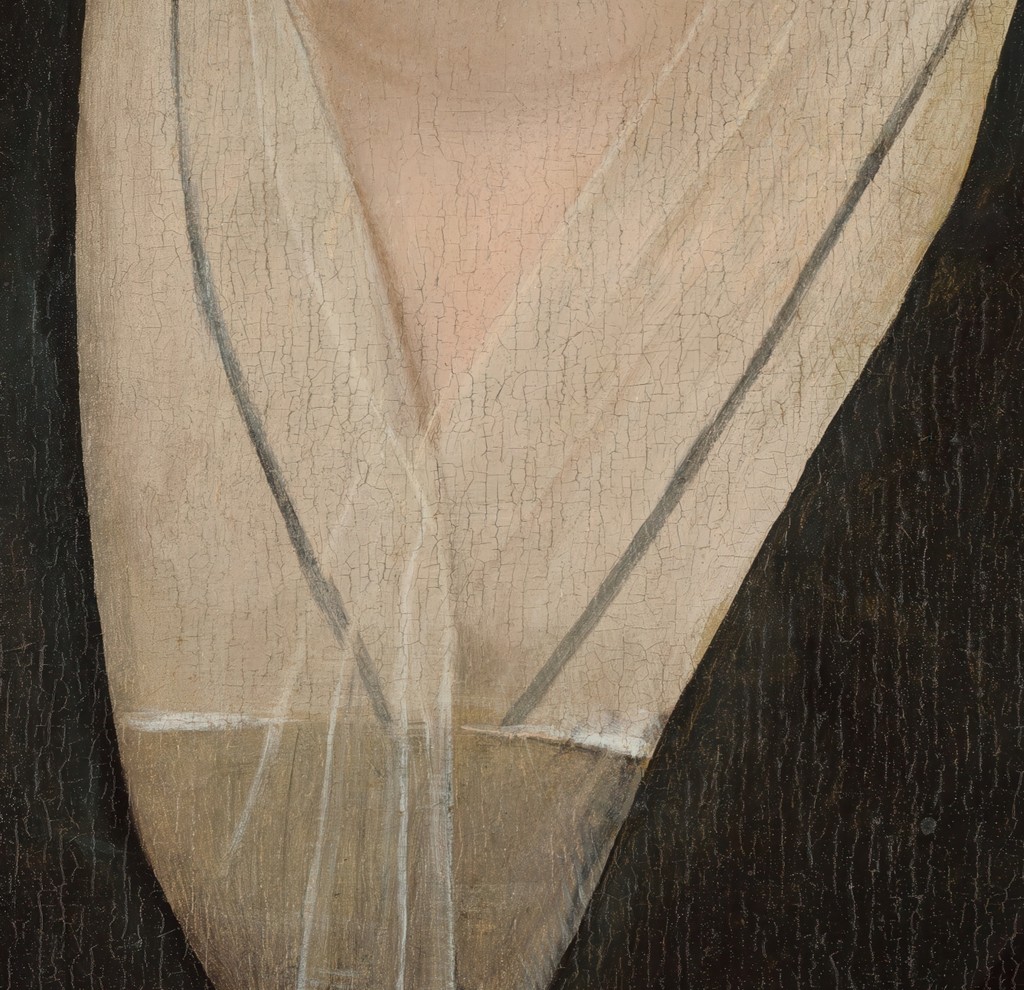
These numbered details show how Rogier builds the sitter's presence through lowered eyes, controlled geometry, translucent fabric, restrained colour and extraordinarily precise hands.
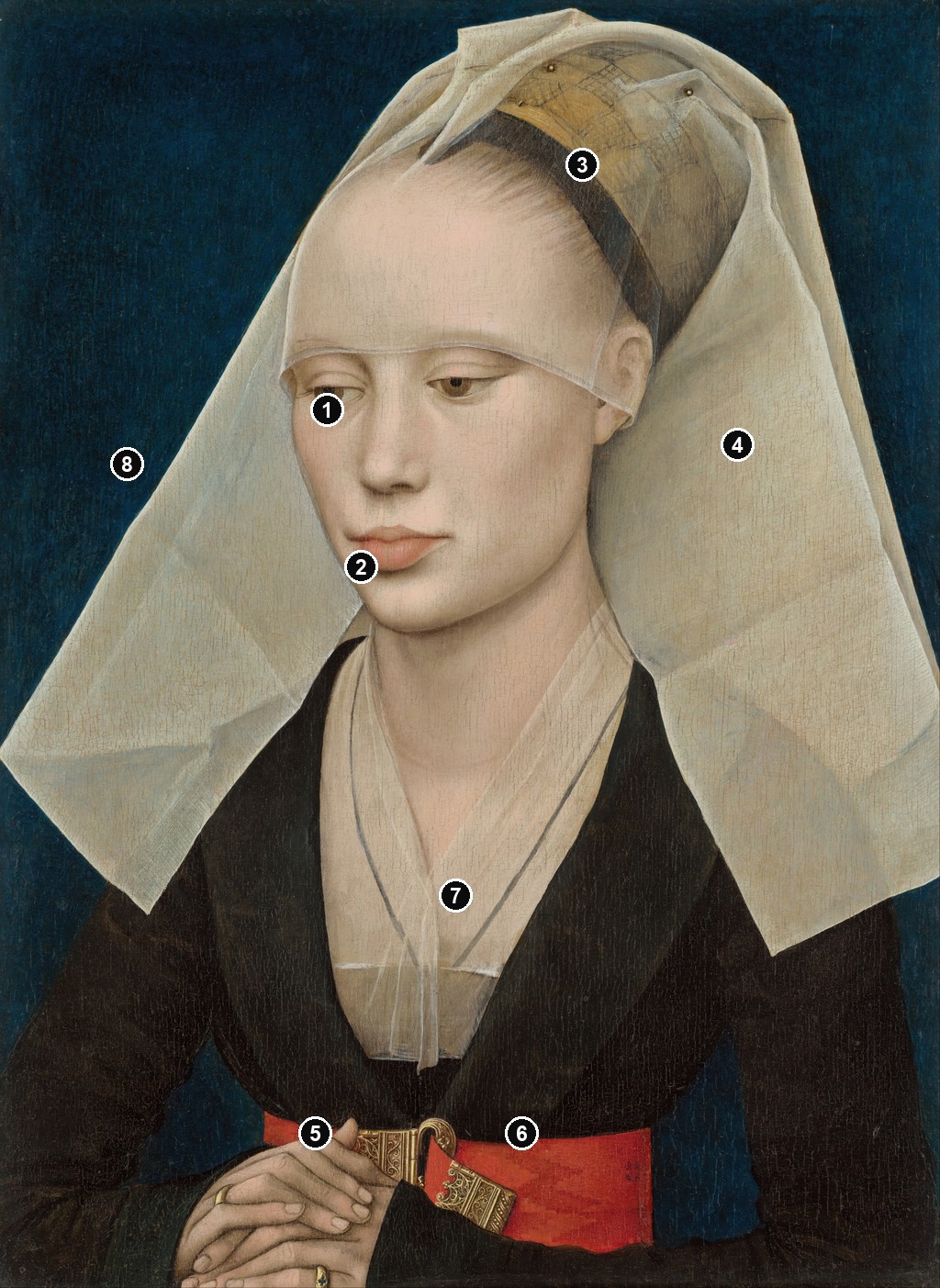
Details from PORTRAIT OF A LADY
Close looking reveals how pose, costume and finish turn reserve into intensity.
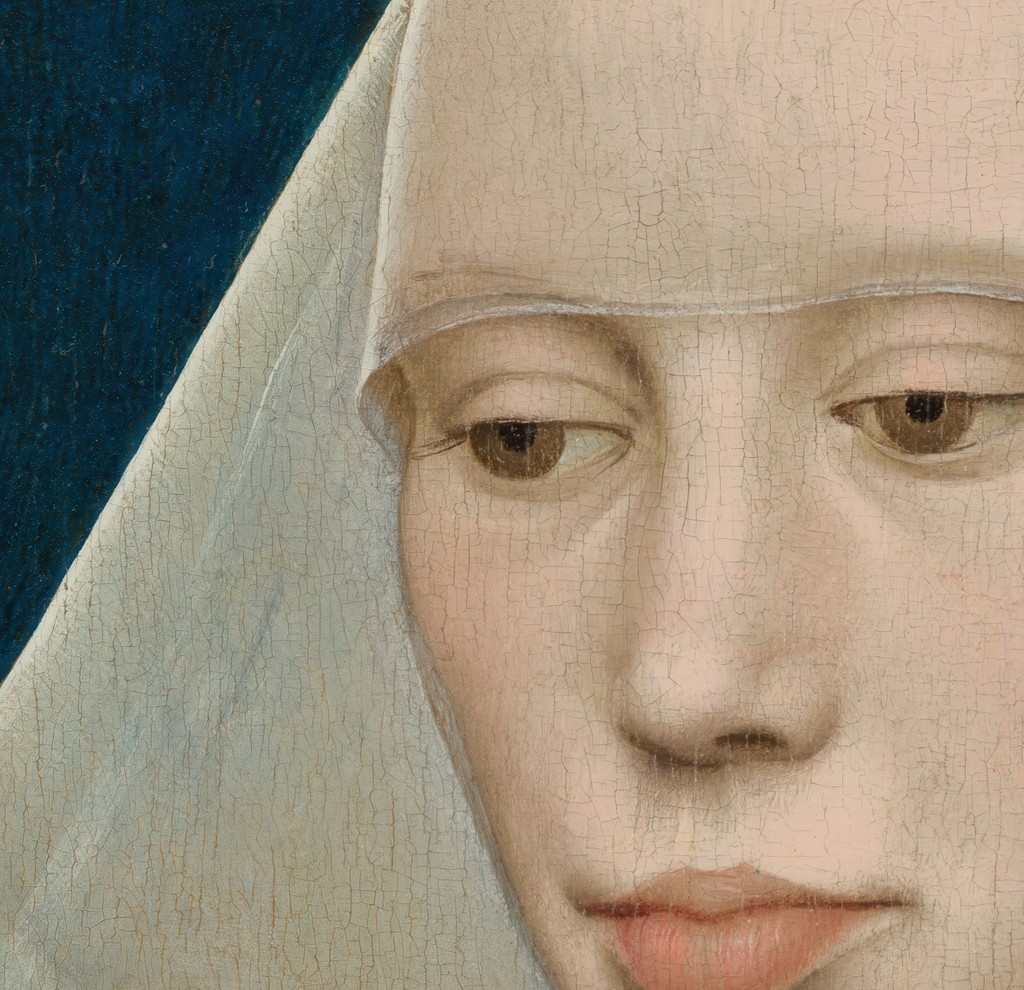
Lowered eyes and fine brow
The sidelong, lowered gaze creates self-possession rather than direct confrontation.
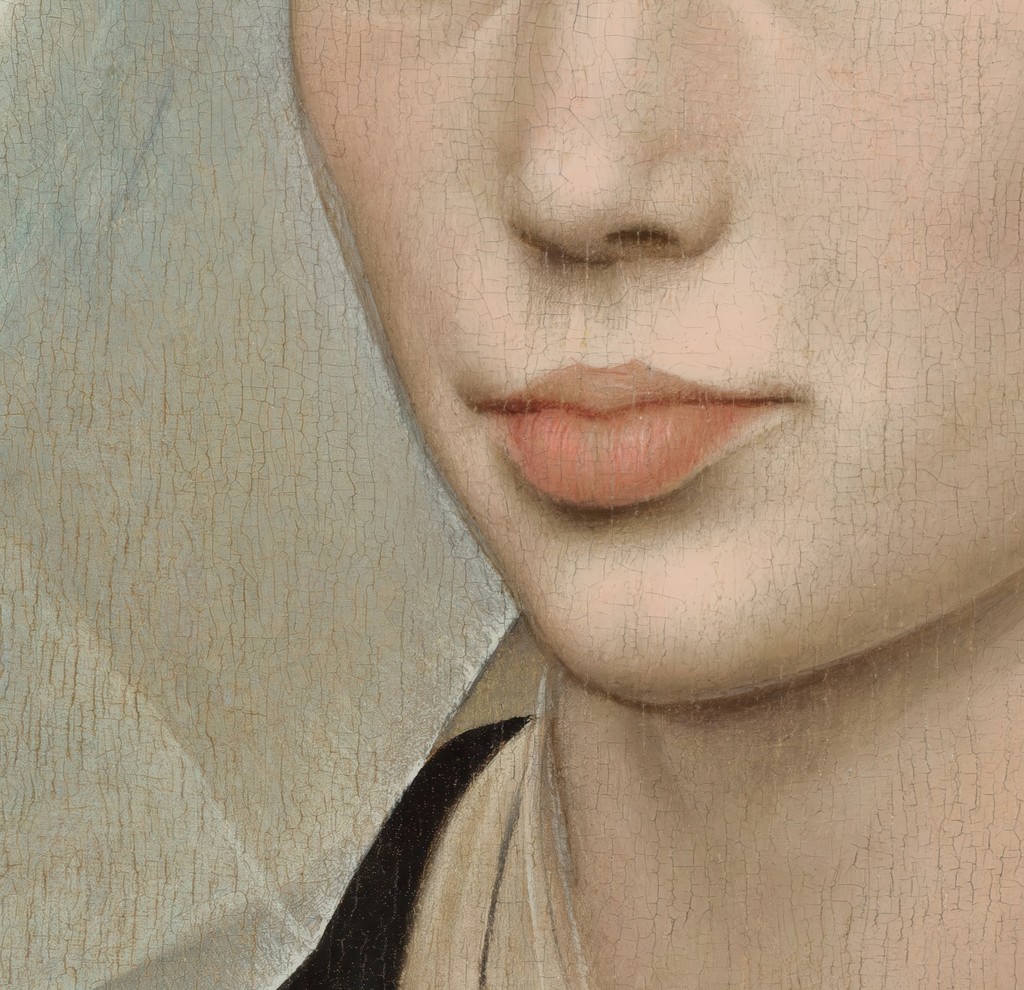
Mouth and chin
The softly closed lips and sharply modelled chin balance delicacy with control.
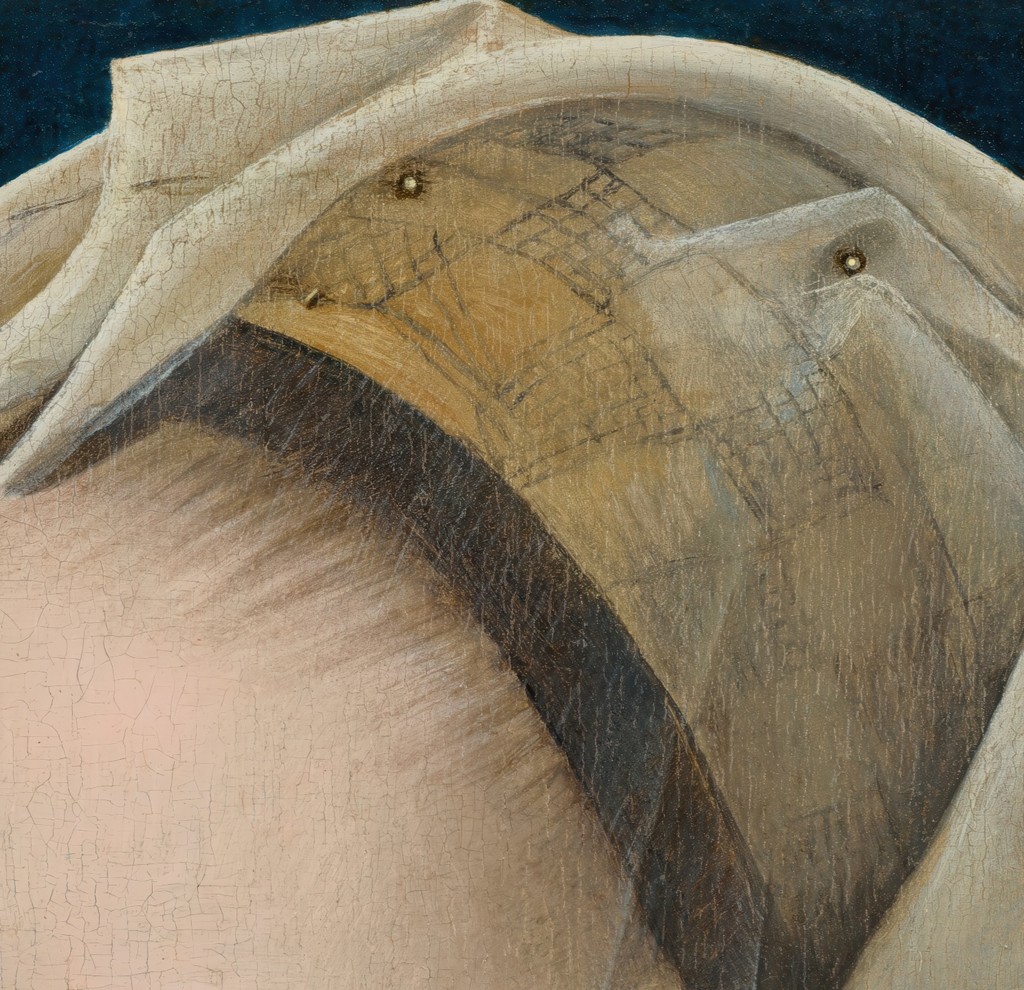
Headdress pins and folds
Tiny pins and angular folds reveal the constructed precision of the fashionable hennin and veil.
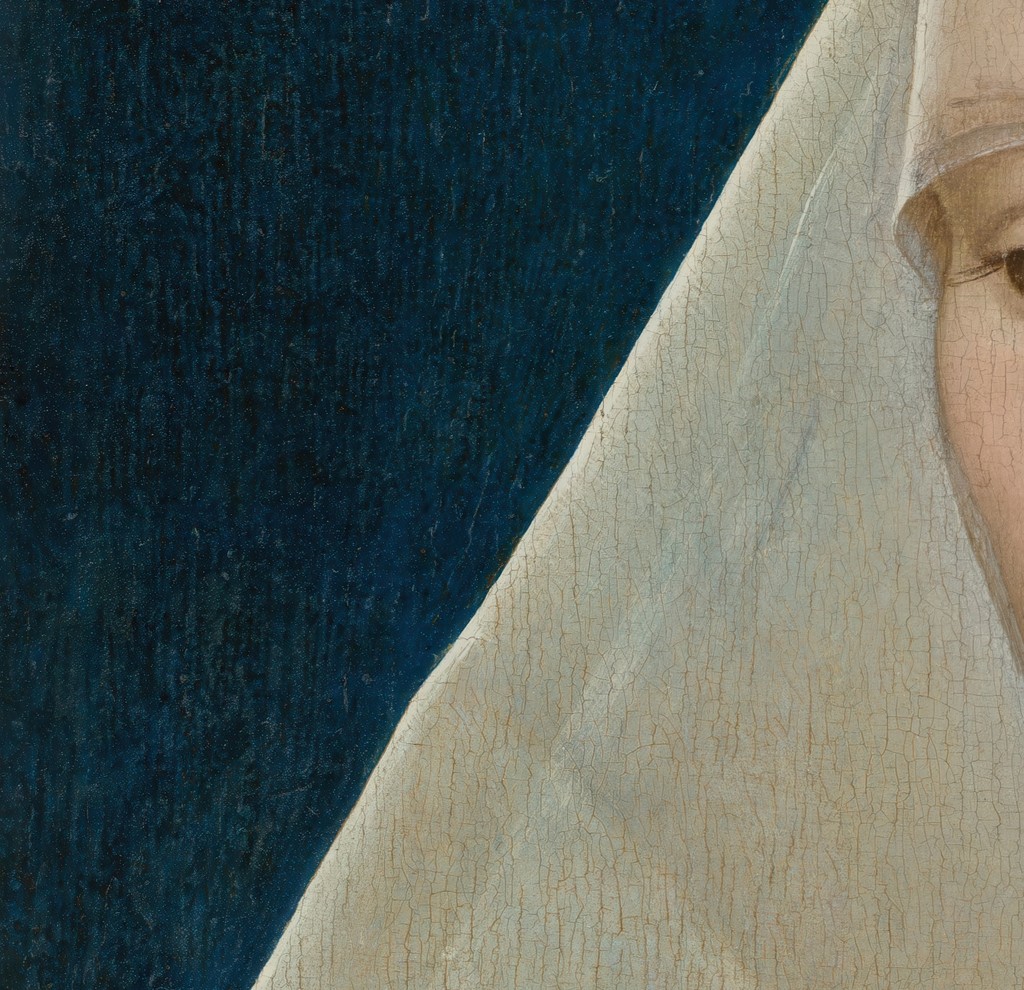
Veil and silhouette
The pale veil forms a broad geometric frame around the face against the dark blue ground.
Folded hands and rings
Long fingers, restrained gesture and carefully placed rings concentrate attention at the lower edge.
Belt buckle and red band
The narrow red accent and gilded buckle interrupt the otherwise subdued palette.
Neckline and black dress
Overlapping dark and translucent forms lead the eye upward toward the sitter's face.
Blue ground and pyramidal form
The plain ground clarifies the portrait's stable pyramidal silhouette and quiet monumentality.
The Unknown Sitter
The sitter has not been securely identified. The NGA describes her as likely noble, based on her dignity, costume and the courtly fashion of the plucked hairline and eyebrows. [1] The evidence suggests high status, but it does not give us a confirmed name.
That uncertainty is important. Many Renaissance portraits tempt viewers to turn immediately toward biography: Who was this person? What family did she belong to? What marriage, alliance or political purpose might the portrait have served? Those questions matter, but Rogier's panel also shows how much a portrait can do when identity is lost.
Without a name, the image becomes a study in social discipline and inner life. The dress and headdress speak of rank and fashion; the hands and face speak of restraint; the dark background removes worldly setting; the small scale asks for close viewing. The sitter is both particular and withheld.
This withholding fits Rogier's art. He often makes emotion legible without making it loose or theatrical. In the Descent from the Cross, grief is visible in bending bodies and controlled faces. In Portrait of a Lady, the same discipline appears in a secular format. The sitter's concentration is intense, but contained inside etiquette, clothing and geometry.
Geometry, Costume and Control
Rogier builds the portrait through interlocking shapes. The headdress opens outward like a pale frame around the head. The deep V of the dress points down toward the clasped hands. The narrow waist and red belt create a horizontal accent that prevents the dark costume from dissolving completely into the background. The face is held between these shapes with remarkable clarity.
The painting's geometry is not cold. It is the means by which Rogier gives the sitter psychological force. The triangular arrangement of veil, face and hands makes the image stable, almost architectural. Within that stability, tiny signs become expressive: the downward eyes, compressed lips, slender fingers and tension in the clasped hands.
The NGA notes that the fashionable dress does not distract from the sitter, because the dark clothing nearly merges with the background while the headdress concentrates attention on the face. It also singles out the precisely rendered gold filigree belt buckle and the red belt as a foil for the hands. [1] Those details show how Rogier controls attention. He is not merely recording costume. He is using costume as a system of emphasis.
This is one reason the portrait feels so refined. Nothing in it is casual. The sitter is placed close to the picture surface, but the formality of the costume and pose keeps the viewer at a respectful distance. Rogier creates intimacy without familiarity.
Hands and Face
The hands are among the most important parts of the portrait. They are small, pale and sharply placed against the dark dress. Their clasped position might suggest modesty or prayerful self-control, but Rogier avoids making the gesture too simple. The fingers appear taut, as if the sitter's composure requires effort.
The face carries the same tension. The lowered eyes do not make her passive. They make her inward. The set lips suggest thought, reserve or controlled feeling. Rogier's genius lies in making these small signs carry the weight that a less disciplined painter might have tried to produce with more obvious drama.
The sitter is not a modern psychological case. The painting belongs to a fifteenth-century courtly and devotional culture, and the signs of modesty, rank and decorum matter. But Rogier still presents personality through restraint. He lets the viewer sense mental activity behind a formal surface.
The NGA's interpretation is especially useful here because it frames the portrait as a meeting of acute mental life and rigid compositional control. [1] That balance is central to Rogier's late portrait style: inner animation held inside outward order.
Late Portrait Style
The NGA describes Portrait of a Lady as an outstanding example of the abstract elegance of Rogier's late portraits. [1] That phrase is worth paraphrasing rather than over-quoting. The painting does not depend on descriptive abundance in the way some Netherlandish works do. It depends on purification.
Compared with the emotional crowding of Rogier's large religious works, this portrait is spare. There is no narrative setting, no symbolic object and no elaborate space. Yet it is not flat or decorative. The face, veil and hands create a quiet drama of attention. Rogier turns the body into a structure for thought.
Around 1460, Rogier had already developed the devotional intensity associated with works such as the Descent from the Cross and major altarpieces. Portrait of a Lady shows that the same visual intelligence could operate at small scale and in secular portraiture. It offers a compact form of his larger artistic concerns: compression, clarity, emotional control and precise surfaces.
Together, those pages can explain how Rogier's portrait formula shaped later Netherlandish and Burgundian court imagery.
Fashion and Burgundian Court Culture
The sitter's costume points toward the courtly culture of the Burgundian Netherlands. The high forehead, plucked hairline, fine veil, dark dress and red belt are not incidental details. They signal status, fashion and self-presentation. The NGA specifically connects the sitter's costume and plucked eyebrows and hairline with styles favoured by highly placed Burgundian women. [1]
This context matters without turning the portrait into a fashion plate. The clothing matters because Rogier uses it to create social meaning. The veil frames the face, the dress suppresses visual noise, and the belt draws attention to the hands. Courtly fashion becomes a pictorial instrument.
Rogier worked in Brussels and became the city's official painter. His career unfolded in a region shaped by court patronage, urban wealth, religious foundations and international collecting. A portrait such as this belongs to that world of rank, decorum and display, even though the sitter's name has disappeared.
His portraits, especially in Bruges, are important for understanding later Netherlandish ways of placing sitters within controlled spaces and moralised social presence. The comparison does not need to imply direct dependence; it simply points readers toward a related Early Netherlandish portrait corridor.
Condition and Technical Notes
The NGA's conservation note is unusually helpful for a public-facing page. It states that the panel is made from a single board with vertical grain. It also notes an unpainted margin on all sides, a slight barbe at the edge of the painted surface and incised lines that were probably used as guides for applying the ground. The painting is described as being in excellent condition. [1]
These technical details matter because they show the portrait as an object, not only an image. Its small scale and careful surface are part of its effect. The panel has survived well enough for viewers to read the subtle relation between face, veil, hands and background with unusual clarity.
The conservation note also records that infrared reflectography revealed almost no underdrawing, apart from a few isolated strokes. It adds that the sitter's silhouette was originally even more slender, because the thickly applied background paint extends into the belt area on both sides; this change is visible in raking light and x-radiography. [1]
These technical points should serve the visual reading rather than turning the portrait into a conservation report. The key point is that Rogier refined the figure's contour and silhouette as part of the painting's formal severity. The sitter's narrowness is not accidental; it belongs to the construction of elegance and restraint.
Provenance
The NGA gives a detailed provenance. The painting was probably in the collection of Leopold Friedrich Franz, Prince of Anhalt, at the Gotisches Haus in Worlitz, near Dessau. It probably remained with the Anhalt family, passed through Friedrich I and Friedrich II, Duke of Anhalt, and was sold in 1925 through Bachstitz Gallery to Duveen Brothers. Andrew W. Mellon purchased it in December 1926; it was later deeded to The A.W. Mellon Educational and Charitable Trust and gifted to the National Gallery of Art in 1937. [1]
The important points for a general reader are that the painting passed through major German aristocratic collecting, the international art market and the Mellon Collection before becoming part of the NGA's founding-era holdings.
The early provenance is not fully secure, and the NGA uses cautious language. That caution needs to remain intact, especially around "probably." The history of ownership is strong enough to summarize, but not strong enough to invent certainty where the museum does not provide it.
Rogier and Portraiture
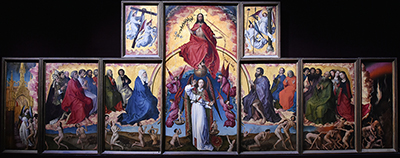
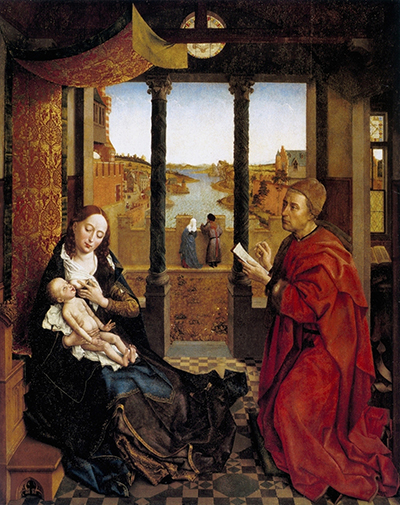
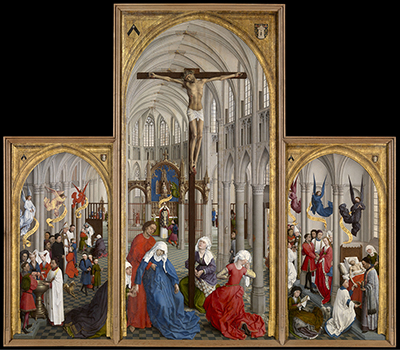
Rogier is often introduced through large religious works: the Descent from the Cross, the Beaune Altarpiece, Saint Luke Drawing the Virgin and the major triptychs. Portrait of a Lady reminds readers that his importance also lies in the history of portraiture.
Early Netherlandish portraiture often combines social identity with devotional or moral seriousness. Sitters are not presented only as likenesses. They are placed into carefully managed states of attention, piety, rank or interiority. Rogier's portrait of an unknown woman is one of the clearest examples of that tendency.
Portrait of a Lady is more self-contained, but it shares the same culture of close viewing, controlled gesture and disciplined presence.
It also connects to Workshop and Influence, because Rogier's portrait mode helped shape the visual language of later Netherlandish artists.
How to Look at the Painting
Start with the face. Notice how little Rogier gives you: lowered eyes, pale skin, a straight nose, closed lips and a high forehead framed by the veil. Then notice how much those few elements do. The sitter seems present but unavailable, close but reserved.
Next, look at the headdress. The veil is not only a piece of clothing. It is a framing device. Its pale, angular planes hold the head in place and create a quiet contrast with the dark dress and background.
Then look down to the hands. Their small tension changes the whole mood of the portrait. Without them, the image might feel purely formal. With them, it becomes psychological. They suggest composure, but also effort.
Finally, look at the red belt and gold buckle. They are the brightest details in the lower half of the work. Rogier uses them carefully, not to distract from the sitter's face, but to guide the eye toward the hands and to register the material refinement of her world.
Why It Matters
Portrait of a Lady matters because it condenses Rogier van der Weyden's art into one small panel. The same artist who could organise large scenes of grief could also construct a portrait from silence, line and reserve. The painting is not dramatic in subject, but it is dramatic in concentration.
Frequently Asked Questions
It is in the National Gallery of Art, Washington, where it has the accession number 1937.1.44. [1]
The National Gallery of Art dates the painting to about 1460. [1]
Her identity is unknown. The NGA suggests that her dignity and costume indicate a woman of noble or highly placed status, but no secure name is attached to the painting. [1]
It is oil on panel. The NGA conservation note identifies the panel as a single board with vertical grain. [1]
The painted surface measures 34 x 25.5 cm. The full panel measures 37 x 27 cm. [1]
The lowered eyes help create the portrait's mood of restraint and inward concentration. In Rogier's hands, the gesture suggests controlled mental life rather than simple passivity.
It is one of Rogier's most powerful late portraits. The painting shows how he could use geometry, costume, hands and facial restraint to create psychological intensity at a small scale.
Discussion
What gives Portrait of a Lady its authority: geometry, costume, hands, restraint, inwardness, or its place in Netherlandish portrait psychology?
Reader Insights
The veil, neckline, hands and pose make the portrait feel almost architectural. Rogier builds inwardness from controlled shapes.
The sitter's restraint is not blankness. It invites the viewer to read small changes in posture, gaze and surface as signs of thought.
This page should stand beside the Descent as a second flagship, proving that Rogier's emotional intelligence worked beyond sacred drama.
Join the Conversation
Have a thought or observation about Portrait of a Lady by Rogier van der Weyden? Share it below. Thoughtful responses may be added to this section as the Rogier van der Weyden cluster develops.
References
- National Gallery of Art, Washington, Portrait of a Lady, collection record for 1937.1.44, accessed 2026-07-11. https://www.nga.gov/artworks/51-portrait-lady
- National Gallery of Art, Washington, artist record for Rogier van der Weyden / Rogier de la Pasture, accessed 2026-07-11. https://www.nga.gov/collection/artist-info.1971.html
- John Oliver Hand and Martha Wolff, Early Netherlandish Painting: The Collections of the National Gallery of Art Systematic Catalogue, Washington, 1986, pp. 241-246, listed in the NGA bibliography for this object.
- Lorne Campbell, Van der Weyden, New York, 1980, listed in the NGA bibliography for this object.
- Lorne Campbell, Renaissance Portraits: European Portrait-Painting in the 14th, 15th, and 16th Centuries, New Haven, 1990, listed in the NGA bibliography for this object.
- Dirk de Vos, Rogier van der Weyden: The Complete Works, Harry N. Abrams, 2000.
- John Oliver Hand, Catherine Metzger and Ron Spronk, Prayers and Portraits: Unfolding the Netherlandish Diptych, National Gallery of Art, Washington, 2006.