

 by Tom Gurney
Tom Gurney BSc (Hons) is an art history expert with over 20 years experience
Published on June 19, 2020 / Updated on July 30, 2026
Email: tomgurney1@gmail.com / Phone: +44 7429 011000
Portrait of Francesco d'Este: Introduction
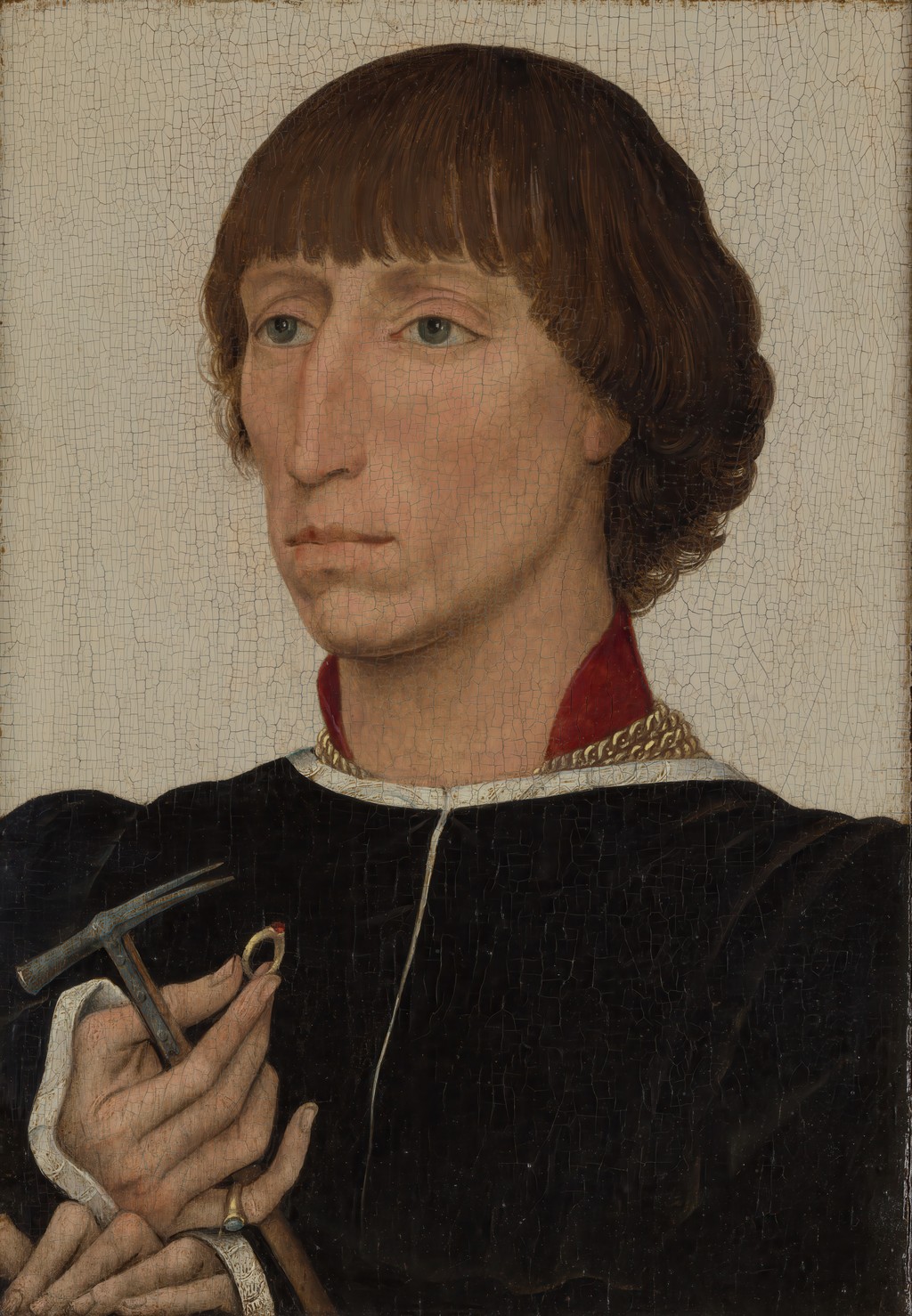
The Portrait of Francesco d'Este shows how Rogier van der Weyden's portrait formula could serve international, courtly identity rather than only devotional seriousness. The sitter is usually identified as Francesco d'Este, illegitimate son of Lionello d'Este, and the identification is supported by the coat of arms and inscription on the reverse of the panel. [1]
The portrait is in the Metropolitan Museum of Art, New York. It is usually dated around 1460, late in Rogier's career, and belongs beside the NGA Portrait of a Lady and the KMSKA Portrait of Philippe de Croy as part of the cluster's portrait route. [1]
Its importance is not only that it shows another sitter. It shows how Rogier's controlled northern portrait language could be adapted for a sitter connected with Italian dynastic culture. The picture is compact, but it opens a broad European network.
At a Glance
- ArtistRogier van der Weyden
- TitlePortrait of Francesco d'Este
- DateAround 1460
- MediumOil on wood panel
- Current locationMetropolitan Museum of Art, New York
- Collection leadFriedsam Collection / Met object lead
- SubjectFrancesco d'Este, usually identified from reverse evidence
Contents
- Introduction
- At a Glance
- Annotated Details
- A Secular Portrait
- Face, Hair And Bearing
- The Reverse
- Hands, Objects And Status
- Evidence And Identification
- Late Rogier Portraiture
- Italian And Burgundian Networks
- Comparing Rogier's Portraits
- Why It Matters
- FAQs
Annotated Details from Portrait of Francesco d'Este
This feature reads the portrait as a two-sided object. The front presents Francesco through face, hands and courtly attributes; the reverse supplies heraldic and inscriptional evidence that helps identify the sitter.
Front: the Portrait
The front is controlled and frontal enough to feel formal, but the face and hands keep the image alert and personal.
Reverse: arms and inscription
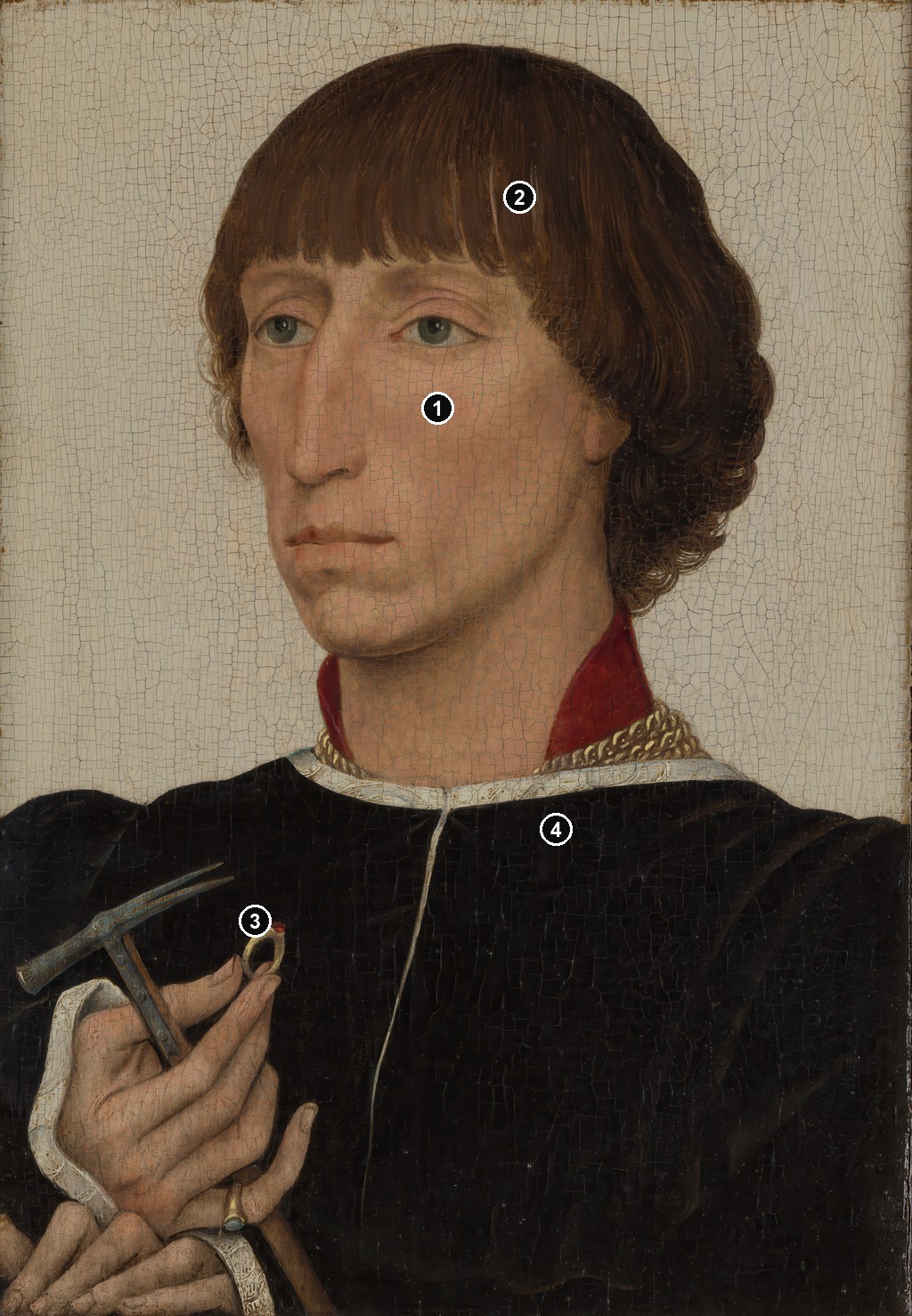
The reverse is not a secondary curiosity. It is part of the object and helps explain how the portrait was identified, remembered and displayed.
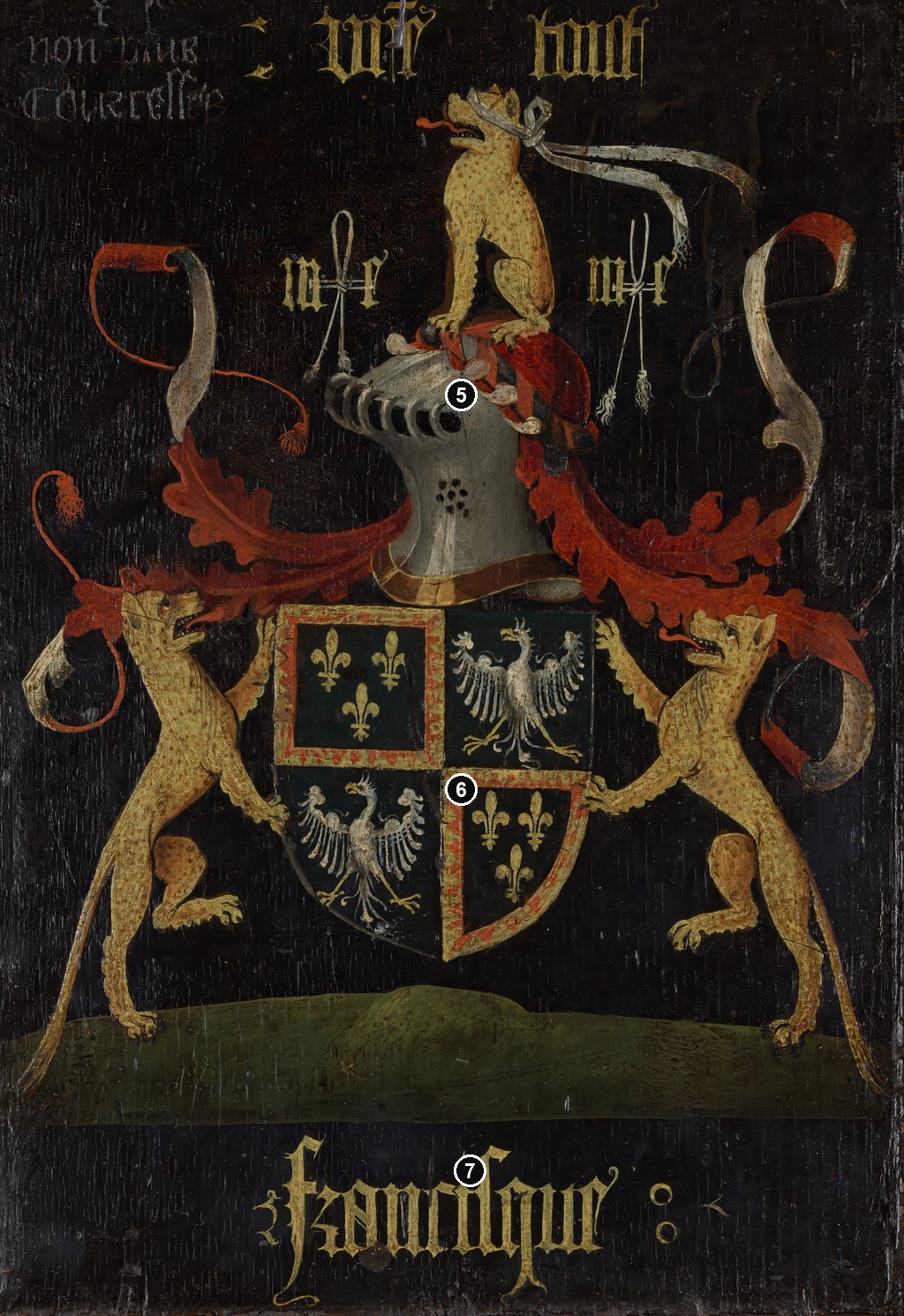
Details from PORTRAIT OF FRANCESCO D'ESTE
The front and reverse details show how Rogier's portraiture can join psychological restraint, status display and object evidence in a single panel.
Front: the Portrait
Face and steady gaze
The face is pale, still and carefully modelled. Rogier gives the sitter presence without theatrical expression, building identity through restraint.
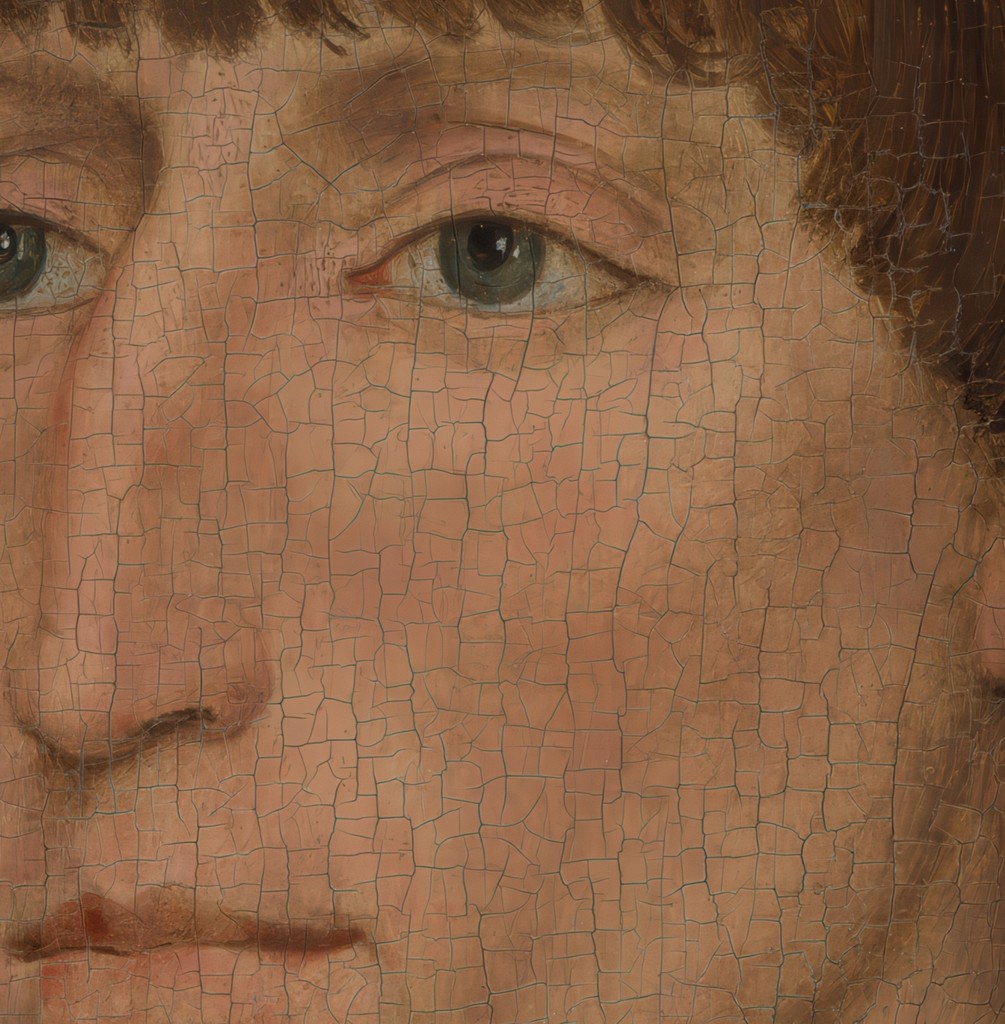
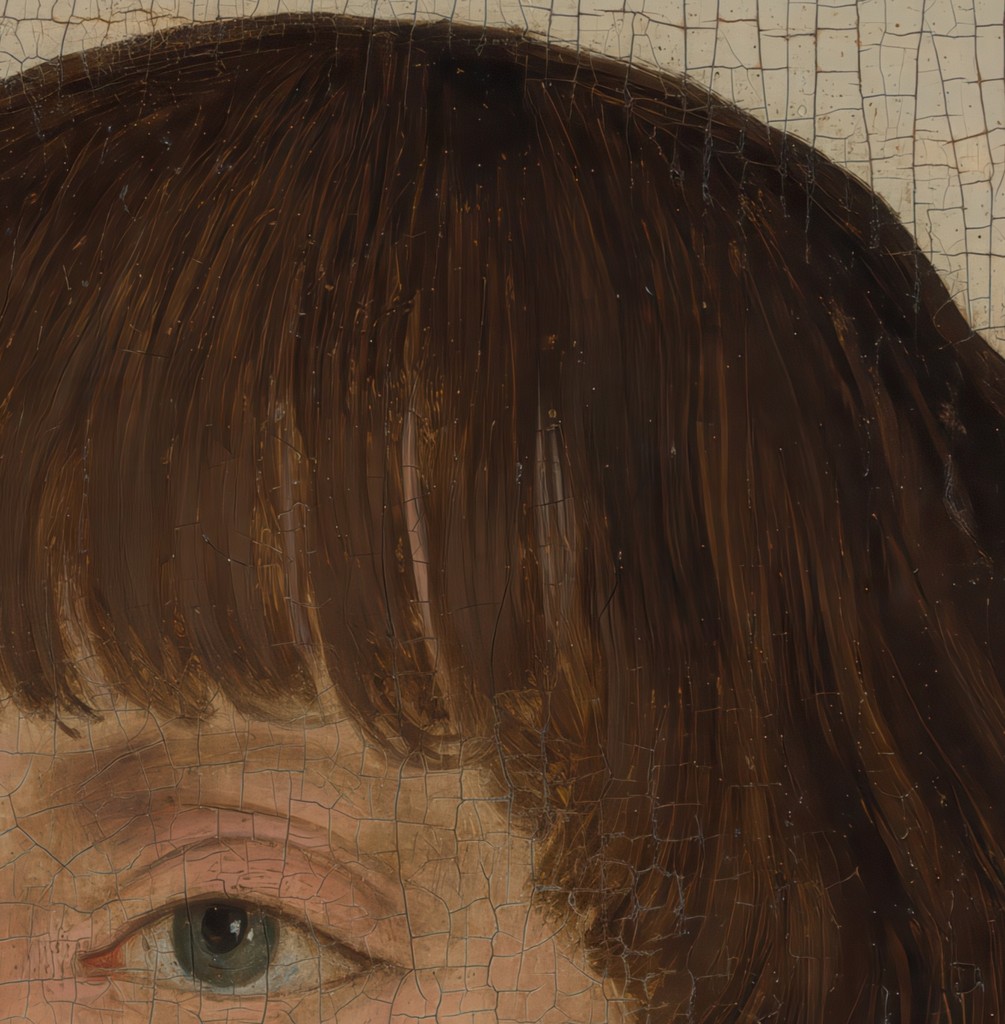
Hair and pale ground
The hairline and pale background sharpen the silhouette. That clean edge makes the head read almost like a designed emblem of courtly identity.
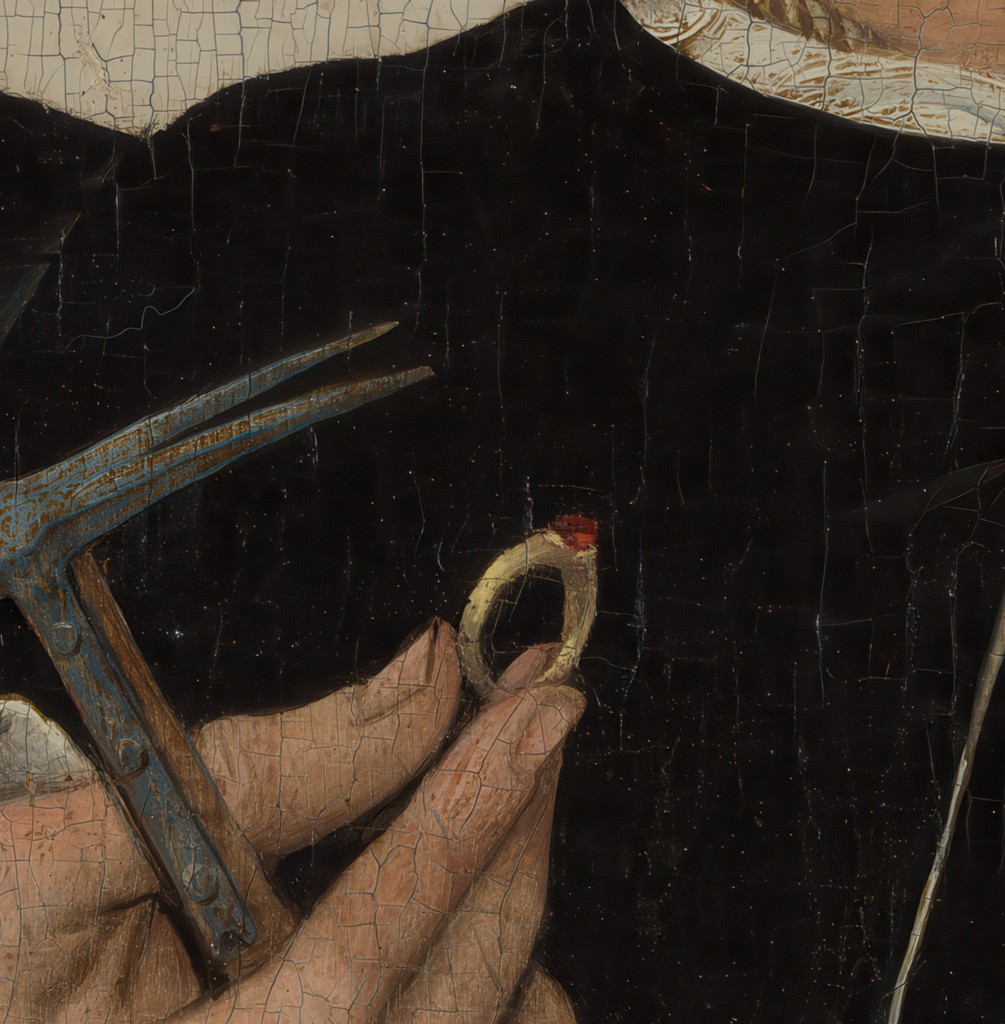
Hands, hammer and ring
The hands and objects are central to the portrait's meaning. They turn a likeness into a display of status, lineage and cultivated identity.
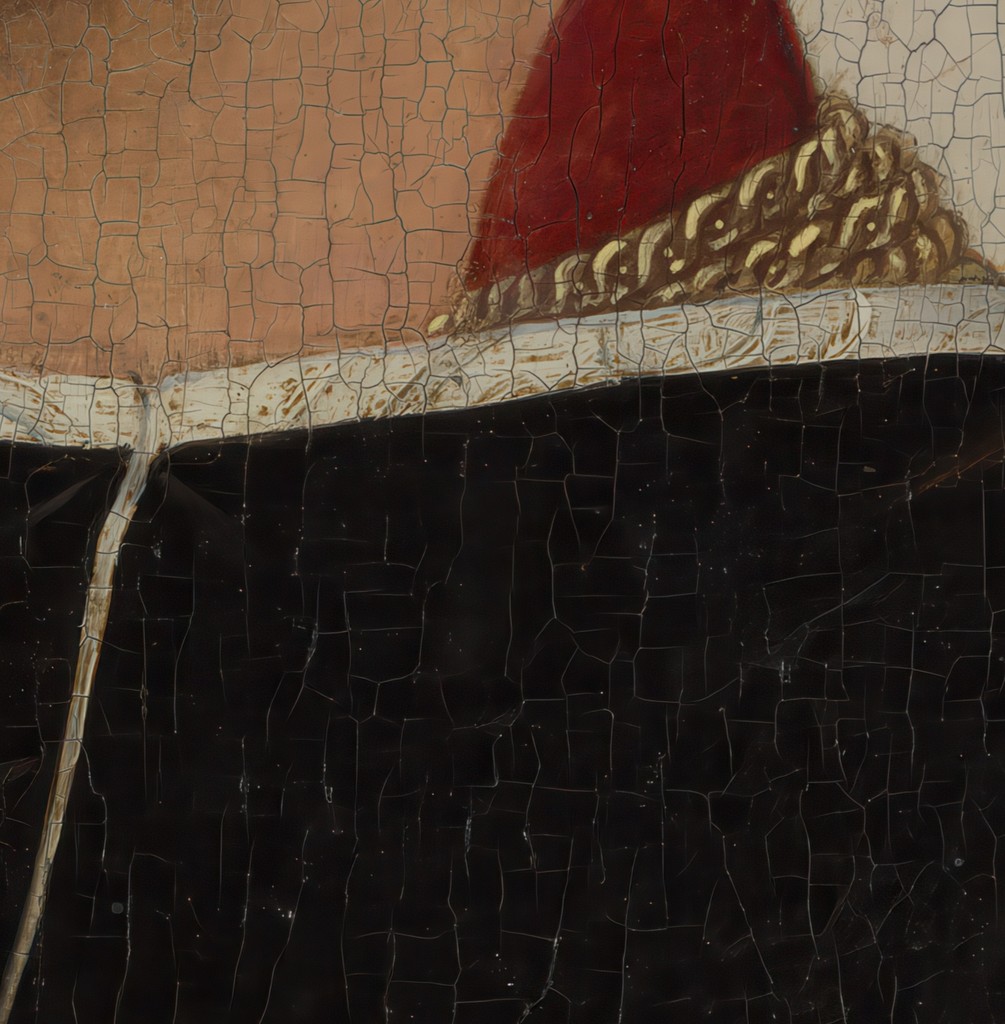
Red collar and black dress
The red collar and dark clothing create a sharp, economical colour structure. Rogier uses costume not as decoration alone, but as a frame for the sitter's social role.
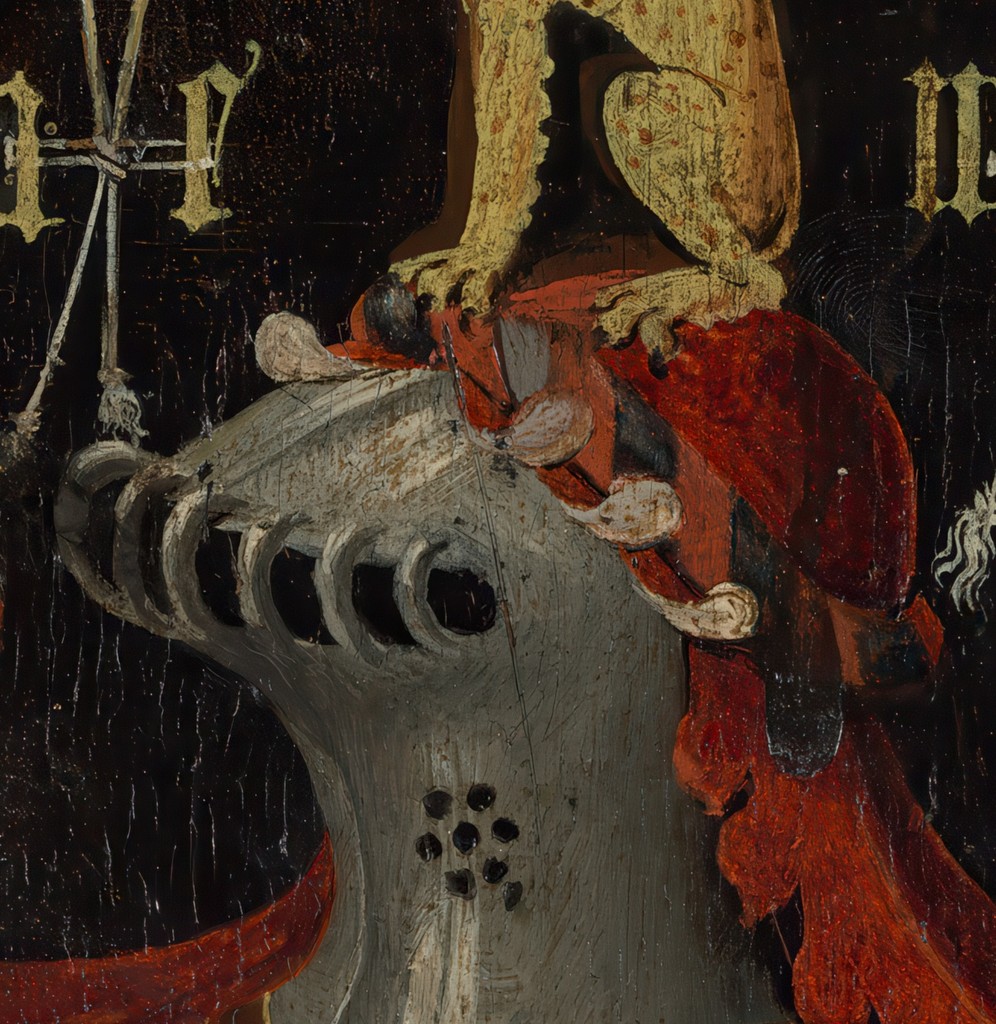
Reverse: arms and inscription
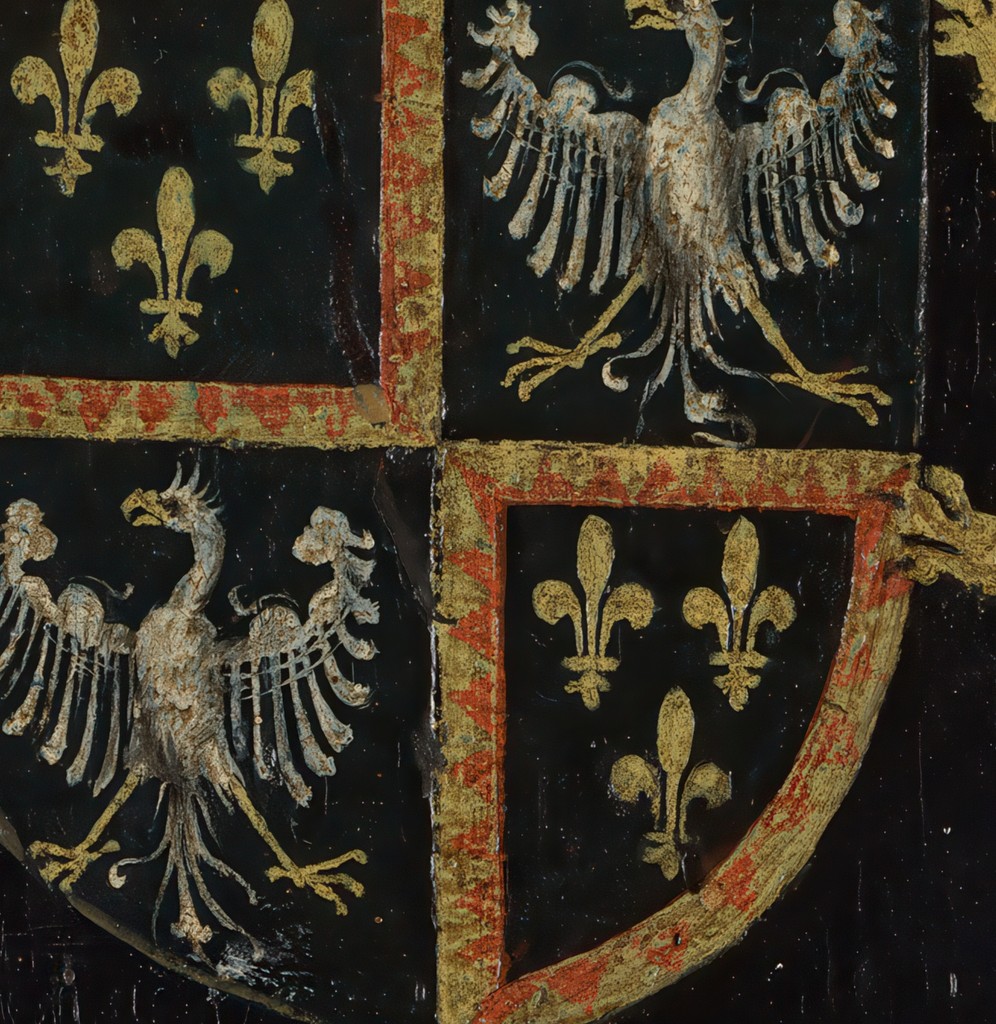
Helmet, crest and heraldic display
The helmet and crest turn the back of the panel into a heraldic statement. The sitter's identity is carried by signs as well as by his face.
Shield and supporting animals
The shield and supporters make lineage visible. They are evidence, decoration and status language at the same time.
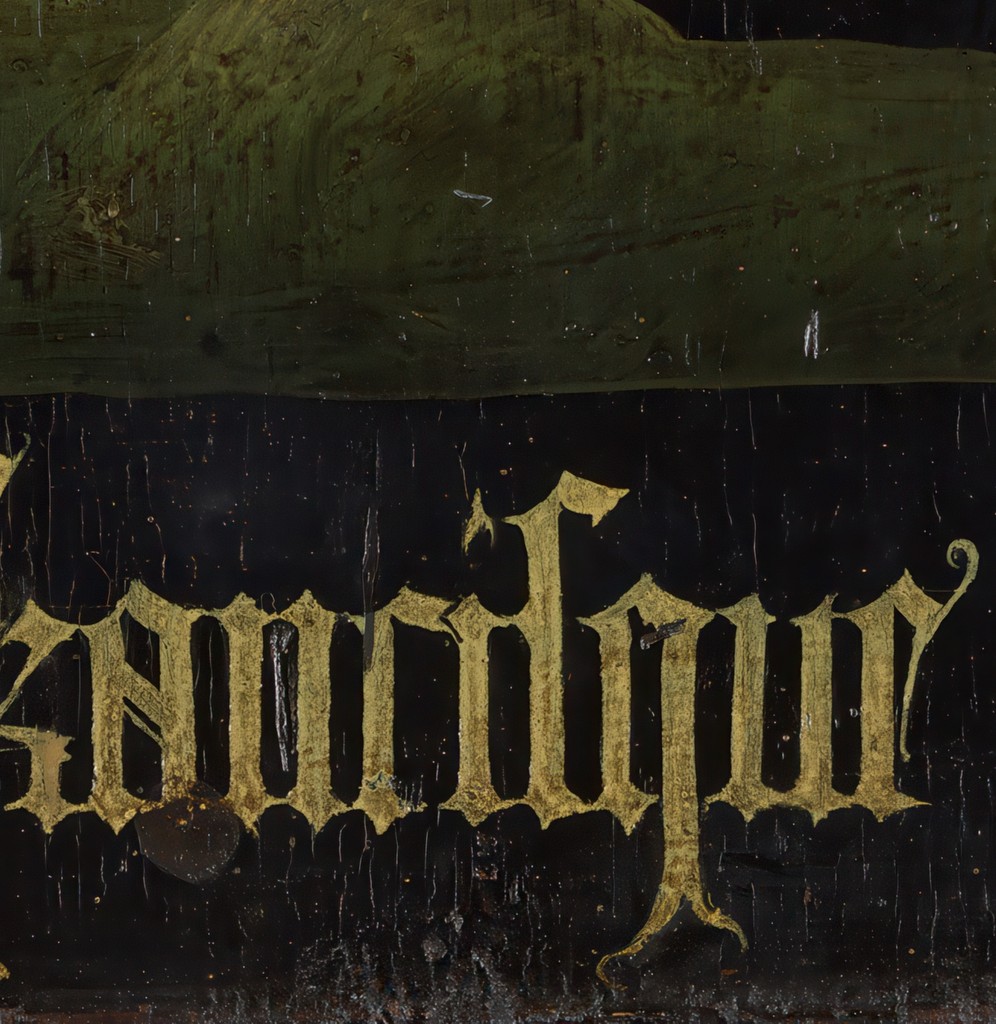
Inscription at the lower edge
The inscription is one reason the reverse matters so much. It reminds readers that a panel painting can preserve written evidence as well as painted likeness.
A Secular Portrait
Many fifteenth-century portraits still carry devotional associations, but the Francesco d'Este portrait is unusually secular in feeling. The sitter is not shown praying before a saint or paired with a sacred image. He is presented as a courtly individual, controlled, alert and socially legible.
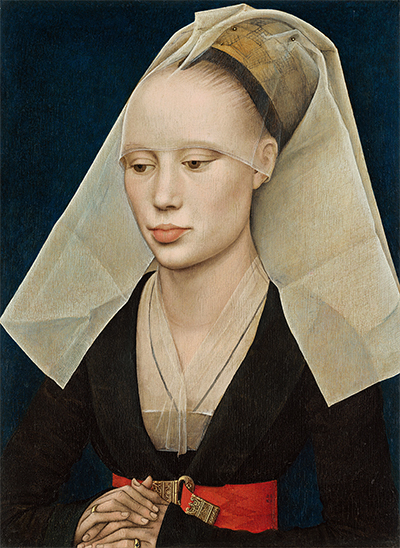
Both this work and Portrait of a Lady are restrained, but they work differently. The Washington portrait emphasizes inward composure and severe elegance. The Francesco portrait emphasizes status, identity and the sitter's courtly presence.
The plain background matters. Rogier does not give the sitter a busy interior or narrative setting. The face, hair, hands and held objects carry the burden of identity. This is one of Rogier's great portrait strategies: he removes distraction so that small signals become decisive.
Face, Hair And Bearing
The sitter is turned in a three-quarter pose, close enough for the viewer to study his features but formal enough to preserve distance. His hair, costume and still expression build a courtly persona rather than an informal likeness.
Rogier's portraits often create tension between individuality and type. The face feels specific, but the presentation is controlled by social codes. That tension is what gives the image its authority. The sitter is both a person and an emblem of status.
This makes the page a useful companion to Portrait of Philippe de Croy. Both portraits use restraint, costume and posture to turn elite identity into visual form. The differences between them help readers see that Rogier did not simply repeat one portrait formula; he adjusted it for different sitters and contexts.
The Reverse
The reverse of the panel is unusually important because heraldry and inscriptional evidence help identify the sitter. [1]
A front-only view can explain the portrait, but the reverse shows how identification can depend on the whole object, not only the painted face. For readers, this is a valuable lesson in old-master evidence. Attribution and sitter identification are not always solved by style alone. They can depend on inscriptions, coats of arms, provenance, object history and technical study.
The reverse also reminds us that a panel painting is an object, not just an image. What is painted or written on the back can change how the front is understood. In this case, the reverse strengthens the link to Francesco d'Este and to dynastic identity.
Hands, Objects And Status
The page presents the objects as status-bearing attributes while keeping their precise significance open.
Rogier's treatment of the hands is central. Like the Portrait of a Lady, the picture makes the hands part of the sitter's identity. The long fingers, the held objects and the shallow space all bring the viewer's attention to controlled display.
The objects should be read with care. They signal courtly identity and self-presentation, but the page should avoid forcing a single overconfident interpretation if the evidence is not secure. Rogier's achievement is that even small held items help shape the sitter's social world.
Evidence And Identification
The Met record makes this portrait unusually useful for explaining how art historians identify sitters. A viewer may first respond to the face, costume and pose, but the identification depends strongly on the reverse side and its heraldic evidence. [1]
That point is important because portrait pages can easily become simple biographies of sitters. This one should remain an object-led interpretation. The sitter's identity matters, but the painting also teaches readers how evidence works: front and back, image and inscription, style and heraldry all have to be considered together.
The reverse also complicates the modern museum experience. In a gallery or online image, viewers often see one side first. Rogier's panel asks for a fuller kind of looking. The object has two faces: the visible sitter and the identity-bearing reverse.
This makes the portrait a natural bridge to the Philippe de Croy page, where a devotional diptych context also affects how the portrait should be understood. In both cases, the portrait is not only a face. It is part of a larger social and material structure.
Late Rogier Portraiture
The portrait belongs to Rogier's late manner. The background is plain and shallow. The sitter's body is strongly designed. The face is observant rather than sentimental. [1]
The stronger claim is that Rogier belongs to the fifteenth-century development of northern portrait formulas that gave sitters social and psychological force.
Late Rogier portraiture is not soft or anecdotal. It is disciplined. The painter gives the sitter a powerful presence through compression: a close format, firm contours, limited setting and carefully chosen signs of identity.
Italian And Burgundian Networks
The d'Este identity opens an important corridor. Rogier's reputation reached Italy, and the Este family belonged to the world of Italian court culture. A portrait like this helps readers see that Early Netherlandish art did not stop at the Alps. It circulated through elite networks, diplomacy, collecting and patronage.
The portrait also gives concrete form to Rogier's international reach. Whatever the exact circumstances of its making, the Este connection places the work within a wider European network without turning the possible Rome journey into certainty.
This caution matters. Rogier's biography includes attractive traditions and debated travel questions. The Francesco portrait allows the page to discuss international reach from the evidence of the object and sitter identity, rather than making the life story do more than the records allow.
Comparing Rogier's Portraits
The portrait route through this cluster should include at least three different kinds of image. Portrait of a Lady shows extreme inward restraint and geometric elegance. Portrait of Philippe de Croy brings youth, courtly status and devotional diptych context into view. Portrait of Francesco d'Este adds international identity and reverse-side evidence.
Together, they show that Rogier's portraits are not interchangeable. He repeatedly uses shallow space, quiet expression and precise hands, but the social meaning changes from sitter to sitter. The format is controlled; the effect is flexible.
This matters for Rogier's wider reputation. He was not only a painter of sacred grief. He helped shape a northern portrait language in which identity could be formal, psychological, dynastic and devotional at once.
The comparison also keeps the page from becoming isolated. Francesco belongs with Portrait of a Lady and Philippe de Croy, but it also speaks to the biography and workshop-and-influence pages. A portrait tied to the Este world shows how Rogier's forms could travel through the same elite networks that carried Netherlandish painting, collecting habits and devotional formats across Europe.
Why It Matters
The portrait's value lies in the combination of portrait psychology, dynastic identity and unusually important reverse-side evidence.
It also broadens the Rogier cluster. Without this page, Rogier can look mainly like a painter of sacred emotion. With this page, he becomes a painter whose forms could serve courtly self-presentation, dynastic memory and international exchange. That makes the portrait a compact but important bridge between the biography, portrait route and workshop-and-influence page.
The reverse makes that bridge unusually concrete. It gives the page a clear evidence story: a face on the front, signs of identity on the back, and a sitter whose world reaches beyond the Burgundian Netherlands.
FAQs
It is in the Metropolitan Museum of Art, New York. [1]
The identification is supported by the coat of arms and inscription on the reverse of the panel. [1]
It shows Rogier's late portrait style and his connection to international courtly identity beyond the Burgundian Netherlands.
Both are restrained portraits, but they differ in social tone. Portrait of a Lady is inward and severe; Francesco d'Este is more openly courtly and secular.
Discussion
What does the Portrait of Francesco d'Este reveal about Rogier's portrait language: status, psychology, costume, hands, or international patronage?
Reader Insights
The sitter's presentation is formal, but not empty. Rogier makes pose, object and expression carry social and psychological weight.
This page helps show how Rogier's reputation moved beyond local devotional commissions into courtly and diplomatic circles.
Compare Francesco d'Este with Portrait of a Lady and Philippe de Croy to see how Rogier adjusts restraint for different sitters.
Join the Conversation
Have a thought or observation about Portrait of Francesco d'Este? Share it below. Thoughtful responses may be added to this section as the Rogier van der Weyden cluster develops.
References
- Metropolitan Museum of Art collection entry for Portrait of Francesco d'Este, accessed 2026-07-11. https://www.metmuseum.org/art/collection/search/437487
- Wikipedia, Portrait of Francesco d'Este, accessed 2026-07-11. https://en.wikipedia.org/wiki/Portrait_of_Francesco_d%27Este
- The National Gallery, London, artist page for Rogier van der Weyden, accessed 2026-07-11. https://www.nationalgallery.org.uk/artists/rogier-van-der-weyden
- Maryan Ainsworth, From Van Eyck to Bruegel: Early Netherlandish Painting in the Metropolitan Museum of Art, New York, 1999.
- Lorne Campbell, Van der Weyden, 2004.