 by Tom Gurney
Tom Gurney BSc (Hons) is an art history expert with over 20 years experience
Published on June 19, 2020 / Page Updated on November 5, 2026
Email: tomgurney1@gmail.com / Phone: +44 7429 011000
Introduction
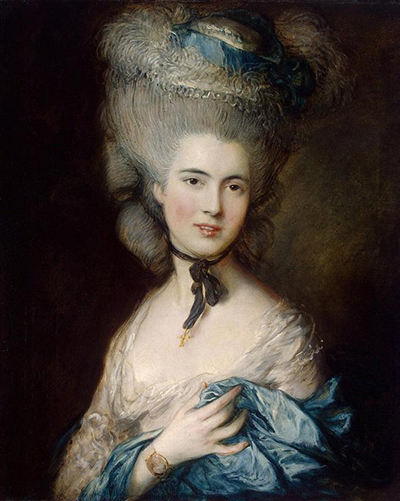
Portrait of a Lady in Blue is the safe title for the Gainsborough portrait now in the State Hermitage Museum, Saint Petersburg. The Hermitage identifies the work as Portrait of a Lady in Blue, dates it to the late 1770s or early 1780s, gives the medium as oil on canvas, records the dimensions as 76.5 × 63.5 cm, and lists the inventory number as ГЭ-3509.[1] It entered the Hermitage in 1916 as a gift of A. Z. Khitrovo.[1] The sitter is not named in the museum record.
That last point is essential. The painting has often circulated in English under titles such as Woman in Blue or with an appended association to a Duchess of Beaufort. Those variants can explain why the image is familiar, but they should not override the Hermitage record. A careful account should begin from what is known: a late Gainsborough portrait of an unknown young woman, richly staged through blue fabric, powdered hair, feathered headwear, a pale shoulder, a small hand and a direct but dreamlike presence.
The picture matters because it draws together several Gainsborough questions in a compact form. It belongs to the great age of his late female portraiture. It shows why blue was not merely a decorative accent for him, but a means of making temperament, fashion and atmosphere. It also demonstrates how easily sitter identity can become overconfident when a compelling face, aristocratic dress and repeated title variants invite a story that the evidence does not actually supply.
At a Glance
- ArtistThomas Gainsborough
- Museum titlePortrait of a Lady in Blue [1]
- DateLate 1770s or early 1780s [1]
- MediumOil on canvas [1]
- Dimensions76.5 × 63.5 cm [1]
- Current holderState Hermitage Museum, Saint Petersburg [1]
- InventoryГЭ-3509 [1]
- SitterUnknown; the Duchess of Beaufort name remains an association
- Provenance pointGift of A. Z. Khitrovo, 1916 [1]
- ExploreBiography; The Blue Boy; Mr and Mrs Andrews; Paintings; Portraits
Contents
- Introduction
- The Hermitage Identity
- Blue as More Than Costume
- Fashion, Body and Social Performance
- The Unknown Sitter
- Late Gainsborough Portraiture
- Blue Boy, Blue Lady
- How to Look at the Painting
- Why the Portrait Matters
The Hermitage Identity
The Hermitage record provides the firm object facts. The work is by Thomas Gainsborough, made in Great Britain in the late 1770s or early 1780s, and held within the Hermitage collection of English painting.[1] It is an oil painting on canvas, measuring 76.5 × 63.5 cm, and is associated with Winter Palace display.[1] The 1916 gift from A. Z. Khitrovo gives the painting a secure modern collection history, even if its eighteenth-century sitter and original patron remain unspecified in the public museum record.[1]
This is enough to stabilise the discussion. The painting does not have to be forced into a named-sitter narrative in order to be significant. Many eighteenth-century portraits carry uncertain or revised identities, and Gainsborough's art often makes that uncertainty particularly seductive because likeness, costume and mood are so finely blended. The sitter seems socially elevated, but her rank, family and commission are not established by the Hermitage entry.
The title Portrait of a Lady in Blue is therefore more responsible than a title that treats the sitter as the Duchess of Beaufort. It identifies what the painting securely presents: a lady, a blue-dominated costume, and a portrait format. The word lady carries enough eighteenth-century social resonance without pretending to know the sitter's name. The blue is not incidental; it is the organising colour of the work.
The inherited Duchess association should be handled as an association only. It may have come from older cataloguing, reproduction captions or later English-language retellings, but without a reliable holder or catalogue statement it cannot carry the argument. The Hermitage record's silence on a named sitter is not a minor omission. It is the boundary within which the interpretation should remain.
Blue as More Than Costume
The Tretyakov Gallery Magazine article on Rokotov and Gainsborough is especially useful because it treats this painting as part of a wider exploration of cold colour in portraiture. It argues that Gainsborough discovered emotional possibilities in greys and blues, using blue not merely to offset warmer tones but as a colour with its own expressive depth.[2] The article places The Blue Boy and Portrait of a Lady in Blue together as examples of this achievement.[2]
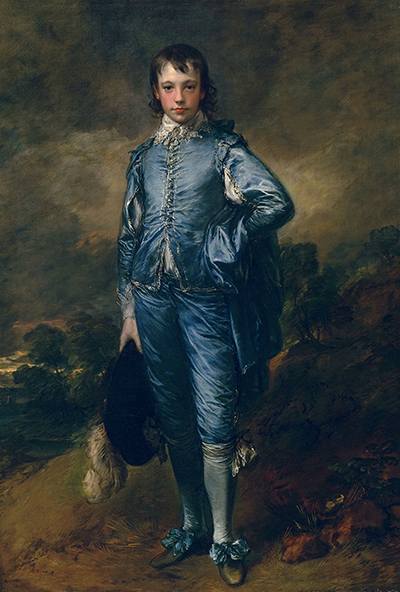
That connection should not flatten the two paintings. The Blue Boy is a full-length male portrait in historicising costume, now at the Huntington, with its own sitter uncertainty and complex modern fame.[3] Portrait of a Lady in Blue is smaller, closer and more intimate. Yet the two works share a crucial point: Gainsborough could make blue carry presence. It could become flesh-adjacent, atmospheric, social, theatrical and psychologically charged.
In the Hermitage portrait, blue is not a single block of colour. It shifts across silk, shadow, feather, ribbon and reflected light. The tone may feel silvery in one passage, pearly in another, and cooler where it meets the darker ground. The effect is refined rather than loud. Blue frames the sitter, but it also seems to loosen around her, creating a sense that costume and air are almost dissolving into one another.
This is where Gainsborough's brushwork matters. The Hermitage description emphasises light, mobile, melting strokes that convey skin, silk and feather with a pastel-like effect.[1] That description is apt because the painting does not depend on hard outline. Its elegance comes from transitions: pale skin into white fabric, blue silk into shadow, powdered hair into feathered ornament, face into surrounding darkness. The sitter is made through delicacy rather than weight.
Blue also changes the emotional register. Red, brown or gold might have made the portrait warmer, grander or more emphatically ceremonial. Blue gives it coolness without chill. The young woman appears fashionable and aristocratic, but not remote in a purely formal way. The colour creates a suspended mood, as if the image belongs to a moment between display and reverie.
Fashion, Body and Social Performance
The sitter's costume belongs to the world of late eighteenth-century fashionable portraiture. She appears with powdered hair arranged high, a small hat or ornament, feathered decoration, blue ribbon and a blue silk scarf or drapery.[2] The shoulder and neckline are exposed enough to make the portrait sensuous, while the pose remains controlled. The hand that holds or steadies the fabric becomes part of the performance.
This is not simply a portrait of clothes. In Gainsborough's hands, costume becomes a language of movement. The scarf seems to slip. The feather appears light. The hair rises in an elaborate structure yet softens at its edges. The dark ground gives the figure a theatrical concentration, but the paint prevents the scene from becoming rigid. Fashion is present, but it is animated.
The Tretyakov comparison with Rokotov's Portrait of a Woman in a Pink Dress helps clarify the point.[2] Both pictures are interested in fashionable femininity, European taste and delicately modulated colour. Yet Gainsborough's sitter is staged with a more openly aristocratic display: exposed shoulder, elaborate coiffure, blue silk, feather and a sense of polished ease. The painting is not a moral inventory of her character. It is a social image made through pose, surface and atmosphere.
That social image can tempt modern readers into assuming a rank or name. The costume looks elite; therefore, the sitter must be a particular duchess. But aristocratic appearance is not the same as documented identity. Portraiture often constructs status through dress, bearing and painterly rhetoric. It tells us how a sitter could be made to appear. It does not always tell us who she was.
The hand is one of the portrait's best details because it interrupts pure display. It is small, pale and refined, but it also performs a task: holding the loosened blue fabric in place. The gesture gives the picture a subtle drama. Nothing dramatic happens, yet the portrait depends on a sense of almost-happening. The scarf may fall; the sitter may speak; the glance may shift. Gainsborough holds the image at that threshold.
The Unknown Sitter
The sitter's unknown identity should be treated as part of the painting's modern meaning. An unidentified portrait changes how the viewer looks. Instead of measuring likeness against biography, the viewer studies how identity is produced by dress, gaze, complexion, posture and colour. The absence of a name makes the visible construction more apparent.
This does not mean the sitter was anonymous in her own lifetime. She may have been known to Gainsborough, to a patron, to a family or to early owners. The loss or uncertainty of that identity is a historical condition, not necessarily an original one. But the surviving public record does not allow a confident name, and the interpretation should respect that limit.
The Duchess of Beaufort association is best understood in that light. It is a useful warning about how portrait titles work. A sitter name can become attached to an image because of family tradition, resemblance, old inventory language or the needs of reproduction culture. Some such traditions prove correct; others do not. In this case, the safest position is to acknowledge that an association exists in circulation while using the Hermitage's unknown-lady framing.
The portrait itself supports restraint. The sitter looks outward, but her expression is not simple disclosure. The eyes, mouth and turn of the head invite attention without giving a narrative. Her social world is implied by costume; her inner life is suggested by mood; her name remains outside the secure evidence. Gainsborough makes the viewer feel close to a person whose documentary identity remains distant.
This is one reason the painting can feel modern. Not modern in style, but modern in the way it separates presence from biography. The portrait does not become empty because the sitter is unnamed. On the contrary, the lack of a fixed name makes the act of looking more concentrated. The viewer attends to paint, fabric, light and expression because no biography steps in to settle the matter.
Late Gainsborough Portraiture
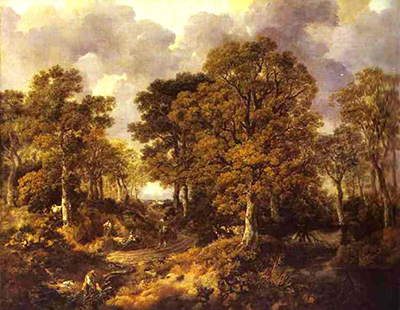
Gainsborough's House describes the artist as a painter who always cared deeply about landscape, while portraiture brought him public success and financial necessity.[4] The National Gallery similarly presents him as a major portrait painter who also remained strongly attached to landscape.[5] Portrait of a Lady in Blue belongs to the portrait side of that double career, yet it also shows the atmospheric sensitivity that made his landscapes matter.
The dark background behind the sitter is not a landscape, but it performs an atmospheric role. It gives depth, shadow and tonal contrast. It lets pale flesh, white fabric and blue silk emerge without a hard architectural setting. Gainsborough often preferred backgrounds that did more than simply locate a figure. Here the background becomes a field of pressure around the sitter.
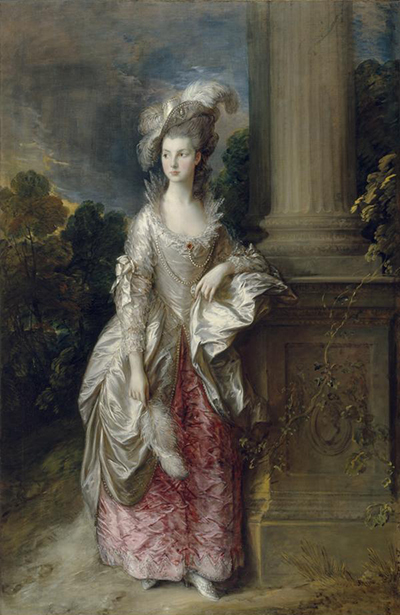
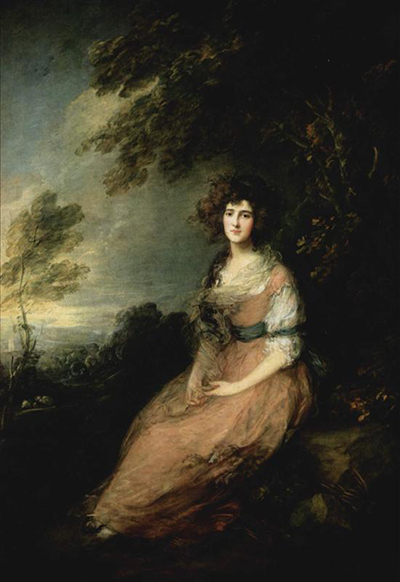
Late Gainsborough portraits frequently balance display and freedom. In works such as Mrs Richard Brinsley Sheridan, the National Gallery of Art records a named sitter, late-1780s date and a long provenance, while the image itself combines portraiture with a pastoral mood.[6] Portrait of a Lady in Blue is more compressed, but it shares a similar looseness of paint and atmosphere. The sitter is fashionable, yet the surface is alive and shifting.
Sarah Siddons, painted in 1785 and now in the National Gallery, offers another useful contrast.[7] That portrait has a famous sitter, theatrical identity and powerful profile. The Hermitage lady is not projected with the same public force. She is nearer, softer, less declarative. Both works show Gainsborough's late command of female portraiture, but they do so through different kinds of presence.
Rosenthal's Paul Mellon Centre study is valuable here because it places Gainsborough's art within the social and commercial world of eighteenth-century British looking.[8] Portraits were not simply private likenesses. They were objects of display, negotiation, taste and social performance. A painting such as Portrait of a Lady in Blue participates in that world even when the sitter's name is uncertain. It makes elegance visible, but it also turns elegance into painterly sensation.
Blue Boy, Blue Lady
The comparison with The Blue Boy is almost unavoidable, but it should be disciplined. The Huntington record identifies The Blue Boy as a full-length portrait of a youth, possibly Jonathan Buttall, painted about 1770 and now one of the Huntington's defining works.[3] Christine Riding's National Gallery publication on the painting's 2022 return to London treats it as a British icon whose fame has exceeded ordinary portraiture.[9] Portrait of a Lady in Blue has not had that same global afterlife.
Still, the two works illuminate each other. Both depend on blue as more than colour. In The Blue Boy, blue costume can invoke Van Dyck, masculine display, performance and historical costume. In Portrait of a Lady in Blue, blue silk and ornament produce femininity, cool refinement and intimate aristocratic mood. The colour becomes a means of social imagination.
There is also an important difference in scale and distance. The Blue Boy is a standing figure with a full-body presence. It asks the viewer to confront costume, stance and youth as a public spectacle. The Hermitage lady is closer to a half-length encounter. Her face, shoulder, hand and fabric dominate. The viewer is invited into a more intimate field of looking, though not necessarily into greater knowledge.
Both paintings warn against overconfident sitter stories. The Huntington treats the Blue Boy sitter as probable rather than absolutely settled.[3] The Hermitage does not name the Lady in Blue.[1] These uncertainties are not embarrassing gaps. They are part of how eighteenth-century portraiture survives. Paintings outlive family memory, ownership trails and caption traditions. Colour and presence remain, while names can become unstable.
The phrase Blue Boy has become an icon label. The phrase Lady in Blue is quieter, but it works in a similar direction: it turns colour into identity. That is both helpful and limiting. It helps viewers remember the painting. It limits interpretation if the sitter becomes only the woman with the blue drapery. The better reading is to see blue as an entry into the painting's artifice, not the whole of its meaning.
How to Look at the Painting
Begin with the face. It is not strongly narrative. The mouth, eyes and turn of the head suggest awareness without a fixed story. The sitter appears composed, but not inert. Her expression lies between social poise and inward drift. Gainsborough gives just enough animation to prevent the image from becoming a costume study.
Then look at the edges. The painting is full of transitions. The hair moves into powder and feather; the white skin moves into fabric; the blue scarf moves into darkness; the small hand breaks the broad sweep of silk. Gainsborough's refinement lies in these passages. He makes the materials legible, but he also lets them breathe.
The dark ground is equally important. Without it, the blue might become merely pretty. Against shadow, the blue gains depth, and the pale skin gains luminosity. The background also isolates the sitter, making the image feel less like a room and more like an apparition of fashion and personality. That isolation is one reason the portrait can feel dreamy.
The exposed shoulder and slipping fabric should be read carefully. They contribute to the portrait's elegance and sensuality, but they do not give permission for a speculative biography. Eighteenth-century portraiture often used costume, décolletage, fabric and gesture to construct idealised femininity. Gainsborough's painting participates in that visual culture while retaining an unusually soft and fluid surface.
Finally, keep the unknown name in mind. Looking carefully means not rushing to fill the silence. The sitter may have been aristocratic; she may have been connected to a fashionable patronage network; she may have had a title now lost or disputed. None of those possibilities should become assertion. The strength of the painting lies in how much presence Gainsborough creates without a secure name.
Why the Portrait Matters
Portrait of a Lady in Blue matters first as the Hermitage's Gainsborough: a late British portrait held in Saint Petersburg, with a secure museum identity and a striking colour argument.[1] It gives Russian and international viewers a concentrated example of Gainsborough's late elegance, even without the broad corpus available in British and American collections.
It matters secondly because it shows blue becoming psychological. The Tretyakov article's comparison between Gainsborough and Rokotov is useful precisely because it refuses to treat colour as decoration alone.[2] Blue in this painting helps produce refinement, distance, tenderness, luxury and dreaminess. It is costume, atmosphere and emotional key at once.
It matters thirdly as a lesson in title discipline. A Woman in Blue, Portrait of a Lady in Blue and the Duchess of Beaufort association do not carry equal authority. The Hermitage title and unknown-sitter position should lead. Other variants can be mentioned only as part of the painting's reception and circulation. This protects the work from a false certainty that would make the story simpler but weaker.
The portrait's final appeal is the balance between glamour and uncertainty. The sitter is vividly present: powdered hair, feathered hat, pale skin, blue silk, small hand, dark ground. Yet she remains unnamed. Gainsborough's art turns that combination into a virtue. The painting does not need a famous sitter to be compelling. It needs close looking, careful language and respect for the blue silence around the lady's name.
Frequently Asked Questions
Discussion
How should the portrait’s glamour and uncertain sitter identity be balanced?
Reader Insights
How does the Hermitage record set the boundary for title, date and sitter claims?
Where does blue move from costume into mood and painterly sensation?
How can the Duchess association be acknowledged without turning it into a documented identity?
Join the Conversation
Share your reading below.
References
- State Hermitage Museum, “Thomas Gainsborough, Portrait of a Lady in Blue,” digital collection record, inventory ГЭ-3509. View source.
- Lyudmila Markina, “‘Poets of the Human Visage’: Fyodor Rokotov and Thomas Gainsborough,” The Tretyakov Gallery Magazine, no. 2, 2016. View source.
- The Huntington Library, Art Museum, and Botanical Gardens, “Thomas Gainsborough, The Blue Boy,” collection record. View source.
- Gainsborough's House, “About Thomas Gainsborough.” View source.
- National Gallery, London, “Thomas Gainsborough,” artist biography. View source.
- National Gallery of Art, Washington, “Thomas Gainsborough, Mrs Richard Brinsley Sheridan.” View source.
- National Gallery, London, “Thomas Gainsborough, Mrs Siddons.” View source.
- Michael Rosenthal, The Art of Thomas Gainsborough: "A Little Business for the Eye" (New Haven and London: Yale University Press for the Paul Mellon Centre for Studies in British Art, 1999). Publication record.
- Christine Riding, Gainsborough's Blue Boy: The Return of a British Icon, with contributions by Susanna Avery-Quash, Melinda McCurdy, Jacqueline Riding and Imogen Tedbury (London: National Gallery Company, 2022).