

 by Tom Gurney
Tom Gurney BSc (Hons) is an art history expert with over 20 years experience
Published on June 19, 2020 / Updated on August 2, 2026
Email: tomgurney1@gmail.com / Phone: +44 7429 011000
Contents
- Introduction
- Rural Childhood In The 1870s
- A Quiet Painting After A National Crisis
- How The Work Connect
Introduction
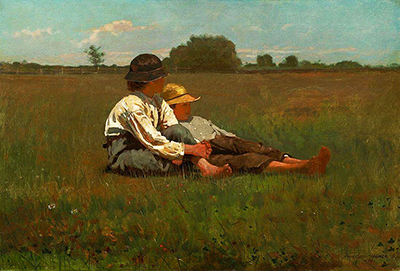
Winslow Homer's Boys in a Pasture is a small 1874 oil painting that belongs to the rural-childhood side of his post-Civil War career. The Museum of Fine Arts, Boston records the work as oil on canvas, 40.32 x 58.1 cm, or 15 7/8 x 22 7/8 inches. The current MFA object record lists the credit line as The Hayden Collection--Charles Henry Hayden Fund, with accession number 53.2552, and notes that the painting is on view. [1]
Those object facts are important because this article stays grounded. Boys in a Pasture is not a major public argument on the scale of Snap the Whip, Breezing Up or Prisoners from the Front. Its value is quieter. It helps the Homer cluster show how the 1870s rural and leisure subjects worked: children, open country, rest, sunlit air and the tension between apparent innocence and a postwar culture looking for stability. [2]
The painting shows two boys lying in a field. The scene is simple enough to read quickly. There is no event to decode, no dramatic gesture, no boat in danger and no battlefield memory placed on the surface. Homer gives the viewer bodies at rest, grass, open space and a low, close vantage point. The boys are not posed as formal portraits. They seem absorbed by the day and by each other, held inside a landscape that feels larger than the small canvas. [3]
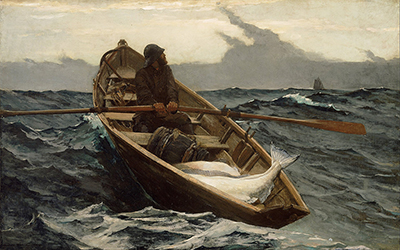
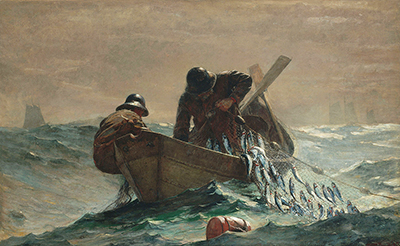
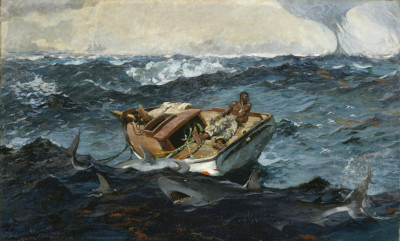
That simplicity is the reason the painting belongs on the site. Homer was especially good at making ordinary scenes feel exact without making them thin. Boys in a Pasture gives readers a way to pause inside a part of his career that can be overshadowed by the later marine works. Before the severe seas of The Fog Warning, The Herring Net and The Gulf Stream, Homer spent sustained energy on children, country spaces, beaches, games, chores and leisure. [1]
Rural Childhood In The 1870s
The local Homer packets identify women, children, leisure and rural subjects as central to the paintings of the 1870s. Boys in a Pasture fits that pattern directly. It belongs near Snap the Whip, Breezing Up, Crossing the Pasture and Weaning the Calf, even though each of those works handles childhood differently. [2]
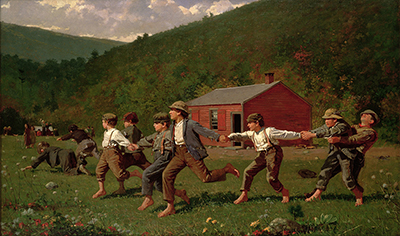
In Snap the Whip, children are active, linked together by a game that almost breaks apart. The subject can feel joyful, but it also carries a sharp sense of balance, strain and communal movement. In Breezing Up, a young crew moves across the water in a confident boat, turning childhood toward skill, wind and maritime promise. Crossing the Pasture and Weaning the Calf move closer to farm life and rural responsibility. Boys in a Pasture is more still. Its children are not working, racing or steering. They are resting. [3]
That stillness matters. Homer does not need the boys to perform an obvious lesson. He lets the pasture carry the mood. The viewer is close to the ground, which makes the field feel wide and enveloping. The boys' reclining bodies become part of the land rather than figures standing proudly before it. The result is not just a charming scene of childhood. It is a study of leisure as a physical condition: lying down, looking outward, feeling time open. [1]
A Quiet Painting After A National Crisis
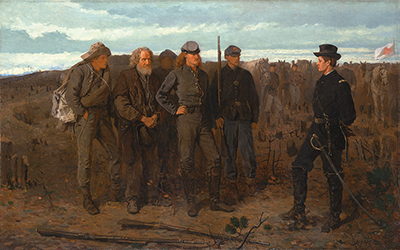
It would be too much to make Boys in a Pasture an explicit Civil War painting. The scene does not ask for that. Still, chronology matters. Homer had built part of his early reputation through Civil War illustration and paintings such as Prisoners from the Front. By the 1870s, his subjects often moved into rural, coastal and leisure settings. These images can look calm, but they were made in a country still organizing itself after war and emancipation. [2]
That does not mean every child in a field stands for national recovery. The better approach is more modest. Boys in a Pasture shows one way Homer gave postwar viewers images of ordinary time: boys in grass, a summer-like stillness, a world without immediate crisis. The painting's calm is real. Its restraint is also real. Homer does not sentimentalize the boys with theatrical sweetness. He keeps the surface plain and the observation direct. [3]
This is where the painting can help readers understand Homer's range. The same artist who could make a military encounter feel historically weighted could also make a field scene hold attention without obvious drama. Boys in a Pasture does not need a large narrative because its subject is looking, resting and inhabiting a place. It asks the viewer to notice how childhood can be represented without turning into anecdote. [1]
How The Work Connect
Boys in a Pasture is best treated as a concise support page inside the paintings route. It links to Paintings for the broader oil-painting context and Biography for Homer's 1870s career. The strongest thematic links are Snap the Whip, Breezing Up, Crossing the Pasture and Weaning the Calf, because they let readers compare rural childhood, play, work and leisure without forcing this small painting to carry the whole argument. [2]
The article can also point indirectly toward the later marine works by contrast. In the famous sea paintings, people confront weather, distance and physical risk. In Boys in a Pasture, the bodies are safe, horizontal and close to the earth. That contrast helps the cluster. Homer did not move from simple subjects to serious subjects in a straight line. He kept returning to ordinary people in particular environments, and he changed the pressure around them depending on place, medium and moment. [3]
Boys in a Pasture earns retention because it gives the Homer cluster a compact rural pause. It is not dramatic, and it does not need to be padded into drama. Its strength is the way it lets childhood, leisure and land become enough. The boys rest in the grass, and the painting rests with them, making a small but useful bridge between Homer's postwar figure subjects and the larger nineteenth-century American desire to find meaning in ordinary rural life. [1]
Discussion
Winslow Homer rewards close looking because his strongest images rarely close down into one easy meaning. Use the prompts below to test how the work changes as you move between subject, place, medium and history.
Reader Insights
First Look
What detail in Boys in a Pasture changes how the whole work feels?
Homer's Method
Where do you see Homer's balance between clear observation and unresolved meaning?
Cluster Context
Which related Homer work helps you read this page more carefully?
Join the Conversation
Share a thoughtful observation below, especially if a detail, source connection or related Homer page changed the way you read the work.
References
- Museum of Fine Arts, Boston object record, Boys in a Pasture, Winslow Homer, 1874, object
33506, accession53.2552: https://mfaboston6.emuseum.com/objects/33506/boys-in-a-pasture - MFA Boston Custom Prints page,
Boys in a Pasture, 1874, used only for broad 1870s rural-childhood/leisure framing: https://customprints.mfa.org/detail/476118/homer-boys-in-a-pasture-1874 - Local Winslow Homer Phase 1 approval brief, provisional URL decision matrix, medium-hub source packet, homepage/biography source packet, internal-link ledger, quote ledger, glossary ledger and Tom image-policy ledger dated 2026-07-20.
 Winslow Homer.jpg)