

 by Tom Gurney
Tom Gurney BSc (Hons) is an art history expert with over 20 years experience
Published on June 19, 2020 / Updated on August 2, 2026
Email: tomgurney1@gmail.com / Phone: +44 7429 011000
Contents
- Introduction
- What the Painting Shows
- The Dory, The Schooner And The System Of Work
- Halibut Fishing And Risk
- Prouts Neck And Homer's Late Marine Turn
- Suspense Without A Final Ending
- Agency, Fate And Human Limits
- Why The Distant Schooner Matters
- Related Works In Homer's Marine Cluster
- Why The Painting Still Feels Modern
Introduction
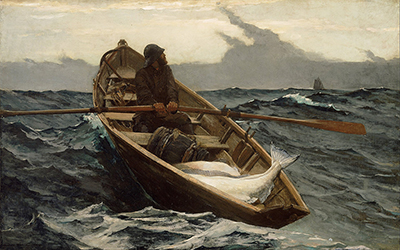
Winslow Homer's The Fog Warning is one of his great paintings of human judgment at sea. A fisherman rows a small dory across rough water. A heavy halibut catch lies in the stern. Behind him, in the distance, a schooner moves away toward fog. The man has food, skill and a boat, but those advantages are not enough to make the scene feel safe. [1] Homer builds the painting around a frighteningly practical question: can the fisherman get back before weather, distance and exhaustion overtake him?
The painting was made in 1885, soon after Homer had settled at Prouts Neck, Maine. It is an oil on canvas now in the Museum of Fine Arts, Boston. The MFA object facts record its dimensions as 76.83 x 123.19 centimeters, or 30 1/4 x 48 1/2 inches. The credit line is an anonymous gift with credit to the Otis Norcross Fund, and the accession number is 94.72. [2]
Those facts establish the object, but they do not explain why the painting has remained so compelling. The Fog Warning is not a simple shipwreck picture. Nothing has yet happened that could be called a final disaster. The fisherman is still rowing. His dory is still afloat. The schooner is still visible. The catch is still there. Yet every part of the painting tells the viewer that time is narrowing. The fog can hide the schooner. The waves can slow the dory. The halibut that proves the fisherman's success also weighs the boat down. The distance between small craft and mother vessel becomes the painting's central drama. [3]
Homer had spent years learning how to make ordinary events carry moral pressure. His Civil War work taught him how posture and silence could make history visible. His 1870s paintings of children, labor and leisure showed how clear scenes could hold larger public meanings. His time in Cullercoats and Tynemouth deepened his attention to fishing communities and coastal work. After he moved to Prouts Neck, the sea became even more central. In The Fog Warning, that long training comes together in a single image of labor under threat. [4]
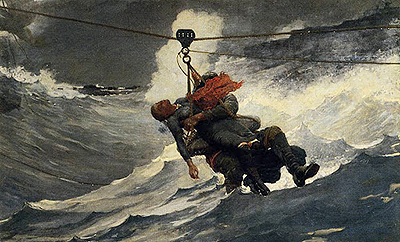
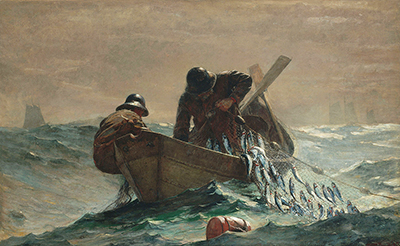
The article therefore deserves a full flagship treatment. The painting sits between Homer's working-sea pictures and his more severe late visions of danger. It connects naturally to The Herring Net, where men work together with their catch; to The Life Line, where rescue technology crosses the surf; to The Gulf Stream, where danger becomes more isolated and historically charged; and to Lost on the Grand Banks, where North Atlantic peril becomes explicit. The Fog Warning is quieter than some of those works, but its suspense is no less intense. [5]
It is also one of Homer's most exact paintings about agency. The fisherman is not passive. He looks back, judges distance and pulls at the oars. He has already done difficult work. The danger is that skill may not be enough. Homer makes the viewer feel the gap between competence and control. That gap is the painting's subject. [6]
What the Painting Shows
The first thing to notice is the dory. It is small, open and low in the water, built for work rather than display. Homer places it across a restless sea, with the fisherman seated at the oars and the stern loaded with halibut. The boat is not decorative. It is the fisherman's workplace, transport and possible lifeline. Its smallness matters because the sea around it feels large, mobile and indifferent. [7]
The fisherman is turned partly backward. He does not face only the direction in which he rows. His body and attention are split between effort and assessment. He must move the boat, but he must also measure the situation behind him. That backward glance gives the painting much of its tension. It tells the viewer that the man understands the stakes. He is not unaware of the fog or the schooner. He is reading his world in real time. [8]
The halibut catch in the stern is one of the painting's most important details. It confirms that the fisherman has succeeded in his work. He has not gone out and failed. He has found fish, landed them and loaded them into the dory. Yet that success now creates danger. The catch makes the boat heavier. It also makes the return more urgent, because the day's work has value only if it reaches the schooner and shore. Homer turns a sign of achievement into a source of risk. [9]
The distant schooner is equally important. It is the larger vessel, the point of return and the fisherman's connection to the wider fishing operation. In the painting, it is far away and moving toward fog. It may still be reachable, but the viewer cannot be sure. The schooner becomes a measure of distance, safety and time. It is close enough to be seen, but far enough to be uncertain. [10]
Fog is the painting's invisible approaching force. Homer does not need to cover the entire scene in blank whiteness. The warning is enough. Fog changes navigation, visibility and judgment. A fisherman in a small dory depends on his ability to locate the schooner and the larger pattern of sea and weather. Once fog thickens, a visible return path can disappear. The title points to that moment just before loss of certainty. [1]
The water completes the drama. The sea is not a theatrical storm, but it is active enough to make every stroke of the oars matter. The waves lift and drop the dory. The surface is uneven, and the boat has to be worked through it. Homer avoids melodrama by keeping the scene believable. The danger feels practical rather than exaggerated. [2]
This practicality is one reason the painting is so powerful. The viewer does not need a wreck, lightning or a breaking mast to understand the threat. The scene is built from normal elements of fishing life: a dory, a catch, a schooner, distance, weather and fatigue. Homer shows how quickly ordinary working conditions can become life-threatening when the sea controls the terms. [3]
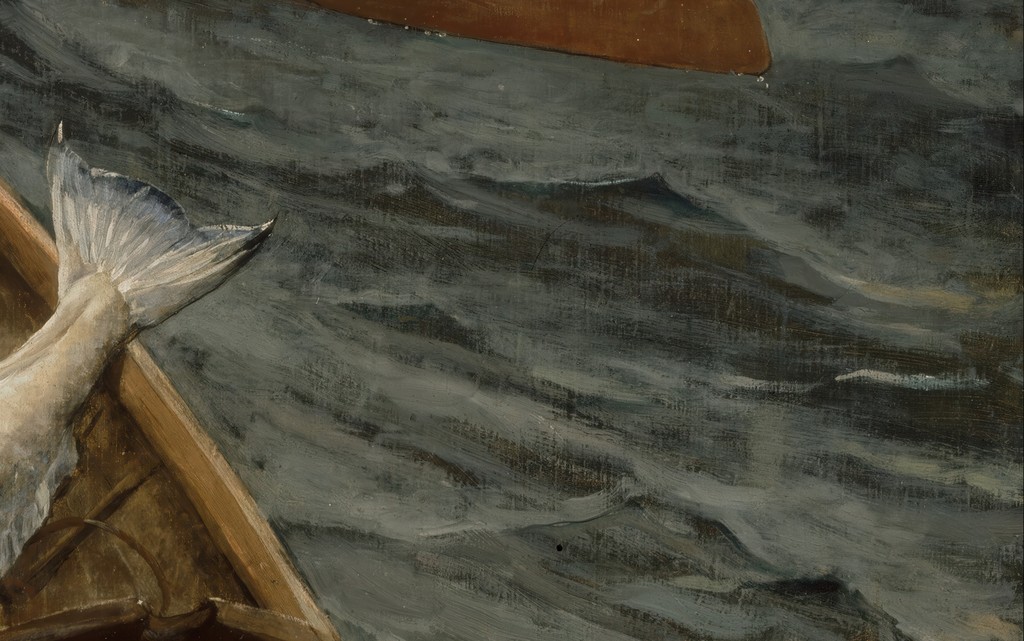
Annotated Details from The Fog Warning
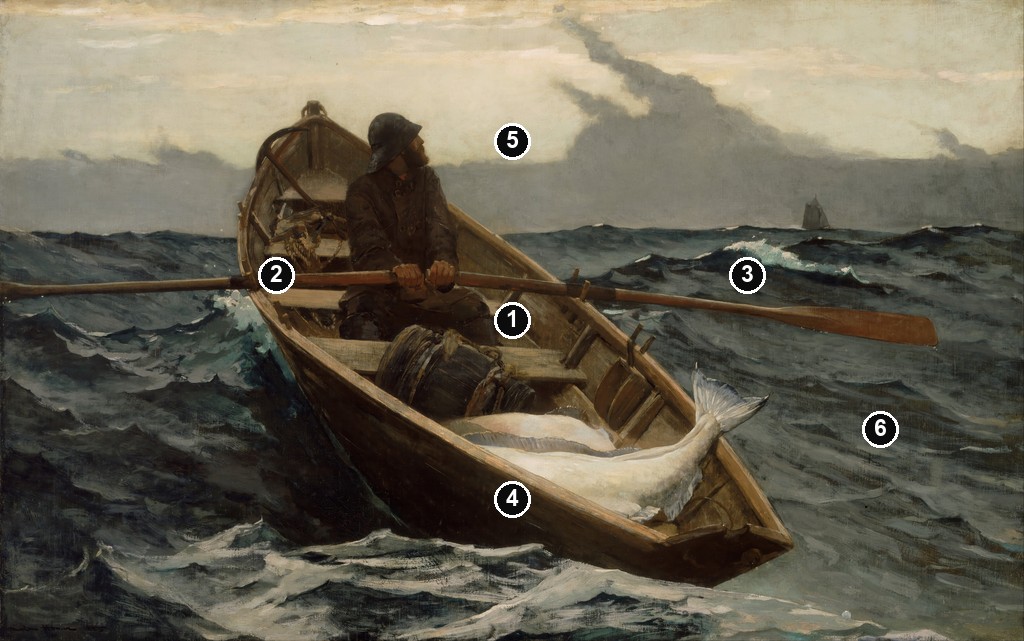
Details from THE FOG WARNING
Close looking follows the composition through figure, setting, foreground and surrounding visual pressure.
Central Action
The central passage carries the first act of close looking, where pose, spacing and surrounding detail establish the main visual problem.
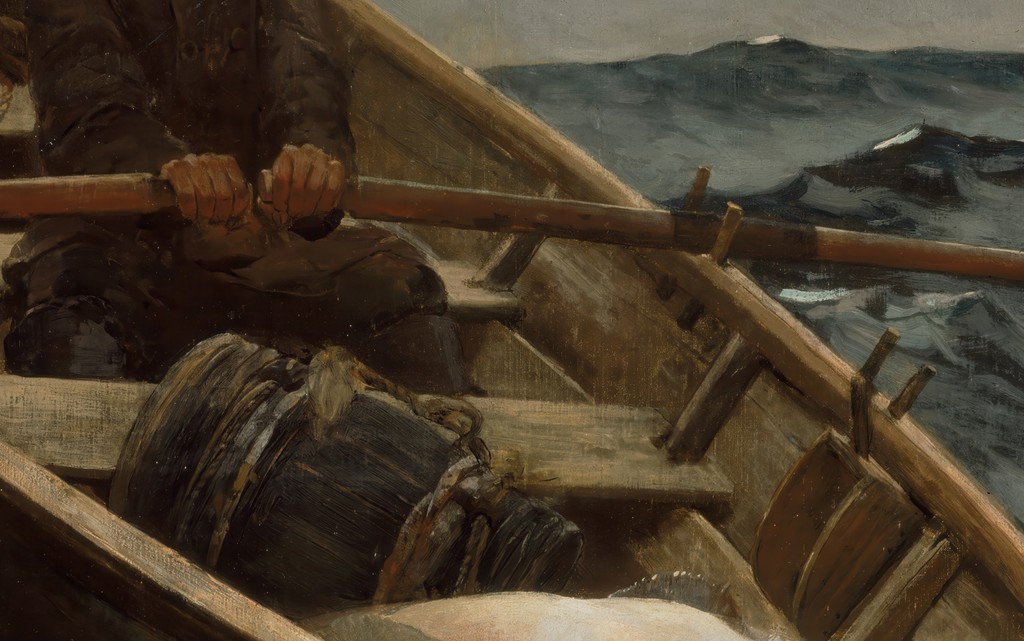
Left-Hand Structure
The left side helps frame the composition and shows how Homer balances incident against the broader setting.
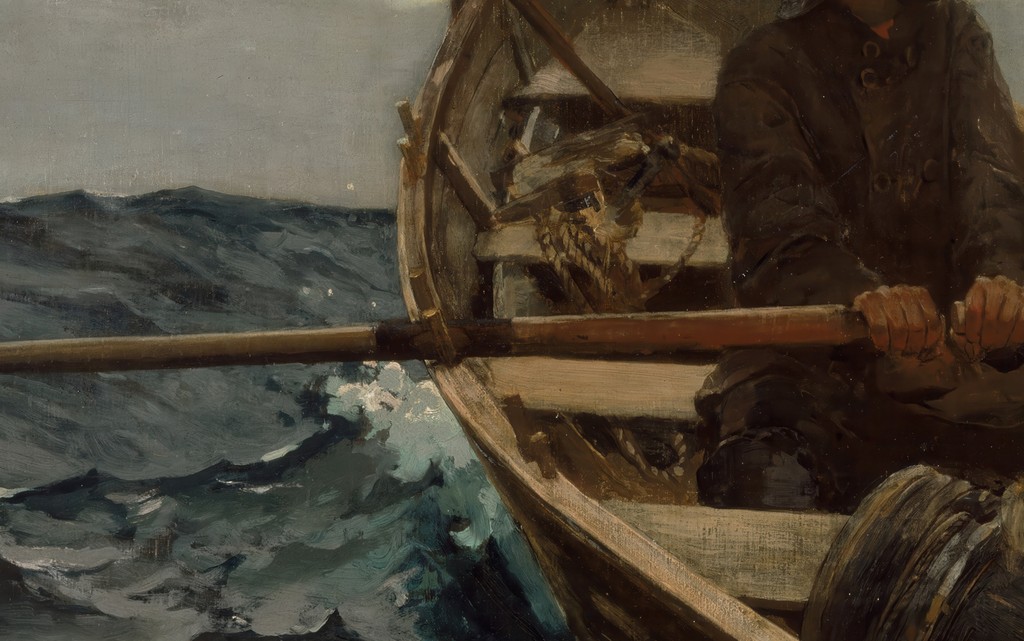
Right-Hand Structure
The right side answers the central group with a second visual pressure, often through movement, distance or environmental force.
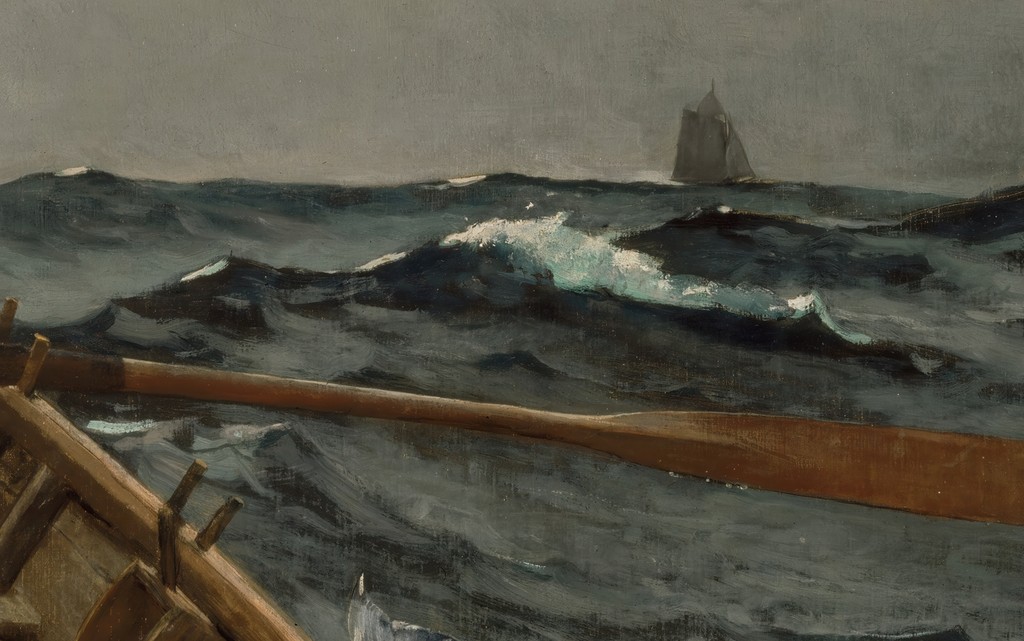
Foreground Detail
The foreground gives the viewer a threshold into the image and often contains the practical evidence of work, risk or play.
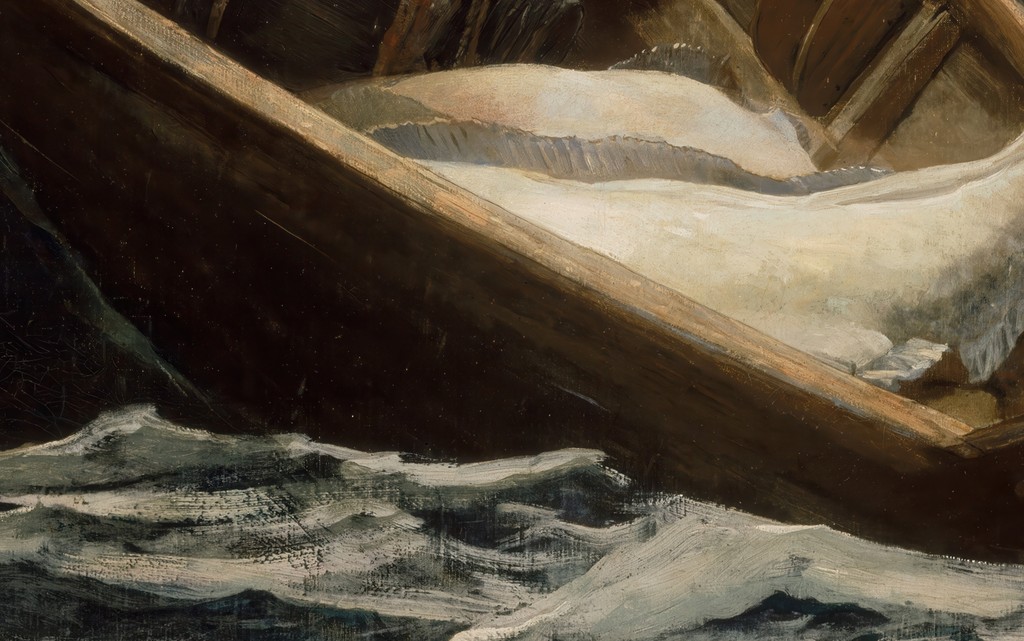
Background Distance
The background opens the picture into weather, landscape or social space, making the scene larger than the immediate figures.
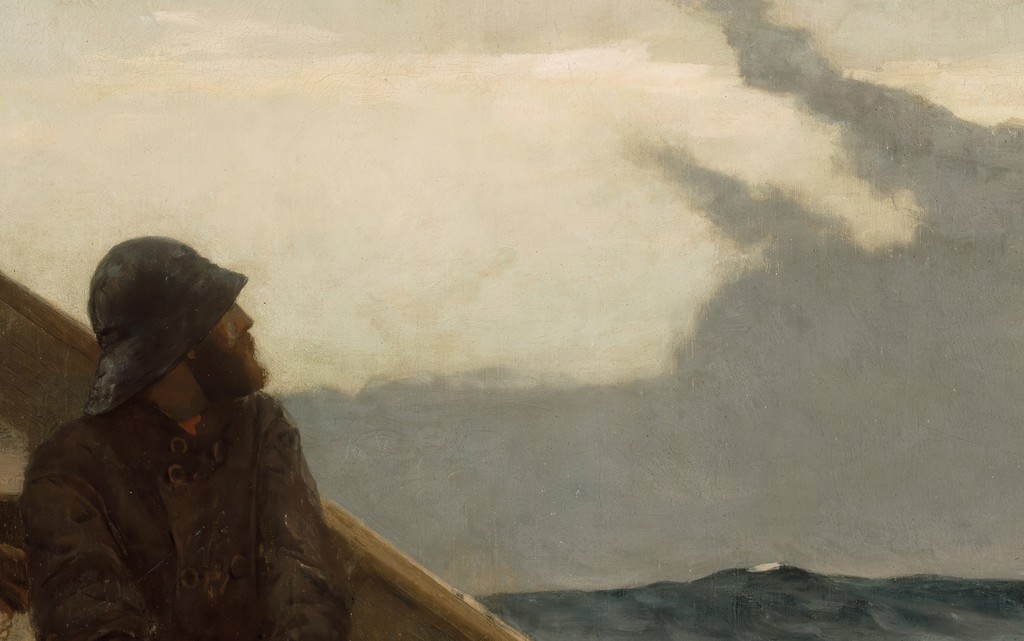
Edge Rhythm
A detail near the edge shows how the composition keeps the eye moving instead of closing around a single motif.
The Dory, The Schooner And The System Of Work
The Fog Warning depends on the relationship between the dory and the schooner. The fisherman is alone in the small boat, but he is not simply an isolated wanderer. The distant schooner tells us that his labor belongs to a larger fishing system. The small craft went out from the larger vessel, and the fisherman must return to it with the catch. [4]
That relationship gives the painting its structure. The dory is close, immediate and vulnerable. The schooner is far, larger and comparatively secure. Between them lies water, weather and time. The viewer understands the painting by measuring that gap again and again. How far is the fisherman from the schooner? How fast can he row? How quickly will the fog close in? How much does the catch slow him? Homer does not answer those questions. He makes them active inside the viewer's looking. [5]
The dory also changes the scale of the human figure. In a heroic marine painting, a sailor might stand on a deck, command a vessel or battle a storm in an obvious pose of courage. Homer chooses a lower, more restrained image of labor. The fisherman sits and rows. His heroism, if we use that word at all, is practical. It lies in attention, endurance and judgment rather than in theatrical action. [6]
The schooner is not presented as pure rescue. It is a point of safety, but it is also part of the work that exposed the fisherman to danger in the first place. The whole system requires small boats to move away from the larger vessel in search of fish. The very method that enables the catch creates the crisis of return. Homer lets that contradiction remain visible. [7]
This is why the painting does not need to be read as a generic image of man against nature. It is also an image of labor organization. The fisherman is at risk because of a way of working: halibut fishing from a dory in relation to a mother schooner. Nature matters enormously, but the situation is not nature alone. It is work under natural pressure. [8]
The halibut intensify that reading. They are heavy bodies in the boat, not picturesque props. They tell the viewer what the fisherman has been doing and what he stands to lose. The catch has monetary and human value. It represents food, income and completed work. At the same time, it makes the boat more difficult to manage. Homer compresses the economics of fishing into the stern of the dory. [9]
The fisherman's backward glance brings the system back to the level of the individual. He cannot control the fog or the schooner's movement. He cannot make the sea flatten. He can only read, row and decide. The painting honors his agency without pretending that agency is unlimited. That balance is central to Homer's late marine art. [10]
Halibut Fishing And Risk
The subject of halibut fishing matters because it grounds the painting in a specific form of maritime labor. Homer is not merely painting a man in a boat for atmospheric effect. The catch identifies the work as demanding, valuable and dangerous. The fish are large enough to change how we read the boat. Their presence makes the dory seem even smaller and the return even more urgent. [1]
Fishing pictures can easily become sentimental if they ignore labor. Homer does the opposite. He lets the viewer feel that the fisherman has been working before the painted moment begins. The scene we see is not the whole story. Before this instant, the man rowed out, fished, handled the catch and loaded the dory. The painting begins after success but before safety. That middle position is crucial. [2]
Success at sea is not complete until it is brought back. In The Fog Warning, the fisherman has proof of skill behind him, but the proof is also a burden. The halibut are what he needs to save, and they are what make saving himself harder. The painting's irony is quiet but severe. [3]
The sea turns that irony into suspense. A loaded dory sits differently in the water from an empty one. The fisherman must row through waves while maintaining balance and direction. He must keep track of the schooner even as the weather changes. The work requires strength, but also judgment. Homer emphasizes the moment when the question is not whether the fisherman is brave, but whether the conditions will allow his bravery to matter. [4]
This is one reason the painting avoids a simple moral lesson. If the fisherman reaches the schooner, his judgment and endurance will seem vindicated. If he does not, the failure will not necessarily belong to him. Homer creates a situation in which outcome and merit do not line up neatly. A skilled worker still be overcome by weather and distance. [5]
That idea gives the painting a modern seriousness. Homer is interested in work, but he is not interested in easy praise. The fisherman is neither anonymous labor decoration nor a triumphant emblem. He is a person performing skilled work under conditions that can become fatal. The painting asks viewers to respect that work without pretending it is safely under human command. [6]
The halibut also keep the painting from becoming purely psychological. The fisherman's fear or concern matters, but the fish make the problem material. Weight, time, distance and visibility are the facts. The emotional drama grows from those facts. Homer does not need to invent a melodramatic expression. He lets practical danger produce feeling. [7]
Prouts Neck And Homer's Late Marine Turn
Homer painted The Fog Warning soon after settling at Prouts Neck in Maine. That move changed the center of his artistic life. He had already made important paintings of the sea before 1883, and his English period at Cullercoats and Tynemouth had deepened his interest in coastal labor. But Prouts Neck gave him a long-term base from which to study the Atlantic with unusual intensity. [8]
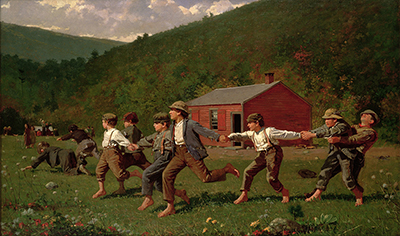
The Prouts Neck context matters because the painting belongs to a shift in Homer's art from social and anecdotal subjects toward more concentrated encounters with sea, weather and risk. Earlier works such as Breezing Up show water as active but broadly hopeful. The boys in that painting can move with the wind, and the boat becomes an image of skill and confidence. In The Fog Warning, the sea is more adult, more uncertain and more costly. [9]
The painting also looks back to the Cullercoats period. In England, Homer studied fishing communities whose lives were shaped by weather, work and waiting. Works connected to Tynemouth and Cullercoats show his growing seriousness about coastal labor, especially the labor of people whose relationship to the sea was daily rather than recreational. The Fog Warning carries that attention into a North Atlantic fishing subject. [10]
At Prouts Neck, Homer did not simply paint waves as spectacle. He used the sea to examine situations where human control is partial. That is why The Fog Warning feels different from a decorative marine view. The ocean is not scenery behind a human story. It is the condition that defines the story. The waves, fog and distance decide what the fisherman does. [1]
The move to Maine also matters biographically because it is often misunderstood as a simple retreat from the world. Homer's late seascapes can look isolated, but they are not empty of human or historical meaning. The Fog Warning is a good corrective to that simplification. It is a Prouts Neck-era work, but it is not only about solitude. It is about work, systems, risk and the fragile relation between individual skill and the larger forces of weather and economy. [2]
This makes the painting especially useful within the Winslow Homer cluster. It links the biography page to the marine works without turning late Homer into a single mood. It shows that his late art includes human labor as well as elemental sea. The fisherman belongs with the rescue figures of The Life Line, the working fishermen of The Herring Net, and the isolated central figure of The Gulf Stream, but he is not the same as any of them. [3]
The Prouts Neck context also clarifies the painting's restraint. Homer had no need to overstate the danger. He knew how much could be implied by a change in weather, a stretch of distance or a boat's relation to the waves. The drama is exact because the world is exact. [4]
Suspense Without A Final Ending
The most memorable feature of The Fog Warning is that it withholds the ending. A more conventional maritime picture might show the fisherman safely reaching the schooner, lost in fog or overtaken by a storm. Homer stops before resolution. The painting's event is the recognition of danger, not its conclusion. [5]
That choice changes the viewer's role. We are not asked simply to admire a rescue or mourn a disaster. We are asked to judge the situation with the fisherman. The eye moves from the dory to the schooner, from the schooner to the fog, from the fog back to the loaded stern, and then to the fisherman's body at the oars. Looking becomes a kind of calculation. [6]
This is why the painting's title is so effective. A warning is not the disaster itself. It is the moment when knowledge arrives before certainty. The fisherman has enough information to know that the situation is dangerous, but not enough to know the outcome. The viewer is placed in the same interval. [7]
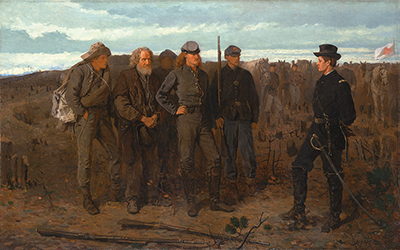
Homer often worked powerfully with intervals. In Prisoners from the Front, the encounter between Union officer and Confederate captives is charged by what has happened before and what will happen after, but the painting remains focused on a restrained present. In A Visit from the Old Mistress, the postwar social encounter is full of history and implication, but action is minimal. In The Fog Warning, the drama again lies in a present that is crowded by before and after. [8]
The before is clear enough: the fisherman has worked and caught halibut. The after is unclear: he may return, or he may not. Between them is the painted moment, and Homer makes it almost unbearably active. The man's oars, body and glance all belong to that middle state. [9]
The fog also works as a metaphor without ceasing to be weather. It is easy to make fog too symbolic, but Homer keeps it practical. Fog means loss of visibility. It means the schooner can disappear. It means sound and direction can become uncertain. Because the practical danger is so strong, any larger meaning grows naturally from it. [10]
The viewer's uncertainty is therefore earned. We do not know the ending because the fisherman does not know the ending. The painting respects the terms of the situation. It does not let viewers feel wiser than the person inside the boat. [1]
That restraint is part of Homer's greatness. He gives enough narrative information to create suspense, but not enough to turn the painting into illustration of a completed story. The picture remains open, and that openness is not vagueness. It is precision about uncertainty. [2]
Agency, Fate And Human Limits
The Fog Warning is often powerful because it refuses to choose between agency and fate. The fisherman is not helpless. He rows, looks, judges and acts. He has skill, strength and experience. At the same time, the conditions around him may be stronger than any of those qualities. Homer makes both truths visible. [3]
This balance matters for how the article should describe the figure. It would be wrong to treat him as merely a victim. He is not simply waiting for disaster. The whole painting is animated by his effort. But it would also be wrong to make him a heroic master of the sea. The fog, distance and loaded boat define the limits of what mastery can mean. [4]
The painting's emotional force comes from that middle ground. Human beings can act intelligently and still face conditions beyond control. That is a severe idea, but Homer does not present it abstractly. He gives it to us in a body rowing a boat. [5]
The fisherman's glance is the visual center of that idea. He looks toward the schooner and the approaching weather, but his body must keep rowing. His attention is divided because survival requires divided attention. He cannot simply stare at danger, and he cannot simply ignore it. He has to work while knowing. [6]
That act of knowing separates the painting from pure accident. The fog warning has been perceived. The question is what can be done with that perception. Homer makes the painting less about sudden catastrophe than about the burden of seeing danger soon enough, but perhaps not soon enough to escape it. [7]
The loaded stern complicates this further. The fisherman could perhaps row more easily without the catch, but the catch is the reason he is there. To abandon it would change the meaning of the day, the labor and the economy that sent him out. The painting quietly asks what survival costs and what work demands. It does not answer with an easy moral. [8]
This is where The Fog Warning connects to several other Homer pages. In The Life Line, the human body is suspended between danger and rescue technology. In The Gulf Stream, a man is isolated after control has already failed. In The Herring Net, labor happens in partnership and under pressure. In The Fog Warning, danger appears while action is still possible. The fisherman is inside the narrowing window when decision and endurance still matter. [9]
Why The Distant Schooner Matters
The schooner is small in the composition, but it carries enormous meaning. It is the fisherman's destination, the visible sign of a larger human world, and the most plausible path back to safety. Without it, the painting would become a simpler image of a man alone at sea. With it, the painting becomes a drama of separation. [10]
The schooner also creates a line of sight. The fisherman looks back, and the viewer follows. The boat in the distance is not merely background. It organizes the painting's space. It makes the sea measurable by the difficulty of return. [1]
Because the schooner is moving toward fog, it also creates urgency. If it were stationary and clear, the danger would feel less severe. If it were already gone, the painting would become closer to tragedy. Homer chooses the in-between state. The schooner is still there, but its reliability is fading. [2]
This in-between state is what makes the painting so readable and so unsettling. The viewer can see the problem at once. Yet the problem remains unsolved. The schooner is hope, but not guarantee. It is connection, but not rescue. It is a goal, but not an answer. [3]
The schooner also reminds us that the fisherman is part of a crewed world even when shown alone. His isolation is situational, not absolute. Other people exist somewhere on that vessel. The crisis is that the distance between them and him may become too great. Homer makes loneliness out of separation within a working system. [4]
That is different from the isolation in The Gulf Stream, where the central figure's damaged boat and distant ship produce a more severe sense of abandonment. In The Fog Warning, the fisherman is still in relation to a known vessel. The emotional charge comes from watching that relation strain almost to the point of breaking. [5]
Related Works In Homer's Marine Cluster
The Fog Warning belongs to a group of Homer works in which the sea is not merely picturesque. It is a place of labor, risk, decision and sometimes historical pressure. The painting therefore link readers into the broader Homer cluster rather than sit as an isolated famous image. [6]
The Herring Net is the closest labor comparison. Both paintings involve fishermen and catches at sea, and both make working conditions central. But The Herring Net emphasizes cooperative labor. Two men work together with the net and fish, while the sea presses around them. The Fog Warning narrows the drama to one man in one dory, returning from work under threat of fog. [7]
The Life Line offers a different comparison. It focuses on rescue, technology and the suspended body. Its danger is dramatic, but the presence of the lifesaving apparatus gives the scene a visible structure of intervention. The Fog Warning has no such apparatus. The fisherman has his oars, his judgment and the distant schooner. Help is not staged; return must be earned across water. [8]
The Gulf Stream intensifies the theme of isolation. There, a damaged boat, sharks, a waterspout, sugarcane and a distant ship create a larger meditation on survival and history. Compared with it, The Fog Warning is still tied to daily labor and a known return point. Yet both paintings ask viewers to confront uncertainty rather than a closed ending. [9]
Northeaster shows the late Homer sea with human presence greatly reduced. Waves crash against rocks, and the sea itself becomes the dominant force. Placed beside it, The Fog Warning shows why human figures remain important in Homer's marine art. The fisherman gives the sea ethical and practical stakes. The water matters because someone must cross it. [10]
Lost on the Grand Banks belongs in this orbit as another North Atlantic peril subject. It shares the broader world of fishing danger and exposed boats, though its final source and image treatment remains separate. For internal linking, it can help readers see that The Fog Warning is part of a larger body of works about the risks built into maritime labor. [1]
The article can also connect backward to Homer's watercolors and Cullercoats/Tynemouth material. Works such as Three Fisher Girls, Tynemouth help explain the seriousness with which Homer treated fishing communities before the Prouts Neck marine paintings. The Watercolours hub can support that context without turning this article into a biography substitute. [2]
Why The Painting Still Feels Modern
The Fog Warning still feels modern because its drama depends on uncertainty rather than spectacle. Homer gives viewers enough information to understand the danger, but he does not turn the scene into a moral fable. The fisherman may survive. He may not. The painting remains at the point where effort, weather and chance have not yet settled the matter. [3]
That unresolved structure suits modern viewers because it resembles real risk more than staged adventure. In life, danger often arrives as partial information: a change in weather, a distance that suddenly feels too large, a task that took longer than expected, a burden that seemed manageable until conditions changed. Homer turns that kind of recognition into art. [4]
The painting also respects labor. It does not romanticize fishing as picturesque poverty or simple courage. It shows that work at sea requires knowledge, physical effort and constant judgment. It also shows that the worker's knowledge is not a shield against every danger. That is a hard, honest view. [5]
The image's emotional intelligence lies in how little Homer explains. He does not tell us the fisherman's name, inner monologue or final fate. He does not describe the weather in words beyond the title's warning. He does not make the schooner large enough to reassure us. Instead, he arranges facts so that viewers feel the situation unfolding. [6]
This is why the painting is best introduced on the site as more than a famous marine image. It is a picture of attention under pressure. The fisherman looks because looking matters. He rows because action matters. The fog advances because the world does not pause for human calculation. The painting's greatness lies in holding all three facts together. [7]
For readers new to Homer, The Fog Warning can serve as an entry into the artist's late art. It has a clear subject, a dramatic composition and a memorable situation. For readers who know Homer already, it deepens the story. It shows that his marine paintings are not interchangeable seascapes. Each one tests a different relation between human life and the sea. [8]
The Fog Warning also belongs among the approved Famous Artworks for the cluster because it gives the group something essential. Breezing Up shows the sea as fresh movement and youthful trust. The Gulf Stream shows isolation and historical pressure. The Life Line shows rescue. The Herring Net shows cooperative labor. The Fog Warning shows the moment when work has succeeded, but safety has not. [9]
That is its particular power. Homer does not paint the catch as triumph or the fog as final doom. He paints the hard interval between them. The fisherman is neither saved nor lost. He is working, judging and rowing through a world that may or may not let him return. [10]
Discussion
Winslow Homer rewards close looking because his strongest images rarely close down into one easy meaning. Use the prompts below to test how the work changes as you move between subject, place, medium and history.
Reader Insights
First Look
What detail in The Fog Warning changes how the whole work feels?
Homer's Method
Where do you see Homer's balance between clear observation and unresolved meaning?
Cluster Context
Which related Homer work helps you read this page more carefully?
Join the Conversation
Share a thoughtful observation below, especially if a detail, source connection or related Homer page changed the way you read the work.
References
- Museum of Fine Arts, Boston, article by Ethan Lasser, The Fog Warning, 2020.
- Museum of Fine Arts, Boston eMuseum object record source lead, The Fog Warning, accession
94.72. - Museum of Fine Arts, Boston web-use and gallery-photography policy, as captured in the approved image-rights review.
phase-1a-conditional-route-flagship-source-packets-2026-07-20.md, Packet K: The Fog Warning.phase-1a-formal-source-packets-initial-2026-07-20.md, Packet 7: The Fog Warning.approved-eight-image-rights-review-2026-07-20.md.tom-image-policy-issue-bearing-pd-assets-2026-07-20.md.internal-link-ledger-2026-07-20.md.quote-ledger-2026-07-20.md.glossary-ledger-2026-07-20.md.
 Winslow Homer.jpg)