

 by Tom Gurney
Tom Gurney BSc (Hons) is an art history expert with over 20 years experience
Published on June 19, 2020 / Updated on August 2, 2026
Email: tomgurney1@gmail.com / Phone: +44 7429 011000
Contents
- Introduction
- A Painting In The 1885 Marine Cluster
- Grand Banks, Distance And The Risk Of Return
- Prouts Neck And Homer's Late Sea
- Companion Works And Cluster Placement
- Why This Painting Matters
Introduction
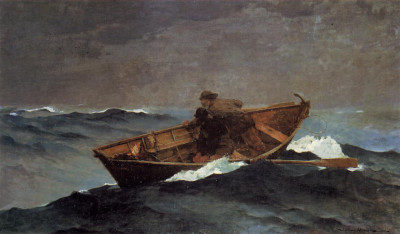
Winslow Homer's Lost on the Grand Banks belongs to the hard maritime world he developed soon after settling at Prouts Neck, Maine. The local source packets identify it as an 1885 work in a private collection and place it beside The Fog Warning and The Herring Net, two of Homer's best-known paintings of North Atlantic fishing, open water and human exposure. That relationship is the safest way to approach the article until a direct object packet is captured. [1]
The painting's title gives the reader an immediate frame. The Grand Banks were associated with offshore fishing, distance, fog and risk. Homer does not need to present the sea as spectacle for the subject to feel severe. In this late marine group, danger often appears through working conditions: a small boat, uncertain weather, a difficult return, a human figure or crew set against the scale of the Atlantic. Lost on the Grand Banks therefore be read as part of Homer's larger investigation of maritime labor rather than as a generic shipwreck scene. [2]
For that reason, this draft uses the most reliable local anchors: the 1885 date, private-collection status, Prouts Neck and Grand Banks context, and the work's relationship to Homer's late maritime peril sequence. It avoids unsupported biography, speculative iconography and risky image claims. [3]
A Painting In The 1885 Marine Cluster
The year 1885 matters because it places Lost on the Grand Banks in a concentrated moment of Homer's mature marine painting. The Fog Warning and The Herring Net also belong to 1885. Both show fishing labor in small craft, both carry the pressure of open water, and both transform practical work into a charged visual problem. They are not pictures of the sea as a scenic backdrop. They are pictures of people whose livelihood depends on judgment inside unstable conditions. [4]
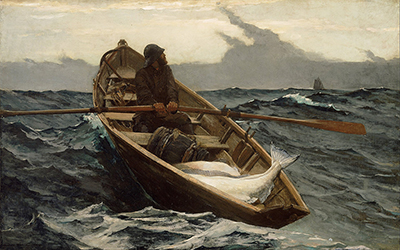
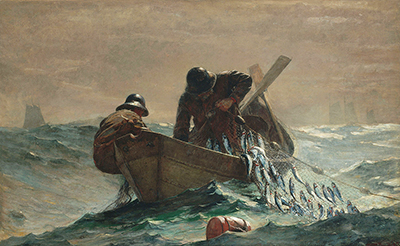
Lost on the Grand Banks extends that field of concern. Its title moves the viewer from labor in progress toward the possibility of failed return. In The Herring Net, two fishermen work a loaded net while distant schooners hover in mist. In The Fog Warning, a lone fisherman in a dory must measure his distance from safety as fog threatens the way back. Lost on the Grand Banks sits near those works because it brings the same maritime system into a more explicit condition of danger. [5]
This does not mean the three paintings is best collapsed into one meaning. Homer repeatedly returned to fishing boats, distance, mist and exposure because each arrangement let him test a different question. [6] What does teamwork look like when the catch itself creates risk? What does solitude look like when fog and distance begin to matter? What does a title like Lost on the Grand Banks do to the viewer before any detailed interpretation begins?
The answer begins with scale. Homer's late marine pictures often make human beings feel capable and vulnerable at the same time. Fishermen know their work. They understand boats, weather, gear and water. Yet knowledge does not cancel the size of the sea. Homer is at his strongest when he refuses to choose between skill and danger. The people in his sea paintings are not helpless decorations, but neither are they masters of the environment. [1]
That balance is central to the Prouts Neck phase. After moving to Maine in 1883, Homer built a body of work that increasingly tested human action against weather, water and coastal force. The local biography and medium-hub packets connect this phase to his earlier Cullercoats experience, where he observed fishing communities on the North Sea. By 1885, those observations had hardened into oil paintings that give working maritime life a grave and monumental presence. [2]
Grand Banks, Distance And The Risk Of Return
The phrase Grand Banks carries its own emotional weight. It points away from sheltered shore and toward offshore fishing grounds where distance, weather and navigation matter. In a Homer context, that distance is not merely geographic. It is moral and visual. The farther a boat moves from land, the less protection the viewer can imagine for the people inside it. [3]
Homer's marine art often depends on this feeling of measured distance. The Fog Warning makes the viewer aware of a fisherman, his catch, his dory, a distant schooner and the encroaching weather between them. The painting's suspense lies in the question of return. The Herring Net keeps larger vessels in the background while the real bodily danger unfolds in the small boat. Lost on the Grand Banks belongs to the same logic, but its title gives the threat a sharper edge. [4]
The word lost is best handled carefully. It can suggest disorientation, disappearance, death, or the failure of human systems that normally make fishing possible: navigation, visibility, communication, timing and return. A responsible manuscript does not need to turn that word into melodrama. It should let the title register as Homerian severity. The danger is not theatrical because it is built into the work itself. [5]
This is one reason the painting is useful in the Homer cluster even with a thin source packet. It helps readers understand that Homer's sea paintings are not all the same kind of peril. Some show rescue. Some show labor. Some show weather. Some show a person or boat placed at the edge of a larger natural and economic system. Lost on the Grand Banks names the most feared outcome of that system without requiring the article to invent a story beyond the evidence. [6]
The safest reading is therefore thematic and contextual. The painting belongs to Homer's late maritime peril corridor: fishing labor, exposed boats, offshore distance, uncertain return and the Atlantic as a force larger than human intention. That corridor also includes The Life Line, where modern rescue technology enters the scene, and The Gulf Stream, where isolation at sea becomes more historically and symbolically charged. [1]
Prouts Neck And Homer's Late Sea
Prouts Neck gave Homer a long-term vantage point on the Maine coast. The local biography packets identify his 1883 move there as a major transition after his earlier career as an illustrator, Civil War observer, postwar painter, watercolorist and traveler. In the Prouts Neck phase, the sea became less like a setting and more like an active condition. It shaped the terms under which people worked, survived, waited or failed to return. [2]
Lost on the Grand Banks is best read within that shift. It is not simply a painting of a named fishing area. It is part of a late-career turn toward the Atlantic as an arena of pressure. Homer had already spent years looking at rural life, children, leisure, Reconstruction subjects, watercolors and travel scenes. The late marine paintings bring a different severity. They often narrow the scene until the viewer has to confront weather, distance, bodies and water without much narrative explanation. [3]
That narrowing does not make the paintings empty. It makes each practical detail matter more. A boat is not just a boat; it is a fragile working platform. Fog is not just atmosphere; it changes the meaning of distance. A catch is not just abundance; it adds weight and urgency. A title is not just identification; it can tell the reader how to feel the danger around a scene. [4]
The Prouts Neck setting also helps explain why these works are not picturesque coastal souvenirs. Homer was not merely recording pretty water. He was building images in which the coast and sea test human action. In Northeaster, that testing becomes almost entirely elemental: waves striking rocks, human presence removed or minimized. In Lost on the Grand Banks, the human and occupational frame remains closer. The sea is still connected to work, livelihood and the fate of people who go out into it. [5]
This connection between labor and elemental force is one of Homer's great achievements. He can make a fishing subject feel specific without reducing it to illustration. He can make a marine danger feel large without losing the practical world that produced it. Lost on the Grand Banks matters because it sits at that crossing point. [6]
Companion Works And Cluster Placement
The strongest internal links for this article are the works that already have fuller local source support. The Fog Warning is the most immediate companion because the MFA packet explicitly places Lost on the Grand Banks near it in the 1885 maritime group. The Fog Warning helps readers understand dory-based danger, distance from a larger vessel and the suspense of return. [1]
The Herring Net gives a different but equally useful comparison. There the focus is not on being lost, but on the difficulty of fishing work itself. The men work together, the catch is heavy, and the small boat becomes the place where success and risk meet. Linking from Lost on the Grand Banks to The Herring Net can help readers see that Homer's sea is a workplace before it becomes a symbol. [2]
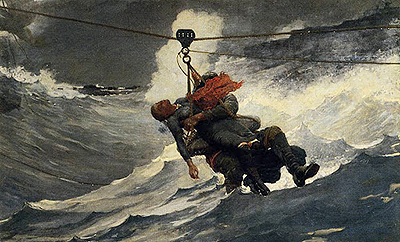
The Life Line expands the corridor from fishing to rescue. That page centers on lifesaving technology and the spectacle of a body carried across storm water. It does not need to be confused with Lost on the Grand Banks, but it belongs nearby because both works depend on the fragility of human life at sea. One addresses danger through rescue; the other through the possibility that rescue or return may not come. [3]
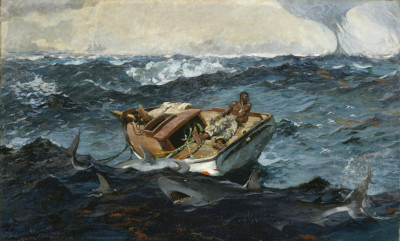
The Gulf Stream is a later and more complex comparison. Its Bahamas and Caribbean context, Black protagonist, damaged boat, sharks and reworked history take Homer's marine peril into a different register. The connection is best made with caution. Lost on the Grand Banks does not need to be treated as a simple prelude to The Gulf Stream, but both works show how Homer used the sea to press human vulnerability into larger meanings. [4]
The article should also link to the cluster spine: Winslow Homer, Biography and Paintings. Watercolours may be useful as a broader context link because the local packets connect Homer's Cullercoats and coastal observation to his wider watermedia practice, but this article does not need to overstate medium evidence until the direct object route is stronger. [5]
Why This Painting Matters
Lost on the Grand Banks matters because it gives the Homer cluster a concise route into one of his darkest maritime themes: the working sea as a place where skill, livelihood and danger cannot be separated. Even without a full direct object packet, the painting's date, title, private-collection status and companion relationship to the 1885 fishing works are enough to establish its editorial value. [6]
It helps readers see that Homer's marine art is not a single story of storms and heroism. His sea can be a workplace, a route home, a rescue field, a fishing economy, a natural force or a place where human knowledge reaches its limit. Lost on the Grand Banks belongs to the part of that world where return is uncertain. [1]
The painting also sharpens the meaning of the better-documented companion pages. After reading it, a viewer can return to The Fog Warning with more attention to the distant schooner and the threat of fog. They can see The Herring Net as more than a successful catch. They can understand The Life Line as one possible answer to the danger that other works leave unresolved. And they can approach The Gulf Stream as part of Homer's larger habit of placing human life at sea under pressure. [2]
Discussion
Winslow Homer rewards close looking because his strongest images rarely close down into one easy meaning. Use the prompts below to test how the work changes as you move between subject, place, medium and history.
Reader Insights
First Look
What detail in Lost on the Grand Banks changes how the whole work feels?
Homer's Method
Where do you see Homer's balance between clear observation and unresolved meaning?
Cluster Context
Which related Homer work helps you read this page more carefully?
Join the Conversation
Share a thoughtful observation below, especially if a detail, source connection or related Homer page changed the way you read the work.
References
- MFA Boston The Fog Warning article and object/source packet as captured locally, used for 1885 Prouts Neck context and the companion relationship among The Fog Warning, The Herring Net and Lost on the Grand Banks.
- Winslow Homer Phase 1A conditional-route flagship source packet, 2026-07-20, especially Packet K for The Fog Warning.
- Winslow Homer Phase 1A green-route flagship source packet, 2026-07-20, especially Packet E for The Gulf Stream.
- Winslow Homer Phase 1A homepage/biography source packet, 2026-07-20, used for career chronology, Prouts Neck context and late marine painting.
- Winslow Homer Phase 1A medium-hub source packet, 2026-07-20, used for Paintings and Watercolours context.
- Winslow Homer provisional URL decision matrix, internal-link ledger, quote ledger, glossary ledger and Tom image-policy ledger, all dated 2026-07-20.
 Winslow Homer.jpg)