

 by Tom Gurney
Tom Gurney BSc (Hons) is an art history expert with over 20 years experience
Published on June 19, 2020 / Updated on August 2, 2026
Email: tomgurney1@gmail.com / Phone: +44 7429 011000
Contents
- Introduction
- From Civil War Observation To Outdoor Oil Painting
- Croquet As Social Arrangement
- Relation To Homer's 1870s Leisure Subjects
- Why This Work Belongs In The Homer Cluster
Introduction
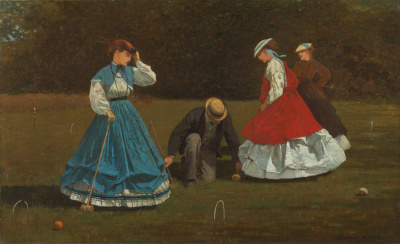
Winslow Homer's Croquet Scene is an 1866 oil painting about outdoor leisure, social poise and the way a modern game could become a serious pictorial subject. The Art Institute of Chicago records the work as oil on canvas, 40.3 x 66.2 cm, or 15 7/8 x 26 1/16 inches. It belongs to the Friends of American Art Collection; Goodman Fund, with reference number 1942.35. [1]
Those facts place the painting early in Homer's career as an oil painter. In 1866, he was still close to the Civil War illustration work that had sharpened his observational habits. He was also beginning to turn those habits toward painted outdoor scenes in which figures, costume, sunlight and social behavior could carry meaning without military drama. Croquet Scene belongs to that turn. It is not a battlefield image or a later marine struggle. It is a small, bright painting of recreation, but it is not slight. [2]
The painting shows women and a man on a lawn during a game of croquet. A crouching male figure attends to a ball near the woman in red. Another woman, placed toward the left foreground, shields her eyes from the light. The players are separated across the grass rather than grouped into a single conversational knot. Their spacing matters. Croquet gives Homer a game with rules, positions, turns and physical restraint. The subject is leisure, but the picture is built from attention, timing and social choreography. [3]
The Art Institute of Chicago's object interpretation identifies croquet as a popular sport recently introduced to the United States from the British Isles. That context is useful because it prevents the scene from becoming just an attractive garden moment. Homer is painting a fashionable activity inside a postwar culture where class, gender, imported habits and outdoor sociability all met on the lawn. The players are at play, but they are also performing a kind of public ease. [4]
From Civil War Observation To Outdoor Oil Painting
Croquet Scene gains much of its interest from its date. Homer had begun his career as a commercial illustrator, and the local biography packet records his Civil War work for illustrated publication as one of the foundations of his art. By the late 1860s, however, he was increasingly using oil painting to explore contemporary subjects outside the battlefield: sunlight, fashionable leisure, children, resort life, rural scenes and modern American figures. [1]
This shift is best described carefully. Croquet Scene does not erase the war or announce a simple return to innocence. It shows Homer testing what else modern painting could observe after the war: not only soldiers and prisoners, but also how people inhabit social spaces when danger is absent. The painting's calm is part of its historical position. In a country still reorganizing itself after conflict, images of leisure could carry their own pressure because they asked what ordinary life looked like now. [2]
Homer's illustrator's eye remains visible in the clarity of the arrangement. Each figure has a legible role. The game supplies a sequence of action, but Homer does not narrate it like a cartoon. Instead, he fixes the moment when the players' positions, gestures and clothing create a patterned outdoor scene. The result is observational without being documentary. We are not simply watching a game; we are watching a painter convert a game into structure. [3]
The AIC route also emphasizes the painting's bold patterning, strong contours and brilliant light effects. Those qualities make the canvas feel crisp and immediate. The shapes of dresses, hats, mallets, foliage and grass do not dissolve into atmosphere. They press forward. Homer gives sunlight a graphic force, turning glare and color into part of the picture's social energy. [4]
Croquet As Social Arrangement
Croquet was well suited to Homer because it is both active and restrained. It requires movement, but not the explosive motion of Snap the Whip. It is competitive, but not violent. It takes place outdoors, but within a controlled leisure setting. That combination allowed Homer to study posture, spacing and attention. [1]
The figures in Croquet Scene are not anonymous decorations on a lawn. They are readable through their positions. The crouching man interrupts the vertical rhythm of the women and pulls attention down to the ball. The woman in red becomes a focal point because her turn appears to organize the moment. The woman shielding her eyes introduces the sensation of bright afternoon light while also suggesting the slight discomforts of outdoor elegance. These are small observations, but Homer was very good at letting small observations carry a scene. [2]
The painting's class setting also matters. The local paintings-hub packet identifies women, children, leisure and rural subjects as central to Homer's postwar painting range. Croquet Scene belongs to the leisure side of that group, especially because croquet was associated with fashionable outdoor recreation. The lawn becomes a social stage: maintained, open, polite and governed by rules. Homer does not mock the players, but he does not turn them into icons of effortless grace either. He gives them the awkwardness of real bodies negotiating rules, sunlight and clothing. [3]
That is why the article should avoid over-sentimental language. Croquet Scene is breezy, but it is not empty. It studies a moment when play, class and gender become visible through arrangement. The viewer can enjoy the color and light while also noticing that every figure is held inside a system of position and etiquette. [4]
Relation To Homer's 1870s Leisure Subjects
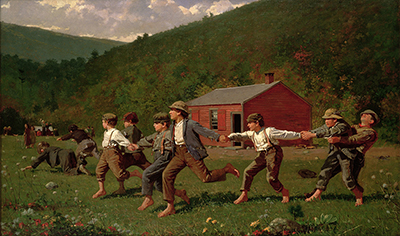
Although Croquet Scene was painted in 1866, it points toward the 1870s works that would become central to Homer's public image. The strongest comparison is Snap the Whip. Both paintings use a game to organize a group of figures. Both turn play into a test of bodies in space. But the emotional key is different. In Snap the Whip, children run, stretch and nearly break apart as their line swings through motion. In Croquet Scene, adults and young women occupy a world of measured turns and controlled gestures. [1]
Breezing Up (A Fair Wind) offers another useful comparison. There, outdoor recreation and skill meet on the water: young figures in a boat respond to wind, balance and maritime knowledge. In Croquet Scene, the setting is a lawn rather than a boat, and the stakes are social rather than environmental. Both works show Homer making leisure physically specific. He is interested in how people hold themselves when a rule, a tool or a natural condition directs their bodies. [2]
Boys in a Pasture belongs to the quieter rural-childhood side of the same broad cluster. It shows rest rather than play. Croquet Scene is more formal, more social and more visibly shaped by class. Read together, the articles can help visitors see that Homer's postwar ordinary subjects were not interchangeable. Childhood, rest, boating, games and fashionable recreation each gave him a different structure for looking. [3]
The painting also belongs in the Paintings hub because it helps fill the early leisure corridor between Civil War subjects and later rural and marine works. It does not need to be expanded into a flagship or split into subpages. Its best role is concise and connective: a strong early oil painting that shows Homer translating observed modern life into sunlit pattern, contour and social rhythm. [4]
Why This Work Belongs In The Homer Cluster
Croquet Scene earns its place because it broadens the rescued Homer cluster. Without pages like this, Homer can too easily appear as a sequence of Civil War images and sea dramas. Those are essential, but they are not the whole career. The early leisure paintings show an artist learning to make modern American life visible through ordinary subjects: games, beaches, fields, boats, children and outdoor social rituals. [1]
For the reader, this article should do three things. It gives the object facts clearly. It explains why croquet mattered as a fashionable imported sport in the 1860s. And it connects the painting to the larger Homer pattern: illustration-trained clarity, outdoor light, figure grouping and the serious study of apparently casual scenes. [2]
Handled at the right scale, Croquet Scene becomes more than a pretty game on a lawn. It shows Homer in the act of changing subjects after the Civil War: taking the discipline of illustration into oil paint, observing people at leisure, and discovering how sunlight, clothing, contour and social spacing could make an everyday pastime feel freshly modern. [3]
Discussion
Winslow Homer rewards close looking because his strongest images rarely close down into one easy meaning. Use the prompts below to test how the work changes as you move between subject, place, medium and history.
Reader Insights
First Look
What detail in Croquet Scene changes how the whole work feels?
Homer's Method
Where do you see Homer's balance between clear observation and unresolved meaning?
Cluster Context
Which related Homer work helps you read this page more carefully?
Join the Conversation
Share a thoughtful observation below, especially if a detail, source connection or related Homer page changed the way you read the work.
References
- Art Institute of Chicago object record, Croquet Scene, Winslow Homer, 1866, reference number
1942.35: https://www.artic.edu/artworks/44018/croquet-scene - Art Institute of Chicago artist record for Winslow Homer, used for broad career support and AIC collection context: https://www.artic.edu/artists/34988/winslow-homer
- Smithsonian Institution Inventory of American Paintings entry for Croquet Scene, used only as a supporting object-summary and bibliography lead: https://www.si.edu/object/croquet-scene-painting%3Asiris_ari_254855
- Local Winslow Homer Phase 1 approval brief, URL decision matrix, homepage/biography packet, medium-hub packet, internal-link ledger, quote ledger, glossary ledger and Tom image-policy ledger dated 2026-07-20.
 Winslow Homer.jpg)