

 by Tom Gurney
Tom Gurney BSc (Hons) is an art history expert with over 20 years experience
Published on June 19, 2020 / Updated on August 2, 2026
Email: tomgurney1@gmail.com / Phone: +44 7429 011000
Contents
Introduction
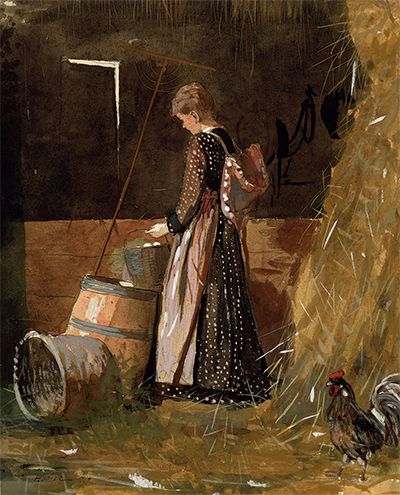
Winslow Homer's Fresh Eggs is a small 1874 watercolor that belongs to the rural genre side of his 1870s work. The National Gallery of Art records the work as watercolor, gouache, and graphite on wove paper, with a sheet size of 23.7 x 19.4 cm, or 9 5/16 x 7 5/8 inches. The NGA object record lists the credit line as Collection of Mr. and Mrs. Paul Mellon, accession number 1994.59.26, and notes that the work is not currently on view. [1]
Those facts matter because they correct the article's safest starting point. Fresh Eggs does not need to be treated as a large oil painting or as a major narrative picture. It is a compact work on paper, and its value inside the Homer cluster is connective. It lets readers see how Homer used watercolor and mixed paper media for ordinary rural subjects: a figure, a farm interior or yard, straw, tools, a basket of eggs, and the daily work implied by those objects. [2]
The scene centers on a young woman standing with a basket of eggs. Around her are farm details that keep the subject practical rather than theatrical: a barrel, an overturned barrel, a rake, straw, a haystack, a rooster, and a dark interior space beyond. Homer does not need a dramatic incident. The article should read the work as a small study of domestic labor, looking, and rural order. [3]
Rural Work On Paper
The best context for Fresh Eggs is the watercolor route, not a heroic paintings route. The local Watercolours hub packet identifies Homer watercolors as central to his mobility, experiment, color, light, and place-based observation. Fresh Eggs fits that route because it uses modest means for a scene of everyday country work. Gouache and graphite also matter here, since the NGA medium line shows that the surface is not only transparent watercolor. It belongs to Homer's broader paper practice. [4]
At the same time, the subject connects naturally to Homer's rural and domestic figure pages. The Milk Maid offers the nearest route because both works turn farm labor into a figure subject. On the Stile belongs nearby as another rural figure page, while Weaning the Calf, Crossing the Pasture, and Boys in a Pasture widen the corridor into children, fields, animals, chores, rest, and rural life. [5]
These comparisons stays modest. Fresh Eggs is not evidence for a single program of farm imagery, and the direct object record does not support a detailed claim about sitter, location, patronage, or original meaning. Its usefulness is simpler: it shows Homer paying attention to small acts of work and to the textures of rural space at a moment when his career was moving through children, leisure, country subjects, watercolor, and postwar American life. [1]
A Support Page, Not A Flagship
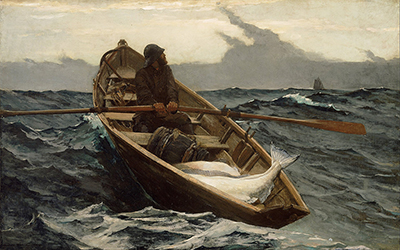
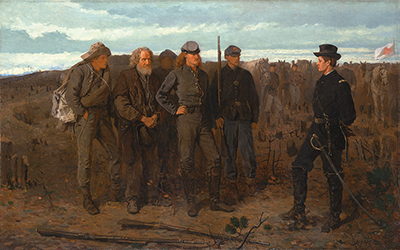
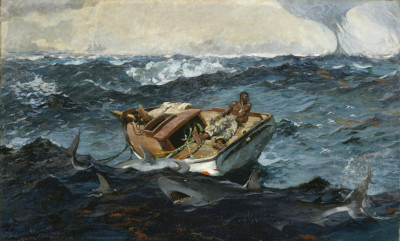
The article is best retained as a concise support page because it fills a real gap. Major works such as The Gulf Stream, Breezing Up, The Fog Warning, and Prisoners from the Front show Homer working at public scale and historical pressure. Fresh Eggs shows the quieter side of the same career: a woman in a rural setting, a task held in suspension, and materials of farm life arranged with visual economy. [2]
The work also helps the Watercolours hub. The current visible Watercolours module includes Fresh Eggs among seven active links, so this article remains a useful browse target when that protected module is preserved. It gives readers a rural figure stop between the Gloucester/coastal watercolors, A Wall, Nassau, The Milk Maid, and the broader watercolor discussion. [3]
Handled at this scale, Fresh Eggs becomes a useful small page: not a major argument, but a clean rural watercolor entry that strengthens Homer's domestic labor, farm life, and 1870s paper-practice corridor. [4]
Discussion
Winslow Homer rewards close looking because his strongest images rarely close down into one easy meaning. Use the prompts below to test how the work changes as you move between subject, place, medium and history.
Reader Insights
First Look
What detail in Fresh Eggs changes how the whole work feels?
Homer's Method
Where do you see Homer's balance between clear observation and unresolved meaning?
Cluster Context
Which related Homer work helps you read this page more carefully?
Join the Conversation
Share a thoughtful observation below, especially if a detail, source connection or related Homer page changed the way you read the work.
References
- National Gallery of Art object record, Fresh Eggs, Winslow Homer, 1874, accession
1994.59.26: https://www.nga.gov/artworks/89671-fresh-eggs - National Gallery of Art artist record: https://www.nga.gov/artists/1401-winslow-homer
- National Gallery of Art, Winslow Homer publication: https://www.nga.gov/research/publications/winslow-homer
- Art Institute of Chicago, Watercolors by Winslow Homer: The Color of Light overview: https://archive.artic.edu/homer_exhb/overview/
- Local Winslow Homer Phase 1 approval brief, provisional URL decision matrix, medium-hub source packet, homepage/biography source packet, internal-link ledger, quote ledger, glossary ledger, and Tom image-policy ledger dated 2026-07-20.
 Winslow Homer.jpg)