

 by Tom Gurney
Tom Gurney BSc (Hons) is an art history expert with over 20 years experience
Published on June 19, 2020 / Updated on August 2, 2026
Email: tomgurney1@gmail.com / Phone: +44 7429 011000
Contents
- Introduction
- What The Watercolor Shows
- Bahamas, Weather And Late Homer
- Relation To The Gulf Stream
- Nassau, Palms And Other Bahamas Watercolors
- Why This Work Belongs In The Cluster
Introduction
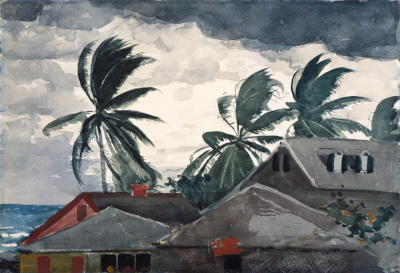
Winslow Homer's Hurricane, Bahamas is a late watercolor about weather before disaster becomes aftermath. Painted in 1898, it shows a tropical storm scene with dark clouds, wind-struck palms and a small but important sign of colonial presence. The Metropolitan Museum of Art records the work as watercolor and graphite on off-white wove paper, measuring 14 7/16 x 21 1/16 inches, or 36.7 x 53.5 cm. It entered the Met through the Amelia B. Lazarus Fund in 1910 and carries object number 10.228.7. [1]
The article belongs in the Winslow Homer rescue because it strengthens the Bahamas and Caribbean corridor around The Gulf Stream. It is not a major oil painting and does not need to be inflated into one. Its value is sharper than that: it shows Homer using watercolor to study violent weather, tropical light, British colonial signals and the late marine imagination that would soon feed into The Gulf Stream. [2]
Hurricane, Bahamas also gives the cluster a different point in the storm sequence. After the Hurricane, Bahamas looks at wreckage and a body on shore after catastrophe. Hurricane, Bahamas stays with the storm's approach or force. The viewer does not receive a rescue narrative, a shipwreck scene or a settled outcome. Instead, Homer asks the eye to read pressure in clouds, palms, wind and a flag. [3]
What The Watercolor Shows
The first impression is motion. The palms are not upright decorative markers of a warm destination. They bend and whip under violent wind. Their height makes the storm visible because the trunks and crowns act almost like measuring instruments. Homer does not need to show a full narrative of human struggle. Weather is made legible through what it does to the landscape. [1]
The sheet's medium helps that reading. Watercolor can move quickly between wash, stain, edge and reserve. Graphite gives the composition structure, while the watercolor surface can suggest unsettled air and the movement of weather across foliage and sky. The work's scale is modest, but the scene is built around instability. Nothing in it asks to be read as calm. [2]
The Red Ensign at the lower center is easy to overlook, but it gives the article one of its most useful source-led details. The flag connects the scene to the Bahamas as a British colonial territory rather than a neutral island setting. Homer lets the flag sit inside the weather, not outside it. The result is a small watercolor in which storm, place and empire meet without a long explanatory narrative. [3]
Bahamas, Weather And Late Homer
Homer's late career is often described through Prouts Neck and the Maine coast, but the local biography and watercolors packets make clear that travel also remained important. After 1884, Homer spent winters in places including Nassau, Bermuda and Florida, and the Bahamas/Bermuda works expanded his light, weather and water subjects. Hurricane, Bahamas belongs to that travel context. [1]
The work is especially useful because it complicates the idea of the tropical watercolor as a pleasant souvenir. Homer had already proved that watercolor could carry direct observation, atmosphere and experiment. By the 1890s, he could use the medium for more than sunlight and color. In this sheet, the Caribbean environment becomes severe. The palms, clouds and flag are not decorative accessories. They are the subject. [2]
The date also gives the article a careful historical edge. The Met connects the tempestuous weather and colonial flag to wider Caribbean turmoil in 1898, especially events involving Cuba and Puerto Rico. That connection remains phrased as an interpretive possibility, not as a fixed allegory. The painting does not become a news illustration of those events. But it does show that Homer's late tropical weather could carry more than meteorological interest. [3]
Relation To The Gulf Stream
The strongest internal route from this article is The Gulf Stream. The Met treats Homer's storm images from the Bahamas and Maine as important precursors to the turbulence of The Gulf Stream. That does not mean Hurricane, Bahamas is a study for the oil painting in a simple one-to-one way. It is better understood as part of the same late field of concerns: weather, water, exposure, Caribbean geography and unresolved human risk. [1]
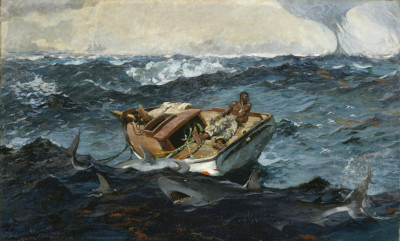
The Gulf Stream was painted in 1899 and later reworked by 1906. It places a Black man in a damaged boat on rough water, surrounded by sharks, storm signs and historical pressure. Hurricane, Bahamas has no central human protagonist like that. Its drama is environmental and political by implication. Yet both works resist the easy tourist view of warm water and tropical color. In each, the Caribbean is a place where beauty and danger are inseparable. [2]
The watercolor also helps readers understand how Homer could prepare visual intensity through small sheets. The palms and clouds in Hurricane, Bahamas train attention on turbulent atmosphere. The flag ties the scene to maritime empire. The compressed format makes every visible element work harder. When a reader moves from this article to The Gulf Stream, the larger oil painting can be seen not as a sudden invention but as part of a late pattern of storm, sea and history. [3]
The connection to After the Hurricane, Bahamas is equally useful. That watercolor deals with what remains after violent weather has passed: wreckage, shore, body, receding cloud and returning light. Hurricane, Bahamas keeps the viewer inside the event's pressure. Together, the two pages let the cluster describe a sequence without inventing a narrative between the works. One shows storm force. The other shows aftermath. [1]
Nassau, Palms And Other Bahamas Watercolors
Hurricane, Bahamas should also link across the quieter Nassau pages. A Wall, Nassau uses a wall, gate, vegetation and distant sea to think about threshold and public or private space. Palm Tree, Nassau can later support the same Bahamas watercolor route if its source and image row hold. These pages does not need to be merged into one generic travel article. Their value comes from the differences between them. [2]
In A Wall, Nassau, the viewer meets a built boundary in bright light. In Hurricane, Bahamas, the viewer meets weather as a force that bends the visible world. In After the Hurricane, Bahamas, the viewer meets the cost of violent weather after it has acted. The subjects differ, but together they help the Watercolours hub show why Homer's late travel sheets matter. They are not simply smaller relatives of the oil paintings. They are independent tests of place, medium and perception. [3]
The palms are central to this article because they might have become easy tropical shorthand. Homer makes them do harder work. They locate the scene, but they also reveal the hurricane. They are beautiful, but they are under stress. They belong to Nassau or the Bahamas setting, but they are not passive scenery. That tension keeps the watercolor from flattening into travel illustration. [1]
Why This Work Belongs In The Cluster
Hurricane, Bahamas is a support page, but it is a strong one. It helps explain how Homer moved between watercolor and oil, between travel observation and historical pressure, and between tropical light and dangerous weather. The subject is compact enough for a concise article, but the Met record gives enough evidence to keep the article above the thin-source band. [2]
The best internal links are Biography, Paintings, Watercolours, The Gulf Stream, After the Hurricane, Bahamas, A Wall, Nassau, Palm Tree, Nassau and Northeaster. Those routes place the work inside Homer's late weather, Bahamas, watercolor and marine-risk networks without turning it into a hub by stealth. [3]
For readers, the watercolor is useful because it makes a small lesson visible. Homer did not need a wrecked boat, a drowning figure or a monumental canvas to make weather serious. In Hurricane, Bahamas, dark cloud, strained palms and a colonial flag are enough. The storm is both natural and historical in feeling. It moves through the scene, and the scene records its pressure. [1]
That is the article's final editorial value. It gives the Homer cluster a storm before the wreckage and a Bahamas image before the full weight of The Gulf Stream. It asks readers to slow down in front of a watercolor and notice how much force Homer can place in air, trees, paper and a small flag. [2]
Discussion
Winslow Homer rewards close looking because his strongest images rarely close down into one easy meaning. Use the prompts below to test how the work changes as you move between subject, place, medium and history.
Reader Insights
First Look
What detail in Hurricane, Bahamas changes how the whole work feels?
Homer's Method
Where do you see Homer's balance between clear observation and unresolved meaning?
Cluster Context
Which related Homer work helps you read this page more carefully?
Join the Conversation
Share a thoughtful observation below, especially if a detail, source connection or related Homer page changed the way you read the work.
References
- Metropolitan Museum of Art object record, Hurricane, Bahamas, Winslow Homer, 1898, object number
10.228.7: https://www.metmuseum.org/art/collection/search/11124 - Met Open Access information on public-domain images and data, as presented from the object record research resources.
- Local Winslow Homer Phase 1 approval brief, provisional URL decision matrix, green-route flagship source packet, green-route manuscript briefs, medium-hub source packet, homepage/biography source packet, internal-link ledger, quote ledger, glossary ledger and Tom image-policy ledger dated 2026-07-20.
 Winslow Homer.jpg)