

 by Tom Gurney
Tom Gurney BSc (Hons) is an art history expert with over 20 years experience
Published on June 19, 2020 / Updated on August 2, 2026
Email: tomgurney1@gmail.com / Phone: +44 7429 011000
Contents
- Introduction
- The Two Men
- What The Painting Shows
- Adirondack Context
- Reception And Source Limits
- Related Homer Works
- Why This Work Belongs In The Homer Cluster
Introduction
Winslow Homer's Two Guides is an Adirondack painting about place, memory and outdoor knowledge. The Clark Art Institute store record gives the work as Two Guides, 1877, by Winslow Homer, oil on canvas, acquired by Sterling Clark in 1916. A Clark collection-book page adds why that acquisition matters: Robert Sterling Clark bought Two Guides early in his Homer collecting life, after his first Homer purchase in 1915, and the painting became part of a Clark Homer collection that spans oils, watercolors, drawings, etchings and wood engravings. [1]
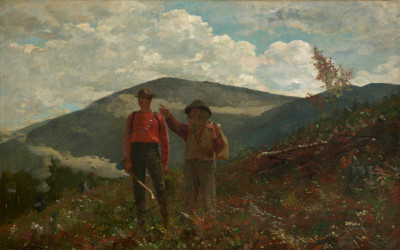
The painting shows two men in an Adirondack landscape. One is younger, taller and dressed in a vivid red shirt. The other is older, bearded and equipped with a pack basket. The figures stand among cut trees, flowers and low vegetation, with a mountain and clouded sky behind them. The older guide points outward, away from the viewer, as if naming a route, landmark or memory that lies beyond the picture's edge. Homer makes that gesture the painting's quiet engine. The subject is not a hunt in progress, but a transfer of knowledge. [2]
The Two Men
Even with that caution, the identifications matter. Homer was not painting generic decorative staffage in front of a mountain. He was interested in people whose knowledge of the Adirondacks was practical, local and embodied. The pack basket, axes, gesture and stance all point toward work. These guides are not visitors consuming scenery. They are people who know how to move through it. [3]
That distinction gives the painting its place inside the Winslow Homer rescue. Homer often returns to figures who understand their environments through use: fishermen, hunters, lifesaving crews, canoeists, field workers and guides. In Two Guides, the subject is less dramatic than a storm or a rescue, but the same principle is present. The landscape is not empty scenery. It is a place that has to be read. [4]
What The Painting Shows
Two Guides is structured around contrast. The younger guide's red shirt draws the eye immediately, while the older guide's bearded head, pack basket and pointing arm hold the narrative attention. One figure suggests energy and physical readiness. The other suggests experience and memory. Homer does not need to turn the scene into a lesson. The composition lets the viewer feel the difference between youthful strength and seasoned knowledge. [5]
The foreground is also important. Flowers, ferns, stumps and cut trunks prevent the scene from becoming a pure mountain panorama. Human work has already touched this place. The axes and cut timber make the Adirondack setting more complicated than untouched wilderness. Homer shows beauty, but he also shows use. [6]
The mountain behind the men gives the painting its scale. It is not simply a backdrop; it is the thing the guides know. The older man's gesture links body and landscape, making the painted space feel like territory rather than view. He points into a world that exceeds the canvas, while the younger man stands beside him as a listener, companion or successor. [1]
This is why the painting stays source-led but not be flattened into an object row. It has enough interpretive life for a public page: two identifiable men, a specific Adirondack region, a Clark collection route, a history of changing reception and a strong relationship to Homer's larger outdoor subjects. [2]
Adirondack Context
The Adirondacks gave Homer a different kind of subject from the open sea. The region brought together mountains, tourism, sport, logging, camps, guides, hunting, fishing and local labor. A visitor might see scenery. A guide had to know weather, trails, rivers, animals, routes and risk. [3]
Two Guides is strongest when read in that space between landscape and labor. The painting does not make the men small before nature in the way a sublime landscape might. Instead, it gives them vertical weight in the composition. They stand as the viewer's entrance into the mountain setting. The older guide's pointing arm makes knowledge visible; the younger guide's red shirt anchors the scene in immediate physical presence. [4]
This also keeps the article from drifting into generic wilderness romance. The cut trees, tools and named guides belong to a lived Adirondack world. Homer's interest is not only in grand natural scenery, but in the human relationships that make a place intelligible. [5]
Reception And Source Limits
The Clark-related interpretive text mirrored by Traditional Fine Arts Organization records a useful reception arc. It says the painting received little attention at the National Academy of Design annual exhibition in 1878, then found a warmer critical climate when shown several times in the 1890s. That history is best used carefully. It supports the idea that Two Guides was not fixed in reputation from the beginning, and that later viewers became more responsive to Homer's handling and subject. [6]
No direct quotes are needed. The public article can paraphrase the available evidence without borrowing old critical language or repeating colorful descriptions of Phelps from nineteenth-century sources. That restraint is useful. It keeps the article focused on what can be supported without turning the guides into anecdote. [1]
Related Homer Works
Two Guides is the natural companion to The Adirondack Guide. The smaller Adirondack Guide concentrates on one standing figure with a rifle; Two Guides expands the guide subject into a larger landscape and a relationship between two men. Together they show that Homer treated guides as more than props. They represent outdoor competence, local knowledge and the social world around mountain travel. [2]
The article also belongs near Canoe in the Rapids, Hound and Hunter, A Huntsman and Dogs and Below Zero. Those works are not direct sequels, but they share a concern with outdoor skill under pressure. In the canoe subject, skill appears as balance and judgment in moving water. In the hunting pictures, it appears through dogs, rifles, boats, deer and winter. In Two Guides, it appears through gesture, age, tools and familiarity with place. [3]
That cluster value is the main reason to retain the article. Homer is often approached through Civil War art, childhood scenes, marine labor, Prouts Neck seascapes and the Bahamas. Two Guides helps protect another route: the inland Homer, attentive to mountains, guides, hunting, fishing, travel and the complicated human use of wild regions. [4]
Why This Work Belongs In The Homer Cluster
Two Guides is best a concise standard artwork page, not a flagship treatment. Its source base is meaningful, but the direct object record still needs final capture. The article therefore avoids unsupported claims about Homer's exact working process, studio practice, emotional intention or the full biographies of the sitters. It says cautiously that the painting is an Adirondack guide subject in the Clark Art Institute collection, that Clark material dates it to 1877 and records Sterling Clark's 1916 acquisition, and that richer secondary Clark-related text identifies the guides and places the work in Keene Valley and Adirondack reception history. [5]
The reader-facing value is clear. Two Guides turns landscape into relationship. The mountain matters because the men know it. The gesture matters because knowledge moves from one person toward another. The cut timber matters because the Adirondacks are shown as worked, traveled and remembered, not as an untouched backdrop. [6]
keep the copy lean, link it into the biography and paintings hub, then connect it to the Adirondack guide and hunting cluster. The painting does not need padding. It already gives the Homer cluster a strong inland scene: two guides, one mountain, one pointing arm and a landscape made legible by human experience. [1]
Discussion
Winslow Homer rewards close looking because his strongest images rarely close down into one easy meaning. Use the prompts below to test how the work changes as you move between subject, place, medium and history.
Reader Insights
First Look
What detail in Two Guides changes how the whole work feels?
Homer's Method
Where do you see Homer's balance between clear observation and unresolved meaning?
Cluster Context
Which related Homer work helps you read this page more carefully?
Join the Conversation
Share a thoughtful observation below, especially if a detail, source connection or related Homer page changed the way you read the work.
References
- Clark Art Institute Museum Store record for
Two Guides, 1877: https://store.clarkart.edu/products/two-guides-1877 - Clark Art Institute Museum Store page for Winslow Homer the Clark Collection, Marc Simpson catalogue listing: https://store.clarkart.edu/products/winslow-homer-the-clark-collection
- Clark object route lead for Two Guides: https://www.clarkart.edu/ArtPiece/Detail/Two-Guides
- Traditional Fine Arts Organization mirror of Clark Art Institute collection text for Winslow Homer at the Clark, used only as secondary Clark-related interpretation and reception support: https://www.tfaoi.org/permc/perm10a.htm
- Getty Research Institute / BHA bibliographic record for David Tatham, The two guides: Winslow Homer at Keene Valley, Adirondacks, American Art Journal 20, no. 2, 1988, used as a source lead only: https://bha-test.inist.fr/vibad/index.php?action=getRecordDetail&idt=oba_1178504&lang=en
- Local Winslow Homer provisional URL decision matrix, active URL baseline audit, medium-hub packet, internal-link ledger, image ledger, quote ledger and related Adirondack/hunting manuscripts dated 2026-07-20.
 Winslow Homer.jpg)