

 by Tom Gurney
Tom Gurney BSc (Hons) is an art history expert with over 20 years experience
Published on June 19, 2020 / Updated on September 6, 2026
Email: tomgurney1@gmail.com / Phone: +44 7429 011000
Lucretia by Artemisia Gentileschi
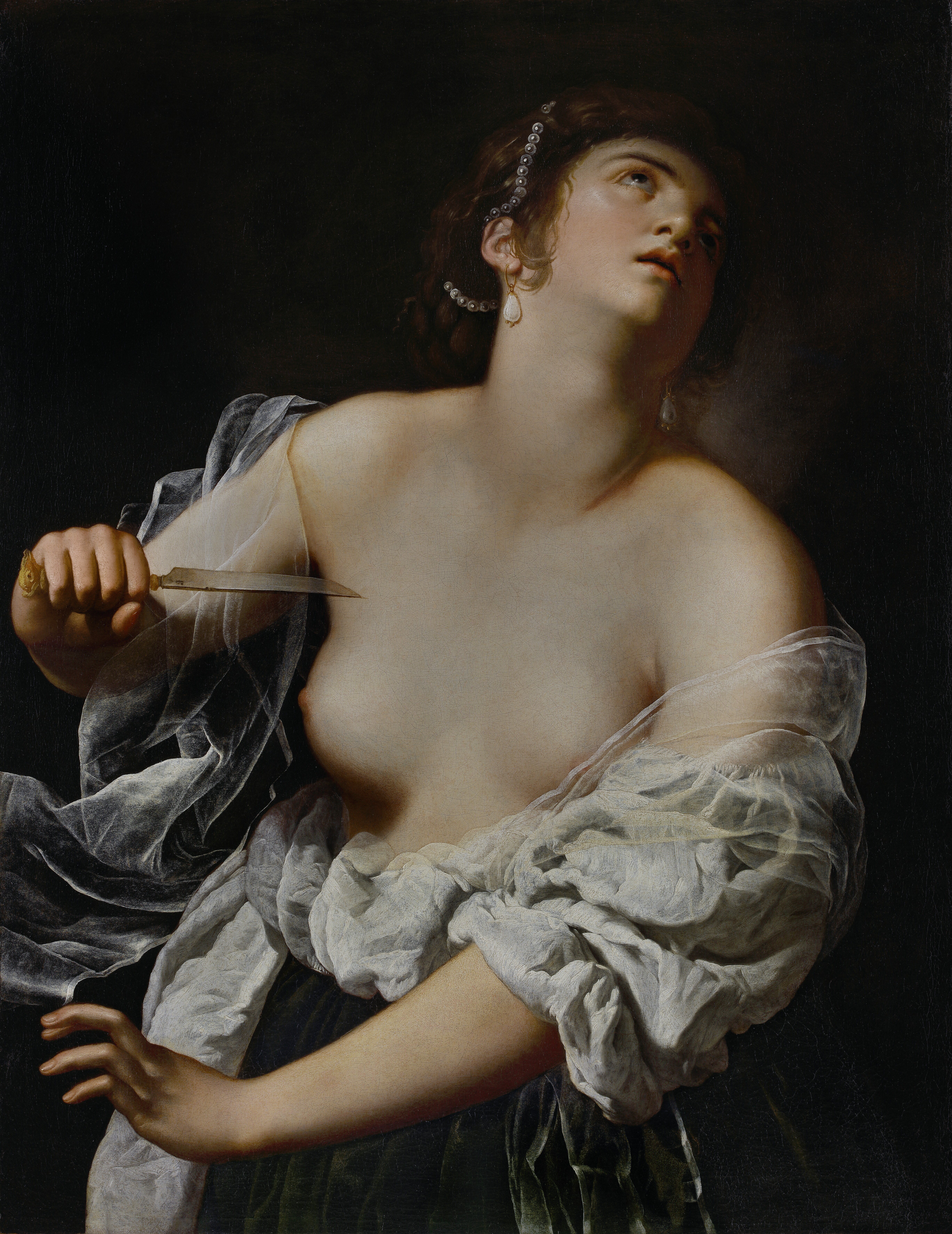
Artemisia Gentileschi's Lucretia is one of the most difficult and powerful paintings in her late-1620s career. The subject is a Roman woman at the moment before self-inflicted death, after sexual violence and public dishonour have been forced into her story. Artemisia does not turn that crisis into spectacle. She isolates Lucretia, brings her close to the viewer, and makes the painting hinge on a single terrible decision. [1][2]
The painting belongs to the J. Paul Getty Museum, which acquired it in 2021 after its rediscovery from private collections. Getty identifies the work as Lucretia, about 1627, by Artemisia Gentileschi, oil on canvas, with the museum object number 2021.14. The collection route records the dimensions as 92.9 x 72.7 cm, while Getty's acquisition article gives the equivalent imperial measurements as about 36 1/2 x 28 5/8 in. [1][2]
This article treats Lucretia as a serious history painting, not as a sensational image of violence. The story includes rape and suicide, but Artemisia's achievement lies in how she makes the figure's inner crisis visible: through gesture, light, fabric, upward gaze and the suspended moment before action.
Image reference: J. Paul Getty Museum.
At a Glance
- ArtistArtemisia Gentileschi
- TitleLucretia
- Dateabout 1627. [1][2]
- Mediumoil on canvas. [1][2]
- Dimensions92.9 x 72.7 cm, or about 36 1/2 x 28 5/8 in. [1][2]
- CollectionJ. Paul Getty Museum. [1][2]
- Object number2021.14. [1][2]
- Subjectthe Roman heroine Lucretia at the moment before self-inflicted death
- Career contextprobably Artemisia's Venetian period in the late 1620s. [1][3]
- Reader cautionthe painting represents sexual violence and self-harm within an ancient Roman story; the discussion below stays in restrained art-historical terms
Contents
- The Getty Object
- The Story of Lucretia
- Annotated Details
- Body, Gesture and Decision
- Venice and a Changing Style
- Rediscovery and Acquisition
- A Strong-Women Display Context
- Artemisia and Heroic Women
- Private Crisis and Public History
- Sensitive Subject Framing
The Getty Object
Getty announced the acquisition of Artemisia Gentileschi's Lucretia on March 30, 2021. The announcement identifies the painting as a recently rediscovered work, about 1627, oil on canvas, in the Getty Museum collection with object number 2021.14. [1]
The Getty collection route confirms the same core identity: Lucretia, Artemisia Gentileschi, about 1627, oil on canvas, J. Paul Getty Museum, object number 2021.14, with dimensions of 92.9 x 72.7 cm. [2] That current object identity controls this article.
The painting should not be confused with other Lucretia images, with Artemisia's Cleopatra subjects, or with the broader group of classical women facing death. Comparisons can help readers understand the subject, but they should not blur the Getty object's date, collection or modern rediscovery.
The acquisition also changed the public map of Artemisia's work. Like recent museum acquisitions and rediscoveries elsewhere, Getty's Lucretia is part of a renewed effort to place Artemisia at the centre of Baroque painting rather than at its margins.
The Story of Lucretia
Lucretia's story comes from ancient Roman history and legend. Getty summarizes the episode through Livy's account: Lucretia was the wife of Lucius Tarquinius Collatinus; Sextus Tarquinius raped her; she summoned her husband and father, asked them to avenge what had happened, and killed herself while asserting her innocence. Her death helped spark the revolt that overthrew the Tarquin monarchy and marked the founding of the Roman Republic. [1]
Early modern artists returned to Lucretia because the subject joined private violation, public honour, moral crisis and political consequence. The story was not simply an episode of personal grief. It was used as an image of virtue, courage and the collapse of tyrannical power.
For a modern reader, that tradition needs care. Lucretia's self-inflicted death should not be romanticised. Nor should the painting be treated as if it gives a simple moral answer to sexual violence. Artemisia inherited a subject with a long history, but she made the moment feel painfully immediate. The viewer is not looking at an abstract example of Roman virtue. The viewer is looking at a woman whose body and face carry the pressure of an unbearable decision.
Annotated Details from Lucretia
This annotated close reading follows Getty's Lucretia as a tightly controlled image of suspended decision. The upturned face, raised dagger, hand at the chest, white drapery, deep red fabric and tense diagonal pose all concentrate the Roman story into one restrained, difficult moment. The module keeps the subject in art-historical language and does not treat the violence as spectacle.
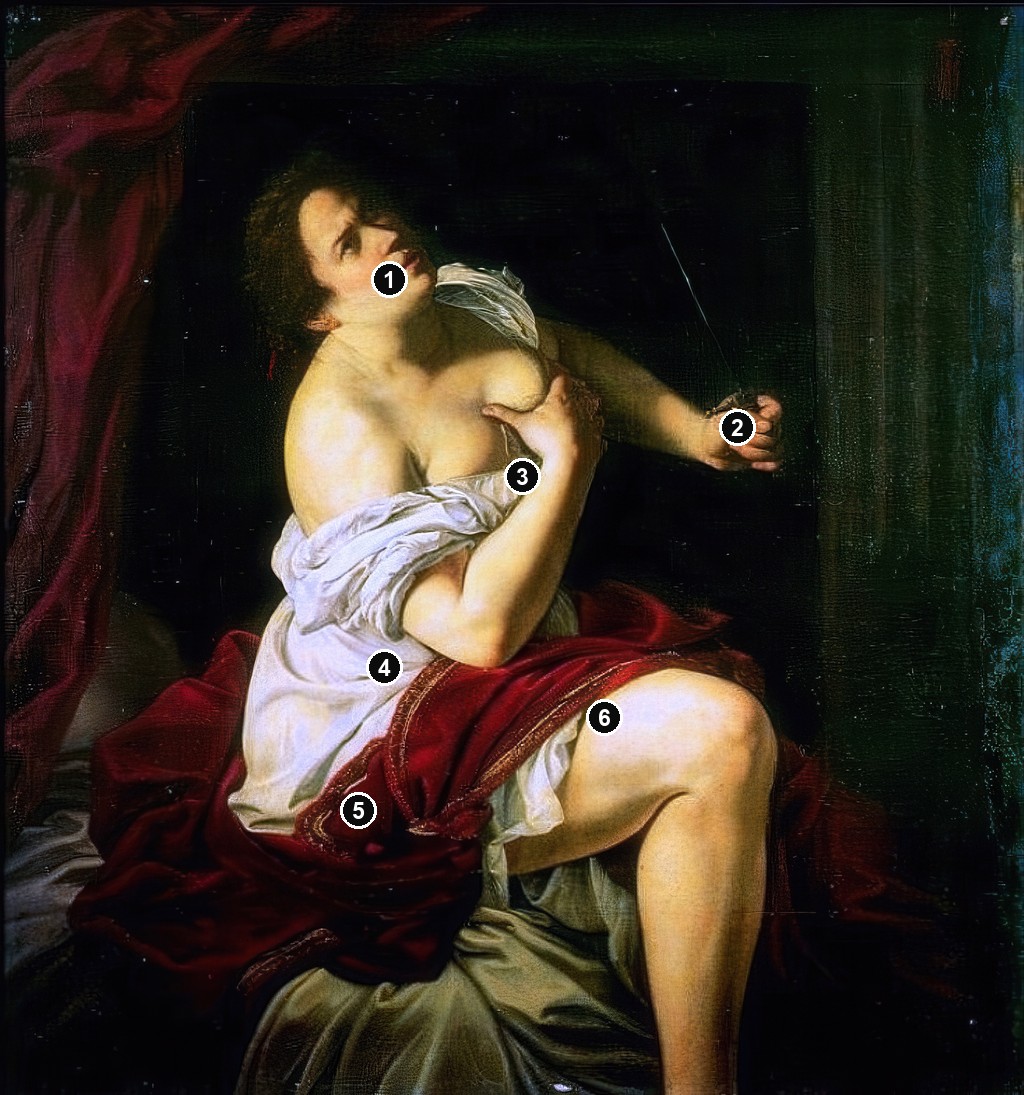
Details from LUCRETIA
The details show how Artemisia makes the figure's crisis visible through gesture, fabric, light and pose. Each crop keeps attention on pictorial choices rather than sensational narrative.
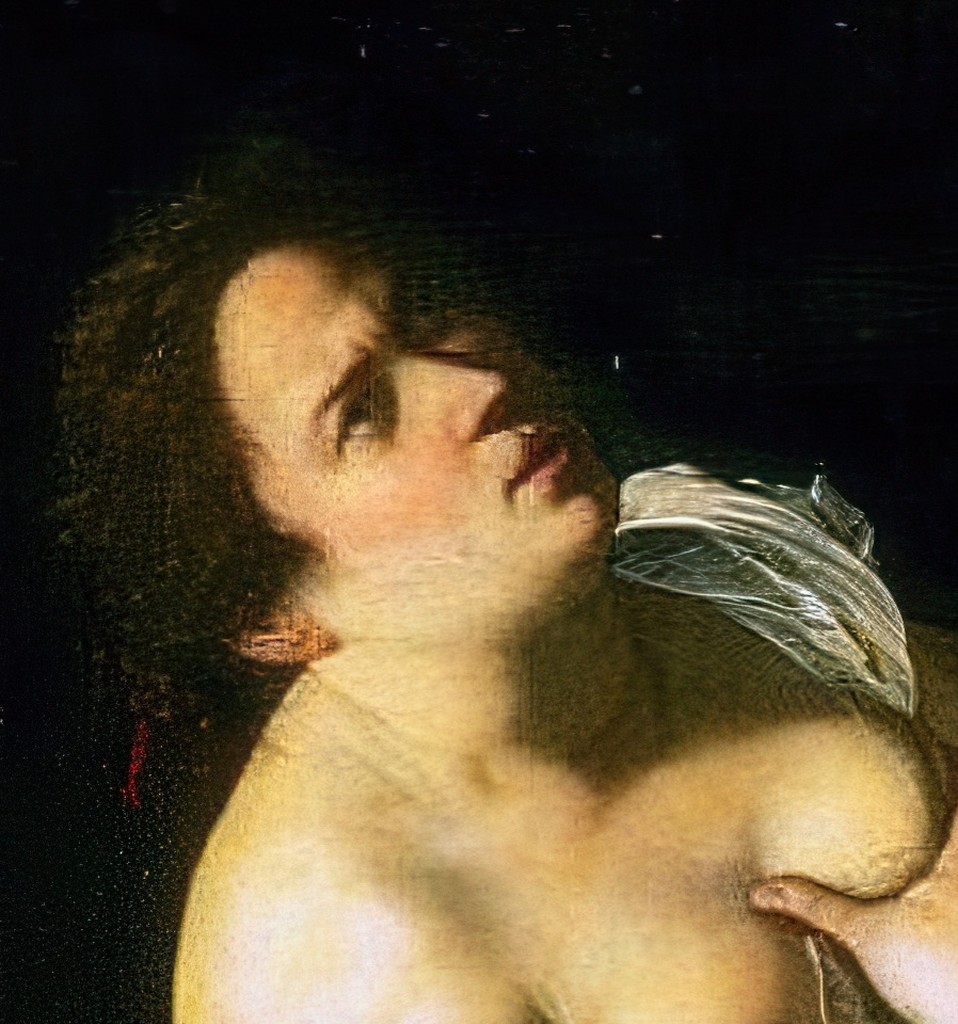
Upturned face
Lucretia's face turns upward rather than toward the viewer. The raised gaze makes the moment feel inward and searching, as if judgment or witness lies outside the picture's dark room.
Raised dagger
The dagger is held away from the body but close enough to define the scene. Artemisia keeps the action suspended, so the blade signals the irreversible decision without turning the painting into gore.
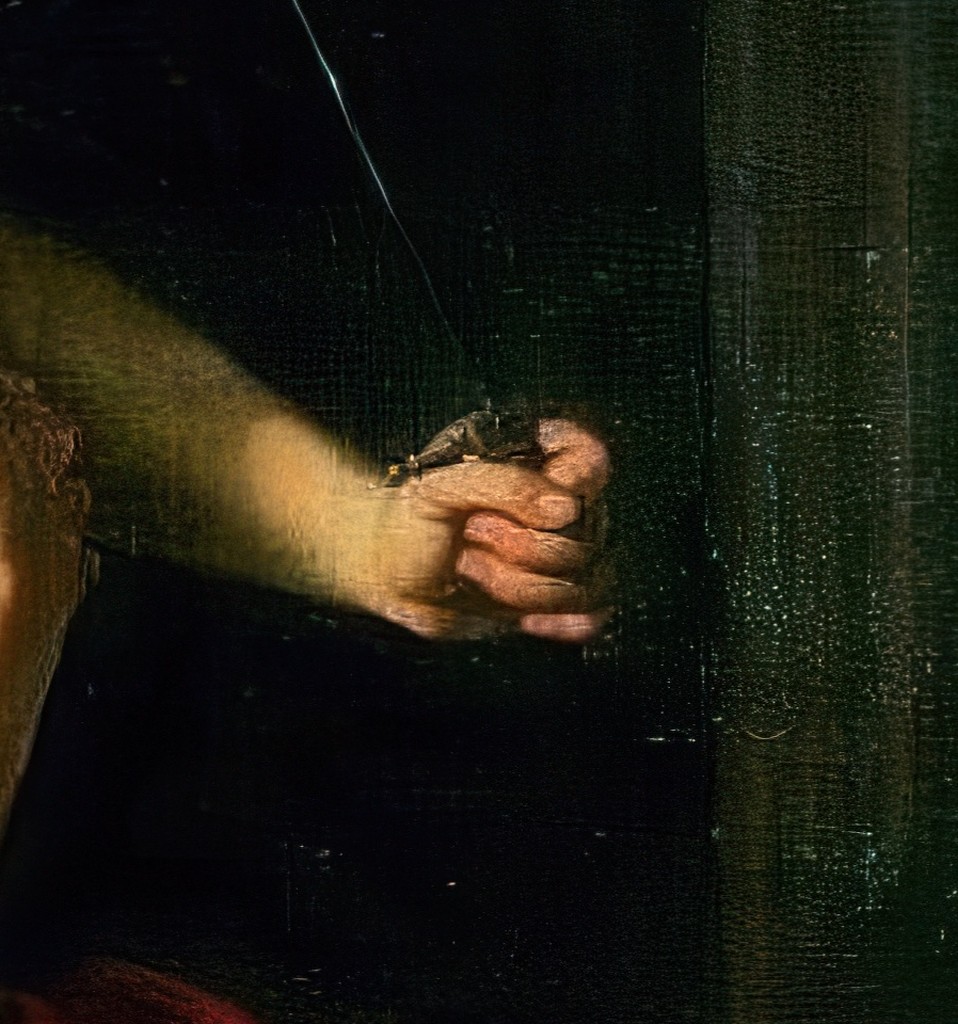
Hand at the chest
The hand pressing near the chest gives the crisis a physical centre. Gesture, exposed skin and shadow make the ancient story feel bodily and immediate while still keeping the tone restrained.
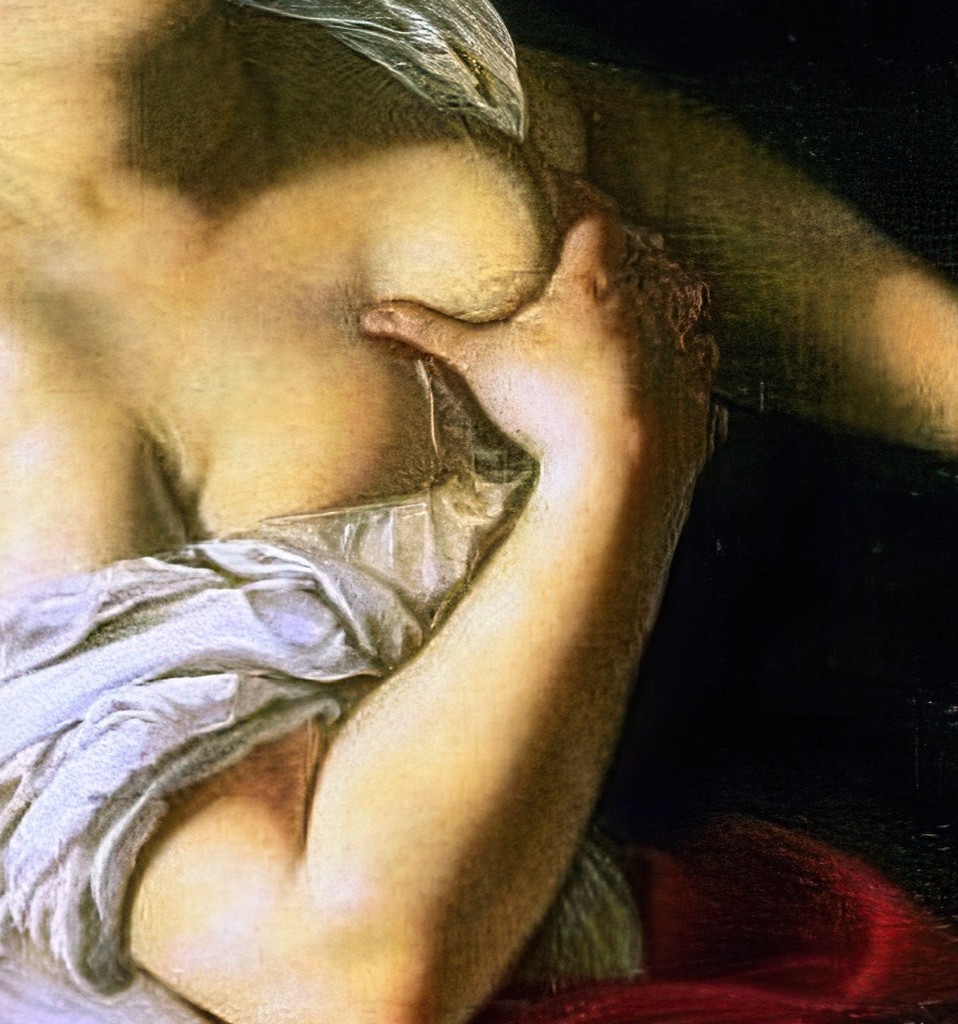
White drapery
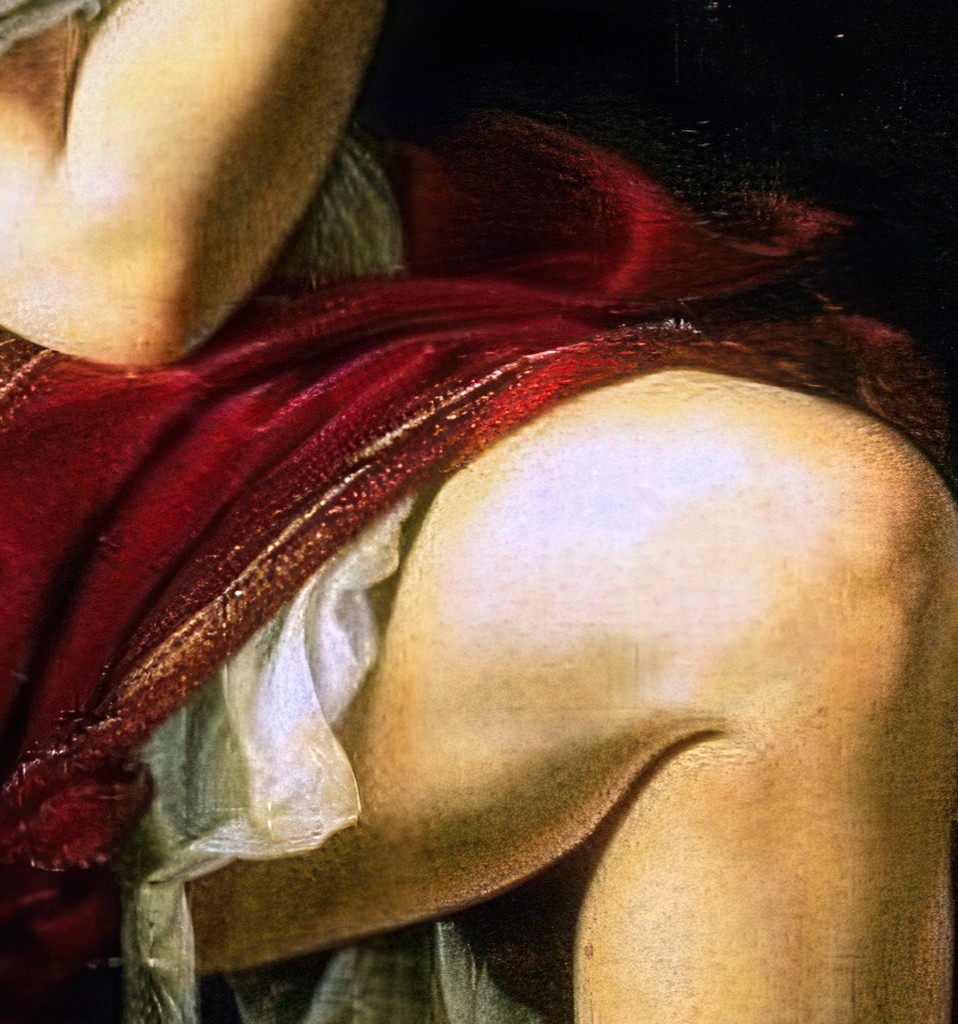
The white drapery twists across the figure in sharp folds. Its brightness catches the eye, but the fabric also heightens the sense of movement and pressure around the body.
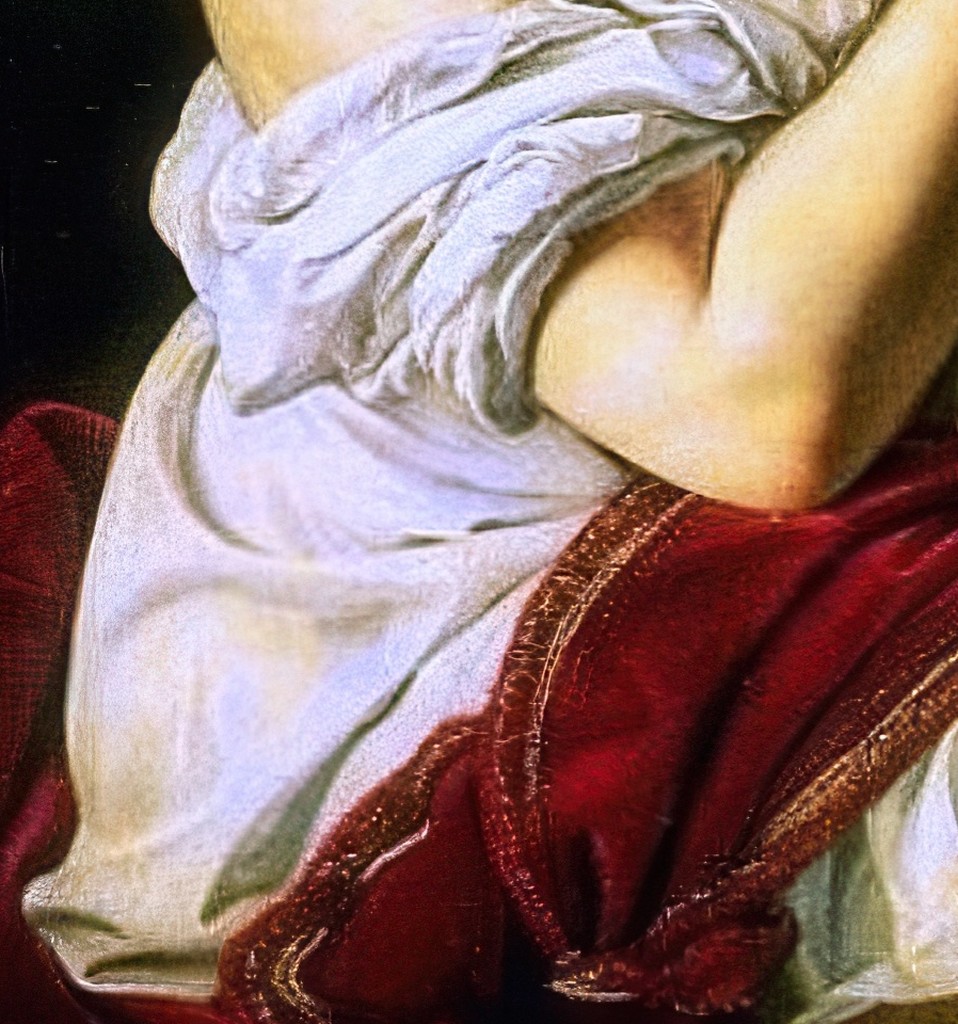
Deep red drapery
The deep red fabric at the lower edge gives the painting warmth and severity. It anchors the pale figure in a darker Venetian-inflected colour field rather than a neutral setting.
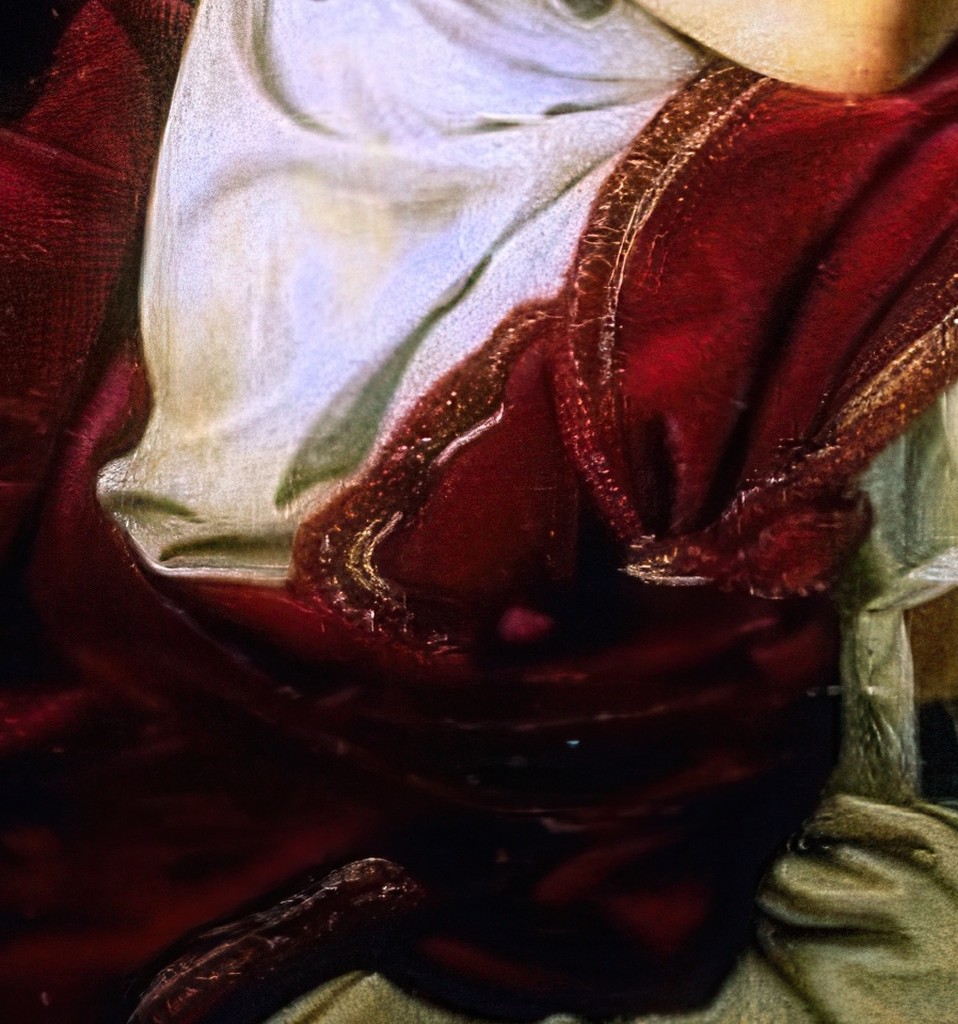
Tense diagonal pose
The body turns across the picture in a tense diagonal. That pose keeps Lucretia between inward collapse and outward action, which is why the image feels held at the threshold.
Body, Gesture and Decision
Getty describes Lucretia emerging from shadow, looking upward, tilting her head back and holding a dagger near her exposed chest. [1] Those features shape the whole emotional structure of the painting.
The figure is isolated. There is no crowd, no courtroom, no husband, no father, no attacker and no public assembly. Artemisia removes the surrounding narrative so that the crisis concentrates in one body. The painting becomes a study of suspended action.
The upward gaze matters. Lucretia does not look at the viewer as Judith often does, nor does she recoil outward like Susanna. Her eyes and head turn beyond the immediate space of the painting. That gesture gives the scene a tragic vertical movement: the body is caught in shadow and fabric, while the face turns toward judgment, witness or release.
The blade matters too, but it should not dominate the description. Artemisia does not need gore to make the subject intense. The dagger's force lies in its nearness to the body and in the moment before it is used. The viewer understands what will happen, but the painting holds the instant just before the irreversible act.
The fabric is just as important as the dagger. Getty connects the painting with Venetian art and points to the swirling drapery, free brushwork and more lyrical handling of the figure. [1][3] The cloth does not soften the subject into decoration. It intensifies the image by making the body seem caught in movement, colour and pressure.
Venice and a Changing Style
Getty's sources place the painting close to Artemisia's time in Venice around 1627. That moment is important because it is less familiar than her Rome, Florence and Naples periods. Getty's Artemisia essay describes Venice as a once-overlooked chapter that has become clearer through new documents and paintings. [3]
In 1627, a printed pamphlet included poems dedicated to several paintings Artemisia made in Venice, including a Lucretia. Getty notes that the author was probably Giovanni Francesco Loredan, part of a circle of writers, artists, musicians, librettists and patrons around Artemisia. The poems do not describe the painting in enough detail to prove the identification absolutely, but Getty considers it highly probable that the Getty Lucretia is the painting praised in that Venetian context. [1][3]
That evidence should be handled without overstatement. Getty presents strong support connecting the painting to Artemisia's Venetian period and to the 1627 poetic references. This makes the work valuable not only as an image of Lucretia, but also as a key object for understanding Artemisia's movement from Roman Caravaggism toward a more graceful, Venetian-inflected maturity.
The change can be seen in the handling. Earlier Artemisia paintings often feel stark, compressed and Caravaggesque. The Getty Lucretia remains dramatic, but its fabric, paint surface and figure type speak to Titian, Veronese and the Venetian tradition of richly staged female protagonists. [1][3]
Rediscovery and Acquisition
Getty described the painting as recently rediscovered after being held in private collections for centuries. [1] That modern history is part of the work's present importance. It did not enter Getty as a long-familiar museum icon. It reappeared into scholarship, the market and public attention, then became part of a major museum collection.
The acquisition was announced in 2021, at a moment when Artemisia's reputation was already undergoing intense public reassessment. Getty's broader Artemisia essay describes how new works, newly discovered documents and recent exhibitions have changed the understanding of her career. [3] Lucretia fits that pattern closely. It gives museums and readers another major work from a period that had been less visible.
For Getty, the acquisition also strengthened a collection context already connected to the Gentileschi family. Getty's acquisition article frames Lucretia as part of a larger reassessment of Artemisia's independent achievement. [1]
The rediscovery story should not overwhelm the painting itself. The object matters because of what Artemisia did with the subject. But the modern history explains why current Getty evidence should control the basic facts: object number, size, acquisition, dating and Venetian context all need to stay attached to the museum record and acquisition history.
A Strong-Women Display Context
Getty's 2025 exhibition Artemisia's Strong Women: Rescuing a Masterpiece placed Lucretia in a broader display about Artemisia's portrayals of powerful women. The exhibition centred on the conservation of Hercules and Omphale, but Getty listed Lucretia among the selected works shown in that context. [4]
That setting is useful because it shows how Getty has framed the painting after acquisition. Lucretia is not only a rediscovered object. It is part of a museum argument about Artemisia's repeated interest in women at points of moral pressure, reversal, danger or self-command.
The strong-women label can be helpful, but it also needs care. Lucretia's strength is not simple triumph. She is not victorious in the way Judith appears victorious, and she is not protected by divine rescue. Her story is tragic and bound to ancient ideas of honour that modern readers may find troubling. The painting's power comes from Artemisia's ability to hold those tensions without simplifying them.
Placed near other Artemisia subjects, Lucretia helps expand the meaning of strength. Strength can appear as action, resistance, endurance, speech, grief or inward resolve. In this work, strength is shown at an extremity, where a violent story has narrowed Lucretia's choices almost beyond recognition. Artemisia makes that extremity visible without needing narrative clutter.
Artemisia and Heroic Women
Lucretia belongs to the broad group of female figures that made Artemisia's art so distinctive: Susanna, Judith, Esther, Mary Magdalene, Saint Catherine and others. But those figures should not be flattened into one meaning.
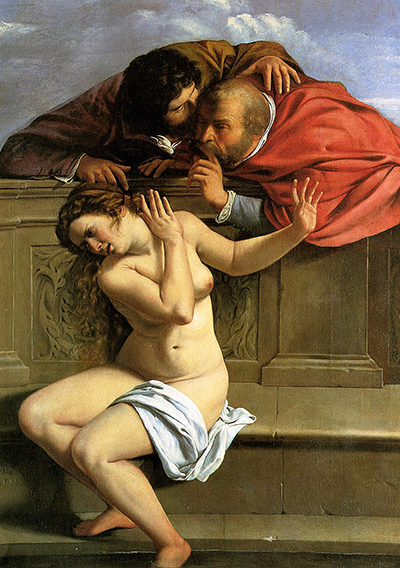
Susanna is a young woman resisting coercive looking and false accusation. Judith is a widow who kills an enemy general to save her people. Esther risks approaching a king whose anger could destroy her. Mary Magdalene turns inward toward devotion and spiritual transformation. Saint Catherine joins learned self-command with martyrdom. Lucretia is different again: a classical heroine whose story links sexual violence, honour, self-inflicted death and political revolt.
The shared thread is not simply female suffering. Artemisia's women are often shown at moments when inward pressure becomes visible in the body. Lucretia's raised face, exposed body, twisting fabric and poised dagger make decision feel physical. The painting's power lies in that bodily seriousness.
It is tempting to read Lucretia only through Artemisia's biography, because both Lucretia and Artemisia were victims of sexual violence. Getty acknowledges that the subject may have carried personal significance for Artemisia. [1] A careful reading can include that context without making it the only explanation. Artemisia was not simply illustrating her own life. She was entering a classical subject with a long artistic and political history and making it newly forceful through her own pictorial intelligence.
Private Crisis and Public History
One reason Lucretia became such an important subject is that her private suffering was understood to have public consequences. In Livy's account, as summarized by Getty, her death helped ignite political revolt against the Tarquin monarchy. Early modern viewers therefore saw the subject through several frames at once: chastity, family honour, tyranny, courage and the birth of republican liberty. [1]
Artemisia's painting keeps the political outcome offstage. There are no men swearing revenge, no citizens gathering, no city in upheaval. The viewer receives the moment before history turns outward. That choice matters. It makes the painting less about Roman spectacle and more about the intolerable pressure placed on one person.
The absence of other figures also changes how responsibility feels in the image. Lucretia stands alone, but the story around her is full of others: the man who assaulted her, the family she calls to witness her innocence, the political order that will be overturned in her name. Artemisia's isolation of the figure does not erase that world. It makes its pressure more concentrated.
This is where the painting's beauty becomes ethically complicated. The drapery, flesh tones and upward face are visually compelling, but the subject is severe. A responsible reading should let the beauty and the severity remain in tension. Artemisia's skill does not make the story easy. It makes the viewer stay with a moment that would otherwise be turned into a moral slogan.
Sensitive Subject Framing
Because Lucretia depicts the moment before self-inflicted death after rape, the public language around the painting should stay measured. The subject should be named clearly, but the violence should not be lingered over for shock value.
A humane reading can do three things at once. It can recognise the ancient story's sexual violence and self-harm. It can explain why early modern viewers treated Lucretia as an example of courage, chastity and political consequence. It can also acknowledge that modern readers may find the tradition painful, because it binds a woman's honour to the aftermath of violence done to her.
Artemisia's painting does not solve that tension. It intensifies it. The beauty of the brushwork and fabric does not cancel the subject's severity. The upward face does not make the moment easy. The painting's achievement is that it refuses to let Lucretia become merely a symbol. She remains a person at the threshold of an irreversible act.
That is why restraint is the right tone. The painting deserves close visual attention, but not melodrama. Its tragedy is already there.
How to Read the Painting Today
Begin with the isolation. Artemisia has removed almost everything except Lucretia herself. The story's political consequences are huge, but the painting gives the viewer the private moment before public history begins.
Then look at the direction of the body. The exposed chest and dagger create one axis; the lifted head and eyes create another. The painting holds Lucretia between the physical immediacy of the act and a search for witness beyond the room.
Look at the fabric and paint. The swirling drapery and freer brushwork connect the work to Artemisia's Venetian moment. They also make the figure feel alive, unstable and in motion, rather than fixed as a cold emblem.
Finally, compare Lucretia with Artemisia's other women carefully. Judith acts outwardly. Susanna resists violation. Esther risks speech before power. Magdalene turns suffering into devotional intensity. Lucretia inhabits a tragic classical story in which bodily harm, honour and politics meet. Artemisia gives that story a form that is both beautiful and almost unbearable.
That is the painting's lasting force. It asks viewers to see Lucretia not as a decorative heroine, but as a woman held in a moment of extreme moral and emotional pressure.
Related Pages
- Artemisia Gentileschi
- Artemisia Gentileschi Biography
- Artemisia Gentileschi Paintings
- Susanna and the Elders
- Judith Slaying Holofernes, Florence
- Judith Slaying Holofernes, Naples
- Esther before Ahasuerus
- Mary Magdalene in Ecstasy
- Baroque Artists
Frequently Asked Questions
Discussion
What should readers notice when looking closely at Artemisia Gentileschi's Lucretia?
Reader Insights
How does Artemisia make the moment feel suspended rather than merely narrative?
How can a viewer discuss the subject clearly without turning the violence into spectacle?
Where do the fabric, colour and freer brushwork suggest Artemisia's Venetian turn?
Join the Conversation
Share your reading of this painting below.
References
- Getty Museum, Getty Museum Acquires Recently Rediscovered Painting by Artemisia Gentileschi.
- J. Paul Getty Museum Collection, Lucretia. Image source checked from Getty media route: Getty IIIF image. Credit line for reproduction: Artemisia Gentileschi, Lucretia, about 1627, oil on canvas, J. Paul Getty Museum, 2021.14. Digital image courtesy of Getty's Open Content Program.
- Getty, Davide Gasparotto, Artemisia Gentileschi: the Woman, the Artist.
- Getty Exhibitions, Artemisia's Strong Women: Rescuing a Masterpiece.
- Getty, Terms of Use, including Open Content Program and Museum Collection Online copyright terms.
 Artemisia Gentileschi.jpg)
 Artemisia Gentileschi.jpg)