

 by Tom Gurney
Tom Gurney BSc (Hons) is an art history expert with over 20 years experience
Published on June 19, 2020 / Updated on September 6, 2026
Email: tomgurney1@gmail.com / Phone: +44 7429 011000
Self-Portrait as the Allegory of Painting by Artemisia Gentileschi
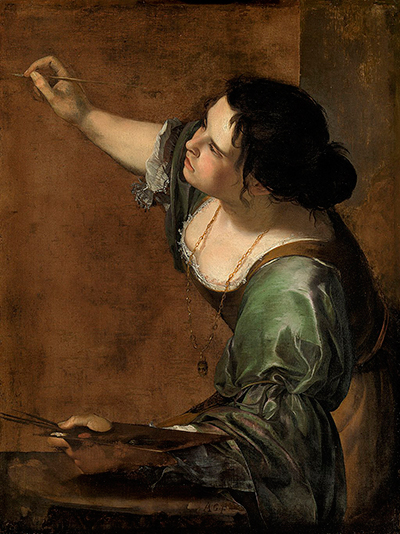
Artemisia Gentileschi's Self-Portrait as the Allegory of Painting, also known as La Pittura, is one of the most brilliant acts of self-definition in Baroque art. The painting shows Artemisia in the act of making a picture, but it is not simply a portrait of an artist at work. It also presents her as Painting itself, the female personification of the art according to early modern allegorical tradition. [1][3]
That double identity gives the picture its force. Artemisia appears as a real painter, with brush, palette, working body and absorbed concentration. At the same time, she takes on the signs of La Pittura, the allegorical figure of Painting described in emblematic and iconographic traditions. The result is a self-portrait, a professional statement and an allegory folded into one image.
The painting belongs to the Royal Collection and is connected with Artemisia's brief stay in London in the late 1630s, when she entered the world of Charles I and Henrietta Maria. Royal Collection Trust describes it as the only known firmly attributed work by Artemisia that survives from her London period. [1] That makes it a crucial object not only for understanding her self-portraiture, but also for understanding the international reach of her career.
Image reference: Royal Collection Trust.
At a Glance
- ArtistArtemisia Gentileschi
- TitleSelf-Portrait as the Allegory of Painting
- Alternate titleLa Pittura
- DateAbout 1638-9 [6]
- MediumOil on canvas [6]
- Dimensions98.6 x 75.2 cm [6]
- CollectionRoyal Collection [1]
- InventoryRCIN 405551 [1]
- Likely contextArtemisia's London period at the court of Charles I and Henrietta Maria [1]
- SubjectArtemisia as both painter and the allegory of Painting
- Main themesSelf-portraiture, allegory, professional identity and gender
Contents
- What La Pittura Means
- Self-Portrait and Allegory
- The Royal Collection Object
- Artemisia in London
- Painting as Work
- Annotated Details
- Hair, Chain, Mask and Colour
- Gender and Professional Authority
- Compared with Other Self-Images
- The Painter and the Viewer
What La Pittura Means
La Pittura means Painting. In early modern Europe, abstract ideas were often represented as human figures with recognisable attributes. Justice might hold scales. Fortune might stand near a wheel. Painting could be imagined as a woman with particular signs: dishevelled hair, a gold chain, a mask, coloured fabric, brush and palette. These signs helped learned viewers identify the figure as the personification of the art. [2][3]
Royal Collection Trust connects the figure to Cesare Ripa's Iconologia, an influential iconographic handbook first published in 1593 and widely used in Baroque culture. Ripa's description of Painting includes dark, dishevelled hair, a gold chain, a mask and shot silk, among other attributes. [2] Artemisia does not copy the formula mechanically. She adapts it into a working self-image.
This is why the painting remains readable even when its allegorical code is unfamiliar. The viewer can first see a woman painting: body turned, arm raised, hair loose, clothes rumpled by work, face absorbed. Then the symbols sharpen the meaning. The brush and palette identify the craft. The chain and mask point toward imitation and artifice. The shimmering fabric shows colour and painterly skill. The loosened hair suggests imaginative heat rather than social neatness.
A Self-Portrait and an Allegory at Once
The central question is not whether the painting is a self-portrait or an allegory. It is both. If the work were only a self-portrait, it would show Artemisia representing herself as a professional painter. If the work were only an allegory, it would show the personification of Painting according to learned tradition. Artemisia joins the two.
She makes the allegorical body and the artist's body the same. She does not stand beside Painting. She becomes Painting. This creates the conceptual leap that gives the work its modern fame and its historical sharpness.
Smarthistory describes this as a sophisticated use of early modern gender assumptions: because Painting was imagined as female, Artemisia could inhabit the allegory through self-portraiture in a way structurally unavailable to male artists without representing themselves across gender. [3] The point is not a simple slogan about who could paint the subject. The point is that Artemisia turned a cultural limitation into a pictorial advantage.
The Royal Collection Object
The Royal Collection object is dated about 1638-9 and identified as RCIN 405551. Royal Collection exhibition material gives the medium as oil on canvas and the dimensions as 98.6 x 75.2 cm. [6] The painting is associated with Artemisia's London period, a short but important chapter near the end of a career that had already taken her through Rome, Florence, Venice and Naples. [4]
Royal Collection Trust presents the painting as the only known firmly attributed work by Artemisia that survives from her stay in London. [1] That phrasing is important. It does not mean Artemisia made only this work in connection with London. Royal Collection Trust's broader Artemisia story notes that inventories of Charles I's collection listed several paintings by her, though for many years only La Pittura was thought still to survive in the collection. [2]
The painting's survival gives it unusual weight. Charles I was one of the great collectors of seventeenth-century Europe, and his collection included major Italian, Netherlandish and courtly works. The presence of Artemisia's self-portrait in this world places her within high-level European collecting rather than at the margins of Baroque art.
Artemisia in London
Artemisia's London visit was brief. The National Gallery states that she visited London in 1639, perhaps to assist her ailing father Orazio with ceiling paintings for the Queen's House at Greenwich, and that she was back in Naples the following year. [4] Royal Collection Trust places her in the late 1630s at the court of Charles I and Henrietta Maria. [1]
Orazio matters here, but the painting must not be reduced to him. He was an important artist, a court painter in England and Artemisia's first teacher. His presence helped connect her to London. Yet La Pittura is not Orazio's statement. It is Artemisia's.
The London context is striking because Artemisia had already established herself elsewhere. She was not arriving as a novice or as a dependent daughter. By this point she had worked in Florence, joined elite artistic circles, returned to Rome, travelled, and settled in Naples, where she ran a successful studio. [4] La Pittura belongs to a mature artist who understood both the labour of painting and the value of reputation.
Painting as Work
One of the most powerful things about La Pittura is that Artemisia does not show Painting as a still emblem. She shows Painting as work.
The figure twists across the canvas, leaning into an action that continues beyond the visible frame. Her right arm lifts the brush toward a surface we cannot see. Her other hand holds the palette. The body is not frontally arranged for calm display; it is caught in movement. The viewer sees a person occupied by the demands of making.
Smarthistory's analysis emphasises this bodily labour: the figure carries palette and brush, works toward a canvas outside the image, and appears with the practical pressure of someone physically engaged in painting. [3] Artemisia is not presenting herself as a distant courtly presence. She is presenting herself as an artist in action.
The unseen canvas is a brilliant device. Because the surface she paints is outside the picture, the viewer is made aware of an implied world beyond the frame. We are watching Artemisia make a painting, but we cannot see what she makes. The subject of the visible picture becomes the act of painting itself.
Annotated Details from Self-Portrait as the Allegory of Painting
This annotated close reading follows the Royal Collection painting as a working self-image: the turned head, raised brush, palette, gold chain, rich sleeve and painted ground all help Artemisia join the real labour of painting to the allegorical figure of La Pittura. The module belongs to the canonical Royal Collection / RCIN 405551 page, not the separate held Allegory of Painting route.
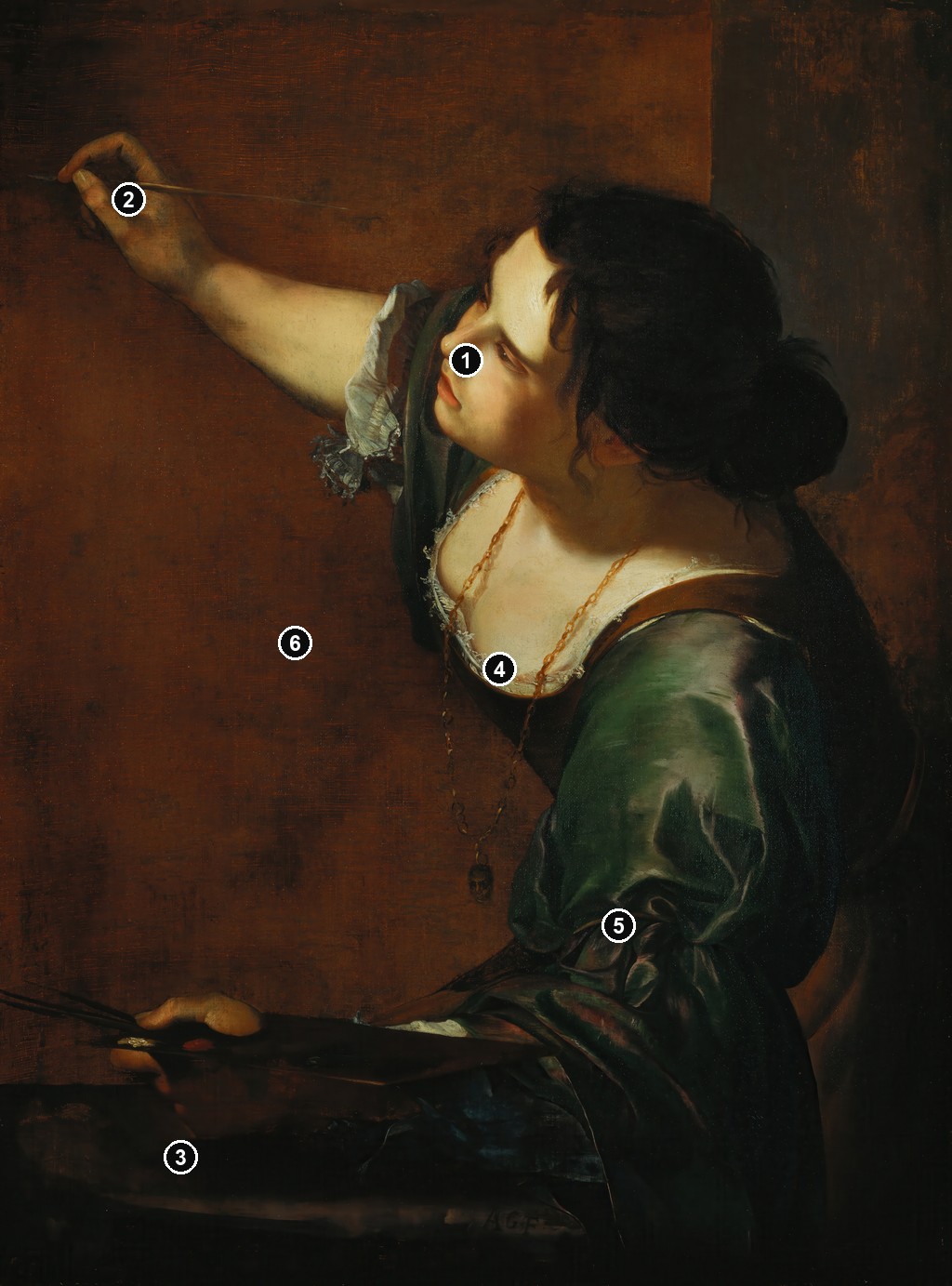
Details from SELF-PORTRAIT AS THE ALLEGORY OF PAINTING
The details show how Artemisia makes professional labour, allegorical attributes and bodily movement work together. The painting's force comes from seeing the artist as both a maker and Painting personified.
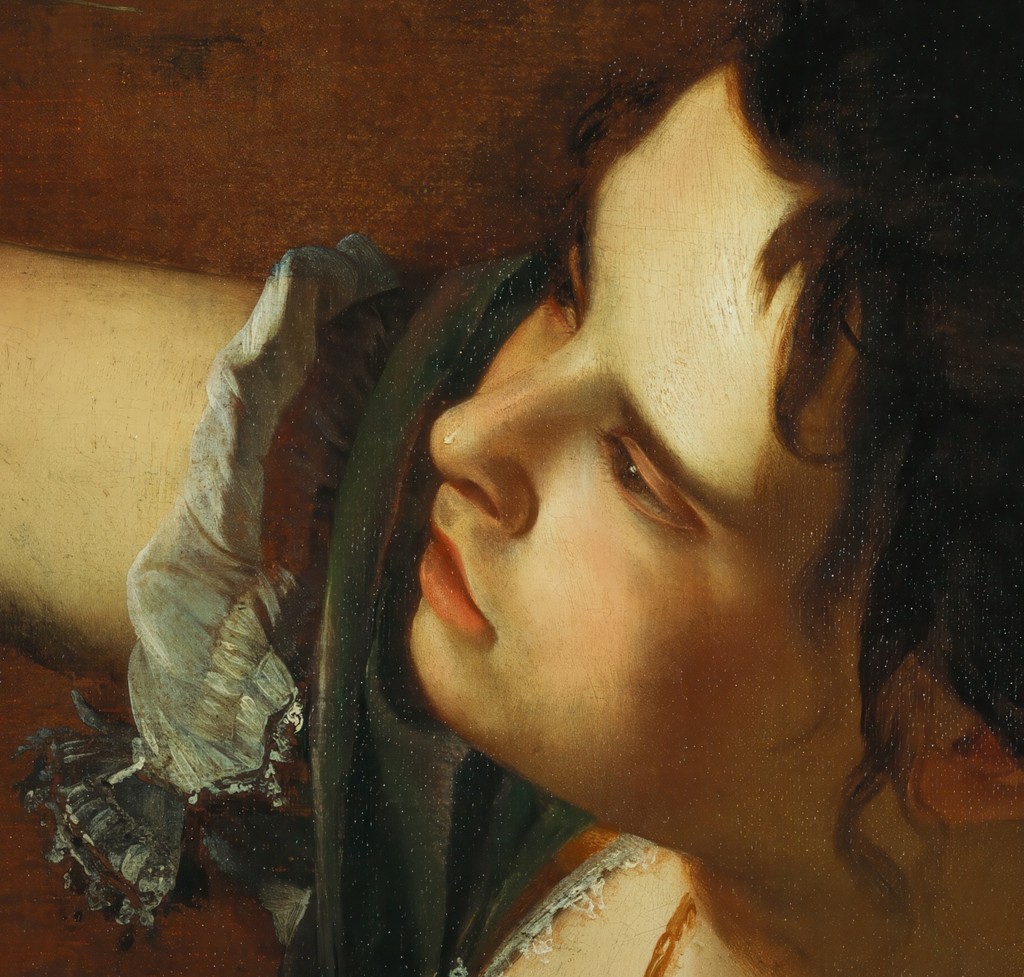
Turned head and open mouth
The head turns toward the unseen canvas rather than toward the viewer. The parted lips and absorbed gaze make Painting feel active, breathing and concentrated rather than silent decoration.
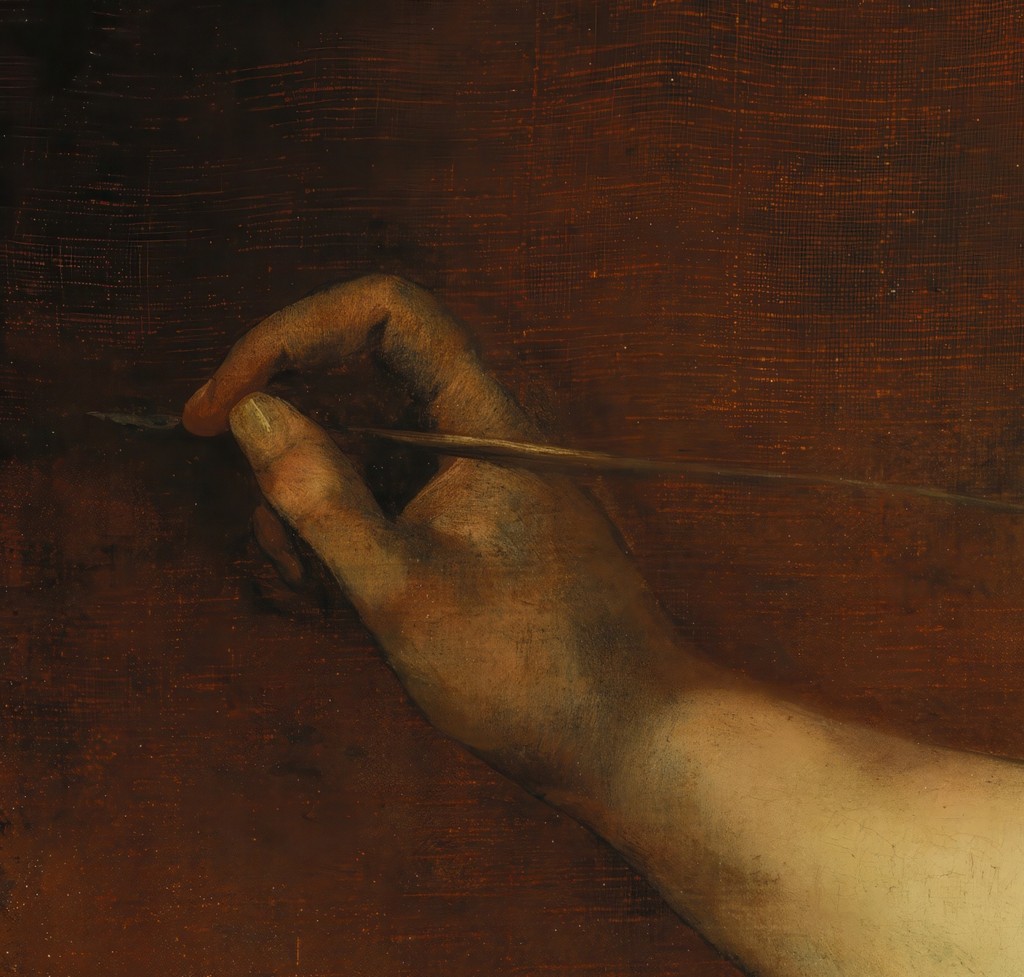
Brush hand reaching outward
The raised hand extends beyond the body toward the surface Artemisia is painting. The gesture keeps the viewer aware that the image is about making, not posing.
Palette and working hand
The lower hand and palette anchor the allegory in craft. Artemisia does not present Painting as an abstract idea alone; she ties it to tools, colour and manual control.
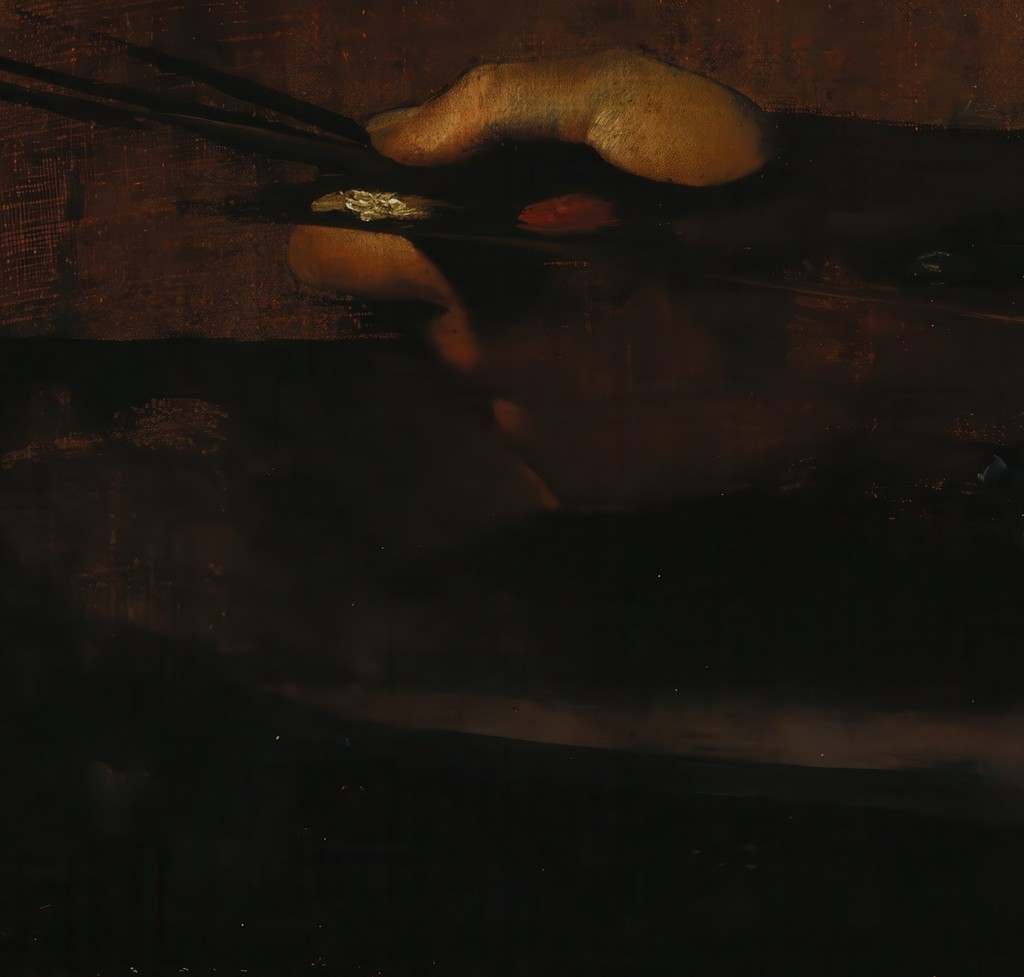
Gold chain and symbolic dress
The chain and dress connect the figure to the iconographic tradition of La Pittura. These attributes do not sit apart from the artist; they become part of her working body.
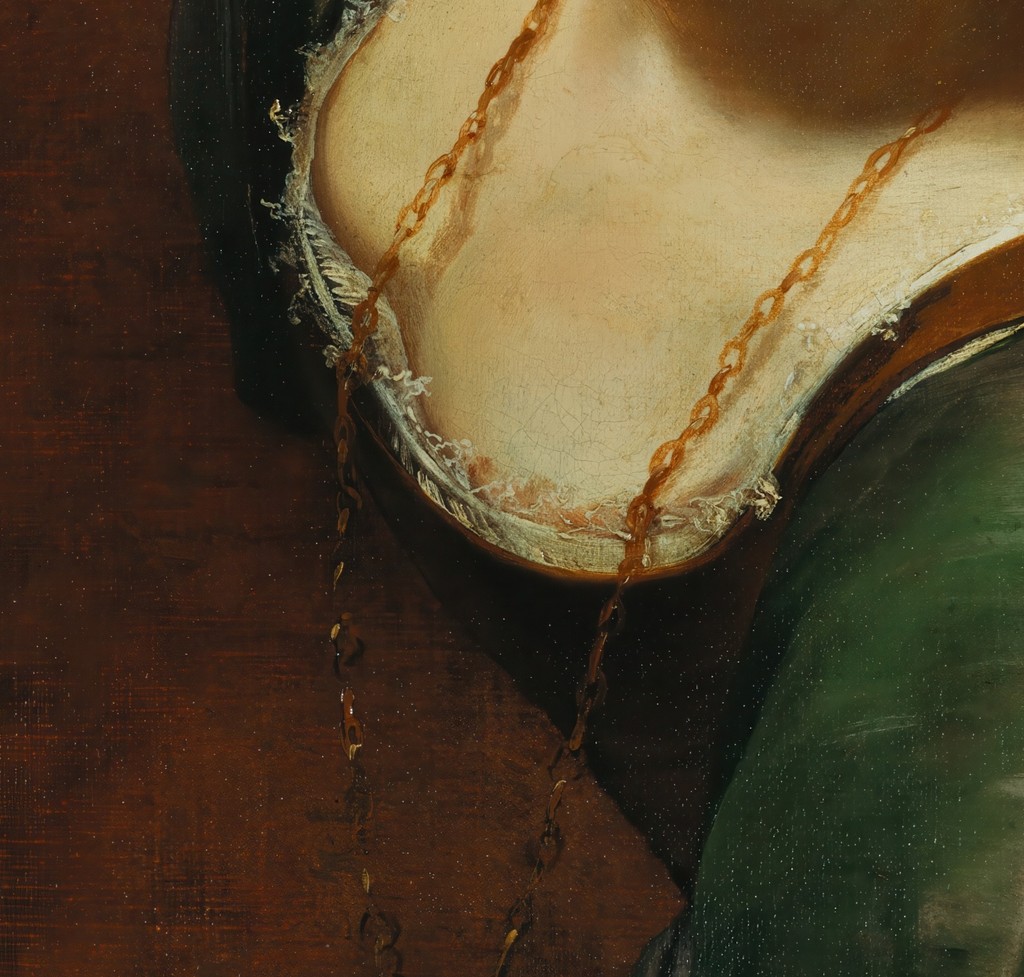
Diagonal working body
The green sleeve and twisting torso make the composition move diagonally through the canvas. Artemisia turns self-portraiture into a record of physical engagement.
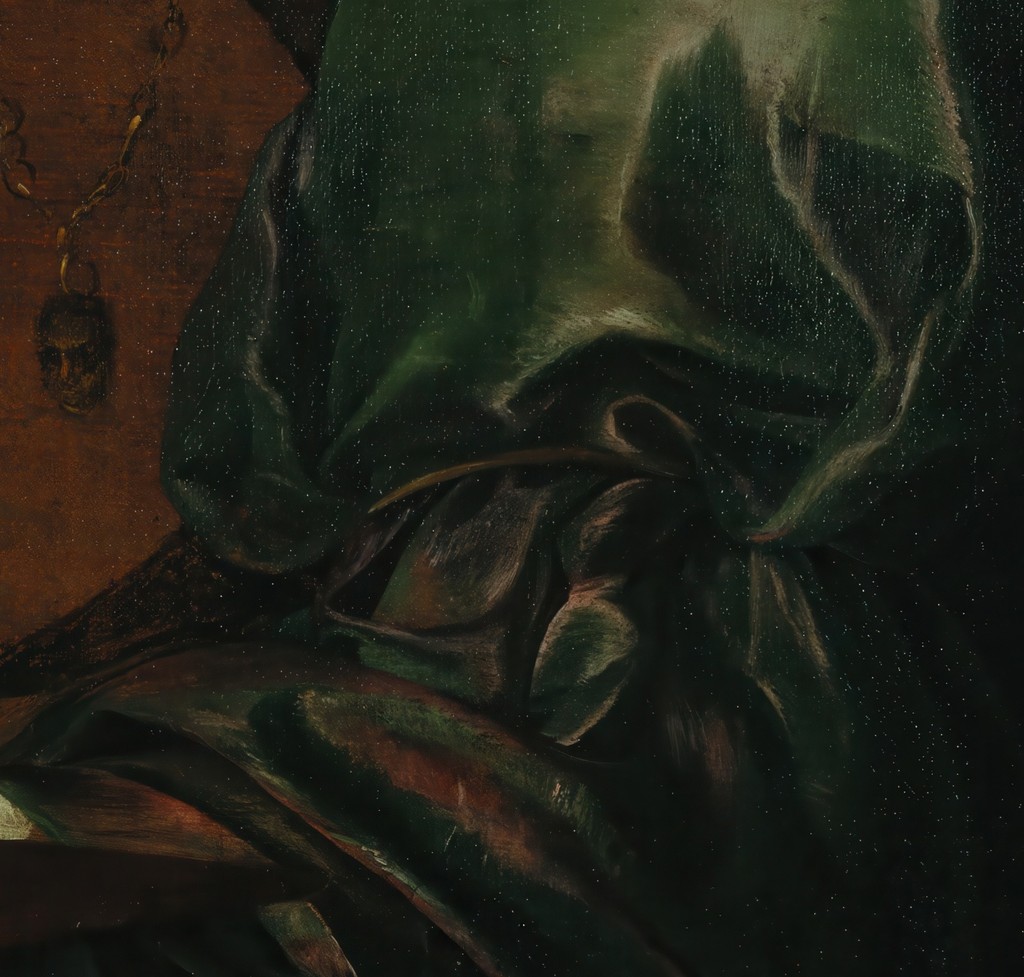
Painted ground and unseen canvas
The broad painted ground points toward the surface beyond the frame. We see the painter's action, but not the image she is making, so the act of painting becomes the subject.

Hair, Chain, Mask and Colour
The details of the painting turn work into allegory. The loose hair is not merely informal. In the allegorical tradition, dishevelled hair could suggest creative energy and imaginative force. Royal Collection Trust connects this attribute to Ripa's description of Painting. [2]
The gold chain and mask are equally important. The mask is associated with imitation, one of the central ideas attached to painting in early modern theory. Painting imitates the visible world, but it also transforms it. The mask hanging from the chain makes that idea visible without turning the painting into a textbook.
The dress matters too. Royal Collection Trust notes the role of iridescent or shot silk in demonstrating mastery of colour. [2] This is an elegant idea: the allegory of Painting wears colour as proof of what painting can do. Artemisia's fabric is not just costume. It is an argument about painterly skill.
The Missing Gag
One of the most interesting differences between Artemisia's painting and Ripa's description concerns speech. Smarthistory notes that Ripa's description of Painting included a mouth covered with a cloth, while Artemisia's figure has no such gag. [3] That difference has become a powerful point of interpretation.
It would be easy to overstate the matter, as if every departure from a handbook must be read as a manifesto. But in this case the difference matters because the painting is already about professional voice. Artemisia is using a recognised allegorical type, yet she alters it to fit a living, working painter.
The open mouth gives the figure a different presence. She is absorbed, not silenced. Her parted lips suggest breath, effort and concentration. Painting is not mute decoration. Painting has a body, an intelligence and a voice.
Gender and Professional Authority
La Pittura is often described as a painting only Artemisia could have made. That statement needs care. Male artists could and did paint allegories of Painting. They could paint women personifying the art. They could paint themselves as learned artists, gentlemen or courtly creators. What they could not do in the same direct way was combine their own likeness with the female personification of Painting.
Artemisia's gender therefore becomes more than a biographical fact. It becomes part of the painting's structure. The allegory of Painting was female. Artemisia was a woman painter. The two identities could meet without disguise.
That is why the painting is not simply about exceptional womanhood. It is about a specific pictorial opportunity. In a culture that limited women's training and public authority, Artemisia found a way to use the language of that culture to claim the highest possible identification with her art.
Compared with Saint Catherine and the Lute Player
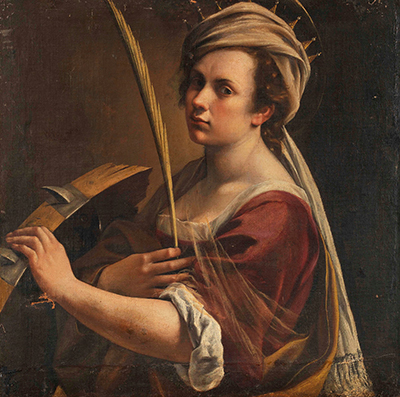
Artemisia's self-images form one of the richest threads in her work. Self-Portrait as Saint Catherine of Alexandria, now in the National Gallery, shows her in the guise of a learned martyr, with the broken wheel and palm that identify the saint. The National Gallery connects that painting with Artemisia's Florentine self-portrait practice and notes its relationship to Self-Portrait as a Lute Player at the Wadsworth Atheneum. [5]
Those earlier self-images matter because they show Artemisia testing different identities. As Saint Catherine, she takes on sanctity, learning, suffering and steadfastness. As a lute player, she enters a world of music, courtly accomplishment and cultivated performance. In La Pittura, she moves from role-playing within a subject to embodying the personification of her own art.
The National Gallery's Saint Catherine material also offers a useful caution. It notes that self-portraits and disguised self-images can be tied to self-promotion, patron demand, market conditions and artistic experiment, and that not every use of Artemisia's features should be reduced to autobiography. [5] That caution applies to La Pittura too. The painting is personal, but it is also professional, symbolic and courtly.
Courtly Viewers and Visual Play
The painting's first viewers were likely prepared for its sophistication. Seventeenth-century court culture valued wit, invention, allegory and the ability to recognise visual codes. A picture that asked viewers to see both Artemisia and Painting would have offered exactly the kind of layered pleasure such audiences enjoyed.
This matters because La Pittura is sometimes discussed as if its meaning belongs mainly to modern viewers. Modern audiences have certainly given the work new urgency, especially in histories of women artists. But its core intelligence is historical. Artemisia was working with a language her contemporaries could read.
Royal Collection Trust's account of Charles I's inventories makes this wider context visible: several paintings by Artemisia were listed in the king's collection, even if their later histories became complicated. [2] La Pittura therefore represents both an individual act of self-fashioning and a larger record of how Artemisia's work entered elite European collections.
The Painter and the Viewer
Because La Pittura shows Artemisia with palette and brush, it can be tempting to treat the painting as a direct glimpse into her studio. It is better understood as something more constructed. The work uses the appearance of immediate labour to make a larger claim about art, identity and status.
The painting also reverses the usual relationship between artist and viewer. In many portraits, the sitter meets the viewer, establishing presence through eye contact. In La Pittura, Artemisia does not look out. Her attention is directed elsewhere, toward the surface she is painting.
This lack of direct address gives the image a particular authority. Artemisia is not performing availability. She is absorbed in making. The viewer is allowed to witness, but not to interrupt. That is a subtle but powerful change in the politics of looking.
Why the Painting Still Feels Radical
La Pittura still feels radical because it refuses several expectations at once. It refuses the idea that a woman painter should hide behind modesty. It refuses the separation between manual work and artistic intellect. It refuses a passive allegorical figure. It refuses a self-portrait that merely records likeness.
The figure is active, but not frantic. Learned, but not cold. Symbolic, but not lifeless. Physical, but not reduced to labour. Artemisia holds these tensions together with remarkable economy.
The painting also changes how the viewer understands self-portraiture. Many self-portraits say, "This is what I look like." Some say, "This is my status." La Pittura says something more difficult: this is what my art is, and I am its living form.
Reception and Rediscovery
Artemisia was admired in her lifetime, worked for important patrons and circulated through major European centres. Yet, like many women artists, her reputation later dimmed in the long narratives of art history. The National Gallery notes that her work has been substantially re-evaluated over the last half-century, and that many paintings remain unidentified. [5]
La Pittura has become central to that re-evaluation because it gives such a powerful answer to the question of artistic identity. It does not merely prove that Artemisia could paint. It shows that she could think through painting about what painting was.
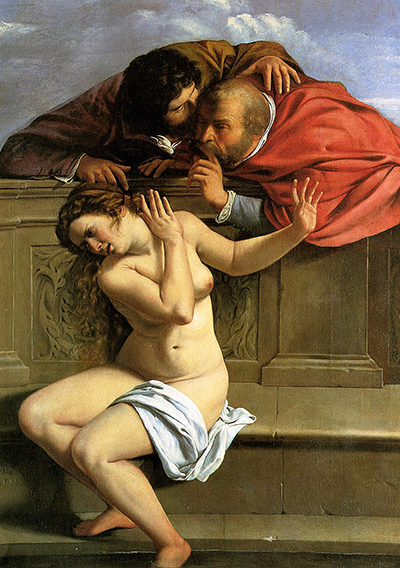
Royal Collection research has further strengthened Artemisia's London story through work on Charles I's collection and the rediscovery of another Artemisia painting, Susanna and the Elders, in the Royal Collection. [2] That recent work helps place La Pittura in a richer Stuart context rather than leaving it as an isolated survivor.
How to Read La Pittura Today
Begin with the action. Artemisia is painting. Her arm is raised, her body turns, and her attention is directed toward a canvas beyond the frame. The work is not staged as a polite portrait. It is staged as concentration.
Then look for the allegory. The hair, chain, mask, brush, palette and rich fabric connect the figure to the personification of Painting. These attributes do not sit outside the image. They are woven into the working body.
Next, hold the self-portrait and allegory together. The painting is strongest when neither side is reduced. It is not merely Artemisia wearing a costume, and it is not merely a symbolic woman who happens to resemble the artist. It is a deliberate fusion.
Finally, place the work in Artemisia's career. La Pittura comes after the early Roman and Florentine breakthroughs, after the self-images associated with Florence, and in connection with the London courtly world. It shows a mature artist turning professional identity into one of her most inventive subjects.
Related Pages
- Artemisia Gentileschi
- Biography
- Paintings
- Self-Portrait as Saint Catherine of Alexandria
- Self-Portrait as a Lute Player
- Self-Portrait as the Allegory of Painting
- Allegory of Inclination
- Susanna and the Elders
- Judith Slaying Holofernes, Florence
- Judith Slaying Holofernes, Naples
- Drawings
- Prints
- Baroque Artists
Frequently Asked Questions
Discussion
What should readers notice when looking closely at Artemisia Gentileschi's Self-Portrait as the Allegory of Painting?
Reader Insights
Where do you see Artemisia as a real painter, and where do you see Painting as an allegory?
How does the raised arm and unseen canvas change the way you read the self-portrait?
Which attribute, such as the mask, chain, hair or fabric, feels most important to the painting's meaning?
Join the Conversation
Share your reading of this painting below.
References
- Royal Collection Trust, Self-Portrait as the Allegory of Painting (La Pittura).
- Royal Collection Trust, Artemisia Gentileschi.
- Smarthistory, Dr. Letha Ch'ien, Artemisia Gentileschi, Self-Portrait as the Allegory of Painting or La Pittura.
- National Gallery, London, Artemisia Gentileschi (1593-1654 or later).
- National Gallery, London, Artemisia Gentileschi, Self-Portrait as Saint Catherine of Alexandria.
- Royal Collection Trust, Self-Portrait as the Allegory of Painting (La Pittura), Masterpieces from Buckingham Palace exhibition record.
 Artemisia Gentileschi.jpg)
 Artemisia Gentileschi.jpg)