

 by Tom Gurney
Tom Gurney BSc (Hons) is an art history expert with over 20 years experience
Published on June 19, 2020 / Updated on September 6, 2026
Email: tomgurney1@gmail.com / Phone: +44 7429 011000
Esther before Ahasuerus by Artemisia Gentileschi
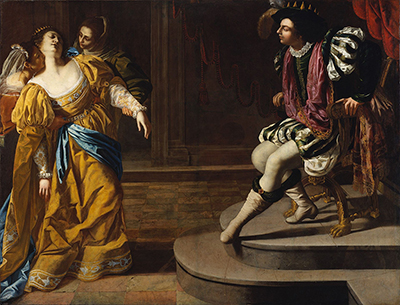
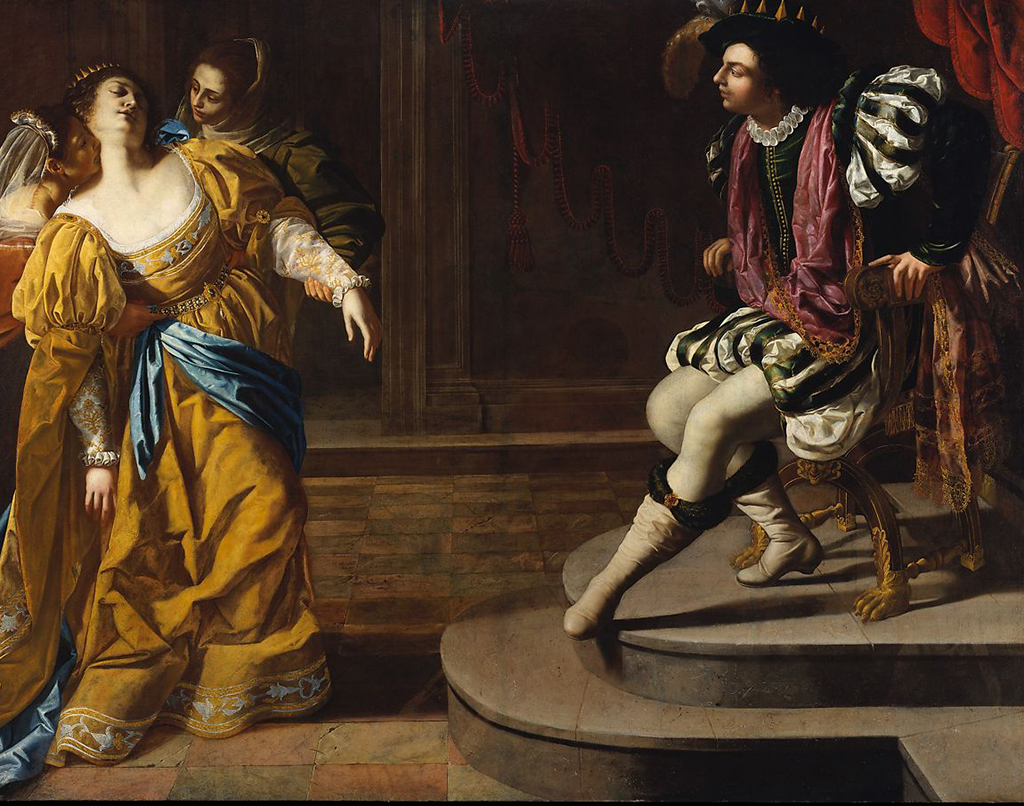
Artemisia Gentileschi's Esther before Ahasuerus is a painting about danger disguised as ceremony. The scene looks courtly: a king on his throne, rich costume, attendants, marble pavement and a wide stage-like space between the figures. But the story is a crisis. Esther has entered the king's presence without being summoned, risking death in order to plead for her people. Artemisia shows the moment when the risk becomes visible in the body: Esther faints before Ahasuerus just before he grants her request. [1]
The painting belongs to the Metropolitan Museum of Art, which describes it as one of Artemisia's most ambitious works. That ambition is not only a matter of scale, though the canvas is large. It lies in the way Artemisia turns a biblical subject into theatre. The figures wear contemporary-looking costume rather than archaeological dress; the king performs majesty with almost excessive display; Esther collapses with dignity rather than melodrama; and the empty space between them becomes the pause in which the story's outcome is still uncertain. [1][2]
This article focuses on the Met painting only. It should be read beside Artemisia's other heroines, including Susanna and Judith, but it is not a duplicate of those stories. Esther's courage is different. She does not resist an assault, kill an enemy or command a sword. She crosses a boundary, risks punishment and uses presence, timing and intelligence to change the fate of a people.
Image reference: Metropolitan Museum of Art.
At a Glance
- ArtistArtemisia Gentileschi
- TitleEsther before Ahasuerus [1]
- Date1620s [1]
- Mediumoil on canvas [1]
- Dimensions82 in. x 8 ft. 11 3/4 in. (208.3 x 273.7 cm) [1]
- CollectionMetropolitan Museum of Art, New York [1]
- DepartmentEuropean Paintings [1]
- ClassificationPaintings [1]
- Credit lineGift of Elinor Dorrance Ingersoll, 1969 [1]
- Object number69.281 [1]
- Display statusnot on view according to the current Met record [1]
- SubjectEsther appearing before King Ahasuerus to plead for her people
- Key technical detailArtemisia painted out a servant of African descent restraining a dog; traces remain partly visible beneath the marble pavement near the king. [1][2]
- Main themescourtly theatre, risk, female agency, costume, gesture, pentimento, biblical history painting
Contents
- The Story of Esther
- Object, Scale and the Met Painting
- A Court Scene Built Like Theatre
- Esther's Body and Public Risk
- Ahasuerus and the Performance of Power
- The Painted-Out Servant and Dog
- Costume, Splendour and Historical Distance
- Esther Among Artemisia's Heroines
- Biography Without Reducing the Painting
- Provenance, Display and Modern Reception
The Story of Esther
The Book of Esther tells the story of a Jewish queen in the Persian court. Ahasuerus, often identified with Xerxes, has taken Esther as his queen without knowing her Jewish identity. When Haman, the king's powerful minister, plans the destruction of the Jews, Esther faces a terrifying choice. If she remains silent, her people may die. If she approaches the king without being summoned, she may be put to death.
Her courage is therefore political and bodily at once. She must enter a public space where protocol is dangerous. The king's favour is uncertain. Her status as queen does not protect her from the law of the court. The drama begins before she says anything, because simply appearing before Ahasuerus is already an act of risk.
Artemisia chooses the moment of collapse. Esther has come before the king in splendour, accompanied by attendants, but the strain of the encounter overwhelms her. She faints as Ahasuerus rises from the throne. In narrative terms, the fainting is part of the turning point: the king moves from distant authority toward concern, and Esther's dangerous approach begins to succeed.
This makes the painting different from scenes of direct physical combat. Esther's action is not a blow, but it is still an intervention. She risks herself by crossing the boundary between obedience and appeal.
Object, Scale and the Met Painting
The Met identifies the painting as an oil on canvas from the 1620s. At more than eight feet wide, it has the scale of a public drama. Esther and her attendants occupy the left side, while Ahasuerus sits and rises on the right. Between them is a broad expanse of marble pavement, the visual pause that makes the encounter feel staged and unstable. [1]
The scale matters because Artemisia is not treating the subject as a small moral illustration. She builds a scene large enough for bodies, costume, architecture and silence to work together. The viewer does not simply identify Esther and Ahasuerus. The viewer stands before an event that feels like a court performance.
The painting entered the Met as the Gift of Elinor Dorrance Ingersoll in 1969 and carries the object number 69.281. [1] Those facts help anchor the discussion in a specific museum object. Artemisia's heroine subjects are often reproduced online and separated from their material histories, but this canvas has its own size, collection record, display status, provenance trail and conservation questions.
The Met marks the artwork image as Public Domain and part of its Open Access programme, while the object record remains the factual anchor for title, date, medium, scale, collection and credit. [1]
A Court Scene Built Like Theatre
The Met's account stresses that Artemisia did not aim for archaeological reconstruction. She conceived the scene through contemporary theatre. That explains much of the painting's strange power. The figures are placed like actors across a stage. Costume, gesture and distance carry the drama as much as facial expression. [1]
Esther appears at the left, richly dressed, supported by her attendants. Her body bends and sinks, but the collapse is not undignified. Artemisia lets vulnerability and grandeur occupy the same figure. Esther's risk is real precisely because she is not shown as helpless from the start. She has prepared, entered, appeared and only then fallen.
Ahasuerus occupies the right, elevated by throne, costume and gesture. He is king, husband and judge at once. His body turns toward Esther, and the theatricality of his dress makes him look both powerful and oddly performative. The painting shows authority as spectacle.
The space between them is crucial. It is not empty filler. It is the charged distance between request and response, law and mercy, death and pardon. Artemisia makes that gap the centre of the painting.
Esther's Body and Public Risk
Esther's fainting could have become sentimental, but Artemisia gives it structure. The queen's body tilts and slackens while her attendants support her. Her physical weakness is visible, yet it does not cancel her courage. In fact, the collapse makes the cost of her action visible.
This is important because Esther's heroism is easy to misunderstand. She does not look forceful in the way Judith looks forceful. She does not resist like Susanna or stand for artistic labour like La Pittura. Her heroism lies in entering the dangerous room and submitting herself to the consequences of that entry.
The faint is therefore not simply weakness. It is the body's response to political danger. Artemisia gives the viewer a heroine who acts before she can control how her body reacts. That makes the scene more human and more complicated than a simple image of triumph.
The attendants also matter. They keep Esther upright, visually and narratively. Their presence shows that this crisis is witnessed and supported. Like Judith's maidservant in the Detroit painting, they make female action feel social rather than solitary, though their roles are quieter here.
Ahasuerus and the Performance of Power
Ahasuerus is visually extravagant. His costume, posture and elevated position turn him into a figure of courtly display. Artemisia does not make him a simple villain. He is dangerous because he holds the power of response. He can punish, pardon or remain unmoved.
The king's extended body and rich dress also make the scene theatrical. He is not only a biblical monarch; he is a performer of kingship. His authority depends on being seen. The throne, plumes, fabrics and gesture create a spectacle of command.
That spectacle makes Esther's entrance more daring. She has interrupted the order of the court. She has forced the king's public role to bend toward a private plea and a public crisis. The painting's tension lies in whether royal display will become royal mercy.
Artemisia does not need to show Haman, Mordecai or the larger court plot. She concentrates the story into two poles: Esther's vulnerable courage and Ahasuerus's unsettled authority. The fate of many people is compressed into the space between them.
The Painted-Out Servant and Dog
One of the painting's most fascinating details is not fully visible. The Met notes that Artemisia originally included a servant of African descent restraining a dog, but painted the figure out. The traces are still partly visible beneath the marble pavement to the left of the king's knee. [1]
Keith Christiansen's Met essay treats this change as central to the painting's design. The removed figure and dog would have made the centre of the composition busier and more incident-filled. By suppressing them, Artemisia strengthened the empty space between Esther and Ahasuerus. [2]
That revision tells us something about Artemisia's intelligence as a composer. She was not merely filling a biblical scene with attractive details. She was controlling the emotional rhythm of the picture. Removing a vivid detail could make the painting stronger because the drama needed breath, silence and distance.
The painted-out servant also gives readers a way to think about pentimento without turning the page into technical jargon. A pentimento is not just a curiosity under the surface. Here, it shows an artist making a decision about focus. Artemisia chose the tension of the gap over the distraction of an additional narrative figure.
Costume, Splendour and Historical Distance
The painting does not dress its figures as archaeological Persians. Artemisia uses the language of her own visual world: rich fabrics, elaborate courtly costume, theatrical display and bodies arranged for dramatic effect. This makes the biblical story feel near rather than remote. [1][2]
That choice changes the viewer's relationship to Esther. She is not a distant ancient type. She becomes a woman moving through a recognisable culture of display, rank and performance. Her clothing is splendid, but splendour does not make her safe. It makes her visible.
Visibility is one of the painting's central risks. Esther must appear before the king to save her people. She must be seen. Yet being seen is exactly what exposes her to punishment. Artemisia understands that paradox and gives it visual form through costume and staging.
Ahasuerus's splendour works differently. His clothing confirms his authority, but it also makes him slightly theatrical. He seems almost caught in the role of king. Esther's collapse interrupts that role and pulls him toward response.
Esther Among Artemisia's Heroines
It is tempting to gather Artemisia's heroines under one simple label, but that would flatten the paintings. Esther, Judith and Susanna all face danger, but the structure of danger is different in each work.
In Susanna and the Elders, a woman is trapped by coercive looking and false accusation. In the Florence and Naples Judith Slaying Holofernes paintings, a woman and her maidservant carry out a violent act of deliverance. In the Detroit Judith and Her Maidservant, the same story becomes suspense after action. In Esther before Ahasuerus, the crisis is public, courtly and verbal before it becomes physical.
Esther's courage is therefore not the same as Judith's. Judith acts with a blade. Esther acts with presence. Judith enters the enemy camp to kill. Esther enters the royal presence to plead. Both risk death, but the paintings ask us to notice different forms of agency.
This distinction is what makes the Met painting so valuable in Artemisia's career. It shows that her interest in women under pressure was not limited to violence. She could paint negotiation, ceremony, fear and political intelligence with the same seriousness she brought to bloodier subjects.
Biography Without Reducing the Painting
Artemisia's biography is often brought into every heroine painting she made. That is understandable, but it can become limiting. Esther before Ahasuerus should not be treated as a hidden autobiography or a simple reflection of one event in Artemisia's life.
The better approach is to see how the painting belongs to her mature professional identity. The Met's account places Artemisia among the major artistic centres of Rome, Florence, Venice, Naples and London. The painting's scale and ambition show an artist confident in history painting, theatrical staging and large narrative design. [1]
Christiansen's essay also pushes against reducing Artemisia to victimhood. It frames her as a learned, ambitious artist whose career extended into literary and courtly circles, including Venice and Naples. [2] That matters for this painting because Esther before Ahasuerus is a sophisticated court drama, not a private confession.
The page should therefore keep biography in proportion. Artemisia's life helps explain why modern viewers care so deeply about her women under pressure. But the painting itself deserves attention as a constructed object: scale, space, costume, pentimento, gesture and narrative timing.
Provenance, Display and Modern Reception
The Met record gives the painting a modern museum identity. It is part of the Department of European Paintings, was given in 1969 by Elinor Dorrance Ingersoll, and is currently listed as not on view. [1]
That display status is worth noting carefully. It should not be turned into a larger claim about the painting's importance or absence. Museum display changes for many reasons. The public point is simply that the current online record is the best place to confirm object details before visiting or citing the work.
The painting's modern reception has been shaped strongly by the Met's own interpretation. Christiansen's essay draws attention to gendered society, courtly theatre, the painted-out figure and the emotional space at the centre of the composition. [2] Those themes have helped make the painting more than a biblical illustration in public understanding.
Its importance also lies in range. Viewers who know Artemisia mainly through Judith may be surprised by the different tone of Esther before Ahasuerus. The canvas is dramatic, but not graphic. It is tense, but not bloody. It proves that Artemisia's Baroque intensity could work through pause as well as impact.
How to Read the Painting Today
Begin with the gap. The space between Esther and Ahasuerus is where the drama happens. It is the distance between danger and mercy, appearance and response, law and exception. Artemisia makes the empty centre speak.
Then look at Esther's collapse. She is not simply fainting for theatrical effect. Her body registers the cost of the action she has taken. She has crossed the court's boundary, and her body falters at the moment when the king's reaction will decide everything.
Look next at Ahasuerus. His splendour makes authority visible, but his movement toward Esther suggests that authority is changing. The painting catches him at the point where royal performance may become human concern.
Finally, look for the hidden revision. The partly visible trace of the painted-out servant and dog reminds us that Artemisia made choices. She removed a vivid detail so that the pause between the main figures could carry more weight. The painting we see is therefore not only a biblical story; it is evidence of artistic judgement.
That is why Esther before Ahasuerus deserves its own place in Artemisia Gentileschi's work. It shows a heroine whose courage is staged through vulnerability, an artist thinking through theatre and composition, and a biblical crisis held at the exact second before mercy arrives.
Related Pages
- Artemisia Gentileschi
- Artemisia Gentileschi Biography
- Artemisia Gentileschi Paintings
- Susanna and the Elders
- Judith Slaying Holofernes, Florence
- Judith Slaying Holofernes, Naples
- Judith and Her Maidservant
- Lucretia
- Baroque Artists
Frequently Asked Questions
Discussion
What should readers notice when looking closely at Artemisia Gentileschi's Esther before Ahasuerus?
Reader Insights
How does the wide gap between Esther and Ahasuerus hold the painting's suspense?
Where does Esther's collapse read as vulnerability, and where does it remain an act of courage?
How does the painted-out servant and dog change your sense of Artemisia's compositional judgement?
Join the Conversation
Share your reading of this painting below.
References
- Metropolitan Museum of Art, Esther before Ahasuerus. Credit line for reproduction: Artemisia Gentileschi, Esther before Ahasuerus, 1620s, oil on canvas. The Metropolitan Museum of Art, Gift of Elinor Dorrance Ingersoll, 1969, 69.281. Public Domain / Open Access.
- Metropolitan Museum of Art, Keith Christiansen, Artemisia Gentileschi's Esther Before Ahasuerus.
 Artemisia Gentileschi.jpg)
 Artemisia Gentileschi.jpg)