Advice before the Race by Edgar Degas

View Advice before the Race in its artwork record.

* As an Amazon Associate, and partner with Google Adsense and Ezoic, I earn from qualifying purchases.


by
Tom Gurney BSc (Hons) is an art history expert with over 20 years experience
Published on June 19, 2020 / Updated on September 28, 2026
Email: tomgurney1@gmail.com / Phone: +44 7429 011000

Degas Racehorses At Longchamp: Introduction

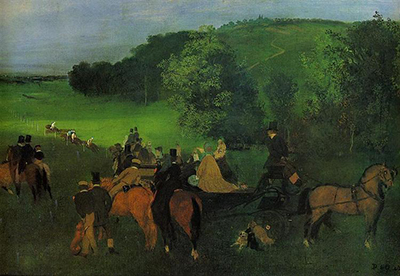
A group of racehorses and riders presses together on green ground. Near the centre, a dark-clothed person stands with their back to us, almost absorbed into the horses around them. Small flashes of bright riding colours break up the deeper browns and blacks. The scene is busy, but no race has begun. Edgar Degas's painting is catalogued in French as Conseils avant la course—Advice before the Race—in Michel Schulman's digital catalogue raisonné, number MS64. It is held in a private collection. [1] [10]

This picture is not the Museum of Fine Arts, Boston painting titled Racehorses at Longchamp. It is Advice before the Race, catalogued as Schulman MS64, and no particular track is identified. The French title directs our attention to the time before competition, while the exact venue remains unverified. [1][2]

The work at a glance

  • ArtistEdgar Degas (1834–1917)
  • Catalogue titleConseils avant la course
  • English titleAdvice before the Race
  • Date1870s; precise date disputed
  • MediumOil on a parqueted wood panel, according to Schulman
  • Size32 × 40 cm, according to Schulman
  • CollectionPrivate collection
  • CatalogueMichel Schulman MS64

Contents

  1. Introduction
  2. At a Glance
  3. The pause before movement
  4. A dense painting on a small panel
  5. Why Degas watched racing
  6. A date that needs care
  7. Two works called racehorses at Longchamp
  8. Looking again

The pause before movement

The horses stand close enough that the viewer must separate bodies, heads and riders one by one. A dark horse in the central group anchors the image. To either side, other animals angle at slightly different directions, breaking any simple line of procession. The painted gathering seems ready to disperse, yet Degas gives us the unstable pause rather than the burst of a start. [1]

The figure seen from behind occupies a charged position. They face into the mounted group, their back closing the space between us and the riders. The catalogue's title suggests advice being given before the race, but it does not identify the person, the recipient or the words exchanged. A raised or outstretched arm can indicate a gesture within the picture; it cannot prove a conversation outside it. Degas makes the possibility of interaction visible without supplying a script. [1]

Small colours do much of the work of distinguishing the jockeys. Against dark horses and dark clothing, brighter caps and jackets catch the eye. These accents create a rhythm across the cluster: one sharp colour, then another, and another. They also tell us that the riders belong to the visual world of horse racing, where silks mark different entrants. We need no claim about a named race or owner to recognise their role. [1][3]

Behind them, green and yellow-green land rises across the upper part of the picture. It provides a broad setting without furnishing an exact map. There is no identifiable grandstand or legible sign in the reproduced image to pin the scene to Longchamp. The old web title may reflect a tradition of describing Degas's racing subjects generally, but here the catalogue's own name remains the better guide to the work. [1]

A dense painting on a small panel

At 32 × 40 cm, the object is modest in size. The panel is a little wider than it is high. Degas fits a surprisingly crowded group into this limited space, leaving no sweeping strip of empty track. Overlap becomes the picture's central device: horse against horse, rider against rider, standing person against mounted figures. It creates a sense of activity even though the animals have not yet accelerated. [1]

The catalogue describes the medium as oil and the support as a parqueted wood panel. “Parqueted” refers to a system of wooden supports attached behind a panel; a front-facing reproduction does not tell us when or why such a backing was added. It is therefore safer to state the catalogue's material description than to invent a conservation history. The painting's compact scale and overlapping forms are visible. Details of its physical surface, back and later treatment would require examining the object or a technical report. [1]

Dark forms concentrate around the central horses and the standing figure. The green ground and lighter hillside give these forms contrast. Bright spots of riding costume keep the centre from becoming a single mass. The arrangement makes the viewer's eye work in stages, picking out a muzzle, a rider, the dark coat, and then another horse. It is a constructed visual experience, although the casual gathering might at first suggest a quickly observed scene. [1]

Edges matter here as much as the centre. Horses and riders approach the picture's sides, making the scene feel larger than the panel can contain. The field behind them offers breathing space, but the near group fills most of what we see. Degas balances the sense of a broad racecourse with the close scale of people and animals waiting together. The resulting picture sits between landscape and group study. [1]

The work is signed at lower left according to the catalogue. That entry also gives its present location only as a private collection. A current owner name, public viewing location or exhibition schedule should not be guessed from earlier sales and loans. What matters for identifying this image is the combination of composition, catalogue number, dimensions and support, rather than the broad English phrase “racehorses at Longchamp.” [1]

Why Degas watched racing

Horse racing offered nineteenth-century artists a modern social setting as well as a study in animal movement. The Metropolitan Museum of Art's Manet/Degas exhibition guide describes racecourses near Paris as places of fashion, crowds, competition and speed. It notes that Degas began painting racing subjects in the early 1860s and often favoured the seconds before the start. That wider account helps explain why a gathering of jockeys could interest him as much as a galloping finish. It is context for MS64, not a report that the museum owns or has dated this specific panel. [3]

The National Gallery of Art's Degas at the Races exhibition assembled paintings, drawings, prints and sculptures to show the breadth of his attention to horses. Its catalogue lists MS64 among reproduced works, according to Schulman's bibliography, though the catalogue entry marks it as not exhibited in the Washington show. A reproduced picture is not the same as an object on a gallery wall. We can place this private painting within a researched subject while keeping its own exhibition status precise. [1][4]

Degas could bring several interests together at a track. A horse's changing posture challenged the artist to understand bodies in motion. Jockeys' contrasting silks supplied colour and social identity. A crowded course offered ways to crop a composition and interrupt a conventional central view. In MS64, those interests meet before the actual race: tension is carried by proximity, angles and the expectation that the group will soon move. [1][3][4]

This interest was sustained rather than confined to one painting. The NGA's The Races shows another group of mounted riders, but its arrangement, ownership and measurements are different. The Musée d’Orsay's At the Races includes horses and a carriage in a broad field. These comparisons show Degas revisiting the subject and changing the balance among horse, rider, onlooker and space. They do not make the pictures versions of a single object. [4][5][6]

Watch: Edgar Degas

Explore his paintings, drawings and sculpture in three short videos.

A date that needs care

Schulman's catalogue labels MS64 circa 1876. Yet the same entry says that Ferdinand Bischoffsheim had owned it before April 1872, followed by Durand-Ruel in that month and Jean-Baptiste Faure in March 1874. If that ownership sequence describes this very painting accurately, it cannot first have been made around 1876. The catalogue gives both statements without an explanation in its public entry. Until they are reconciled, “1870s” is the most useful concise label, with the precise date expressly uncertain. [1]

Commercial image listings offer different early dates. Artothek describes the pictured work as Racehorses (Leaving the Weighing), circa 1871, while King & McGaw uses circa 1871–72. Those labels may draw on earlier catalogues or licensing metadata, but neither is a named owner of the painting. Their dates strengthen the reason to question “circa 1876”; they do not independently establish a single year. Likewise, “Leaving the Weighing” is a historical English title, not visual proof that we see a particular building or know the exact step in race procedure. [1][7][8]

The catalogue entry traces many later changes of hands, exhibitions and sales. It names a Christie’s London sale in 1991 and a Sotheby’s London sale in 2004 before the present private collection. Because its early chronology is internally contradictory, a full sequence of nineteenth-century ownership should be checked against original sale catalogues before being retold as certain. The later citations nonetheless show that scholars have studied and reproduced the image under changing titles. [1]

The catalogue's object page and concordance disagree about the work's Lemoisne number. Schulman MS64 identifies this oil painting without relying on that disputed cross-reference. [1]

Two works called racehorses at Longchamp

The Museum of Fine Arts, Boston owns a separate oil titled Racehorses at Longchamp, accession 03.1034. Its image shows riders with much more open ground and sky. Boston dates that work 1871, possibly reworked in 1874, and its catalogue record concerns a canvas rather than this private wood panel. Michel Schulman lists the Boston work separately as MS87. The common English phrase hides two distinct compositions, supports and collection histories. [1][2][9]

The difference is visible even before reading labels. MS64 draws the viewer up against a tightly packed group with a standing dark-clothed person seen from behind. Boston's painting gives the horses and riders more space and an expansive sky. A visitor who remembers one image should be able to recognise that the other is a separate work. That visual check matters because an inaccurate web caption could easily carry Boston's date, size or location over to a private painting. [1][2]

The same caution applies to other Degas racing pictures. NGA The Races and Orsay At the Races have their own collection numbers and reproductions. The subject unites them; it does not merge their object identities. The close-packed riders and dark standing figure identify MS64 in the catalogue. [1][5][6]

Looking again

Begin at the standing person's dark back, then try to trace the horse immediately beyond them. Follow the colours of the jockeys across the group and notice how often one figure partly hides another. Finally, step back to see the green land behind the cluster. The composition makes a short interval feel full: animals hold still or shift position, riders gather, and a human gesture seems to pass among them. [1]

Degas did not need to show a full-speed race to evoke racing. In Advice before the Race, the close bodies and angled forms make preparation itself the event. The catalogue record identifies the private panel, while its conflicting dates leave part of the historical story open. Its precise track remains unnamed. Those limits sharpen the picture rather than diminish it: we can see how Degas built suspense from a group that has not yet started to run. [1][3]

Artworks directory

A selected index of documented works, combining owner records with entries sampled across Michel Schulman’s digital catalogue raisonné. It is not a complete catalogue. View the full catalogue

406 artworks

NameDateMedium
>Group of dancers (MS 77)1893Pastel
[Self-Portrait with Christine and Yvonne Lerolle]probably 1895–96Photograph
A Woman Seated beside a Vase of Flowers (Madame Paul Valpinçon?)1865Oil painting
Achille de Gas as midshipman (MS 718)1857Painting
Achille Degas (MS 715)1864Painting
After the bath - Woman Drying Herself (MS 1038)1888—1892Pastel
After the bath (MS 1037)1893Pastel
After the bath (MS 1046)1905Pastel
After the bath (MS 1060)1895Pastel
After the bath (MS 1061)1898Pastel
After the bath (MS 1062)1895Pastel
After the bath (MS 1063)1896Painting
After the bath (MS 1064)1896Painting
After the bath (MS 1065)1896Painting
After the bath (MS 1391)1900Pastel
After the bath (MS 1402)1888Pastel
After the bath (MS 1744)1886Pastel
Arlequin et danseuses (MS 2224)1884Pastel
At the café Châteaudun (MS 1913)1869—1871Painting
At the horse track (MS 1929)1869—1872Painting
At the Milliner's1881Pastel
At the milliner's (MS 2587)1882—1885Painting
At the milliner's (MS 562)1882Pastel
At the milliner's (MS 565)1882Pastel
At the milliner's (MS 567)1885Painting
At the races (MS 85)1861Painting
At the races - Jockeys (MS 92)1868Painting
At the races - The start. (MS 98)1860Painting
Auguste de Gas (MS 1243)1857Painting
Autumn landscape (MS 1403)1890Pastel
Ballet Dancers in the Wingsc. 1890–1900Pastel
Ballet scene (MS 452)1885Painting
Ballet scene (MS 454)1896Painting
Ballet scene (MS 458)1887—1890Pastel
Bather Drying Herselfc. 1883–84Pastel
Beach at low tide (MS 1730)1869Pastel
Beach at low tide (MS 1742)1869Pastel
Beach at low tide (MS 1907)1869Pastel
Beach at low tide (MS 1915)1869Pastel
Beach at low tide (MS 2070)1869Pastel
Before the race (MS 73)1882Painting
Before the race (MS 74)1882Painting
Before the race (MS 81)1884Pastel
Before the race (MS 82)1885Pastel
Before the race (MS 86)1884Painting
Before the start (MS 78)1885Pastel
Boat at low tide (MS 1407)1869Pastel
Breakfast after the bath (MS 1039)1890Pastel
Breakfast after the bath (MS 1565)1895—1898Pastel
Bust of a woman (MS 869)1887—1890Painting
By the seashore (MS 1917)1869Pastel
Calm sea seen from a cliff (MS 1741)1869Painting
Chatting (MS 2061)1882—1885Pastel
Cliff on the seashore (MS 1230)1869Pastel
Cliff on the seashore (MS 671)1869Pastel
Copy after "The Finding of Moses" by Véronèse (MS 1401)1860Painting
Criminals physiognomies (MS 858)1881Pastel
Crouching nude woman from behind (MS 1235)1876Pastel
Dance exercises (MS 270)1891Pastel
Dancer (MS 282)1899Pastel
Dancer (MS 492)1880—1885Pastel
Dancer adjusting her bodice (MS 1576)1875Painting
Dancer adjusting her bodice (MS 293)1890Painting
Dancer adjusting her shoulder strap (MS 283)1899Pastel
Dancer adjusting her shoulder strap (MS 285)1889—1896Pastel
Dancer adjusting her shoulder straps (MS 275)1896—1899Pastel
Dancer Adjusting Her Slipper1873Graphite and chalk
Dancer adjusting her slipper (MS 1588)1887Pastel
Dancer adjusting her slipppers (MS 1581)1880Pastel
Dancer at the barre (MS 1731)1895—1898Pastel
Dancer at the barre (MS 2073)1874Pastel
Dancer at the barre (MS 2570)1885Pastel
Dancer bending (MS 486)1874—1879Pastel
Dancer bowing on her knee (MS 494)1895Pastel
Dancer combing her hair (MS 1390)1879Painting
Dancer dressing (MS 1745)1889Pastel
Dancer exercising (MS 483)1874Pastel
Dancer fastening her shoe (MS 2077)1887Pastel
Dancer in blue (MS 2349)1902Pastel
Dancer in bust (MS 1726)1897Pastel
Dancer in bust (MS 277)1895—1899Pastel
Dancer in green (MS 2608)1897—1901Pastel
Dancer in green (MS 273)1878Pastel
Dancer in pink bowing (MS 1418)1878Pastel
Dancer in red (MS 280)1893Pastel
Dancer in Ukrainian Dress1899Pastel
Dancer leaning (MS 2585)1874—1879Pastel
Dancer Moving Forward, Arms Raisedc. 1885–90Sculpture
Dancer nude study (MS 2348)1902Pastel
Dancer on stage (MS 1415)1879Painting
Dancer on stage (MS 478)1881—1885Pastel
Dancer Putting on Her Stocking1890s/1911Sculpture
Dancer reading (MS 165)1879Pastel
Dancer seated (MS 121)1872Painting
Dancer seen from behind (MS 2211)1889Pastel
Dancer seen from the back (MS 171)1874Painting
Dancer tilting (MS 423)1883Pastel
Dancer with a fan (MS 2592)1876Pastel
Dancer with arms crossed (MS 274)1872Painting
Dancer with arms raised (MS 1743)1891Pastel
Dancer with green bodice (MS 2345)1902Pastel
Dancer with raised arms (MS 475)1870Painting
Dancer with tambourine (MS 2053)1882Pastel
Dancer with tambourine (MS 450)1883Painting
Dancer with tambourine (MS 465)1897Painting
Dancers (MS 2215)1878Painting
Dancers (MS 2217)1890Pastel
Dancers (MS 2362)1904—1906Pastel
Dancers (MS 294)1890Pastel
Dancers (MS 471)1878Pastel
Dancers adjusting their hair (MS 286)1897Pastel
Dancers at rest (MS 1228)1898Pastel
Dancers at rest (MS 224)1874Painting
Dancers at the barre (MS 266)1877Pastel
Dancers at the barre (MS 267)1880Pastel
Dancers at the barre (MS 268)1900Painting
Dancers at the barre (MS 269)1900Pastel
Dancers Backstage1876/1883Oil painting
Dancers backstage (MS 271)1890Painting
Dancers behind the wings (MS 288)1880Pastel
Dancers bowing (MS 453)1885Pastel
Dancers in a landscape setting (MS 466)1895—1898Pastel
Dancers in pink (MS 1738)1900Pastel
Dancers in pink (MS 2364)1904Pastel
Dancers in red skirts (MS 451)1884Painting
Dancers in white (MS 1748)1878Pastel
Dancers in yellow skirts (MS 2359)1903Pastel
Dancers on stage (MS 1417)1881Pastel
Dancers on stage (MS 460)1880Pastel
Dancers on stage (MS 474)1884Pastel
Dancers resting (MS 2604)1890—1895Pastel
Dancers with fans (MS 291)1890Pastel
Dancers, Pink and Greenc. 1890Oil painting
Dante and Virgil at the Entrance of Hell (MS 2072)1857—1860Painting
Degas in studio smock (MS 688)1862Painting
Dunes along the sea (MS 1905)1869Pastel
Edmond Duranty (MS 732)1879Pastel
Elena et Camilla Primicile Carafa di Mantejasi (MS 695)1867Painting
Estelle Musson Balfour (MS 704)1872Painting
Estelle Musson Balfour (MS 710)1863—1865Painting
Fallen jockey (MS 1388)1870Painting
Farm at the foot of a cliff (MS 1918)1869Pastel
Four dancers (MS 1728)1885Pastel
Four dancers (MS 2365)1905Pastel
Four dancers (MS 287)1899Painting
Four dancers in blue (MS 2355)1903Pastel
Four dancers in the wings (MS 2356)1903Pastel
Four dancers on stage (MS 473)1897—1900Pastel
Germain Musson (MS 700)1853Painting
Getting off the bath (MS 1057)1884Pastel
Getting out of the bath (MS 1398)1898Pastel
Getting out of the bath (MS 1583)1879Pastel
Getting out of the bath (MS 1725)1900Pastel
Getting out of the bath (MS 2343)1901Pastel
Getting out of the bath (MS 2607)1895—1898Pastel
Giovanna Bellelli (MS 1242)1856Painting
Giulia Bellelli (MS 722)1858Painting
Green dancers (MS 469)1878Pastel
Hairdressing (MS 1387)1895Painting
Head of a woman (MS 290)1865Pastel
Head of a woman (MS 861)1873—1875Painting
Henri Degas and his niece Lucie Degas (MS 701)1875—1876Painting
Henri Rouart in front of his factory (MS 759)1875Painting
Horse races (MS 1928)1869—1872Painting
Horse races at Longchamp (MS 87)1873Painting
Horse riders in a lanscape (MS 2079)1860—1861Painting
Horse turned to the right (MS 95)1881—1885Pastel
Horse Walkingpossibly early 1870sSculpture
Horsemen riding on the sea shore (MS 1914)1868Pastel
Horseride (MS 80)1890—1895Painting
Horses and jockeys (MS 84)1890Painting
Horses in a medow (MS 2076)1871Painting
Houses along a cliff (MS 1587)1880—1890Painting
Houses on a cliff overlooking the sea (MS 1925)1869Pastel
Houses on the sea shore (MS 1408)1869Pastel
In the dance foyer (MS 2575)1897Pastel
James Tissot (MS 762)1867Painting
Jeantaud, Linet et Laîné (MS 859)1871Painting
Jockey (MS 2213)1889Pastel
Jockey in a red cap (MS 1931)1868Painting
Jockeys (MS 75)1877Painting
Jockeys (MS 83)1890Painting
Jockeys at Epsom (MS 97)1860Painting
Jules Perrot (MS 755)1875Painting
L'arlequin (MS 2223)1890Pastel
La Savoisienne (MS 863)1860—1862Painting
Lady with a parasol (MS 93)1870—1872Painting
Landscapec. 1877–79Monotype
Landscape1892Monotype with pastel
Landscape (MS 1572)1892Pastel
Landscape (MS 2233)1890—1893Painting
Landscape (MS 2234)1890—1893Pastel
Landscape with houses (MS 2567)1885—1890Pastel
Landscape with path leading to a copse of trees (MS 2610)1890—1892Painting
Laundress carrying linen (MS 2351)1902Pastel
Laundresses and horse (MS 2350)1902Pastel
Laundresses carrying baskets (MS 2352)1902Pastel
Little Dancer Aged Fourteen1878–81Sculpture
Little girl carrying flowers in her apron (MS 855)1862Painting
Lyda (MS 91)1870Painting
Marguerite de Gas (MS 713)1853—1854Painting
Mary Cassatt at the Louvre: The Paintings Gallery1879–80Print
Mathilde Musson Bell (MS 706)1872—1873Pastel
Meadow along a stream (MS 1934)1870—1875Pastel
Meadow bordering a river (MS 1577)Pastel
Mlle Bécat at the Ambassadeurs (MS 1410)1885Pastel
Morning toilette (MS 2078)1894Pastel
Mountain lake (MS 2229)1890—1893Pastel
Mountainous landscape (MS 2227)1890—1893Pastel
Mountainous landscape (MS 2230)1890—1893Pastel
Mr. and Mrs. Henry Rouart (MS 2358)1904Pastel
Mr. and Mrs. Louis Rouart (MS 2357)1904Pastel
Mr. and Mrs. Louis Rouart (MS 2360)1904Pastel
Mrs Alexis Rouart and her children (MS 1396)1905Pastel
Mrs Camus (MS 1908)1869Pastel
Naked woman at rest (MS 1557)1880Pastel
Naked woman drying herself (MS 1045)1900Pastel
Naked woman drying herself (MS 1058)1886Pastel
Naked woman warming up (MS 2065)1880Pastel
Nude woman combing her hair (MS 1245)1877—1879Pastel
Nude woman combing her hair (MS 2353)1903Pastel
Olive trees in a mountaineous landscape (MS 1574)1892Pastel
Porrtaits of women (MS 857)1868Painting
Portrait of a man (MS 1733)1864Painting
Portrait of a Man (MS 2220)1890Pastel
Portrait of a man [Portrait of man in an armchair] (MS 853)1866Painting
Portrait of a woman (Attributed) (MS 1404)1867Painting
Portrait of a woman (MS 2067)1885Painting
Portrait of a woman (MS 862)1878—1889Pastel
Portrait of a woman (MS 868)1884Painting
Portrait of a woman (MS 873)1867—1868Painting
Portrait of a woman before a piano (MS 2060)1882—1885Pastel
Portrait of a woman with a hat (MS 872)1884Pastel
Portrait of a woman with hat (MS 870)1887—1890Painting
Portrait of a young girl (MS 1901)1868Painting
Portrait of a young lady (MS 867)1878Painting
Portrait of a young woman after a D-drawing attributed to Leonardo da Vinci (MS 875)1858Painting
Portrait of Brandon (MS 2084)1874—1878Painting
Portrait of Elena Carafa (MS 696)1875Painting
Portrait of Henry Michel-Lévy (MS 1414)1873Painting
Portrait of the artist (MS 690)1863Painting
Preparation for the dance class (MS 247)1890Pastel
Program for the artistic evening of May 15, 1884 at the Ponsin Gallery (MS 2071)1884Pastel
Race Horsesc. 1885–88Pastel
Race horses (MS 76)1880Pastel
Races in the country (MS 96)1869Painting
Reclining nude woman (MS 2342)1901Pastel
René de Gas (MS 720)1855Painting
René de Gas with a inkwell (MS 719)1855Painting
Resting on field (MS 2055)1882Pastel
Riverbank (MS 1571)1890Pastel
Riverbank (MS 2083)1870—1875Pastel
Road in a forest (MS 1932)1870—1875Pastel
Road in a forest (MS 1933)1870—1873Pastel
Rocky coast (MS 1413)1890—1893Pastel
Rocky landscape (MS 2228)1890—1893Painting
Rue du Quesnoy at Saint-Valery-sur-Somme (MS 2069)1895—1898Pastel
Ruins of a bridge over a river (MS 1394)1892Pastel
Scene from the Steeplechase: The Fallen Jockey1866, reworked 1880–81 and c. 1897Oil painting
Sea at low tide (MS 1916)1869Pastel
Sea shore (MS 1920)1869Pastel
Sea shore (MS 1921)1869Pastel
Sea shore (MS 1924)1869Pastel
Seascape (MS 1906)1869Pastel
Seated nude woman combing her hair (MS 1236)1890Pastel
Seated woman brushing her hair (MS 2600)1887—1890Pastel
Self-Portraitc. 1855Drawing
Self-Portrait (MS 689)1862Painting
Self-Portrait (MS 691)1856—1858Painting
Self-Portrait (MS 693)1857—1858Painting
Self-Portrait (MS 694)1857Painting
Self-Portrait with White Collarc. 1857Oil on paper on canvas
Sitting woman combing her hair (MS 2568)1887—1890Pastel
Standing man in a bowler hat (MS 717)1874Painting
Standing nude woman (MS 1237)1880Pastel
Standing nude woman (MS 2218)1890Pastel
Standing woman (MS 1737)1866Painting
Stream in the undergrowth (MS 1935)1870—1875Painting
Studies of a woman's head and a seated dancer (MS 481)1879Pastel
Study for Mr and Mrs Louis Rouart (MS 1750)1904Pastel
Study for Mrs Camus at the piano (MS 2573)1869Pastel
Study of a Nude (Dancer at the Barre)1884–1900Drawing
Study of dancers (MS 2344)1901Painting
Study of folds of a hooded cloak (MS 2074)1861—1864Painting
Study of nude woman (MS 2059)1884Pastel
Study of sky (MS 1923)1869Pastel
The ball (MS 1248)1879Painting
The ballet rehearsal (MS 298)1877Painting
The bath (MS 1586)1900—1905Pastel
The bath (MS 2222)1890Drawing
The cellist Pilet (MS 1253)1868Painting
The child in blue (MS 854)1854Painting
The chocolate cup after the bath (MS 1247)1905—1907Pastel
The convalescent (MS 702)1872—1873Painting
The conversation (MS 1570)1895Pastel
The cup of chocolate (MS 1564)1900—1905Pastel
The Dance Class1874Oil on canvas
The dance class (MS 1406)1876Pastel
The dance class (MS 2068)1876Pastel
The Dance Lessonc. 1879Oil painting
The dance lesson or ballet class (MS 212)1875Pastel
The dance lesson or ballet class (MS 215)1878Painting
The dancer's rest (MS 1724)1885Pastel
The Duchess Montejasi and her Daughters Elena and Camilla (MS 699)1881Painting
The Duchess of Montejasi-Cicerale (MS 698)1868Painting
The duet (MS 1393)1877—1879Pastel
The duet (MS 1416)1877Pastel
The Extras or The chorus (MS 1254)1877Pastel
The false start (MS 99)1870Painting
The Firesidec. 1876–77Monotype
The Giovanna and Giulia Bellelli Sisters (MS 721)1865Painting
The Holy Family - Copy. (MS 1903)1868—1872Painting
The Holy Family after Sebastiano del Piombo (MS 1751)1857Drawing
The march (MS 56)1866Painting
The pedicure (MS 1251)1873Painting
The racecourse - Amateur jockeys near a carriage (MS 1249)1878Painting
The Races1871–72Oil painting
The rehearsal of the ballet (MS 2057)1881Painting
The singer (MS 2591)1877—1880Pastel
The Tubc. 1889Sculpture
The tub (MS 1252)1886Pastel
The violist (MS 2569)1880Pastel
Three dancers (MS 1585)1889Pastel
Three dancers (MS 2064)1879Painting
Three dancers (MS 2210)1889Pastel
Three dancers (MS 2216)1899Pastel
Three dancers (MS 2354)1903Pastel
Three dancers (MS 2614)1899Pastel
Three dancers (MS 467)1895—1898Pastel
Three dancers (MS 468)1890Pastel
Three dancers in salmon pink skirts (MS 2363)1904—1906Pastel
Three heads of men (MS 860)1871Painting
Three jockeys (MS 79)1900Pastel
Three study of dancers (MS 482)1879—1880Pastel
Two bathers (MS 2347)1902Pastel
Two Dancers1873Drawing
Two dancers (MS 1722)1880—1885Pastel
Two dancers (MS 2611)1880Pastel
Two dancers (MS 295)1890Pastel
Two dancers (MS 296)1890Pastel
Two dancers at rest or Dancers in blue (MS 1229)1898Pastel
Two Dancers in bust (MS 2561)1897Pastel
Two harlequins (MS 396)1885Pastel
Two sitting dancers (MS 1736)1896Pastel
Two Womenc. 1878/1880Pastel
Two women at their bath (MS 1568)1895Pastel
Valleys (MS 2232)1890—1893Pastel
View of Saint-Valery-sur-Somme (MS 2560)1896Painting
Walter Sickert, Daniel Halévy, Ludovic Halévy, Jacques-Emile Blanche, Gervex, Boulanger-Cavé (MS 856)1885Pastel
Wheat field and line of trees (MS 2225)1890—1892Pastel
Woman at her toilette (MS 1041)1890—1894Pastel
Woman at her toilette (MS 1048)1903Pastel
Woman at her toilette (MS 1050)1900Pastel
Woman at her toilette (MS 1559)1892Pastel
Woman at her toilette (MS 1561)1905—1907Pastel
Woman at her toilette (MS 2346)1902Pastel
Woman at her toilette (MS 2565)1895—1903Pastel
Woman Bathing in a Shallow Tub1885Pastel
Woman before a mirror (MS 370)1885—1886Pastel
Woman cleaning her left foot (MS 1232)1886Pastel
Woman combing her hair (MS 1746)1894Pastel
Woman combing her hair (MS 1238)1887—1890Pastel
Woman combing her hair (MS 1560)1892—1895Pastel
Woman combing her hair (MS 1727)1890Pastel
Woman combing her hair (MS 2237)1890—1895Pastel
Woman combing her hair before a mirror (MS 1250)1870—1875Painting
Woman comnbing her hair (MS 2209)1885Pastel
Woman drying erself after the bath (MS 2236)1890—1895Pastel
Woman drying her hair (MS 1042)1894Pastel
Woman drying her hair (MS 1044)1897Pastel
Woman drying her hair (MS 1569)1900Pastel
Woman drying her hair (MS 1729)1900—1903Pastel
Woman drying her hair (MS 1732)1885Pastel
Woman drying her left arm (MS 1055)1884Pastel
Woman drying her left arm (MS 1056)1884Pastel
Woman drying her right arm (MS 1052)1884Pastel
Woman drying herself (MS 1053)1884Pastel
Woman drying herself (MS 1059)1886Pastel
Woman drying herself (MS 1397)1888Pastel
Woman drying herself after the bath (MS 1562)1895Pastel
Woman Drying herself after the bath (MS 1563)1883Pastel
Woman drying herself after the bath wearing yellow mules (MS 2208)1889Pastel
Woman getting out of the bath (MS 1240)1881Pastel
Woman Having Her Hair Combedc. 1886–88Pastel
Woman in her bath washing her left leg (MS 1234)1883Pastel
Woman in mauve dress seated in an armchair or Mrs Alexis Rouart and Her Children (MS 2366)1905Pastel
Woman in red dressing gown combing her hair (MS 2207)1880Pastel
Woman Ironingbegun c. 1876, completed c. 1887Oil painting
Woman looking through opera glasses (MS 89)1881Painting
Woman sitting on a lawn (MS 2056)1882Pastel
Woman washing up in her tub (MS 1239)1892Pastel
Woman with a dog (MS 865)1875—1880Painting
Woman with a white apron (MS 94)1855Drawing
Woman with an umbrella (Mrs Jeantaud) (MS 866)1877—1880Painting
Woman with blue hat (MS 1558)1889Pastel
Woman with opera glasses (MS 90)1877Painting
Women ironing (MS 587)1875Painting
Women on the terrace of a café (MS 1241)1877Pastel
Young girl with white shawl (MS 874)1871Painting
Young spartan girls challenging boys (MS 1412)1860Painting
Young woman (MS 871)1890Painting
Young woman in black (MS 879)1861—1865Painting
Young woman in her bath (MS 1566)1890Pastel
Young woman standing by a table (MS 1739)1855Painting
Young woman tying the ribbons of her hat (MS 1244)1882Pastel
Young woman with her hand facing her mouth (MS 864)1875Painting

Discussion

Share what you notice in Degas’s racehorses at longchamp.

Reader Insights

Close Looking

How do the overlapping horses and jockeys guide your eye?

Context

Which colours distinguish riders within the dark group?

Open Question

What can the image tell us about the scene without identifying a particular track?

Join the Conversation

Share your reading of these works below.

References

  1. Michel Schulman, Degas digital catalogue raisonné, Conseils avant la course, MS64, exact photograph, title, private location, dimensions, medium, signature, date and provenance; the date and early history conflict internally. View source
  2. Museum of Fine Arts, Boston, Racehorses at Longchamp, 03.1034, separate Boston composition, medium and owner date. View source
  3. Metropolitan Museum of Art, Manet/Degas visiting guide, “At the Racecourse” section on Parisian racing culture and Degas's treatment of the moments before a start. View source
  4. National Gallery of Art, Degas at the Races, scope and scholarship of the 1998 exhibition. View source
  5. National Gallery of Art, The Races, 1942.9.18, distinct work. View source
  6. Musée d’Orsay, At the Races, RF 1980, distinct work. View source
  7. Artothek, Degas image catalogue, alternative Leaving the Weighing title, circa-1871 label and Christie's Images Ltd image credit. View source
  8. King & McGaw, Racehorses (Leaving the Weighing), alternative circa-1871–72 dealer label. View source
  9. Michel Schulman, Courses de chevaux à Longchamp, MS87, catalogue record for the different Boston picture. View source
  10. Splash image: Edgar Degas, Advice before the Race, 1870s (exact date disputed), oil on parqueted wood panel. Private collection, Schulman MS64. Collection record. View source