

 by Tom Gurney
Tom Gurney BSc (Hons) is an art history expert with over 20 years experience
Published on June 19, 2020June 19, 2020 / Updated on July 6, 2026
Email: tomgurney1@gmail.com / Phone: +44 7429 011000
The Sick Child by Edvard Munch: Memory, Illness and the Wounded Surface
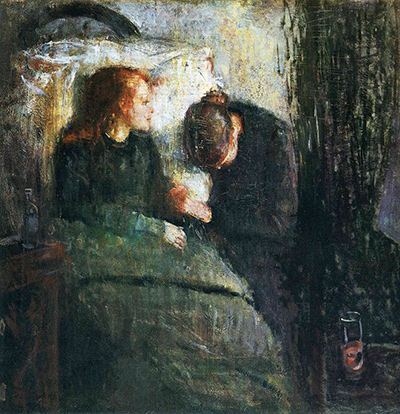
Edvard Munch's The Sick Child is one of his breakthrough works. A pale, red-haired girl is placed against a white pillow while a woman bends beside her. The composition is simple, but the surface is not: thick paint, thin trickling passages, scratches, abrasions and scraped areas make the painting feel wounded, interrupted and emotionally exposed. [1]
The National Museum of Norway records The Sick Child as an oil painting on canvas made between 1885 and 1886, measuring 120 x 118.5 cm. It is signed lower right, carries inventory number NG.M.00839, and was acquired in 1931. [1]
The painting is often connected with Munch's sister Johanne Sophie, who died of tuberculosis in 1877 at the age of fifteen. But the museum's wording is careful: the likely models were Betzy Nilsen and Munch's aunt Karen Bjolstad. Memory, model and motif overlap here rather than collapsing into a simple portrait. [1]
This page anchors the illness and mortality route in the Munch cluster, linking Death in the Sickroom, Child and Death, By the Deathbed, Inheritance and the later psychological power of The Scream. [8]
At a Glance
- Artist:Edvard Munch
- Title:The Sick Child
- Norwegian title:Det syke barn
- Date:Between 1885 and 1886
- Medium:Oil on canvas
- Dimensions:120 x 118.5 cm
- Collection:National Museum of Norway
- Inventory no.:NG.M.00839
- Acquisition:Acquired 1931
Contents
- Museum Perspective
- Looking Carefully
- Sophie, Memory and Models
- Surface and Technique
- The 1886 Scandal
- Versions and Prints
- Provenance and Acquisition
- Meaning and Interpretation
- Things You Might Miss
- Timeline
Museum Perspective
The National Museum describes a simple sickbed composition, with the main image placed centrally and close to the front of the pictorial space. Sparse details concentrate attention on the girl's head against the white pillow, the woman's bent neck and the point of contact between them. [1]
The museum calls The Sick Child Munch's breakthrough work, the painting in which he turned toward a more personal, expressive and emotionally charged art. It is important because subject and technique become inseparable. [1]
The museum also places the picture in a wider nineteenth-century context. Sickbed scenes and dying children were common subjects, often connected with tuberculosis, which remained one of Europe's most life-threatening diseases until the twentieth century. [1]
Munch's difference lies in the handling. The National Museum says the painting's radical form already looks beyond the realism of the 1880s and supports the idea of the work as psychologically charged realism. [1]
Looking Carefully
The white pillow is not a minor prop. It frames the girl's head and makes the pallor of her face visible. The head turns toward the bowed woman, so the emotional centre is not a dramatic gesture but a quiet relationship across a narrow space. [1]
The woman beside the girl does not meet the viewer. Her bent neck and lowered head make grief physically visible. The contact between the figures matters more than facial description; Munch narrows the image to touch, proximity and shared helplessness. [1]
The room contains only a few details: the curtain, a half-empty glass and a bottle on a dresser. These details are enough to suggest illness without turning the scene into a fully described domestic interior. [1]
The close-up format contracts the visible space. That makes the painting feel less like a story observed from outside and more like a memory pressing forward. [5]
Video Guide
This selected video from Thielska Galleriet offers useful visual context before the detailed analysis continues.
Sophie, Memory and Models
The painting is often associated with Munch's sister Johanne Sophie, who died from tuberculosis in 1877 when she was fifteen. Munch was deeply marked by illness and death in childhood, and the subject became one of the foundations of his art. [1] [2]
At the same time, this should not be written as a literal portrait of Sophie. The National Museum records that the models for the girl and woman were probably Betzy Nilsen and Munch's aunt Karen Bjolstad. The painting transforms remembered loss through studio practice. [1]
That distinction strengthens the page. The Sick Child is not moving only because of biography. It is powerful because Munch turns grief into a new pictorial language of surface, proximity and incompletion. [6]
Surface and Technique
The surface is the event. The National Museum describes thick layers of paint alternating with thin, trickling stripes, pastose brushstrokes, scratches and abrasions. The picture calls attention to its own making. [1]
This is why early viewers found the painting difficult. It seemed unfinished, but that unfinished quality is part of its expressive force. The museum even describes Munch here as a master of the unfinished work of art. [1]
Technical study deepens that reading. The National Museum catalogue reports major revisions during the painting's creation and after its first exhibition. X-ray surveys have revealed compositional changes, and an area on the right was later reworked, probably between 1896 and 1907, likely to repair damage and surface weaknesses. [1]
In other words, the damaged, reworked and scratched surface is not a decorative effect. It is bound up with the painting's history, reception and meaning. [4]
The 1886 Scandal
The Sick Child was first shown at the National Annual Autumn Exhibition in 1886 under the title Study. The title already suggests experiment rather than polished academic finish. [1]
The National Museum records both outrage and acclaim. Many critics were provoked by the sketchy and unfinished quality; some saw failure, while others praised boldness and emotive force. The work entered Munch's career as an early scandalous success. [1]
That reaction matters because it marks a shift in Munch's public identity. The painting did not merely show grief; it challenged what a serious painting was supposed to look like. [5]
Versions and Prints
Munch returned to the composition repeatedly. The National Museum records five further painted versions: one from 1896, two from 1907, one from 1925 and one from 1927. [1]
The museum also records four print versions loosely based on the same subject and composition, plus many adaptations. This makes The Sick Child an important bridge to the future Munch prints hub and to The Sick Child I. [1] [7]
The repetition was not simple copying. Each return allowed Munch to test how illness, memory and surface could be carried into new versions and media. [4]
Provenance and Acquisition
The National Museum records the 1885-86 painting as acquired in 1931, with a complex provenance involving Christian Krohg, Olaf Schou, Harald Norregaard, Christian Krohg again and Oda Krohg. [1]
The museum explains that the National Gallery first acquired the 1896 version as part of Olaf Schou's 1909 bequest. In 1931, that later painting was exchanged for the original 1885-86 version then owned by Oda Krohg. [1]
That exchange matters for readers. The National Museum's current painting is the original version, but it reached the collection only after a complicated route through later versions, collectors and ownership disputes. [1]
Meaning and Interpretation
The strongest reading begins with grief, but does not stop there. The Sick Child is about a sickbed, tuberculosis and family memory, yet it is also about how painting can register distress through material form. [1]
The scraped and unresolved surface makes the work feel like an act of recollection rather than a settled narrative. The painting does not simply illustrate death; it shows memory struggling to take shape. [6]
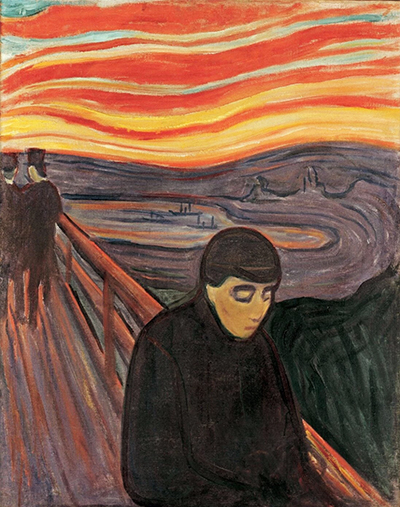
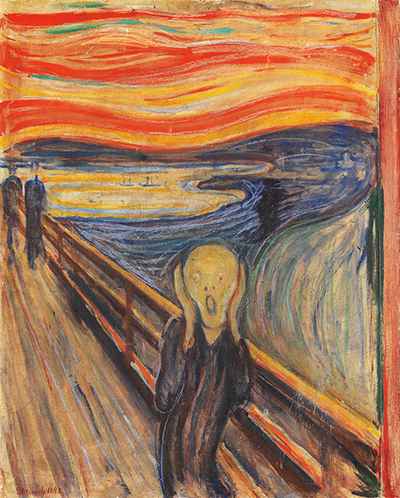
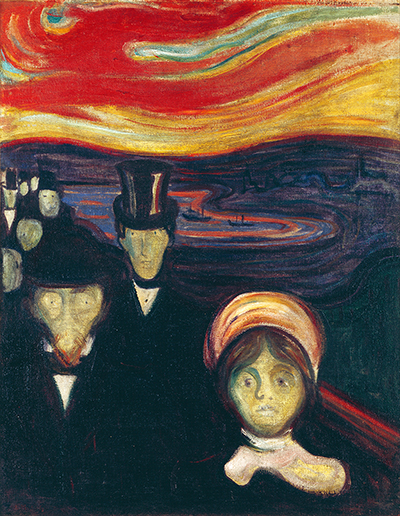
This is why The Sick Child belongs beside the later anxiety pictures. In The Scream, Despair and Anxiety, Munch makes inner states visible through colour, line and surface. In The Sick Child, he begins that process through illness and loss. [5]
The painting's importance is therefore both biographical and formal. It made personal memory into a modern pictorial problem, and Munch's later writings confirm how central the motif remained in his account of his own art. [2] [3]
Things You Might Miss
- The original title was Study. It was first shown under that title at the Autumn Exhibition in 1886. [1]
- The surface is central. Scratches, abrasions and thin/trickling passages are part of the painting's force. [1]
- The sitter is not simply Sophie. The painting is associated with Sophie, but the likely models were Betzy Nilsen and Karen Bjolstad. [1]
- The National Museum version arrived through an exchange. The museum first had the 1896 version before acquiring the original in 1931. [1]
- X-rays matter here. Technical study revealed compositional changes and later reworking. [1]
- The motif continued into prints. Munch made several print versions and adaptations. [7]
Timeline
- 1877 - Munch's sister Johanne Sophie dies of tuberculosis at fifteen. [1]
- 1885-86 - Munch paints the original version of The Sick Child. [1]
- 1886 - The painting is shown at the Autumn Exhibition under the title Study. [1]
- 1896 - Munch paints another version; this later becomes part of Olaf Schou's 1909 bequest. [1]
- 1907 - Munch paints two further versions of the composition. [1]
- 1931 - The National Gallery exchanges the 1896 version for the original 1885-86 painting. [1]
- 2009 - The painting is the central element in a National Museum exhibition on The Sick Child. [1]
Comparison Works
The most important comparison is Death in the Sickroom. Both works return to illness and family death, but The Sick Child compresses the scene into a close sickbed encounter while Death in the Sickroom expands grief into a family group. [5]
Compare it also with Child and Death, By the Deathbed and Inheritance. These works make illness and mortality part of Munch's larger modern subject matter, not only a private trauma. [4]
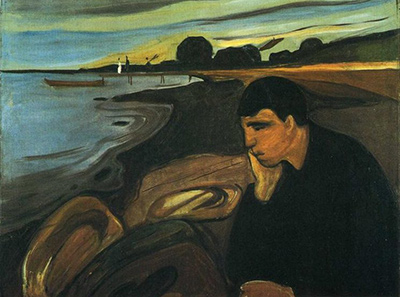
The next route leads to The Scream, Despair, Anxiety and Melancholy. These later works show how Munch continued to make psychological states visible through surface, line and colour. [6]
Finally, compare the painting with The Sick Child I and the print versions. Repetition across media is central to Munch's career, and this subject was one of the motifs he could not leave behind. [7]
FAQs
The original 1885-86 version discussed here is in the National Museum of Norway, inventory number NG.M.00839. It was acquired in 1931. [1]
The painting is often associated with Johanne Sophie Munch, who died of tuberculosis in 1877, but the National Museum records the likely models as Betzy Nilsen and Karen Bjolstad. [1]
When first shown in 1886 as Study, critics were divided by its sketchy, unfinished surface. Some saw failure; others praised its bold emotional force. [1]
The National Museum records five further painted versions after the original, plus four print versions loosely based on the same subject and composition. [1]
The scraped, scratched and reworked surface is part of the painting's expressive meaning. Technical study also shows revisions and later reworking. [1]
References
- National Museum of Norway, Edvard Munch, The Sick Child, object record and catalogue text, accessed 5 July 2026.
- MUNCH, Edvard Munch, accessed 5 July 2026.
- eMunch, Edvard Munch's Writings: The English Edition, accessed 5 July 2026.
- Gerd Woll, Edvard Munch: Complete Paintings, London: Thames & Hudson, 2009.
- Patricia G. Berman, ed., Edvard Munch: The Modern Life of the Soul, New York: Museum of Modern Art, 2006.
- Giulia Bartrum, ed., Edvard Munch: Love and Angst, London: British Museum / Thames & Hudson, 2019.
- MUNCH, Our Collection, accessed 5 July 2026.
- TheHistoryOfArt.org, local Edvard Munch sitemap and internal-link QA, checked 5 July 2026.