

 by Tom Gurney
Tom Gurney BSc (Hons) is an art history expert with over 20 years experience
Published on June 19, 2020 / Updated on July 5, 2026
Email: tomgurney1@gmail.com / Phone: +44 7429 011000
The Kiss by Edvard Munch: Union and the Loss of Self
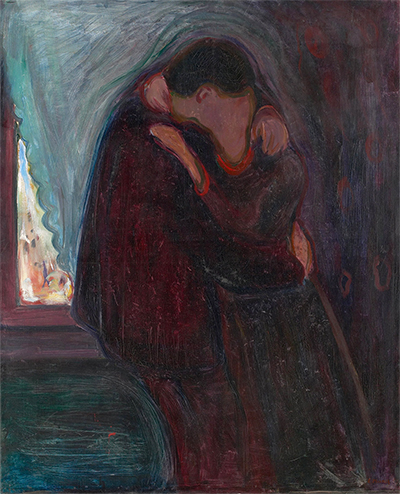
Edvard Munch's The Kiss is one of his most concentrated images of intimacy. A couple stands in a dark room beside a partly covered window. Their bodies press together, their heads meet, and their faces merge into a single featureless shape. The image appears to show union, but Munch makes that union deeply ambivalent. [2]
The main painting discussed here is the 1897 oil on canvas in the MUNCH collection, usually catalogued as 99 x 81 cm. Munch had explored kissing-couple motifs since the late 1880s, including Kiss by the Window in 1892, and later returned to the subject in prints and woodcuts. [1]
This makes The Kiss the natural counterpart to Separation. In Separation, the figures are apart but still bound by memory and hair. In The Kiss, the figures are physically joined, but the joining threatens to erase their separate identities. [5]
For that reason, the painting should not be treated as a simple romantic scene. It belongs to Munch's darker love sequence, where intimacy can mean desire, fusion, enclosure, possession and the fear of losing oneself. [3]
At a Glance
- Artist:Edvard Munch
- Title:The Kiss
- Date:1897
- Medium:Oil on canvas
- Dimensions:99 x 81 cm
- Collection:MUNCH, Oslo
- Motif route:Love, union and The Frieze of Life
Contents
- Why The Kiss Matters
- Looking Carefully
- The Window and the Dark Room
- The Merged Faces
- Versions and Prints
- The Frieze of Life
- Meaning and Interpretation
- Things You Might Miss
- Timeline
- Comparison Works
Why The Kiss Matters
The Kiss matters because it compresses one of Munch's central subjects into a single dark form: what happens when love promises union but threatens individuality. The couple appears joined, but the fusion of the faces makes the embrace unsettling rather than reassuring. [2]
MUNCH presents Munch's 1890s art within Symbolism and the early formation of Expressionism, and records that he later presented The Frieze of Life as a cycle of major human experiences. The Kiss belongs to that cycle's love route. [7]
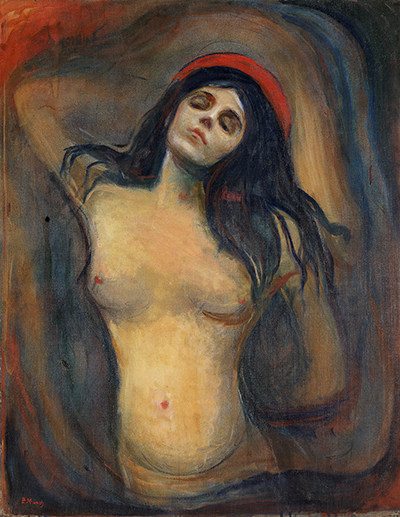
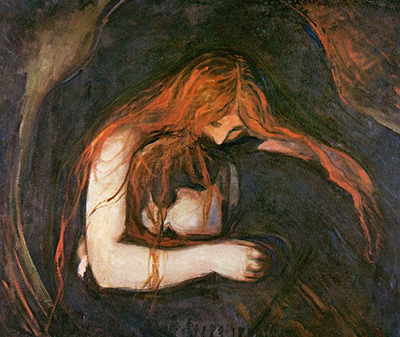
The painting is also essential for internal linking. It sits between Separation, Vampire, Madonna, Dance of Life and Eye in Eye. Together these works show Munch treating love as attraction, merger, possession, erotic vision and loss. [5]
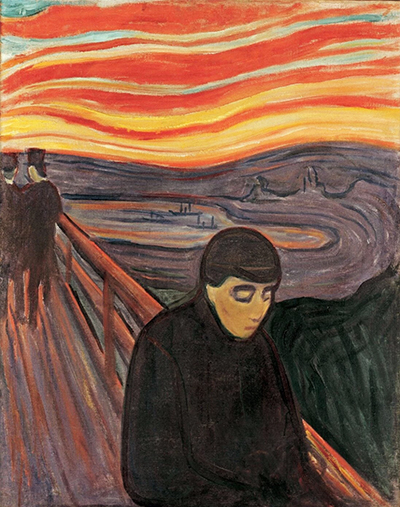
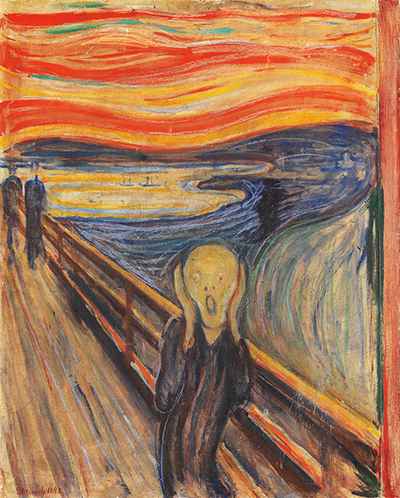
It also gives the cluster a counterweight to the anxiety route of The Scream and Despair. Munch's modernity is not only the figure who screams; it is also the couple who become one shape and thereby lose the clarity of two selves. [3]
Looking Carefully
The painting is built around compression. The couple occupies the centre, locked together in a tight embrace. The room is dark, the surrounding space is narrow, and the window offers only a sliver of light. Munch avoids anecdotal detail so the viewer concentrates on the physical merger of the figures. [4]
The faces are the key. They do not remain two readable profiles. They dissolve into a single blank shape, as if the kiss has erased the boundary between one person and another. This is why the painting feels more serious than sentimental. [2]
The bodies are also simplified. Their clothes and contours form a dark vertical mass, while the heads become the only area where identity might appear. But that is precisely where identity disappears. [3]
The result is a painting that looks intimate at first and claustrophobic a moment later. Munch makes the kiss both an embrace and an enclosure. [5]
The Window and the Dark Room
The window is easy to overlook, but it is essential. It marks an outside world beyond the couple: air, light, street or distance. The curtain partly blocks that world, and the interior becomes the couple's sealed emotional space. [4]
Earlier versions, including Kiss by the Window, make this inside/outside contrast even clearer. The 1897 version simplifies and darkens the motif, reducing the room to a compressed stage for the fusion of the bodies. [1]
The window also gives the painting a subtle tension between life outside and absorption inside. The world continues beyond the room, but the lovers are momentarily cut off from it. [2]
The Merged Faces
Reinhold Heller's reading of the joined faces is central: the figures are difficult to separate exactly where their heads meet. That merger suggests unity, but also a threatening loss of identity. [3]
This is the opposite of Separation. In that painting, physical distance is painful because attachment continues. In The Kiss, physical closeness is unsettling because separation disappears. Munch treats love as a condition in which two dangers coexist: loneliness and absorption. [5]
The blankness of the faces also stops the image from becoming portraiture. We are not asked to identify a particular couple. We are asked to confront a state: intimacy as merger. [2]
That is why the painting has stayed so powerful. It gives viewers a recognisable human act, then removes the ordinary signs that would make it psychologically comfortable. [4]
Versions and Prints
Munch explored the kissing-couple motif across many years. Woll's catalogue places the 1897 painting within a longer sequence that includes earlier painted versions and later graphic works. [1]
Printmaking matters because Munch often used prints to sharpen and circulate his major motifs. The National Gallery of Art's Edvard Munch Master Prints context is useful here: Munch's graphic work was not secondary illustration, but a core part of how he developed repeated themes. [6]
In woodcut and print versions, the couple can become even more compressed, flattened and emblematic. The theme of fusion becomes a graphic problem: how little detail can remain while the kiss still reads as love, union and danger? [6]
That is why the future Munch prints page will be an essential companion to this one. The painting is the flagship object, but the motif lives through repetition. [1]
The Frieze of Life
MUNCH records that Munch presented The Frieze of Life in 1902 as a group of images about central human experiences. The project helps explain why The Kiss should not be isolated as a romantic picture. It is one episode in a larger cycle of attraction, love, anxiety, jealousy, separation and death. [7]
Within that cycle, The Kiss is the moment of union. Separation is the afterimage of distance. Vampire complicates embrace with possession. Madonna turns erotic vision toward mortality and generation. Dance of Life expands the whole sequence into symbolic rhythm. [5]
The painting therefore acts like a hinge between attraction and loss. It gives the love route its most compact image of two people becoming one and asks whether that fusion is fulfilment or danger. [3]
Meaning and Interpretation
The strongest interpretation begins with ambivalence. The Kiss shows closeness, but not easy happiness. The lovers are joined so completely that individuality almost disappears. [2]
Munch's wider work repeatedly treats love as double-edged. It draws people together, but it can also trap, consume, wound or unsettle them. The Kiss is the quietest form of that danger because nothing violent appears on the surface. The threat is in the merger itself. [8]
The dark room intensifies this reading. If the window suggests the world outside, the couple's embrace creates a space where ordinary identity and social visibility are suspended. The painting is private, but not peaceful. [4]
This makes the painting one of Munch's most subtle modern images. It does not need screaming colour or theatrical gesture. It makes intimacy itself unstable. [5]
Things You Might Miss
- The faces become one. The central effect is not just kissing, but the loss of two separate identities. [3]
- The room is almost sealed. The curtain and dark interior make the couple feel cut off from the outside world. [4]
- The painting answers Separation. One page shows painful distance; this one shows unsettling fusion. [5]
- The motif predates 1897. Munch had explored kissing-couple images since the late 1880s and 1892 window versions. [1]
- The prints matter. Munch's woodcuts and prints helped make the motif flatter, stronger and more repeatable. [6]
- It is not Klimt's Kiss. Munch's kiss is darker, more compressed and more psychologically ambivalent. [8]
Timeline
- 1888/89 - Munch begins exploring kissing-couple motifs. [1]
- 1892 - Kiss by the Window develops the interior/window version of the subject. [1]
- 1897 - Munch paints the main MUNCH version of The Kiss. [1]
- 1902 - Munch presents The Frieze of Life as a connected cycle. [7]
- 1903 - The Kiss appears within the love sequence in Munch's exhibition context. [4]
Comparison Works
The first comparison is Separation. The two works form a pair of opposites: separation without release, and union without safety. [5]
The second is Vampire, where embrace becomes more possessive and hair becomes a binding force. The Kiss is quieter, but it shares the idea that intimacy can overwhelm individuality. [8]
The third route moves through Madonna, Dance of Life and Eye in Eye. These works develop Munch's larger vocabulary of desire, encounter, erotic vision and symbolic life-cycle imagery. [5]
Finally, compare the page with The Scream and Despair. They belong to the anxiety route, but they help reveal a shared method: Munch takes a human state and turns it into a concentrated visual form. [3]
FAQs
The main 1897 oil painting is in the MUNCH collection in Oslo and is usually catalogued as 99 x 81 cm. [1]
It shows intimacy as both union and loss of self. The lovers merge into one shape, making the embrace tender and unsettling at the same time. [2]
Yes. It belongs to Munch's love route within The Frieze of Life, alongside works such as Separation, Vampire, Madonna and Dance of Life. [7]
Separation shows figures apart but still connected. The Kiss shows figures together, but so fused that their separate identities begin to disappear. [5]
Yes. Munch developed the kissing-couple motif in graphic work, and the print versions are important for understanding how he repeated and simplified major themes. [6]
References
- Gerd Woll, Edvard Munch: Complete Paintings, London: Thames & Hudson, 2009.
- Museum of Modern Art, Edvard Munch: The Kiss, educational/audio material, accessed 4 July 2026.
- Reinhold Heller, Edvard Munch: Life and Work, Munich: Prestel, 1993.
- Ulrich Bischoff, Edvard Munch: 1863-1944, Cologne: Taschen, 2000.
- Patricia G. Berman, ed., Edvard Munch: The Modern Life of the Soul, New York: Museum of Modern Art, 2006.
- National Gallery of Art, Edvard Munch Master Prints, Washington, DC, 2010.
- MUNCH, Edvard Munch, accessed 4 July 2026.
- MUNCH, Our Collection, accessed 4 July 2026.