

 by Tom Gurney
Tom Gurney BSc (Hons) is an art history expert with over 20 years experience
Published on June 19, 2020 / Updated on July 5, 2026
Email: tomgurney1@gmail.com / Phone: +44 7429 011000
Introduction
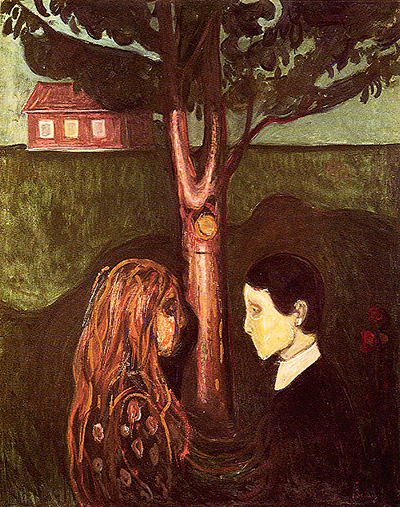
Eye in Eye is one of Edvard Munch's quiet but unnerving love images. Dated 1899-1900 and associated with the MUNCH collection, it reduces a meeting between two figures to a few charged elements: the couple, a central tree, a small house and the locked exchange of sight. [2] [3]
The painting matters because it sits between Munch's romantic and psychological motifs. It is not as famous as The Kiss, Separation or Vampire, but it helps explain how Munch built drama from encounter itself. The two figures do not need a theatrical embrace or narrative action. Their looking is the event. [4]
At a Glance
- Artist: Edvard Munch
- Title: Eye in Eye
- Date: 1899-1900
- Collection: MUNCH, Oslo
- Subject: Two figures facing one another in a reduced landscape
- Cluster role: Love-route connector between attraction, fusion, jealousy and separation
Why This Painting Matters
Eye in Eye gives Munch's love imagery an unusually compressed form. In The Kiss, the two figures fuse. In Separation, they pull apart. In Vampire, embrace becomes difficult to separate from possession and pain. Eye in Eye comes before those outcomes. It shows the charged moment of looking, when relation has begun but has not yet become union, loss or violence. [4] [6]
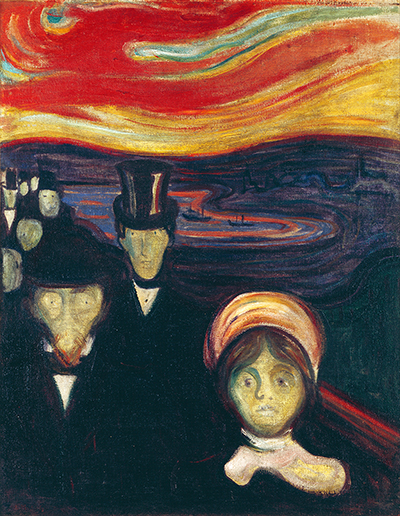
That is why the painting is valuable for the Munch cluster. It is a bridge between pages about love and pages about anxiety. The scene appears simple, but it has the emotional pressure of a threshold: two people stand near one another, yet the tree and the house turn the space between them into a problem. [8]
Museum and Frieze Context
MUNCH presents Munch as a central modern artist whose career stretched from the 1880s until his death in 1944, with recurring experiments across media. That long practice matters because Eye in Eye should not be treated as a stray romantic scene. It belongs to the repeated visual language through which Munch returned to love, anxiety, sickness and death. [1]
Scholarly discussion of Munch's Frieze of Life is the best frame for this work. The Frieze was not a single fixed series but a way of organising human experience into connected motifs. Eye in Eye belongs to the encounter and attraction side of that world, close to The Kiss and Dance of Life but also near darker images such as Jealousy, Vampire, Ashes and Separation. [4] [6]
Looking Carefully
The painting is built from very few parts. Two figures face each other. A tree rises between them and the small house behind. The setting is not described in the detailed language of naturalist landscape. It is simplified until the emotional geometry becomes clear. [3]
The most important detail is the exchange of sight. The title tells us how to look: eye in eye. Munch reduces facial expression so that the gaze carries almost everything. If the figures seem oddly silent, that silence is part of the painting's force. Communication happens through looking rather than speech. [5]
The tree is equally important. It does not merely decorate the scene. Placed in the centre, it divides the composition and interrupts the path between figure, house and background. A cautious reading should stop short of assigning it one fixed meaning, but the visual evidence is clear: the tree makes the encounter feel blocked, structured and tense. [6]
The House Behind the Couple
The small house changes the scene. Without it, Eye in Eye might read simply as a meeting in nature. With it, the image begins to imply domestic possibility: shelter, intimacy, future life or social order. Yet the house is behind the tree, not openly available. [3]
That spatial arrangement makes the painting feel suspended. The couple's gaze is intense, but nothing is resolved. They are close enough for attraction and far enough for uncertainty. Munch's love imagery often works this way: emotion is not explained by plot, but by the pressure of figures, colour, distance and repeated motifs. [4]
Comparison Works
Eye in Eye is most useful when placed among Munch's better-known love images. These comparison routes were checked against the local Edvard Munch sitemap during production. [8]
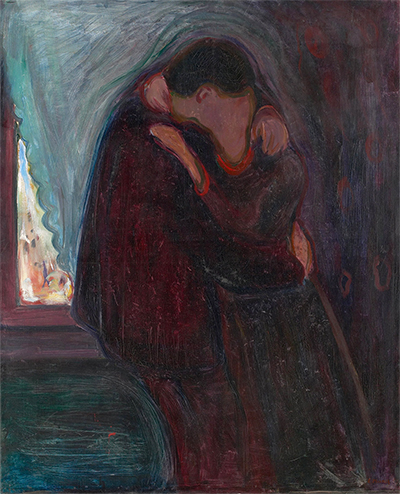
- The Kiss shows a later stage of relation, where two heads and bodies merge into one form. [4]
- Separation gives the opposite condition: the figures are apart, yet still bound by memory and pain. [4]
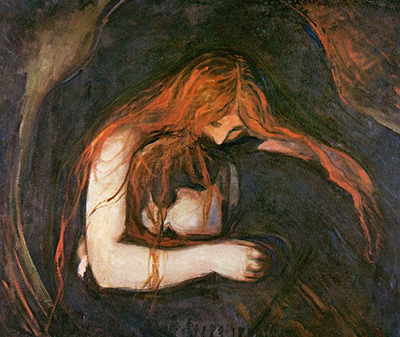
- Vampire makes the embrace more ambiguous, mixing tenderness, red hair and bodily surrender. [6]
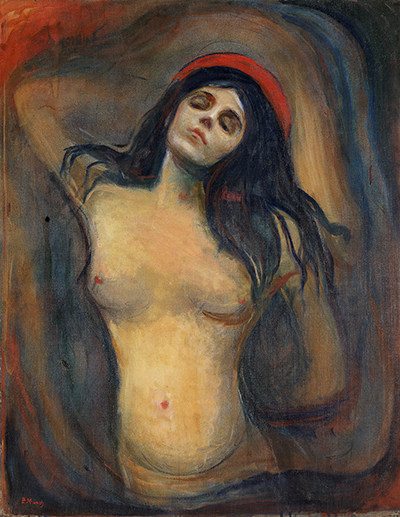
- Madonna turns erotic attraction into a larger image of sexuality, birth and death. [6]
- Dance of Life places love within a public rhythm of youth, desire, ageing and mortality. [4]
- Jealousy and Ashes show that looking can wound as well as connect. Eye in Eye is quieter than those paintings, but it shares their central problem: to look at another person is already to enter a charged emotional field. [5]
Things You Might Miss
- The mouths are reduced, so the eyes carry the encounter. [5]
- The tree is not background decoration. Its central position shapes the whole emotional structure. [6]
- The house matters because it gives the scene a possible domestic horizon, even though the composition blocks any easy access to it. [3]
- The painting is a love image without embrace. That makes it a useful prelude to The Kiss, Vampire and Separation. [4]
- Its simplicity is strategic. Fewer objects mean each element has more interpretive weight. [6]
Interpretation
Eye in Eye should be read as a painting about encounter, not simply romance. Munch shows the instant when two people become intensely present to each other, but he refuses to make that presence reassuring. The locked gaze is powerful, yet the space around it is uneasy. [6]
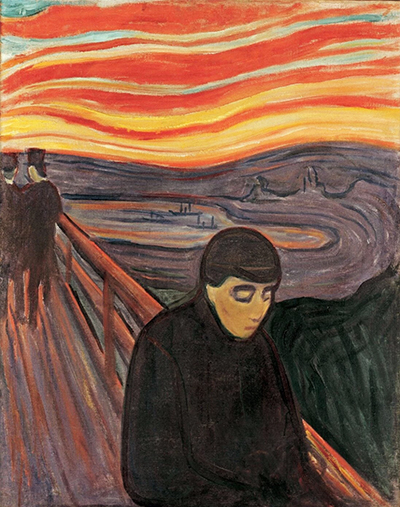
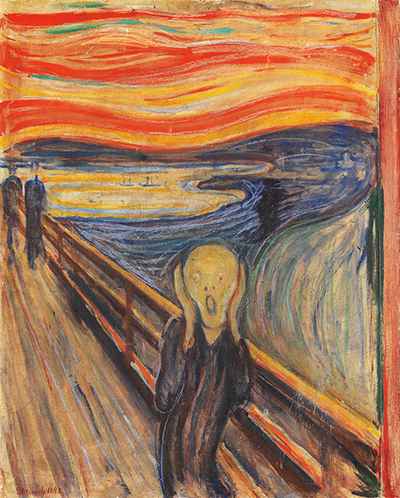
The painting's restraint is important. It does not need the red sky of The Scream or the wounded body language of Separation. Its drama comes from a few relationships: eye to eye, body to body, tree to house, foreground to background. The result is a small but concentrated statement about attraction as both connection and disturbance. [7]
Timeline
- 1863: Edvard Munch is born. [1]
- 1890s: Munch develops the motifs of love, anxiety, jealousy and death that later gather around the Frieze of Life. [4]
- 1899-1900: Eye in Eye is usually dated to this turn-of-the-century period. [3]
- 1902: Munch presents major works as the Frieze of Life, giving his repeated motifs a larger cycle of human experience. [4]
- 1944: Munch dies, leaving a large body of paintings, prints and drawings to the city of Oslo. [1] [2]
Where to Go Next
Read Eye in Eye as the beginning of a love-route sequence. Move next to The Kiss for fusion, Vampire for embrace made ambiguous, Jealousy for looking as exclusion, Ashes for emotional aftermath and Separation for love after rupture. Together, these pages show why Munch's art of feeling is not only about anxiety but also about the unstable forms of desire. [4] [8]
FAQs
It shows two figures facing one another in a simplified landscape. The central subject is the locked exchange of sight, which turns a possible romantic encounter into something more psychologically tense. [5]
The work is usually dated 1899-1900. [3]
The work is associated with the MUNCH collection in Oslo. [2]
Eye in Eye shows encounter before fusion. The Kiss shows the couple merged into a single form, while Eye in Eye keeps the figures separate and makes looking the main event. [4]
References
- MUNCH, "Edvard Munch (1863-1944)," official artist page, accessed 5 July 2026.
- MUNCH, "Catalogue Raisonne / About the Collection," accessed 5 July 2026.
- Gerd Woll, Edvard Munch: Complete Paintings, London: Thames & Hudson, 2009.
- Arne Eggum, Edvard Munch: The Frieze of Life, 1993.
- Reinhold Heller, Edvard Munch: The Scream, London: Allen Lane, 1973.
- Patricia G. Berman, ed., Edvard Munch: The Modern Life of the Soul, Museum of Modern Art, 2006.
- eMunch, Edvard Munch's Writings: The English Edition, accessed 5 July 2026.
- TheHistoryOfArt.org, Edvard Munch sitemap and local internal-link validation, checked 5 July 2026.