

 by Tom Gurney
Tom Gurney BSc (Hons) is an art history expert with over 20 years experience
Published on June 19, 2020June 19, 2020 / Updated on July 6, 2026
Email: tomgurney1@gmail.com / Phone: +44 7429 011000
Madonna by Edvard Munch: Love, Sanctity and the Red Halo
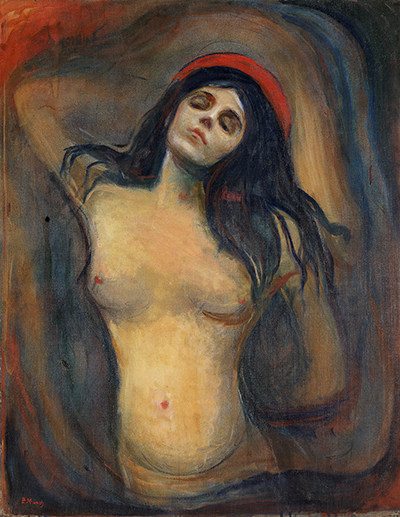
Edvard Munch's Madonna is one of his most charged images of love, sexuality, birth and death. A half-length woman arches backward, eyes closed, against quivering lines of dark colour. Around her head is not the gold halo of traditional Christian imagery, but a red one. The painting makes its tension visible before any explanation begins. [1]
The National Museum of Norway records its Madonna as an 1894 oil painting on canvas, 90.5 x 70.5 cm, inventory number NG.M.00841. It is signed lower left and entered the collection as a gift from Olaf Schou in 1909. [1]
The title is the key. Madonna normally refers to the mother of Jesus, but the National Museum records the alternative title Elskende kvinde, or Amorous Woman. Munch sets sacred naming against erotic pose, and the viewer has to hold both meanings at once. [1]
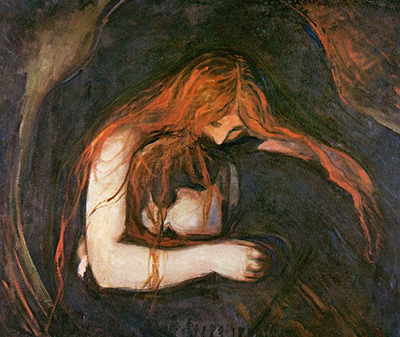
That is why this page belongs at the centre of the Munch cluster's love-and-death route, beside The Kiss, Vampire, Separation and Dance of Life. It is also a bridge to the future Munch prints page, because the motif became one of Munch's most famous printed images. [7]
At a Glance
- Artist:Edvard Munch
- Title:Madonna
- Alternative title:Elskende kvinde / Amorous Woman
- Date:1894
- Medium:Oil on canvas
- Dimensions:90.5 x 70.5 cm
- Collection:National Museum of Norway
- Inventory no.:NG.M.00841
- Acquisition:Gift from Olaf Schou, 1909
Contents
- Museum Perspective
- Looking Carefully
- The Title Problem
- Munch's Writing
- Versions, Prints and the Border
- Exhibition History
- The Frieze of Life
- Meaning and Interpretation
- Things You Might Miss
- Timeline
Museum Perspective
The National Museum's catalogue text begins with looking. It describes a woman shown half-length, arching her back, with one arm behind her head and the other behind her back. Her eyes are closed and she appears almost to float against a background of undulating lines. [1]
The museum then identifies the central tension: the title Madonna contrasts with both the figure and the alternative title Amorous Woman. The halo is present, but it is red rather than gold. That small shift changes the whole temperature of the image. [1]
The museum's own interpretation is careful and useful. It says the picture combines erotic and religious associations, making the woman both a lover and an exalted figure. This is the strongest way to approach the painting: not as a single coded symbol, but as a collision of meanings. [1]
The catalogue also gives the page its factual frame. Munch painted five versions of Madonna between 1894 and 1897, and recent research cited by the museum confirms that the National Museum's painting is the first in the series. [1]
Looking Carefully
The pose is open, but not straightforward. The figure's arms are hidden or lifted away from the viewer, so the body becomes a single curving form. Her eyes are closed, which makes the image less like a portrait and more like a visionary or inward state. [1]
The red halo is the painting's sharpest visual paradox. It preserves the circular sign of sanctity while replacing the expected gold with a colour associated here with blood, desire, heat and bodily life. The religious reference remains, but it has been transformed. [1]
The dark lines around the body matter too. They do not describe a room or a stable setting. They pulse around the figure, making the space feel psychological rather than architectural. In this sense, Madonna belongs with Munch's wider 1890s practice of making emotion visible through line and colour. [6]
The painting also withholds the expected Christian narrative. There is no child, no domestic setting and no supporting saintly iconography. Munch gives the viewer a Madonna without the usual devotional structure around her. [7]
Video Guide
This selected video from Nasjonalmuseet offers useful visual context before the detailed analysis continues.
The Title Problem
The title Madonna cannot be treated as a simple label. It brings in a long tradition of images of the Virgin Mary, but Munch's figure is not shown as a serene mother with the Christ Child. The alternative title Amorous Woman pulls the work toward desire and erotic presence. [1]
This tension is not a mistake or an afterthought. It is the engine of the work. Munch uses a religious title to intensify an image of sexuality, and he uses erotic subject matter to disturb a sacred visual category. [6]
That is why it is too weak to describe the painting only as an erotic Virgin Mary. The better reading is that Munch forces sanctity, desire, procreation and death into the same image. [1] [4]
Munch's Writing
Munch's own notes help explain why the image is not only erotic. A note cited by the National Museum and preserved in the eMunch archive describes the "woman in a state of abandon" and connects that abandon with the painful beauty of a Madonna. [1] [4]
Another Munch text, also cited by the museum, places the subject in a life-and-death frame: "death holds out a hand to life." That short phrase is crucial. It shows that Munch was thinking beyond erotic display toward generation, mortality and continuity. [1] [4]
The National Museum also cites the poet Sigbjorn Obstfelder, who called the image a "Madonna of the Earth." That response belongs to the painting's early reception and shows how quickly viewers read it as a secular, bodily and still quasi-religious image. [1]
These quotations should be used with care. They do not make the work a puzzle with one solution. They confirm that Munch and his circle understood Madonna as an image where sexuality, holiness, childbirth and death press into one another. [7]
Versions, Prints and the Border
The National Museum records five painted versions of the Madonna motif, traditionally dated between 1894 and 1897. None of the five existing versions carries a date, which is why chronology has been debated. The museum's 2022 catalogue text cites recent research confirming its painting as the first version. [1]
The printed versions are essential, not secondary. The museum records an etching from 1894 and a lithograph from 1895/1902. The lithograph encloses the figure in a border of sperm cells with a foetus in the lower-left corner, making explicit the reproductive theme that the painting holds more indirectly. [1] [8]
This border has often become the most repeated fact about Madonna, but it should not be treated as mere shock value. In Munch's printed version, the border turns frame into meaning. The image is about desire, conception, birth and death as a cycle, not only about a single nude figure. [6]
Printmaking also changed the public life of the motif. Like The Scream and Vampire, Madonna became repeatable, variable and portable through graphic work. That makes it one of the strongest bridges from the painting pages into the Munch prints route. [3] [8]
Exhibition History
The National Museum records the first showing of a version of Madonna at the Blanch art dealership in Stockholm in 1894. It appeared in a sequence called "Studies for a mood series: Love," and the catalogue included entries under the title Kvinnan som älskar, or The Amorous Woman. [1]
Munch also showed two versions of the motif simultaneously in several exhibitions. At Ugo Barroccio in Berlin in March 1895, they appeared in the sequence Die Liebe, with one titled Madonna and another Das liebende Weib. [1]
In 1903, Madonna appeared in Munch's Leipzig exhibition at P.H. Beyer & Sohn, where he presented what later became known as The Frieze of Life as a coherent series. Documentary photographs show Madonna hung near Ashes in the section dealing with the flowering and fall of love. [1]
The Frieze of Life
Madonna belongs to Munch's larger project around love, anxiety, jealousy, illness and death. The National Museum's exhibition history ties it directly to the sequence of love works that became part of The Frieze of Life. [1]
Within that cycle, Madonna does something different from The Kiss. The Kiss turns love into union and merged identity. Madonna turns love into a sacred-erotic image of procreation and mortality. [6]
It also differs from Separation and Vampire. Those works explore love as distance, possession and wound. Madonna is more iconic. It condenses the whole cycle into one frontal, floating body. [7]
Meaning and Interpretation
The strongest interpretation begins with what can be seen and documented. The title is sacred; the alternative title is erotic. The halo is present; its colour is red. The body is nude; the eyes are closed. The painted versions multiply; the lithograph adds a reproductive border. [1]
From those facts, the meaning becomes clearer. Madonna is not simply blasphemous, devotional or erotic. It is an image of contradiction: woman as lover, holy figure, source of life and figure shadowed by death. [1] [4]
This is also where interpretation must avoid overclaiming. Munch's depictions of women are often difficult, contradictory and charged, but this page should not turn the painting into a simple statement of misogyny or biography. The evidence supports a more precise reading: Munch used the Madonna motif to stage the unstable relationship between desire, sanctity, generation and mortality. [6] [7]
That complexity is why the painting remains so powerful. It feels iconic, but it resists the calm certainty of an icon. Its subject is the uneasy passage between body, spirit, birth and death. [1]
Things You Might Miss
- The halo is not missing. Munch keeps the sign of sanctity, but turns it red. [1]
- The alternative title changes the reading. Amorous Woman makes desire part of the documented title history. [1]
- The National Museum version is now treated as first. Recent research cited by the museum confirms it as the first painted version. [1]
- The famous sperm-and-foetus border belongs to the lithograph. The painted version does not carry that same border. [1] [8]
- The work was part of love sequences before it became an isolated icon. Early exhibitions placed it in series such as Love and Die Liebe. [1]
- The page should be read with the prints. Munch's graphic versions make the motif's reproductive symbolism more explicit. [8]
Timeline
- 1894 - Munch creates the National Museum's Madonna, now confirmed by recent research cited by the museum as the first painted version. [1]
- 1894 - A version is shown at Blanch in Stockholm in a sequence called "Studies for a mood series: Love." [1]
- 1894 - Munch makes an etched version of the subject. [1]
- 1895 - Madonna versions are shown in Berlin at Ugo Barroccio in the sequence Die Liebe. [1]
- 1895/1902 - Munch develops the lithographic version with sperm cells and a foetus in the frame. [1]
- 1903 - Madonna appears in Munch's Leipzig exhibition, where the future Frieze of Life is presented as a coherent series. [1]
- 1909 - Olaf Schou gives the painting to the National Gallery. [1]
Comparison Works
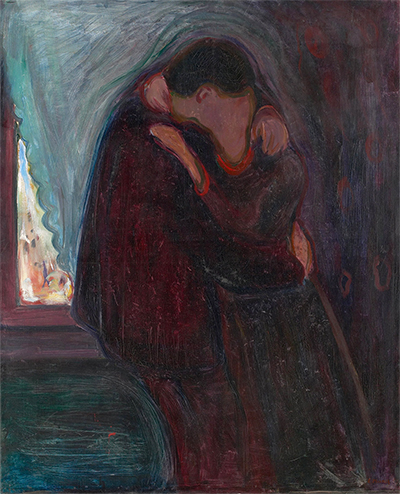
Compare Madonna first with The Kiss. In The Kiss, bodies merge until identity seems to dissolve. In Madonna, one body becomes an icon of erotic and sacred force. Both works ask what love does to the self. [6]
Then compare it with Vampire and Separation. Those paintings make love darker through embrace, hair, wound and distance. Madonna is less narrative, but it belongs to the same love-and-death route. [7]
Dance of Life is the next essential comparison because it expands the subject into a full cycle of desire, maturity and loss. Madonna condenses that cycle into a single figure. [5]
Finally, compare Madonna with Puberty and Ashes. These works show Munch returning to sexuality as a psychological and symbolic threshold, rather than as a simple academic nude subject. [6]
FAQs
The 1894 version discussed here is in the National Museum of Norway, inventory number NG.M.00841. It entered the collection as a gift from Olaf Schou in 1909. [1]
The painting combines sacred and erotic associations. The religious title, red halo, nude body, closed eyes and version history connect love, sanctity, procreation and death. [1]
Yes. The National Museum records Elskende kvinde, or Amorous Woman, as an alternative title, and early exhibition titles also used related wording. [1]
The National Museum records five painted versions of the motif between 1894 and 1897, as well as an 1894 etching and a lithograph from 1895/1902. [1]
References
- National Museum of Norway, Edvard Munch, Madonna, object record and catalogue text, accessed 5 July 2026.
- MUNCH, Edvard Munch, accessed 5 July 2026.
- MUNCH, Our Collection, accessed 5 July 2026.
- eMunch, Edvard Munch's Writings: The English Edition, accessed 5 July 2026.
- Gerd Woll, Edvard Munch: Complete Paintings, London: Thames & Hudson, 2009.
- Patricia G. Berman, ed., Edvard Munch: The Modern Life of the Soul, New York: Museum of Modern Art, 2006.
- Giulia Bartrum, ed., Edvard Munch: Love and Angst, London: British Museum / Thames & Hudson, 2019.
- National Gallery of Art, Edvard Munch Master Prints, Washington, DC, 2010.
- TheHistoryOfArt.org, local Edvard Munch sitemap and internal-link QA, checked 5 July 2026.