

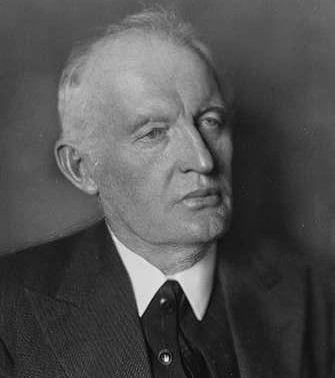
 by Tom Gurney
Tom Gurney BSc (Hons) is an art history expert with over 20 years experience
Published on June 19, 2020June 19, 2020 / Updated on July 6, 2026
Email: tomgurney1@gmail.com / Phone: +44 7429 011000
Edvard Munch Biography: The Life Behind the Modern Soul
Edvard Munch's biography is one of the most powerful life stories in modern art, but it needs to be handled carefully. His childhood illness, family bereavements, difficult relationships, nervous crisis and long late solitude all shaped his art. They do not, however, turn the paintings into simple diary entries. Munch's achievement was to transform life experience into repeatable modern images: the sickroom, the shoreline, the bridge, the embrace, the scream and the ageing body. [1]
MUNCH, the Oslo museum devoted to his work, presents him as one of Modernism's most significant artists and stresses that he experimented across painting, graphic art, drawing, sculpture, photography and film. It also places him in Symbolism in the 1890s and as a pioneer of Expressionist art from the early twentieth century onward. [2]
This biography follows the life in relation to the art. The aim is not to use Munch's suffering as a shortcut to interpretation, but to show how he built a sustained visual language from illness, love, anxiety, death, city life, landscape and self-scrutiny. [7]
At a Glance
- Born: 12 December 1863
- Died: 23 January 1944
- Childhood city: Kristiania, now Oslo
- Major centres: Kristiania/Oslo, Paris, Berlin, Aasgaardstrand, Ekely
- Major project: The Frieze of Life
- Central themes: love, anxiety, illness, death, self-portraiture
Contents
- Childhood and Family Loss
- Training in Kristiania
- The Sick Child and Early Breakthrough
- Paris, Saint-Cloud and New Ideas
- Berlin and the 1890s
- The Frieze of Life
- Crisis and Return to Norway
- Ekely and Late Life
- Timeline
- Biography and Legacy
Video Guide
This selected video from MUNCH offers useful visual context before the detailed analysis continues.
Childhood and Family Loss
Edvard Munch was born on 12 December 1863, the son of Christian Munch, a military doctor, and Laura Munch. MUNCH records that he spent his childhood in Kristiania, now Oslo, where the family lived on his father's modest salary. [1]
When Munch was five, his mother died from tuberculosis. His aunt Karen moved into the household and became a substitute mother to the children. This early experience of illness and death later became part of the emotional world behind works such as The Sick Child and Death in the Sickroom. [1]
Munch himself was often ill as a child and spent long periods at home. MUNCH notes that his poor health kept him from ordinary schooling for stretches of time, but also gave him space to draw. He drew landscapes, rooms, portraits, still lifes, imagined scenes and copies after other artists. [1]
The childhood story matters, but not because it explains every later motif. It matters because Munch learned early that the body, family, fear and memory could not be separated. Later, he would turn those conditions into images that felt both personal and shared. [7]
Training in Kristiania
At seventeen, MUNCH records, Munch wrote in his diary: "It is my decision now to become a painter." In 1880, he enrolled at the Royal School of Art and Design in Kristiania, where he drew from live models and began to feel his talent awaken. [1]
Kristiania gave Munch both training and friction. He rented studio space with friends and met Christian Krohg, whom MUNCH describes as his first mentor and supporter. Krohg's encouragement helped push Munch toward a more independent art. [1]
The survival and publication of Munch's writings also matters for biography. The eMunch archive makes texts and correspondence available in a scholarly digital edition, giving later readers a way to check Munch's words against the myths that have gathered around his life. [6]
The young artist also encountered the Kristiania Bohemians, a radical circle associated with Hans Jaeger. Their calls for free expression and social rebellion did not simply provide subject matter; they helped create a climate in which Munch could imagine art as confession, critique and psychological experiment. [8]
The Sick Child and Early Breakthrough
In 1886, Munch exhibited the painting he later called The Sick Child. MUNCH links the image to the death of his sister Sophie, who died from tuberculosis when Munch was fourteen. The subject was not unusual in nineteenth-century art, but Munch's handling was. The painting seemed rough, wounded and unfinished. [1]
MUNCH describes the work as both praised and fiercely criticised, and as a small breakthrough. That judgement is important because it shows Munch discovering a problem that would stay with him: how could a painting carry the pressure of memory and grief without smoothing it into polite sentiment? [1]
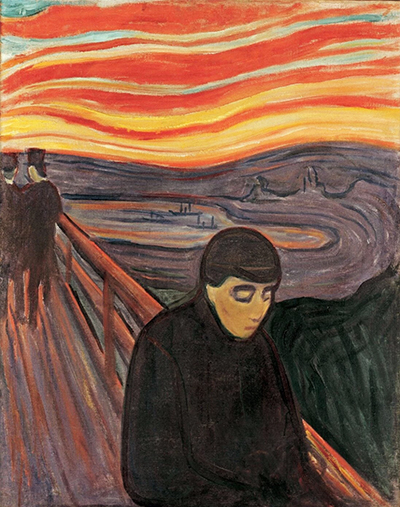
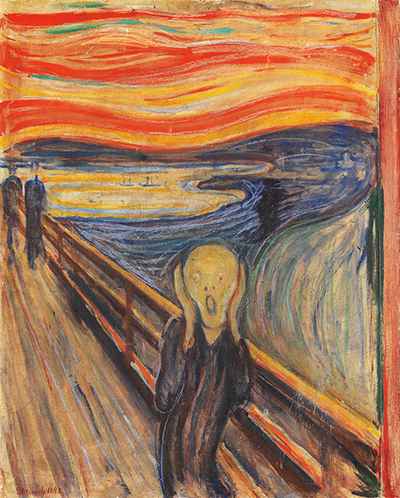
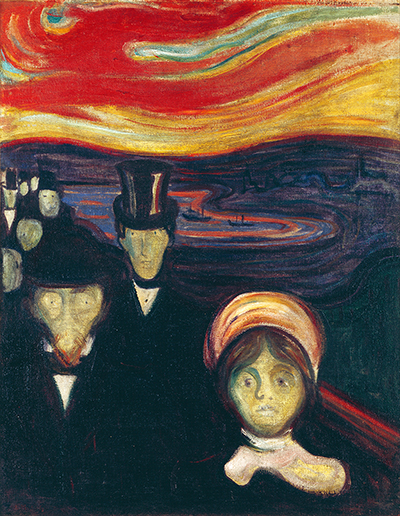
The answer was not only subject matter. Munch made the surface, colour and structure of the work part of its emotional force. In that sense, The Sick Child begins the route that later leads to The Scream, Despair and Anxiety. [9]
Paris, Saint-Cloud and New Ideas
In 1889, Munch held a solo exhibition in Kristiania. MUNCH describes it as the first solo exhibition in the city, and notes that it helped him secure a scholarship for a year in Paris. Shortly before he left, he and his father said goodbye for the last time. [1]
His father died later that year. In Paris and then Saint-Cloud, Munch moved through grief, poverty and artistic uncertainty. MUNCH records that he emerged from this crisis with new artistic ideas: he wanted an art that was personal and profound, stripped down to the existential states of the human soul. [1]
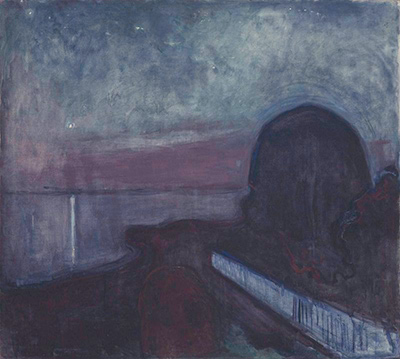
This period is essential for understanding the shift from early naturalism toward psychological modernism. Works such as Night in Saint-Cloud and later anxiety landscapes do not merely describe places. They use interior space, moonlight, distance and silence to organise emotional states. [8]
Berlin and the 1890s
The turning point came in 1892, when Munch was invited to exhibit at the Association of Berlin Artists. The show polarised its audience and was closed after one week. MUNCH records Munch's response in a letter to Aunt Karen: "I could not have a better form of publicity." [1]
Berlin gave Munch notoriety and a new intellectual circle. He met figures including August Strindberg, Stanislaw Przybyszewski and Dagny Juel. They gathered in the bohemian setting known as The Black Piglet, a world of conversation, argument, drinking and artistic provocation. [1]
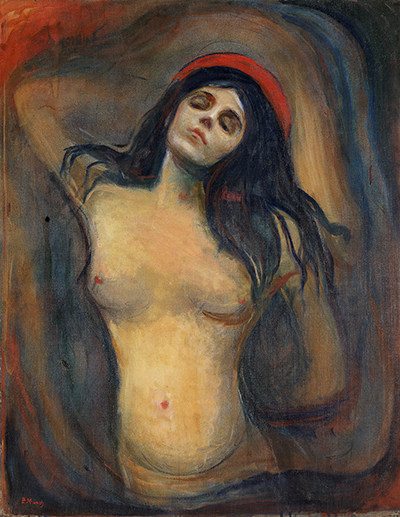
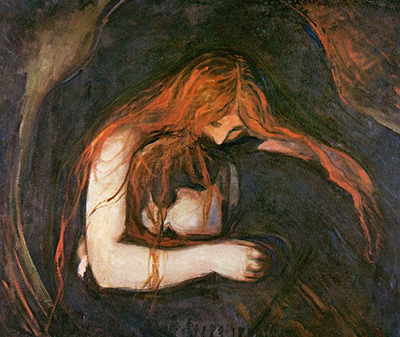
During the 1890s, Munch created some of the motifs that define his reputation: The Scream, Vampire, Puberty and Madonna. The decade also brought printmaking, which MUNCH says gave him freedom to experiment and allowed him to reproduce his artworks in greater quantities. [1]
Printmaking matters biographically because it changed how Munch worked. A motif was no longer only a single painted object. It could be repeated, varied, sold, circulated and reimagined. This is why the future Munch prints page is central to the cluster rather than a side topic. [4]
The Frieze of Life
In 1902, MUNCH records, Munch presented a group of images representing major aspects of human existence. He called it The Frieze of Life. The project gives the Munch cluster its deepest structure: love, anxiety, jealousy, illness and death are not isolated themes, but parts of a cycle. [1]
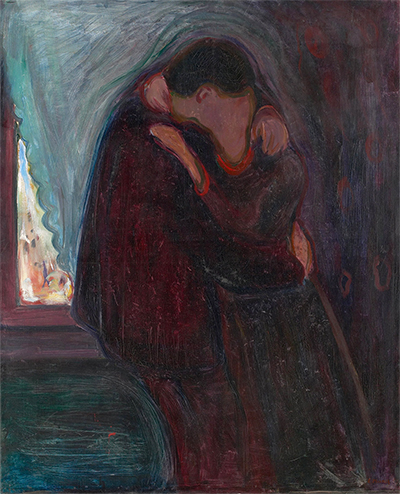
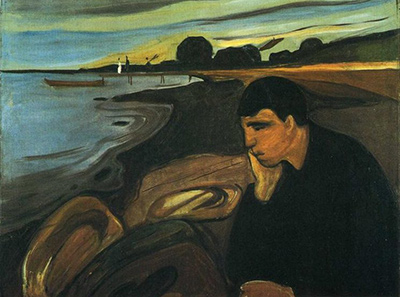
The anxiety route links The Scream, Despair, Anxiety and Sick Mood at Sunset: Despair. The love and separation route links Separation, The Kiss, Vampire, Madonna and Dance of Life. The illness and mortality route links The Sick Child, Death in the Sickroom and related deathbed scenes. [9]
Seen this way, Munch's biography becomes less a series of anecdotes and more a pressure system. Personal memories, relationships, medical crisis and artistic ambition all feed a set of images designed to speak beyond one life. [7]
Crisis and Return to Norway
The years after 1902 were turbulent. MUNCH records Munch's relationship with Mathilde "Tulla" Larsen, their travels, and the quarrel that ended with a gunshot from a pistol Munch kept in his house. His hand was injured, and the event haunted him. [1]
His physical and mental health deteriorated. In 1908, on the brink of exhaustion, he asked to be committed to Dr Daniel Jacobson's private clinic in Copenhagen, where he stayed for several months. MUNCH notes that this was the first time in years he was completely abstinent. [1]
After treatment, Munch returned to Norway and entered a new phase. Between 1909 and 1916 he worked on the decorations for the University of Oslo Aula. These monumental paintings, including versions of The Sun, belong to a brighter and more public side of his art than many readers expect from the painter of The Scream. [1]
Ekely and Late Life
In 1916, Munch bought Ekely, a former plant nursery on the outskirts of Oslo. MUNCH records that he moved into its Swiss-style villa and built several studio spaces. He painted gardens, fruit trees, horses, fields, figures and self-portraits there for the rest of his life. [1]
The late period should not be treated simply as an afterword to the 1890s. Munch's late self-portraits, including Self-Portrait Between the Clock and the Bed, turn age, work, bodily frailty and mortality into stark pictorial problems. [9]
In 1940, German troops invaded Norway. MUNCH records that Munch became anxious about his artworks, changed his will and left nearly all of his works to the municipality of Oslo. He died peacefully in his sleep on 23 January 1944. [1]
That bequest transformed Munch's legacy. MUNCH records that its collection now consists of almost 28,000 artworks and more than 42,000 unique museum objects, and describes the bequest as one of the world's largest collections of works by a single artist. [3]
Timeline
- 1863 - Edvard Munch is born on 12 December. [1]
- 1868 - His mother dies from tuberculosis. [1]
- 1880 - He enrols at the Royal School of Art and Design in Kristiania. [1]
- 1886 - The Sick Child brings praise, criticism and an early breakthrough. [1]
- 1889 - Munch holds a solo exhibition in Kristiania and travels to Paris. [1]
- 1892 - His Berlin exhibition is closed after one week. [1]
- 1902 - Munch presents The Frieze of Life. [1]
- 1908 - He enters Dr Daniel Jacobson's clinic in Copenhagen. [1]
- 1916 - Munch buys Ekely outside Oslo. [1]
- 1944 - He dies on 23 January. [1]
Biography and Legacy
The central fact of Munch's biography is not that he suffered. Many artists suffer. What makes Munch important is that he found durable forms for states that often remain private: anxiety, grief, jealousy, erotic fear, bodily weakness and the knowledge of death. [7]
MoMA's artist record confirms the international museum frame around his work, identifying Munch as Norwegian, 1863-1944, associating him with Expressionism, painting and print, and listing 73 works online. It also records major exhibitions including Edvard Munch: The Modern Life of the Soul. [4]
The National Museum of Norway's record for The Scream anchors the best-known work in the biography. It records the 1893 version as tempera and crayon on cardboard, 73.5 x 91 cm, inventory number NG.M.00939, and a gift from Olaf Schou in 1910. [5]
Munch's life gives the cluster its human shape. His art gives that life a structure that can be read across pages: childhood and illness, city and scandal, love and separation, crisis and return, Ekely and the late self-portrait. [10]
FAQs
Edvard Munch was born on 12 December 1863. [1]
Munch died on 23 January 1944. [1]
Munch's childhood was shaped by illness, home education, drawing and the death of his mother from tuberculosis when he was five. His aunt Karen then became a key figure in the household. [1]
The Sick Child, exhibited in 1886, was an early breakthrough. MUNCH describes it as both praised and fiercely criticised. [1]
The Frieze of Life was Munch's 1902 grouping of images about human existence, including love, anxiety, jealousy, illness and death. [1]
In 1916, Munch bought Ekely outside Oslo and lived there for the rest of his life. [1]
References
- MUNCH, "Edvard Munch's life 1863-1944," accessed July 4, 2026, https://www.munch.no/en/edvard-munch/edvard-munch-timeline/.
- MUNCH, "Edvard Munch 1863-1944," accessed July 4, 2026, https://www.munch.no/en/edvard-munch/.
- MUNCH, "About the collection," accessed July 4, 2026, https://www.munch.no/en/our-collection/.
- Museum of Modern Art, "Edvard Munch," artist record, accessed July 4, 2026, https://www.moma.org/artists/4164-edvard-munch.
- National Museum of Norway, "Edvard Munch, The Scream," object record, accessed July 4, 2026, https://www.nasjonalmuseet.no/en/collection/object/NG.M.00939.
- eMunch.no, "Edvard Munch's Writings: The English edition," accessed July 4, 2026, https://emunch.no/english.xhtml.
- Sue Prideaux, Edvard Munch: Behind the Scream, New Haven: Yale University Press, 2005.
- Patricia G. Berman, ed., Edvard Munch: The Modern Life of the Soul, New York: Museum of Modern Art, 2006.
- Gerd Woll, Edvard Munch: Complete Paintings, London: Thames & Hudson, 2009.
- Reinhold Heller, Edvard Munch: The Scream, London: Allen Lane, 1973.