King of Northumbria and Deira Ford Madox Brown.jpg)
 by
Tom Gurney
Tom Gurney BSc (Hons) is an art history expert with over 20 years experience
Published on June 19, 2020 / Updated on October 30, 2026
Email:
tomgurney1@gmail.com
/ Phone:
+44 7429 011000
Cartoon for The Baptism of Edwin by Ford Madox Brown: Introduction
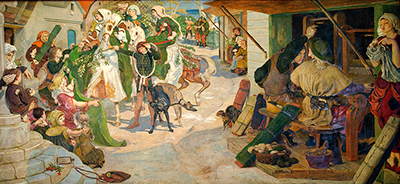
A king bends over a font while a bishop raises his hand. Around them, adults pray, children look elsewhere, and a crowd peers over a barrier. In Ford Madox Brown’s Cartoon for The Baptism of Edwin , a ceremony that changes a kingdom also becomes a gathering of people with different things on their minds.
The National Gallery of Victoria’s work is a monumental design on paper for Brown’s Manchester Town Hall decoration. [1]
Measuring more than three metres across, it carries the composition in pastel, coloured chalks and grey gouache. The museum dates it 1879–1891 and identifies it as accession 216-2. [2]
It is a separate object from the painting on the wall in Manchester.
The event represented belongs to a much earlier century: the baptism of Edwin, king of Northumbria, in 627. The NGV describes Brown’s treatment as combining historical ambition with lightness and quirky incident. [1]
That combination is visible in the distance between the solemn principal figures and the restless life surrounding them.
At a Glance
- Artist Ford Madox Brown.
- Collection title The Baptism of Edwin, King of Northumbria .
- Object A monumental cartoon for a Manchester Town Hall mural.
- Date 1879–1891; the lower-left monogram is accompanied by “79–91”.
- Medium Pastel, coloured chalks and grey gouache.
- Dimensions 146.5 × 318.5 cm, image and sheet.
- Collection National Gallery of Victoria, Melbourne; Felton Bequest, 1905.
- Accession number 216-2. The NGV gives Bennett’s catalogue reference as A106.7. [2]
- Historical subject Edwin’s conversion and baptism in 627, represented as part of the history behind Manchester. [1]
This work across Ford Madox Brown’s career
Manfred on the Jungfrau
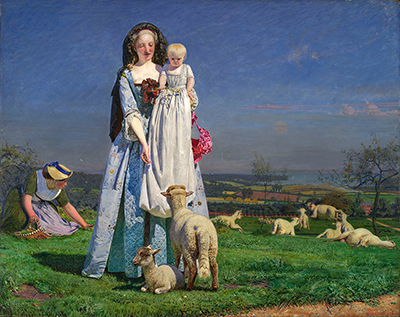
1841; retouched 1861Pretty Baa-Lambs
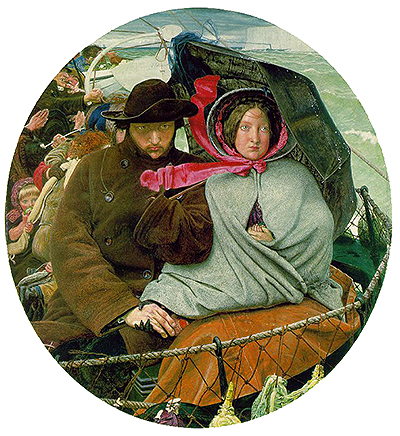
1851–1859The Last of England
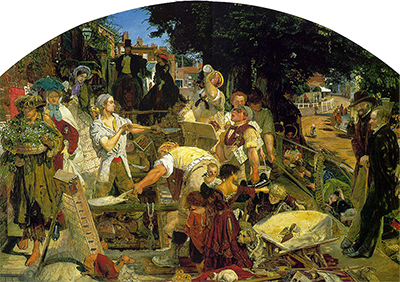
1852–1855Work
1852–1865King René’s Honeymoon
Tate watercolour, 1864Manchester Murals
1878–1893Contents
- A large drawing with a public destination
- Looking across the ceremony
- Reconstructing Edwin’s baptism
- Chalk, colour and the work of design
- Religious history for a civic audience
- From Manchester to Melbourne
A large drawing with a public destination
“Cartoon” here means a preparatory design for another work. It does not imply a comic illustration, a quick doodle or a small sketch. [3]
The NGV sheet is nearly one and a half metres high and over three metres wide. [2]
Its scale allows the arrangement of bodies, the intervals between groups and the large areas of colour to be considered as a substantial composition.
That purpose helps explain the conspicuous space across the middle of the foreground. The baptism occupies the left; the women and children form another group on the right. Brown connects them through the patterned floor, the long barrier behind them and the congregation gathered beyond it. The comparatively open centre keeps the participants from merging into one crowded band. It also makes the viewer look across the room, from the action at the font to its witnesses.
Ford Madox Hueffer’s 1896 biography describes a full-size cartoon among the preparations for the wall painting, alongside a smaller coloured sketch and studies of heads. It then records the tracing of the outline onto the wall before the painting proceeded. This account explains the practical importance of a cartoon within the commission. [4]
The broad dates on the NGV work also need to stay attached to this particular object.
Its inscription, recorded in brown and black chalk, reads “F.M.B.” in monogram followed by “79–91”. [2]
The museum’s date range follows those years. Neither 627, the date of the historical event, nor the execution history of the installed mural can substitute for the catalogue date of the cartoon.
Looking across the ceremony
The king’s exposed upper body provides a bright, relatively simple shape among elaborate robes. His bent posture carries him towards the water. Immediately beside him, the upright bishop establishes a different rhythm: a tall figure, rich vestments and an elevated hand. Their contrasting positions make the central act understandable before the smaller incidents become clear.
On the far left, the back of a large, yellow-robed figure partly closes the scene. On the right, a blue-clad woman stands above a child and a kneeling attendant. These substantial masses of colour hold the edges of the design. Between them, the bishop’s patterned clothing attracts attention without requiring a deep recession into the building.
The congregation is arranged differently. A screen or cloth-covered rail conceals much of its bodily movement, leaving a row of faces above a long warm-coloured surface. Some heads turn towards the ceremony; others seem more interested in their neighbours. Against these repeated small shapes, the few tall standing figures become especially prominent.
Hueffer’s description of the mural identifies the woman as Edwin’s queen and the child beside her as their daughter. He also describes the young attendants at the bishop’s back as less than reverent, one teasing while another blows on his incense. His account belongs to the larger design’s early reception, and helps explain the mixture of ceremony and distraction visible here. His more elaborate assignments of thoughts and feelings to the congregation remain his interpretation. [4]
The small figures are consequential because they change the pace of looking. From a distance, the event appears stately and legible. Looking more closely brings out unequal attention, childish curiosity and the practical business of holding objects or maintaining a pose. Brown gives the ceremony a surrounding life that continues while the king is being baptised.
Reconstructing Edwin’s baptism
In his explanation of the subject, reproduced by Hueffer, Brown located the baptism at York and named the early medieval historian Bede as his authority. He connected the event to Manchester through Edwin’s rule over Deira. That connection allowed a royal ceremony outside Manchester itself to enter a civic sequence concerned with the city’s historical foundations. [4]
Brown’s explanation also distinguishes the historical narrative from his own visual reconstruction. He referred to a wooden church built for the baptism, then explained why he had represented a Roman mosaic as its floor. For him, the reused pavement suggested the survival of Roman remains and linked the scene to the cycle’s Roman subject. The floor was therefore a deliberate device for joining different periods of the story. It is not an eyewitness record of Edwin’s church. [4]
In the cartoon, patterns make that idea visible. The floor spreads between the groups, while repeated circular ornament runs across the barrier behind them. The angular window openings puncture the dark upper part of the interior. Ornament and architecture organise the space around the human action; they also give the imagined early building a particular character.
Brown further explained the absence of a mitre on the bishop by reference to historical costume. Whatever the limits of nineteenth-century reconstruction, this was a picture in which accessories were expected to carry an argument about the past. The artist wanted the viewer to see a particular historical society, rather than a religious ceremony in an unspecified setting. [4]
In his discussion of the wall painting, Hueffer also connected its design with Brown’s earlier Baptism of St Oswald for stained glass at the church of that saint in Durham. This is a useful reminder that the Manchester subject belonged to a continuing practice of religious decoration, in which a composition could be reconsidered for another setting and medium. [4]
Watch: Ford Madox Brown
Choose a film exploring the people, stories and visual details in two of Brown’s best-known paintings.
Pre-Raphaelites: Ford Madox Brown – Work
Curator Tim Barringer explores the figures and stories within Work.
Watch on YouTubeChalk, colour and the work of design
The NGV’s material description brings together pastel, coloured chalks and grey gouache. [2]
These are the materials of this paper object; the techniques used to paint the Manchester walls belong to another stage of the commission. Calling the cartoon “spirit fresco” would confuse the design with its destination.
Brown’s much earlier essay, “On the Mechanism of a Historical Picture”, offers useful context for his attention to planning. Writing in 1850, he advised painters to research costume and surroundings before settling the composition. He argued that colour and light should be considered alongside the positions of figures, rather than postponed until after an outline had been designed. [3]
That advice helps a viewer understand why a coloured cartoon can be more than a map of contours. Here, the pale body at the font, the bishop’s ornamented vestments, the long ochre barrier and the blue on the right all help distinguish one part of the narrative from another. Colour participates in the organisation of the action.
In the same essay, Brown described a cartoon as a means of settling the size and position of figures, the architecture, the ground plan and the proportions of the whole. He discussed both tracing and squaring as possible ways to transfer designs. These were general instructions written decades before the Manchester commission, not evidence that a particular transfer method was used on the NGV sheet. They nevertheless show how seriously he regarded the relationship between a drawing and the larger work it prepared. [3]
Readers interested in that wider practice can explore Brown’s drawings . The Melbourne cartoon makes its own unusually forceful case for drawing as a place where narrative, bodily action and decorative arrangement meet.
Religious history for a civic audience
Brown’s 1893 essay “Of Mural Painting” explains a principle that suits this composition particularly well. He wrote that a wall picture should retain its sense of solidity, rather than appear to be “a hole in the wall”. In the cartoon, the long barrier and the compact arrangement of bodies make much of the scene read across the surface. There are views through the windows, but they remain small openings within an emphatically enclosed gathering. [5]
The same essay argued that publicly funded murals should offer subjects their audience could understand and take an interest in. Brown also believed religious subjects could engage different viewers through their poetry and humanity, without requiring the artist and spectator to share the same degree of religious belief. These are his stated views late in the Manchester project; they help explain the breadth of human response admitted into this baptism scene. [5]
The relationship between belief and civic history becomes clearer alongside the other Manchester murals . This cartoon concentrates on conversion, ritual and witnesses. The Establishment of the Flemish Weavers in Manchester offers a different point of entry into the larger cycle, through the history of work and settlement. Each subject asks a crowded human scene to carry part of a public history.
Ford Madox Brown, The Establishment of the Flemish Weavers in Manchester, reduced preparatory painting. Manchester Art Gallery. A separate design for the Town Hall cycle.
From Manchester to Melbourne
The cartoon’s later history gave the preparatory work a life independent of the building for which it was designed.
The NGV acquired it through the Felton Bequest in 1905. [2]
Its Medieval Moderns exhibition label explains that the gallery’s director, Lindsay Bernard Hall, purchased two Brown works during his visit to London that year. Brown’s standing as a mentor and inspiration to the Pre-Raphaelite circle was part of Hall’s interest. [1]
That acquisition preserves an important change of context. A design made in relation to a municipal interior can now be studied as a substantial work on paper. The viewer can attend to Brown’s arrangement of colour and gesture while remembering that its first purpose reached beyond the sheet, towards a painted public room.
Artworks directory
Explore paintings, drawings, cartoons, illustrations and decorative designs documented in museum collections and specialist research. Distinct versions are listed separately; repeated print impressions are grouped. The coverage includes studies and works without a dedicated article and remains open to further research.
| Name | Date | Medium |
|---|---|---|
| Work (Manchester) | 1852–1865 | Oil on canvas |
| The Last of England (Birmingham) | 1852–1855 | Oil on panel |
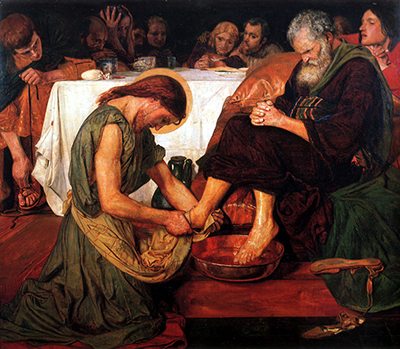
| Jesus Washing Peter’s Feet | 1852–1856 | Oil on canvas |
| Pretty Baa-Lambs | 1851–1859 | Oil on panel |
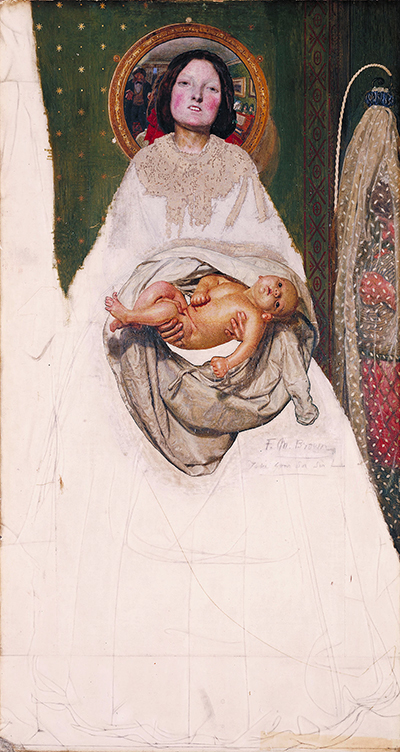
| Take Your Son, Sir | ?1851–1892 | Oil on canvas |
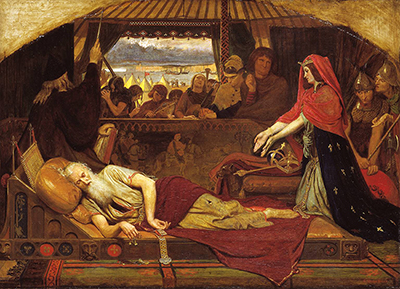
| Lear and Cordelia | 1849–1854 | Oil on canvas |
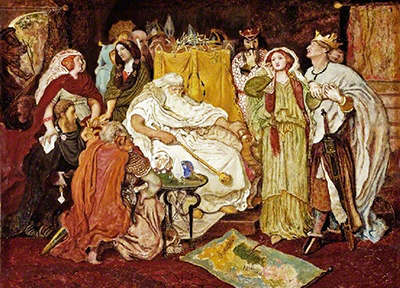
| Cordelia’s Portion | 1867–1875 | Oil on canvas |
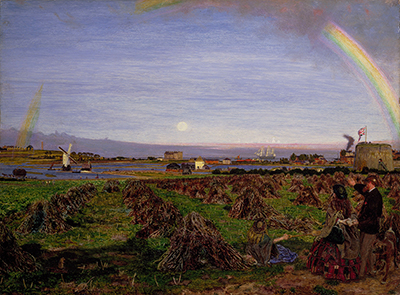
| Walton-on-the-Naze | 1859–1860 | Oil on canvas |
| Chaucer at the Court of Edward III (Tate) | 1856–1868 | Oil on canvas |
| Carrying Corn | 1854–1855 | Oil on mahogany |
| The Hayfield (The Hay Harvest) | 1855–1856 | Oil on mahogany |
| Stages of Cruelty | 1856–1890 | Oil on canvas |
| The Irish Girl | 1860 | Oil on canvas laid on board |
| Romeo and Juliet (Delaware) | 1869–1870 | Oil on canvas |
| The Seeds and Fruit of English Poetry | 1845–1853 | Oil on canvas |
| Self-Portrait | 1877 | Oil on canvas |
| The Bromley Children | Probably 1844 | Oil on canvas |
| The Bromley Family | 1844 | Oil on canvas |
| Byron’s Dream (Manchester) | 1874; worked on into 1875 | Oil on canvas |
| Cartoon for The Baptism of Edwin | 1879–1891 | Pastel, coloured chalks and grey gouache |
| The Coat of Many Colours | 1864–1866 | Oil on canvas |
| The Convalescent (Birmingham) | Dated October 1872 | Pastel |
| Crabtree Watching the Transit of Venus (reduced painting) | 1881–1888 | Tempera on panel |
| Cromwell on His Farm (Lady Lever) | Completed 1874 | Oil on canvas |
| Cromwell Protector of the Vaudois | 1877 | Oil on canvas |
| Dalton Collecting Marsh-Fire Gas (Town Hall mural) | 1886–1887 | Mural on canvas |
| The Establishment of the Flemish Weavers (reduced painting) | 1881; completed 1888 | Tempera on panel |
| The Finding of Don Juan by Haidée (NGV) | 1869–1870; later retouched | Watercolour and gouache over pencil |
| Henry and Millicent Fawcett | 1872 | Oil on canvas |
| Jacob and Joseph’s Coat (Ponce) | c.1868–1871 | Oil on canvas |
| James Leathart | 1863–1864; altered 1869 | Oil on canvas |
| King René’s Honeymoon (Tate watercolour) | 1864 | Graphite, watercolour, gouache and gum arabic on card |
| King René’s Honeymoon Cabinet (collaborative work) | 1861; exhibited 1862 | Oak, inlaid woods, painted panels and metal mounts; Brown designed Architecture |
| Manfred on the Jungfrau | 1841; retouched 1861 | Oil on canvas |
| Millie Smith | 1846 | Oil on paper laid on panel |
| William Michael Rossetti by Lamplight | 1856–1857 | Oil on panel |
| The Traveller (Manchester oil) | 1868–1884 | Oil on panel |
| Waiting: An English Fireside of 1854–55 | 1851–1855 | Oil on panel |
| An English Autumn Afternoon | 1852–1853; finished c.1854 | Oil on canvas |
| Alfred the Great: Sketch of Alfred drawing in the Sand | 1843–1845 | pencil |
| Historical Notes and Sketches of Alfred the Great | 1843–1850 | brown ink writing over pencil |
| Angels watching the Crown of Thorns: Study of clasped Hands | 1846 | black chalk |
| Architecture: Study of Gothic Arches and 14th Century Vaulting | c. 1847 | brown pen and ink over pencil on grey paper |
| The Ascension: Study of Angels and Hands | 1844 | brown pen and ink over pencil |
| The Ascension: Study of a Group of Angels | 1844 | brown pen and ink over pencil |
| The Ascension: Study of a Group of six flying Angels | 1844 | brown pen and ink over pencil |
| The Ascension: Two nude Angels holding onto each other | 1844 | brown brush and ink over pencil |
| The Ascension: Study for a kneeling Apostle | 1844 | black chalk touched with white on brown-toned paper |
| Head of a Child | c. 1844 | black chalk touched with white on brown toned paper |
| The Ascension: Drapery Study of a praying Apostle | 1844 | black chalk |
| The Spirit of Justice: Seated Figure in ecclesiastical Robes, gripping a Staff with left Hand raised in a Blessing | 1844 | black chalk |
| The Ascension: Study for an Apostle | 1844 | black chalk |
| The Spirit of Justice: Body of seated Figure in ecclesiastical Robes holding a Staff and a Book | 1844 | black chalk |
| The Ascension: Study of an Apostle | 1844 | black chalk on toned paper |
| Full-length Sketch of a standing, naked Child | 1844 | black chalk on toned paper |
| The Ascension: Study for Christ | 1844 | brown pen and ink over pencil |
| Caricature: Composite Drawing: A Stunner | 1861–1863 | pencil |
| A Victorian Woman in her Underwear | 1861–1863 | pencil |
| Caricature: Composite Drawing: Bewigged Head | 1861–1863 | pencil |
| Bowed Head of a bearded Man | 1861–1863 | pencil |
| Chaucer at the Court of Edward III: Early compositional Study | 1845 | pencil with brown pen and ink |
| Chaucer at the Court of Edward III: Study for Milton and two Designs for Tombstones | c.1845–c.1846 | pencil with brown frame outline |
| Chaucer at the Court of Edward III: Tracing of the Figure of Milton | c.1845–c.1849 | brown pen and ink with pencil on tracing paper |
| Chaucer at the Court of Edward III: Tracing of a Gothic Arch | c.1845–c.1849 | brown pen and ink with pencil on tracing paper |
| Chaucer at the Court of Edward III: Early compositional Study | 1845 | pencil with brown pen and ink |
| Chaucer at the Court of Edward III: Nude Studies of two Boys | 1845 | pencil, laid down |
| Chaucer at the Court of Edward III: Nude Studies of four Figures | 1845 | pencil |
| Chaucer at the Court of Edward III: Eight early Studies of Figures and Hands | 1845 | pencil |
| Chaucer at the Court of Edward III: Nude Studies for the Figures of Byron, Shakespeare and Burns | 1845 | black chalk |
| Chaucer at the Court of Edward III: Drapery Study for Burns | 1847 | black chalk |
| Chaucer at the Court of Edward III: Study of a right Leg and left Foot for Milton | 1847 | black chalk |
| Chaucer at the Court of Edward III: Study of a left Leg for Shakespeare | 1847 | black chalk |
| Chaucer at the Court of Edward III: Study of Drapery for Milton | 1847 | black chalk |
| Chaucer at the Court of Edward III: Drapery Study for Shakespeare | 1847 | black chalk |
| Chaucer at the Court of Edward III: Study of a Man in a medieval Hood | 1847 | black chalk |
| Chaucer at the Court of Edward III: Study for the Cardinal | 1847 | black chalk |
| Chaucer at the Court of Edward III: Drapery Study in Profile for Courtier | 1847 | black chalk |
| Chaucer at the Court of Edward III: Drapery Study | 1847 | black chalk |
| Chaucer at the Court of Edward III: Female Nude Study of a Muse holding onto a Rail | 1847 | pencil |
| Chaucer at the Court of Edward III: Female Nude: Study of a Muse | 1847 | pencil |
| Chaucer at the Court of Edward III: Nude Study for seated Lady | 1847 | pencil |
| Chaucer at the Court of Edward III: Nude Study of a Woman with right Arm raised | 1847 | pencil |
| Chaucer at the Court of Edward III: Two Studies of Back of a seated Woman's Head | 1847 | pencil |
| Chaucer at the Court of Edward III: Two Studies of a seated Woman in lost Profile Pose and from the Back | 1847 | pencil |
| Chaucer at the Court of Edward III: Nude Study of a Woman | 1847 | pencil |
| Chaucer at the Court of Edward III: Sketch of a Woman supporting another Figure | 1847 | pencil |
| Chaucer at the Court of Edward III: Study of the Heads and Shoulders of two Women | 1847 | pencil |
| Chaucer at the Court of Edward III: Drapery Study for Edward III with Outline of a Child | 1847 | black chalk |
| Chaucer at the Court of Edward III: Foreshortened Study for Head of a Jester | 1847 | pencil |
| Chaucer at the Court of Edward III: Head of Alexander Pope | 1847 | black chalk |
| Chaucer at the Court of Edward III: Two Hand Studies | 1847 | black chalk |
| Chaucer at the Court of Edward III: Study of Head of Milton copied from Sculpture | 1848 | black chalk |
| Chaucer at the Court of Edward III: Nude Studies for the Squire and the Courtier talking to Gower | 1848 | pencil |
| Chaucer at the Court of Edward III: Drapery Study for the Black Prince | 1848 | black chalk with touches of white |
| Chaucer at the Court of Edward III: Three Studies of Hands | 1848 | Black chalk |
| Chaucer at the Court of Edward III: Four Studies of Hands | 1848 | black chalk touched with white |
| Chaucer at the Court of Edward III: Study of a clasped right Hand for one of the Poets | 1848 | black chalk |
| Chaucer at the Court of Edward III: Study of a left Hand for Burns | 1848 | black chalk heightened with touches of white |
| Chaucer at the Court of Edward III: Study of Drapery for Burns | 1848 | black chalk |
| Chaucer at the Court of Edward III: Drapery Study | 1848 | black chalk |
| Chaucer at the Court of Edward III: Drapery Study for the Black Prince | 1851 | black and white chalks on brown-toned paper |
| Chaucer at the Court of Edward III: Study for Squire's Legs | 1851 | black chalk heightened with white |
| Chaucer at the Court of Edward III: Two Head Studies of an old Woman | 1851 | black chalk |
| Costume Study: Five Sketches of Armour and Costume | 1844 | brown pen and ink over pencil |
| Costume Study: Archbishop's Dress | 1845 | brown pen and ink on tracing paper |
| Costume Studies: French and Italian thirteenth and fourteenth-century Costumes (seven Drawings) | 1845 | brown pen and ink on tracing paper |
| Costume Study: Seigneur de Rimini | 1845 | brown pen and ink on tracing paper |
| Dalziels' Bible Gallery: The Death of Eglon | 1863–1865 | engraved woodblock; designed by Brown, engraved by the Dalziel Brothers |
| Dalziels' Bible Gallery: The Death of Eglon | 1881 | wood engraving; designed by Brown, engraved by the Dalziel Brothers |
| Dalziels' Bible Gallery: Elijah and the Widow's Son | 1863–1865 | engraved woodblock; designed by Brown, engraved by the Dalziel Brothers |
| Dalziels' Bible Gallery: Elijah and the Widow's Son | 1881 | wood engraving; designed by Brown, engraved by the Dalziel Brothers |
| Dalziels' Bible Gallery: Joseph’s Coat (Compositional Sketch and four Studies for Jacob's Granddaughter) | 1863–1865 | pencil on paper |
| Dalziels' Bible Gallery: Joseph's Coat | 1863–1865 | engraved woodblock; designed by Brown, engraved by the Dalziel Brothers |
| Dalziels' Bible Gallery: Joseph’s Coat | 1881 | wood engraving; designed by Brown, engraved by the Dalziel Brothers |
| Decorative Sketches: Venus Reclining on a Shell in the Midst of the Sea | 1848–1849 | brown pen and ink over pencil |
| Decorative Design: Ornamental Pattern | 1850 | watercolour and bodycolour over pen and ink, and pencil on two sheets of paper |
| Down Stream: Main Illustration (Last Year's First of May) | 1871 | wood engraving; designed by Brown, print execution by an engraver |
| Down Stream: Tailpiece to the Poem (This Year's First of June) | 1871 | wood engraving; designed by Brown, print execution by an engraver |
| The Establishment of Flemish Weavers in Manchester A.D. 1363: Four Studies of Parts of a Horse | 1879–1882 | black, white and red chalk on rough brown paper |
| Female: Two Studies of young Woman in eighteenth-century Costume | 1849 | pencil |
| Infant's Repast: Study of Mother and Child | 1848 | black and white chalk |
| Infant's Repast: Study of Mother and Child with separate Arm and Leg Studies of the Child | 1848 | black chalk with grey wash |
| King Lear: Sketch of Lear questioning Cordelia | 1844 | brown pen and ink over pencil |
| Alfred the Great: Compositional Sketches | 1843–1845 | pencil |
| King Lear: Sketches of Lear imagining his unfaithful Daughters’ Trial and Lear in the Storm | 1844 | brown pen and ink over pencil |
| Alfred the Great: Compositional Studies and Sketches and Chaucer at the Court of Edward III: Study of Cherubs | 1843–1849 | pencil |
| King Lear: Kent accuses Oswald | 1844 | brown pen and ink with pencil underneath |
| King Lear: Lear recounts his Wrongs to Regan | Undated | Brown pen and ink over pencil |
| King Lear: Cordelia at Lear's Bedside (Lear's Awakening) | 1844 | brown pen and ink over pencil |
| Cordelia Parting from Her Sisters (The Germ) | 1850; reprinted 1901 | Etching; designed by Brown, print execution by an engraver |
| King René's Honeymoon: Study for Architecture | 1861 | brush and brown ink, with watercolour, over pencil on brown paper |
| The Last of England: Cartoon | 1852 | pencil, image edged with brown ink |
| The Last of England: Portrait of Emma Hill | December 1852 | chalks with scratching out on two sheets of paper |
| Lear and Cordelia and The Infant’s Repast: Four Studies of Hands | 1849 | black chalk |
| Lyra Germanica - the Christian Life: Abraham and Isaac | 1868 | wood engraving; designed by Brown, print execution by an engraver |
| Lyra Germanica - the Christian Life: Finished Design for The Entombment | 1867 | black pen and ink |
| Lyra Germanica - the Christian Life: The Entombment | 1868 | wood engraving; designed by Brown, print execution by an engraver |
| Male: Sketch of Man reclining on Steps with Hands bound together | 1844 | brown pen and ink over pencil |
| Male: Academic nude Study, half-length with Moustache and Arms folded | 1846–1849 | black chalk |
| Male: Academic Study of Nude holding a Staff | 1847 | pencil |
| Male: Academic Study of Nude posed as a Sculptor | 1847 | chalk with grey wash |
| Male: Academic Study, three-quarter length Nude, with a Moustache and clenched Fists | 1847 | black chalk |
| Oure Ladye of Saturday Night: Seven Sketches | 1846 | pencil |
| Oure Ladye of Saturday Night: Four Studies for Angel holding Child | 1847 | pencil |
| Oure Ladye of Saturday Night: Study of Angel holding Child | 1847 | black chalk |
| Oure Ladye of Saturday Night: Study of Arm and Hands for Angel holding Bowl of Water | 1847 | black chalk |
| Oure Ladye of Saturday Night: Drapery Study for Angel holding Bowl of Water | 1847 | black chalk |
| Oure Ladye of Saturday Night: Study of Head for Angel holding Bowl of Water | 1847 | black chalk with rubbing and grey wash |
| Oure Ladye of Saturday Night: Study of Child seated on Knees of the Virgin and two separate Studies of the Child's Legs | 1847 | pencil on brown-toned paper |
| Oure Ladye of Saturday Night: Frieze Design | c. 1847 | pencil and black pen and ink |
| Oure Ladye of Saturday Night: Three Studies of Arms and Legs of Child | 1847 | pencil |
| Oure Ladye of Saturday Night: Three Studies of Child's Legs on Virgin's Knees | 1847 | pencil |
| Oure Ladye of Saturday Night: Studies of Right Foot and Left Hand of Child | 1847 | pencil on light brown paper |
| Oure Ladye of Saturday Night: Drapery Study for Virgin | 1847 | black chalk |
| Oure Ladye of Saturday Night: Study for Head of Virgin | 1847 | black chalk with wash |
| Parisina’s Sleep: Study for Prince Azo and Parisina | 1842 | black chalk with pencil side drawing |
| Parisina's Sleep: Study for Head of Prince Azo | 1842 | black chalk with grey wash |
| Parisina's Sleep: Study for the Head of Parisina | 1842 | black and white chalk with grey wash |
| Poets of the Nineteenth Century: The Prisoner of Chillon: Compositional Sketch | 1856 | pencil |
| Profile of a Man's left Eye and Nose | c.1856 | pencil |
| Poets of the Nineteenth Century: The Prisoner of Chillon: Study of a Corpse | 1856 | pencil |
| Designs for Decoration | c.1856 | pencil |
| Poets of the Nineteenth Century: The Prisoner of Chillon | 1857 | wood engraving; designed by Brown, print execution by an engraver |
| Portrait: Head Study of Daniel Casey (three-quarter view) | 1848 | black chalk |
| Portrait: Head Study of Daniel Casey (full-face) | 1848 | black chalk |
| Portrait: Miss Iza Duffus Hardy | 1872 | pastel and coloured chalks on brown paper |
| Portrait: Emma Hill (later Mrs Madox Brown) | 1848 | black chalk |
| Portrait: Emma Hill (later Mrs Madox Brown) | 1852 | pencil |
| Portrait: Mrs Madox Brown (neé Emma Hill) | 9 May 1854 | pencil |
| The Repose in Egypt: Compositional Sketch | 1847 | pencil |
| Study of a Statue of the Discobolus | 1845 | Black chalk |
| William Shakespeare: Study | 1849–1850 | pencil |
| William Shakespeare: Invitation Card | 1850 | wood engraving; designed by Brown, print execution by an engraver |
| The Spirit of Justice: Study for Baron and his Advisor, with Sketches of Erudition and Wisdom | 1844–1845 | brown pen and ink over pencil |
| The Spirit of Justice: Drapery Study for Erudition | 1844–1845 | black chalk |
| Drapery Study and Sketch of Two Legs | Undated | Black chalk |
| The Spirit of Justice: Study for Wisdom | 1844–1845 | black chalk with grey wash |
| The Spirit of Justice: Study for Head of the Baron | 1844–1845 | black chalk |
| The Spirit of Justice: Study for the Head of central Bishop | 1844–1845 | black chalk |
| The Spirit of Justice: Study for the Head of a Bishop | 1844–1845 | black chalk with grey wash |
| The Spirit of Justice: Study for the uplifted left Arm of Justice | 1844–1845 | black chalk |
| The Spirit of Justice: Study for Head of Counsellor in a Coronet | 1844–1845 | black chalk with touches of blue chalk |
| The Spirit of Justice: Study for Head of Counsellor | 1844–1845 | black chalk |
| The Spirit of Justice: Drapery Study for the Central Bishop | 1844–1845 | Black chalk |
| Part of a Drapery Study | 1844–1845 | black chalk |
| The Spirit of Justice: Study for Head of Widow | 1844–1845 | black chalk |
| Stages of Cruelty: Study for the Child (Catherine Madox Brown) | 1857 | black chalk on pale grey paper |
| Stained Glass Design: Cartoon for Zachariah, The High Priest | 1872 | black chalk |
| Stained Glass Design: Cartoon for The Young Milton | 1874 | black chalk |
| Stained Glass Design: Cartoon for St Simon | 1874 | black chalk |
| Sterne's 'Sentimental Journey': Study for Yorick and La Fleur talking to Maria’s Mother | 1842 | brown pen and ink over pencil |
| The Body of Harold brought before William the Conqueror: Eight Sketches of Figure Groups | c.1844 | pencil |
| Sterne's 'Sentimental Journey' : Yorick (Laurence Sterne) and Maria Walking | 1842 | pen and ink, watercolour and bodycolour over pencil |
| Study of Tree Trunk with Roots | c.1847 | black chalk, heightened with white chalk on buff paper |
| Two Studies of Tree Trunks | c.1846 | black chalk |
| Unknown Subject: Compositional Sketch | 1843–1850 | pencil |
| Wycliffe reading his Translation of the Bible: Nude Study for Chaucer | 1847 | pencil |
| Wycliffe reading his Translation of the Bible: Study for Chaucer | 1847 | pencil |
| Wycliffe reading his Translation of the Bible: Nude Study of Gower | 1847 | pencil |
| Wycliffe reading his Translation of the Bible: Study for Gower | 1847 | pencil |
| Wycliffe reading his Translation of the Bible: Nude Study for John of Gaunt and Chaucer's right Hand | 1847 | pencil and black chalk |
| Wycliffe reading his Translation of the Bible: Study of John of Gaunt and Chaucer's Left Hand | 1847 | pencil and black chalk |
| Wycliffe reading his Translation of the Bible: Study for Wycliffe | 1847 | black chalk |
| Wycliffe reading his Translation of the Bible: Nude Study for Wycliffe | 1847 | pencil |
| Wycliffe reading his Translation of the Bible: Drapery Study for Wycliffe | 1847 | black chalk |
| Wycliffe reading his Translation of the Bible: Drapery Study for Chaucer | 1848 | black chalk |
| Wycliffe reading his Translation of the Bible: Study of Legs for John of Gaunt and two Studies of Feet for Wycliffe | 1848 | black chalk |
| Wycliffe Reading his Translation of the Bible: Studies of Hands for John of Gaunt and Gower | 1847 | black chalk |
| Wycliffe reading his Translation of the Bible: Study for Head of Wycliffe | 1847 | pencil |
| Wycliffe reading his Translation of the Bible: Study for Constance and Child | 1847 | pencil |
| Wycliffe reading his Translation of the Bible: Unfinished Study for Head of Constance | 1847–48 | pencil |
| Wycliffe reading his Translation of the Bible: Portrait of Elizabeth Bamford modelling for Constance | 1848 | pencil |
| Wycliffe reading his Translation of the Bible: Study for Head of Constance | 1848 | chalk over pencil |
| Wycliffe reading his Translation of the Bible: Study for Head of Chaucer | 1848 | pencil |
| Wycliffe reading his Translation of the Bible: Study of Monk representing the Catholic Faith | 1848 | black chalk with brown pen and ink, squared up |
| Wycliffe reading his Translation of the Bible: Study of young Woman representing the Protestant Faith | 1848 | black chalk |
| Cathy Madox Brown at the Age of Three (Tate N01356) | 1853 | Graphite on paper |
| King René‘s Honeymoon (Tate N02409) | date not known | Ink on paper |
| Sheepshearing (Tate N02410) | c.1887 | Ink and graphite on paper |
| Studies for ‘Work’ (Tate N02411) | 1855 | Graphite and ink on paper |
| Design for Badge for Gillum’s Homes (Tate N02412) | date not known | Ink and graphite on paper |
| Arkwright’s Mill (Tate N02413) | 1878 | Graphite on paper |
| Study for ‘John Kay’ (Tate N02414) | 1889 | Graphite on paper |
| Study for ‘Southend’ (Tate N02415) | date not known | Graphite on paper |
| ‘Where are you going, my pretty maid?’ (Tate N02416) | date not known | Graphite on paper |
| Section of the Bridgewater Canal (Tate N02417) | 1890 | Ink on paper |
| A Barge on the Bridgewater Canal (Tate N02418) | 1890 | Graphite on paper |
| Study of the Tow-Path on the Bridgewater Canal (Tate N02419) | 1890 | Graphite on paper |
| Our Lady of Good Children (Tate N02684) | 1847–61 | Pastel, watercolour and gold paint on paper |
| Arkwright’s Mill (Tate N02791) | 1881 | Graphite on paper |
| The Bridgewater Canal (Tate N02792) | 1890 | Ink on paper |
| The Bridgewater Canal (Tate N02793) | date not known | Chalk and graphite on paper |
| The Last of England (Tate N03064) | 1864–6 | Watercolour on paper |
| Mauvais Sujet (Tate N03228) | 1863 | Watercolour on paper |
| Study of a Man Painting (Tate N03472) | 1839 | Graphite on paper |
| The Brent at Hendon (Tate N03528) | 1854–5 | Oil paint on board on mahogany |
| Study for the Dean in the ‘Execution of Mary Queen of Scots’ (Tate N04280) | c.1840 | Oil paint on paper |
| Sketch for ‘Jesus Washing Peter’s Feet’ (Tate N04281) | 1852 | Graphite on paper |
| Sketch for ‘Cromwell on his Farm’ (Tate N04282) | c.1853 | Graphite on paper |
| The Coat of Many Colours (Tate N04584) | 1867 | Watercolour and gouache on paper |
| Stages of Cruelty (Tate N04625) | c.1856 | Watercolour on paper |
| Head of a Girl (Tate N04803) | date not known | Oil paint on paper |
| Portrait of Dykes Barry as a Child (Tate N04866) | 1853 | Oil paint on mahogany |
| Jesus Washing Peter’s Feet (Tate N05301) | 1857–8 | Watercolour on paper |
| Platt Lane (Tate N05383) | 1884 | Oil paint on canvas |
| Study of F.G. Stephens for ‘Jesus Washing Peter’s Feet’. Verso: A Head Crowned with Laurels (Tate T00571) | 1852 | Graphite on paper. Verso: graphite on paper |
| Sketch for ‘Jesus Washing Peter’s Feet’ (Tate T01035) | c.1851 | Ink and graphite on paper |
| Chaucer at the Court of Edward III (Sydney) | 1845–1851 | Oil on canvas |
| Wycliffe Reading His Translation of the Bible to John of Gaunt (Bradford) | 1848 | Oil on canvas |
| Work (Birmingham replica) | 1859–1863 | Oil on canvas |
| The Spirit of Justice (Book of Art reproduction) | Published 1846 | Wood engraving after Brown’s cartoon; engraver unknown |
| The Execution of Mary Queen of Scots | 1840–1842 | Oil on canvas |
| The Prisoner of Chillon (Manchester oil) | 1843 | Oil on canvas |
| The Parting of Cordelia from Her Sisters (oil) | 1853 | Oil on canvas |
| Cordelia’s Portion (Lady Lever) | 1866–1872 | Watercolour, gouache and pastel |
| The Ascension | 1844–1845 | Oil on canvas |
| Manfred in the Chamois Hunter’s Hut (oil sketch) | 1840 | Oil on canvas |
| Dr Primrose and His Daughters (The Vicar of Wakefield) | 1840–1841 | Oil on canvas |
| The Body of Harold Brought before William the Conqueror | 1844–1861 | Oil on canvas |
| The Seeds and Fruits of English Poetry (Bedford cartoon) | 1845 | Black chalk on paper |
| Wycliffe Reading His Translation of the Bible (oil sketch) | 1847–1848 | Oil on board |
| Cromwell Discussing the Protection of the Vaudois (Nottingham) | 1877–1878 | Oil on canvas |
| Two Drawings of Men in Hoods | c.1845 | Pencil on paper |
| The Seeds and Fruits of English Poetry: Study of the Right Side | c.1845 | Brown pen and ink with pencil |
| Chaucer: A Man in a Hood with a Liripipe and Two Drapery Studies | 1848 | Oil on canvas |
| The Prisoner of Chillon Entreating His Jailors (Yale watercolour) | 1858 | Watercolour heightened with bodycolour |
| Elijah and the Widow’s Son (Birmingham oil) | 1864 | Oil on panel |
| He That Soweth (Lyra Germanica) | Published 1868 | Wood engraving by the Dalziel Brothers after Brown |
| The Entombment (NGV) | 1871–1878 | Watercolour, gouache, gold paint and gum arabic over pencil |
| The Sower (Morris firm tile) | c.1864–1873 | Tile; design by Brown, workshop execution |
| Childe Harold’s Pilgrimage (Byron illustration) | Published 1870 | Steel engraving by Herbert Bourne after Brown |
| The Two Foscari (Byron illustration) | Published 1870 | Steel engraving by Herbert Bourne after Brown |
| The Corsair (Byron illustration) | Published 1870 | Steel engraving by Herbert Bourne after Brown |
| Sardanapalus (Byron illustration) | Published 1870 | Steel engraving by Herbert Bourne after Brown |
| Don Juan (Byron illustration) | Published 1870 | Steel engraving by Herbert Bourne after Brown |
| Byron’s Dream (roundel title-page design) | Published 1870 | Steel engraving by Herbert Bourne after Brown |
| The Finding of Don Juan by Haidée (Birmingham oil) | 1870–1873 | Oil on canvas |
| The Dream of Sardanapalus (Delaware) | 1871–1872 | Watercolour on paper |
| The Traveller (Once a Week) | Published 1869 | Wood engraving by Joseph Swain after Brown |
| The Infant’s Repast | 1848 | Oil on board |
| Oliver Madox Brown Aged Four (Dwale Bluth frontispiece) | Published 1876 | Etching |
| Oliver Madox Brown as a Young Man (Dwale Bluth frontispiece) | Published 1876 | Etching |
| A Beggar and Other Fantasies: Title-page Illustration | Published 1889 | Photo-engraving after Brown |
| Dramas in Miniature: Title-page Illustration | Published 1891 | Photo-engraving after Brown |
| The Brown Owl: Frontispiece | Published 1892 | Photo-engraving after Brown |
| The Brown Owl: Central Illustration | Published 1892 | Photo-engraving after Brown |
| The Feather: Frontispiece | Published 1892 | Photo-engraving after Brown |
| The Ascension: Study for Christ | 1844 | Pen and ink |
| King Lear: Lear Questions Cordelia (Whitworth) | 1844 | Pencil, pen and brown ink |
| King Lear: France Claims the Dispossessed Cordelia (Whitworth) | 1844 | Pencil, pen and brown ink |
| King Lear: Cordelia Parts from Her Sisters (Whitworth) | 1844 | Pencil, pen and brown ink |
| King Lear: Goneril and Regan Together (Whitworth) | 1844 | Pencil, pen and brown ink |
| King Lear: Goneril Tells Oswald How to Treat Lear (Whitworth) | 1844 | Pencil, pen and brown ink |
| King Lear: Oswald’s Insolence to Lear (Whitworth) | 1844 | Pencil, pen and brown ink |
| King Lear: Lear Rebukes Oswald (Whitworth) | 1844 | Pencil, pen and brown ink |
| King Lear: Kent Trips Oswald (Whitworth) | 1844 | Pencil, pen and brown ink |
| King Lear: Goneril’s Complaint to Lear (Whitworth) | 1844 | Pencil, pen and brown ink |
| King Lear: Lear Curses Goneril’s Infidelity (Whitworth) | 1844 | Pencil, pen and brown ink |
| King Lear: Kent Challenges Oswald (Whitworth) | 1844 | Pencil, pen and brown ink |
| King Lear: Kent in the Stocks (Whitworth) | 1844 | Pencil, pen and brown ink |
| King Lear: Lear Recounts His Wrongs to Regan (Whitworth) | 1844 | Pencil, pen and brown ink |
| King Lear: Lear Parts from Regan and Goneril (Whitworth) | 1844 | Pencil, pen and brown ink |
| King Lear: Lear and the Fool in the Storm (Whitworth) | 1844 | Pencil, pen and brown ink |
| King Lear: Lear Mad on the Beach at Dover (Whitworth) | 1844 | Pencil, pen and brown ink |
| King Lear: Alternative Study: Lear Curses Goneril (Whitworth) | 1844 | Pencil, pen and brown ink |
| King Lear: Lear Imagines His Daughters’ Trial (Whitworth) | 1844 | Pencil |
| King Lear: Alternative Study: Lear in the Storm (Whitworth) | 1844 | Pencil, pen and brown ink |
| The Last of England (Fitzwilliam) | 1860 | Oil on canvas |
| The Convalescent (Metropolitan Museum) | Dated 1872 | Pastel |
| Self-Portrait (Walker drawing) | 1850; retouched 1853 | Black chalk |
| Byron’s Dream (Whitworth) | 1889 | Watercolour over graphite |
| Cordelia Parting from Her Sisters (Cleveland sketch) | 1854 | Pen and oil on paper mounted on panel |
| David and Goliath: Cartoon for Stained Glass Window at Jesus College, Cambridge | 1872 | Charcoal and graphite on Japanese paper |
| The Virgin Swooning (recto) | 1844 | Black chalk on laid paper |
| Two Drapery Studies (verso) | c.1844 | Black chalk |
| Architecture: King René’s Honeymoon (stained glass) | 1862 | Stained glass; designed by Brown, made by Morris, Marshall, Faulkner & Co. |
| The Romans Building a Fort at Mancenion (Town Hall mural) | 1880 | Spirit fresco |
| The Baptism of Edwin (Town Hall mural) | 1879–1880 | Spirit fresco |
| The Expulsion of the Danes (Town Hall mural) | 1880–1881 | Spirit fresco |
| The Establishment of the Flemish Weavers (Town Hall mural) | 1881–1882 | Spirit fresco |
| Crabtree Watching the Transit of Venus (Town Hall mural) | 1882–1883 | Spirit fresco |
| The Proclamation Regarding Weights and Measures (Town Hall mural) | 1883–1884 | Spirit fresco |
| Wycliffe on Trial (Town Hall mural) | 1885–1886 | Spirit fresco |
| Chetham’s Life’s Dream (Town Hall mural) | 1885–1886 | Mural on canvas |
| Bradshaw’s Defence of Manchester (Town Hall mural) | 1892–1893 | Mural on canvas |
| John Kay, Inventor of the Fly Shuttle (Town Hall mural) | 1888–1890 | Mural on canvas |
| The Opening of the Bridgewater Canal (Town Hall mural) | 1891–1892 | Mural on canvas |
Frequently Asked Questions
Brown gives the ceremony witnesses whose attention and behaviour vary.
The NGV singles out his light touch and quirky details, while Hueffer’s early account describes the children’s distractions. [1] [4]
The contrast makes a moment of religious and political importance recognisable as a gathering of individual people.
Discussion
Look again at the images and ideas explored in Cartoon for The Baptism of Edwin by Ford Madox Brown. These editorial prompts invite your observations.
Reader Insights
Look first at the floor between the baptism and the group on the right. How does this interval affect the importance of the figures around it? Consider how different the scene would feel if another large figure occupied the centre.
Choose one participant who appears absorbed in the ceremony and another whose attention seems to wander. Compare their head, hands and posture. How much of the event can Brown communicate without giving everyone the same response?
Try following the principal colour areas before looking at individual faces: yellow at the left, the bishop’s patterned clothing, the long warm barrier and blue at the right. Consider how these areas hold the scene together while keeping its different groups distinct.
Join the Conversation
Share a detail, comparison or question about Cartoon for The Baptism of Edwin by Ford Madox Brown below.
References
- National Gallery of Victoria , Medieval Moderns: The Pre-Raphaelite Brotherhood , artwork labels, p. 5, Brown’s The Baptism of Edwin . View source .
- National Gallery of Victoria , The Baptism of Edwin, King of Northumbria , 1879–1891, accession 216-2. Collection record, including medium, measurements, inscription, acquisition and the museum-supplied Bennett A106.7 reference. View source .
- Ford Madox Brown , “On the Mechanism of a Historical Picture. Part I. The Design”, The Germ (1850), pp. 70–73, in the digitised collected edition. View source .
- Ford Madox Hueffer , Ford Madox Brown: A Record of His Life and Work (1896), pp. 327–330: preparations for The Baptism of Edwin , Brown’s explanation of the subject and Hueffer’s description. View source .
- Ford Madox Brown , “Of Mural Painting”, in Arts and Crafts Essays (1893), passages on wall solidity, public audiences and religious subjects; Wikisource transcription. View source .
- Ford Madox Hueffer, Ford Madox Brown: A Record of His Life and Work, 1896; selected career, object and mural passages. View source.
- Laura MacCulloch, Ford Madox Brown: Works on Paper and Archive Material at Birmingham Museums and Art Gallery, 2009, volumeI; catalogue entries. View source.
- Tim Barringer, Ford Madox Brown, Work, MAVCOR, 2014. View source.
- Tate, official historical collection dataset; Ford Madox Brown accession records. View source.
- National Portrait Gallery, Henry Fawcett and Millicent Garrett Fawcett, NPG1603; portrait and frame record. View source.
- Laura MacCulloch, Ford Madox Brown: Works on Paper and Archive Material at Birmingham Museums and Art Gallery, 2009, volumeII; illustration lists, pp1–24. View source.
- Fitzwilliam Museum, The Last of England, M.Add.3. View source.
- Metropolitan Museum of Art, The Convalescent, 10.46. View source.
- Carol Blackett-Ord / National Portrait Gallery, Ford Madox Brown: all known portraits. View source.
- The Whitworth / Art UK, Byron’s Dream, 1889 watercolour. View source.
- Cleveland Museum of Art, Cordelia Parting from Her Sisters, 2013.261. View source.
- Cleveland Museum of Art, David and Goliath: Cartoon for Stained Glass Window at Jesus College, Cambridge, 1872, 2013.247. View source.
- National Gallery of Art, The Virgin Swooning, recto, 1987.73.1.a. View source.
- National Gallery of Art, Two Drapery Studies, verso, object70237. View source.
- Victoria and Albert Museum, Architecture: King René’s Honeymoon, CIRC.516-1953. View source.
- Manchester City Council, The Ford Madox Brown Murals; cycle and individual scenes. View source.
- Splash image, Ford Madox Brown, The Baptism of Edwin, King of Northumbria, 1879–1891. Cartoon in pastel, coloured chalks and grey gouache. National Gallery of Victoria, 216-2.