 by
Tom Gurney
Tom Gurney BSc (Hons) is an art history expert with over 20 years experience
Published on June 19, 2020 / Updated on October 30, 2026
Email:
tomgurney1@gmail.com
/ Phone:
+44 7429 011000
Chaucer at the Court of Edward III by Ford Madox Brown: Introduction
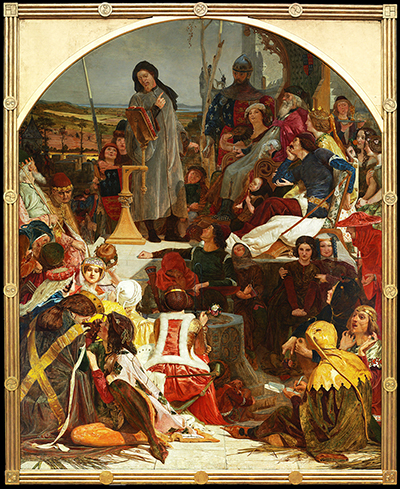
A poet stands at a lectern while a royal court gathers around him. Some listeners attend closely; others flirt, argue or turn towards a neighbour. In Chaucer at the Court of Edward III , Ford Madox Brown makes the life of English poetry emerge from this crowded mixture of ceremony and ordinary behaviour.
The painting illustrated here is Tate’s reduced version, dated 1856–1868. Its accession number is N02063. [1] The much larger composition was completed for exhibition in 1851 and subsequently went to Sydney. Brown returned to its design over many years, making the distinction between the original and later versions essential to its history. [2]
Brown imagined Chaucer reading the moving story of Custance to Edward III and his household. In explaining the picture, he supplied names and motives for many people, while admitting the freedom with which he had invented some of its courtly types. Its convincing human detail serves an ambitious idea: that the poet deserves a place at the centre of national history. [2]
At a Glance
- Artist Ford Madox Brown
- Title Chaucer at the Court of Edward III
- Date 1856–1868
- Medium Oil paint on canvas
- Dimensions 123.2 × 99.1 cm, excluding the frame
- Collection Tate, accession N02063; purchased in 1906
- Relationship to the original Reduced version of the large composition completed in 1851, now in Sydney
Tate’s collection data supplies the reduced painting’s date, medium, measurements and acquisition details. [1]
This work across Ford Madox Brown’s career
Manfred on the Jungfrau
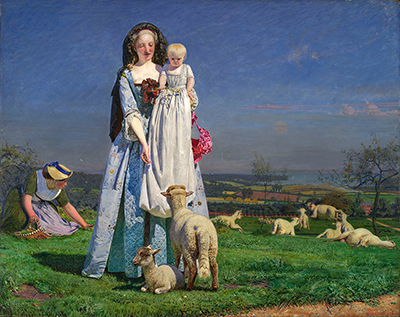
1841; retouched 1861Pretty Baa-Lambs
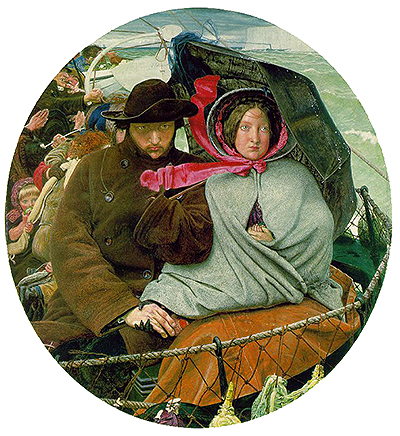
1851–1859The Last of England
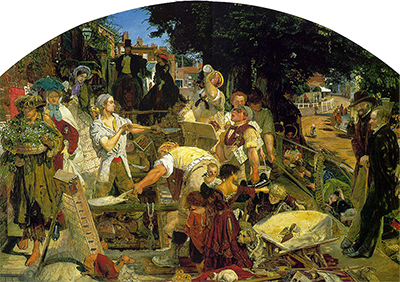
1852–1855Work
1852–1865Chaucer at the Court of Edward III by Ford Madox Brown (current article)
1856–1868 for Tate N02063King René’s Honeymoon
Tate watercolour, 1864Manchester Murals
1878–1893Contents
- A Court Held Together by a Voice
- Who Is in Brown's Medieval Gathering?
- What Is Chaucer Reading?
- From English Poetry to a Single Painting
- Research, Models and the Work of Invention
- Sunlight, Colour and the Arch
- The Sydney Original and Later Versions
A Court Held Together by a Voice
Begin with Chaucer's raised hand. One finger points upwards while the open book rests on an elaborate golden stand. His long grey robe forms a quiet vertical shape among the brilliant fabrics, angled limbs and restless hands around him. The book and the gesture make him the scene's speaking centre, although he stands away from its geometrical middle.
The arrangement immediately tests that centrality. A standing knight, a king beneath a canopy and a sick man reclining nearby compete for attention across the upper half. Below, the gathering spreads across steps and a paved foreground. Seen from behind, a woman in red and white helps pull the eye into the crowd. At the right, two men converse beside an open notebook; at the left, figures bend towards one another rather than looking straight at the poet. Brown leaves several small dramas active at once.
These differences have a basis in his own explanation. He described a troubadour torn between professional jealousy and admiration, a jester absorbed enough to forget his role, two critics discussing the reading and a youthful squire preoccupied with love. Listening becomes something visible through a tilted head, an interrupted occupation or an argument. The court contains a range of responses rather than a single expression of reverence. [2]
Brown's description also guards against mistaking every picturesque figure for a named historical person. Some are types chosen to animate the period: musician, courtier, priest, fool and lover. He even admitted that the jester was more Shakespearean than medieval. That admission is revealing. The research supports an imagined world in which Brown can stage recognisable human behaviour; it does not remove his freedom to invent. [2]
Beyond the assembly, a landscape stretches into the distance. A comparatively open sky and fields balance the dense foreground. The court occupies a terrace open to the air, with the carved canopy and architecture enclosing only part of the view. The setting gives the reading the intimacy of an outdoor gathering while the composition's arch confers the formality of a monument.
Who Is in Brown's Medieval Gathering?
Brown places the elderly Edward III beneath the canopy, with Alice Perrers beside him. John of Gaunt stands in armour near Chaucer. The Black Prince reclines against his wife Joanna, the Fair Maid of Kent. Brown's 1865 explanation presents the prince as gravely ill and Gaunt's armour as a sign that the responsibility for action has passed to him. These are the relationships Brown wanted viewers to read in the picture. [2]
The arrangement makes several kinds of authority visible. The king is seated and sheltered. Gaunt's upright armoured body supplies a contrasting image of readiness. The prince's extended legs and supported torso introduce weakness into the company of crowns and weapons. Chaucer commands neither the throne nor the sword, yet his voice briefly provides the gathering's common occupation. This is one way to understand the composition's elevation of poetry without treating every courtier as an obedient admirer.
Brown identified the hooded critic in the lower right as the poet John Gower. Beside him, another courtier listens and gestures. Following Brown’s description keeps his intended identities distinct from what can be established simply by looking: the pair are engaged in conversation, but their clothes and expressions alone cannot supply their names. [2]
Later identifications disagree with Brown’s, MacCulloch notes. [3]
MacCulloch identifies Saunders’s Cabinet Pictures of English Life: Chaucer as Brown’s published portrait source. [3]
A living model also entered the process. Arthur Hughes, recalling his first visit to Brown’s studio, remembered the enormous canvas and identified Dante Gabriel Rossetti as Chaucer’s model. Hueffer reproduces a study of Rossetti’s head associated with the picture. An inherited likeness and a face observed in the studio could therefore contribute to the same medieval person. Neither is a portrait made in Chaucer’s presence. [2]
Hueffer also records members of Brown's circle as models for other figures, including William Michael Rossetti for the troubadour and the surgeon John Marshall for the jester. Such information illuminates the making of the original design. It does not turn the medieval court into a documentary group portrait of Brown's friends, or establish that each face was repainted from the same sitter for every subsequent version. [2]
What Is Chaucer Reading?
In his 1865 exhibition catalogue, Brown called the reading the “Legend of Custance” and quoted the passage in which a mother comforts her crying child. The lines occur in The Man of Law's Tale , part of The Canterbury Tales , at II.834–840. Custance kneels, covers her child's eyes with her kerchief, lulls him in her arms and looks towards heaven. The surrounding verses place this tenderness at the moment of her enforced departure by sea. [2] [4]
The choice gives the reading an emotional character more specific than a general celebration of literary fame. Brown imagined the audience hearing a scene of vulnerability and maternal protection. Its still, intimate action offers a marked contrast to the outward splendour of the court. The story reaches listeners surrounded by armour, heraldry and rich clothes, asking their attention for a frightened woman and a small child. This contrast follows from the passage Brown selected, although the painting does not assign a precise emotional response to every listener. [2]
Sheen, on the Black Prince’s forty-fifth birthday, was the occasion specified in Brown’s 1851 exhibition title. [3]
In his 1865 explanation, however, Brown described the prince as being in his fortieth year. His account presents the scene as a supposition, then explains the choices that give it dramatic coherence. The title and the later commentary should consequently be read as stages in Brown’s reconstruction, rather than combined into a consistent eyewitness record of one documented occasion. [2]
From English Poetry to a Single Painting
Brown’s diary begins on 4 September 1847 by looking back to the summer of 1845. At the British Museum he had read Sir James Mackintosh’s history, seeking a subject that could express something broad about England’s past. A passage connecting Chaucer’s achievement with the status of the English language gave him an immediate vision of the poet reading before knights, ladies and the king in the open air. The sunshine belonged to the conception from the beginning. [5]
In Rome he consulted Chaucer’s works and life at the English Academy and developed the composition through an oil sketch, a chalk drawing and an outline. The larger project changed its subject as well as its form. Brown first considered a scheme about the English language, with Wycliffe on a wing; difficulties in balancing the figures and accommodating prose writers eventually led him to poetry alone. The evolving titles record decisions about what the painting could contain. [5]
The resulting triptych would surround Chaucer’s court with later poets. In the diary Brown names Burns, Byron, Spenser and Shakespeare among his favourites; subsequent entries record practical work on Milton and Pope as well. This was a personal selection as much as a public monument. Brown remembered the project as a source of pleasure during his first wife’s final illness, and her encouragement as an obligation to carry it through. [5]
MacCulloch proposes a Westminster competition connection, notes Scottish and Irish poets and discusses Richmond’s Protestant interpretation of Chaucer and Wycliffe. [3]
These interpretations help explain the scheme’s cultural ambition without establishing that Parliament commissioned it. The project could join a medieval scene to an argument about the writers who followed it: the architecture would bring people from different centuries into one account of literary inheritance. Its relationship with Wycliffe also survives directly in Brown’s record of the alternatives he considered. [5]
Brown’s 1865 catalogue states that he began the London painting in 1847 and completed it early in 1851, while also making Wycliffe , King Lear and other works. He then explained why he had abandoned the wings: returning to England had made him recognise the achievements of living poets. A selection confined to the dead would either be incomplete or look like an overconfident act of literary judgement. This was the artist’s retrospective explanation, rather than a dated account of one decisive day. [2]
MacCulloch dates abandonment to 1849; time pressure offers another possible explanation in her account. [3]
The surviving Seeds and Fruit of English Poetry design makes the broader ambition visible. Rows of poets occupy the architectural wings, while the court supplies the central event. Compare the many compartments of that conception with the close gathering in the finished picture. Once Chaucer stood alone, the argument about literary origins had to be carried by the reading, its audience and the elaborate setting.
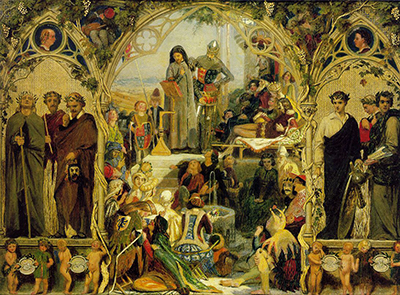
Brown’s Seeds and Fruit of English Poetry design preserves the broader triptych conception with later poets around Chaucer’s court.
Research, Models and the Work of Invention
Brown’s preparatory drawings break the crowded assembly into separate problems. Some sheets isolate a hand or a head; others leave the face blank and concentrate on fabric. The signed drawings reproduced with MacCulloch’s catalogue also make the stages visible: a body can be outlined before a robe is settled, and one area can be shaded closely while an adjacent form remains almost empty.
Her catalogue identifies prince and squire drapery studies and an older woman’s studies used for two male courtiers. [3]
In the prince’s torso studies, folds draw towards the bent elbow, turn around the waist and break over the belt. Light chalk picks out their ridges against the darker paper. The study of bent legs gives the knees, shins and bare feet a clear structure before the finished costume covers them. On the sheet with two heads of an older woman, a larger downward-looking face and a smaller profile test different views of the same aged features. These are investigations of particular bodily effects, rather than miniature copies of complete courtiers.
The hands are equally purposeful. Separate studies turn a palm, close fingers around a stick or lift an index finger away from a loosely curled hand. At this scale the differences between gripping, supporting and gesturing are substantial. In the painting, those actions help distinguish a speaker from a listener, or an absorbed spectator from someone pursuing a conversation of his own.
The jester’s hood was something Brown made as well as drew. On 22 October 1847 he recorded painting the king’s cloak, setting a workwoman to Chaucer’s gown and making ears for the hood himself. The entry then moves to Milton’s drapery, still part of the projected wings. The same working day could serve the medieval court and the later poets who would eventually disappear from the design. [5]
The reproduced jester study shows why such an object could be useful: the head tips back, exposing the underside of the chin, while the hood wraps around the jaw and rises into a curved ear. Drawing the garment from that awkward angle makes the turn of the head legible through the costume. Brown’s later painted fool belongs among the listeners, but this preparatory view treats the figure as a physical problem to be solved.
MacCulloch documents Abbey research, links Edward to his effigy and proposes Stothard’s illustrated effigies as costume sources. [3]
Brown’s own March 1851 letter gives a complementary view of historical reconstruction. With thirty-three days left before submission, he was still obtaining chain mail, feathers for a fan and cloth of gold; flowers, a dog and white velvet remained on his list. He had painted the heads and most hands, yet the picture still depended on finding small things to observe. Research and invention continued through shopping, borrowing, making and looking. [2]
This mixture of sources helps explain the picture’s distinctive realism. An old likeness could establish an identity, a model could supply a face or pose, and cloth could supply folds. Together they gave an invented event the physical density of something seen, without turning it into an eyewitness record.
Watch: Ford Madox Brown
Choose a film exploring the people, stories and visual details in two of Brown’s best-known paintings.
Pre-Raphaelites: Ford Madox Brown – Work
Curator Tim Barringer explores the figures and stories within Work.
Watch on YouTubeSunlight, Colour and the Arch
Brown singled out the original Chaucer as his first sustained attempt to represent light and shade as they existed at one particular moment. His 1865 account described “Sunlight, not too bright, such as is pleasant to sit in out-of-doors.” He was looking for a specific condition of illumination rather than a general formula for lighting historical figures. [2]
In the Tate version, that concern is apparent in the pale paving, the small dark intervals between bodies, the gleam of armour and the sharp changes across folded fabric. The white of the prince's hose and the red and white costume near the centre draw attention through their brightness as well as their position. The eye can move between minute effects of illumination and the larger organisation of the crowd.
The golden arch adds another kind of order. It sets a calm, continuous curve over the broken rhythms of faces and limbs. At its centre, the opening to the sky helps Chaucer's head and raised finger remain distinct. At the edges, the arch compresses the company, contributing to the sense that the court is both a place people inhabit and a carefully displayed image of the past.
The treatment also marks a stage in Brown's developing interest in outdoor light. It offers a useful comparison with the more exposed sunshine of Pretty Baa-Lambs , without requiring these different pictures to follow one identical procedure. Brown's own account of Chaucer identifies a comfortable, moderated sunlight, suited to people assembled to listen. [2]
The Sydney Original and Later Versions
Brown finished the large original for the Royal Academy in 1851 after an exhausting final push. In his diary’s later account of that year, he remembered working three whole nights in one week, resting for only a couple of hours in his clothes. He also named models, including John Marshall for the jester, Maitland for the prince and Julia Wild for the woman below who turns round. This testimony gives the imposing historical scene a very specific studio history. [5]
His letter of 14 May 1851 reported favourable criticism alongside violent abuse. The painting had been hung too high, without its frame, and reflected light badly. Brown thought that pictures made by him and his Pre-Raphaelite friends suffered by being displayed among work so unlike theirs, and proposed that they should be shown separately. Its reception concerned the conditions of exhibition as well as the subject itself. [2]
Further recognition followed. The official catalogue of the 1855 Paris Universal Exhibition lists Chaucer at the Court of Edward III as no.746, belonging to R. Dickinson. Hueffer records the Liverpool Academy’s £50 prize for the picture in 1858. These notices belong to the large composition’s history; they should not be transferred to the later Tate canvas. [6] [2]
The early sale was less rewarding than such public exposure might suggest. Brown recorded an arrangement under which Robert Dickinson would pay him 85 per cent of a future resale. An auction found no buyer, and the £20 received on account in 1854 was, at the time of that diary entry, all Brown had obtained. The distinction between an agreement to sell and money actually paid was consequential for the artist. [5]
Dealer David Thomas White later bought it for £50. MacCulloch records Brown’s recovery in 1863 for six pictures, after hearing that White threatened to cut it up. [3]
In 1876 the Sydney Fine Arts Committee bought the painting. Hueffer describes Brown’s pleasure at seeing a work find a permanent home in a public gallery. The route from studio to public collection had taken decades, with continued work and changes of ownership separating the first exhibition from its eventual destination. [2]
Later, misleading news of a Sydney fire led Brown to believe the painting had been destroyed. Hueffer reproduces his distressed response and describes his offer to paint it again, despite expecting another eight or ten years of work. The painting had actually been housed elsewhere and survived. The offer nevertheless shows how strongly Brown still valued this undertaking from his youth. [2]
Tate dates the smaller oil version to 1856–1868. [1]
MacCulloch traces the reduction through Seddon’s 1851 start, Brown’s 1863 resumption and Goodwin’s assistance in 1868. [3]
The early assistance has direct documentary support: Brown wrote in March 1851 that Thomas Seddon had begun a reproduction of the large picture, which he hoped later to turn into a finished copy, before Seddon became seriously ill. Hueffer subsequently associates the Chaucer duplicate with Frederick Leyland and records work on it until April 1868. These accounts explain why a replica can have a preparatory history extending beyond its museum date range. [2]
Birmingham’s related watercolour shows the upper portion of the composition. The poet, lectern and royal group remain, while much of the gathering in the lower half has gone. Its more compact arrangement provides another way to see how the reading and the throne organise the design.
MacCulloch considers it a possible contemporary copy of the finished painting, distinct from the diary’s sketch. [3]
Brown’s diary describes work on a paper watercolour sketch at Stockwell, subsequently bought by the painter Mark Anthony for twelve guineas. That record establishes another version, but does not by itself identify the Birmingham object. Keeping the works separate preserves the uncertainty around the latter’s authorship while acknowledging the documented circulation of the composition. [5]
Artworks directory
Explore paintings, drawings, cartoons, illustrations and decorative designs documented in museum collections and specialist research. Distinct versions are listed separately; repeated print impressions are grouped. The coverage includes studies and works without a dedicated article and remains open to further research.
| Name | Date | Medium |
|---|---|---|
| Work (Manchester) | 1852–1865 | Oil on canvas |
| The Last of England (Birmingham) | 1852–1855 | Oil on panel |
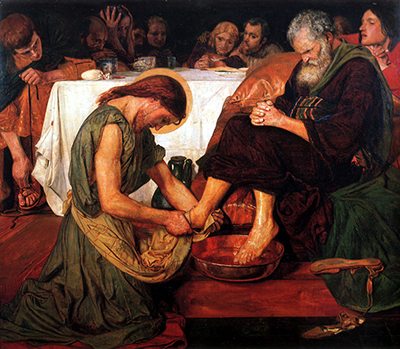
| Jesus Washing Peter’s Feet | 1852–1856 | Oil on canvas |
| Pretty Baa-Lambs | 1851–1859 | Oil on panel |
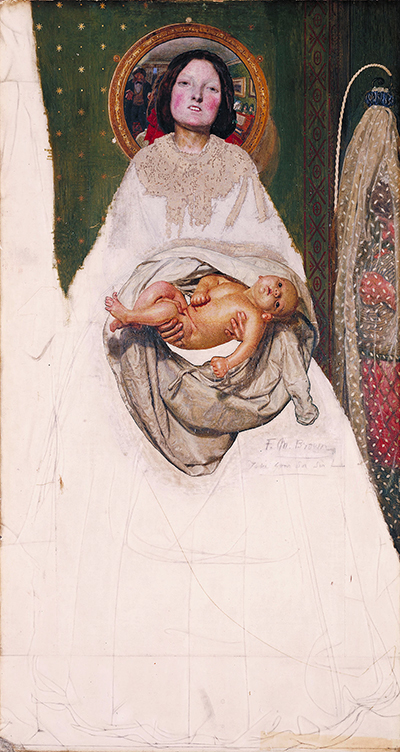
| Take Your Son, Sir | ?1851–1892 | Oil on canvas |
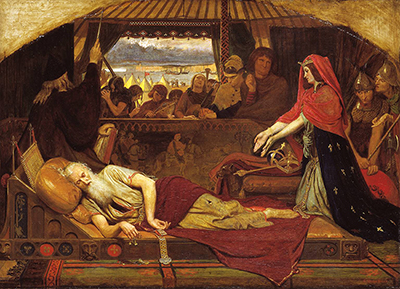
| Lear and Cordelia | 1849–1854 | Oil on canvas |
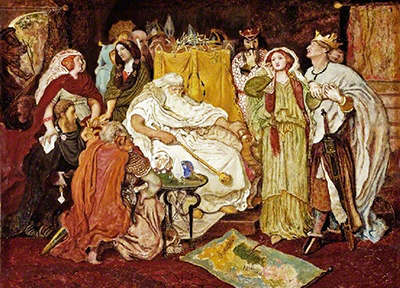
| Cordelia’s Portion | 1867–1875 | Oil on canvas |
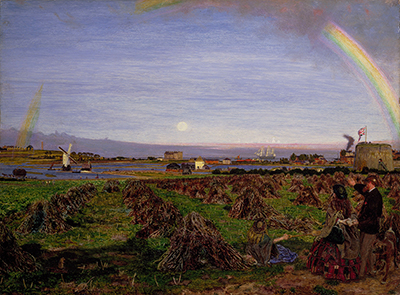
| Walton-on-the-Naze | 1859–1860 | Oil on canvas |
| Chaucer at the Court of Edward III (Tate) | 1856–1868 | Oil on canvas |
| Carrying Corn | 1854–1855 | Oil on mahogany |
| The Hayfield (The Hay Harvest) | 1855–1856 | Oil on mahogany |
| Stages of Cruelty | 1856–1890 | Oil on canvas |
| The Irish Girl | 1860 | Oil on canvas laid on board |
| Romeo and Juliet (Delaware) | 1869–1870 | Oil on canvas |
| The Seeds and Fruit of English Poetry | 1845–1853 | Oil on canvas |
| Self-Portrait | 1877 | Oil on canvas |
| The Bromley Children | Probably 1844 | Oil on canvas |
| The Bromley Family | 1844 | Oil on canvas |
| Byron’s Dream (Manchester) | 1874; worked on into 1875 | Oil on canvas |
| Cartoon for The Baptism of Edwin | 1879–1891 | Pastel, coloured chalks and grey gouache |
| The Coat of Many Colours | 1864–1866 | Oil on canvas |
| The Convalescent (Birmingham) | Dated October 1872 | Pastel |
| Crabtree Watching the Transit of Venus (reduced painting) | 1881–1888 | Tempera on panel |
| Cromwell on His Farm (Lady Lever) | Completed 1874 | Oil on canvas |
| Cromwell Protector of the Vaudois | 1877 | Oil on canvas |
| Dalton Collecting Marsh-Fire Gas (Town Hall mural) | 1886–1887 | Mural on canvas |
| The Establishment of the Flemish Weavers (reduced painting) | 1881; completed 1888 | Tempera on panel |
| The Finding of Don Juan by Haidée (NGV) | 1869–1870; later retouched | Watercolour and gouache over pencil |
| Henry and Millicent Fawcett | 1872 | Oil on canvas |
| Jacob and Joseph’s Coat (Ponce) | c.1868–1871 | Oil on canvas |
| James Leathart | 1863–1864; altered 1869 | Oil on canvas |
| King René’s Honeymoon (Tate watercolour) | 1864 | Graphite, watercolour, gouache and gum arabic on card |
| King René’s Honeymoon Cabinet (collaborative work) | 1861; exhibited 1862 | Oak, inlaid woods, painted panels and metal mounts; Brown designed Architecture |
| Manfred on the Jungfrau | 1841; retouched 1861 | Oil on canvas |
| Millie Smith | 1846 | Oil on paper laid on panel |
| William Michael Rossetti by Lamplight | 1856–1857 | Oil on panel |
| The Traveller (Manchester oil) | 1868–1884 | Oil on panel |
| Waiting: An English Fireside of 1854–55 | 1851–1855 | Oil on panel |
| An English Autumn Afternoon | 1852–1853; finished c.1854 | Oil on canvas |
| Alfred the Great: Sketch of Alfred drawing in the Sand | 1843–1845 | pencil |
| Historical Notes and Sketches of Alfred the Great | 1843–1850 | brown ink writing over pencil |
| Angels watching the Crown of Thorns: Study of clasped Hands | 1846 | black chalk |
| Architecture: Study of Gothic Arches and 14th Century Vaulting | c. 1847 | brown pen and ink over pencil on grey paper |
| The Ascension: Study of Angels and Hands | 1844 | brown pen and ink over pencil |
| The Ascension: Study of a Group of Angels | 1844 | brown pen and ink over pencil |
| The Ascension: Study of a Group of six flying Angels | 1844 | brown pen and ink over pencil |
| The Ascension: Two nude Angels holding onto each other | 1844 | brown brush and ink over pencil |
| The Ascension: Study for a kneeling Apostle | 1844 | black chalk touched with white on brown-toned paper |
| Head of a Child | c. 1844 | black chalk touched with white on brown toned paper |
| The Ascension: Drapery Study of a praying Apostle | 1844 | black chalk |
| The Spirit of Justice: Seated Figure in ecclesiastical Robes, gripping a Staff with left Hand raised in a Blessing | 1844 | black chalk |
| The Ascension: Study for an Apostle | 1844 | black chalk |
| The Spirit of Justice: Body of seated Figure in ecclesiastical Robes holding a Staff and a Book | 1844 | black chalk |
| The Ascension: Study of an Apostle | 1844 | black chalk on toned paper |
| Full-length Sketch of a standing, naked Child | 1844 | black chalk on toned paper |
| The Ascension: Study for Christ | 1844 | brown pen and ink over pencil |
| Caricature: Composite Drawing: A Stunner | 1861–1863 | pencil |
| A Victorian Woman in her Underwear | 1861–1863 | pencil |
| Caricature: Composite Drawing: Bewigged Head | 1861–1863 | pencil |
| Bowed Head of a bearded Man | 1861–1863 | pencil |
| Chaucer at the Court of Edward III: Early compositional Study | 1845 | pencil with brown pen and ink |
| Chaucer at the Court of Edward III: Study for Milton and two Designs for Tombstones | c.1845–c.1846 | pencil with brown frame outline |
| Chaucer at the Court of Edward III: Tracing of the Figure of Milton | c.1845–c.1849 | brown pen and ink with pencil on tracing paper |
| Chaucer at the Court of Edward III: Tracing of a Gothic Arch | c.1845–c.1849 | brown pen and ink with pencil on tracing paper |
| Chaucer at the Court of Edward III: Early compositional Study | 1845 | pencil with brown pen and ink |
| Chaucer at the Court of Edward III: Nude Studies of two Boys | 1845 | pencil, laid down |
| Chaucer at the Court of Edward III: Nude Studies of four Figures | 1845 | pencil |
| Chaucer at the Court of Edward III: Eight early Studies of Figures and Hands | 1845 | pencil |
| Chaucer at the Court of Edward III: Nude Studies for the Figures of Byron, Shakespeare and Burns | 1845 | black chalk |
| Chaucer at the Court of Edward III: Drapery Study for Burns | 1847 | black chalk |
| Chaucer at the Court of Edward III: Study of a right Leg and left Foot for Milton | 1847 | black chalk |
| Chaucer at the Court of Edward III: Study of a left Leg for Shakespeare | 1847 | black chalk |
| Chaucer at the Court of Edward III: Study of Drapery for Milton | 1847 | black chalk |
| Chaucer at the Court of Edward III: Drapery Study for Shakespeare | 1847 | black chalk |
| Chaucer at the Court of Edward III: Study of a Man in a medieval Hood | 1847 | black chalk |
| Chaucer at the Court of Edward III: Study for the Cardinal | 1847 | black chalk |
| Chaucer at the Court of Edward III: Drapery Study in Profile for Courtier | 1847 | black chalk |
| Chaucer at the Court of Edward III: Drapery Study | 1847 | black chalk |
| Chaucer at the Court of Edward III: Female Nude Study of a Muse holding onto a Rail | 1847 | pencil |
| Chaucer at the Court of Edward III: Female Nude: Study of a Muse | 1847 | pencil |
| Chaucer at the Court of Edward III: Nude Study for seated Lady | 1847 | pencil |
| Chaucer at the Court of Edward III: Nude Study of a Woman with right Arm raised | 1847 | pencil |
| Chaucer at the Court of Edward III: Two Studies of Back of a seated Woman's Head | 1847 | pencil |
| Chaucer at the Court of Edward III: Two Studies of a seated Woman in lost Profile Pose and from the Back | 1847 | pencil |
| Chaucer at the Court of Edward III: Nude Study of a Woman | 1847 | pencil |
| Chaucer at the Court of Edward III: Sketch of a Woman supporting another Figure | 1847 | pencil |
| Chaucer at the Court of Edward III: Study of the Heads and Shoulders of two Women | 1847 | pencil |
| Chaucer at the Court of Edward III: Drapery Study for Edward III with Outline of a Child | 1847 | black chalk |
| Chaucer at the Court of Edward III: Foreshortened Study for Head of a Jester | 1847 | pencil |
| Chaucer at the Court of Edward III: Head of Alexander Pope | 1847 | black chalk |
| Chaucer at the Court of Edward III: Two Hand Studies | 1847 | black chalk |
| Chaucer at the Court of Edward III: Study of Head of Milton copied from Sculpture | 1848 | black chalk |
| Chaucer at the Court of Edward III: Nude Studies for the Squire and the Courtier talking to Gower | 1848 | pencil |
| Chaucer at the Court of Edward III: Drapery Study for the Black Prince | 1848 | black chalk with touches of white |
| Chaucer at the Court of Edward III: Three Studies of Hands | 1848 | Black chalk |
| Chaucer at the Court of Edward III: Four Studies of Hands | 1848 | black chalk touched with white |
| Chaucer at the Court of Edward III: Study of a clasped right Hand for one of the Poets | 1848 | black chalk |
| Chaucer at the Court of Edward III: Study of a left Hand for Burns | 1848 | black chalk heightened with touches of white |
| Chaucer at the Court of Edward III: Study of Drapery for Burns | 1848 | black chalk |
| Chaucer at the Court of Edward III: Drapery Study | 1848 | black chalk |
| Chaucer at the Court of Edward III: Drapery Study for the Black Prince | 1851 | black and white chalks on brown-toned paper |
| Chaucer at the Court of Edward III: Study for Squire's Legs | 1851 | black chalk heightened with white |
| Chaucer at the Court of Edward III: Two Head Studies of an old Woman | 1851 | black chalk |
| Costume Study: Five Sketches of Armour and Costume | 1844 | brown pen and ink over pencil |
| Costume Study: Archbishop's Dress | 1845 | brown pen and ink on tracing paper |
| Costume Studies: French and Italian thirteenth and fourteenth-century Costumes (seven Drawings) | 1845 | brown pen and ink on tracing paper |
| Costume Study: Seigneur de Rimini | 1845 | brown pen and ink on tracing paper |
| Dalziels' Bible Gallery: The Death of Eglon | 1863–1865 | engraved woodblock; designed by Brown, engraved by the Dalziel Brothers |
| Dalziels' Bible Gallery: The Death of Eglon | 1881 | wood engraving; designed by Brown, engraved by the Dalziel Brothers |
| Dalziels' Bible Gallery: Elijah and the Widow's Son | 1863–1865 | engraved woodblock; designed by Brown, engraved by the Dalziel Brothers |
| Dalziels' Bible Gallery: Elijah and the Widow's Son | 1881 | wood engraving; designed by Brown, engraved by the Dalziel Brothers |
| Dalziels' Bible Gallery: Joseph’s Coat (Compositional Sketch and four Studies for Jacob's Granddaughter) | 1863–1865 | pencil on paper |
| Dalziels' Bible Gallery: Joseph's Coat | 1863–1865 | engraved woodblock; designed by Brown, engraved by the Dalziel Brothers |
| Dalziels' Bible Gallery: Joseph’s Coat | 1881 | wood engraving; designed by Brown, engraved by the Dalziel Brothers |
| Decorative Sketches: Venus Reclining on a Shell in the Midst of the Sea | 1848–1849 | brown pen and ink over pencil |
| Decorative Design: Ornamental Pattern | 1850 | watercolour and bodycolour over pen and ink, and pencil on two sheets of paper |
| Down Stream: Main Illustration (Last Year's First of May) | 1871 | wood engraving; designed by Brown, print execution by an engraver |
| Down Stream: Tailpiece to the Poem (This Year's First of June) | 1871 | wood engraving; designed by Brown, print execution by an engraver |
| The Establishment of Flemish Weavers in Manchester A.D. 1363: Four Studies of Parts of a Horse | 1879–1882 | black, white and red chalk on rough brown paper |
| Female: Two Studies of young Woman in eighteenth-century Costume | 1849 | pencil |
| Infant's Repast: Study of Mother and Child | 1848 | black and white chalk |
| Infant's Repast: Study of Mother and Child with separate Arm and Leg Studies of the Child | 1848 | black chalk with grey wash |
| King Lear: Sketch of Lear questioning Cordelia | 1844 | brown pen and ink over pencil |
| Alfred the Great: Compositional Sketches | 1843–1845 | pencil |
| King Lear: Sketches of Lear imagining his unfaithful Daughters’ Trial and Lear in the Storm | 1844 | brown pen and ink over pencil |
| Alfred the Great: Compositional Studies and Sketches and Chaucer at the Court of Edward III: Study of Cherubs | 1843–1849 | pencil |
| King Lear: Kent accuses Oswald | 1844 | brown pen and ink with pencil underneath |
| King Lear: Lear recounts his Wrongs to Regan | Undated | Brown pen and ink over pencil |
| King Lear: Cordelia at Lear's Bedside (Lear's Awakening) | 1844 | brown pen and ink over pencil |
| Cordelia Parting from Her Sisters (The Germ) | 1850; reprinted 1901 | Etching; designed by Brown, print execution by an engraver |
| King René's Honeymoon: Study for Architecture | 1861 | brush and brown ink, with watercolour, over pencil on brown paper |
| The Last of England: Cartoon | 1852 | pencil, image edged with brown ink |
| The Last of England: Portrait of Emma Hill | December 1852 | chalks with scratching out on two sheets of paper |
| Lear and Cordelia and The Infant’s Repast: Four Studies of Hands | 1849 | black chalk |
| Lyra Germanica - the Christian Life: Abraham and Isaac | 1868 | wood engraving; designed by Brown, print execution by an engraver |
| Lyra Germanica - the Christian Life: Finished Design for The Entombment | 1867 | black pen and ink |
| Lyra Germanica - the Christian Life: The Entombment | 1868 | wood engraving; designed by Brown, print execution by an engraver |
| Male: Sketch of Man reclining on Steps with Hands bound together | 1844 | brown pen and ink over pencil |
| Male: Academic nude Study, half-length with Moustache and Arms folded | 1846–1849 | black chalk |
| Male: Academic Study of Nude holding a Staff | 1847 | pencil |
| Male: Academic Study of Nude posed as a Sculptor | 1847 | chalk with grey wash |
| Male: Academic Study, three-quarter length Nude, with a Moustache and clenched Fists | 1847 | black chalk |
| Oure Ladye of Saturday Night: Seven Sketches | 1846 | pencil |
| Oure Ladye of Saturday Night: Four Studies for Angel holding Child | 1847 | pencil |
| Oure Ladye of Saturday Night: Study of Angel holding Child | 1847 | black chalk |
| Oure Ladye of Saturday Night: Study of Arm and Hands for Angel holding Bowl of Water | 1847 | black chalk |
| Oure Ladye of Saturday Night: Drapery Study for Angel holding Bowl of Water | 1847 | black chalk |
| Oure Ladye of Saturday Night: Study of Head for Angel holding Bowl of Water | 1847 | black chalk with rubbing and grey wash |
| Oure Ladye of Saturday Night: Study of Child seated on Knees of the Virgin and two separate Studies of the Child's Legs | 1847 | pencil on brown-toned paper |
| Oure Ladye of Saturday Night: Frieze Design | c. 1847 | pencil and black pen and ink |
| Oure Ladye of Saturday Night: Three Studies of Arms and Legs of Child | 1847 | pencil |
| Oure Ladye of Saturday Night: Three Studies of Child's Legs on Virgin's Knees | 1847 | pencil |
| Oure Ladye of Saturday Night: Studies of Right Foot and Left Hand of Child | 1847 | pencil on light brown paper |
| Oure Ladye of Saturday Night: Drapery Study for Virgin | 1847 | black chalk |
| Oure Ladye of Saturday Night: Study for Head of Virgin | 1847 | black chalk with wash |
| Parisina’s Sleep: Study for Prince Azo and Parisina | 1842 | black chalk with pencil side drawing |
| Parisina's Sleep: Study for Head of Prince Azo | 1842 | black chalk with grey wash |
| Parisina's Sleep: Study for the Head of Parisina | 1842 | black and white chalk with grey wash |
| Poets of the Nineteenth Century: The Prisoner of Chillon: Compositional Sketch | 1856 | pencil |
| Profile of a Man's left Eye and Nose | c.1856 | pencil |
| Poets of the Nineteenth Century: The Prisoner of Chillon: Study of a Corpse | 1856 | pencil |
| Designs for Decoration | c.1856 | pencil |
| Poets of the Nineteenth Century: The Prisoner of Chillon | 1857 | wood engraving; designed by Brown, print execution by an engraver |
| Portrait: Head Study of Daniel Casey (three-quarter view) | 1848 | black chalk |
| Portrait: Head Study of Daniel Casey (full-face) | 1848 | black chalk |
| Portrait: Miss Iza Duffus Hardy | 1872 | pastel and coloured chalks on brown paper |
| Portrait: Emma Hill (later Mrs Madox Brown) | 1848 | black chalk |
| Portrait: Emma Hill (later Mrs Madox Brown) | 1852 | pencil |
| Portrait: Mrs Madox Brown (neé Emma Hill) | 9 May 1854 | pencil |
| The Repose in Egypt: Compositional Sketch | 1847 | pencil |
| Study of a Statue of the Discobolus | 1845 | Black chalk |
| William Shakespeare: Study | 1849–1850 | pencil |
| William Shakespeare: Invitation Card | 1850 | wood engraving; designed by Brown, print execution by an engraver |
| The Spirit of Justice: Study for Baron and his Advisor, with Sketches of Erudition and Wisdom | 1844–1845 | brown pen and ink over pencil |
| The Spirit of Justice: Drapery Study for Erudition | 1844–1845 | black chalk |
| Drapery Study and Sketch of Two Legs | Undated | Black chalk |
| The Spirit of Justice: Study for Wisdom | 1844–1845 | black chalk with grey wash |
| The Spirit of Justice: Study for Head of the Baron | 1844–1845 | black chalk |
| The Spirit of Justice: Study for the Head of central Bishop | 1844–1845 | black chalk |
| The Spirit of Justice: Study for the Head of a Bishop | 1844–1845 | black chalk with grey wash |
| The Spirit of Justice: Study for the uplifted left Arm of Justice | 1844–1845 | black chalk |
| The Spirit of Justice: Study for Head of Counsellor in a Coronet | 1844–1845 | black chalk with touches of blue chalk |
| The Spirit of Justice: Study for Head of Counsellor | 1844–1845 | black chalk |
| The Spirit of Justice: Drapery Study for the Central Bishop | 1844–1845 | Black chalk |
| Part of a Drapery Study | 1844–1845 | black chalk |
| The Spirit of Justice: Study for Head of Widow | 1844–1845 | black chalk |
| Stages of Cruelty: Study for the Child (Catherine Madox Brown) | 1857 | black chalk on pale grey paper |
| Stained Glass Design: Cartoon for Zachariah, The High Priest | 1872 | black chalk |
| Stained Glass Design: Cartoon for The Young Milton | 1874 | black chalk |
| Stained Glass Design: Cartoon for St Simon | 1874 | black chalk |
| Sterne's 'Sentimental Journey': Study for Yorick and La Fleur talking to Maria’s Mother | 1842 | brown pen and ink over pencil |
| The Body of Harold brought before William the Conqueror: Eight Sketches of Figure Groups | c.1844 | pencil |
| Sterne's 'Sentimental Journey' : Yorick (Laurence Sterne) and Maria Walking | 1842 | pen and ink, watercolour and bodycolour over pencil |
| Study of Tree Trunk with Roots | c.1847 | black chalk, heightened with white chalk on buff paper |
| Two Studies of Tree Trunks | c.1846 | black chalk |
| Unknown Subject: Compositional Sketch | 1843–1850 | pencil |
| Wycliffe reading his Translation of the Bible: Nude Study for Chaucer | 1847 | pencil |
| Wycliffe reading his Translation of the Bible: Study for Chaucer | 1847 | pencil |
| Wycliffe reading his Translation of the Bible: Nude Study of Gower | 1847 | pencil |
| Wycliffe reading his Translation of the Bible: Study for Gower | 1847 | pencil |
| Wycliffe reading his Translation of the Bible: Nude Study for John of Gaunt and Chaucer's right Hand | 1847 | pencil and black chalk |
| Wycliffe reading his Translation of the Bible: Study of John of Gaunt and Chaucer's Left Hand | 1847 | pencil and black chalk |
| Wycliffe reading his Translation of the Bible: Study for Wycliffe | 1847 | black chalk |
| Wycliffe reading his Translation of the Bible: Nude Study for Wycliffe | 1847 | pencil |
| Wycliffe reading his Translation of the Bible: Drapery Study for Wycliffe | 1847 | black chalk |
| Wycliffe reading his Translation of the Bible: Drapery Study for Chaucer | 1848 | black chalk |
| Wycliffe reading his Translation of the Bible: Study of Legs for John of Gaunt and two Studies of Feet for Wycliffe | 1848 | black chalk |
| Wycliffe Reading his Translation of the Bible: Studies of Hands for John of Gaunt and Gower | 1847 | black chalk |
| Wycliffe reading his Translation of the Bible: Study for Head of Wycliffe | 1847 | pencil |
| Wycliffe reading his Translation of the Bible: Study for Constance and Child | 1847 | pencil |
| Wycliffe reading his Translation of the Bible: Unfinished Study for Head of Constance | 1847–48 | pencil |
| Wycliffe reading his Translation of the Bible: Portrait of Elizabeth Bamford modelling for Constance | 1848 | pencil |
| Wycliffe reading his Translation of the Bible: Study for Head of Constance | 1848 | chalk over pencil |
| Wycliffe reading his Translation of the Bible: Study for Head of Chaucer | 1848 | pencil |
| Wycliffe reading his Translation of the Bible: Study of Monk representing the Catholic Faith | 1848 | black chalk with brown pen and ink, squared up |
| Wycliffe reading his Translation of the Bible: Study of young Woman representing the Protestant Faith | 1848 | black chalk |
| Cathy Madox Brown at the Age of Three (Tate N01356) | 1853 | Graphite on paper |
| King René‘s Honeymoon (Tate N02409) | date not known | Ink on paper |
| Sheepshearing (Tate N02410) | c.1887 | Ink and graphite on paper |
| Studies for ‘Work’ (Tate N02411) | 1855 | Graphite and ink on paper |
| Design for Badge for Gillum’s Homes (Tate N02412) | date not known | Ink and graphite on paper |
| Arkwright’s Mill (Tate N02413) | 1878 | Graphite on paper |
| Study for ‘John Kay’ (Tate N02414) | 1889 | Graphite on paper |
| Study for ‘Southend’ (Tate N02415) | date not known | Graphite on paper |
| ‘Where are you going, my pretty maid?’ (Tate N02416) | date not known | Graphite on paper |
| Section of the Bridgewater Canal (Tate N02417) | 1890 | Ink on paper |
| A Barge on the Bridgewater Canal (Tate N02418) | 1890 | Graphite on paper |
| Study of the Tow-Path on the Bridgewater Canal (Tate N02419) | 1890 | Graphite on paper |
| Our Lady of Good Children (Tate N02684) | 1847–61 | Pastel, watercolour and gold paint on paper |
| Arkwright’s Mill (Tate N02791) | 1881 | Graphite on paper |
| The Bridgewater Canal (Tate N02792) | 1890 | Ink on paper |
| The Bridgewater Canal (Tate N02793) | date not known | Chalk and graphite on paper |
| The Last of England (Tate N03064) | 1864–6 | Watercolour on paper |
| Mauvais Sujet (Tate N03228) | 1863 | Watercolour on paper |
| Study of a Man Painting (Tate N03472) | 1839 | Graphite on paper |
| The Brent at Hendon (Tate N03528) | 1854–5 | Oil paint on board on mahogany |
| Study for the Dean in the ‘Execution of Mary Queen of Scots’ (Tate N04280) | c.1840 | Oil paint on paper |
| Sketch for ‘Jesus Washing Peter’s Feet’ (Tate N04281) | 1852 | Graphite on paper |
| Sketch for ‘Cromwell on his Farm’ (Tate N04282) | c.1853 | Graphite on paper |
| The Coat of Many Colours (Tate N04584) | 1867 | Watercolour and gouache on paper |
| Stages of Cruelty (Tate N04625) | c.1856 | Watercolour on paper |
| Head of a Girl (Tate N04803) | date not known | Oil paint on paper |
| Portrait of Dykes Barry as a Child (Tate N04866) | 1853 | Oil paint on mahogany |
| Jesus Washing Peter’s Feet (Tate N05301) | 1857–8 | Watercolour on paper |
| Platt Lane (Tate N05383) | 1884 | Oil paint on canvas |
| Study of F.G. Stephens for ‘Jesus Washing Peter’s Feet’. Verso: A Head Crowned with Laurels (Tate T00571) | 1852 | Graphite on paper. Verso: graphite on paper |
| Sketch for ‘Jesus Washing Peter’s Feet’ (Tate T01035) | c.1851 | Ink and graphite on paper |
| Chaucer at the Court of Edward III (Sydney) | 1845–1851 | Oil on canvas |
| Wycliffe Reading His Translation of the Bible to John of Gaunt (Bradford) | 1848 | Oil on canvas |
| Work (Birmingham replica) | 1859–1863 | Oil on canvas |
| The Spirit of Justice (Book of Art reproduction) | Published 1846 | Wood engraving after Brown’s cartoon; engraver unknown |
| The Execution of Mary Queen of Scots | 1840–1842 | Oil on canvas |
| The Prisoner of Chillon (Manchester oil) | 1843 | Oil on canvas |
| The Parting of Cordelia from Her Sisters (oil) | 1853 | Oil on canvas |
| Cordelia’s Portion (Lady Lever) | 1866–1872 | Watercolour, gouache and pastel |
| The Ascension | 1844–1845 | Oil on canvas |
| Manfred in the Chamois Hunter’s Hut (oil sketch) | 1840 | Oil on canvas |
| Dr Primrose and His Daughters (The Vicar of Wakefield) | 1840–1841 | Oil on canvas |
| The Body of Harold Brought before William the Conqueror | 1844–1861 | Oil on canvas |
| The Seeds and Fruits of English Poetry (Bedford cartoon) | 1845 | Black chalk on paper |
| Wycliffe Reading His Translation of the Bible (oil sketch) | 1847–1848 | Oil on board |
| Cromwell Discussing the Protection of the Vaudois (Nottingham) | 1877–1878 | Oil on canvas |
| Two Drawings of Men in Hoods | c.1845 | Pencil on paper |
| The Seeds and Fruits of English Poetry: Study of the Right Side | c.1845 | Brown pen and ink with pencil |
| Chaucer: A Man in a Hood with a Liripipe and Two Drapery Studies | 1848 | Oil on canvas |
| The Prisoner of Chillon Entreating His Jailors (Yale watercolour) | 1858 | Watercolour heightened with bodycolour |
| Elijah and the Widow’s Son (Birmingham oil) | 1864 | Oil on panel |
| He That Soweth (Lyra Germanica) | Published 1868 | Wood engraving by the Dalziel Brothers after Brown |
| The Entombment (NGV) | 1871–1878 | Watercolour, gouache, gold paint and gum arabic over pencil |
| The Sower (Morris firm tile) | c.1864–1873 | Tile; design by Brown, workshop execution |
| Childe Harold’s Pilgrimage (Byron illustration) | Published 1870 | Steel engraving by Herbert Bourne after Brown |
| The Two Foscari (Byron illustration) | Published 1870 | Steel engraving by Herbert Bourne after Brown |
| The Corsair (Byron illustration) | Published 1870 | Steel engraving by Herbert Bourne after Brown |
| Sardanapalus (Byron illustration) | Published 1870 | Steel engraving by Herbert Bourne after Brown |
| Don Juan (Byron illustration) | Published 1870 | Steel engraving by Herbert Bourne after Brown |
| Byron’s Dream (roundel title-page design) | Published 1870 | Steel engraving by Herbert Bourne after Brown |
| The Finding of Don Juan by Haidée (Birmingham oil) | 1870–1873 | Oil on canvas |
| The Dream of Sardanapalus (Delaware) | 1871–1872 | Watercolour on paper |
| The Traveller (Once a Week) | Published 1869 | Wood engraving by Joseph Swain after Brown |
| The Infant’s Repast | 1848 | Oil on board |
| Oliver Madox Brown Aged Four (Dwale Bluth frontispiece) | Published 1876 | Etching |
| Oliver Madox Brown as a Young Man (Dwale Bluth frontispiece) | Published 1876 | Etching |
| A Beggar and Other Fantasies: Title-page Illustration | Published 1889 | Photo-engraving after Brown |
| Dramas in Miniature: Title-page Illustration | Published 1891 | Photo-engraving after Brown |
| The Brown Owl: Frontispiece | Published 1892 | Photo-engraving after Brown |
| The Brown Owl: Central Illustration | Published 1892 | Photo-engraving after Brown |
| The Feather: Frontispiece | Published 1892 | Photo-engraving after Brown |
| The Ascension: Study for Christ | 1844 | Pen and ink |
| King Lear: Lear Questions Cordelia (Whitworth) | 1844 | Pencil, pen and brown ink |
| King Lear: France Claims the Dispossessed Cordelia (Whitworth) | 1844 | Pencil, pen and brown ink |
| King Lear: Cordelia Parts from Her Sisters (Whitworth) | 1844 | Pencil, pen and brown ink |
| King Lear: Goneril and Regan Together (Whitworth) | 1844 | Pencil, pen and brown ink |
| King Lear: Goneril Tells Oswald How to Treat Lear (Whitworth) | 1844 | Pencil, pen and brown ink |
| King Lear: Oswald’s Insolence to Lear (Whitworth) | 1844 | Pencil, pen and brown ink |
| King Lear: Lear Rebukes Oswald (Whitworth) | 1844 | Pencil, pen and brown ink |
| King Lear: Kent Trips Oswald (Whitworth) | 1844 | Pencil, pen and brown ink |
| King Lear: Goneril’s Complaint to Lear (Whitworth) | 1844 | Pencil, pen and brown ink |
| King Lear: Lear Curses Goneril’s Infidelity (Whitworth) | 1844 | Pencil, pen and brown ink |
| King Lear: Kent Challenges Oswald (Whitworth) | 1844 | Pencil, pen and brown ink |
| King Lear: Kent in the Stocks (Whitworth) | 1844 | Pencil, pen and brown ink |
| King Lear: Lear Recounts His Wrongs to Regan (Whitworth) | 1844 | Pencil, pen and brown ink |
| King Lear: Lear Parts from Regan and Goneril (Whitworth) | 1844 | Pencil, pen and brown ink |
| King Lear: Lear and the Fool in the Storm (Whitworth) | 1844 | Pencil, pen and brown ink |
| King Lear: Lear Mad on the Beach at Dover (Whitworth) | 1844 | Pencil, pen and brown ink |
| King Lear: Alternative Study: Lear Curses Goneril (Whitworth) | 1844 | Pencil, pen and brown ink |
| King Lear: Lear Imagines His Daughters’ Trial (Whitworth) | 1844 | Pencil |
| King Lear: Alternative Study: Lear in the Storm (Whitworth) | 1844 | Pencil, pen and brown ink |
| The Last of England (Fitzwilliam) | 1860 | Oil on canvas |
| The Convalescent (Metropolitan Museum) | Dated 1872 | Pastel |
| Self-Portrait (Walker drawing) | 1850; retouched 1853 | Black chalk |
| Byron’s Dream (Whitworth) | 1889 | Watercolour over graphite |
| Cordelia Parting from Her Sisters (Cleveland sketch) | 1854 | Pen and oil on paper mounted on panel |
| David and Goliath: Cartoon for Stained Glass Window at Jesus College, Cambridge | 1872 | Charcoal and graphite on Japanese paper |
| The Virgin Swooning (recto) | 1844 | Black chalk on laid paper |
| Two Drapery Studies (verso) | c.1844 | Black chalk |
| Architecture: King René’s Honeymoon (stained glass) | 1862 | Stained glass; designed by Brown, made by Morris, Marshall, Faulkner & Co. |
| The Romans Building a Fort at Mancenion (Town Hall mural) | 1880 | Spirit fresco |
| The Baptism of Edwin (Town Hall mural) | 1879–1880 | Spirit fresco |
| The Expulsion of the Danes (Town Hall mural) | 1880–1881 | Spirit fresco |
| The Establishment of the Flemish Weavers (Town Hall mural) | 1881–1882 | Spirit fresco |
| Crabtree Watching the Transit of Venus (Town Hall mural) | 1882–1883 | Spirit fresco |
| The Proclamation Regarding Weights and Measures (Town Hall mural) | 1883–1884 | Spirit fresco |
| Wycliffe on Trial (Town Hall mural) | 1885–1886 | Spirit fresco |
| Chetham’s Life’s Dream (Town Hall mural) | 1885–1886 | Mural on canvas |
| Bradshaw’s Defence of Manchester (Town Hall mural) | 1892–1893 | Mural on canvas |
| John Kay, Inventor of the Fly Shuttle (Town Hall mural) | 1888–1890 | Mural on canvas |
| The Opening of the Bridgewater Canal (Town Hall mural) | 1891–1892 | Mural on canvas |
Frequently Asked Questions
Brown presents an imagined reading before named royal figures and invented courtly types. His own explanation supplies their relationships and motives; the painting’s detail does not establish that this particular gathering took place. [2]
Discussion
Look again at the images and ideas explored in Chaucer at the Court of Edward III by Ford Madox Brown. These editorial prompts invite your observations.
Reader Insights
Compare Chaucer's upright stance and speaking hand with the seated king, the armoured Gaunt and the reclining prince. Consider how the painting distributes attention among literary achievement, rank, physical strength and vulnerability.
Follow the glances around the court. Which figures appear absorbed, distracted, affectionate or argumentative? The composition invites a distinction between being physically present at a reading and sharing the same experience of it.
Consider the combination of old portrait sources, living models, studied drapery and constructed props. Which details make the scene feel immediate, and which remind you that it has been deliberately staged?
Join the Conversation
Share a detail, comparison or question about Chaucer at the Court of Edward III by Ford Madox Brown below.
References
- Tate Gallery , official historical collection dataset, record N02063, Chaucer at the Court of Edward III : date, medium, support dimensions and credit line. View source .
- Ford Madox Hueffer , Ford Madox Brown: A Record of His Life and Work , 1896, pp.41–43, 69–75, 158, 232–235, 306–307 and 359–360. Includes Brown’s 1865 catalogue descriptions, March and May 1851 letters, Arthur Hughes’s recollection, later replica work, the Sydney purchase and the mistaken fire report. Read source View source .
- Laura MacCulloch , Ford Madox Brown: Works on Paper and Archive Material at Birmingham Museums and Art Gallery , PhD thesis, University of Birmingham, 2009, volume one, pp.98–104, 109–114 and 204–208; selected catalogue entries 15–55, especially nos.38–48 and 52–55 (pp.220–226). Original drawings and related watercolour reproduced in volume two, PDF pp.59–71. Read catalogue · View reproduced works View source 1 . View source 2 .
- Geoffrey Chaucer , The Man of Law’s Tale , II.820–875, especially II.834–840, Middle English primary text on Harvard’s Geoffrey Chaucer Website. Read text View source .
- Ford Madox Brown , diary, selected entries edited by William Michael Rossetti in Præraphaelite Diaries and Letters , 1900, especially 4 September 1847, pp.61–66; October 1847, pp.70–73; and the retrospective account of 1850–1851, pp.107–109. Read primary text View source .
- Paris Universal Exhibition 1855 , official catalogue of the British section, p.168, no.746, Chaucer at the Court of Edward III , property of R. Dickinson. Read catalogue page View source .
- Ford Madox Hueffer, Ford Madox Brown: A Record of His Life and Work, 1896; selected career, object and mural passages. View source.
- Laura MacCulloch, Ford Madox Brown: Works on Paper and Archive Material at Birmingham Museums and Art Gallery, 2009, volumeI; catalogue entries. View source.
- Tim Barringer, Ford Madox Brown, Work, MAVCOR, 2014. View source.
- Tate, official historical collection dataset; Ford Madox Brown accession records. View source.
- National Portrait Gallery, Henry Fawcett and Millicent Garrett Fawcett, NPG1603; portrait and frame record. View source.
- Laura MacCulloch, Ford Madox Brown: Works on Paper and Archive Material at Birmingham Museums and Art Gallery, 2009, volumeII; illustration lists, pp1–24. View source.
- Fitzwilliam Museum, The Last of England, M.Add.3. View source.
- Metropolitan Museum of Art, The Convalescent, 10.46. View source.
- Carol Blackett-Ord / National Portrait Gallery, Ford Madox Brown: all known portraits. View source.
- The Whitworth / Art UK, Byron’s Dream, 1889 watercolour. View source.
- Cleveland Museum of Art, Cordelia Parting from Her Sisters, 2013.261. View source.
- Cleveland Museum of Art, David and Goliath: Cartoon for Stained Glass Window at Jesus College, Cambridge, 1872, 2013.247. View source.
- National Gallery of Art, The Virgin Swooning, recto, 1987.73.1.a. View source.
- National Gallery of Art, Two Drapery Studies, verso, object70237. View source.
- Victoria and Albert Museum, Architecture: King René’s Honeymoon, CIRC.516-1953. View source.
- Manchester City Council, The Ford Madox Brown Murals; cycle and individual scenes. View source.
- Splash image, Ford Madox Brown, Chaucer at the Court of Edward III, 1856–1868. Oil on canvas. Tate N02063; reduced version, shown with its frame.