 by Tom Gurney
Tom Gurney BSc (Hons) is an art history expert with over 20 years experience
Email: tomgurney1@gmail.com / Phone: +44 7429 011000
The Kongouro from New Holland: Introduction
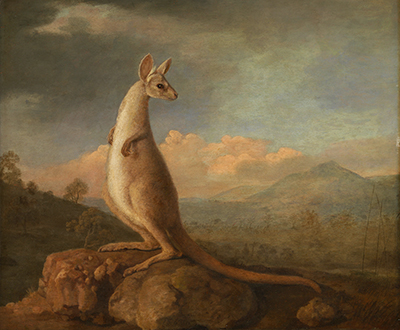
George Stubbs painted The Kongouro from New Holland in 1772 for Joseph Banks, following Banks's return from Cook's first Pacific voyage. He had never observed a living kangaroo: the apparently immediate likeness came from evidence carried across great distances. [1]
A small head turns towards the right above a heavy, upright body. Short forelimbs hang against the chest; enormous hind feet rest on rocks; a thick tail sweeps away across the ground. Behind this single creature, low trees, distant hills and pink clouds spread across a landscape almost empty of incident. The picture gives the animal both a firm position and an expansive setting. Looking at it, we can follow a coherent body from ears to tail without quite forgetting how unusual its proportions are. [1]
At a Glance
This work across George Stubbs’s career
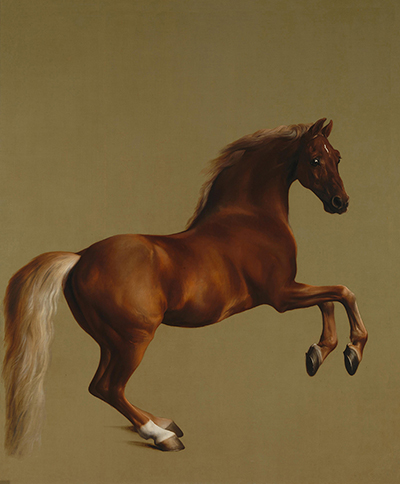
Whistlejacket
about 1762 [6]Contents
- The painting in Greenwich
- A body built from unequal parts
- The encounter at Endeavour River
- What could Stubbs use?
- Wax, wood and the limits of technical knowledge
- From exhibition picture to printed animal
- Reputation, repetition and colonial use
- Banks, Parham and public ownership
- Videos on George Stubbs
The painting in Greenwich
The National Maritime Museum, Royal Museums Greenwich, holds the painting as ZBA5754. Its catalogue specifies beeswax on mahogany panel and painting dimensions of 605 × 715 × 10 millimetres, distinct from the frame. The museum lists it in the Pacific Encounters gallery. [1]
The date 1770 sometimes attached to the title belongs to its early exhibition history, rather than replacing the painting's 1772 date. The export expert's report records both Banks panels as signed and dated 1772 and lists the kangaroo at the Society of Artists in 1773 as catalogue number 318, followed by the large dog at 319. [14]
Portrait of a Large Dog (Dingo), ZBA5755, is the other 1772 Banks painting, now held in Greenwich. The two works formed a pair, but each represents a different Australian animal and requires its own history. The museum identifies the pair as the earliest paintings of these animals in Western art. [15]
A body built from unequal parts
The kangaroo occupies the left half of the composition, but it does not simply face into the open space. Its lower body and long feet extend towards the left while its head turns back to the right. This reversal introduces a small but persistent twist into an otherwise stable pose. The ears repeat the upward movement of the neck, with their different angles keeping the silhouette from becoming a single straight column. The tiny forepaws provide a second interruption: dark, curled forms set against the paler front of the body. [1]
Light runs down the neck and belly, while a darker passage rounds the right side of the animal. The transition gives considerable weight to the torso. It also makes the small face unusually delicate by comparison. The eye is a dark point with a lighter glint, and the narrow muzzle projects beyond the neck. These visible details invite attention to the head without making the animal look directly out at us. Its attention seems directed across the picture; what it might be looking at remains outside the scene. [1]
The tail changes the balance of the design. From the broad base beneath the body it travels towards the lower right, becoming progressively thinner. Its low horizontal course answers the tall neck and ears. The foreground rocks provide an irregular platform, rather than a flat stage: separate warm and shadowed faces give the feet places to rest, while crevices divide the mass beneath them. Weight is made convincing through these contacts. The picture's stillness depends as much on the ground under the animal as on its upright outline. [1]
The landscape has its own changes of scale. Small trees on the left slope lead towards a much softer middle distance; a larger mountain rises on the right. Slender plants at the right edge answer the distant trees without competing with the kangaroo. The clouds gather in a warm band behind the body, below a much larger stretch of subdued sky. They help separate the animal's contour from the distance. The hills and scattered trees establish distance without giving us a named locality within the picture. The setting supplies depth and atmosphere, while the animal remains the dominant particular. [1]
The encounter at Endeavour River
Cook's journal shows how difficult a first description could be. On 24 June 1770 he compared the animal's size and general shape to a greyhound, then distinguished it by its leaping movement, which reminded him of a hare or deer. Crucially, he admitted that long grass had prevented him from seeing its legs. The description was an observation made under restricted conditions, with familiar animals supplying temporary points of comparison. It was not a complete anatomical account awaiting straightforward illustration. [16]
Banks's own July entries describe a progression from pursuit to possession. On 7 July his greyhound chased two animals but was defeated by the long grass, which the animals cleared in bounds. On 14 July a specimen weighing 38 pounds was killed; Banks described its short forelegs and disproportionate hind limbs. The next day it was cooked for dinner. On 29 July the greyhound caught a much smaller animal, weighing only eight and a half pounds. These entries distinguish several encounters and specimens. They do not identify a particular one as the unquestionable model for Stubbs's painting. [17]
The same journals also prevent the encounter from being told as an arrival in a world without prior knowledge. In his entry for 23 July, Cook described a member of the ship's company meeting local people who were cooking a bird and part of one of these animals. They allowed him to leave and directed him towards the ship when he went the wrong way. Even within Cook's account, the creature that challenged European description belonged to an existing human landscape of hunting, food and practical knowledge. [16]
The name carries that relationship into the painting's title. The State Library of Queensland identifies gangurru as the Guugu Yimithirr word anglicised as kangaroo. Its Old Words, New Ways exhibition placed Cook's written record alongside the Guugu Yimithirr account of the encounter at Wahalumbaal Birri, the Endeavour River, told by Harold Ludwick. That pairing matters: the ship's journals are records of particular visitors, while the country and its languages have histories beyond their pages. The unfamiliar spelling Kongouro preserves the sound of an encounter, rather than marking the invention of the animal or its name. [18]
Scientific collection and imperial ambition were connected in the voyage's instructions. The Admiralty's additional orders of 30 July 1768 required Cook to observe animals and other natural products, collect specimens, survey coasts and report information useful to trade and navigation. They also instructed him to take possession of suitable places in the king's name with the inhabitants' consent, or to claim uninhabited country. These clauses place the gathering of natural knowledge within an official programme concerned with territorial and commercial advantage. They do not make every subsequent image a direct instruction from the state. Banks's commission remains a particular act of patronage within that larger relationship between animal painting and empire. [19]
What could Stubbs use?
Royal Museums Greenwich explains the reconstruction through Banks's written and spoken descriptions, Parkinson's pencil sketches and a lost pelt, described as stuffed or inflated. The museum also records the paired paintings with Dance's portrait of Cook among the works displayed in Banks's Soho Square house, where collections and scientific sociability came together. [1]
Sydney Parkinson's drawing and Stubbs's painting must nevertheless remain distinct objects. The National Museum of Australia identifies Parkinson's sketch as a work made at Endeavour River and credits the Natural History Museum in London as its source. It belongs to the voyage itself. Stubbs's finished landscape painting belongs to the later work of representing the animal in Britain. The survival of a drawing establishes an earlier act of observation; it does not, on its own, establish that Stubbs saw it. [20]
The precise studio procedure has been disputed. In an essay published by Australia's National Portrait Gallery, Angus Trumble challenged the stuffed or inflated skin story and emphasised the limited documented evidence, including a skull associated with Banks and Parkinson's drawings. His discussion is a retrospective exhibition review, rather than a report of a newly discovered studio document. It nonetheless raises a useful distinction between a plausible reconstruction and a documented action. The familiar story of Stubbs personally blowing up a skin is more definite than the surviving evidence warrants. Trumble's scepticism does not prove that no skin was available; it shows why the method should remain qualified. [21]
Access to the drawings is another uncertainty. Des Cowley and Brian Hubber, writing in The La Trobe Journal in 2000, noted the belief that Parkinson's two rough sketches had been unavailable to Stubbs. That differs from the account given by the present holding museum. The safest distinction is between the kinds of evidence associated with Banks's collections and the exact materials demonstrably before the painter. We can understand the picture as a mediated likeness without pretending that every step in its manufacture has been recovered. [22]
The export assessment records disagreements over whether the picture represents a wallaby, a wallaroo or a small or young kangaroo. A familiar title therefore does not settle the precise zoological identification of the painted animal. [14]
A contemporary scientific account helps explain the material problem. In the section on the kangaroo published in John White's Journal of a Voyage to New South Wales in 1790, the anatomist John Hunter recalled that the first material brought home consisted of skins and skulls. Banks had given him one skull. Hunter hoped the teeth would indicate the animal's relationship to familiar groups, but found that they did not fit the categories he knew. He therefore had to wait for a whole specimen. His statement documents an incomplete supply of evidence; it is not an inventory of Stubbs's studio. [23]
Hunter also insisted that form and internal construction could not supply everything needed for natural history: observations of how animals lived were necessary too. That makes the kangaroo's painted stillness especially instructive. A coherent outline could communicate appearance across distance while leaving movement, reproduction and habits to further observation. Neither the artist's skill nor the authority of a finished picture abolished those limits. [23]
Wax, wood and the limits of technical knowledge
Stubbs's experiments with painting media had a wide range, explored more fully in his technique and printmaking. John Mills and Raymond White's 1985 study analysed media in ten other paintings. Their results distinguished earlier wax or non-drying oil/fat and resin mixtures from later paintings containing drying oil as well; they also explained the difficulties of separating related materials analytically. Neither the kangaroo nor the dingo appears in their sample table. The study therefore offers context for the artist's experiments, rather than a recipe for these particular panels. The catalogue term beeswax should not be expanded into a claim about an exact mixture, a heating procedure or the complete absence of oil. [24]
The reproduction shows a continuous relationship between animal and setting. The light on the body is warmer than much of the sky, but the brown shadows connect it to the earth and rock. The creature has a clear outline without becoming a cut-out diagram. Its light belly, dark paws and tapering tail remain integrated with the same pictorial atmosphere. These are effects available to ordinary looking; identifying the substances that produced them requires a different kind of evidence. [1]
From exhibition picture to printed animal
One of the clearest records of the painting's transformation survives at the Art Gallery of South Australia. Its engraving An animal found on the coast of New Holland called kanguroo, accession 752G15, is plate 20 from John Hawkesworth's account of the voyages, published in 1773. The maker is unknown and Stubbs is named as the artist after whom it was made. The gallery identifies this impression as state ii of iii. It is a reproductive print, rather than an engraving made by Stubbs himself. [25]
In that impression the composition is reversed: the animal stands on the right and turns its head towards the left. The long tail now travels towards the lower left corner. Colour has been replaced by closely arranged lines, with denser passages making the body and foreground stand out against the sky. The landscape remains, but its relation to the viewer has changed with the reversal. Comparison makes the distinction concrete. The engraving transmits the characteristic body and backward glance while producing a new object with its own marks, orientation and scale. [25]
The book carrying that plate was itself a construction from earlier records. Helen Wallis's study of the publication of Cook's journals describes Hawkesworth's appointment to turn the expedition papers into a narrative and the controversy his volumes provoked. Commercial success did not bring agreement about their reliability or presentation. A second English edition and a New York edition appeared in 1773, with French and German editions following in 1774. The kangaroo's printed dissemination thus belonged to an active publishing business, in which selection, rewriting, illustration and translation shaped what distant readers encountered. [26]
A different format appears in An animal of a new species found on the coast of New South Wales, held by the National Gallery of Victoria as 2013.741. The museum identifies it as the plate facing page 320 in the July 1773 Gentleman's Magazine: an etching and engraving by an unknown maker after Stubbs. The image measures only 13.7 × 9.6 centimetres. Its narrow vertical shape is already a substantial departure from the horizontal painting. [27]
Here the animal rises through most of the little rectangle. It keeps the rightward-looking head of the painting, while the distant mountain has been drawn close behind it. Rocks crowd the feet, and the tail leads into the bottom corner. With less landscape on either side, the relation between tall ears, tiny arms and great hindquarters becomes particularly emphatic. The title above announces a new species. The print turns a painted encounter into a compact piece of visual information that can accompany a magazine description. [27]
Jocelyn Anderson places such images within a wider magazine public. Her study argues that inexpensive periodical illustrations reached audiences different from visitors to art exhibitions or buyers of substantial voyage books. The Gentleman's Magazine circulated among varied literate readers, including women and people working in trades and service. She also traces the kangaroo image into a German-language Pennsylvania almanac for 1775, published in 1774. This history explains why an image could travel much further than its painted original. It does not require every later maker to have stood before Banks's panel. The painting's printed descendants belonged to networks of copying, adaptation and distribution. [28]
Reputation, repetition and colonial use
Repetition did not mean that the image went unquestioned. Cowley and Hubber trace its appearance in Pennant and Bewick, while noting Buffon's objections to the figure. They describe the revealing case of an 1812 English translation of Buffon's natural history: a version of Stubbs's kangaroo was added despite the author's dismissal of the earlier image as defective. Publishers could preserve a familiar form even while printing doubts about it. The picture's authority was therefore sustained partly by circulation, alongside changing knowledge of the animal. [22]
Contemporary response was also more particular than a general claim of instant acclaim suggests. Anderson cites a 1773 exhibition review that treated the kangaroo as an unusual subject. That response concerns the novelty of what was shown; it does not establish unanimous praise for the picture's anatomy or artistic quality. The difference between a striking subject and a universally admired painting is important to its reception. [28]
The design also acquired uses far removed from natural history books. In her study of Aboriginal breastplates, Alison Clark examines the brass plate inscribed for Sandy, Chief of Coringori, now in National Museums Scotland. Its engraved kangaroo appears to derive from Stubbs's image, with the backward-looking pose related to European heraldic conventions. Clark keeps the derivation tentative. She also explains the unequal relations behind the giving of such plates: colonisers sought to impose recognisable hierarchies and secure intermediaries, while Aboriginal wearers could act within those constrained circumstances. An image of an Australian animal could consequently return to Australia within an object entangled with colonial authority. That later use should not be mistaken for Stubbs's original commission or for a design he supplied to the plate's maker. [29]
A much later official reuse occurred in the Royal Australian Mint's 2013 Explorers' First Sightings series. The Mint's announcement identifies Stubbs's portrait as the basis for the kangaroo design, issued in gold and silver versions and credited to designer A. Baggio. By then the image could serve as a historical reference within Australian national commemoration. Its reuse commemorated an early European representation of the animal, rather than providing a new zoological likeness. [30]
Banks, Parham and public ownership
The export report traces ownership through the family of Banks's widow, Dorothea, to Mary Keith, then a 1970 sale through Hazlitt, Gooden & Fox to Clive and Alicia Pearson at Parham Park. It also lists the kangaroo's Walker (1951) and Whitechapel (1957) exhibitions. [14]
The pair returned to public debate during the 2013 export review. The government's announcement of 5 February placed a temporary export bar on the works to allow a matching British offer, quoting a recommended price of £5.5 million. This was a stage in the acquisition process, not a description of their permanent destination or the final museum purchase cost. [31]
The competing Australian interest was substantial. Reporting the outcome in November 2013, ABC News relayed the National Gallery of Australia's disappointment and its argument that the paintings were more relevant to Australian art than to British maritime history. It also reported the gallery's statement that negotiations through an intermediary had continued for about three years. The dispute exposed two different claims of cultural significance: the history of the British voyage and the history of Australian representation. Neither argument changes the fact that Stubbs made the paintings in Britain from evidence associated with that voyage. [32]
Art Fund's acquisition record gives a total cost of £4,455,000 and records its assistance with support from the Wolfson Foundation. It dates the support to 2013. Keeping this figure separate from the export-review price avoids turning several different moments in the transaction into one supposed auction result. Public acquisition also changed the conditions under which the paintings could be studied: objects long associated with family ownership entered a museum collection. [33]
The National Maritime Museum's 2013–14 annual report identifies the two Stubbs paintings among its major acquisitions. Its account connects them with the museum's exploration collections and the development of new displays concerned with changing attitudes to science and navigation. The report describes a £4.45 million acquisition and singles out Eyal Ofer among its supporters. It places the purchase within an endeavour to create further galleries, rather than treating it simply as an isolated addition to the picture collection. Their setting in a maritime museum consequently places the London pictures back beside the voyages that made their production possible. The museum setting brings paintings, exploration records and the history of scientific collecting into conversation. [34]
The kangaroo was subsequently the focus of the Grant Museum of Zoology's 2015 exhibition Strange Creatures: The Art of Unknown Animals. Researchers approached animal representation through art, exploration, science, taxidermy and even toy models. The exhibition asked how people encounter animals through representations when they cannot encounter them directly. In that setting the picture was useful precisely because it combined persuasive form with an incomplete history of observation. Its uncertainties became subjects for examination, rather than defects to be concealed. [35]
Return to the panel and that double character remains visible. The animal is presented with the solidity of an individual presence: feet meeting stone, pale fur rounding into shade, a head held above an imposing body. Yet there is no human observer within the landscape to fix the encounter in a particular place or moment. The picture offers the creature to our eyes while leaving the circumstances behind its appearance elsewhere. Its lasting interest lies in that space between a convincing painted body and the dispersed knowledge from which it was assembled. [21]
Videos on George Stubbs
Explore Stubbs’s equestrian painting in its wider context, including two readings of Whistlejacket.
A Horse Lover’s Guide to the YCBA
A museum tour that places Stubbs alongside other artists who painted horses. It includes a look at Pumpkin with a Stable-lad.
Watch on YouTubeGeorge Stubbs artworks directory
Search works and related prints documented in this guide. Separate versions and printing matrices have separate entries; printmakers are named where known. Unidentified historical titles and untraced studio-sale material are discussed in the essays. A dash means that a date is not established here.
| Name | Date | Medium |
|---|---|---|
| A Bay Horse with a Groom | 1791 | Painting |
| A Bay Hunter with Two Playful Spaniels | 1777 | Painting |
| A Bay Hunter, a Springer Spaniel and a Sussex Spaniel in a wooded river Landscape | 1782 | Painting |
| A Cheetah and a Stag with Two Indian Attendants | about 1764 | Painting |
| A Couple of Fox Hounds (coloured print after Stubbs) | — | Print after Stubbs |
| A Couple of Foxhounds | 1792 | Painting |
| A Foxhound on the Scent | 1788 | Drawing |
| A Gentleman driving a Lady in a Phaeton | 1787 | Painting |
| A Grey Horse | 1793 | Painting |
| A Grey Horse (cantering companion) | 1793 | Painting |
| A Grey Stallion in a Landscape | — | Painting |
| A Horse Affrighted at a Lion | 1 May 1788 | |
| A Horse Belonging to the Rt. Honourable Lord Grosvenor called Bandy from his Crooked Leg | about 1763 | Painting |
| A Horse Frightened by a Lion | 1777 | |
| A Lion (A Lion Resting on a Rock) | 1 May 1788 | |
| A Lion Attacking a Horse | 1770 | Painting |
| A Lion Attacking a Horse (monumental Yale canvas) | 1762 | Painting |
| A lion attacking a horse (NGV) | about 1765 | Painting |
| A Lion Devouring a Horse (1788 print) | 1788 | |
| A lion devouring a horse (attribution disputed) | Proposed mid-1770s | Painting |
| A mare and foal with a bay horse | 1771 | Painting |
| A Monkey | 1799 | Painting |
| A Prancing Horse, Facing Right | c. 1790 | Drawing |
| A Rough Dog | 1790 | Painting |
| A Saddled Bay Hunter | 1786 | Painting |
| A Sleeping Leopard | 1 January 1791 | |
| A Tiger and a Sleeping Leopard | 1 May 1788 | |
| A Tigress (John Dixon after Stubbs) | 1772 | Print after Stubbs |
| A Tyger (A Recumbent Leopard by a Tree) | 1 May 1788 | |
| A Tyger (Sleeping Leopard) | 1 May 1788 | |
| An animal found on the coast of New Holland called kanguroo (after Stubbs) | 1773 | Print after Stubbs |
| An animal of a new species found on the coast of New South Wales (after Stubbs) | July 1773 | Print after Stubbs |
| Antinous and Jockey | — | Painting |
| Antinoüs, a chestnut racehorse, in a landscape | Undated | Painting |
| Bandy belonging to Lord Grosvenor (print after Stubbs) | — | Print after Stubbs |
| Baronet (George Townley Stubbs after Stubbs) | 20 February 1794 | Print after Stubbs |
| Baronet with Sam Chifney Up | 1791 | Painting |
| Baronet with Samuel Chifney up (Royal Collection) | 1791 | Painting |
| Bay Hunter by a Lake | 1787 | Painting |
| Brood Mares (Benjamin Green after Stubbs) | Issue 14 November 1776 | Print after Stubbs |
| Brood Mares and Foals | usually dated 1767 | Painting |
| Brown and White Norfolk or Water Spaniel | 1778 | Painting |
| Bulls Fighting | 1786 | Painting |
| Captain Samuel Sharpe Pocklington with His Wife, Pleasance, and possibly His Sister, Frances | 1769 | Painting |
| Death of the Doe (attribution disputed) | 1804 | |
| Der Englische Hühnerhund (Johann Wölfle after Stubbs) | about 1860 | Print after Stubbs |
| Dog (A Foxhound Viewed from Behind) | 1 May 1788 | |
| Dog [A Foxhound on the Scent] | 1788 | |
| Drill and albino baboon | before 1789 | Painting |
| Eclipse (Charles Hunt after Stubbs) | 12 November 1839 | Print after Stubbs |
| Eclipse (George Townley Stubbs after Stubbs) | 1796 | Print after Stubbs |
| Eclipse (oil study) | — | Painting |
| Eclipse (Thomas Burke after Stubbs) | First published 1772 | Print after Stubbs |
| Eclipse and John Wildman (Benjamin Green after Stubbs) | 1772 | Print after Stubbs |
| Eclipse at Newmarket (Jockey Club version) | Proposed early 1790s; often dated 1770 | Painting |
| Eclipse at Newmarket with a groom and jockey | 1770 | Painting |
| Eclipse with Mr Wildman and His Sons | 1769–71 | Painting |
| Eclipse, the Property of Capt.n O Kelly (anonymous print after Stubbs) | Imprint 4 June 1804; impression undated | Print after Stubbs |
| Euston | 1774 | Painting |
| Finished Study for the Seventh Anatomical Table of the Muscles of the Horse | 1756–58 | Drawing |
| Five Brood Mares at the Duke of Cumberland's Stud Farm in Windsor Great Park | 1765 | Painting |
| Fowl Body, Lateral View (Highly Finished Study for an Unpublished Table; Shows the Last Stage in Dissection) | — | Drawing |
| Fowl Body, Lateral View (Probably Prepared for Transfer to the Plate for Engraving of Table XV) | — | Drawing |
| Fowl Skeleton, Lateral View (Finished Study for Table V) | — | Drawing |
| Freeman, the Earl of Clarendon's Gamekeeper, with a Dying Doe and Hound (Yale) | 1800 | Painting |
| George Stubbs (enamel self-portrait) | 1781 | Enamel |
| Gimcrack (George Townley Stubbs after Stubbs) | 1775 | Print after Stubbs |
| Gimcrack on Newmarket Heath, with a trainer, a jockey and a stable lad | about 1765 | Painting |
| Gimcrack, with John Pratt up, on Newmarket Heath | about 1765 | Painting |
| Hambletonian, Rubbing Down | 1800 | Painting |
| Hay-Makers | 1791 | |
| Haycarting | 1795 | Enamel |
| Haymakers | 1785 | Painting |
| Haymakers (Lady Lever Art Gallery) | 1794 | Enamel |
| Hollyhock (with later additions by Vernet and Boucher) | about 1765–70 | Painting |
| Horse Attacked by a Lion (Episode C) | 1768–69 | Painting |
| Horse Attacked by a Lion (Tate enamel) | 1769 | Enamel |
| Horse Devoured by a Lion | Possibly exhibited 1763 | Painting |
| Horse Frightened by a Lion | 1770 | Painting |
| Horse Frightened by a Lion (Episode A; Wedgwood and Bentley after Stubbs) | — | Sculpture |
| Horse Frightened by a Lion (Tate) | Possibly exhibited 1763 | Painting |
| Horse Frightened by a Lion (Yale) | 1762–68 | Painting |
| Horse in the Shade of a Wood | 1780 | Painting |
| Hound Coursing a Stag | about 1762 | Painting |
| Human Figure, Anterior View (Intended for a Plate That was Never Published) | — | Drawing |
| Human Skeleton, Lateral View | 1795–1806 | Drawing |
| Hunt servants setting out (Southill commission) | 1767 | Painting |
| Hühnerhund (The Spanish Pointer) | about 1766 | Painting |
| John and Sophia Musters Riding at Colwick Hall | 1777 | Painting |
| John Musters on his hunter Pilgrim | 1777–78 | Painting |
| Labourers | 1789 | |
| Labourers (Richard Earlom after Stubbs and Amos Greene) | 25 March 1790 | Print after Stubbs |
| Laetitia, Lady Lade (d.1825) | 1793 | Painting |
| Lemon and White Water Spaniel | — | Painting |
| Lion Attacking a Stag | — | Painting |
| Lord Grosvenor's Arabian Stallion with a Groom | about 1765 | Painting |
| Lord Grosvenor's Arabian Stallion with a Groom (Peter Mazell after Stubbs) | 1771 | Print after Stubbs |
| Mambrino (Eaton Hall painting) | — | Painting |
| Mambrino (George Townley Stubbs after Stubbs) | 1794 | Print after Stubbs |
| Mares and Foals belonging to the 2nd Viscount Bolingbroke | about 1761–62 | Painting |
| Mares and foals beneath large oak trees | — | Painting |
| Mares and Foals by a stream | Exhibited 1764 | Painting |
| Mares and Foals in a River Landscape | about 1763–68 | Painting |
| Mares and Foals in an Extensive Landscape | about 1769 | Painting |
| Mares and Foals without a Background | 1762 | Painting |
| Moose Deer (after Stubbs) (Arctic Zoology plate VIII) | 1784–85 publication | Print after Stubbs |
| Newmarket Heath with a Rubbing-Down House | — | Painting |
| Otho (1796 print after Stubbs) | 1 December 1796 | Print after Stubbs |
| Otho, with John Larkin up | 1768 | Painting |
| Pangloss | about 1762 | Painting |
| Patch (Grafton commission) | 1759 | Painting |
| Phaeton and the Chariot of the Sun (enamel) | 1775 | Enamel |
| Phaeton with a Pair of Cream Ponies and a Stable-Lad | 1780–84 | Painting |
| Phillis | 1772 | Painting |
| Portrait of a Large Dog (Dingo) | 1772 | Painting |
| Pumpkin with a Stable-lad | 1774 | Painting |
| Racehorses Exercising at Goodwood | 1759–60 | Painting |
| Reapers (1791 print) | 1791 | |
| Reapers (Tate) | 1785 | Painting |
| Reapers (Yale) | 1795 | Enamel |
| Red Deer: A Stag and a Hind | 1792 | Painting |
| Richard Wedgwood | — | Enamel |
| Ringwood, a Brocklesby Foxhound | 1792 | Painting |
| Scrub, a bay horse belonging to the Marquess of Rockingham | about 1762 | Painting |
| Self Portrait on a White Hunter | 1782 | Enamel |
| Self-Portrait | about 1759 | Painting |
| Shooting (1770 Woollett plate after Stubbs) | 1770 | Print after Stubbs |
| Shooting (1771 Woollett plate after Stubbs) | 1771 | Print after Stubbs |
| Shooting at Goodwood | 1759–60 | Painting |
| Sir John Nelthorpe as a boy | 1756 | Painting |
| Sir John Nelthorpe partridge shooting with one pointer | — | Painting |
| Sir John Nelthorpe, 6th Baronet, out Shooting with His Dogs in Barton Field, Lincolnshire | 1776 | Painting |
| Sleeping Leopard | 1777 | Enamel |
| Soldiers of the 10th Light Dragoons | 1793 | Painting |
| Stallion and Mare (George Townley Stubbs after Stubbs) | 1776; reissued 1789 | Print after Stubbs |
| Steward and gamekeeper with dogs (Southill commission) | 1767 | Painting |
| Studies of a Lemur (Lemur murinus) in six different attitudes | 1773 | Drawing |
| Study for the Self-portrait in Enamel | c. 1781 | Drawing |
| Study of a Lemur | 1773 | Drawing |
| Study of a Racehorse in Action: Galloping to Left, a Semi-Anatomical Study, with Skin Flayed to Show Action of Muscles | — | Drawing |
| Study of the Legs of a Draught-Horse Pulling a Harrow (attributed to Stubbs) | Proposed about 1786 | Drawing |
| Sweet William (Grosvenor panel) | — | Painting |
| Sweet William (Turf Gallery canvas) | — | Painting |
| The Black Stallion Sampson, Portrayed from Three Angles (with landscape additions) | about 1764 | Painting |
| The Charlton Hunt | 1759–60 | Painting |
| The Fall of Phaeton | — | Sculpture |
| The Frightened Horse | 1780 | Sculpture |
| The Grosvenor Hunt | — | Painting |
| The Haymakers (Upton House) | 1783 | Painting |
| The Horse and Lion (George Townley Stubbs after George Stubbs) | 1770 | Print after Stubbs |
| The Kongouro from New Holland | 1772 | Painting |
| The Labourers | 1779 | Painting |
| The Labourers (Southill original) | 1767 | Painting |
| The lion and horse (Benjamin Green after Stubbs) | 1769; reissued 1777 | Print after Stubbs |
| The Milbanke and Melbourne Families | about 1769 | Painting |
| The Moose | 1770 | Painting |
| The Prince of Wales's Phaeton | 1793 | Painting |
| The Reapers (Upton House) | 1783 | Painting |
| The Sebra, or Wild Ass (George Townley Stubbs after Stubbs) | 1771 | Print after Stubbs |
| The Spanish Pointer (Bradford version) | about 1766–68 | Painting |
| The Spanish Pointer (William Woollett after Stubbs) | January 1768 | Print after Stubbs |
| The Third Duke of Dorset's Hunter with a Groom and a Dog | 1768 | Painting |
| Thomas Freeman, Lord Clarendon's gamekeeper, with a dog and a shot doe (with George Townly Stubbs) | 1803 | Painting |
| Turf, with Jockey up, at Newmarket | — | Painting |
| Turk and Crab | — | Painting |
| Two Bay Hunters Communing On The Bank Of A Lake | — | Painting |
| Tygers at Play | 1780 | |
| Viscount Gormanston's White Dog | 1781 | Painting |
| Viscount Gormanston's White Dog (canvas version) | — | Painting |
| Water Spaniel | 1769 | Painting |
| Wedgwood Family Portrait | 1780 | Painting |
| Whistlejacket | about 1762 | Painting |
| Whistlejacket with two other stallions and a groom | Recorded 1762 | Painting |
| White Poodle in a Punt | about 1780 | Painting |
| William Anderson with two Saddle-Horses | 1793 | Painting |
| Working Drawing for the Seventh Anatomical Table of the Muscles of the Horse | 1756–58 | Drawing |
| Zebra | 1763 | Painting |
Discussion
Look again at the images and ideas explored in The Kongouro from New Holland. These editorial prompts invite your observations.
Reader Insights
How does the animal’s pose relate to the distant landscape?
How does uncertainty about the studio aids affect your reading of the picture?
How does knowing the artist’s access to his subject change what you ask of the image?
Join the Conversation
Share a detail, comparison or question about The Kongouro from New Holland below.
References
- Royal Museums Greenwich, ‘The Kongouro from New Holland’ (Kangaroo), ZBA5754. Accessed 4 November 2026. View source.
- Goodwood, The Collection, Painting Collection modal, Racehorses Exercising at Goodwood; An exciting acquisition: a study by George Stubbs, 30 June 2023; History of the Estate Hounds, 4 October 2023; About Goodwood Racecourse. Accessed 4 November 2026. View source.
- Goodwood, The Collection, Painting Collection modal, Racehorses Exercising at Goodwood; An exciting acquisition: a study by George Stubbs, 30 June 2023; History of the Estate Hounds, 4 October 2023; About Goodwood Racecourse. Accessed 4 November 2026. View source.
- Goodwood, The Collection, Painting Collection modal, Racehorses Exercising at Goodwood; An exciting acquisition: a study by George Stubbs, 30 June 2023; History of the Estate Hounds, 4 October 2023; About Goodwood Racecourse. Accessed 4 November 2026. View source.
- Goodwood, The Collection, Painting Collection modal, Racehorses Exercising at Goodwood; An exciting acquisition: a study by George Stubbs, 30 June 2023; History of the Estate Hounds, 4 October 2023; About Goodwood Racecourse. Accessed 4 November 2026. View source.
- National Gallery, Whistlejacket, NG6569, current collection record, provenance, in-depth discussion and frame entry. View source.
- Yale Center for British Art, Zebra, B1981.25.617, current object metadata, gallery labels, Malcolm Warner’s 1998 catalogue entry and provenance supplied through the museum’s public collection record. View source.
- Christie’s, Gimcrack on Newmarket Heath, with a trainer, a jockey and a stable lad, London, 5 July 2011, lot 12; object details, essay, provenance, exhibitions and whole image. View source.
- Christie’s, Gimcrack on Newmarket Heath, with a trainer, a jockey and a stable lad, London, 5 July 2011, lot 12; object details, essay, provenance, exhibitions and whole image. View source.
- Yale University Art Gallery, A Lion Attacking a Horse, 1770, 1955.27.1, collection record. Accessed 4 November 2026. View source.
- Royal Museums Greenwich, ‘The Kongouro from New Holland’ (Kangaroo), ZBA5754. Accessed 4 November 2026. View source.
- Tate, George Stubbs, Haymakers, 1785, T02256; details, Terry Riggs’s collection text (January 1998), and online caption. Collection record. View source.
- Frances Bailey, ‘Hambletonian, Rubbing Down: A masterpiece by George Stubbs’, National Trust Cultural Heritage Magazine, Autumn/Winter 2024, pp. 22–33. Article. View source.
- Arts Council England, Case 13, 2012/13: The Kongouro from New Holland and Portrait of a Large Dog — Expert adviser’s statement, pp. 1–2, 5–9. Accessed 4 November 2026. View source.
- Royal Museums Greenwich, ‘Portrait of a Large Dog’ (Dingo), ZBA5755. Accessed 4 November 2026. View source.
- James Cook, Endeavour journal, 24 June and 23 July 1770, transcripts supplied by the National Library of Australia, reproduced by the National Museum of Australia. June journal; July journal. Accessed 4 November 2026. View source 1. View source 2.
- Joseph Banks, Endeavour journal, 7, 14–15 and 29 July 1770, transcription. Accessed 4 November 2026. View source.
- State Library of Queensland, Old Words, New Ways, 3 February 2021. Accessed 4 November 2026. View source.
- British Admiralty, Additional instructions for Lieutenant James Cook, 30 July 1768, National Library of Australia transcript. Accessed 4 November 2026. View source.
- National Museum of Australia, The first European drawing of a kangaroo, made by Sydney Parkinson at Endeavour River, source: Natural History Museum, London. Accessed 4 November 2026. View source.
- Angus Trumble, Stubbs and the horse, National Portrait Gallery, Australia, posted 30 October 2018; retrospective exhibition review. Accessed 4 November 2026. View source.
- Des Cowley and Brian Hubber, Distinct Creation: Early European Images of Australian Animals, The La Trobe Journal 66 (Spring 2000), kangaroo section, pp. 4–12. Accessed 4 November 2026. View source.
- John Hunter, Of the Kangaroo and introductory observations, in John White, Journal of a Voyage to New South Wales (1790), transcription. Accessed 4 November 2026. View source.
- John Mills and Raymond White, The Mediums used by George Stubbs: Some Further Studies, National Gallery Technical Bulletin 9 (1985), pp. 60–64, especially Table 1. Accessed 4 November 2026. View source.
- Art Gallery of South Australia, An animal found on the coast of New Holland called kanguroo, 752G15, collection entry and whole image. Accessed 4 November 2026. View source.
- Helen Wallis, Publication of Cook’s Journals: Some New Sources and Assessments, Pacific Studies 1.2 (1978), pp. 163–194; relevant discussion pp. 163–169. Accessed 4 November 2026. View source.
- National Gallery of Victoria, An animal of a new species found on the coast of New South Wales, 2013.741. Accessed 4 November 2026. View source.
- Jocelyn Anderson, Elegant Engravings of the Pacific: Illustrations of James Cook’s Expeditions in British Eighteenth-Century Magazines, British Art Studies 7 (November 2017), especially Figure 2 and notes 13–16. Accessed 4 November 2026. View source.
- Alison Clark, Objects of Power: Australian Aboriginal Breastplates and Scottish Pastoralists, Journal of Irish and Scottish Studies 11.1 (2023), article 2, especially pp. 2–4 and 7–10. Accessed 4 November 2026. View source.
- Royal Australian Mint, Mint Issue 94 (September 2012), pp. 6–7: 2013 Explorers’ First Sightings. Accessed 4 November 2026. View source.
- Department for Culture, Media and Sport, Culture Minister defers export of Britain’s first Kangaroo and Dingo, 5 February 2013. Accessed 4 November 2026. View source.
- Mary Gearin, George Stubbs’s iconic oil paintings, the first depicting Australia, to remain in Britain, ABC News, 7 November 2013, reporting the National Gallery of Australia’s statement. Accessed 4 November 2026. View source.
- Art Fund, The Kongouro from New Holland; Portrait of a Large Dog, acquisition record, support dated 2013. Accessed 4 November 2026. View source.
- National Maritime Museum, Annual Report and Accounts 2013–14, acquisitions and exploration-gallery discussion. Accessed 4 November 2026. View source.
- University College London, Grant Museum of Zoology, Strange Creatures: The Art of Unknown Animals, account of the 2015 exhibition. Accessed 4 November 2026. View source.
- Basic title, date and material metadata for Tate’s Reapers (T02257) and Otho (T02375) is adapted from the Tate collection dataset, October 2014, released under CC0. TheHistoryOfArt.org has reconciled labels and versions. This credit does not apply to Tate’s authored catalogue commentary or images.
- Data Source: Yale Center for British Art. Basic object fields are adapted and reconciled for this directory. Reuse is subject to the Center’s Open Data and Data Services Terms of Use. No museum endorsement is implied. This metadata credit does not relabel scholarly essays or images as open data.
- Basic object metadata for A Horse Frightened by a Lion, 1985.38, The Cleveland Museum of Art, John L. Severance Fund, is available under CC0. Titles and design-level grouping have been reconciled for this directory.