 by Tom Gurney
Tom Gurney BSc (Hons) is an art history expert with over 20 years experience
Email: tomgurney1@gmail.com / Phone: +44 7429 011000
Viscount Gormanston’s White Dog: Introduction
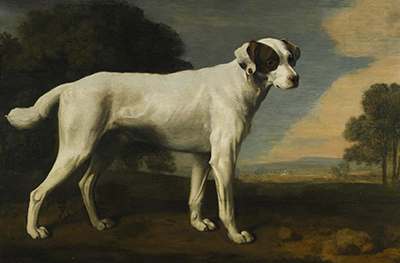
A large white dog stands across George Stubbs’s landscape, its body seen from the side and its face turned towards us. Brown patches around the eyes and ears interrupt the pale coat. The animal fills the foreground so completely that the distant country seems to open around its legs. [1]
At a Glance
This work across George Stubbs’s career
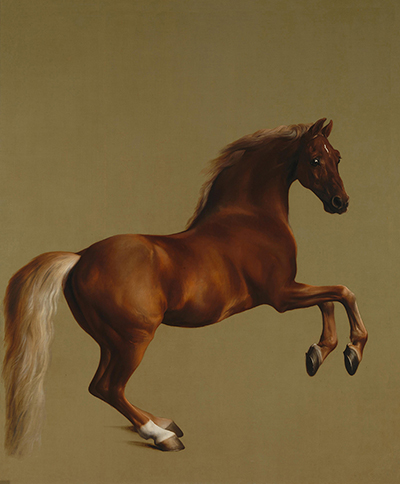
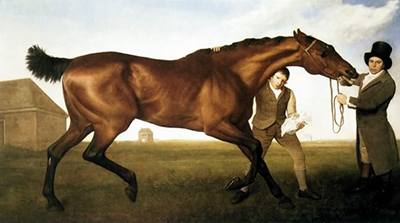
Whistlejacket
about 1762 [8]Contents
- A portrait for Gormanston
- Landscape, light and scale
- The Irish patron and the journey home
- Standing and pointing
- An oak panel and its painted surface
- From a family collection to sporting-art display
- Videos on George Stubbs
A portrait for Gormanston
Viscount Gormanston’s White Dog is signed and dated 1781. Anthony Preston, 11th Viscount Gormanston, commissioned it. Painted in oils on panel, it measures 90.5 by 137.5 centimetres. [2] [3]
Stubbs presents the dog at an angle that combines a long view of the body with a more immediate encounter at the head. Its back runs almost horizontally, with slight rises and dips over the shoulders and hindquarters. At the right, the neck rises and narrows into the head. The muzzle projects beyond the chest, but the turn of the face lets us see the nearer eye clearly and a little of the other side. [1]
That head contains the strongest contrasts in the animal’s colouring. Dark ears fold beside the face; brown surrounds the eyes; a white stripe descends between them towards the nose. The nearer eye sits within a dark patch, with a small bright accent distinguishing it from the surrounding paint. Warm brown at the end of the muzzle softens the transition towards the nose, while pale fur around the mouth keeps its outline visible. [1]
The body is white without being an uninterrupted white surface. Grey and warmer cream passages describe the broad ribcage, the hollow behind it and the muscular upper hind leg. Along the underside, a deep shadow separates the belly from the landscape. Light catches short strokes of fur on the chest and flank. The changes are quiet enough to preserve the coat’s overall brightness while giving the animal a substantial, unevenly lit body. [1]
All four feet meet the ground. Their staggered placement makes the stance more complicated than a simple silhouette. The nearer foreleg descends almost straight before ending in a broad pale paw; its partner appears slightly farther back. At the left, the two hind legs create a wider opening, one reaching backwards and the other falling beneath the body. Dark spaces between them let the landscape show through, distinguishing limbs that might otherwise merge into one white mass. [1]
The short tail curves away from the hindquarters towards the left. A narrow light edge separates it from the dark foliage. The line of the tail, the long back and the upright forelegs establish a stable framework, while the turned head interrupts that framework with a change of direction. The pose holds together as a standing body even as the face introduces a second point of attention. [1]
Landscape, light and scale
A dense mass of trees occupies the left side, behind the dog’s back and hindquarters. It is dark enough to make the pale contour unusually clear. The right side opens into a much lighter distance, with a low band of blue-grey hills and a group of slender trees near the edge. These two halves give the animal different surroundings: the torso emerges against depth and darkness, whereas the head rises into the comparatively open sky. [1]
The sky’s warm cloud shapes move diagonally behind the head. A broad, muted blue passage lies immediately around the face; farther right, ochre-coloured clouds brighten the opening above the trees. This arrangement separates the head from the distant ground without enclosing it in a halo or an isolated blank. The landscape remains continuous, but its changes of tone give different parts of the dog different degrees of emphasis. [1]
The ground is similarly varied. Brown earth surrounds the paws, with scattered stones and small plants rather than a smooth stage. A darker band crosses the middle distance beneath the belly, then yields to the lighter country beyond. The dog appears close enough for individual toes to matter, while the distant hills are compressed into softly differentiated strips. Stubbs makes the transition from bodily detail to expansive space feel gradual. [1]
The dog’s scale is decisive. Its body stretches across most of the width, and its legs leave little foreground below them. The landscape supplies depth without reducing the animal to one incident among many. There is no painted handler, leash or gun directing our attention elsewhere. The viewer encounters the standing dog first, then discovers how much country has been fitted into the spaces around it. [1]
The Irish patron and the journey home
Anthony Preston belonged to an Irish Catholic aristocratic family whose status was less secure than the title alone suggests. David Murphy’s Dictionary of Irish Biography account records his succession in 1757 and a Grand Tour in 1760–61 with the Catholic scholar John Turberville Needham. They visited Venice, Milan and Rome. On returning, Preston faced poor family finances and political disfavour. He later signed a petition to George III for Catholic relief in 1777. [17]
The family’s title had continued in use after the outlawries of earlier viscounts, although it was not then legally recognised. That recognition was recovered by Anthony’s son Jenico in 1800. Anthony himself died in London in December 1786 and was buried at Stamullen, County Meath. This places the portrait within the life of a particular Irish patron, rather than an anonymous aristocratic owner. [17]
It was shipped to Ireland in July 1785. Sotheby’s, citing Egerton, describes agent Michael Hornsby arranging a protective case and Dublin customs delivery. Two Opie portraits apparently travelled too; one shows Gormanston caressing a possibly identical dog’s head. [2]
Sotheby’s also records a version on canvas, suggesting that it too was painted for Gormanston. Contemporary references leave this white dog’s breed unspecified, although another commission was called a setter. The white animal is generally considered a pointer. [2]
Standing and pointing
A comparison with The Spanish Pointer shows how differently Stubbs could organise the presence of a hunting dog. Munich’s painting, called Hühnerhund in the Bayerische Staatsgemäldesammlungen catalogue, dates from about 1766. The museum explains its action as the moment when a pointer stops after detecting a scent. There, a working behaviour is the picture’s central event. [18]
The Munich dog holds its body low and lifts one forepaw. Its head reaches forward towards the left, within a landscape dominated by an enormous sky. Gormanston’s dog stands higher, with four feet planted and a head turned more openly towards the spectator. These differences change the encounter. One composition concentrates on a pause within forward movement; the other spreads a standing animal’s pale body across the foreground and brings its face into a more direct exchange with the viewer. [19] [1]
The distinction matters because a pointer’s name refers to work. The 1790 General History of Quadrupeds, illustrated by Thomas Bewick, describes Spanish pointers as finding partridges and pheasants for either gun or net. It discusses instruction, endurance and crosses with English pointers as practical concerns. Its language belongs to an eighteenth-century account of dogs and their uses. It explains the sporting background against which such portraits were viewed without supplying a pedigree for Gormanston’s animal. [20]
An oak panel and its painted surface
A physical account of this particular painting survives in the independent restorer Sarah Walden’s report for the 2010 sale. She identified four pieces of oak: the central join appeared undisturbed, while two others had been reglued and supported from behind. Her description connects the broad painted image to a substantial, assembled wooden support. [21]
Walden also described fine washes, little raised paint and wood grain becoming more apparent through the ageing surface. She tentatively dated the previous restoration to the 1960s or 1970s, noting extensive retouching in the sky and across the repaired joins, one crossing the eye, and strengthening of the farther hind paw. In contrast, the forepaws, nearer hind paw and delicate fur strokes on the body and chest retained careful modelling. This was a dated assessment made without laboratory examination. [21]
Her distinctions are useful when looking closely: the visible image includes both Stubbs’s finely handled paint and later intervention. The report does not offer a single uniform judgement of preservation, but differentiates particular limbs, passages of fur, landscape and structural joins. Reading it alongside the photograph encourages attention to the painting as a worked and subsequently repaired object. [21]
From a family collection to sporting-art display
The painting was reproduced in Tancred Borenius’s survey of eighteenth-century English painting in 1938. Later publications included Stubbs’s Dogs in 1984 and Egerton’s catalogue raisonné in 2007, where it is numbered 227. [2]
The picture descended at Gormanston until about 1944, then passed through C. Marshall Spink and Walter Hutchinson. Its catalogue lists a 1948 exhibition at Hutchinson House. Christie’s sold it in July 1951 to Carlyle; Lord Beaverbrook subsequently acquired it. It reappeared at Sotheby’s in 2010 and Paris in 2016. [2] [3]
Hutchinson assembled an unusually ambitious collection of sporting pictures. The Government Art Collection’s account of another work he owned, Old Trodgon, a Fighting Cock, describes his National Gallery of British Sports and Pastimes in Stratford Place, off Oxford Street. Its home, Derby House, became Hutchinson House. Despite the national title, the collection was not given to the nation; it dispersed after his death. That setting brought animal portraits into a collecting project organised around the breadth of sporting life. [22]
The collection’s name also helps explain why a dog portrait could be treated as more than an incidental study of an animal. Sporting pictures encompassed the creatures, people and practices through which owners defined their leisure. Within that setting, an individual dog’s portrait belonged beside paintings of horses and other sporting subjects. The later history gives another context for the kind of concentrated animal presence explored across Stubbs’s paintings of animals. [22]
Videos on George Stubbs
Explore Stubbs’s equestrian painting in its wider context, including two readings of Whistlejacket.
A Horse Lover’s Guide to the YCBA
A museum tour that places Stubbs alongside other artists who painted horses. It includes a look at Pumpkin with a Stable-lad.
Watch on YouTubeGeorge Stubbs artworks directory
Search works and related prints documented in this guide. Separate versions and printing matrices have separate entries; printmakers are named where known. Unidentified historical titles and untraced studio-sale material are discussed in the essays. A dash means that a date is not established here.
| Name | Date | Medium |
|---|---|---|
| A Bay Horse with a Groom | 1791 | Painting |
| A Bay Hunter with Two Playful Spaniels | 1777 | Painting |
| A Bay Hunter, a Springer Spaniel and a Sussex Spaniel in a wooded river Landscape | 1782 | Painting |
| A Cheetah and a Stag with Two Indian Attendants | about 1764 | Painting |
| A Couple of Fox Hounds (coloured print after Stubbs) | — | Print after Stubbs |
| A Couple of Foxhounds | 1792 | Painting |
| A Foxhound on the Scent | 1788 | Drawing |
| A Gentleman driving a Lady in a Phaeton | 1787 | Painting |
| A Grey Horse | 1793 | Painting |
| A Grey Horse (cantering companion) | 1793 | Painting |
| A Grey Stallion in a Landscape | — | Painting |
| A Horse Affrighted at a Lion | 1 May 1788 | |
| A Horse Belonging to the Rt. Honourable Lord Grosvenor called Bandy from his Crooked Leg | about 1763 | Painting |
| A Horse Frightened by a Lion | 1777 | |
| A Lion (A Lion Resting on a Rock) | 1 May 1788 | |
| A Lion Attacking a Horse | 1770 | Painting |
| A Lion Attacking a Horse (monumental Yale canvas) | 1762 | Painting |
| A lion attacking a horse (NGV) | about 1765 | Painting |
| A Lion Devouring a Horse (1788 print) | 1788 | |
| A lion devouring a horse (attribution disputed) | Proposed mid-1770s | Painting |
| A mare and foal with a bay horse | 1771 | Painting |
| A Monkey | 1799 | Painting |
| A Prancing Horse, Facing Right | c. 1790 | Drawing |
| A Rough Dog | 1790 | Painting |
| A Saddled Bay Hunter | 1786 | Painting |
| A Sleeping Leopard | 1 January 1791 | |
| A Tiger and a Sleeping Leopard | 1 May 1788 | |
| A Tigress (John Dixon after Stubbs) | 1772 | Print after Stubbs |
| A Tyger (A Recumbent Leopard by a Tree) | 1 May 1788 | |
| A Tyger (Sleeping Leopard) | 1 May 1788 | |
| An animal found on the coast of New Holland called kanguroo (after Stubbs) | 1773 | Print after Stubbs |
| An animal of a new species found on the coast of New South Wales (after Stubbs) | July 1773 | Print after Stubbs |
| Antinous and Jockey | — | Painting |
| Antinoüs, a chestnut racehorse, in a landscape | Undated | Painting |
| Bandy belonging to Lord Grosvenor (print after Stubbs) | — | Print after Stubbs |
| Baronet (George Townley Stubbs after Stubbs) | 20 February 1794 | Print after Stubbs |
| Baronet with Sam Chifney Up | 1791 | Painting |
| Baronet with Samuel Chifney up (Royal Collection) | 1791 | Painting |
| Bay Hunter by a Lake | 1787 | Painting |
| Brood Mares (Benjamin Green after Stubbs) | Issue 14 November 1776 | Print after Stubbs |
| Brood Mares and Foals | usually dated 1767 | Painting |
| Brown and White Norfolk or Water Spaniel | 1778 | Painting |
| Bulls Fighting | 1786 | Painting |
| Captain Samuel Sharpe Pocklington with His Wife, Pleasance, and possibly His Sister, Frances | 1769 | Painting |
| Death of the Doe (attribution disputed) | 1804 | |
| Der Englische Hühnerhund (Johann Wölfle after Stubbs) | about 1860 | Print after Stubbs |
| Dog (A Foxhound Viewed from Behind) | 1 May 1788 | |
| Dog [A Foxhound on the Scent] | 1788 | |
| Drill and albino baboon | before 1789 | Painting |
| Eclipse (Charles Hunt after Stubbs) | 12 November 1839 | Print after Stubbs |
| Eclipse (George Townley Stubbs after Stubbs) | 1796 | Print after Stubbs |
| Eclipse (oil study) | — | Painting |
| Eclipse (Thomas Burke after Stubbs) | First published 1772 | Print after Stubbs |
| Eclipse and John Wildman (Benjamin Green after Stubbs) | 1772 | Print after Stubbs |
| Eclipse at Newmarket (Jockey Club version) | Proposed early 1790s; often dated 1770 | Painting |
| Eclipse at Newmarket with a groom and jockey | 1770 | Painting |
| Eclipse with Mr Wildman and His Sons | 1769–71 | Painting |
| Eclipse, the Property of Capt.n O Kelly (anonymous print after Stubbs) | Imprint 4 June 1804; impression undated | Print after Stubbs |
| Euston | 1774 | Painting |
| Finished Study for the Seventh Anatomical Table of the Muscles of the Horse | 1756–58 | Drawing |
| Five Brood Mares at the Duke of Cumberland's Stud Farm in Windsor Great Park | 1765 | Painting |
| Fowl Body, Lateral View (Highly Finished Study for an Unpublished Table; Shows the Last Stage in Dissection) | — | Drawing |
| Fowl Body, Lateral View (Probably Prepared for Transfer to the Plate for Engraving of Table XV) | — | Drawing |
| Fowl Skeleton, Lateral View (Finished Study for Table V) | — | Drawing |
| Freeman, the Earl of Clarendon's Gamekeeper, with a Dying Doe and Hound (Yale) | 1800 | Painting |
| George Stubbs (enamel self-portrait) | 1781 | Enamel |
| Gimcrack (George Townley Stubbs after Stubbs) | 1775 | Print after Stubbs |
| Gimcrack on Newmarket Heath, with a trainer, a jockey and a stable lad | about 1765 | Painting |
| Gimcrack, with John Pratt up, on Newmarket Heath | about 1765 | Painting |
| Hambletonian, Rubbing Down | 1800 | Painting |
| Hay-Makers | 1791 | |
| Haycarting | 1795 | Enamel |
| Haymakers | 1785 | Painting |
| Haymakers (Lady Lever Art Gallery) | 1794 | Enamel |
| Hollyhock (with later additions by Vernet and Boucher) | about 1765–70 | Painting |
| Horse Attacked by a Lion (Episode C) | 1768–69 | Painting |
| Horse Attacked by a Lion (Tate enamel) | 1769 | Enamel |
| Horse Devoured by a Lion | Possibly exhibited 1763 | Painting |
| Horse Frightened by a Lion | 1770 | Painting |
| Horse Frightened by a Lion (Episode A; Wedgwood and Bentley after Stubbs) | — | Sculpture |
| Horse Frightened by a Lion (Tate) | Possibly exhibited 1763 | Painting |
| Horse Frightened by a Lion (Yale) | 1762–68 | Painting |
| Horse in the Shade of a Wood | 1780 | Painting |
| Hound Coursing a Stag | about 1762 | Painting |
| Human Figure, Anterior View (Intended for a Plate That was Never Published) | — | Drawing |
| Human Skeleton, Lateral View | 1795–1806 | Drawing |
| Hunt servants setting out (Southill commission) | 1767 | Painting |
| Hühnerhund (The Spanish Pointer) | about 1766 | Painting |
| John and Sophia Musters Riding at Colwick Hall | 1777 | Painting |
| John Musters on his hunter Pilgrim | 1777–78 | Painting |
| Labourers | 1789 | |
| Labourers (Richard Earlom after Stubbs and Amos Greene) | 25 March 1790 | Print after Stubbs |
| Laetitia, Lady Lade (d.1825) | 1793 | Painting |
| Lemon and White Water Spaniel | — | Painting |
| Lion Attacking a Stag | — | Painting |
| Lord Grosvenor's Arabian Stallion with a Groom | about 1765 | Painting |
| Lord Grosvenor's Arabian Stallion with a Groom (Peter Mazell after Stubbs) | 1771 | Print after Stubbs |
| Mambrino (Eaton Hall painting) | — | Painting |
| Mambrino (George Townley Stubbs after Stubbs) | 1794 | Print after Stubbs |
| Mares and Foals belonging to the 2nd Viscount Bolingbroke | about 1761–62 | Painting |
| Mares and foals beneath large oak trees | — | Painting |
| Mares and Foals by a stream | Exhibited 1764 | Painting |
| Mares and Foals in a River Landscape | about 1763–68 | Painting |
| Mares and Foals in an Extensive Landscape | about 1769 | Painting |
| Mares and Foals without a Background | 1762 | Painting |
| Moose Deer (after Stubbs) (Arctic Zoology plate VIII) | 1784–85 publication | Print after Stubbs |
| Newmarket Heath with a Rubbing-Down House | — | Painting |
| Otho (1796 print after Stubbs) | 1 December 1796 | Print after Stubbs |
| Otho, with John Larkin up | 1768 | Painting |
| Pangloss | about 1762 | Painting |
| Patch (Grafton commission) | 1759 | Painting |
| Phaeton and the Chariot of the Sun (enamel) | 1775 | Enamel |
| Phaeton with a Pair of Cream Ponies and a Stable-Lad | 1780–84 | Painting |
| Phillis | 1772 | Painting |
| Portrait of a Large Dog (Dingo) | 1772 | Painting |
| Pumpkin with a Stable-lad | 1774 | Painting |
| Racehorses Exercising at Goodwood | 1759–60 | Painting |
| Reapers (1791 print) | 1791 | |
| Reapers (Tate) | 1785 | Painting |
| Reapers (Yale) | 1795 | Enamel |
| Red Deer: A Stag and a Hind | 1792 | Painting |
| Richard Wedgwood | — | Enamel |
| Ringwood, a Brocklesby Foxhound | 1792 | Painting |
| Scrub, a bay horse belonging to the Marquess of Rockingham | about 1762 | Painting |
| Self Portrait on a White Hunter | 1782 | Enamel |
| Self-Portrait | about 1759 | Painting |
| Shooting (1770 Woollett plate after Stubbs) | 1770 | Print after Stubbs |
| Shooting (1771 Woollett plate after Stubbs) | 1771 | Print after Stubbs |
| Shooting at Goodwood | 1759–60 | Painting |
| Sir John Nelthorpe as a boy | 1756 | Painting |
| Sir John Nelthorpe partridge shooting with one pointer | — | Painting |
| Sir John Nelthorpe, 6th Baronet, out Shooting with His Dogs in Barton Field, Lincolnshire | 1776 | Painting |
| Sleeping Leopard | 1777 | Enamel |
| Soldiers of the 10th Light Dragoons | 1793 | Painting |
| Stallion and Mare (George Townley Stubbs after Stubbs) | 1776; reissued 1789 | Print after Stubbs |
| Steward and gamekeeper with dogs (Southill commission) | 1767 | Painting |
| Studies of a Lemur (Lemur murinus) in six different attitudes | 1773 | Drawing |
| Study for the Self-portrait in Enamel | c. 1781 | Drawing |
| Study of a Lemur | 1773 | Drawing |
| Study of a Racehorse in Action: Galloping to Left, a Semi-Anatomical Study, with Skin Flayed to Show Action of Muscles | — | Drawing |
| Study of the Legs of a Draught-Horse Pulling a Harrow (attributed to Stubbs) | Proposed about 1786 | Drawing |
| Sweet William (Grosvenor panel) | — | Painting |
| Sweet William (Turf Gallery canvas) | — | Painting |
| The Black Stallion Sampson, Portrayed from Three Angles (with landscape additions) | about 1764 | Painting |
| The Charlton Hunt | 1759–60 | Painting |
| The Fall of Phaeton | — | Sculpture |
| The Frightened Horse | 1780 | Sculpture |
| The Grosvenor Hunt | — | Painting |
| The Haymakers (Upton House) | 1783 | Painting |
| The Horse and Lion (George Townley Stubbs after George Stubbs) | 1770 | Print after Stubbs |
| The Kongouro from New Holland | 1772 | Painting |
| The Labourers | 1779 | Painting |
| The Labourers (Southill original) | 1767 | Painting |
| The lion and horse (Benjamin Green after Stubbs) | 1769; reissued 1777 | Print after Stubbs |
| The Milbanke and Melbourne Families | about 1769 | Painting |
| The Moose | 1770 | Painting |
| The Prince of Wales's Phaeton | 1793 | Painting |
| The Reapers (Upton House) | 1783 | Painting |
| The Sebra, or Wild Ass (George Townley Stubbs after Stubbs) | 1771 | Print after Stubbs |
| The Spanish Pointer (Bradford version) | about 1766–68 | Painting |
| The Spanish Pointer (William Woollett after Stubbs) | January 1768 | Print after Stubbs |
| The Third Duke of Dorset's Hunter with a Groom and a Dog | 1768 | Painting |
| Thomas Freeman, Lord Clarendon's gamekeeper, with a dog and a shot doe (with George Townly Stubbs) | 1803 | Painting |
| Turf, with Jockey up, at Newmarket | — | Painting |
| Turk and Crab | — | Painting |
| Two Bay Hunters Communing On The Bank Of A Lake | — | Painting |
| Tygers at Play | 1780 | |
| Viscount Gormanston's White Dog | 1781 | Painting |
| Viscount Gormanston's White Dog (canvas version) | — | Painting |
| Water Spaniel | 1769 | Painting |
| Wedgwood Family Portrait | 1780 | Painting |
| Whistlejacket | about 1762 | Painting |
| Whistlejacket with two other stallions and a groom | Recorded 1762 | Painting |
| White Poodle in a Punt | about 1780 | Painting |
| William Anderson with two Saddle-Horses | 1793 | Painting |
| Working Drawing for the Seventh Anatomical Table of the Muscles of the Horse | 1756–58 | Drawing |
| Zebra | 1763 | Painting |
Discussion
Look again at the images and ideas explored in Viscount Gormanston’s White Dog. These editorial prompts invite your observations.
Reader Insights
Which feature makes the dog seem most immediately present: its size, its white coat, the placement of its feet or the turn of its face?
How does the darker landscape at the left change your reading of the body?
Compare the standing pose with the lifted forepaw of the Munich pointer.
Join the Conversation
Share a detail, comparison or question about Viscount Gormanston’s White Dog below.
References
- Sotheby’s, Whole photograph of Viscount Gormanston’s White Dog, 2010 lot43. Accessed 4 November 2026. View source.
- Sotheby’s, Viscount Gormanston’s White Dog, 8 December 2010, lot43, catalogue entry citing Judy Egerton, George Stubbs, Painter (2007), p.444, no.227. Accessed 4 November 2026. View source.
- Sotheby’s, Portrait du chien blanc du vicomte Gormanston, 2016, lot66, catalogue p.192, indexed entry via Gazette Drouot (in French and English). Accessed 4 November 2026. View source.
- Goodwood, The Collection, Painting Collection modal, Racehorses Exercising at Goodwood; An exciting acquisition: a study by George Stubbs, 30 June 2023; History of the Estate Hounds, 4 October 2023; About Goodwood Racecourse. Accessed 4 November 2026. View source.
- Goodwood, The Collection, Painting Collection modal, Racehorses Exercising at Goodwood; An exciting acquisition: a study by George Stubbs, 30 June 2023; History of the Estate Hounds, 4 October 2023; About Goodwood Racecourse. Accessed 4 November 2026. View source.
- Goodwood, The Collection, Painting Collection modal, Racehorses Exercising at Goodwood; An exciting acquisition: a study by George Stubbs, 30 June 2023; History of the Estate Hounds, 4 October 2023; About Goodwood Racecourse. Accessed 4 November 2026. View source.
- Goodwood, The Collection, Painting Collection modal, Racehorses Exercising at Goodwood; An exciting acquisition: a study by George Stubbs, 30 June 2023; History of the Estate Hounds, 4 October 2023; About Goodwood Racecourse. Accessed 4 November 2026. View source.
- National Gallery, Whistlejacket, NG6569, current collection record, provenance, in-depth discussion and frame entry. View source.
- Yale Center for British Art, Zebra, B1981.25.617, current object metadata, gallery labels, Malcolm Warner’s 1998 catalogue entry and provenance supplied through the museum’s public collection record. View source.
- Christie’s, Gimcrack on Newmarket Heath, with a trainer, a jockey and a stable lad, London, 5 July 2011, lot 12; object details, essay, provenance, exhibitions and whole image. View source.
- Christie’s, Gimcrack on Newmarket Heath, with a trainer, a jockey and a stable lad, London, 5 July 2011, lot 12; object details, essay, provenance, exhibitions and whole image. View source.
- Yale University Art Gallery, A Lion Attacking a Horse, 1770, 1955.27.1, collection record. Accessed 4 November 2026. View source.
- Royal Museums Greenwich, ‘The Kongouro from New Holland’ (Kangaroo), ZBA5754. Accessed 4 November 2026. View source.
- Sotheby’s, Viscount Gormanston’s White Dog, 8 December 2010, lot43, catalogue entry citing Judy Egerton, George Stubbs, Painter (2007), p.444, no.227. Accessed 4 November 2026. View source.
- Tate, George Stubbs, Haymakers, 1785, T02256; details, Terry Riggs’s collection text (January 1998), and online caption. Collection record. View source.
- Frances Bailey, ‘Hambletonian, Rubbing Down: A masterpiece by George Stubbs’, National Trust Cultural Heritage Magazine, Autumn/Winter 2024, pp. 22–33. Article. View source.
- David Murphy, “Preston, Anthony”, Dictionary of Irish Biography, Royal Irish Academy (2009). Accessed 4 November 2026. View source.
- Bayerische Staatsgemäldesammlungen, Hühnerhund, inventory1602. Accessed 4 November 2026. View source.
- Bayerische Staatsgemäldesammlungen, Whole image of Hühnerhund. Accessed 4 November 2026. View source.
- Ralph Beilby and Thomas Bewick, A General History of Quadrupeds (1790), p.314. Accessed 4 November 2026. View source.
- Sarah Walden, Independent condition report for Viscount Gormanston’s White Dog, published with Sotheby’s 2010 lot43. Accessed 4 November 2026. View source.
- Government Art Collection, Old Trodgon, a Fighting Cock, GAC13513, account of Walter Hutchinson’s collection. Accessed 4 November 2026. View source.
- Basic title, date and material metadata for Tate’s Reapers (T02257) and Otho (T02375) is adapted from the Tate collection dataset, October 2014, released under CC0. TheHistoryOfArt.org has reconciled labels and versions. This credit does not apply to Tate’s authored catalogue commentary or images.
- Data Source: Yale Center for British Art. Basic object fields are adapted and reconciled for this directory. Reuse is subject to the Center’s Open Data and Data Services Terms of Use. No museum endorsement is implied. This metadata credit does not relabel scholarly essays or images as open data.
- Basic object metadata for A Horse Frightened by a Lion, 1985.38, The Cleveland Museum of Art, John L. Severance Fund, is available under CC0. Titles and design-level grouping have been reconciled for this directory.