 by Tom Gurney
Tom Gurney BSc (Hons) is an art history expert with over 20 years experience
Email: tomgurney1@gmail.com / Phone: +44 7429 011000
Mares and Foals in a River Landscape by George Stubbs: Introduction
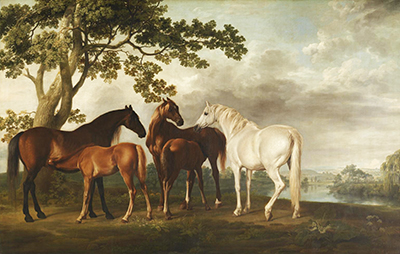
George Stubbs’s Mares and Foals in a River Landscape belongs to Tate, which dates it to about 1763–68. Painted in oil on canvas, it measures 101.6 × 161.9 cm. [1]
Three mares and two foals gather beside a river. Two of the young animals feed, while the pale mare at the right turns her head towards the others. A broad tree spreads above them; beyond their compact bodies, the water opens a view of distant country. Stubbs gives the animals a strong collective presence without making them all look or stand alike. [2]
At a Glance
This work across George Stubbs’s career
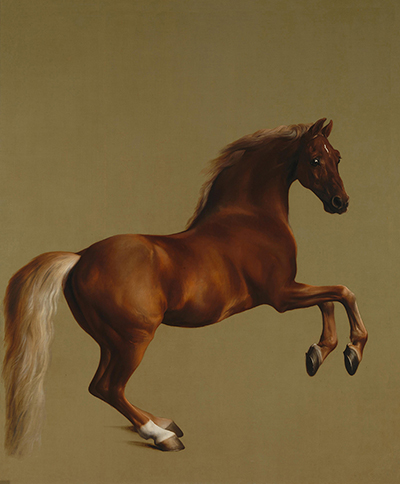
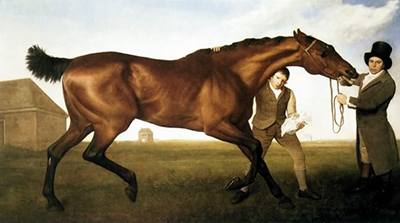
Whistlejacket
about 1762 [7]Contents
- Five horses and two feeding pairs
- The tree and the river
- Breeding and a borrowed composition
- A painting above a dining-room door
- Observation, anatomy and design
- Other mares, other paintings
- From private decoration to public reproduction
- Videos on George Stubbs
Five horses and two feeding pairs
The darkest mare occupies the left edge of the group. Her hindquarters are close to the tree, while her long neck and head reach towards the centre. The strong, almost horizontal line of her back descends into a sloping neck. Beneath it, the lighter foal faces in the opposite direction, its muzzle tucked against her underside. Their bodies cross without becoming confused: the foal’s warm flank stands clearly in front of the mare’s dark legs. [2]
This first foal has its rump towards the middle of the picture and its head to the left. A narrow pale tail falls over the curve of its hindquarters. Its slender legs stand apart, showing both its small scale and the space it needs to reach upwards. The feeding action is legible through position rather than movement. Nothing interrupts it, and the mare keeps her head raised above the foal’s back. [2]
The central mare is browner and more warmly lit than her neighbour. Her chest faces towards us, but her head turns to the right. A long fall of mane catches the light beside her neck. Compared with the dark mare’s extended profile, her body is more difficult to take in at once: the second foal stands in front of her, and the grey mare overlaps her on the other side. [2]
That second foal shows its rounded hindquarters to the viewer. Its tail descends nearly vertically, and its head disappears into the sheltered space beneath the adult. This backward view changes the pattern established by the first foal’s broadside body. We see a different way of approaching the same activity. The two young animals are close in colour and size, yet their opposed positions give each feeding pair its own shape. [2]
The grey mare is the clearest individual silhouette. Her pale body is placed against the lower sky, with little of the group behind her hindquarters. She turns her head left, bringing her dark muzzle close to the central mare’s back. Her mane breaks into soft strands along the neck. A long tail falls behind her, balancing the much shorter, lifted line of her face at the other end. [2]
One hind leg crosses forward beneath the grey mare’s body. That oblique line gives her stance an easy asymmetry, while the other legs carry the body more directly. Her ears and dark eye are small accents within the large pale head. The light along her shoulder and flank is interrupted by gentle shadows, so that the body reads as a rounded volume rather than a flat white shape. [2]
The adult heads occupy three different positions: the dark mare reaches down and inwards, the central mare rises higher, and the grey looks back across the group. Below them, the foals create a second level of contact. These differing heights prevent the five horses from becoming a row of interchangeable profiles. The overlapping bodies remain close, but their heads, tails and legs give us several distinct points from which to follow the gathering. [2]
The tree and the river
At the left, the tree is almost as solid a presence as the horses. Several trunks rise together, dividing into branches that stretch across much of the upper picture. Their bark is uneven, with pale ridges catching the light. The foliage is broken into separate clusters, leaving patches of sky between them. A low branch reaches over the central mare, bringing the upper and lower halves of the painting close together. [2]
The branches do not enclose the animals completely. They spread from the crowded left towards the open sky, stopping before the far right edge. Beneath them, the horses occupy a similarly uneven space: the dark mare is pressed towards the side, whereas the grey has room around her outline. Tree and animals together make one part of the canvas feel densely inhabited, while allowing the distant country to remain visible. [2]
The river enters our view beside the grey mare and widens towards the right. Its surface is a cooler, lighter strip beyond the brown foreground bank. Trees on the farther shore are reduced to small masses; their reflections and the dark edges of the banks give the water a winding direction. A drooping tree at the extreme right marks a nearer turn, helping distinguish the water’s successive reaches. [2]
Beyond the river lie low fields, scattered trees and a pale horizon. The distant land is much lighter than the ground under the horses. This difference in tone makes the view seem deep even though the foreground group occupies a fairly shallow strip. The horses’ legs keep us close to the near bank; the fine, faint marks of the farther country invite us to look past them. [2]
The sky contains broad areas of grey cloud as well as thinner, brighter passages. Above the pale mare, a darker cloud helps make her light neck and mane visible. Higher up, small rounded cloud forms loosen into a more open atmosphere. The painting does not need a dramatic incident in the weather: changes in light are enough to distinguish the sheltered foreground from the expansive distance. [2]
Along the bottom edge, earth, grass and broad leaves establish a rougher surface. The vegetation is most conspicuous towards the right, where its jagged shapes contrast with the smooth flank above. Dark hollows and small lit patches make the bank uneven, yet the horses stand firmly within it. Their hooves belong to a continuous piece of ground, rather than hovering against the scenery. [2]
The Frick Collection’s exhibition account calls the setting imaginary and interprets the tree’s curved boughs as an echo of the nursing mares’ sheltering forms. It also gives the river a significant role in the grey mare’s isolation against light and cloud. That reading treats the landscape as part of Stubbs’s invention, rather than as a backdrop added merely to fill the canvas. [16]
Breeding and a borrowed composition
Judy Egerton connects these pictures with breeders’ investment in future racers and breeding stock. Choosing parents was expensive; a mare’s value could lie in her offspring as well as her own performance. [17]
Rockingham’s Mares and Foals without a Background contained five mares and two foals. A receipt of 15 August 1762 records it within a five-picture commission. [17] Egerton identifies two mother-and-foal pairs reused here, with a chestnut changed to grey. [18]
Tate notes the omission of Rockingham’s two central mares and an altered pose at the right. [1]
Egerton identified at least ten variations. Some patrons admired compositions derived from horses they did not own. [18]
A painting above a dining-room door
Tate suggests an overdoor function: the painting probably hung above a dining-room doorway with two other works by Stubbs. Its likely patron was George Brodrick, third Viscount Midleton, whose choice gave the group an ornamental role within a domestic interior. [1]
The Frick account describes Midleton as someone who did not own racehorses and proposes that he commissioned the work because he admired Stubbs’s invention. The distinction matters: the picture’s association with breeding does not make it a record of Midleton’s own stud. A patron could appreciate the beauty of horses and their painted arrangement without owning the animals represented. [16]
Even at a small scale, the image remains easy to recognise. The pale mare stands out immediately, while the two brown adults and their foals gather into a darker mass beside her. The tree supplies a large vertical feature, and the river gives the composition an open end. At closer range, the small differences between hooves, ears, manes and overlapping legs reward a slower examination. [2]
Observation, anatomy and design
Stubbs’s The Anatomy of the Horse, published in 1766, brought his investigations of equine structure into print. The Metropolitan Museum’s copy identifies him as both author and illustrator, with etched illustrations. Painting horses and investigating their bodies were sustained, connected activities in his career. [19]
Terry Riggs, writing for Tate, suggests that life studies preceded these compositions, although none has been located. An unfinished painting elsewhere in the series preserves detailed horses against a blank background, providing evidence for a method in which the animals were painted before their setting. [1]
Riggs proposes engravings by Matham after Collaert as possible models. He describes a conical arrangement, with the feeding foals directing attention around it: a carefully designed group, rather than a chance encounter. [1]
The range of views makes that design tangible. One foal offers a long side, the other a compact rear view; one adult shows an extended profile, another a frontal chest. The grey combines a broad flank with a sharply turned neck. Such variety lets the viewer consider several bodily aspects within one close gathering. The horses appear related through their placement, but each presents a different problem of shape and overlap. [2]
Other mares, other paintings
The National Trust’s Five Brood Mares, at Ascott, is a separate royal commission of 1765. It measures 99.1 × 188 cm and depicts five adult mares, rather than the three adults and two foals seen here. The Duke of Cumberland’s Windsor stud supplied that picture’s subject. [20]
The Kimbell Art Museum acquired Mares and Foals belonging to the 2nd Viscount Bolingbroke in 2024. It dates the work to about 1761–62 and describes three mares with three foals. Its six-horse group has a different patron and history from Tate’s five. [21]
A further distinction is the much larger Mares and Foals in an Extensive Landscape, dated about 1769 and measuring 184.5 × 274 cm. Christie’s associates its commission with the Duke of Grafton, while allowing John Smyth as an alternative. That canvas repeats the group made for Colonel George Lane Parker; Tate’s painting instead draws upon Rockingham’s. [22]
From private decoration to public reproduction
Tate purchased the painting in 1959 with assistance from the Pilgrim Trust. Its accession number is T00295. [1]
The painting found a new public on a ninepenny British postage stamp issued on 10 July 1967. The Postal Museum’s archival history records Harrison & Sons judging Mares and Foals in a Landscape particularly suitable for reproduction. The horizontal stamp was printed in photogravure, and recorded net sales of the ninepenny denomination exceeded 9.5 million. A picture associated with a private dining room thus circulated on a remarkable scale through an everyday public medium. [23]
Reducing paintings to stamps involved practical choices. During the selection process, the committee accepted the printers’ advice to depart from the usual format in order to preserve the originals’ proportions. The suitability of Stubbs’s design was considered alongside works by Lawrence, Lowry and other painters. Reproduction introduced a new test of the composition: its clarity had to survive a drastic reduction in size. [23]
Its later scholarly life also extends beyond Stubbs studies. In her 2018 thesis, Alison Elizabeth Wright compares it with Charles Towne’s Three Horses in a Stormy Landscape of 1836. She contrasts Stubbs’s gentle variation with Towne’s more insistent mirroring and circular arrangement. The comparison makes repetition a matter of degree and character: closely grouped horses can produce very different pictorial effects. [24]
Videos on George Stubbs
Explore Stubbs’s equestrian painting in its wider context, including two readings of Whistlejacket.
A Horse Lover’s Guide to the YCBA
A museum tour that places Stubbs alongside other artists who painted horses. It includes a look at Pumpkin with a Stable-lad.
Watch on YouTubeGeorge Stubbs artworks directory
Search works and related prints documented in this guide. Separate versions and printing matrices have separate entries; printmakers are named where known. Unidentified historical titles and untraced studio-sale material are discussed in the essays. A dash means that a date is not established here.
| Name | Date | Medium |
|---|---|---|
| A Bay Horse with a Groom | 1791 | Painting |
| A Bay Hunter with Two Playful Spaniels | 1777 | Painting |
| A Bay Hunter, a Springer Spaniel and a Sussex Spaniel in a wooded river Landscape | 1782 | Painting |
| A Cheetah and a Stag with Two Indian Attendants | about 1764 | Painting |
| A Couple of Fox Hounds (coloured print after Stubbs) | — | Print after Stubbs |
| A Couple of Foxhounds | 1792 | Painting |
| A Foxhound on the Scent | 1788 | Drawing |
| A Gentleman driving a Lady in a Phaeton | 1787 | Painting |
| A Grey Horse | 1793 | Painting |
| A Grey Horse (cantering companion) | 1793 | Painting |
| A Grey Stallion in a Landscape | — | Painting |
| A Horse Affrighted at a Lion | 1 May 1788 | |
| A Horse Belonging to the Rt. Honourable Lord Grosvenor called Bandy from his Crooked Leg | about 1763 | Painting |
| A Horse Frightened by a Lion | 1777 | |
| A Lion (A Lion Resting on a Rock) | 1 May 1788 | |
| A Lion Attacking a Horse | 1770 | Painting |
| A Lion Attacking a Horse (monumental Yale canvas) | 1762 | Painting |
| A lion attacking a horse (NGV) | about 1765 | Painting |
| A Lion Devouring a Horse (1788 print) | 1788 | |
| A lion devouring a horse (attribution disputed) | Proposed mid-1770s | Painting |
| A mare and foal with a bay horse | 1771 | Painting |
| A Monkey | 1799 | Painting |
| A Prancing Horse, Facing Right | c. 1790 | Drawing |
| A Rough Dog | 1790 | Painting |
| A Saddled Bay Hunter | 1786 | Painting |
| A Sleeping Leopard | 1 January 1791 | |
| A Tiger and a Sleeping Leopard | 1 May 1788 | |
| A Tigress (John Dixon after Stubbs) | 1772 | Print after Stubbs |
| A Tyger (A Recumbent Leopard by a Tree) | 1 May 1788 | |
| A Tyger (Sleeping Leopard) | 1 May 1788 | |
| An animal found on the coast of New Holland called kanguroo (after Stubbs) | 1773 | Print after Stubbs |
| An animal of a new species found on the coast of New South Wales (after Stubbs) | July 1773 | Print after Stubbs |
| Antinous and Jockey | — | Painting |
| Antinoüs, a chestnut racehorse, in a landscape | Undated | Painting |
| Bandy belonging to Lord Grosvenor (print after Stubbs) | — | Print after Stubbs |
| Baronet (George Townley Stubbs after Stubbs) | 20 February 1794 | Print after Stubbs |
| Baronet with Sam Chifney Up | 1791 | Painting |
| Baronet with Samuel Chifney up (Royal Collection) | 1791 | Painting |
| Bay Hunter by a Lake | 1787 | Painting |
| Brood Mares (Benjamin Green after Stubbs) | Issue 14 November 1776 | Print after Stubbs |
| Brood Mares and Foals | usually dated 1767 | Painting |
| Brown and White Norfolk or Water Spaniel | 1778 | Painting |
| Bulls Fighting | 1786 | Painting |
| Captain Samuel Sharpe Pocklington with His Wife, Pleasance, and possibly His Sister, Frances | 1769 | Painting |
| Death of the Doe (attribution disputed) | 1804 | |
| Der Englische Hühnerhund (Johann Wölfle after Stubbs) | about 1860 | Print after Stubbs |
| Dog (A Foxhound Viewed from Behind) | 1 May 1788 | |
| Dog [A Foxhound on the Scent] | 1788 | |
| Drill and albino baboon | before 1789 | Painting |
| Eclipse (Charles Hunt after Stubbs) | 12 November 1839 | Print after Stubbs |
| Eclipse (George Townley Stubbs after Stubbs) | 1796 | Print after Stubbs |
| Eclipse (oil study) | — | Painting |
| Eclipse (Thomas Burke after Stubbs) | First published 1772 | Print after Stubbs |
| Eclipse and John Wildman (Benjamin Green after Stubbs) | 1772 | Print after Stubbs |
| Eclipse at Newmarket (Jockey Club version) | Proposed early 1790s; often dated 1770 | Painting |
| Eclipse at Newmarket with a groom and jockey | 1770 | Painting |
| Eclipse with Mr Wildman and His Sons | 1769–71 | Painting |
| Eclipse, the Property of Capt.n O Kelly (anonymous print after Stubbs) | Imprint 4 June 1804; impression undated | Print after Stubbs |
| Euston | 1774 | Painting |
| Finished Study for the Seventh Anatomical Table of the Muscles of the Horse | 1756–58 | Drawing |
| Five Brood Mares at the Duke of Cumberland's Stud Farm in Windsor Great Park | 1765 | Painting |
| Fowl Body, Lateral View (Highly Finished Study for an Unpublished Table; Shows the Last Stage in Dissection) | — | Drawing |
| Fowl Body, Lateral View (Probably Prepared for Transfer to the Plate for Engraving of Table XV) | — | Drawing |
| Fowl Skeleton, Lateral View (Finished Study for Table V) | — | Drawing |
| Freeman, the Earl of Clarendon's Gamekeeper, with a Dying Doe and Hound (Yale) | 1800 | Painting |
| George Stubbs (enamel self-portrait) | 1781 | Enamel |
| Gimcrack (George Townley Stubbs after Stubbs) | 1775 | Print after Stubbs |
| Gimcrack on Newmarket Heath, with a trainer, a jockey and a stable lad | about 1765 | Painting |
| Gimcrack, with John Pratt up, on Newmarket Heath | about 1765 | Painting |
| Hambletonian, Rubbing Down | 1800 | Painting |
| Hay-Makers | 1791 | |
| Haycarting | 1795 | Enamel |
| Haymakers | 1785 | Painting |
| Haymakers (Lady Lever Art Gallery) | 1794 | Enamel |
| Hollyhock (with later additions by Vernet and Boucher) | about 1765–70 | Painting |
| Horse Attacked by a Lion (Episode C) | 1768–69 | Painting |
| Horse Attacked by a Lion (Tate enamel) | 1769 | Enamel |
| Horse Devoured by a Lion | Possibly exhibited 1763 | Painting |
| Horse Frightened by a Lion | 1770 | Painting |
| Horse Frightened by a Lion (Episode A; Wedgwood and Bentley after Stubbs) | — | Sculpture |
| Horse Frightened by a Lion (Tate) | Possibly exhibited 1763 | Painting |
| Horse Frightened by a Lion (Yale) | 1762–68 | Painting |
| Horse in the Shade of a Wood | 1780 | Painting |
| Hound Coursing a Stag | about 1762 | Painting |
| Human Figure, Anterior View (Intended for a Plate That was Never Published) | — | Drawing |
| Human Skeleton, Lateral View | 1795–1806 | Drawing |
| Hunt servants setting out (Southill commission) | 1767 | Painting |
| Hühnerhund (The Spanish Pointer) | about 1766 | Painting |
| John and Sophia Musters Riding at Colwick Hall | 1777 | Painting |
| John Musters on his hunter Pilgrim | 1777–78 | Painting |
| Labourers | 1789 | |
| Labourers (Richard Earlom after Stubbs and Amos Greene) | 25 March 1790 | Print after Stubbs |
| Laetitia, Lady Lade (d.1825) | 1793 | Painting |
| Lemon and White Water Spaniel | — | Painting |
| Lion Attacking a Stag | — | Painting |
| Lord Grosvenor's Arabian Stallion with a Groom | about 1765 | Painting |
| Lord Grosvenor's Arabian Stallion with a Groom (Peter Mazell after Stubbs) | 1771 | Print after Stubbs |
| Mambrino (Eaton Hall painting) | — | Painting |
| Mambrino (George Townley Stubbs after Stubbs) | 1794 | Print after Stubbs |
| Mares and Foals belonging to the 2nd Viscount Bolingbroke | about 1761–62 | Painting |
| Mares and foals beneath large oak trees | — | Painting |
| Mares and Foals by a stream | Exhibited 1764 | Painting |
| Mares and Foals in a River Landscape | about 1763–68 | Painting |
| Mares and Foals in an Extensive Landscape | about 1769 | Painting |
| Mares and Foals without a Background | 1762 | Painting |
| Moose Deer (after Stubbs) (Arctic Zoology plate VIII) | 1784–85 publication | Print after Stubbs |
| Newmarket Heath with a Rubbing-Down House | — | Painting |
| Otho (1796 print after Stubbs) | 1 December 1796 | Print after Stubbs |
| Otho, with John Larkin up | 1768 | Painting |
| Pangloss | about 1762 | Painting |
| Patch (Grafton commission) | 1759 | Painting |
| Phaeton and the Chariot of the Sun (enamel) | 1775 | Enamel |
| Phaeton with a Pair of Cream Ponies and a Stable-Lad | 1780–84 | Painting |
| Phillis | 1772 | Painting |
| Portrait of a Large Dog (Dingo) | 1772 | Painting |
| Pumpkin with a Stable-lad | 1774 | Painting |
| Racehorses Exercising at Goodwood | 1759–60 | Painting |
| Reapers (1791 print) | 1791 | |
| Reapers (Tate) | 1785 | Painting |
| Reapers (Yale) | 1795 | Enamel |
| Red Deer: A Stag and a Hind | 1792 | Painting |
| Richard Wedgwood | — | Enamel |
| Ringwood, a Brocklesby Foxhound | 1792 | Painting |
| Scrub, a bay horse belonging to the Marquess of Rockingham | about 1762 | Painting |
| Self Portrait on a White Hunter | 1782 | Enamel |
| Self-Portrait | about 1759 | Painting |
| Shooting (1770 Woollett plate after Stubbs) | 1770 | Print after Stubbs |
| Shooting (1771 Woollett plate after Stubbs) | 1771 | Print after Stubbs |
| Shooting at Goodwood | 1759–60 | Painting |
| Sir John Nelthorpe as a boy | 1756 | Painting |
| Sir John Nelthorpe partridge shooting with one pointer | — | Painting |
| Sir John Nelthorpe, 6th Baronet, out Shooting with His Dogs in Barton Field, Lincolnshire | 1776 | Painting |
| Sleeping Leopard | 1777 | Enamel |
| Soldiers of the 10th Light Dragoons | 1793 | Painting |
| Stallion and Mare (George Townley Stubbs after Stubbs) | 1776; reissued 1789 | Print after Stubbs |
| Steward and gamekeeper with dogs (Southill commission) | 1767 | Painting |
| Studies of a Lemur (Lemur murinus) in six different attitudes | 1773 | Drawing |
| Study for the Self-portrait in Enamel | c. 1781 | Drawing |
| Study of a Lemur | 1773 | Drawing |
| Study of a Racehorse in Action: Galloping to Left, a Semi-Anatomical Study, with Skin Flayed to Show Action of Muscles | — | Drawing |
| Study of the Legs of a Draught-Horse Pulling a Harrow (attributed to Stubbs) | Proposed about 1786 | Drawing |
| Sweet William (Grosvenor panel) | — | Painting |
| Sweet William (Turf Gallery canvas) | — | Painting |
| The Black Stallion Sampson, Portrayed from Three Angles (with landscape additions) | about 1764 | Painting |
| The Charlton Hunt | 1759–60 | Painting |
| The Fall of Phaeton | — | Sculpture |
| The Frightened Horse | 1780 | Sculpture |
| The Grosvenor Hunt | — | Painting |
| The Haymakers (Upton House) | 1783 | Painting |
| The Horse and Lion (George Townley Stubbs after George Stubbs) | 1770 | Print after Stubbs |
| The Kongouro from New Holland | 1772 | Painting |
| The Labourers | 1779 | Painting |
| The Labourers (Southill original) | 1767 | Painting |
| The lion and horse (Benjamin Green after Stubbs) | 1769; reissued 1777 | Print after Stubbs |
| The Milbanke and Melbourne Families | about 1769 | Painting |
| The Moose | 1770 | Painting |
| The Prince of Wales's Phaeton | 1793 | Painting |
| The Reapers (Upton House) | 1783 | Painting |
| The Sebra, or Wild Ass (George Townley Stubbs after Stubbs) | 1771 | Print after Stubbs |
| The Spanish Pointer (Bradford version) | about 1766–68 | Painting |
| The Spanish Pointer (William Woollett after Stubbs) | January 1768 | Print after Stubbs |
| The Third Duke of Dorset's Hunter with a Groom and a Dog | 1768 | Painting |
| Thomas Freeman, Lord Clarendon's gamekeeper, with a dog and a shot doe (with George Townly Stubbs) | 1803 | Painting |
| Turf, with Jockey up, at Newmarket | — | Painting |
| Turk and Crab | — | Painting |
| Two Bay Hunters Communing On The Bank Of A Lake | — | Painting |
| Tygers at Play | 1780 | |
| Viscount Gormanston's White Dog | 1781 | Painting |
| Viscount Gormanston's White Dog (canvas version) | — | Painting |
| Water Spaniel | 1769 | Painting |
| Wedgwood Family Portrait | 1780 | Painting |
| Whistlejacket | about 1762 | Painting |
| Whistlejacket with two other stallions and a groom | Recorded 1762 | Painting |
| White Poodle in a Punt | about 1780 | Painting |
| William Anderson with two Saddle-Horses | 1793 | Painting |
| Working Drawing for the Seventh Anatomical Table of the Muscles of the Horse | 1756–58 | Drawing |
| Zebra | 1763 | Painting |
Discussion
Look again at the images and ideas explored in Mares and Foals in a River Landscape by George Stubbs. These editorial prompts invite your observations.
Reader Insights
How do water and trees connect the separate groups of animals?
Which difference from another mares-and-foals painting most rewards a second look?
How does the spacing between the animals shape the group more than any single pose?
Join the Conversation
Share a detail, comparison or question about Mares and Foals in a River Landscape by George Stubbs below.
References
- Tate, Mares and Foals in a River Landscape, T00295, current Details and Caption; Terry Riggs, Collection Text, January 1998. Accessed 4 November 2026. View source.
- Tate, whole image of Mares and Foals in a River Landscape, T00295. Accessed and inspected 4 November 2026. View source.
- Goodwood, The Collection, Painting Collection modal, Racehorses Exercising at Goodwood; An exciting acquisition: a study by George Stubbs, 30 June 2023; History of the Estate Hounds, 4 October 2023; About Goodwood Racecourse. Accessed 4 November 2026. View source.
- Goodwood, The Collection, Painting Collection modal, Racehorses Exercising at Goodwood; An exciting acquisition: a study by George Stubbs, 30 June 2023; History of the Estate Hounds, 4 October 2023; About Goodwood Racecourse. Accessed 4 November 2026. View source.
- Goodwood, The Collection, Painting Collection modal, Racehorses Exercising at Goodwood; An exciting acquisition: a study by George Stubbs, 30 June 2023; History of the Estate Hounds, 4 October 2023; About Goodwood Racecourse. Accessed 4 November 2026. View source.
- Goodwood, The Collection, Painting Collection modal, Racehorses Exercising at Goodwood; An exciting acquisition: a study by George Stubbs, 30 June 2023; History of the Estate Hounds, 4 October 2023; About Goodwood Racecourse. Accessed 4 November 2026. View source.
- National Gallery, Whistlejacket, NG6569, current collection record, provenance, in-depth discussion and frame entry. View source.
- Yale Center for British Art, Zebra, B1981.25.617, current object metadata, gallery labels, Malcolm Warner’s 1998 catalogue entry and provenance supplied through the museum’s public collection record. View source.
- Tate, Mares and Foals in a River Landscape, T00295, current Details and Caption; Terry Riggs, Collection Text, January 1998. Accessed 4 November 2026. View source.
- Christie’s, Gimcrack on Newmarket Heath, with a trainer, a jockey and a stable lad, London, 5 July 2011, lot 12; object details, essay, provenance, exhibitions and whole image. View source.
- Christie’s, Gimcrack on Newmarket Heath, with a trainer, a jockey and a stable lad, London, 5 July 2011, lot 12; object details, essay, provenance, exhibitions and whole image. View source.
- Yale University Art Gallery, A Lion Attacking a Horse, 1770, 1955.27.1, collection record. Accessed 4 November 2026. View source.
- Royal Museums Greenwich, ‘The Kongouro from New Holland’ (Kangaroo), ZBA5754. Accessed 4 November 2026. View source.
- Tate, George Stubbs, Haymakers, 1785, T02256; details, Terry Riggs’s collection text (January 1998), and online caption. Collection record. View source.
- Frances Bailey, ‘Hambletonian, Rubbing Down: A masterpiece by George Stubbs’, National Trust Cultural Heritage Magazine, Autumn/Winter 2024, pp. 22–33. Article. View source.
- The Frick Collection, George Stubbs: A Celebration, exhibition images and texts, entry for Mares and Foals in a River Landscape, 2007. Accessed through the indexed institutional text 4 November 2026. View source.
- Judy Egerton, Whistlejacket, National Gallery Catalogues: The British Paintings, 2000, discussion of breeding, Rockingham’s commissions and the receipt of 15 August 1762. Accessed 4 November 2026. View source.
- Judy Egerton, essay for A Mare and Foal with a Bay Horse, Christie’s, Sporting Art, 2002, lot 5. Accessed 4 November 2026. View source.
- Metropolitan Museum of Art, The Anatomy of the Horse, 1766, 53.599.1bis. Accessed 4 November 2026. View source.
- National Trust Collections, Five Brood Mares at the Duke of Cumberland’s Stud Farm in Windsor Great Park, 1535163. Accessed 4 November 2026. View source.
- Kimbell Art Museum, “Kimbell Acquires Masterpiece by George Stubbs”, 28 June 2024. Accessed through the indexed institutional text 4 November 2026. View source.
- Christie’s, Mares and Foals in an Extensive Landscape, lot 21, 2 July 2024. Accessed 4 November 2026. View source.
- The Postal Museum, Special Stamp History: British Paintings, 1967, pp. 5 and 9. Accessed through the indexed institutional text 4 November 2026. View source.
- Alison Elizabeth Wright, Animal and Sporting Painting in Britain, 1760–c.1850: Its Artistic Practices, Patronage and Public Display, PhD thesis, University of East Anglia, 2018, pp. 15–16 and fig. 2, p. 219. Accessed 4 November 2026. View source.
- Basic title, date and material metadata for Tate’s Reapers (T02257) and Otho (T02375) is adapted from the Tate collection dataset, October 2014, released under CC0. TheHistoryOfArt.org has reconciled labels and versions. This credit does not apply to Tate’s authored catalogue commentary or images.
- Data Source: Yale Center for British Art. Basic object fields are adapted and reconciled for this directory. Reuse is subject to the Center’s Open Data and Data Services Terms of Use. No museum endorsement is implied. This metadata credit does not relabel scholarly essays or images as open data.
- Basic object metadata for A Horse Frightened by a Lion, 1985.38, The Cleveland Museum of Art, John L. Severance Fund, is available under CC0. Titles and design-level grouping have been reconciled for this directory.