

 by Tom Gurney
Tom Gurney BSc (Hons) is an art history expert with over 20 years experience
Published on June 19, 2020 / Updated on July 19, 2026
Email: tomgurney1@gmail.com / Phone: +44 7429 011000
Ellen Terry as Lady Macbeth by John Singer Sargent: Introduction
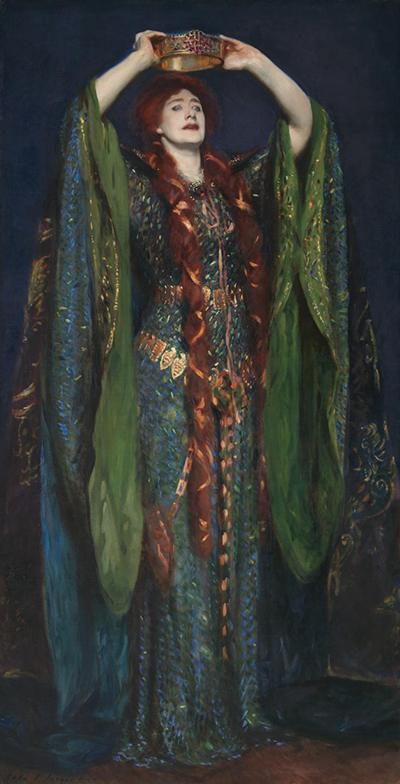
John Singer Sargent's Ellen Terry as Lady Macbeth is a portrait of an actor at the point where role, costume, celebrity, and painting become almost impossible to separate. Terry stands in the green dress she wore for Henry Irving's 1888 Lyceum Theatre production of Macbeth, lifting Duncan's crown above her head in a gesture Sargent invented for the canvas. The result is not a simple record of one moment on stage. It is a painted image of theatrical power.
The painting matters because it makes performance monumental. Terry is recognizable as a celebrated Victorian actor, yet Sargent does not present her as a private sitter. He shows her as Lady Macbeth, absorbed into Shakespearean ambition, stage light, medievalizing costume, and the visual culture of late nineteenth-century theatre. Her raised arms, long plaits, crown, green dress, and dark surrounding space turn the actor into an image of command.
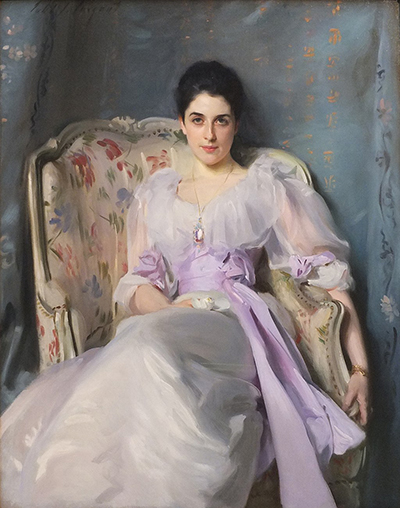
Sargent had already learned how to make portraits behave like social events. Madame X had shown how a sitter's public appearance could become dangerous when intensified by paint. Lady Agnew of Lochnaw would show how seated ease and dress could become aristocratic authority. In Ellen Terry as Lady Macbeth, the question changes. The sitter is famous for becoming other people. Sargent paints not only the woman and not only the role, but the act of theatrical transformation itself.
At a Glance
- ArtistJohn Singer Sargent [1]
- TitleEllen Terry as Lady Macbeth [1]
- Date1889 [1]
- MediumOil on canvas [1]
- Dimensions221 x 114.3 cm [1]
- SitterDame Ellen Terry as Lady Macbeth [1]
- Current collectionTate, London, object N02053 [1], [2]
- Role contextTerry played Lady Macbeth opposite Henry Irving at the Lyceum Theatre, London, in the production that opened on 29 December 1888 [1]
- Costumethe famous green beetle-wing dress designed by Alice Laura Comyns-Carr and made by Adaline Cort Nettleship [1]
- Related versionSargent's 1906 work in the National Portrait Gallery, London, is a later replica connected with Terry's jubilee programme, not the Tate painting [1], [2]
Contents
- Introduction
- Ellen Terry And The Lyceum Macbeth
- Sargent Sees A Stage Image
- The Beetle-Wing Dress
- A Pose Shakespeare Never Staged
- Close Looking
- Portrait, Performance And Celebrity
- Tate Original And National Portrait Gallery Replica
- Place In Sargent's 1880s Career
- Reception, Memory And The Surviving Costume
- Related Works And Where To Go Next
Ellen Terry And The Lyceum Macbeth
Ellen Terry was one of the defining actors of the Victorian stage. For this painting, the important fact is not every step of her long career, but the way her fame met the role of Lady Macbeth in 1888. Terry had been closely associated with Henry Irving's Lyceum Theatre, where acting, staging, costume, lighting, and publicity combined to create theatre as a public spectacle. When Irving revived Macbeth, taking the title role himself and casting Terry as Lady Macbeth, the production brought together one of the period's most famous theatrical partnerships.
The opening night was 29 December 1888. Sargent attended and was struck by Terry's entrance and visual force. National Portrait Gallery writing records that he was deeply impressed by her performance and by the spectacle of her appearance under the dim gaslight. Tate's own summary gives the essential chain: Sargent saw Terry perform, was struck by her appearance and interpretation, persuaded her to sit, and painted her in full costume. [1], [2]
That sequence is crucial. Sargent did not make an actor portrait from abstract admiration for Shakespeare. He responded to a specific modern theatrical event. Terry's Lady Macbeth was not simply a literary character. She was a London stage phenomenon, seen by a public that followed the Lyceum and by writers, artists, critics, and fashionable audiences attentive to dress and gesture. The painting belongs to that world of performance and spectatorship.
At the same time, the portrait should not be mistaken for a literal stage still. Sargent did not choose a documentary moment from Irving's staging. He invented a pose: Terry lifts the crown over her own head, making ambition visible as a physical act. Art UK's essay by Antony Sher notes that this crowning gesture was not an actual moment in the production and reads it as a visualization of Lady Macbeth's inner hunger for power. That distinction makes the painting richer. Sargent saw a performance, then made a new image that theatre itself had not given him. [3]
Terry was therefore both sitter and collaborator, but also material for Sargent's invention. She brought her role, face, body, fame, costume, and stage memory. Sargent brought the pose, scale, painterly surface, and visual condensation. The painting lives in the charged space between them.
Sargent Sees A Stage Image
The National Portrait Gallery's extended entry preserves the vivid studio history around the work. Sargent began the Tate portrait early in 1889. He worked in Tite Street, Chelsea, and Terry came to the studio in costume. Oscar Wilde, who lived nearby, noticed the surreal force of Lady Macbeth arriving by carriage in full regalia. The anecdote matters because it shows how the work began before the canvas: the role had already escaped the stage and entered the street, the studio, and the social imagination of London. [1], [2]
Sargent's first idea was different from the final Tate painting. According to the NPG record, he initially imagined Lady Macbeth entering in Act 1, scene 6, coming from Macbeth's castle by torchlight to welcome Duncan. Terry later remembered that Sargent liked the swirl of the dress, the torches, and attendants bowing on either side. He made her walk in the studio until the movement reached the point he wanted, then rushed to the canvas to paint. [1], [2]
That abandoned idea survives in related form at Smallhythe Place, where the National Trust records an oil painting by Sargent of Terry as Lady Macbeth before an archway with indistinct bowing figures. The Trust identifies it as connected to the earlier idea and notes that Sargent later made a grisaille replica for Terry's 1906 jubilee programme. The existence of this design helps explain the Tate portrait by contrast. Sargent moved away from a processional scene with attendants and toward a single commanding figure. [1], [2]
The final Tate painting is more concentrated than the first idea. It removes the bowing figures, torchlit architecture, and narrative entrance. Terry stands alone. She does not welcome Duncan. She crowns herself. Sargent keeps the theatrical costume and Shakespearean role, but he strips the scene down until the body becomes the drama. [1], [2]
This decision is deeply characteristic of Sargent's portrait intelligence. He often understood that a sitter could become stronger when the setting did less. In Madame X, a spare ground turns a society figure into an icon of style and exposure. In Ellen Terry as Lady Macbeth, the darker surrounding field lets costume, gesture, and face carry the whole idea of performance.
The Beetle-Wing Dress
The dress is not background ornament. It is the engine of the painting. The National Trust's record for the surviving costume identifies it as the beetle-wing dress made for Terry's Lady Macbeth in Irving's Lyceum production. It was designed by Alice Laura Comyns-Carr and made by Adaline Cort Nettleship. Its materials include cotton, silk, lace, beetle-wing cases, glass, and metal. The dress belongs to costume history as much as to theatre history. [4], [5]
The National Trust describes the costume as a shimmering emerald-green dress embroidered with iridescent beetle-wing cases. It was meant to catch stage light and create the effect of scales. Other costume elements included a heather-colored velvet cloak, jewelry, belt, scabbard, knife, and Terry's long dark red hair, plaited with gold. The whole ensemble was designed to be seen under theatrical conditions, where movement and light could make surface glitter. [4], [5]
This explains why Sargent was so interested in it. He was one of the great painters of fabric, but he did not paint fabric only to display skill. Clothing in his portraits creates identity. A black dress makes Madame X severe; a white dress and lilac sash help make Lady Agnew's ease visible; the green beetle-wing dress turns Terry into a figure of role, danger, and spectacle. Costume becomes structure.
The dress also shaped how Lady Macbeth could be imagined. National Trust writing notes that the costume was designed to invoke fear and that the beetle-wing cases suggested serpent scales. The green color belonged not to gentle prettiness but to ambition, enchantment, and menace. Yet the dress was also beautiful. That doubleness matters. Lady Macbeth is not pictured as a crude villain. She appears proud, splendid, dangerous, and theatrical. [4], [5]
The costume was part of a larger visual program. National Trust research explains that Comyns-Carr's design drew on medieval and artistic references, including the influence of Edward Burne-Jones and historical dress models. Victorian Shakespeare did not aim only to recite the play. It built worlds through clothing, stage picture, gesture, lighting, and artistic reference. Sargent's painting belongs to that expanded theatre. [4], [5]
The survival of the dress at Smallhythe Place gives the painting an unusual material afterlife. Many stage costumes vanish after use, altered, discarded, or worn out. Terry's beetle-wing dress endured because her celebrity, the role, and Sargent's painting turned it into an object of memory. The National Trust has treated it as a fragile historic costume requiring careful conservation. That survival lets viewers understand that Sargent was not inventing the garment's splendor out of nothing. He was translating an actual theatrical object into paint. [4], [5]
A Pose Shakespeare Never Staged
The most important invention in the painting is the gesture. Terry raises Duncan's crown above her head as if she is about to lower it onto herself. This is not a literal moment from Shakespeare's play or from Irving's production. It is Sargent's pictorial invention, and it changes the meaning of the portrait.
In Shakespeare, Lady Macbeth's ambition is often expressed through language, persuasion, and psychological pressure. She imagines power, urges Macbeth toward murder, and tries to master fear. Sargent turns that inward pressure into a single vertical action. The crown is above her head, the arms lift, the body elongates, and the face seems caught between command and trance. Desire for rule becomes an image.
Art UK's Antony Sher reads the invented crowning as a fantasy of Lady Macbeth's subconscious, connected to her craving for ultimate power. Whether one follows that reading fully or more cautiously, the key point is clear: Sargent uses a non-stage gesture to make the role legible. The painting is not theatre reportage. It is interpretation. [3]
The crown also changes Terry's relation to the viewer. She does not bow, kneel, plead, welcome, or recoil. She acts. The gesture gives her authority before she has the crown on her head. She becomes the image's maker of destiny, not only Macbeth's accomplice. This is why the painting can feel more powerful than a conventional actor portrait. It shows not a performer waiting for applause, but a character seizing symbolic power.
The invented pose also gives the canvas its shape. Without the lifted arms, the long vertical format would be less compelling. The arms extend the body upward; the crown crowns the composition; the hair descends as counterweight; the dress spreads and glitters below. The whole painting is organized by the ascent toward the crown.
That ascent is theatrical, but not simply melodramatic. Sargent balances extravagance with control. The pose could have become theatrical excess. Instead, the figure has a strange stillness. She seems both in performance and beyond performance, like an actor caught at the instant when role becomes icon.
Close Looking
The first impression is vertical power. Terry's body rises through the narrow canvas, and the raised arms push the image upward. The crown is small compared with the figure, but it controls the whole scene because every line seems to move toward it. Sargent makes the object of ambition physically high, just out of possession but already claimed.
The face is not treated like a society portrait face. Terry does not meet the viewer with conversational gaze. Her eyes appear lifted or inwardly focused, tied to the action rather than to us. The face is absorbed by the role. This matters because Terry's fame depended on expressive transformation. Sargent does not need to give a domestic likeness. He gives a face under the pressure of Shakespearean identity.
The hair is one of the painting's strongest vertical devices. Terry's long plaits descend heavily beside the green costume, bringing warmth and bodily force into the design. National Trust writing on the costume notes the stage effect of Terry's dark red hair plaited with gold. In the painting, the hair works like another material surface, neither simple natural detail nor mere decoration. It intensifies the medieval and legendary atmosphere of the image. [4], [5]
The dress fills the center of the canvas with green light. Its tight surface, sparkling beetle-wing ornaments, and patterned fall turn the body into a column of theatrical texture. Sargent does not describe every case or strand evenly. He suggests shimmer through varied touches, letting the viewer sense the glitter rather than count it. The dress seems hard and soft at once: armor, serpent skin, textile, and stage costume.
The sleeves and bodice shape the torso without making the body ordinary. The garment clings and glows, but it also abstracts Terry into a figure of role. She is not undressed by the viewer's gaze. She is armored by costume. The beetle-wing effect makes the dress appear almost alive, changing with light. This visual instability suits Lady Macbeth, whose strength in the early acts depends on controlling appearances while hiding violence beneath them.
The crown, by contrast, is compact and bright. Sargent does not need it to dominate by size. Its symbolic charge is enough. Held above Terry's head, it becomes both prop and destiny. It is Duncan's crown, Macbeth's future crown, and the image's compositional crown all at once.
The dark surrounding space is essential. If Sargent had painted a detailed stage set, the viewer might read the image as a theatre scene. By simplifying the background, he turns the figure into an apparition of the role. The darkness lets the green dress and pale arms carry light. It also recalls the conditions of gaslit theatre, where a body could flare against shadow and become larger than ordinary life.
The arms are perhaps the boldest part of the design. They are raised high, framing the head and crown, and they create a ritual shape. In many portraits, hands reveal social tension at a smaller scale. Here the hands and arms define the entire image. The body speaks through gesture before it speaks through face.
Sargent's paint handling keeps the whole from becoming stiff. The figure is monumental, but the surface remains alive. The costume shimmers, the hair has weight, the arms are firm but not frozen, and the dark space breathes around the figure. The painting's theatricality is not pasted on through props. It is built through surface, scale, and the controlled distribution of light.
The viewer is left in an unusual position. We are not seeing Terry backstage, nor are we sitting in the Lyceum watching the production. We are confronting a performance image that has been purified into emblem. The painting asks us to see theatre as a form of portraiture: a person made visible by becoming a role.
Portrait, Performance And Celebrity
Sargent's portrait practice often turns identity into performance. Society sitters perform rank, beauty, confidence, or modernity. Artists and writers perform creative intelligence. Public figures perform office. Ellen Terry was different because performance was her profession. Sargent did not need to uncover a hidden theatricality in the sitter. He had to find a painted form equal to a woman already famous for transformation.
The portrait belongs with Sargent's images of artists and friends because it is less like a formal commission and more like a creative encounter. The National Portrait Gallery and Met exhibitions on Sargent's artist-friend portraits have emphasized how his images of actors, writers, musicians, and fellow painters allowed greater invention than many society commissions. Terry's portrait fits that pattern. It is not restrained by normal drawing-room expectations. [6], [7]
Victorian celebrity also matters. Terry's public knew her through theatre, photographs, reviews, roles, costumes, and reputation. The NPG collection includes photographic images of Terry as Lady Macbeth by Window & Grove, evidence of how stage identity circulated through print and portrait media. Sargent's painting entered that network but surpassed ordinary theatrical publicity. It made Terry's role into a museum-scale image. [6], [7]
The portrait also helped preserve a form of theatre that could not otherwise survive unchanged. A live performance vanishes when it ends. Reviews, photographs, costumes, and memories remain, but none is the performance itself. Sargent's painting does not recover Terry's acting in full; no painting could. Instead, it preserves the visual shock of her Lady Macbeth as Sargent understood it. The painting becomes a memory machine for a lost theatrical event.
That afterlife is part of the work's fascination. Terry's performance helped cause the painting; the painting then helped define memory of the performance. The dress, actor, role, and canvas reinforced one another. When modern viewers think of Ellen Terry as Lady Macbeth, many are thinking through Sargent's invented crown pose, even though it was not a stage moment.
Tate Original And National Portrait Gallery Replica
The Tate painting is the 1889 original, object N02053. The Smithsonian Catalog of American Portraits lists it as an oil on canvas by Sargent, dated 1889, owned by Tate, with dimensions of 221 x 114.3 cm. Tate's summary likewise gives the original as oil on canvas and places it in the Tate collection. [1], [2]
The National Portrait Gallery, London, holds a different work: Sargent's 1906 replica, based on the 1889 work. The NPG gives its medium as oil on canvas and its overall size as 34 x 28 1/2 inches, or 863 x 725 mm. It is signed at lower left to Ellen Terry from John S. Sargent. This object is NPG 2273. [6], [7]
The distinction is not a minor cataloguing detail. The Tate work shows Terry alone in the famous beetle-wing dress, lifting the crown. The NPG replica is connected with the earlier processional design and Terry's jubilee programme. According to the NPG extended entry, Terry wanted to reproduce her version as an illustration for the souvenir programme of her jubilee matinee at Drury Lane on 12 June 1906. Sargent, concerned that the preliminary sketch would not reproduce well, made a new version for that purpose. [1], [2]
The NPG entry describes the 1906 work as a larger and more tightly worked composition in grisaille, with added detail in the figure and attendants, closer attention to architectural forms, cobblestones, and a stone archway. It remained in Terry's possession until her death and was purchased for the National Portrait Gallery at the sale of her collection at Christie's on 17 December 1928. [6], [7]
This history reveals Sargent's continuing affection for Terry and the image. The role had not faded for her by 1906; it had become part of her jubilee memory. Sargent's willingness to make another version shows that the subject retained personal and public meaning nearly two decades after the Tate painting. [1], [2]
It also warns viewers to be precise. The famous Tate portrait and the NPG replica belong to the same Terry-Lady Macbeth constellation, but they are not interchangeable. One is the monumental 1889 portrait that distills Terry into the crown gesture. The other is a later work tied to the abandoned processional idea and to commemorative reproduction. Together they show how Sargent's response to Terry moved between performance scene, actor portrait, and memory image. [1], [2]
Place In Sargent's 1880s Career
The painting came at a crucial point in Sargent's career. The 1884 reaction to Madame X had damaged his position in Paris. London became increasingly important as he rebuilt his reputation through British and Anglo-American circles. Ellen Terry as Lady Macbeth belongs to that London world, but it is not a cautious society portrait. It shows Sargent using portraiture boldly again, this time through theatre rather than Parisian scandal.
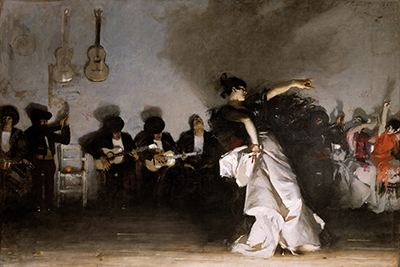
In the 1880s, Sargent was already moving among different kinds of painting: formal portraits, family pictures, Spanish performance scenes, garden works, and images of creative friends. El Jaleo had shown how he could make performance into large-scale painting. Ellen Terry as Lady Macbeth does something related but more personal. It is not an anonymous performance scene. It is a named actor transformed by a named role.
The work also anticipates later Sargent portrait questions. How does clothing create identity? How does a public figure control or lose control of appearance? How does a painted pose turn a living person into an icon? These questions run through his best portraits. Terry's painting answers them with unusual clarity because theatre makes the act of transformation visible.
The portrait is therefore central to Sargent's art, not a decorative eccentricity. It brings together many of his strongest gifts: scale, costume, hands, pose, surface, celebrity, and the tension between person and role. It also shows why his portraits remain modern. They understand that identity is performed under pressure, and that being seen can enlarge a person into something both powerful and unstable.
Reception, Memory And The Surviving Costume
Terry later described Sargent's portrait as the sensation of the year. The phrase is often repeated because it captures the way the painting joined theatre gossip, artistic admiration, costume fascination, and celebrity. It was not only a studio work admired by painters. It belonged to a wider public appetite for the Lyceum, for Shakespearean acting, and for the visual drama of Terry's Lady Macbeth.
The portrait and the dress strengthened one another. The costume had already made an impact on stage, where light, movement, and Terry's hair helped create its effect. Sargent's painting gave that effect a fixed and portable form. Viewers who had not seen the Lyceum performance could still encounter its visual legend through the painting. Viewers who had seen Terry on stage could return to the image as a concentrated memory of what had startled them.
The National Trust's costume record makes clear that the dress itself carried meaning beyond the painting. It was conceived as part of Lady Macbeth's character, not as generic splendour. Its green shimmer, beetle-wing cases, cloak, jewelry, and medievalizing design helped shape the audience's understanding of the role before Terry spoke. The costume made ambition visible through surface. [4], [5]
That material survival also changes how one reads Sargent. In many portraits, a famous dress or studio prop is known only through the painted result. Here, the costume's continued presence at Smallhythe Place lets the viewer test the relation between textile and paint. Sargent did not copy the dress mechanically; he made its stage power into pictorial power. The beetle wings, which moved and flashed under performance light, become in oil a field of suggested shimmer.
The conservation attention given to the dress also reminds us that theatre objects are vulnerable. A painted canvas can enter a museum and be treated as a stable artwork. A stage costume is made for bodies, sweat, movement, alteration, travel, and reuse. Terry's dress survived because it became more than costume. It became a relic of performance, a record of design, and a companion to one of Sargent's most memorable portraits.
The painting's afterlife therefore depends on a triangle: Terry's performance, Sargent's canvas, and the surviving dress. Each preserves something the others cannot. The performance gave the first shock. The painting gave the image monumental form. The dress preserves the material intelligence of Victorian stage design. Together they keep Lady Macbeth visible as art, theatre, and object.
Related Works And Where To Go Next
The closest Sargent comparison is El Jaleo, another major image of performance. El Jaleo turns music and dance into a broad stage of movement, while Ellen Terry as Lady Macbeth concentrates theatrical power into one body. Both works show Sargent using still paint to suggest live performance.
Portrait of Madame X is the strongest comparison for public image and risk. Gautreau and Terry were very different sitters, but both portraits show women whose appearances had public force before Sargent painted them. In one case, fashionable self-presentation becomes scandal. In the other, theatrical costume becomes iconic role.
The portraits hub is useful for seeing Terry among Sargent's actors, artists, friends, society women, public figures, and creative sitters. The paintings hub places the work among his broader oil practice, where portraiture, performance, travel, garden light, and war painting overlap. The style and technique essay helps explain why costume, hands, and staging matter so much in Sargent.
Terry's portrait also belongs beside later actor portraits such as Ada Rehan. Sargent's theatre images remind viewers that acting was one of the modern arts of visibility. The actor's body, costume, and role offered Sargent an ideal subject because they made public identity openly constructed.
Frequently Asked Questions
The painting shows Dame Ellen Terry, one of the most famous actors of the Victorian stage, in the role of Lady Macbeth from Henry Irving's 1888 Lyceum Theatre production of Shakespeare's Macbeth.
Sargent painted the Tate portrait in 1889, after seeing Terry perform in Macbeth at the Lyceum Theatre. The production opened on 29 December 1888. [1], [2]
The 1889 original is in Tate, London, object N02053. A related 1906 replica by Sargent is in the National Portrait Gallery, London, as NPG 2273. [1], [2]
No. The National Portrait Gallery work is a 1906 replica based on Sargent's earlier Lady Macbeth design. The Tate work is the 1889 oil portrait of Terry standing alone in costume and lifting the crown. [1], [2]
The beetle-wing dress was designed by Alice Laura Comyns-Carr and made by Adaline Cort Nettleship for Terry's Lady Macbeth. Its green iridescent beetle-wing cases shimmered under stage lighting and suggested scales or soft armor. The surviving costume is now one of the most famous theatrical garments associated with Victorian Shakespeare.
The crowning pose was Sargent's invention for the painting, not a literal staged moment from Irving's production. That invention lets the image express Lady Macbeth's ambition in one commanding gesture.
It shows Sargent turning portraiture into theatre. The work connects his interest in costume, public identity, performance, and painterly surface, and it belongs among his most powerful images of a sitter becoming a role.
Discussion
Sargent's Ellen Terry as Lady Macbeth asks whether a portrait can show a person, a performance, and a public fantasy at once. Terry appears as herself only by becoming someone else.
Reader Insights
What is the first detail that shapes your reading of Ellen Terry as Lady Macbeth by John Singer Sargent: pose, setting, light, costume, brushwork or historical context?
Which small visual decision begins to matter more after a longer look, and how does it change the mood of the page?
Which comparison helps most: another Sargent portrait, a travel subject, a public commission, or a work by one of his contemporaries?
Join the Conversation
Share a thoughtful comment below about what you notice, question or compare when looking at this page.
References
- Tate, *Ellen Terry as Lady Macbeth* https://www.tate.org.uk/art/artworks/sargent-ellen-terry-as-lady-macbeth-n02053
- Tate shop, *John Singer Sargent: Ellen Terry as Lady Macbeth* https://shop.tate.org.uk/john-singer-sargent-ellen-terry-as-lady-macbeth/johsar002
- Art UK, Antony Sher, *Shakespeare's Macbeth: Antony Sher on art historical depictions* https://artuk.org/discover/stories/shakespeares-macbeth-antony-sher-on-art-historical-depictions
- National Trust Collections, *Beetle Wing Dress for Lady Macbeth* https://www.nationaltrustcollections.org.uk/object/1118839
- National Trust Collections, *Dame Ellen Terry as Lady Macbeth in William Shakespeare's Macbeth* https://www.nationaltrustcollections.org.uk/object/1118214
- Smithsonian National Portrait Gallery, Catalog of American Portraits, *Ellen Terry as Lady Macbeth* https://npg.si.edu/object/npg_N02053
- National Portrait Gallery, London, *Ellen Terry as Lady Macbeth* https://www.npg.org.uk/collections/search/portraitExtended/mw06272/Ellen-Terry-as-Lady-Macbeth