


 by Tom Gurney
Tom Gurney BSc (Hons) is an art history expert with over 20 years experience
Published on June 19, 2020 / Updated on July 19, 2026
Email: tomgurney1@gmail.com / Phone: +44 7429 011000
Portrait of Madame X by John Singer Sargent: Introduction
John Singer Sargent's Portrait of Madame X is one of the most famous portraits of the nineteenth century because it still feels like a social event caught at the moment of becoming dangerous. A woman stands almost life-size against a dark, shallow ground. Her body turns toward the viewer, her head moves into profile, one hand grips a small table, and the black dress seems at once elegant, severe and unstable. The portrait is beautiful, but it is not soothing. It makes glamour look tense.
The sitter was Virginie Amelie Avegno Gautreau, the Louisiana-born wife of a French banker and a celebrated figure in Paris society. Sargent painted her in 1883-84 and submitted the portrait to the Paris Salon of 1884. He hoped the picture would strengthen his reputation in Paris. Instead, it provoked ridicule and discomfort, especially because the original version showed the right strap of Gautreau's gown slipping from her shoulder [1], [2].
That scandal matters, but it is not the whole meaning of the painting. Madame X is also a study of self-fashioning, celebrity, technical revision, painterly ambition and the social risks of being seen. Sargent did not simply record a fashionable woman. He transformed her into a monumental image of display. That transformation made the portrait unforgettable, and it also made it perilous.
At a Glance
- ArtistJohn Singer Sargent [3]
- TitleMadame X (Virginie Amelie Avegno Gautreau), often called Portrait of Madame X [3]
- Date1883-84 [3]
- MediumOil on canvas [3]
- Dimensions82 1/8 x 43 1/4 in. (208.6 x 109.9 cm) [3]
- SitterVirginie Amelie Avegno Gautreau, later Madame Pierre Gautreau [3]
- First shownParis Salon, 1884 [3]
- Current collectionThe Metropolitan Museum of Art, New York, Arthur Hoppock Hearn Fund, 1916, object 16.53 [3], [2]
- DisplayThe Met Fifth Avenue, American Wing, Gallery 771, as checked on the Met object record [3], [2]
- Image statusThe Met marks the main work Public Domain and provides an Open Access image [1]
Contents
- Introduction
- Annotated Details
- Who Was Madame X?
- Sargent In Paris
- Composition And Pose
- Skin, Costume And Self-Fashioning
- Studies And Working Process
- The 1884 Salon Reception
- The Strap And The Technical Evidence
- Sargent After The Scandal
- How Madame X Came To The Met
- Why The Painting Still Feels Modern
- How To Look At Madame X
- Related Works And Where To Go Next
Annotated Details from Portrait of Madame X
The numbered details trace how Sargent builds the portrait's poised silhouette from profile, neckline and hands to the dark satin gown and curved table.
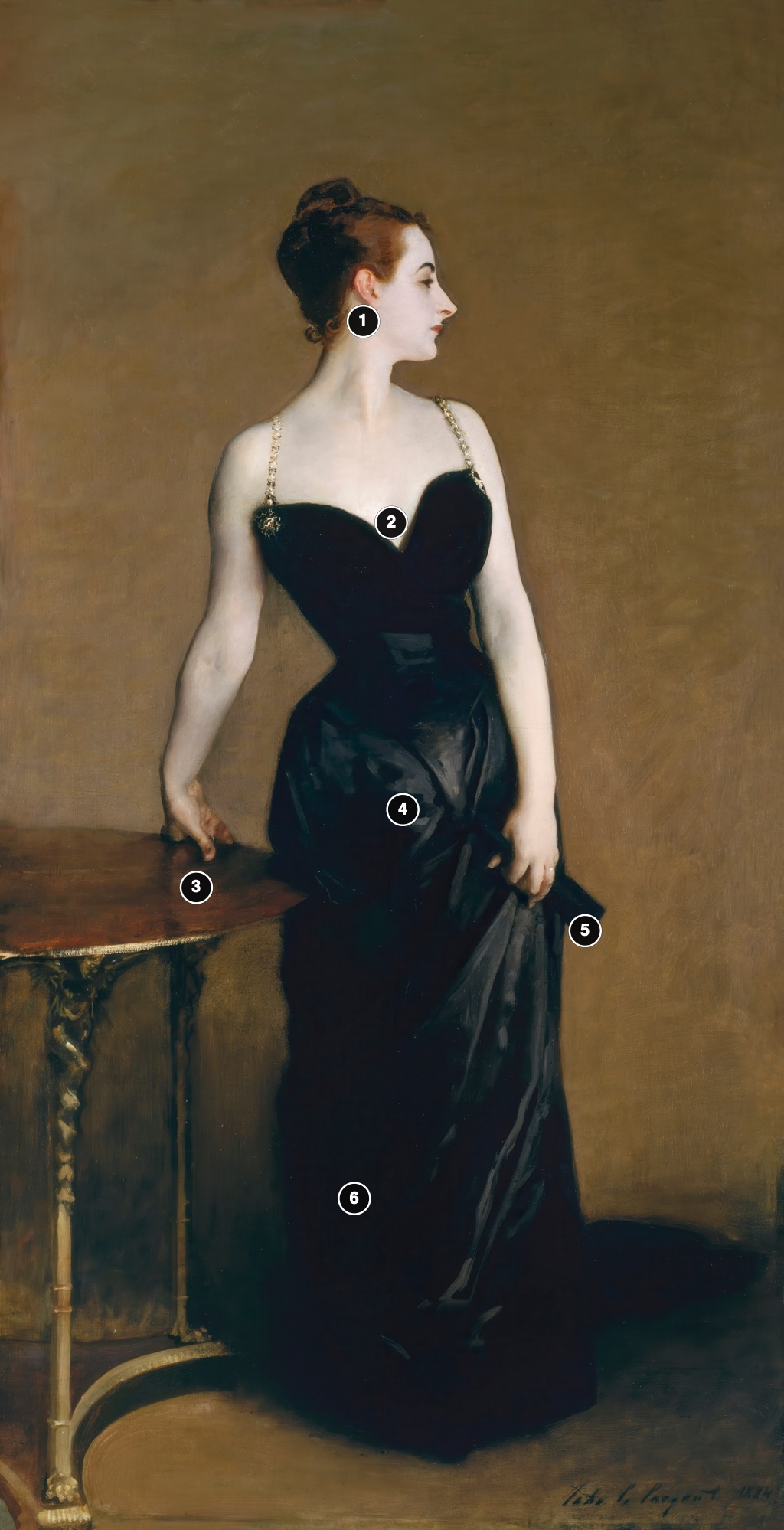
Details from PORTRAIT OF MADAME X
Close looking reveals how the pale figure, taut pose, sparse setting and shifting reflections across the black dress create the portrait's striking presence.
Profile, hair and tiara
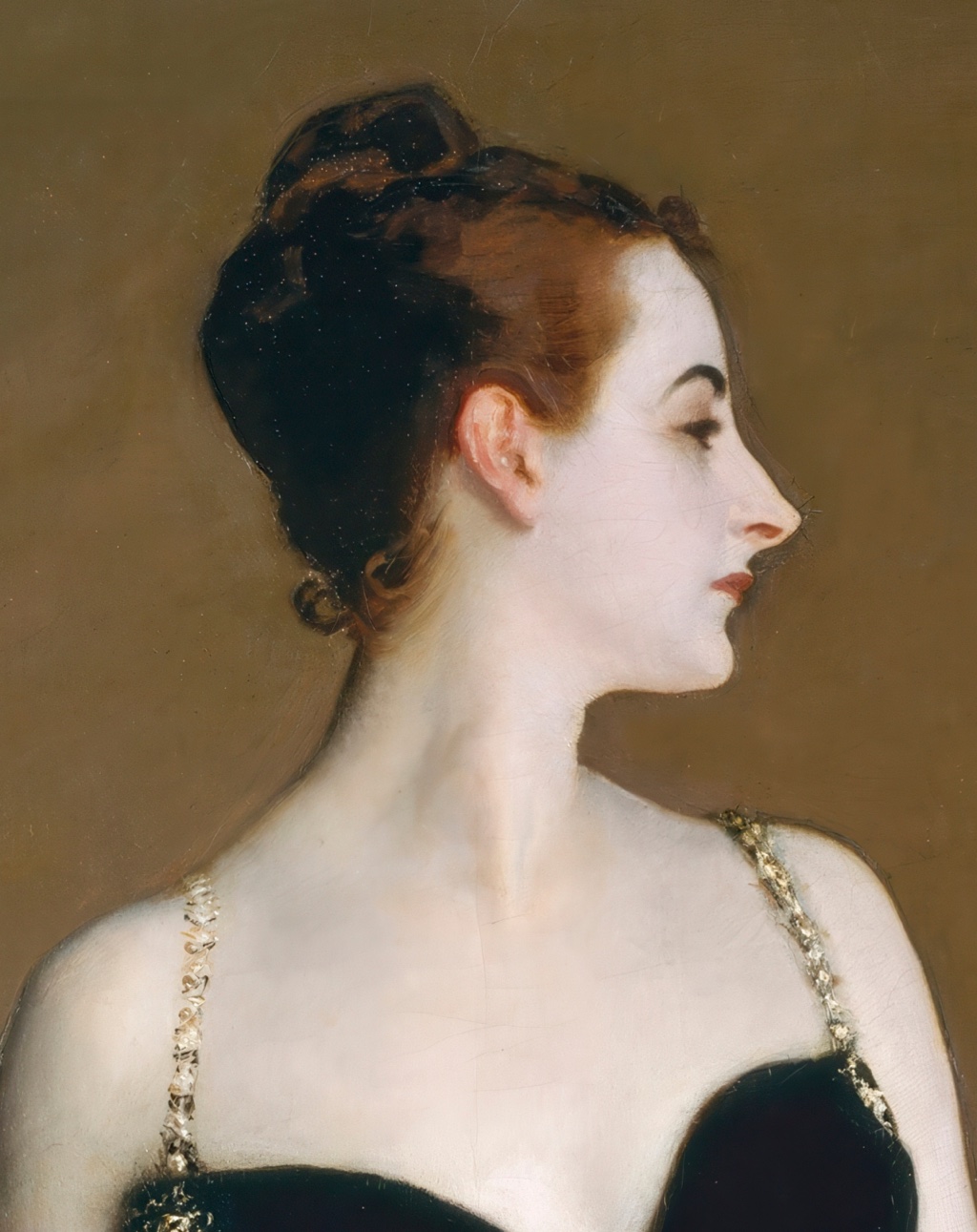
The sharply turned profile is set against a broad brown field, while the coiled hair and small tiara concentrate fine dark accents behind the pale face.
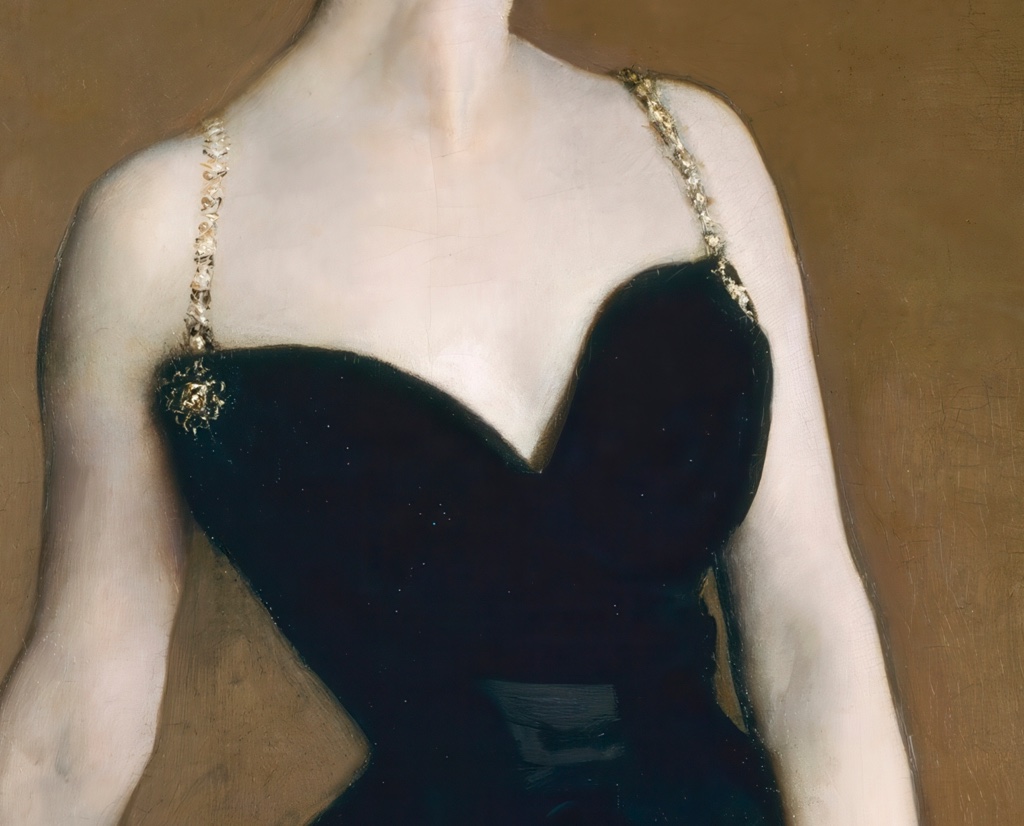
Jeweled straps and neckline
The jeweled straps rise from the deep heart-shaped neckline, their small bright links marking the transition between pale skin and the nearly black bodice.
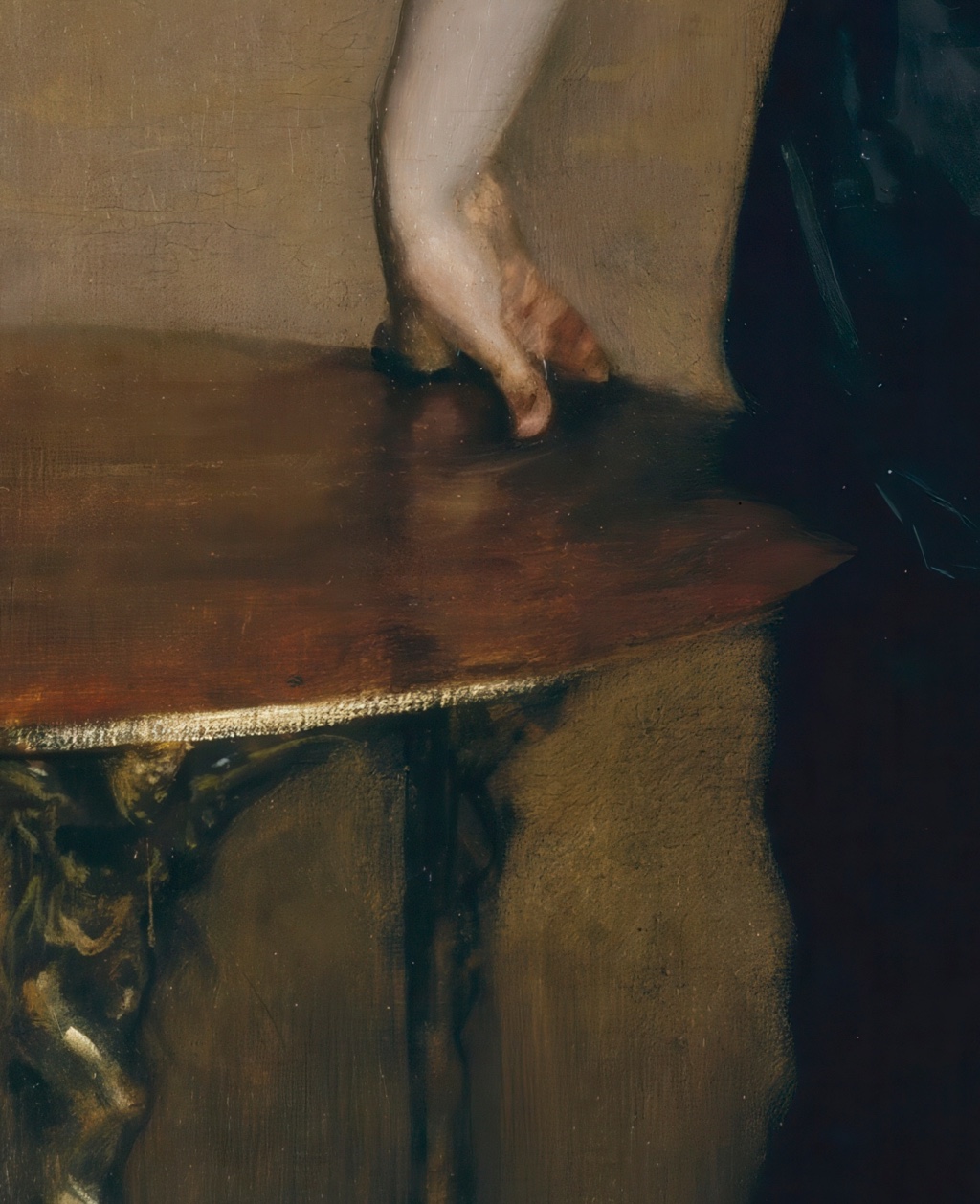
Right hand on the table
Her right hand bends firmly against the table's edge, turning the extended arm into a tense diagonal and anchoring the pose to the sparse setting.
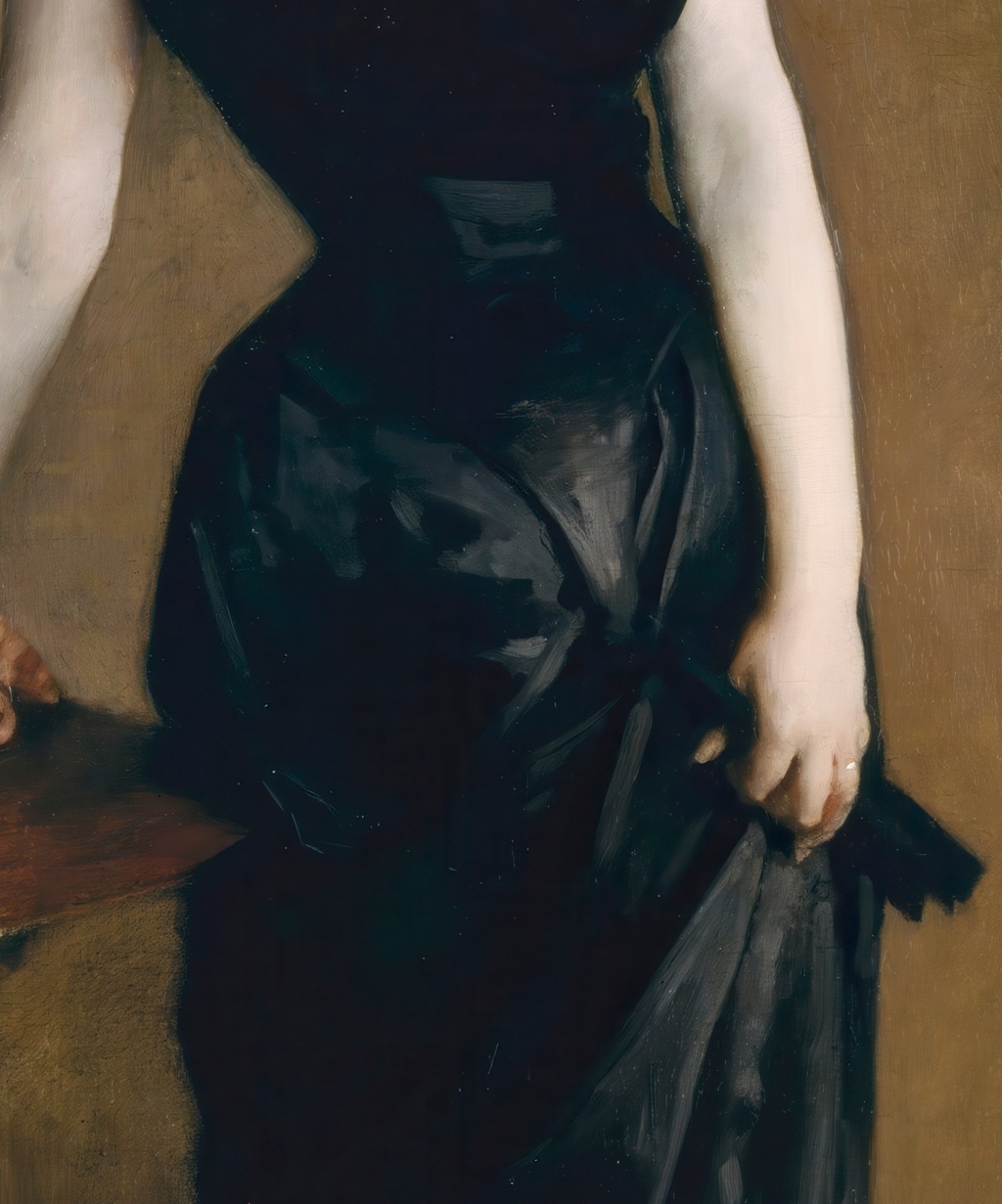
Cinched waist and black satin
The tightly narrowed waist gives way to broad blue-black and grey strokes, which make the satin skirt read through reflected light rather than outline alone.
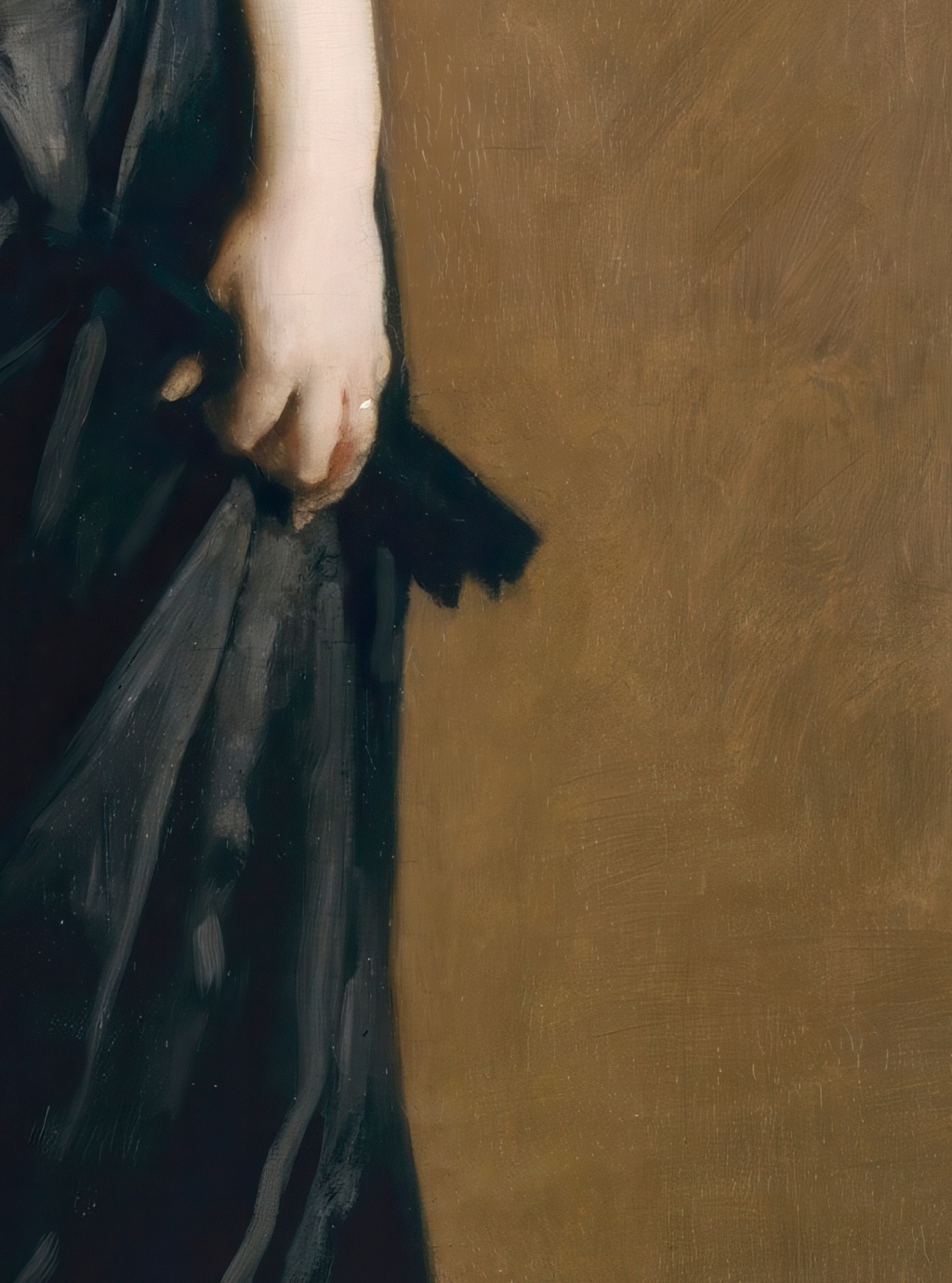
Fan, left hand and wedding ring
The left hand gathers the dress beside the folded fan; a small glint at the ring finger punctuates the meeting of pale skin and dark fabric.
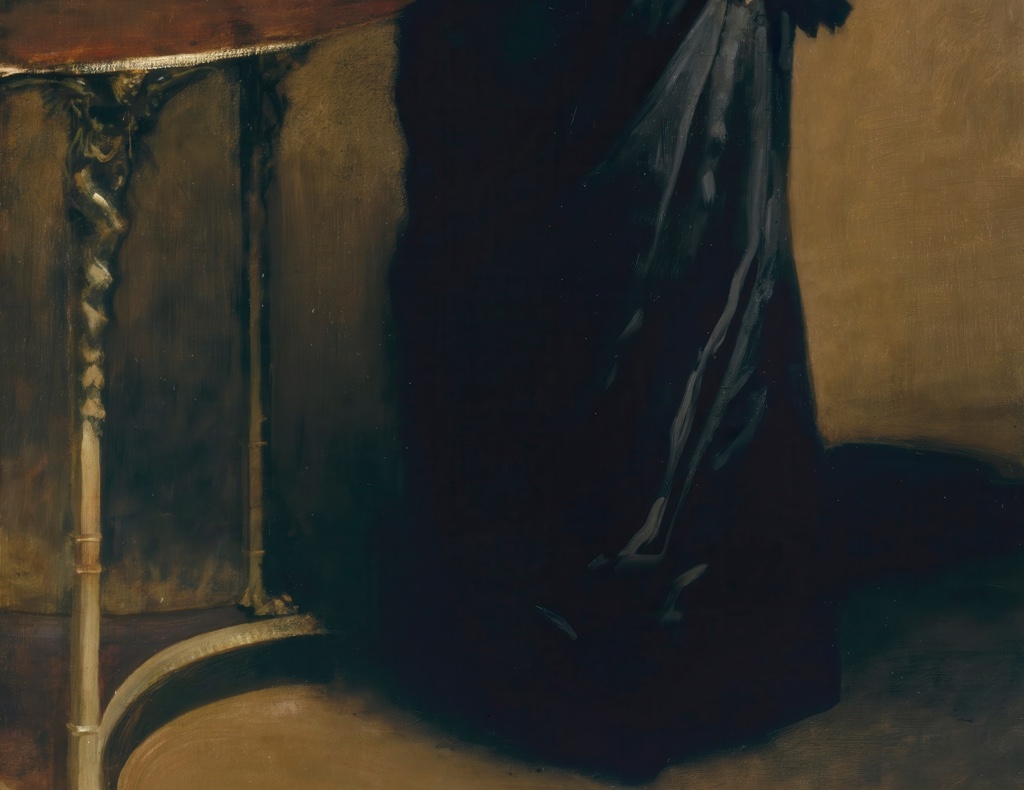
Table, gown and sweeping train
The table's curved top and slender support counter the descending mass of the gown, whose train spreads across the floor in long, subdued folds.
Who Was Madame X?
Virginie Amelie Avegno Gautreau was born in Louisiana in 1859 and became known in Paris as the wife of the banker Pierre Gautreau. By the early 1880s she was not famous for political power, royal rank or artistic profession. She was famous for appearance. Her beauty, clothes, cosmetics and public bearing made her a recognizable figure in fashionable Paris [2].
That distinction is central to the painting. Sargent did not choose a sitter whose importance was fixed by office or inherited title. He chose someone whose prominence was made through visibility. Gautreau belonged to a world in which beauty could act as social capital and in which a person's public image could become a kind of performance. Her profile, pale skin, dark dress and crescent hair ornament were not incidental details. They were part of how she became legible to Paris society.
The Met's audio and essays emphasize Gautreau's cultivated appearance: her striking skin tone, couture gowns, cosmetics, and bold way of presenting herself [1], [2]. Those details help explain why the portrait caused such unease. Sargent was painting a woman who already understood herself as an image. He did not invent her theatricality from nothing; he concentrated it until the social performance became almost too visible.
The portrait's title adds another layer. Sargent eventually asked The Met not to name the sitter directly, because of the old conflict surrounding the picture [1]. The title Madame X therefore both hides and exposes her. It withholds the proper name while making the sitter more mysterious, more iconic and more detached from ordinary biography. The name turns a specific society figure into a symbol of Parisian glamour under pressure.
Sargent In Paris
When Sargent painted Gautreau, he was an ambitious young artist working in Paris, the city where he had trained with Carolus-Duran and where the Salon still mattered intensely. In 1874, at eighteen, he had gone to Paris to become a painter; by the early 1880s he was seeking not only commissions but recognition in a competitive exhibition world [4].
The Salon was not a neutral setting. It was a vast arena of judgment where critics, artists, patrons and ordinary visitors encountered pictures as public events. A portrait shown there did more than preserve likeness. It exposed sitter and painter to talk, comparison and ridicule. For an artist of Sargent's ambition, the Salon offered a chance at professional ascent. It also carried risk.
Madame X was not a normal commissioned portrait. Sargent pursued Gautreau as a subject and worked with her cooperation, hoping that the result would enhance his reputation [1], [2]. That choice matters because it shows his artistic calculation. He saw in Gautreau an opportunity to make a modern grand portrait: large in scale, severe in palette, socially charged, and unlike the more conventional likenesses that filled elite interiors.
The painting belongs to Sargent's decisive Paris decade, the subject of the Met's Sargent and Paris publication. That period produced bold early works and helped form the style that made him famous: strong tonal design, confident surfaces, old-master ambition and fascination with modern social types [4]. Madame X is not an isolated accident within that career. It is the moment when Sargent's Paris ambition became most visible and most costly.
Composition And Pose
The portrait's power begins with its arrangement. Gautreau stands against a dark, nearly empty ground, without a richly described room to soften the encounter. The body is turned toward the viewer, but the face moves into profile. This split creates the painting's basic tension. The sitter is on display, yet she refuses direct exchange. She is present as form, costume and social force, but emotionally withheld.
The table at the right seems modest until one notices how much it does. Gautreau's hand presses against it, giving the pose a visible point of support. Without that contact, the body might feel impossibly balanced. With it, the figure becomes tense rather than calm. The hand stabilizes the composition and exposes strain at the same time.
The dress is equally important. Its black surface frames the pale skin and gives the body a sculptural severity. Sargent does not use a busy pattern or decorative setting to explain the sitter. He reduces the visual field until the figure becomes a stark arrangement of black, flesh, profile, shoulder, arm and table. The result is a portrait that feels closer to a public emblem than to a private likeness.
Scale adds to the effect. At more than six feet tall, the canvas makes Gautreau imposing. She is not a delicate miniature of fashion. She is a commanding vertical presence. The height of the picture turns social appearance into monumentality, while the narrow format intensifies the sense that the body has been pressed into a controlled theatrical space.
The near monochrome palette also strengthens the drama. The dominant darks, the pale flesh, the muted ground and the restricted color range make small variations matter. Skin, dress, hair and background become a sequence of controlled contrasts. Sargent's economy gives the painting its chill. It does not flatter by abundance; it unsettles by reduction.
The pose has often been discussed because of the shoulder strap, but the larger design is just as radical. The head in profile, the turned body, the exposed shoulders and the sideways pressure of the arm make the figure look both statuesque and unstable. The painting's scandal was not caused by one detail alone. The whole composition turns elegance into tension.
The empty space around Gautreau also changes how the figure operates. Sargent does not place her in a room that explains her social position through furniture, books, flowers or family possessions. The background gives almost nothing away. That absence pushes the viewer back toward the body as the chief field of meaning: the profile, the gown, the arm, the shoulder, the crescent ornament, the long vertical descent of black fabric. The sitter's social meaning has to be read from appearance itself.
The table is a particularly strange partner in the composition. It is not large enough to become a full setting, and it is not decorative enough to soften the picture. It works like a prop in a stage scene: just enough support to make the pose possible, just enough presence to reveal the pressure of standing. Gautreau's fingers do not rest casually on it. They stiffen against it. Sargent turns a small contact point into a sign of bodily control.
The profile sharpens that sense of control. Many society portraits build rapport through the sitter's gaze, inviting the viewer into an imagined conversation. Madame X withholds that invitation. Gautreau does not need to look at the viewer to dominate the picture. Her refusal of eye contact makes her seem more distant, but also more commanding. The viewer is allowed to see her, not to meet her.
Sargent also uses asymmetry to keep the figure alive. The composition is severe, but it is not static. The turned head, exposed shoulder, braced hand and tilted arm all pull against one another. The body seems to be holding a pose that cannot relax. That unresolved energy is one reason the portrait does not become a merely elegant design. The form has pressure inside it.
Skin, Costume And Self-Fashioning
Gautreau's appearance was famous before Sargent painted her, and the portrait makes that reputation central. The Met's audio material notes her distinctive profile, cosmetics and signature look [1]. The conservation essay Revealing Madame X discusses Sargent's attention to her pale, lavender-toned skin and the cosmetic practices associated with her appearance [5].
The skin is one of the portrait's most startling features. It is not warm in the conventional way of flattering portrait flesh. It appears cool, pale and almost artificial against the dark dress. That artificiality matters. Sargent was not simply painting the body. He was painting a cultivated surface, a figure shaped by fashion, cosmetics and social theater.
The black dress works with that effect. It exposes the shoulders and neckline while enclosing the body in a severe shape. The gown is seductive, but also armored. It creates a clean silhouette that makes Gautreau seem less like a conversational sitter than like a designed object of attention. The dress announces control, but the history of the strap reveals how easily control could be read as disorder.
The crescent ornament in Gautreau's hair is small, but it has large symbolic force. It appears in the finished portrait and also helps identify her in Sargent's informal drawing Madame Gautreau Peering over the Top of a Piano [1]. The ornament turns the sitter into someone with a repeatable visual signature. It is part of her brand before the word would have been used in this way.
Sargent understood that Gautreau's self-presentation was not a minor accessory to her identity. It was the subject. The painting examines a woman who had already turned appearance into social power. That is why Madame X feels modern. It is a portrait of a person, but also a portrait of fame made through looking.
The portrait also forces a difficult distinction between likeness and persona. A likeness asks whether a painting resembles a sitter. A persona asks how a sitter wishes to be seen, how others already see her, and how the painter intensifies or challenges that image. Gautreau's cosmetics and dress were part of her chosen public language. Sargent did not merely reproduce that language; he made it almost architectural.
That is why the painting can feel both admiring and unsparing. Sargent clearly understood the power of Gautreau's beauty, but he did not make it comfortable. The pale skin does not simply flatter; it startles. The dress does not simply seduce; it hardens. The profile does not simply refine; it distances. Everything that could have made Gautreau conventionally charming becomes, in Sargent's hands, more severe and less easily owned by the viewer.
Fashion in the portrait therefore works as social language. The gown, cosmetics and ornament do not just decorate Gautreau; they create the conditions under which she can be recognized. Sargent makes that language unusually legible. He shows how style can become authority, but also how authority built from style can be attacked as artificial, excessive or improper.
Studies And Working Process
The finished portrait can look brutally decisive, but Sargent's preparation was extensive. The Met's essay Where Is Madame X? states that he created more studies for this portrait than for any other [2]. That fact changes how the painting should be understood. It was not a casual bravura performance. It was the result of repeated tests of pose, profile, gesture and social image.
The Met holds several related studies. Virginie Amelie Avegno Gautreau, Study for "Madame X" is a graphite drawing dated 1883-84, object 31.43.2 [3]. Another study, object 1970.47, also dated 1883-84, includes the note that Sargent made more preparatory studies for Madame X than for any other portrait [6]. These works on paper show Sargent thinking through the pose before the oil painting became the famous Salon object.
Whispers (Virginie Amelie Avegno Gautreau and a Friend), object 50.130.117, captures Gautreau in a more informal register [1]. The Met describes Sargent as a painter who sketched almost incessantly, and this drawing records a candid moment rather than the monumental severity of the final portrait. It helps restore the human and social world behind the icon. Gautreau was not only the hard profile of the finished painting. She was also a moving, observed person in Sargent's circle of looking.
The recently acquired Madame Gautreau Peering over the Top of a Piano adds a different kind of evidence [1]. It is part of a letter to Sargent's friend Albert Millbank and verges on caricature. The small crescent above Gautreau's head identifies her by the same signature ornament seen in the finished work. In the accompanying prose, Sargent jokes that she is driving his ideas away. The drawing reveals frustration, humor and intimacy in the making of a portrait now often treated as cold and remote.
These studies matter because they show how far Sargent traveled between observation and monument. In the drawings, Gautreau can be fleeting, social, informal or almost comic. In the painting, she becomes still, severe and iconic. The distance between those states is the work of portraiture. Sargent selected from life, intensified the selection, and made the sitter more concentrated than ordinary presence.
The studies also show that the most famous feature of the portrait, its almost frozen poise, was not simply discovered at the end. Sargent worked toward it. He tried alternatives and reduced them. The final picture's power comes partly from this narrowing process. Many possible Gautreaus disappear so that one monumental Madame X can remain.
This preparation also helps correct a common misunderstanding of Sargent's virtuosity. His brushwork often looks fast, and his reputation has long depended on apparent ease, but Madame X shows a slower, more anxious kind of invention. The studies reveal a painter circling a problem: how to make a modern society figure into a grand image without making her merely pretty, merely fashionable or merely strange.
The drawings are especially useful because they show the difference between observed life and public form. In Whispers, Gautreau belongs to a social moment shared with another figure. In the piano letter drawing, she appears through humor and irritation. In the studies for the final painting, the profile and pose become increasingly isolated from ordinary behavior. Sargent's process was one of removal as much as addition. He removed anecdote, conversation and setting until the image became almost ritualized.
The piano letter is especially revealing because it punctures the later myth of absolute distance. The final painting can make the relationship between artist and sitter seem cold, but the letter drawing suggests a more lively process of sittings, interruptions and comic exasperation [1]. Sargent was not only constructing an icon. He was dealing with a difficult human encounter, full of fascination and frustration.
The 1884 Salon Reception
When Sargent submitted the portrait to the Paris Salon of 1884, he expected the painting to help establish him. The opposite happened. The Met object record states that the portrait received more ridicule than praise [1]. The Met's essays describe the reaction as severe enough to devastate both sitter and painter [2], [1].
The criticism focused partly on the dress and the fallen strap, but the discomfort went deeper. Viewers objected to Gautreau's haughty bearing, exposed shoulders, dramatic cosmetics and artificiality [1]. The painting did not present beauty as modest or socially contained. It made beauty assertive, constructed and public. The result was not a reassuring portrait of elegance but a confrontation with display itself.
Gautreau and her mother begged Sargent to remove the painting from the exhibition, according to the Met archive essay [1]. Sargent refused, defending the image on the grounds that he had painted her as she appeared. That defense is revealing. He did not admit that the portrait invented scandal from nothing. He argued, instead, that the picture showed the visible truth of Gautreau's cultivated persona.
The painting was shown without naming the sitter, but recognition was immediate enough to matter [1]. In an elite society where reputation traveled through salons, gossip, display and criticism, anonymity could not protect Gautreau. The picture's force came from recognizability and transformation together. Viewers knew who she was, but Sargent had made her into something sharper and more exposed.
For Sargent, the Salon reaction changed the geography of his career. It did not end his life as a painter, but it weakened his prospects in Paris and helped push him toward London [1]. The irony is clear: a portrait intended to secure Paris success made Paris less hospitable. Madame X became a professional wound before it became a museum icon.
The scandal also reveals the moral unease around female visibility in nineteenth-century society. Gautreau was criticized not simply because she was seen, but because she appeared to control the conditions of being seen. Sargent's painting turned that control into a public image. The hostility suggests that the portrait touched a nerve in the culture that produced it.
It is important, though, not to treat Gautreau only as a victim of Sargent's ambition. The Met material emphasizes her complicity in the making of the portrait [1], [2]. She agreed to pose and had already cultivated the kind of appearance that made her famous. The tragedy of the Salon reception lies partly in the fact that artist and sitter seem to have shared an appetite for a bold image, only to discover that the public meaning of that image could not be governed once it entered the exhibition room.
The reaction also exposed the difference between private daring and public display. What could be admired in society, discussed in drawing rooms, or cultivated as a personal style might become intolerable when enlarged, formalized and placed before the Salon crowd. Sargent made Gautreau's self-fashioning official. That act changed its social temperature.
The episode therefore belongs to the history of portraiture as well as gossip. Portraits of recognizable people are never only images. They can act on reputations. They can alter the balance between sitter, artist and audience. In Madame X, Sargent discovered how violent that triangle could become when the image exceeded the comfort of its first viewers.
That triangle is still part of the painting's drama. The sitter wanted to be seen, the painter wanted recognition, and the Salon audience wanted the authority to judge both of them. The portrait became the place where those desires collided. Its fame has lasted because none of the three positions is simple. Gautreau is not only exposed, Sargent is not only triumphant, and the audience is not only prudish. Each is implicated in the spectacle.
The Strap And The Technical Evidence
The fallen strap has become the most famous detail in the story of Madame X. In the Salon version, Gautreau's right strap slipped from her shoulder. After the exhibition, Sargent repainted the strap in the upright position. The painting now seen at The Met is the revised version [1].
The change can make the current painting seem more controlled, but the earlier state still haunts it. Knowing that the strap once slipped changes how viewers read the whole pose. Even with the strap restored, the shoulders, neckline, hand and turned body continue to feel precarious. The alteration solved one visible problem, but it did not remove the portrait's deeper tension.
The Met's conservation essay Revealing Madame X gives the painting an even richer technical history. X-radiography and infrared reflectography revealed many changes as Sargent worked toward the Salon version, including adjustments to the profile, the ear and the arms [5]. These findings show that the portrait's apparent clarity was reached through revision.
The background also changed. The Met essay notes that an earlier studio response described the palette as blue, green, white and black, and that Sargent later changed the background; traces of a different color remain visible at the edge [5]. The current neutral ground therefore conceals a more vivid earlier chromatic life. What looks inevitable was once unsettled.
Scanning X-ray fluorescence has also mapped pigments and elements within the work. The Met's essay discusses cerulean, viridian, earth pigments, bone black, vermilion and red lake, including the surprising use of dark and translucent viridian in the black dress and the hair [5]. This matters because it deepens the painting's color story. The black dress is not merely black, and the pale flesh is not merely pale. The surface is built from complicated choices that the eye experiences as severity.
Technical research therefore changes the mythology of Madame X. The famous portrait is not only a scandalous image; it is a record of repeated adjustment. Sargent revised pose, color, background and strap. The painting became iconic not because it was untouched, but because Sargent kept pushing it toward the image he needed.
The technical findings also make the finished severity more impressive. The painting looks stripped down, but it is not simple. The black dress contains unexpected chromatic life. The background carries a history of alteration. The flesh depends on subtle pigment decisions rather than blunt whiteness. Sargent achieved visual reduction through complex means.
This matters for interpretation because the scandal can make the picture seem like a story of social accident: a strap falls, critics react, careers change. The conservation evidence restores the artist's labor. Madame X was not merely unlucky. It was intensely made. Its danger came from the precision with which Sargent built it.
The color research also helps explain why reproductions can flatten the picture. A small image may reduce the work to pale skin and black dress, but the actual painting depends on hidden variety: green in the darks, red in selected flesh passages, and changed color beneath the visible surface [5]. Sargent's restraint was not a lack of color. It was the control of color until it served the portrait's cool theatrical force.
Sargent After The Scandal
After the Salon, Sargent kept the painting rather than sending it into another owner's collection. Since it had not been commissioned, he retained it and displayed it in his studio [2], [1]. That fact is important. The painting had caused pain, but Sargent did not abandon it. He remained proud of it.
The studio photograph by Adolphe Giraudon, now in The Met's collection, shows Sargent in his Paris studio with Madame X prominently displayed [7]. The photograph shows the painting after the strap was corrected and places it within an interior designed to communicate cosmopolitan taste. Sargent appears not as an artist hiding a failure, but as one who continues to stage the painting as part of his artistic identity.
The studio setting also reveals the role of persona. Sargent surrounded himself with art, textiles, objects and references that presented him as worldly, cultivated and stylish [7]. In that setting, Madame X becomes more than a single portrait. It becomes evidence of the kind of painter Sargent wanted to be: bold, sophisticated, international and aware of the theatrical power of display.
Yet the painting remained difficult to show. According to the Met archive essay, Sargent did not exhibit it publicly for more than twenty years after the Salon [1]. Its reputation had to cool before it could become desirable again. By the late 1890s and early twentieth century, Sargent's career had recovered, and the portrait's notoriety began to work differently. What had been damaging could become compelling.
In 1905 Sargent began showing the portrait again, first at the Carfax Gallery in London and later in exhibitions in London, Berlin and Rome [1]. This second life is crucial. The painting did not pass directly from scandal to museum masterpiece. It moved through decades of retention, reappearance and changing public appetite.
By the time the portrait reappeared, Sargent himself had changed. He had become one of the most sought-after portrait painters in Britain and America, with a reputation strong enough to alter how the earlier picture was received. The scandal did not vanish, but it became part of the painting's aura rather than only a professional injury. Success gave Sargent the power to reclaim the work.
The portrait's delayed reemergence also changed Gautreau's image. In 1884, the painting was tied to immediate social embarrassment. Decades later, it could be seen as a daring work by a major painter and as a sign of a vanished Parisian world. Time turned offense into legend. That transformation is one reason museum visitors now often approach the picture already knowing the story, but also ready to admire the boldness that first caused trouble.
How Madame X Came To The Met
The painting entered The Metropolitan Museum of Art in 1916, more than thirty years after its first Salon display. The Met archive essay gives the essential story through Sargent's correspondence with Edward "Ned" Robinson, the museum's director and Sargent's longtime friend [1].
On 8 January 1916, Sargent wrote from London that his portrait of Gautreau was in America after the Panama-Pacific International Exposition in San Francisco. He felt inclined to let it stay in the United States if a museum wanted it, and he offered it to The Met for 1,000 pounds [1]. The amount was modest for a major work by an artist of his standing, and Robinson quickly recognized the opportunity.
Gautreau had died in 1915, and Sargent wanted the painting placed in an American public collection [1], [5]. This desire matters because Sargent, despite having lived much of his life abroad, considered himself American and wanted what he regarded as one of his most important works to remain in the United States. The painting's relocation to New York was therefore not simply a sale. It was a reputational decision.
Sargent also asked that the museum not call the painting by the sitter's name, because of the old conflict [1], [5]. That request produced the title that helped make the work famous: Madame X. The name is tactful, but also theatrical. It protects the sitter while turning her into an emblem. It keeps the scandal present by refusing to say everything.
The Met acquired the painting through the Arthur Hoppock Hearn Fund in 1916, and the object record now identifies it as 16.53 [1]. Over time, the portrait became one of the museum's most recognizable American Wing works. Its afterlife at The Met completed a remarkable reversal: a painting that once damaged Sargent's Paris hopes became one of the foundations of his legacy in America.
Robinson's role is also important. He was not a distant administrator making a cold purchase. The Met archive essay explains that he had known Sargent since his time at the Museum of Fine Arts, Boston, and that he admired Sargent's work [1]. That relationship helped make the acquisition possible. The painting entered The Met through a mixture of friendship, institutional ambition and the artist's desire to place the work in America.
The purchase also changed the audience permanently. At the Salon, Madame X had been judged within the social world that recognized Gautreau. At The Met, it became part of American art history and museum memory. Viewers no longer needed to belong to Paris society to encounter the image. The painting's meaning widened from scandalous portrait to public cultural landmark. [3], [2]
The title helped that widening. Madame X sounds less like a society portrait and more like a mystery. It invites viewers who know nothing of Gautreau to feel that the painting contains a withheld story. The concealment is partly protective, but it also gives the image unusual staying power. The sitter becomes anonymous enough to seem symbolic and specific enough to remain historically real.
Why The Painting Still Feels Modern
Madame X still feels modern because it understands that identity can be manufactured through appearance. Gautreau's fame depended on how she looked, dressed, moved and was discussed. Sargent's portrait makes that condition visible. It shows a person whose social power is inseparable from self-presentation.
The painting also anticipates modern forms of celebrity. Gautreau was not a performer in the formal theatrical sense, but she inhabited society as a visible role. The Met's Where Is Madame X? essay connects her to the idea of the "professional beauty," a woman who used appearance to gain celebrity and social standing [2]. Sargent's achievement was to make that role monumental.
The portrait's coldness is part of its intelligence. Gautreau does not welcome the viewer. She does not soften herself to be liked. She is displayed, but not surrendered. This creates an unstable power relation. The viewer looks at her, but she seems to withhold the ordinary rewards of portrait looking: intimacy, warmth, psychological access.
That withholding is one reason the painting survives changing taste. A simple scandal picture would lose force once the scandal faded. Madame X remains powerful because it is about the mechanics of looking. Who controls an image? What happens when a portrait intensifies a sitter's chosen persona? When does admiration turn into punishment? These questions still feel alive.
The painting is also modern in its spareness. Sargent strips away much of the furniture of social portraiture. There is no elaborate landscape, family narrative or symbolic clutter. The sitter's body, dress and profile do nearly all the work. The result feels severe enough to stand near later modern images of fashion, celebrity and constructed selfhood.
Modern viewers may also recognize in the portrait a familiar conflict between image-making and judgment. Gautreau's appearance made her famous, but the same visibility made her vulnerable. Sargent's painting magnified the mechanism. The sitter becomes unforgettable because she is so controlled, but that control is exactly what the Salon audience punished.
This is why the painting has not settled into a single meaning. It can be read as admiration, exposure, ambition, cruelty, sympathy, social analysis or technical triumph. Its greatness lies partly in refusing to choose only one. Sargent made a portrait strong enough to preserve contradiction.
The painting also asks viewers to consider the ethics of brilliance. Sargent's image is astonishingly effective, but effectiveness is not innocent. The portrait helped injure Gautreau's standing, even as it later secured her immortality in art. That double result is uncomfortable and important. Madame X shows that a great portrait can preserve a sitter and wound her at the same time.
How To Look At Madame X
A useful way to begin is with the profile. Gautreau's face is turned away, so the viewer cannot possess her through eye contact. The profile turns her into a silhouette, almost a coin, cameo or classical figure. But the body faces more openly, creating a contradiction between display and refusal.
Then look at the shoulders and neckline. The exposed skin is a field of pale light in the painting, but it is also the area where scandal gathered. In the current version, the strap sits properly, yet the viewer senses how little it would take for order to collapse. The painting makes decorum look fragile.
The hand on the table deserves sustained attention. It is not a relaxed hand. It presses, braces and steadies. That small gesture gives the figure psychological tension without turning the face toward the viewer. Sargent makes the body speak where the face withholds.
The dress should be read as structure. Its blackness is not an empty dark shape. Technical research shows that Sargent's blacks and darks involve subtle pigments and complex choices [5]. Visually, the dress creates a severe column that transforms fashion into architecture. The garment both reveals and contains the sitter.
The background is also active, though it appears spare. Its subdued neutrality makes the figure feel isolated, but the Met's technical essay shows that the ground passed through changes [5]. The calm background now visible is the result of decision, not absence.
Finally, imagine the original Salon condition. The painting now hangs as a museum masterpiece, but it first appeared in a charged exhibition space among viewers who recognized the sitter and judged the painter's daring. The museum setting can make the portrait seem inevitable. Its first audience experienced it as a rupture.
Then return to the title. Madame X is not the name Sargent first needed in order to paint her, but the name that allowed the painting to live afterward. It makes the sitter anonymous and famous at the same time. That contradiction belongs to the whole work. Gautreau is both a person and an icon, both exposed and concealed, both historical and strangely present.
The best viewing of the painting holds all of these states together. Look at it as a portrait of Virginie Gautreau. Look at it as a risky Salon picture. Look at it as a technical object full of changes. Look at it as a museum icon. The painting becomes larger, not smaller, when its glamour is allowed to remain complicated.
It also helps to resist the temptation to treat the scandal as a quaint old story. The portrait still speaks because the basic problem has not disappeared. People continue to shape themselves for visibility, and audiences continue to punish the very self-fashioning they consume. Sargent gave that pattern a nineteenth-century form, but the tension is not confined to the nineteenth century.
Related Works And Where To Go Next
Whispers (Virginie Amelie Avegno Gautreau and a Friend) is the strongest supporting work for seeing Gautreau outside the final icon [1]. It is a rapid drawing, marked Public Domain by The Met, and it shows Sargent's ability to catch an informal social moment with very few lines.
The graphite studies for Madame X are essential for understanding the painting's preparation, even when their images are not presented by The Met as reusable assets [3], [6]. They show that Sargent's final austerity came through experiment rather than instant certainty.
The studio photograph by Adolphe Giraudon helps place the painting in Sargent's self-presentation after the scandal [7]. It shows Madame X not as a banished embarrassment but as a prominent work within the artist's Paris studio.
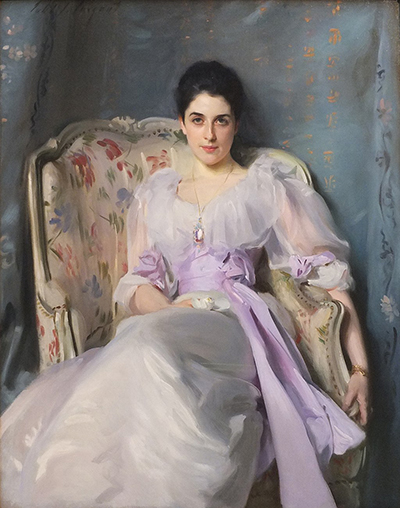
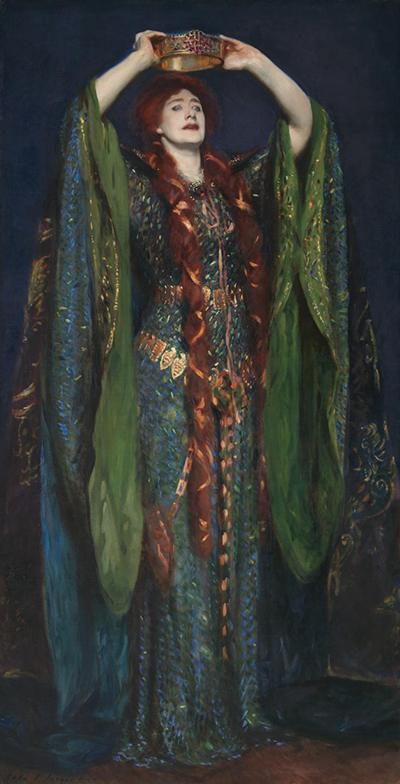
Within Sargent's wider career, the painting connects naturally to his biography, his portrait practice, and his style and technique. It also creates a useful contrast with later portraits such as Lady Agnew of Lochnaw and Ellen Terry as Lady Macbeth, where costume, role and social presence operate in different ways. Madame X remains the sharpest case because it shows what can happen when a portrait becomes too forceful for the society that produced it.
Frequently Asked Questions
Madame X was Virginie Amelie Avegno Gautreau, a Louisiana-born woman who became a celebrated figure in Paris society after marrying the French banker Pierre Gautreau.
The portrait was controversial at the Paris Salon of 1884 because Sargent presented Gautreau with a severe profile, pale cosmetic effect, exposed shoulders and, in the original version, a strap slipping from her right shoulder. The reaction also reflected unease with Gautreau's celebrity and self-fashioning.
Yes. After the Salon, Sargent repainted the right shoulder strap in an upright position. Technical research has also revealed other changes to the profile, ear, arms, background and pigment structure.
The painting is in The Metropolitan Museum of Art in New York. The Met object record lists it as on view at The Met Fifth Avenue in Gallery 771. [3], [2]
No. Sargent undertook the portrait without a formal commission, working with Gautreau's cooperation because he believed the picture could enhance his reputation.
When Sargent sold the work to The Met in 1916, he asked that the museum avoid using Gautreau's name because of the old conflict surrounding the portrait. The title Madame X preserved anonymity while adding mystery. [3], [2]
Discussion
Portrait of Madame X raises a question that still feels urgent: when a portrait makes someone's public image more powerful than ordinary society can tolerate, is the painter revealing the sitter, judging the audience, or doing both at once?
Reader Insights
What is the first detail that shapes your reading of Portrait of Madame X by John Singer Sargent: pose, setting, light, costume, brushwork or historical context?
Which small visual decision begins to matter more after a longer look, and how does it change the mood of the page?
Which comparison helps most: another Sargent portrait, a travel subject, a public commission, or a work by one of his contemporaries?
Join the Conversation
Share a thoughtful comment below about what you notice, question or compare when looking at this page.
References
- Metropolitan Museum of Art, From the Archives: How Madame X Came to The Met https://www.metmuseum.org/perspectives/how-madame-x-came-to-the-met
- Metropolitan Museum of Art, Where Is Madame X? https://www.metmuseum.org/exhibitions/listings/2015/sargent-portraits-of-artists-and-friends/blog/posts/where-is-madame-x
- Metropolitan Museum of Art, Madame X (Virginie Amelie Avegno Gautreau) https://www.metmuseum.org/art/collection/search/12127
- Metropolitan Museum of Art, Sargent and Paris https://www.metmuseum.org/met-publications/sargent-and-paris
- Metropolitan Museum of Art, Revealing Madame X https://www.metmuseum.org/essays/revealing-madame-x
- Metropolitan Museum of Art, Virginia Amelie Avegno Gautreau, Study for "Madame X" https://www.metmuseum.org/art/collection/search/12330
- Metropolitan Museum of Art, John Singer Sargent [1856-1925] in His Studio with the Painting of Madame X https://www.metmuseum.org/art/collection/search/893358