

 by Tom Gurney
Tom Gurney BSc (Hons) is an art history expert with over 20 years experience
Published on June 19, 2020 / Updated on July 19, 2026
Email: tomgurney1@gmail.com / Phone: +44 7429 011000
John Singer Sargent Biography: Introduction
John Singer Sargent lived as if national borders were never quite large enough to contain an artist. He was born in Florence to American parents, trained in Paris, rebuilt his career in London, worked for British and American patrons, returned again and again to Italy and Spain, formed deep ties with Boston, and ended his career with a monumental painting of First World War injury. His life was not a simple journey from one artistic center to another. It was a career made from movement: between countries, media, patrons, languages, exhibition worlds and public roles.
Sargent is often remembered first as the painter of Portrait of Madame X, the Paris Salon picture whose reception changed the direction of his career. That story is central, but it can become too dominant. The fuller biography includes a European childhood, serious Paris training, early subject paintings, American expatriate networks, London portrait success, Boston murals, watercolors made during restless travel, studies and drawings that reveal his working method, and the late public gravity of Gassed. He was not only the painter of fashionable society. He was a painter trying repeatedly to escape the limits of that success.
The Museum of Fine Arts Boston, which holds major Sargent works and archive material, presents him as an artist whose formation and career were fundamentally international [1]. That is the starting point. Sargent's life cannot be reduced to American, British, French or Italian identity alone. It belongs to the transatlantic art world of the late nineteenth and early twentieth centuries.
At a Glance
- Born12 January 1856, Florence [1]
- Died14 April 1925, London [1]
- ParentsFitzWilliam Sargent and Mary Newbold Singer Sargent [1]
- NationalityAmerican, born abroad and active across Europe and the United States [1]
- TrainingParis, especially with Carolus-Duran [1]
- Known forportraits, society paintings, watercolors, murals, drawings, prints, travel subjects and war art [1]
- Major turning pointthe 1884 Paris Salon reception of Portrait of Madame X [1]
- Major placesFlorence, Paris, London, Boston, Venice, Spain and other travel sites [1]
- Key worksPortrait of Madame X, The Daughters of Edward Darley Boit, El Jaleo, Carnation, Lily, Lily, Rose, Lady Agnew of Lochnaw, Ellen Terry as Lady Macbeth, Claude Monet Painting by the Edge of a Wood, Theodore Roosevelt and Gassed [1]
Contents
- Introduction
- Family, Florence And An Expatriate Childhood
- Early Artistic Formation
- Paris And Carolus-Duran
- Early Success And Ambition
- Portrait Of Madame X And The Paris Turning Point
- London And The Mature Portrait Career
- Boston And The American Institutional World
- Travel, Watercolors And The Need For Freedom
- Drawings, Prints And Working Method
- Public Commissions And Late Ambition
- War Artist And Gassed
- Final Years
- Reputation And Reassessment
- Why His Life Matters
Family, Florence And An Expatriate Childhood
Sargent's biography begins before his birth, with his parents' decision to live abroad. FitzWilliam Sargent came from a New England family, and Mary Newbold Singer Sargent belonged to a family with cultural and social ambition. Their life in Europe shaped their son's formation in ways that no later training could erase. John Singer Sargent was born in Florence, a city saturated with Renaissance art and with the social world of foreign residents who treated Europe as home, school and museum.
The Sargent family did not settle into one fixed pattern of ordinary schooling. They moved often, and the children's education was uneven by conventional standards but rich in exposure. Sargent grew up around languages, music, drawing, churches, galleries, old-master paintings and European cities. This was not professional art training yet, but it formed the kind of eye that could later move quickly among visual traditions.
His mother encouraged artistic interests, and travel itself became a kind of education. The young Sargent saw art not as a distant subject in books but as part of daily movement through cities and collections. Italy gave him early access to painting, sculpture and architecture. France gave him the language of modern artistic ambition. Spain would later give him old-master models and performance subjects. England and America would give him patrons and institutions.
This childhood also made Sargent socially adaptable. He learned early how to move among people who belonged to different countries and classes. That mattered for portraiture. A portraitist must understand not only faces but manners, expectations, discomforts and social performance. Sargent's later fluency with sitters did not appear from nowhere. It grew from a life spent watching people adjust themselves across settings.
The cost of this upbringing was also real. Sargent did not grow from one stable national school or hometown culture. He became, instead, an artist of in-between spaces. That in-between identity gave him freedom, but it also means his biography has to be told through networks rather than through one place.
The family's mobility also explains why Sargent's art can feel so sure of social codes without being narrowly provincial. He learned to observe rooms before he needed to command them. Hotels, rented lodgings, artists' circles, expatriate visits, museum interiors and seasonal travel all taught him that identity was something people carried, adjusted and performed. Later, when he painted a sitter in evening dress, theatrical costume, military uniform or presidential formality, he was drawing on a lifetime of watching how people become themselves before an audience.
This background helps clarify the difference between Sargent and many artists trained through a more settled national story. He was American by citizenship and family, but Europe was not merely a place he visited after becoming an artist. It was the ground of his childhood. That made his eventual American importance more complex. He could speak to American patrons who wanted European refinement, to European patrons who wanted modern likeness, and to museums that later wanted to claim him as part of American art.
Early Artistic Formation
Before Sargent became a Paris-trained painter, he was a young artist learning how to look. Drawing came early. So did music and a broad cultural education shaped by his family's travels. His early exposure to European art gave him a store of visual memory that later training could organize.
Florence, Rome and other Italian settings mattered because they made the old masters physically available. For a young artist, this meant more than admiration. It meant learning scale, composition, gesture, costume, religious drama, portrait authority and the relationship between figure and space. Sargent did not become an Italianate history painter, but Italian art gave him a foundation in what ambitious painting could be.
His early development also shows how different artistic education could be for a mobile expatriate family. He did not pass neatly through a single academy from childhood onward. Instead, he gathered skills through travel, private instruction, museum looking and eventually formal training. That mixture made him unusually prepared for cosmopolitan portraiture. He could speak to elite American families abroad, European patrons, artists, musicians and theatrical figures with equal confidence.
By adolescence, it was clear that Sargent's talent required serious direction. Paris offered the professional world he needed. The city was still one of the most important centers for artistic training and exhibition, and the Salon remained a crucial public arena. To enter Paris was to enter competition.
The move toward professional training also changed the meaning of his gift. A gifted child can impress a family circle; a professional painter must survive comparison with other ambitious artists. Sargent's early education had given him fluency, but Paris demanded order. It required him to convert a mobile, museum-fed eye into repeatable method. That conversion is one reason his mature work can look effortless while remaining architecturally strong.
It is also important that Sargent's formation was not limited to portrait likeness. He studied figure composition, costume, old-master scale, landscape, interiors and the theatre of pose. Even when he later made portraits for paying sitters, the pictures often carry ambitions drawn from larger traditions. The sitter becomes a figure in space, a problem of design, a social performance and a painterly event at once.
Paris And Carolus-Duran
Sargent's decisive training came in Paris with Carolus-Duran. This connection shaped his technique and public ambitions. Carolus-Duran encouraged a direct method of painting, building forms through strong tonal relationships rather than laboriously filling in every detail from outline to finish. The effect, in Sargent's mature work, could look spontaneous. But the spontaneity depended on discipline: the ability to see large relations quickly and place the decisive marks where they mattered.
Paris also brought Sargent into a world where technique and reputation were tested publicly. The Salon was not simply a place to display pictures. It was a court of public judgment, critical response and professional possibility. An artist could be made there, damaged there or forced to change course. Sargent learned early that painting was not only a private act of making; it was a public act of exposure.
Spanish painting was another powerful force in these years. Sargent studied Diego Velazquez and absorbed lessons in tonal breadth, painterly economy and aristocratic presence. The National Gallery of Art's material on Sargent and Spain helps show that Spanish art and culture remained important throughout his career, not only as early influence but as recurring subject and model [2].
Velazquez offered Sargent a way to think about grandeur without stiffness. A portrait could be loose and authoritative, spare and sumptuous, formal and alive. That lesson appears throughout Sargent's mature portraiture. Sitters stand or sit in public roles, but the paint itself keeps them from becoming inert.
Paris also placed Sargent among artists who were rethinking modern painting. He was close enough to Impressionism to understand outdoor light and modern subjects, but he did not become simply an Impressionist. His ambitions remained tied to portraiture, exhibition success and the broad European tradition of figure painting. This mixture gave him flexibility, but it also made him hard to categorize.
Carolus-Duran's teaching suited Sargent because it did not ask him to choose between bravura and structure. The method depended on building the large masses first: head, body, costume, background, value and silhouette. Detail came later, and only where it earned its place. This is why a Sargent portrait can feel both rapid and controlled. The eye reads a sleeve, a chair or a dress as luxurious, but the picture is often held together by severe decisions about dark and light. [3], [4]
Paris also trained Sargent in the psychology of exhibition. A Salon painting had to survive a crowded room, critical notice and comparison with rival pictures. It needed immediate force from a distance and enough complexity to hold attention nearby. Sargent's best early works understand that double demand. They announce themselves through pose, scale and tonal drama, then reveal subtler unease through spacing, gesture and expression.
The Spanish current in his art should be understood in this context. Velazquez was not a decorative influence for Sargent, but a model for how painting could make status, flesh, fabric and air feel inseparable. Spanish art allowed him to use darkness with confidence and to let an apparently simple arrangement carry social authority. That lesson would remain with him long after his student years.
Early Success And Ambition
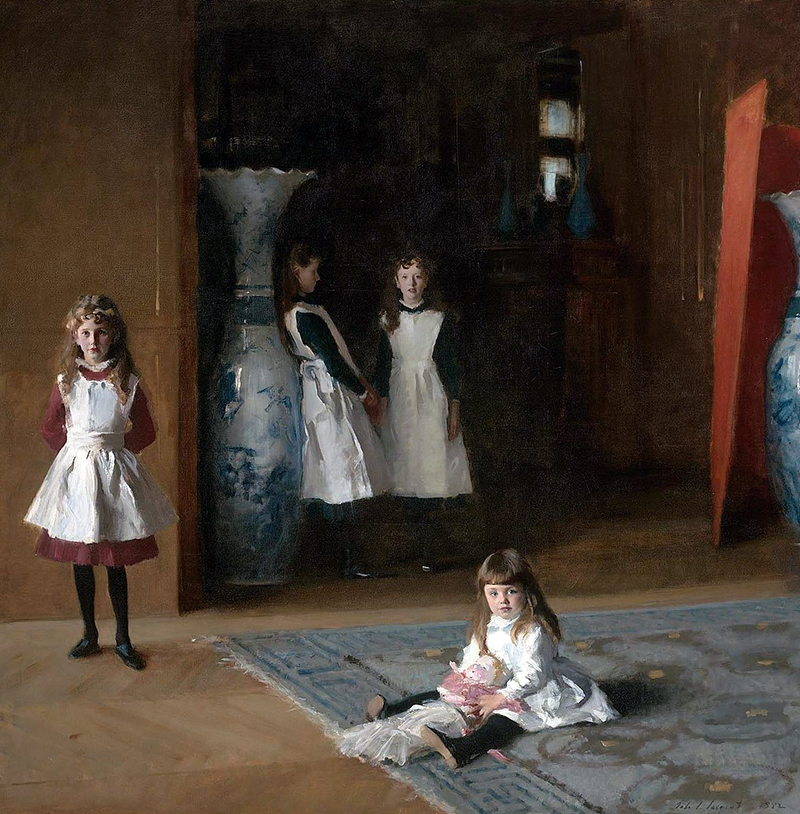
Before Portrait of Madame X, Sargent was already a serious and ambitious painter. The Daughters of Edward Darley Boit, painted in 1882, shows that he could turn a portrait commission into a major artistic problem. The painting depicts the four daughters of Edward Darley Boit in a large interior, but it refuses the usual warmth of a family group. The children are separated by space, shadow and scale; the tall vases in the room become almost as commanding as the figures [5].
That painting reveals Sargent's early maturity. He was not merely flattering patrons or recording likenesses. He was testing how figures inhabit space and how a portrait can become psychologically and compositionally strange. MFA scholarship around the painting, including Sargent's Daughters, shows how much interpretive weight the work has carried [5].
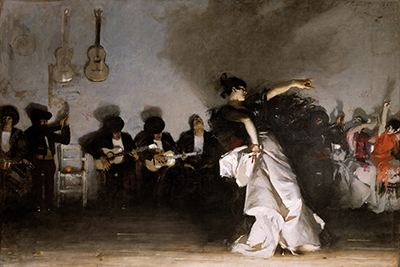
El Jaleo, also from 1882, shows a different kind of ambition. The painting's Spanish dance subject, long format and dramatic lighting connect Sargent to performance and Spanish visual culture [6], [7]. It is not a society portrait, but it uses a portraitist's understanding of bodies, pose and stage presence. The dancer becomes movement made visible.
These early works matter because they prevent the biography from turning into a simple before-and-after story around Madame X. Sargent was already building a large artistic identity before the scandal. He was capable of family portraiture, performance painting, old-master dialogue and modern social observation. The 1884 crisis changed his career, but it did not create his talent.
The early 1880s show an artist interested in risk. The Daughters of Edward Darley Boit is unsettling because it refuses the easy pleasures of a childhood group portrait. El Jaleo is bold because it turns dance into a long, shadowed stage where sound and movement seem to press against the edges of the canvas. Both works use spectacle, but neither is merely showy. They ask how the viewer looks at bodies that are partly revealed and partly withheld.
That ambition helps explain why Sargent pursued Madame Gautreau as a subject. He was not looking only for another commission. He saw in her a chance to make a Parisian image of style, danger and modern celebrity. The problem was that such an image could not be fully controlled once it entered the Salon. Sargent's early ambition was therefore inseparable from the risks of display.
Portrait Of Madame X And The Paris Turning Point
Portrait of Madame X was the decisive public crisis of Sargent's early career. The sitter was Virginie Amelie Avegno Gautreau, a Paris society figure known for her beauty and distinctive self-presentation. Sargent painted her in a black dress, with pale skin, a strong profile and a pose that made the body both elegant and tense. The painting was shown at the Paris Salon in 1884 [3].
The version first exhibited included a shoulder strap slipping from the sitter's right shoulder. Sargent later repainted the strap in a more conventional position. The revision is important, but the scandal cannot be explained by the strap alone. The deeper problem was that the painting made Gautreau's public image too stark, too exposed and too powerful for its first social setting.
The Metropolitan Museum of Art's essay on the painting's history helps explain how the work became inseparable from its first reception [4]. A portrait that Sargent hoped would establish him became a public liability. It damaged the sitter's reputation and weakened Sargent's position in Paris. The painting was not simply criticized as a work of art; it was treated as a social event gone wrong.
For Sargent, the consequences were professional and geographic. Paris had been his training ground and public stage, but after Madame X he increasingly turned toward London. This shift can look like exile, but it also shows how mobile his career was. He could lose ground in one capital and rebuild in another.
The episode also taught a lasting lesson about portraiture. Sargent's gift was the ability to make social presence vivid. Madame X revealed the danger of that gift. A portrait could become more memorable, and more uncontrollable, than either artist or sitter expected.
The scandal can be misunderstood if it is reduced to prudery alone. Gautreau had cultivated a striking appearance, and Sargent amplified that cultivated self into a picture of almost sculptural severity. The pale skin, dark dress, profile and tense pose created a persona more concentrated than ordinary social viewing allowed. Viewers at the Salon were not simply seeing a woman; they were seeing the social machinery of beauty, display and judgment sharpened into paint.
Sargent's later decision to keep the painting, revise it and eventually place it with the Metropolitan Museum of Art also shows how the meaning of the work changed over time. What once damaged him became one of the pictures most closely tied to his name. The biography therefore includes a reversal: an early failure of reception later became central to his reputation. Few works in his career show so clearly how unstable the life of a portrait can be. [3], [4]
London And The Mature Portrait Career
London became the place where Sargent remade himself. The process was not instantaneous. He had to rebuild trust, attract new patrons and prove that his art could satisfy the demands of British and Anglo-American portrait culture. Over time, he did more than recover. He became one of the dominant portrait painters of the age.
His London and mature portrait career included many kinds of sitters. Aristocratic women, wealthy Americans, artists, actors, children, military figures and political leaders all entered his studio. The variety matters because Sargent's portraiture was not a single formula. He adjusted his language to the role before him.
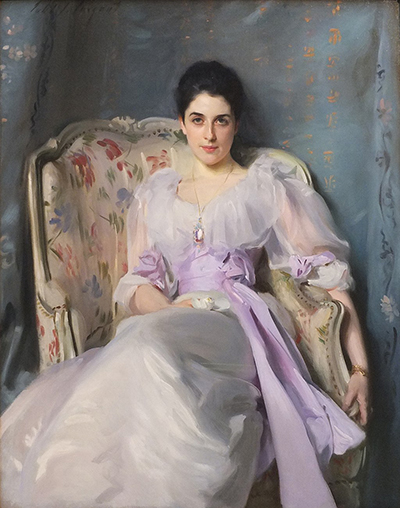
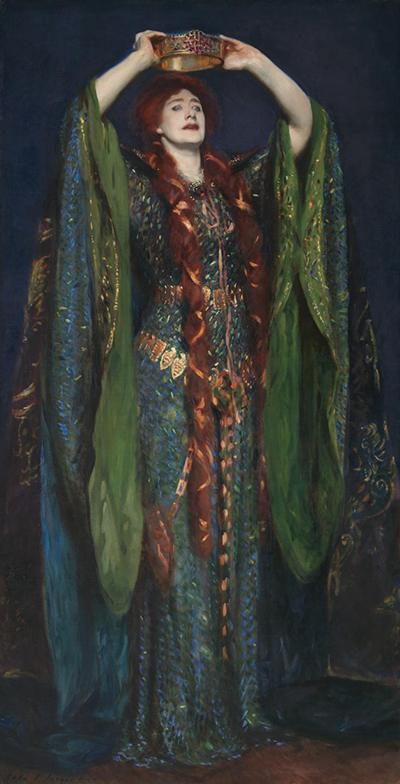
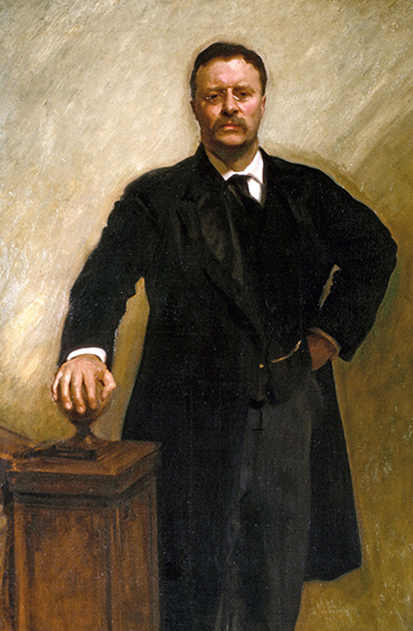
Lady Agnew of Lochnaw shows relaxed aristocratic authority. The sitter reclines in a chair and meets the viewer with a direct gaze. The painting's beauty depends on fabric and surface, but its force comes from controlled ease [8]. Ellen Terry as Lady Macbeth turns theatrical identity into portraiture, showing an actor in a role rather than a private sitter [9]. Theodore Roosevelt belongs to presidential image-making, where the sitter's public role carries institutional weight [10].
Sargent also painted artist friends and patrons. Claude Monet Painting by the Edge of a Wood shows Monet outdoors, absorbed in work. Auguste Rodin places Sargent in relation to another major maker. Charles Deering opens onto the world of collecting, friendship and patronage. These portraits show that Sargent's career depended on networks, not isolated commissions.
The mature portrait career brought success, but also fatigue. Sargent increasingly resisted being known only as a portraitist. The demand for likenesses could become repetitive, and he sought other forms of artistic freedom in murals, watercolors and travel subjects. That resistance is one of the central tensions of his biography: the painter mastered a form that threatened to define him too narrowly.
The mechanics of Sargent's portrait success were demanding. A society portrait required likeness, tact, invention and speed. It had to satisfy the sitter and the family, but it also had to operate in a wider social world where clothes, pose, background and finish signaled rank, taste and modernity. Sargent's genius was to make these pressures look natural. The most successful portraits seem as if the sitter simply arrived that way, though the result depended on negotiation, selection and painterly control.
His portraits of women are especially central to his fame, but they are not interchangeable. Some emphasize command, others fragility, theatricality, reserve, grandeur or fatigue. He understood dress as structure, not mere ornament. A black gown could become architecture; a pale fabric could become light; a chair could become a device for social ease or psychological tension. The brushwork often gives luxury its visible life, but it also keeps the person from disappearing into costume.
Men in Sargent's portraits carry a different set of pressures. Presidential, military, literary and artistic sitters required images of authority, intelligence or professional identity. In these works, Sargent often uses restraint rather than glitter. The pose may be simpler, the palette quieter, the gesture more controlled. Yet the same question remains: how can a person be made convincing as both individual and role?
This is why the portrait career cannot be dismissed as mere society service. It records the visual culture of an international elite, but it also studies the strain of being seen. Sargent's best sitters seem alive because they are caught between self-possession and exposure. That tension links the London triumphs back to Madame X and forward to the solemn bodies of Gassed.
Boston And The American Institutional World
Boston was one of Sargent's most important American centers. The Museum of Fine Arts Boston emphasizes the city's deep ties to him through patrons, collections, archive material and public projects [11]. Boston helps explain how an artist formed abroad became central to American art history.
The MFA holds The Daughters of Edward Darley Boit, one of Sargent's most important early paintings. It also preserves archive material that opens the documentary world around his career [1]. Letters and records matter because they show the working life behind public images: family, friends, patrons, commissions, travel and institutional relationships.
Boston also mattered through public commissions and murals. These projects offered Sargent something portraiture could not: architectural scale and an audience beyond the sitter. They linked his art to civic and institutional ambition. A mural does not behave like a portrait. It belongs to a place, and viewers encounter it repeatedly over time.
This American institutional world complicates Sargent's identity. He did not spend his career as a painter of American scenes in the ordinary sense. Yet American patrons, museums and cities shaped his work and preserved his reputation. Boston, especially, became a place where Sargent's art and archive could be gathered, studied and reinterpreted.
His biography therefore moves in two directions at once. He was a cosmopolitan artist formed by Europe, and he was also an American artist whose legacy became deeply rooted in American institutions.
The Boston connection also gave Sargent a different kind of audience. A portrait patron might ask for likeness and prestige; a museum or civic institution asked for endurance. Works preserved in Boston made it possible for later viewers to study Sargent beyond the gossip of commissions and the glamour of famous sitters. Collection history became part of biography: what survives, where it is kept and how institutions frame it all shape how an artist is remembered.
Boston's importance also complicates the idea that Sargent simply left America at a distance. He did not live a conventional American artistic life, but he repeatedly worked with American patrons and institutions that wanted his cosmopolitan authority. His American reputation was built through transatlantic desire: Americans looked to Sargent partly because he seemed to bring Europe with him, and European audiences saw in him an American-born painter thoroughly at ease in their world.
Travel, Watercolors And The Need For Freedom
Travel gave Sargent visual and professional freedom. Away from the formal portrait studio, he could follow light, architecture, water, costume and movement. Venice, Spain, North Africa, the Alps and other sites gave him subjects that did not depend on the expectations of a sitter.
Watercolor became one of the great outlets for this freedom. It allowed speed, economy and direct response to changing conditions. A watercolor can look casual, but it leaves little room for hesitation. Sargent's watercolors show a trained eye selecting what matters: a reflection, a figure, a wall, a shadow, a patch of exposed paper, a burst of color.
Venice was especially important. Sargent often avoided only the famous monumental views and looked instead at streets, canals, thresholds and figures moving through the city. Street in Venice, now in the National Gallery of Art, belongs to this world of travel observation [12]. The Metropolitan Museum of Art and RISD Museum records for Venetian works also help place his watercolors within a broader practice of looking at the city through movement and light [12], [13].
Spain mattered in a different way. It connected Sargent to Velazquez, performance, music and the visual drama of works such as El Jaleo. The National Gallery of Art's Sargent and Spain material makes clear that Spain was a serious and recurring part of his imagination [2].
North African subjects, including A Street in Algiers, require careful modern interpretation. They belong to Sargent's travel practice, but also to a nineteenth-century European culture of looking shaped by colonial power and Orientalist expectations. A responsible biography can acknowledge both Sargent's observational skill and the historical problems of the visual world he inherited.
The watercolors also reveal a different rhythm of seeing. In oil portraits, Sargent often had to manage likeness, costume and social expectation. In watercolor, he could let architecture break into fragments of light, let a figure remain anonymous, or let blank paper become glare. The medium rewarded omission. What he left untouched could be as important as what he painted.
This travel work also shows how Sargent resisted a single center. Venice was not Paris, Spain was not London, North Africa was not Boston, and each setting asked for a different visual tempo. The result is a biography of repeated departure. He kept leaving the studio, leaving the commission, leaving the fixed identity of portrait painter. Movement was not incidental to his art; it was one of its methods.
At the same time, modern readers need to separate mobility from innocence. Sargent's travel subjects emerged from a world in which European and American artists often moved through other cultures with privileges unavailable to many of the people they depicted. His best works can be admired for observation, color and design while still being read within the uneven histories that made such looking possible.
Drawings, Prints And Working Method
Sargent's art often looks fast, but the biography of his practice is not a story of easy improvisation. Drawings, studies, prints and materials evidence reveal a disciplined working method. The Met's studies connected to Portrait of Madame X show how Sargent tested pose and presentation before the final public image existed [14], [15].
That evidence is important because it challenges the myth of pure virtuosity. Sargent's quickness was real, but it was trained quickness. He could simplify because he knew what he needed. He could leave a passage broad because another passage carried the meaning. The unfinished-looking mark could be the result of judgment, not neglect.
The National Portrait Gallery's research on Sargent's suppliers of artists' materials grounds this practice in the physical world [16]. Paintings and drawings are made with actual materials: supports, brushes, paper, pigment and studio supplies. Sargent's style was not only temperament. It was craft enacted through tools.
Printmaking forms a smaller part of the story, but it belongs here. The Met's essay on Sargent as a lithographer places his lithographs within a late nineteenth-century print culture and within his works-on-paper practice [17]. Lithography shows how his interest in drawing could move into a medium of transfer and multiple impressions.
Works on paper also helped Sargent move beyond the burdens of oil portraiture. Charcoal portraits, studies, watercolors and lithographs offered different kinds of speed and intimacy. They make the biography more complete because they show how often Sargent thought outside the finished oil painting.
Charcoal was particularly important in the later career. It allowed Sargent to make likenesses with an economy that avoided the ceremony of oil portraiture. A charcoal head could be elegant, searching and socially useful without becoming a full performance of costume and setting. This mattered for an artist weary of large commissions. Drawing gave him a way to keep working with faces while reducing the theatrical machinery around them.
Studies also reveal that Sargent's apparent ease often came from repeated looking. A hand, shoulder, head angle or fall of fabric might be tested before the final arrangement took shape. The study does not diminish the finished work's freshness. Instead, it shows how freshness was prepared. Sargent could paint boldly because he had already learned what the picture required.
The material dimension of the work keeps biography close to practice. Brushes, pigments, paper, supports and suppliers do not sound romantic, but they belong to the life of the artist as surely as patrons and exhibitions do. Sargent's career was made not only in salons, studios and museums, but in daily choices of tools and surfaces.
Public Commissions And Late Ambition
Sargent's public commissions were not a decorative footnote. They were part of his effort to widen his artistic identity. Portraiture had brought him fame, but it had also given patrons a narrow idea of what he was for. Murals and public projects allowed him to work at a scale tied to architecture, institution and symbolic program rather than to one sitter.
This ambition was especially visible in Boston. Public commissions there connected Sargent to civic culture and to the idea of art as part of shared institutional space. A portrait may belong to a person or family; a mural belongs to a building and to an audience that returns over time.
The desire to move beyond portraiture grew stronger as Sargent aged. He became increasingly reluctant to continue the endless cycle of commissioned likenesses. This did not mean he disowned portraiture. It meant he wanted the public to see him as more than a fashionable recorder of faces.
That struggle is one of the most human parts of Sargent's biography. Success can become confinement. Sargent's later movement toward murals, watercolors and travel was not a retreat from seriousness. It was a search for a wider field.
Public commissions also asked Sargent to think differently about time. A portrait records an encounter and often a social moment. A mural cycle unfolds across walls, architecture and repeated viewing. It requires a different patience and a different relationship to audience. For Sargent, that shift offered relief from the endless negotiation of individual likeness and opened a path back toward large artistic ambition.
These projects also show the persistence of history painting within his career. Even when modern art seemed to be moving away from allegory and grand programs, Sargent remained interested in scale, symbolic arrangement and the human body as a carrier of meaning. His late ambition was therefore not an escape from tradition, but a renewed argument with it.
War Artist And Gassed
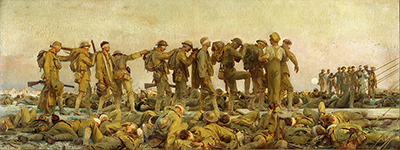
The First World War gave Sargent a subject that transformed the moral tone of his late career. As a war artist, he encountered a public task very different from society portraiture. The result was Gassed, now in the collection of Imperial War Museums [18].
The painting shows soldiers affected by gas, moving in a line with bandaged eyes. Other bodies lie or sit around them. The central procession is ordered, but the order does not create comfort. It makes injury visible on a monumental scale.
Sargent's long experience with bodies, gesture, fabric and procession mattered here. The same artist who could arrange a sitter's hand or dress could also arrange blinded soldiers into a public image of vulnerability. But the purpose changed completely. In a portrait, public image belongs to a sitter. In Gassed, public image belongs to collective memory.
Imperial War Museums' material on the painting, including display and conservation history, shows how strongly it has become tied to the public memory of the First World War [18]. Gassed complicates any easy dismissal of Sargent as only a painter of privilege. It shows his late capacity for solemn public art.
The painting also looks back across Sargent's career in unsettling ways. He had spent decades making bodies eloquent through pose. In Gassed, bodies still communicate, but they do so through injury, dependence and impaired sight. The line of soldiers has a processional dignity, yet the picture refuses consolation. The painter of polished surfaces confronts a subject in which visibility itself has been damaged.
That late turn does not erase the society portraits; it changes how they are read. Sargent's skill with appearance had always involved a tension between display and vulnerability. War made that tension explicit. The biography ends not with an artist merely repeating his triumphs, but with one capable of translating painterly command into public mourning.
Final Years
Sargent died in London on 14 April 1925. By then, he had already lived several artistic lives: Paris-trained prodigy, Salon portraitist, exile from the Madame X crisis, London society painter, Boston muralist, watercolor traveler, maker of drawings, lithographer and war artist.
His final years were marked by the continuing tension between reputation and desire. The public knew him above all as a portraitist, but Sargent had long wanted to be understood more broadly. He had devoted energy to murals, watercolors and work outside the formal portrait commission. The late career therefore looks less like decline than like a sustained attempt to control the meaning of success.
His death did not settle his reputation. If anything, it opened a long argument about what kind of painter he had been.
That argument was shaped partly by timing. Sargent died after modernism had already changed the terms by which ambitious painting was judged. The qualities that had made him famous - finish, elegance, likeness, tonal mastery and social fluency - could look suspect to critics who prized rupture and refusal. Yet the very polish that later critics distrusted was often the instrument of his complexity. He understood the world of surfaces because surfaces had power.
His final years therefore matter not simply as an epilogue, but as a question about artistic identity. What happens when a painter's audience is most eager for the work he is most eager to move beyond? Sargent never escaped that question completely. He answered it by continuing to widen his practice, even when reputation narrowed around him.
Reputation And Reassessment
Sargent's reputation has never been stable. In his lifetime, he was admired for technical brilliance and sought after by patrons. Later, some modernist critics treated him as too polished, too fashionable and too tied to elite society. In an art world that increasingly valued rupture, abstraction and visible rebellion, Sargent could appear conservative.
That view now seems incomplete. Sargent was not radical in the same way as the avant-garde, but his work is deeply modern in its understanding of public identity. He painted an age of international wealth, celebrity, performance, institutions, travel and war. His sitters are not timeless ornaments. They belong to a world in which being seen had social power.
His technique has also been reassessed. The dazzling brushwork is not merely display. It is a form of selection. Sargent knew what to describe and what to leave unresolved. His best work depends on judgment: where to sharpen, where to blur, where to let fabric become structure, where to let a face become public image.
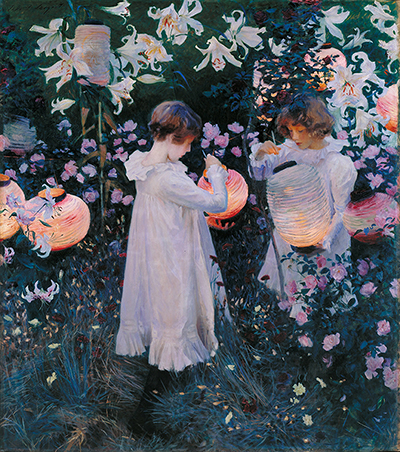
Modern viewers have also returned to the strangeness of paintings once hidden by reputation. The Daughters of Edward Darley Boit looks spatially and psychologically complex. Portrait of Madame X remains a study of social danger. Carnation, Lily, Lily, Rose reveals patience beneath freshness. Gassed stands as a major public image of wartime injury. The watercolors show his eye working with speed and economy. Together, these works make Sargent larger than the old image of society portraitist.
Why His Life Matters
Sargent's biography matters because it shows how an artist can be shaped by success without being explained by it. He mastered portraiture so completely that portraiture threatened to define him. He responded by widening his work: murals, watercolors, travel subjects, drawings, prints and war art.
His life also reveals the international character of modern art before the usual story of modernism takes over. Sargent's world was made from steamship travel, expatriate families, Paris exhibitions, London patrons, American museums, British war commissions, Venetian streets, Spanish performances and Boston archives. His career is a map of that world.
Most of all, Sargent's biography matters because his art asks how people and events become visible. A society woman at the Salon, four children in a room, an actor in Shakespearean costume, a president, an artist painting outdoors, a line of blinded soldiers: all become public through paint. Sargent's life gave him the mobility to see many forms of presence. His art gave them shape.
Frequently Asked Questions
Sargent was born in Florence on 12 January 1856 to American parents.
Yes. Sargent was an American citizen, though he was born abroad and worked for much of his career in Europe. His identity was transatlantic rather than narrowly tied to one place.
Sargent trained in Paris with Carolus-Duran, whose direct painting method helped shape his mature technique. He also studied old masters closely, especially Velazquez.
The painting's reception at the Paris Salon of 1884 damaged Sargent's position in Paris. He increasingly turned toward London, where he rebuilt his career through British and American patronage.
No. Portraits were central to his fame, but he also made murals, watercolors, drawings, prints, travel subjects, garden paintings and war art.
Boston was one of Sargent's most important American centers. Boston patrons, collections, murals and the Museum of Fine Arts Boston's holdings and archive all shaped his legacy. [1], [11]
Gassed, painted after his experience as a war artist during the First World War, is one of his most important late works.
Discussion
Sargent's life raises a question about artistic success: when a painter becomes famous for one kind of work, how much effort does it take to remain larger than that reputation?
Reader Insights
What is the first detail that shapes your reading of John Singer Sargent Biography: pose, setting, light, costume, brushwork or historical context?
Which small visual decision begins to matter more after a longer look, and how does it change the mood of the page?
Which comparison helps most: another Sargent portrait, a travel subject, a public commission, or a work by one of his contemporaries?
Join the Conversation
Share a thoughtful comment below about what you notice, question or compare when looking at this page.
References
- Museum of Fine Arts Boston, John Singer Sargent biography https://www.mfa.org/news/sargent-bio
- National Gallery of Art, Sargent and Spain https://www.nga.gov/research/publications/sargent-and-spain
- Metropolitan Museum of Art, Madame X https://www.metmuseum.org/art/collection/search/12127
- Metropolitan Museum of Art, Where Is Madame X? https://www.metmuseum.org/exhibitions/listings/2015/sargent-portraits-of-artists-and-friends/blog/posts/where-is-madame-x
- Museum of Fine Arts Boston, The Daughters of Edward Darley Boit https://collections.mfa.org/objects/31782
- Isabella Stewart Gardner Museum, El Jaleo https://www.gardnermuseum.org/experience/collection/13259
- National Gallery of Art, John Singer Sargent's El Jaleo https://www.nga.gov/exhibitions/john-singer-sargents-el-jaleo
- National Galleries of Scotland, Lady Agnew of Lochnaw https://www.nationalgalleries.org/art-and-artists/5396
- National Portrait Gallery, Ellen Terry as Lady Macbeth https://www.npg.org.uk/collections/search/portraitExtended/mw06272/Ellen-Terry-as-Lady-Macbeth
- White House Historical Association, Theodore Roosevelt portrait https://www.whitehousehistory.org/photos/theodore-roosevelt
- Museum of Fine Arts Boston, Ties that Bind: Boston and John Singer Sargent https://www.mfa.org/news/sargent-boston-ties
- National Gallery of Art, Street in Venice https://www.nga.gov/artworks/46428-street-venice
- RISD Museum, Rio di Santa Maria Formosa, Venice https://risdmuseum.org/art-design/collection/rio-di-santa-maria-formosa-venice-42223
- Metropolitan Museum of Art, Study for Madame X https://www.metmuseum.org/art/collection/search/12328
- Metropolitan Museum of Art, Madame Gautreau study/letter/drawing record https://www.metmuseum.org/art/collection/search/919018
- National Portrait Gallery, John Singer Sargent's suppliers of artists' materials https://www.npg.org.uk/collections/research/programmes/artists-their-materials-and-suppliers/john-singer-sargents-suppliers-of-artists-materials
- Metropolitan Museum of Art, Now on View: Lithographs by John Singer Sargent https://www.metmuseum.org/perspectives/john-singer-sargent-as-lithographer
- Imperial War Museums, Gassed object record https://www.iwm.org.uk/collections/item/object/23722