

 by Tom Gurney
Tom Gurney BSc (Hons) is an art history expert with over 20 years experience
Published on June 19, 2020 / Updated on July 19, 2026
Email: tomgurney1@gmail.com / Phone: +44 7429 011000
A Street in Algiers by John Singer Sargent: Introduction
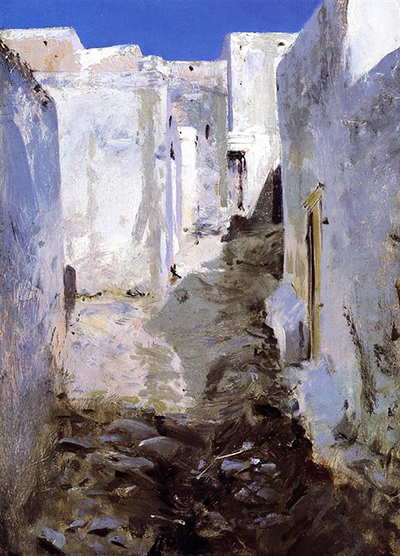
John Singer Sargent's A Street in Algiers belongs to the careful edge of his travel work: a North African subject known through a compact published record and best read through Sargent's wider practice of streets, architecture, movement, and outsider looking. Its value lies in what it reveals about Sargent's travel eye and about the historical frame that made such images possible.
The work matters because Sargent's reputation is still often narrowed to society portraits. Travel subjects like A Street in Algiers show another part of the career: the artist moving through cities, streets, courtyards, architecture, and light. A North African street scene made by a Euro-American artist in the nineteenth century asks for admiration and caution at the same time.
At a Glance
- ArtistJohn Singer Sargent [1]
- TitleA Street in Algiers [1]
- Subject areaSargent's travel work and North African subjects [1]
- Object-specific leadthe JSSGallery/Adelson listing for A Street in Algiers [1]
- Strongest contextSargent's wider travel, watercolor, drawing, and street-scene practice [2], [3], [4], [5]
- Best comparisonStreet in Venice [6]
Contents
- Introduction
- A Travel Subject With A Narrow Record
- Algiers, Travel And Outsider Looking
- Streets, Architecture And Sargent's Eye
- Beside Street In Venice And The Watercolors
- Related Works And Where To Go Next
A Travel Subject With A Narrow Record
The safest way to approach A Street in Algiers is to resist pretending that the record says more than it does. The title gives the essential fact: Sargent is associated with a street scene in Algiers. The JSSGallery/Adelson listing provides the object-specific anchor [1]. Beyond that, the richer evidence comes from Sargent's broader career rather than from a full institutional entry for the work.
That limit is not a failure of the painting as a subject. It simply changes the kind of article the work can sustain. Some Sargent artworks invite long accounts of commission, sitter, exhibition, acquisition, and technical history. Street in Venice, for example, has a full National Gallery of Art record [6]. A Street in Algiers asks for a shorter, more interpretive treatment.
Such restraint is especially important with travel art. When the object facts are compact, the temptation is to compensate with imaginative description or generalized biography. The stronger method is to use well-supported Sargent context to explain why a street in Algiers belongs in the artist's wider pattern of looking.
Algiers, Travel And Outsider Looking
Algiers was not a neutral destination for nineteenth-century European and American artists. North African subjects were often framed through Orientalist expectation: the desire to see unfamiliar streets, architecture, costumes, religious spaces, markets, and urban scenes as signs of difference. That history does not make every travel image identical, but it does shape modern viewing.
Sargent's North African material sits inside that tension. The Sargent biography and watercolors context place A Street in Algiers beside Venice, Spain, Morocco, North Africa, and other travel subjects. The Met's works-on-paper material also shows Sargent studying Spain and Morocco, including architectural views such as Moorish buildings and courtyards in Tetuan [4], [5]. These works belong to a mobile practice of observation, but also to a culture in which mobility itself was a privilege.
The word "street" matters here. A street scene promises immediacy: the sense of a place glimpsed in ordinary movement. Yet a street is also chosen, framed, and converted into an image for viewers elsewhere. Sargent's skill in catching light, architecture, and passing figures should be taken seriously. So should the imbalance between the artist who could travel and paint and the people and places made into subjects.
That double view is the fairest one. A Street in Algiers can be admired for its place within Sargent's art of travel without treating Algiers as an exotic stage set.
Streets, Architecture And Sargent's Eye
Sargent repeatedly found pictorial force in streets and built spaces. In Venice, he turned a narrow passage into a scene of social looking: a woman moves toward the viewer, men stand near the wall, and architecture presses the figures into a charged urban channel [6]. Algiers should not be treated as another version of Venice, but the comparison helps define Sargent's interest in streets as spaces of movement and encounter.
Architecture gave Sargent structure. A wall, doorway, lane, facade, courtyard, shadow, or bright patch of plaster could organize a picture without needing a famous monument. The travel works often turn smaller passages into tests of light, proportion, and human presence.
Works on paper made that habit especially agile. The Met's Sargent drawings and watercolors material emphasizes travel sheets, sketchbooks, graphite, watercolor, and subjects beyond the portrait studio [4], [5]. A Street in Algiers belongs near that way of seeing: quick attention to place, architectural frame, and movement.
Beside Street In Venice And The Watercolors
The best-supported comparison is Street in Venice. That painting shows how Sargent could make an ordinary urban passage feel psychologically alert without turning it into a formal portrait. The figures are unnamed, yet posture, placement, and looking create pressure [6]. A Street in Algiers brings street, architecture, and the outsider's eye into the travel field.
The watercolors give the wider frame. Sargent's watercolors reveal a painter who valued paper, omission, bright reserves, dark accents, and the courage to stop before freshness disappeared. They also widen his geography beyond the studio, carrying Venice, Spain, Morocco, North Africa, the Alps, and other travel sites into the story [7], [4].
But the comparison also marks a difference. Venice is well represented in museum records and familiar Sargent scholarship. The Algiers work comes to the reader through a narrower trail. A concise account gives the painting a place in Sargent's career without giving it a false catalogue weight.
Related Works And Where To Go Next
For Sargent's wider travel practice, start with Watercolors. For a fuller street-scene comparison, use Street in Venice. For line and works on paper, use Drawings; for handling and controlled freshness, use Style and Technique.
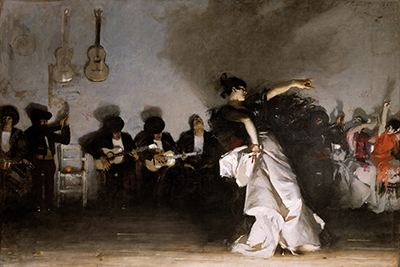
For the life story behind the travel works, continue to Biography. Spanish and North African subjects also sit near El Jaleo, where travel, performance, old-master memory, and cultural framing are more fully supported.
Discussion
A Street in Algiers asks for a modest but serious kind of looking. It is a Sargent travel subject, a street image, and a reminder that painterly freedom abroad was bound to histories of power, access, and representation.
Reader Insights
What is the first detail that shapes your reading of A Street in Algiers by John Singer Sargent: pose, setting, light, costume, brushwork or historical context?
Which small visual decision begins to matter more after a longer look, and how does it change the mood of the page?
Which comparison helps most: another Sargent portrait, a travel subject, a public commission, or a work by one of his contemporaries?
Join the Conversation
Share a thoughtful comment below about what you notice, question or compare when looking at this page.
References
- JSSGallery/Adelson, *A Street in Algiers* https://www.jssgallery.org/Paintings/A_Street_in_Algiers.htm
- Museum of Fine Arts, Boston, John Singer Sargent biography https://www.mfa.org/news/sargent-bio
- National Gallery of Art, *Sargent and Spain* https://www.nga.gov/research/publications/sargent-and-spain
- Metropolitan Museum of Art, *John Singer Sargent Beyond the Portrait Studio* https://www.metmuseum.org/exhibitions/listings/2000/john-singer-sargent
- Metropolitan Museum of Art, *American Drawings and Watercolors in The Metropolitan Museum of Art: John Singer Sargent* https://www.metmuseum.org/fr/met-publications/american-drawings-and-watercolors-in-the-metropolitan-museum-of-art-john-singer-sargent
- National Gallery of Art, *Street in Venice* https://www.nga.gov/artworks/46428-street-venice
- Museum of Fine Arts, Boston, John Singer Sargent gallery https://www.mfa.org/gallery/john-singer-sargent