

 by Tom Gurney
Tom Gurney BSc (Hons) is an art history expert with over 20 years experience
Published on June 19, 2020 / Updated on July 19, 2026
Email: tomgurney1@gmail.com / Phone: +44 7429 011000
John Singer Sargent Self-Portrait, 1906: Introduction
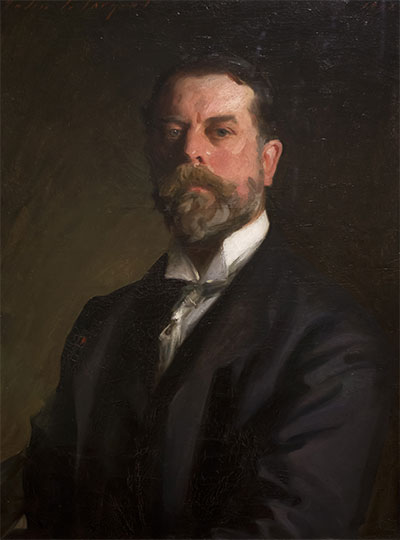
John Singer Sargent's 1906 self-portrait belongs to the later public life of his reputation. By this date he was no longer the young expatriate recovering from the Paris shock of Portrait of Madame X, nor simply the rising London portraitist whose skill needed to be proved to a new set of patrons. He was a famous painter, internationally known, admired for portraiture, and already restless with the demands that fame had placed on him.
That makes the 1906 self-portrait a different kind of image from Sargent's earlier self-portraits of 1886 and 1892. The question is no longer how a young painter presents himself at a moment of transition, or how an established artist appears during his ascent. The question is how a celebrated portraitist allows his own likeness to enter a larger tradition of artists looking at themselves. The Smithsonian/National Portrait Gallery record connects the 1906 self-portrait with the Uffizi, giving the work an institutional frame that matters as much as the date [1].
Sargent spent his career making public identity visible for other people. He painted society figures, actors, artists, children, presidents, officers, patrons, and friends. In 1906, his own face could not be an innocent subject. It carried the history of his method, his fame, his fatigue with portrait commissions, and his continuing authority as a painter.
Contents
- Introduction
- Why 1906 Matters
- The Uffizi Self-Portrait Tradition
- A Famous Portraitist As His Own Sitter
- Portrait Fatigue And Late Work
- The Self-Portrait Sequence
- How To Look At The Portrait
- Related Works And Where To Go Next
Why 1906 Matters
The date gives the painting much of its force. By 1906, Sargent had already rebuilt his career after the hostile Paris reception of Portrait of Madame X. He had become one of the leading portrait painters of the Anglo-American world, with major society portraits, artist portraits, public sitters, and theatrical images behind him. The mature Sargent was not waiting to be discovered.
At the same time, success had become a constraint. The Sargent biography describes a painter whose portrait career brought extraordinary demand but did not define the whole of his ambition [2]. Murals, travel, watercolors, drawings, and later war art all mattered to him. He did not abandon portrait intelligence, but he increasingly sought work less trapped by sittings and commissions.
This is why a self-portrait from 1906 should not be treated as a simple likeness. It belongs to a moment when Sargent was famous for portraying others and increasingly aware of the limits of that fame. Painting himself, or allowing his own image to be preserved through a major institutional context, makes the portrait career turn back on itself. The maker of social visibility becomes visible as a historical figure.
The date also sits beside material evidence from Sargent's wider practice. The style-and-technique article notes that National Portrait Gallery research records purchases of Ingres paper in 1906 and outdoor equipment in the years around 1906 to 1910 [3], [4]. Those details do not describe the self-portrait directly, but they place the year inside a period of mobile, materially active work. Sargent in 1906 was not only a studio portraitist. He was still testing media, supports, travel practice, and the possibilities of work beyond formal portrait commissions.
The Uffizi Self-Portrait Tradition
The Uffizi context gives the 1906 self-portrait its special public meaning. A self-portrait in such a frame is not merely an image the artist makes for private record. It joins a long tradition in which artists' own likenesses become part of art history's memory of makers. The work asks viewers to see Sargent not only as the author of portraits, but as someone whose own face belongs among the faces of artists.
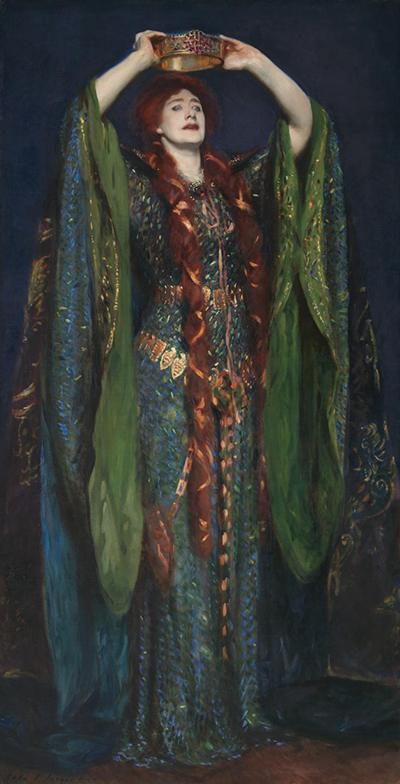
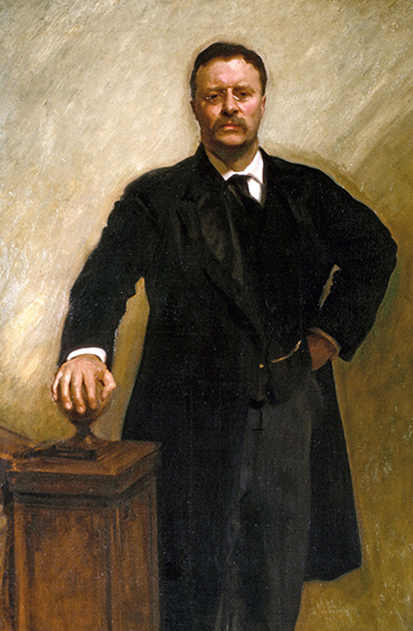
That shift matters because Sargent's reputation was built through other people's images. His career depended on making sitters legible to audiences: a woman in a black gown and pale profile, an actor in Shakespearean costume, a president, a collector, a child in a dark interior, a friend painting outdoors, a military figure in public role. In the Uffizi frame, Sargent himself becomes part of that economy of recognition.
The institutional setting also changes the scale of interpretation. A self-portrait can invite viewers to ask private questions: what did the artist feel, what did he reveal, what did he conceal? Those questions are tempting but not always useful. The Uffizi tradition asks a broader question: how does an artist wish to be represented among other artists? The problem is public before it is psychological.
For Sargent, that public problem was complex. He was American by nationality, born in Florence, trained in Paris, established in London, and active across Europe and the United States. His life resists a single national label [5], [2]. A self-portrait connected with the Uffizi returns Sargent to Italy, the place of his birth and early exposure to European art, while also placing him in an international lineage of painters whose identities exceed one city or school.
The 1906 portrait should be read with that breadth in mind. It is not simply "Sargent painting Sargent." It is Sargent entering view as a painter already claimed by museums, patrons, nations, and art-historical traditions.
A Famous Portraitist As His Own Sitter
Sargent's portraits are never only records of faces. The portraits article frames them as constructions of identity through pose, gaze, costume, setting, surface, and the pressure of being seen [6]. That framework is essential for the 1906 self-portrait. The sitter is the artist, but the problem remains portraiture.
In a commissioned portrait, Sargent had to negotiate another person's public image. A sitter brought rank, beauty, profession, role, family, authority, anxiety, or ambition. Sargent brought arrangement, light, paint, restraint, and pictorial judgment. In a self-portrait, the negotiation turns inward, but it does not disappear. The artist still has to decide what kind of person the picture presents.
The danger is to mistake self-portraiture for confession. Sargent's art does not work best when treated as an open diary. His strongest portraits often withhold as much as they reveal. A direct gaze may be a challenge rather than intimacy. A dark coat, controlled pose, or severe setting may construct authority rather than disclose private feeling. The 1906 self-portrait should be approached as an image of role: painter, professional, public figure, and inheritor of a tradition.
This is especially important because Sargent was so skilled at making painted surfaces look alive. The style-and-technique article describes his mature method as controlled freshness, a balance between broad handling and firm structure [3]. In a self-portrait, that method becomes part of the subject. The viewer is looking not only at Sargent's face, but at the painterly authority that made Sargent famous. The touch, restraint, finish, and omissions all help stage the artist as someone who knows how much an image should say.
Portrait Fatigue And Late Work
By the early twentieth century, Sargent's portrait success had become burdensome. This point should be handled carefully. He did not become important because he rejected portraiture; he became important because he mastered it. But the demand for portraits could narrow public expectation. The world wanted Sargent to keep producing likenesses of the powerful, fashionable, wealthy, creative, and celebrated. Sargent's larger career shows a persistent desire to move beyond that routine.
The 1906 self-portrait sits inside that tension. It is itself a portrait, but it is not an ordinary commission in which another sitter's social need controls the encounter. It gives Sargent a chance to picture the painter as painter, not merely as the supplier of prestige to someone else.
His work around this period makes that distinction important. The watercolors and style studies emphasize travel, paper, sketchbooks, outdoor equipment, and the mobile practice that increasingly drew Sargent away from the formal studio [7], [3]. Murals and public commissions also claimed his attention. Later, Gassed would show how his command of bodies, procession, light, and scale could be turned toward the public memory of war rather than society image-making.
Seen from that angle, the 1906 self-portrait is not a retreat into vanity. It is a compact statement from an artist trying to remain larger than the role by which he was most famous. Sargent had become a portraitist whose portrait career could obscure the rest of him. His own likeness had to carry both the achievement and the problem.
The Self-Portrait Sequence
The 1906 self-portrait becomes clearer when placed beside the earlier self-portraits of 1886 and 1892. The sequence should not be turned into a substitute self-portrait hub, but the comparison is useful because each date belongs to a different career condition.
The 1886 self-portrait, documented through Aberdeen and Smithsonian records, belongs to the period after the Paris crisis of Madame X and Sargent's turn toward London [8], [9]. It is a self-image made near professional uncertainty and reinvention. The 1892 self-portrait, represented through Smithsonian inventory material connected with the National Academy, belongs to a firmer phase of establishment, close to the period when works such as Lady Agnew of Lochnaw helped confirm his British reputation [10], [11].
The 1906 image has a different weight. It is not the painter at the threshold, nor the painter consolidating ascent. It is the painter as recognized master. The Uffizi association intensifies that status because the artist's likeness is no longer only a personal image; it belongs within an institutional tradition of artists representing themselves.
The three works therefore trace a shift from recovery to establishment to recognition. They also show how self-portraiture can mark career stages without becoming autobiography in the sentimental sense. Sargent returns to his own image at intervals, but each return is shaped by public circumstance. He is never only looking into a mirror. He is deciding how the painter should appear at a particular moment in the life of his reputation.
How To Look At The Portrait
Begin by remembering that Sargent is both maker and subject. The picture is not separate from his portrait practice; it is one of the places where that practice becomes self-aware. Ask how the pose presents authority, restraint, or distance. Ask whether the gaze invites the viewer, tests the viewer, or holds something back.
Then look at finish. Sargent often distributed finish unevenly, sharpening what mattered and allowing other passages to remain broad. In a self-portrait, that hierarchy is meaningful. The areas of emphasis tell the viewer where identity is being constructed: face, head, clothing, edge, dark mass, or surface.
Clothing should be read as role rather than accessory. Sargent understood that dress could build public identity in society portraits, theatrical portraits, and portraits of public figures. In a self-portrait, clothing helps decide whether we see the artist as gentleman, professional, modern painter, public figure, or member of a historical lineage.
Finally, keep the institutional frame in view. The 1906 self-portrait is not only a likeness. It is Sargent's image in relation to art history's memory of artists. That makes its restraint powerful. The painting does not need to announce genius dramatically. The career already does that. The portrait's task is to make recognition visible without making it crude.
Related Works And Where To Go Next
For the full career, start with Biography and the main John Singer Sargent overview. They place the 1906 self-portrait within Sargent's international life, Paris training, London portrait success, Boston ties, travel, public commissions, and late war art.
For the portrait problem, continue to Portraits. That essay explains how Sargent used pose, gaze, costume, hands, setting, and surface to construct public identity. For method, use Style and Technique; for the travel and works-on-paper turn that complicates his late portrait identity, use Watercolors and Drawings.
For the self-image sequence, compare Self-Portrait, 1886 and Self-Portrait, 1892.
Frequently Asked Questions
The Smithsonian/National Portrait Gallery record used here identifies the work as Sargent's 1906 self-portrait connected with the Uffizi [1].
The Uffizi association places the work within a major self-portrait tradition. That means the picture is not only a likeness of Sargent. It is an image of the artist entering a public lineage of makers represented by their own faces.
The 1886 image belongs to the period after the Madame X crisis and Sargent's London turn. The 1906 image belongs to mature recognition, when Sargent's reputation as a portraitist was already secure and his own likeness could carry art-historical weight.
It is safer to read it as self-presentation. Sargent's portrait art usually constructs public identity through pose, gaze, clothing, surface, and restraint. Those same terms apply when the sitter is Sargent himself.
By the early twentieth century, Sargent was famous for portraits but increasingly drawn to murals, watercolors, travel, and other work. The 1906 self-portrait matters because it shows the celebrated portraitist presenting himself while the portrait role itself had become both achievement and burden.
Discussion
Sargent's 1906 self-portrait is a mature image of recognition. It shows the portraitist entering the same field of visibility he had so often constructed for others.
Reader Insights
What is the first detail that shapes your reading of John Singer Sargent Self-Portrait, 1906: pose, setting, light, costume, brushwork or historical context?
Which small visual decision begins to matter more after a longer look, and how does it change the mood of the page?
Which comparison helps most: another Sargent portrait, a travel subject, a public commission, or a work by one of his contemporaries?
Join the Conversation
Share a thoughtful comment below about what you notice, question or compare when looking at this page.
References
- Smithsonian/National Portrait Gallery record for John Singer Sargent's 1906 self-portrait https://npg.si.edu/object/npg_Inv._1890_n._3351_GU
- John Singer Sargent Biography: Biography
- John Singer Sargent Style and Technique: Style and Technique
- National Portrait Gallery, "John Singer Sargent's suppliers of artists' materials" https://www.npg.org.uk/collections/research/programmes/artists-their-materials-and-suppliers/john-singer-sargents-suppliers-of-artists-materials
- Museum of Fine Arts, Boston, John Singer Sargent biography https://www.mfa.org/news/sargent-bio
- John Singer Sargent Portraits: Portraits
- John Singer Sargent Watercolors: Watercolors
- Aberdeen Archives, Gallery and Museums, *Self-Portrait* https://emuseum.aberdeencity.gov.uk/objects/3366/self-portrait
- Smithsonian Catalog of American Portraits record for the 1886 self-portrait https://www.si.edu/es/object/self-portrait%3Anpg_01.1.192
- Smithsonian inventory record for John Singer Sargent self-portrait, 1892 https://www.si.edu/object/john-singer-sargent-self-portrait-painting%3Asiris_ari_44346
- National Galleries of Scotland, *Gertrude Vernon, Lady Agnew of Lochnaw* https://www.nationalgalleries.org/art-and-artists/5396