 by Tom Gurney
Tom Gurney BSc (Hons) is an art history expert with over 20 years experience
Published on June 19, 2020 / Updated on November 20, 2026
Email: tomgurney1@gmail.com / Phone: +44 7429 011000
Introduction
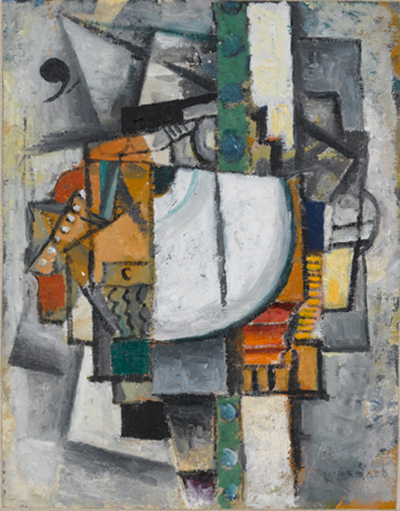
Kazimir Malevich's Cubo-Futurist Composition with Piano breaks a musical subject into an assembly of angular grey planes, orange and green passages, and a large pale central form. The Stedelijk Museum Amsterdam identifies the work as Kubofuturistische compositie met piano, dates it 1913–14 and lists the English translation used here. Its object number, 4.2001(088), is the most useful safeguard against confusing it with Malevich's other pictures and drawings of musical instruments. [1]
The site's small inherited image was compared directly with the Stedelijk's pictured object and matches its arrangement of forms. A 2013 catalogue of the Khardzhiev collection identifies this work as oil on canvas and records a signature, a 1913 date, and an inscription on the reverse. The museum's current item page gives a different dimension string from that catalogue. Both are set out below; the available records do not explain the difference. [1] [2]
At a Glance
- ArtistKazimir Malevich
- Museum titleKubofuturistische compositie met piano
- English titleCubo-Futurist Composition with Piano
- Date1913–14, museum and Khardzhiev catalogue
- MediumOil on canvas, 2013 Khardzhiev catalogue
- Dimensions49.1 × 40.7 cm, current museum page; 39.5 × 31.3 cm, 2013 catalogue
- Object number4.2001(088)
- Holding creditKhardzhiev Foundation loan at the Stedelijk Museum Amsterdam
Contents
- What can be seen in the picture?
- Date, signature and documented exhibition trail
- Two sets of dimensions for one accession
- The Khardzhiev collection and the title's neighbours
- What the title lets the viewer look for
What can be seen in the picture?
The composition is vertical. A broad pale shape curves through the centre, where a conventional still life might put its most recognisable object. Orange and brown blocks crowd its left side. A green upright and a narrow light strip rise above it, while dark diagonal bars cut across the upper and middle parts. At right, grey forms meet yellow and orange marks. These are observations from the museum-matched reproduction, rather than a map of every pictured object. [1]
The title names a piano, yet the picture does not present an instrument in ordinary single-point perspective. A short row of light and dark marks at the right can suggest keys, but that reading is tentative. The curving central white area may be read against the hard-edged surrounding pieces, without assigning it to a documented piano part. Malevich makes the viewer assemble fragments and then notice how the surface resists one stable interpretation. [1]
Colour works as structure. The orange shapes at left and lower right create interruptions in the surrounding greys. A green vertical passes through the centre line and reappears lower down. A heavy dark diagonal near the top pulls the eye toward the pale central area; another set of angular marks at right sends it outward again. The marks look layered, yet the painting is still a single worked canvas. At 400 pixels wide, the site's legacy JPEG does not permit reliable fine-scale claims about brushwork or individual paint layers. [1]
Date, signature and documented exhibition trail
The Stedelijk dates the object 1913–14. Entry 440 of the Khardzhiev catalogue does the same while recording a signature at lower right, dated 1913, and a reverse inscription that includes 1913. These facts can coexist: a dated mark is not necessarily a definitive record that every part of the painting was finished within that calendar year. The catalogue also cites Nakov's dating to late 1913–early 1914. [1] [2]
The 2013 entry points to a newspaper photograph associated with the Jack of Diamonds exhibition in Moscow, February 1914, in which this work can reportedly be seen. That is a valuable documentary lead, but the source consulted here is the catalogue's report of the photograph, not an independent inspection of the original newspaper image. The same entry cites a related drawing in Andersen's 2011 catalogue; a cited relationship should not be treated as proof of a direct preparatory sequence without examining that drawing. [2]
This chronology places the painting before Malevich's first public display of Suprematist canvases at the 1915 0,10 exhibition. It belongs to a moment when he was still taking recognisable subjects through increasingly fractured arrangements. The Stedelijk's account of the Khardzhiev collection distinguishes this earlier experimental work from his later nonrepresentational Suprematism. The piano subject remains a clue to reading this particular work; it should not be erased by treating the canvas as a finished Suprematist painting. [2] [3]
Two sets of dimensions for one accession
The current Stedelijk object page prints 49.1 × 40.7 cm. The 2013 Khardzhiev catalogue gives 39.5 × 31.3 cm for entry 440. Both records share the Dutch title, 1913–14 date and inventory number 4.2001(088), so this is a record discrepancy attached to the same identified object, not evidence for a second version. [1] [2]
Neither source explains whether its dimensions refer to a frame, support, image area or a later measurement. The smaller pair should therefore not quietly replace the museum's current figure, and the larger pair should not make the catalogue vanish. Until a technical object record resolves the distinction, both measurements belong beside their source and date. The painting's approximate portrait format is evident in either case. [1] [2]
The Khardzhiev collection and the title's neighbours
The Stedelijk credits the painting as on loan from the Khardzhiev Foundation. Its collection page records custody and access rather than museum ownership. The museum says Nikolai Khardzhiev's art collection has been in its care since 1998 and includes a substantial group of Malevich works. That history helps explain why the original catalogue can add inscriptions and references absent from the brief public item page. [1] [3]
Entry 440 must be kept separate from the nearby catalogue entries Muziekinstrument and Muziekinstrumenten. Those are pencil drawings with different accession numbers, 4.2001(017) and 4.2001(097). The catalogue also mentions a larger Stedelijk oil painting called Musical Instrument/Lamp, accession A 7680, in a reference for the first drawing. Shared musical vocabulary does not make any of these the piano composition. A reader or image search should use the accession and the matched image, not title words alone. [2]
What the title lets the viewer look for
Once the piano has been named, the repeated narrow shapes become easier to pick out within the composition. They give the eye a rhythm to follow where several fragments approach one another. Elsewhere a line can seem to belong to more than one plane. The visible fragments offer recognizable parts of an instrument without assigning every intervening shape a position in a room. Think of the difference between looking straight at a keyboard and picking up a portion of it from the side. The painting keeps the fragment readable even while the field around it changes direction. [1] [2]
The Khardzhiev catalogue places other musical-instrument works near this entry. That context is useful for seeing a recurrent interest, especially where the naming of one object influences how viewers read surrounding lines. It also makes the repeated catalogue details worth preserving. Entry 440, with its record of the signature, inscription and dimensions, controls the identity of this canvas. The references immediately before it describe separate works, and the shared subject of an instrument is only one part of the comparison. [1] [2]
Frequently Asked Questions
When was it painted?
Is it oil paint?
Where is the piano?
The title identifies the subject, while the image fractures its forms. Marks at the right may evoke keys, but the cited records do not label individual parts of the picture. [1]
Why do two dimensions appear?
Is this the Stedelijk's Musical Instrument/Lamp?
No. Musical Instrument/Lamp is listed in the catalogue as a different oil painting, accession A 7680. This page concerns 4.2001(088). [2]
Discussion
Which shapes suggest an instrument to you, and which resist that reading?
How do the green vertical and dark diagonals direct your eye through the composition?
Reader Insights
Follow the pale central curve as it passes between orange and grey forms.
Compare the image with the title without naming every mark as a piano part.
Keep accession 4.2001(088) distinct from the nearby musical-instrument drawings.
Join the Conversation
Share a close observation or an object-specific source about this Khardzhiev loan.
References
- Stedelijk Museum Amsterdam, Kubofuturistische compositie met piano, 4.2001(088): pictured object, translated title, 1913–14 date, current dimensions, accession and loan credit. Viewed in a browser on 30 September 2026. View source.
- Frank van Lamoen and Geurt Imanse, Russische avant-garde: de Khardzhiev-collectie, publisher-hosted catalogue sample, PDF p. 10, entry 440 (printed p. 337): oil on canvas, catalogue dimensions, signature, reverse annotation and bibliographic references; entries 438–39 distinguish other musical-instrument works. This is a 12-page sample of the 2013 catalogue, not the entire volume. View source.
- Stedelijk Museum Amsterdam, “Unique Malevich drawing discovered during Stedelijk inventory of the Khardzhiev Collection”: institutional account of the loan collection and its research history. View source.