


 by Tom Gurney
Tom Gurney BSc (Hons) is an art history expert with over 20 years experience
Published on June 19, 2020 / Updated on November 20, 2026
Email: tomgurney1@gmail.com / Phone: +44 7429 011000
Introduction
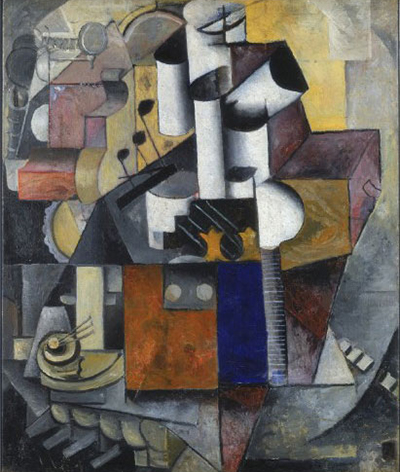
At first glance, Kazimir Malevich's Lamp / Musical Instruments appears to be a compact structure made from pieces of other things. Cylinders, circles, flat angular shapes and dark diagonals overlap; a blue vertical area and yellow passages interrupt a largely grey and brown field. The title suggests a lamp and musical instruments, yet the painting does not present them as easily separable still-life objects. Its parts can be followed without turning each painted shape into a named item. [1] [2]
The Stedelijk Museum Amsterdam catalogues the work under the Dutch title Lamp / Muziekinstrumenten, dates it 1913 and gives it object number A 7680. An original Stedelijk-associated collection catalogue cites an earlier publication that describes this same numbered work as oil on canvas, 83.5 × 69.5 cm. The museum's accessible online object text does not itself state the material or measurements. Keeping the two kinds of source distinct is important here, because nearby drawings have almost the same titles. [1] [2]
At a Glance
- ArtistKazimir Malevich
- Museum titleLamp / Muziekinstrumenten
- English titleLamp / Musical Instruments
- Date1913 in the Stedelijk record
- MaterialOil on canvas according to the 2013 collection catalogue's reference to Andersen 1970; omitted from the accessible online item
- Measurements83.5 × 69.5 cm in the catalogue's Andersen reference; not specified in the accessible current item
- CollectionStedelijk Museum Amsterdam
- Object numberA 7680
Contents
- How the picture holds together
- A 1913 experiment before the black square
- The painting and the similarly named drawings
- Looking beyond the title
- Following the pale forms
How the picture holds together
The composition is busy, but its colours and directions give it order. Tall pale forms near the centre meet several diagonal black divisions. Small circles and larger curves draw the eye across the lower left, while yellow areas recur at the top and within the body of the picture. The dark blue vertical patch has a weight unlike the adjacent browns and greys. Rather than forming one uninterrupted outline, these passages make the viewer move between partial outlines. [1]
The title is a guide, not a key that unlocks every fragment. A rounded form might be read as a part of a lamp or an instrument; a straight dark piece might look like a neck, support or shadow. The painting lets those suggestions coexist. There is no need to identify a particular musical instrument to notice how curved and straight pieces work against one another. The older text on this route called some marks piano keys and musical notation, but the consulted object sources do not identify them as such. [1] [2]
Many boundaries seem to change function as they cross another area. A diagonal can divide one shape and appear to connect another. Pale cylindrical forms suggest volume, while flatter coloured planes press forward without settling into a consistent depth. This tension between rounded volume and shallow arrangement is a useful way to look at Malevich's Cubo-Futurist work. It is a visual description of this canvas, not a claim that the work conceals a finished diagram of a room or performance. [1] [4]
The limited strong colour matters too. Yellow and blue stand out because much of the composition is carried by muted tones, dark edges and light greys. The colours make selected forms easy to find, then the dense crossings complicate the first impression of separation. Malevich did not need a uniform monochrome surface to experiment with the independence of shapes; this 1913 picture approaches the question through overlap and fragments. [1]
A 1913 experiment before the black square
Centre Pompidou places Malevich's development of Cubo-Futurism in 1913, describing a synthesis of the geometric construction associated with French Cubism and tendencies of Italian Futurism. That account gives a useful period setting, but it does not say that every shape in Lamp / Musical Instruments corresponds to a named borrowing from either school. The painting itself offers the more precise starting point: recognisable subject words in the title, fractured forms on the canvas and an unsettled relation between the two. [4]
The date also keeps this work apart from Black Square. The first painted square became public at the end of 1915 as part of Malevich's Suprematist presentation. In Lamp / Musical Instruments, by contrast, the two subject nouns still matter even as the painting breaks their conventional outlines apart. A reader can see formal questions that Malevich would pursue further without pretending that this canvas was already a Suprematist work or that the later painting was its inevitable destination. [1] [4] [5]
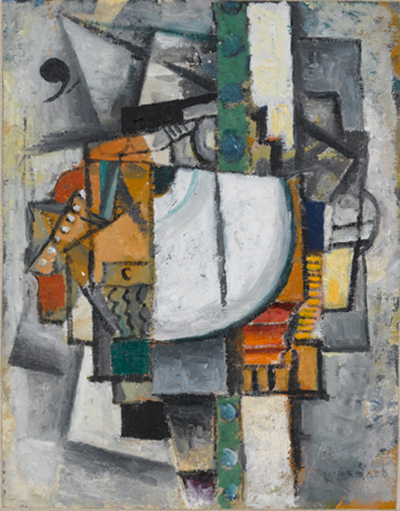
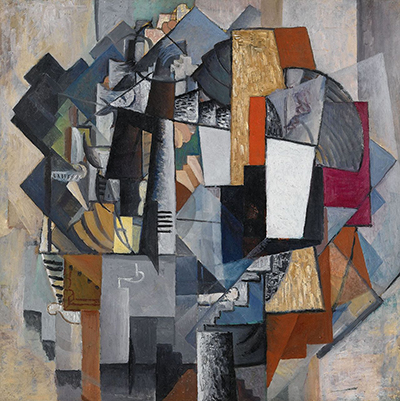
Malevich made several works around instruments, rooms and figures during these years. The overlap in titles makes it tempting to merge them. The Stedelijk-associated catalogue is particularly useful because it names two separate drawings and a small oil painting with piano in the same group of entries. Their existence shows a continuing subject area, not several records for one physical canvas. [2]
The painting and the similarly named drawings
The Stedelijk's painting A 7680 is the object discussed on this page. In the 2013 Khardzhiev collection catalogue, Muziekinstrument is a small pencil-on-paper drawing, accession 4.2001(017), listed as entry 438. Its reverse carries a sketch for a samovar. The entry's references mention the separate A 7680 painting. It would be easy to read that reference as if 438 were the painting's own catalogue entry, but the stated medium, dimensions and accession establish that the listed object is the drawing. [1] [2]
Entry 439 is another pencil-on-paper sheet, Muziekinstrumenten, accession 4.2001(097). The catalogue dates its composition 1913–14 and records an earlier date written on the sheet. Entry 440 is a still different oil-on-canvas work, Cubo-Futurist Composition with Piano, accession 4.2001(088). The near-matching words “musical instrument,” “instruments” and “piano” therefore cross multiple media and works. The museum numbers prevent a visual comparison from becoming a false identity claim. [2]
There is a measurement question too. The legacy page gave 87.5 × 73.5 × 5 cm without an object-specific cited record. The 2013 catalogue's reference to the A 7680 painting gives 83.5 × 69.5 cm and oil on canvas. The accessible Stedelijk online item supplies no measurements to adjudicate the difference. The larger figures might concern an overall presentation, but neither consulted source says so. This page prints the documented catalogue measurement with its attribution instead of inventing an explanation. [1] [2]
Looking beyond the title
Museum.nl includes Lamp/Musical Instrument in a Stedelijk presentation of Malevich's work alongside An Englishman in Moscow and Supremus No. 50. Such a display can make the change across only a few years unusually clear: this crowded, object-suggesting 1913 canvas stands near later paintings that organize colour and shape without an equally legible still-life prompt. The Museum.nl page is a dated description of a display, not a guarantee that all those works will always be hanging together. [3]
The most rewarding first question in front of A 7680 may be simple: how many different ways can the same curved or straight passage be read as the eye moves around it? The title opens an association with domestic light and music, while the painting prevents that association from settling into a conventional still life. That conflict makes the work a specific episode in Malevich's early experiments, not merely a preparatory illustration for the more famous square. [1] [4]
Following the pale forms
The tall pale elements give the eye something to return to after looking at the crowded intersections nearby. Follow one edge until it meets a black diagonal, then carry that diagonal across the composition. It leads into a set of smaller boundaries that are harder to treat as the sides of a single solid object. From there the large curves in the lower part of the canvas turn the eye again. This route through the painting holds together even when the identity of the objects remains uncertain. [1]
The drawings in the Khardzhiev catalogue offer a second way to approach those boundaries. Their size and pencil medium make line central to how they describe an instrument. In A 7680, boundaries can also be made by a change of colour, by a dark edge over a light plane or by shading within one of the larger rounded forms. The different catalogued media put the comparison on firmer ground than a search for one identical instrument in every picture. [1] [2]
Frequently Asked Questions
Where is the painting?
It is catalogued by the Stedelijk Museum Amsterdam as object A 7680. Confirm current display arrangements with the museum before visiting. [1]
When was it made?
What is it made of and how large is it?
A Stedelijk-associated catalogue cites oil on canvas and 83.5 × 69.5 cm for A 7680 in an earlier publication. The accessible current online item omits both medium and dimensions, so the page attributes these details to the catalogue rather than presenting them as newly verified owner measurements. [1] [2]
Is the small Musical Instrument drawing the same work?
No. The 2013 catalogue identifies Muziekinstrument 4.2001(017) as pencil on paper, with dimensions far smaller than the A 7680 painting. Its entry references the painting but does not turn the sheet into that canvas. [2]
Does the picture show piano keys or written music?
Discussion
Which shapes suggest a lamp or an instrument to you, and where does that reading break down?
Follow one diagonal through the picture. Does it separate forms or join them?
Reader Insights
The Stedelijk identifies this painting as A 7680 and dates it 1913.
A collection catalogue distinguishes two similarly titled drawings from the painting.
The title suggests objects, while many painted parts remain open to interpretation.
Join the Conversation
Share a close observation or an object-specific source for Stedelijk A 7680.
References
- Stedelijk Museum Amsterdam, Lamp / Muziekinstrumenten, A 7680: owner item for title, 1913 date and accession; accessible text omits medium and dimensions. View source.
- Stedelijk/Khardzhiev collection catalogue, 2013, printed p. 337, entries 438–440: the original catalogue sample distinguishes the two drawings and piano painting; entry 438's Andersen 1970 reference identifies A 7680 as an 83.5 × 69.5 cm oil-on-canvas painting. View source.
- Museum.nl, “Works of Kazimir Malevich” at the Stedelijk Museum: identifies Lamp/Musical Instrument within a museum presentation; display status is subject to change. View source.
- Centre Pompidou, Kazimir Malevich educational dossier: institutional period context for Cubo-Futurism around 1913, not an object record for A 7680. View source.
- State Tretyakov Gallery, Black Suprematist Square (1915), inv. 11925: owner record for the distinct later canvas and its 1915 exhibition context. View source.



