 by Tom Gurney
Tom Gurney BSc (Hons) is an art history expert with over 20 years experience
Published on June 19, 2020 / Updated on November 20, 2026
Email: tomgurney1@gmail.com / Phone: +44 7429 011000
Introduction
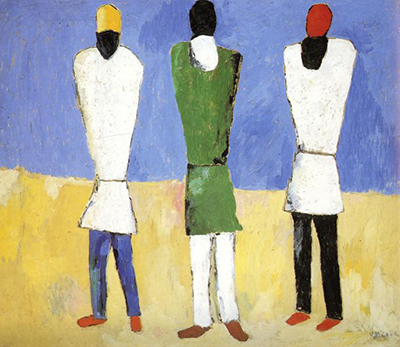
Three people stand in a row against an expanse of blue and a strip of yellow ground. Their faces are dark and featureless. The outer figures wear white tunics; the central figure wears green. This is the Peasants reproduced as figure 5 in Ann Hoenigswald's National Gallery of Art conservation study and as figure 6 in Marie Gasper-Hulvat's doctoral research. Both identify the holder as the State Russian Museum. Gasper-Hulvat records its inventory number as Ж-9480 and dates it 1928–1929. [1] [2]
The local URL contains “1932” because of an inherited title. That date should not be treated as a secure making year. Hoenigswald's caption uses circa 1928; Gasper-Hulvat uses 1928–1929; some online image catalogues give circa 1932. The first two are directly illustrated scholarly studies of this exact three-figure object and make a late-1920s date the better-supported editorial choice. [1] [2] [5]
At a Glance
- ArtistKazimir Malevich
- WorkPeasants (three full-length figures)
- DateCirca 1928; also catalogued 1928–1929 in illustrated scholarship
- MediumOil on canvas, according to a conservator who examined the work
- HoldingState Russian Museum, Saint Petersburg
- InventoryЖ-9480, reported in Gasper-Hulvat's illustrated research
- Size77.5 × 88 cm in later reproductions; not confirmed against a directly accessible owner item
- Distinct workRussian Museum Peasants, Ж-9398, circa 1930, two figures
Contents
- What do the three figures show?
- How was the painting made?
- When was it painted?
- How does it relate to the second peasant cycle?
- Which Peasants is this?
- Repeated bodies and a single figure
What do the three figures show?
Malevich gives each person a narrow, upright body without a clearly modelled arm. White garments flank a green one; black legs below them end in small dark or reddish shoes. The left head has yellow above a black face, the middle is black, and the right has red above black. Their bodies meet the same yellow ground, yet none appears to interact with the others. [1] [2]
The figures’ orientation is difficult to settle from their simplified bodies and dark, featureless heads. Their poses suggest stillness or waiting. The picture does not supply a named place, action or identity for any sitter. Calling them actual workers from a specific farm would go beyond the illustrated records. [1] [2]
The composition is broad and shallow. A horizontal division separates blue from yellow behind the bodies. Unlike a conventional landscape, it gives little depth: no road, village or distant horizon detail tells us how far away anything is. The three tunics become the strongest shapes against the blue. The white ones almost mirror each other, while the green centre both joins and interrupts their rhythm. [1] [2]
How was the painting made?
Hoenigswald examined this painting for a National Gallery of Art conservation study. She reports that Malevich left much of a brownish ground exposed and that drawing in pencil and brush remains visible. A colour detail of the right figure shows those marks near the edge of its white garment. She argues that the matte character of the materials makes an intended varnish unlikely. The last point is her conservation inference, not a surviving instruction from Malevich. [1]
These observations matter because the image can look deceptively like a set of flat coloured cut-outs. The photographed detail shows active drawing and paint edges, while exposed ground changes how the white, blue and ochre areas meet. The surface has a material history that a small reproduction cannot fully show. Readers should not transfer these specific findings to every painting called Peasants. [1]
The measured size often circulated for this three-figure work is 77.5 × 88 cm. Because no directly accessible Russian Museum item for Ж-9480 was found in this review, that measurement is attributed to later cataloguing rather than presented as independently checked owner data. The Russian Museum's online item for Ж-9398 belongs to the separate two-figure work and cannot fill this gap. [3] [5]
When was it painted?
The illustrated 1996–97 conservation study captions the three-figure Peasants “c. 1928.” Gasper-Hulvat's 2012 dissertation captions it “1928–1929” and places it among works Malevich made while constructing a revised chronology of his career for the 1929 Tretyakov exhibition. Her study explains how early dates on some late works have required re-examination; this painting's date is part of that wider scholarly chronology. [1] [2]
The inherited “1932” in this site's URL and in several online image databases is therefore retained only as a locator for existing links. It does not override the illustrated studies. The exact day or month of production is unknown from the material reviewed here. [1] [2] [5]
How does it relate to the second peasant cycle?
The Russian Museum describes Malevich's 1928–1929 return to peasant subjects as a meeting of Suprematist lightness with recognizable human forms. Its account of Head of a Peasant is context for the period, not a catalogue entry for this particular three-figure canvas. [4]
In this painting the frontal figures and bands of colour create a tension between people and abstract design. The blue can be read as sky, but it also acts like a flat colour plane. The white and green tunics identify bodies while forming a repeated geometry. That gives viewers a way to compare the work with Malevich's earlier Suprematist compositions without claiming that it depicts a specific abstract shape or completes a planned sequence. [1] [2] [4]
The facelessness invites historical interpretation, especially given the upheaval of rural life under collectivization. A careful account distinguishes that context from proof of an intended message for Ж-9480. No object-specific statement by Malevich about the identities or fate of these three people has been established in the checked sources. The painting's visible stillness and missing facial detail are secure observations; whether they express oppression, universality, mourning or another idea remains interpretive. [1] [2] [4]
Which Peasants is this?
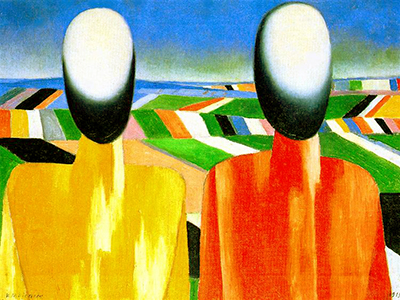
The other Peasants page shows two large, faceless figures in yellow and red over patterned fields. The Russian Museum catalogues that canvas as Ж-9398, circa 1930, 53 × 70 cm. The present work has three full-length figures, a green centre and an almost bare blue-and-yellow ground. They are not versions identifiable by title alone. [1] [3]
This distinction also protects conservation claims. Hoenigswald's exposed-ground and underdrawing observations belong to the three-figure painting illustrated in her figure 5. They should not be attached to Ж-9398 simply because both works are called Peasants in English. [1] [3]
Repeated bodies and a single figure
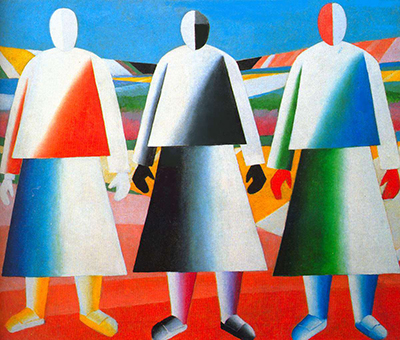
A separately accessioned Peasant in the Field offers a reference for the role of repetition here. The Russian Museum identifies that painting as Ж-9479. A single figure can give a field a central upright around which the land is read. In the three-figure Peasants, the spaces between the figures are also part of the structure. Each is narrow enough to hold the figures together and open enough to show the field through the group. A viewer encounters the three bodies as a line before turning to the details of any individual. [1] [2] [6]
That line also makes differences among the heads more prominent. Reading across the canvas gives a sequence of colours where another painting might make a sequence of facial expressions. The repeated stance makes that variation easier to see without settling who the figures were meant to represent. The NGA’s examination helps bring the physical making of the group back into the comparison. The outlines and internal divisions are decisions made on the canvas, as well as features of the depicted bodies. [1] [2]
Frequently Asked Questions
Was this painted in 1932?
Are the three people identified?
What is the medium?
Hoenigswald calls the work oil on canvas and describes its surface from conservation examination. [1]
Is this the same painting as the two-figure Peasants?
Where is it held?
Discussion
How do the three figures differ in colour and posture?
What effect does the nearly empty blue ground have on their stillness?
Reader Insights
Compare the white outer tunics with the green centre.
Look for places where drawing remains visible near the garments.
How do these three figures differ from the separate two-figure Peasants?
Join the Conversation
Share a close observation or a source-backed detail about Russian Museum Ж-9480.
References
- Ann Hoenigswald, “Kazimir Malevich's Paintings: Surface and Intended Appearance,” National Gallery of Art, Conservation Research 1996/1997, pp. 109–125: exact image in fig. 5, captioned circa 1928, oil on canvas, State Russian Museum; direct technical observations on p. 112. View source.
- Marie E. Gasper-Hulvat, Malevich's Post-Suprematist Paintings and the Construction of History, Bryn Mawr College dissertation, 2012: fig. 6 identifies the three-figure image as Russian Museum Ж-9480 and dates it 1928–1929; introductory dating discussion. View source.
- State Russian Museum, Peasants, Ж-9398: illustrated owner record for a different, two-figure painting. View source.
- State Russian Museum, Head of a Peasant, Ж-9488: museum's contextual account of the second peasant cycle, not a record for Ж-9480. View source.
- WikiArt, Peasants, circa 1932: example of the later date and reported dimensions in secondary online cataloguing; not used to override illustrated scholarly dating. View source.
- State Russian Museum, Peasant in the Field, Ж-9479: separate one-figure canvas for comparison. View source.