 by Tom Gurney
Tom Gurney BSc (Hons) is an art history expert with over 20 years experience
Published on June 19, 2020 / Updated on November 20, 2026
Email: tomgurney1@gmail.com / Phone: +44 7429 011000
Introduction
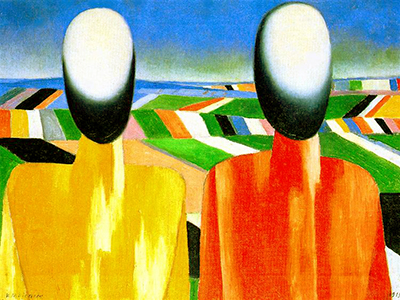
Two figures fill the foreground of Kazimir Malevich's Peasants. Their shirts blaze yellow and red, but neither pale, elongated head has a face. Behind them, coloured fields stretch across a narrow strip beneath a blue sky. The site image matches the State Russian Museum's illustrated Ж-9398, catalogued as circa 1930, oil on canvas, 53 × 70 cm. That accession matters because several late Malevich paintings share titles involving peasants and faceless figures. [1]
The simple arrangement is unusually forceful. The figures stand close enough to dominate the picture, yet their blank heads withhold the individual expressions a double portrait might promise. The small landscape is broken into slanting bands of green, orange, black and white. It feels both like cultivated land and a continuation of Malevich's interest in large painted shapes. The Russian Museum reads the picture as an image of the troubled fate of the peasantry. That interpretation belongs to the museum and is discussed below alongside what a viewer can actually see. [1] [2]
At a Glance
- ArtistKazimir Malevich
- Museum titlePeasants (Russian: Крестьяне)
- DateCirca 1930
- MediumOil on canvas
- Dimensions53 × 70 cm
- CollectionState Russian Museum, Saint Petersburg, Ж-9398
- CompositionTwo faceless foreground figures before striped fields and a blue sky
- Identification cautionA conservation study's different Peasants shows three full-length figures
Contents
- Which Peasants painting is this?
- Looking closely at the two figures
- The landscape behind them
- How has the Russian Museum interpreted the work?
- From Suprematism to late figuration
- Collection record and limits
- Where the two heads meet the sky
Which Peasants painting is this?
The Russian Museum's record for Ж-9398 reproduces the same image as this page: two tall heads, one yellow shirt, one red shirt and a low, highly patterned field. Its short catalogue line gives the title Peasants, approximate 1930 date, oil medium and 53 × 70 cm size. These are claims about a specific canvas, not a title-only match. [1]
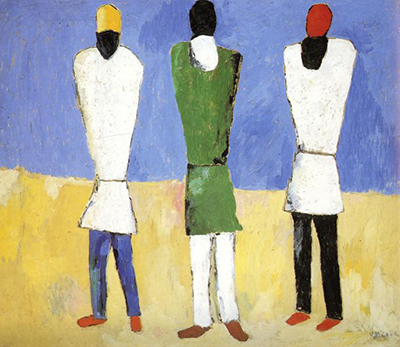
An especially useful warning comes from Ann Hoenigswald's National Gallery of Art conservation study. It also illustrates a Russian Museum work titled Peasants and discusses a brown ground and visible underdrawing. But its figure shows three full-length people, standing against a much simpler field. It is not the two close-up figures on this page. The study's technical observations must not be repeated as if they were tests of Ж-9398. Its circa-1928 date likewise belongs to that separate pictured work. [3]
Another related but different work, Two Peasant Women (1928–30), was exhibited at the Zimmerli Art Museum as a loan from the Encyclopedia of the Russian Avant-Garde project. The museum describes an orange-and-black figure and a white-and-brown figure walking in a field. That composition, collection history and title do not identify the Russian Museum's Ж-9398. [4]
Looking closely at the two figures
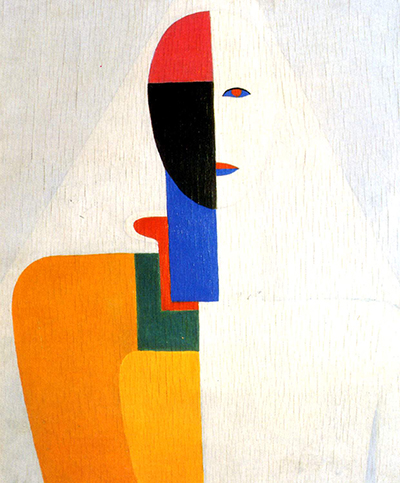
The figures are cropped at the lower edge, so they read almost as busts rather than people walking through a scene. One stands at left in bright lemon yellow; the other stands at right in orange-red. They are similar in scale and posture, a pair rather than a foreground person with a distant companion. Their pale oval upper heads narrow into deep dark lower sections where faces would usually appear. No eyes, mouths or noses locate an individual gaze. [1]
At the same time, the bodies are not interchangeable. The yellow shirt has streaks and patches of light, and its edges shift near the shoulders. The red shirt is warmer and more continuous, with an orange area through the middle. Their long necks connect the blank heads to broad shoulders. The colour boundary between them keeps the pair distinct even though their missing features resist ordinary portrait identification. [1]
The painting does not show their hands. The museum's interpretive text speaks of helplessly lowered arms, but at this crop the lower bodies pass out of view. It is safer to observe the still upright posture and absence of visible hands than to invent a precise gesture. We also cannot establish from the image whether these were portraits of two named sitters or generalized figures. [1] [2]
The landscape behind them
Malevich places the people against a compressed horizontal landscape. A band of dark blue separates the lower sky from the land. Beneath it, small rectangles and diagonal stripes create fields that stretch left and right. Green and yellow suggest crops or open land, while orange, black and white interrupt them with strong graphic contrast. A narrow strip of bright blue sky remains above the heads. [1]
This is not a detailed topographic view. There is no named village, farm, season or weather event in the museum's object record. The repeated bands help us read the setting as agricultural, while their geometric regularity also makes the background a painted pattern. Seen beside the large shirts, the landscape has a different scale: the people appear monumental, the fields unusually shallow and distant. [1]
The colour arrangement drives an unsettling visual contradiction. Yellow and red are lively and radiant, yet the ovals above them are blank. The fields seem ordered, but the figures supply no reassuring activity. A viewer may read that contrast as vulnerability, alienation or a more open kind of human universality. Those are interpretations of the composition, not facts supplied by a written statement of the artist's intent for Ж-9398. [1] [2]
How has the Russian Museum interpreted the work?
The museum's Russian-language commentary places Peasants within Malevich's later peasant cycle and associates its mood with repression of rural people and his own difficult circumstances. It singles out the brilliant lemon and fiery red shirts, the faceless figures, deserted land, cold blue sky and strict horizontal ordering. It describes the result as tragic or oppressive. This is a valuable institutional reading, but its statements about emotion and historical meaning should be attributed rather than treated as visible facts. [2]
The broader historical connection is plausible but should stay precise. The National Museum of the Holodomor in Kyiv likewise interprets faceless or armless figures in Malevich's late peasant imagery as responses to violent collectivization. Its article discusses several works, including a particular drawing with signs replacing faces; it does not identify Ж-9398 as a documentary depiction of a specific famine event. The Russian Museum's circa-1930 date also predates the 1932–33 Holodomor. The work can be discussed in relation to the era's violence without claiming that its two figures represent named victims or a documented scene. [1] [2] [5]
The Zimmerli Museum describes its different Two Peasant Women as part of Malevich's second peasant cycle, connecting late-1920s rural figures to his much earlier interest in peasant subjects, avant-garde form and icon painting. That context helps explain why figuration and broad colour coexist in Ж-9398. It does not collapse the two distinct paintings into one. [4]
From Suprematism to late figuration
In 1915 Malevich made the non-objective Black Square central to Suprematism. The 1930 Peasants restores recognizable bodies and an agricultural setting, but it keeps colour, shape and the relation between foreground and ground visually decisive. The yellow and red areas could almost be read first as tall painted planes; only then do their shoulders and necks lock them into figures. [1] [6]
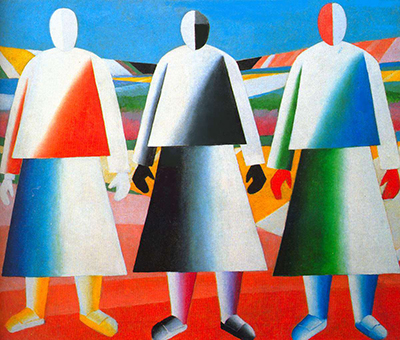
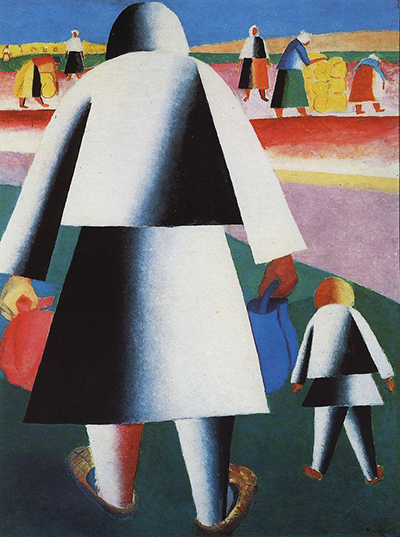
Other late paintings in this cluster offer useful comparisons. Girls in a Field sets more figures against broad rural bands. At Harvesting (Marfa and Vanka) puts an adult and child into a different field arrangement. Their titles and figure counts do not turn them into versions of Ж-9398, but comparing them shows how Malevich repeatedly adjusted the balance between geometric land and human form. [1]
Collection record and limits
The Russian Museum's object page says the work came from Malevich's heirs in Leningrad in 1936 and records a 1977 transfer to the USSR Ministry of Culture. The abbreviated catalogue note does not explain every step of possession or display. The current museum page identifies the work as part of its online collection; it should not be expanded into an invented exhibition history or a precise present gallery location. [1]
The 400-pixel site reproduction lets readers compare the two figures and the patterned field, but it is too small to establish brush depth, ground colour, underdrawing or varnish. The often-cited technical study examines a different same-title composition, so any material claim about this canvas would require object-specific conservation evidence. [1] [3]
Where the two heads meet the sky
The pale upper areas of the heads let their outlines stand out without filling them with the details ordinarily used to recognize an individual. Below, the two shirts are such strong fields of colour that a viewer can follow the figures downwards before looking beyond them to the land. Moving in the opposite direction, from the narrow stripes of the field to the larger areas of clothing, makes clear how much those two bodies interrupt the landscape. They set a scale for the field without giving the viewer a legible gesture or an exchange of glances to explain the encounter. [1] [2]
The separately examined three-figure Peasants gives the viewer more room to see whole bodies. Here the broad shoulders and close crop make the two heads relatively large presences in the painted field. The technical study of the three-figure canvas is useful when comparing how the two compositions have been described, but does not establish the ground or underdrawing in this closer view. The shared title names a related subject and the two surviving paintings organize that subject differently. [1] [3]
Frequently Asked Questions
When was it painted?
The Russian Museum dates the two-figure canvas circa 1930. “Circa” signals an approximate date, not a documented day or year of completion. [1]
Why do the peasants have no faces?
The absence is visible, but the museum's record does not quote an object-specific explanation from Malevich. The museum interprets the blank figures and landscape as conveying tragedy and oppression. Other viewers may see a wider statement about anonymity or vulnerability; such readings should be presented as interpretations. [1] [2]
Is this the Peasants studied by the National Gallery of Art conservator?
Where is the painting?
It is catalogued by the State Russian Museum, Saint Petersburg, as Ж-9398. The checked online record does not establish whether it is currently on view. [1]
Discussion
What changes in your reading of the paired figures when neither face offers an expression?
How do the yellow and red shirts relate to the narrow bands of fields behind them?
Reader Insights
Notice how little of the bodies is shown. Does the crop make the figures feel nearer or more monumental?
Trace the horizontal and diagonal divisions of the land. Where does it stop reading as a landscape and start reading as a pattern?
The museum describes a tragic mood. Which visible features support or complicate that interpretation for you?
Join the Conversation
Share a close observation or a source-backed detail about Russian Museum Ж-9398.
References
- State Russian Museum, Peasants, Ж-9398: illustrated owner record for identity, circa-1930 date, oil on canvas, 53 × 70 cm, acquisition line and collection. View source.
- State Russian Museum, Крестьяне, Ж-9398, Russian-language interpretation: owner's reading of the colours, faceless figures, landscape and historical mood. View source.
- Ann Hoenigswald, “Kazimir Malevich's Paintings: Surface and Intended Appearance,” National Gallery of Art, Conservation Research 1996/1997, pp. 109–125: figure 5 is a different three-figure Peasants, used here to prevent false transfer of technical findings. View source.
- Zimmerli Art Museum, “Late Painting by Kazimir Malevich Now on View at Zimmerli”: identifies a different Two Peasant Women and discusses the second peasant cycle. View source.
- National Museum of the Holodomor, “Where hammer and sickle are, there are death and famine”: institutional interpretation of related late peasant imagery; not an item record for Ж-9398. View source.
- Smarthistory, Charles Cramer and Kim Grant, “Suprematism, Part I: Kazimir Malevich”: historical context for comparing 1915 Suprematism with later figuration. View source.