


 by Tom Gurney
Tom Gurney BSc (Hons) is an art history expert with over 20 years experience
Published on June 19, 2020 / Updated on November 20, 2026
Email: tomgurney1@gmail.com / Phone: +44 7429 011000
Introduction
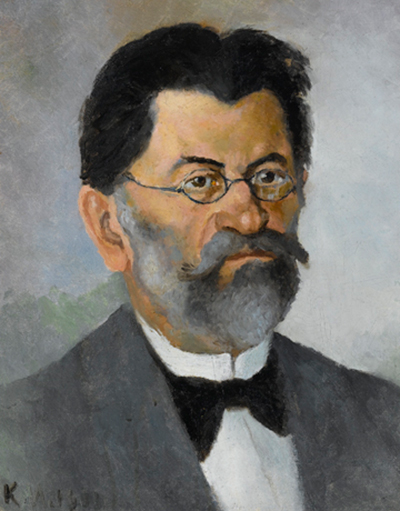
Before the fractured instruments and black squares for which he became famous, Kazimir Malevich painted this close portrait of his father. The man faces slightly to the viewer's right. Round spectacles, a dark moustache, a greying beard and a black bow tie give the head and upper body a precise, contained appearance. The Stedelijk Museum Amsterdam identifies the sitter through the title Portret van de vader van de kunstenaar and dates the work circa 1902–03. Its object number is 4.2001(086). [1]
The site's inherited image matches the Stedelijk's pictured object. Entry 399 of the 2013 Khardzhiev collection catalogue identifies it as oil on canvas, records an undated lower-left signature, and gives the sitter's name through cited scholarship as Severyn Malewicz (1845–1902). The catalogue also reports a photographic model for the painting, but that point is attributed there to Andréi Nakov's earlier research. The photograph itself has not been examined for this article. [1] [2]
At a Glance
- ArtistKazimir Malevich
- Museum titlePortret van de vader van de kunstenaar
- English titlePortrait of the Artist’s Father
- DateCirca 1902–03
- SitterMalevich’s father, identified in cited scholarship as Severyn Malewicz
- MediumOil on canvas, 2013 Khardzhiev catalogue
- Dimensions61 × 51.9 × 6.6 cm, current museum page; 44.8 × 34.8 cm, 2013 catalogue
- Object number4.2001(086)
- Holding creditKhardzhiev Foundation loan at the Stedelijk Museum Amsterdam
Contents
- Looking at the portrait
- Who was the sitter?
- The reported photographic source
- Two dimension records, one painting
- The portrait within Malevich's career
- The portrait and the photograph as separate objects
Looking at the portrait
The head fills much of a vertical rectangle. Dark hair rises against a quiet grey background, and the top of the suit is cut off by the lower edge. Malevich gives attention to the sitter's glasses: their thin, nearly circular frames sit across the eyes and cast delicate dark lines against the face. The beard is broader and softer, mixing grey and dark tones. That difference makes the eyes and mouth unusually easy to locate within a restrained palette. [1]
The sitter does not look squarely out at us. His gaze moves slightly to one side, and the shoulders turn with the head. A white collar and shirt break up the dark jacket, while the bow tie sits near the centre. The background shifts from grey to a muted greenish area around the left shoulder. Nothing in the cited object records identifies the exact room or backdrop; the visible colours are enough to describe it. [1]
At the lower left is a mark that the 2013 catalogue transcribes as Malevich's signature. The catalogue says it is not dated, which is different from saying the entire painting lacks a date in modern scholarship. Its circa 1902–03 dating comes from research and comparison, not a year written beside that signature. The published transcription supplies the evidence for its wording. [1] [2]
Who was the sitter?
The museum's public title calls him the artist's father. The Khardzhiev catalogue's entry cites Nakov's identification as Severyn Malewicz (1845–1902). The Polish spelling of the family name is retained here because that is how the cited passage writes it. These details make the subject more specific than an anonymous gentleman's likeness, but they do not supply an independent account of his character or the precise occasion for the painting. [1] [2]
The same catalogue discusses Malevich's Polish Catholic parents and his family's move toward Moscow after his father's death. Those passages can situate the portrait within family history, yet they should not be used to invent a scene of Malevich painting his father from life. The photographic-source argument makes a posthumous date possible. It is presented by the catalogue as a scholarly conclusion from Nakov's comparison, not as a direct statement by Malevich in the object record. [2]
The reported photographic source
Entry 399 quotes Nakov's 2002 catalogue: a copy of a photograph of Malevich's father, made by the V. Rastanov studio in Kyiv, is reportedly in the Tretyakov Gallery archives. According to that quoted analysis, the painting closely follows the photograph, implying that Malevich worked from it after his father's death in 1902. This is a more precise account than a generic claim that the portrait “looks photographic.” It remains one scholarly argument relayed in a later catalogue until the archived photograph and Nakov's complete entry can be inspected directly. [2]
The reported source also changes how to read the averted gaze and controlled pose. They might reflect the conventions of a studio photograph as well as the painter's choices. But the image on this page alone cannot show exactly what Malevich copied, altered or omitted. The catalogue's quoted comparison supports the existence of a proposed relationship; it does not justify describing unseen photographic details. [2]
Two dimension records, one painting
The Stedelijk's current item page prints 61 × 51.9 × 6.6 cm. The 2013 Khardzhiev catalogue gives 44.8 × 34.8 cm. Both identify the same title, approximate date and accession, 4.2001(086). The records do not state why their measurements differ, or whether one includes frame or mounting. The third current measurement should not automatically be treated as the canvas thickness. [1] [2]
The difference belongs in the article rather than being hidden. When the physical object file is available, the measured components may be clarified. Until then, the catalogue's oil-on-canvas description is secure as a published material statement, while the dimensions should be shown with their respective sources. This is also why an artwork directory should key this portrait to its accession instead of treating a changed size as evidence of another version. [1] [2]
The portrait within Malevich's career
The portrait's direct representation may surprise a viewer who meets Malevich through Black Square. It is an early family image, made roughly a decade before the piano composition and the Suprematist works. The difference is visible: here, recognizable features and clothing organize the composition; later, Malevich would experiment with the construction and eventual removal of recognizable subjects. The portrait demonstrates range in his practice without making it a documented first step toward any specific abstract painting. [1] [2]
The Stedelijk credits this object as on loan from the Khardzhiev Foundation. The museum says Khardzhiev's collection has been in its care since 1998. A public object page is therefore evidence for the museum's cataloguing and custody, not a claim that the museum owns the portrait. The original catalogue adds a richer bibliography, including scholarly datings that do not all agree; this article follows the museum's circa 1902–03 date while acknowledging the cited historical disagreement. [1] [2] [3]
The portrait and the photograph as separate objects
The studio name matters because it tells us what kind of evidence would test the proposed source. A photograph made by the Rastanov studio, an archival copy of that photograph, and Malevich’s oil are physically distinct. The Khardzhiev catalogue relays a comparison with a copy in the Tretyakov archives. A close pose match would substantiate the relationship. It would still leave room to ask what the painter did with the transition from the pale collar to the dark jacket, or with the contrast between the sharply marked glasses and the softer beard. Those passages can be described in the painting while the condition and appearance of the archival image remain to be verified. [1] [2]
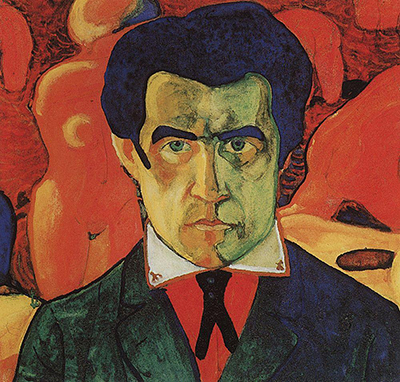
The early Self-Portrait in the Tretyakov Gallery offers a comparison even without the photograph. Its museum caption dates it to 1908–1910 and gives a small sheet worked in watercolour and gouache. The self-portrait turns the head and shoulders into large colour contrasts around a frontal gaze. The earlier portrait, by comparison, gives the glasses and collar much of their definition through narrow differences of tone. Looking at both makes clear how Malevich could shift emphasis within a recognisable likeness. Each object’s material, palette and pose have their own evidence. [1] [2] [4]
Frequently Asked Questions
When did Malevich paint it?
Is the sitter Malevich's father?
Was it painted from a photograph?
The 2013 catalogue quotes Nakov's argument that the canvas follows a Kyiv studio photograph held in copy at the Tretyakov archives. That original archival item has not been checked here. [2]
What medium is it?
The 2013 catalogue identifies oil on canvas. [2]
Why are two sizes reported?
Discussion
How do the thin spectacles and broad beard shape your first impression of the sitter?
Which areas seem tightly described, and which remain quieter or less defined?
Reader Insights
Follow the contrast between the dark jacket and the white collar and shirt.
Notice the turn of the head and gaze away from the viewer.
Keep the reported photographic source separate from what this reproduction alone can establish.
Join the Conversation
Share a close observation or a source tied to this exact portrait, accession 4.2001(086).
References
- Stedelijk Museum Amsterdam, Portret van de vader van de kunstenaar, 4.2001(086): pictured object, translated title, date, current dimensions, accession and Khardzhiev Foundation loan credit. Viewed in a browser on 30 September 2026. View source.
- Frank van Lamoen and Geurt Imanse, Russische avant-garde: de Khardzhiev-collectie, publisher-hosted catalogue sample, PDF p. 9, entry 399 (printed p. 312): oil on canvas, catalogue dimensions, signature and bibliography quoting Nakov's photographic-source argument. This is a 12-page sample of the 2013 catalogue, not the full volume. View source.
- Stedelijk Museum Amsterdam, “Unique Malevich drawing discovered during Stedelijk inventory of the Khardzhiev Collection”: institutional account of the loan collection and its research history. View source.
- Tretyakov Gallery Magazine, Malevich’s Self-Portrait: illustrated comparison, date and medium. View source.



