by Tom Gurney
Tom Gurney BSc (Hons) is an art history expert with over 20 years experience
Published on June 19, 2020 / Updated on November 20, 2026
Email: tomgurney1@gmail.com / Phone: +44 7429 011000
Introduction
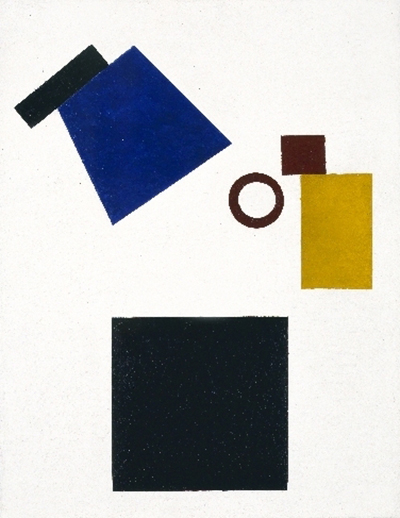
There is no face in Kazimir Malevich's Self-Portrait in Two Dimensions. Against a white field, a large black square stands above a yellow rectangle, a dark ring, a small reddish square and a tilted blue quadrilateral accompanied by a short black bar. The self-portrait is an arrangement of shapes rather than a likeness. The Stedelijk Museum Amsterdam catalogues the painting as Zelfportret in twee dimensies, 1915, accession A 7683. [1] [2]
The title asks what remains of a self-portrait when an artist abandons the recognizable body. It does not authorize assigning each colour a particular facial feature or inventing an autobiographical code. The shapes are visible; their exact relationship to Malevich's appearance is not stated in the checked owner record. [1] [5]
At a Glance
- ArtistKazimir Malevich
- Owner titleZelfportret in twee dimensies
- English titleSelf-Portrait in Two Dimensions; also Suprematism: Self-Portrait in Two Dimensions
- Date1915
- MediumOil on canvas, in MoMA's exhibition checklist
- Dimensions80 × 62 cm, in MoMA's exhibition checklist
- Owner accessionStedelijk Museum Amsterdam A 7683
- Catalogue referenceNakov S-21, as cited by the scholarly image record
- OrientationThe painting has been displayed in opposite orientations; the black-square-upper view is used here
Contents
- What does the painting show?
- Why call it a self-portrait?
- Which way up is Self-Portrait in Two Dimensions?
- Place in Malevich's 1915 work
What does the painting show?
The black square occupies the upper part of a tall white canvas. Its darkness makes it the strongest mass, but it does not fill the entire picture as Malevich's standalone Black Square does. Large stretches of white separate it from the smaller forms below. The result is neither a conventional background nor a depicted room; white is an active interval between shapes. [1] [4]
At the lower left, a bright yellow vertical rectangle overlaps or meets a smaller reddish square. A dark red-brown ring sits to their right. Farther right, the blue quadrilateral tilts and touches a short black diagonal bar. These marks offer different kinds of edge: straight verticals and horizontals, a circular outline, and two angled forms. Their sizes and spacing make the eye move around the surface rather than settle on a single central figure. [4]
The blue shape is especially resistant to a fixed reading. It may look like a square set on a corner, yet its angles and the adjacent black bar make it feel unstable. The ring implies an opening, but it does not reveal a represented space behind the canvas. The painting uses the visual effects of overlap and separation while refusing an ordinary perspectival scene. Those are formal observations of the image, not a deciphered portrait code. [4] [5]
Why call it a self-portrait?
The Stedelijk's Dutch title and MoMA's transliterated Russian title both retain the self-portrait identification. The wording is therefore part of the work's documented identity, even though the painting lacks eyes, nose and mouth. Malevich's 1915 Suprematism shifted attention from depicting objects to the relationships among coloured forms. In that setting, “self-portrait” can be read as a challenge to the usual contract of portraiture: an artist can present a made image of himself without showing his physical likeness. This last sentence is an interpretation of title and image, not a claim to know Malevich's private intention. [1] [2] [5]
The phrase “in two dimensions” directs attention to the canvas as a flat surface. Every square, ring and rectangle is visibly a painted area rather than a modelled body. Some appear to overlap, but none establishes a consistent floor or horizon. The title's word “portrait” pulls the viewer toward identity; “two dimensions” pulls attention back to the painted plane. Their tension is central to the work's effect. [1] [4] [5]
It is tempting to turn the black square into a head, the ring into an eye and the blue quadrilateral into a shoulder. The forms can prompt such associations, but they change when the image is turned. The historically documented change of orientation is a reason to keep those readings exploratory rather than to present them as an artist-approved diagram. [3] [4]
Which way up is Self-Portrait in Two Dimensions?
Reproductions circulate in opposite orientations. In the view shown here, the black square is at the top, the yellow and red shapes at lower left and the tilted blue form at lower right. A photograph of A 7683 in the Stedelijk shows that arrangement in a gallery installation. [1] [4]
The issue is more than a mistaken digital rotation. An image record accompanying T. J. Clark's Farewell to an Idea notes an orientation used at the 1915 0.10 exhibition and again in Moscow in 1919, and says the painting was reversed in Berlin in 1927. That is a documented historical difference in display. The checked source does not prove that every subsequent reproduction or installation followed one fixed orientation. [3]
Turning the picture changes its visual emphasis. With the black square high, that form can feel like a weight above the others. With it low, the dark mass anchors the bottom and the yellow, ring and blue forms appear to rise. The same painted shapes support distinct balances. The work's orientation history helps explain why images of one painting can look so different. [3] [4]
The two orientations also change how the painting is read from left to right. When the black square is high, the lower forms can appear to progress from the vertical yellow block through the ring to the tilted blue shape. Rotating the whole picture reverses that order and brings those forms above the square. The ring still offers a transition from the straight edges on either side of it. The distance between the small forms and the square remains constant. What changes is the position each relation occupies within the viewer’s field. The historical caption and the gallery photograph offer independent ways to identify the arrangement used in each reproduction. [3] [4]
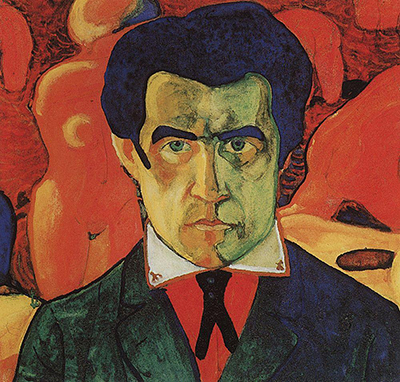
A comparison with Malevich’s early Self-Portrait makes the question of orientation especially concrete. The Tretyakov’s illustrated caption identifies a small work on paper in which the eyes and shoulders immediately establish a way up. A painted face gives the viewer a reference that survives differences in colour reproduction. In the Stedelijk painting, the catalogue title gives the two works a common point of comparison, but the forms supply no equivalent bodily clue to orientation. Even with the black square at the top, its place in the composition depends more on its relation to the edges and the other shapes than on any resemblance to the sitter’s head. [1] [3] [4] [6]
Place in Malevich's 1915 work
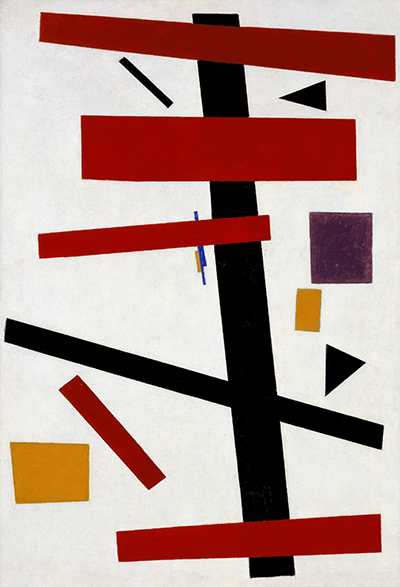
In December 1915 Malevich publicly presented Suprematism at the Last Futurist Exhibition of Paintings 0.10 in Petrograd. MoMA describes this as a shift toward coloured geometric forms against white. Self-Portrait in Two Dimensions belongs to that formative moment, and the scholarly image record links it specifically with 0.10. The owner item's 1915 date and Stedelijk accession identify the canvas; the exhibition history is attributed to that separate scholarly record. [1] [3] [5]
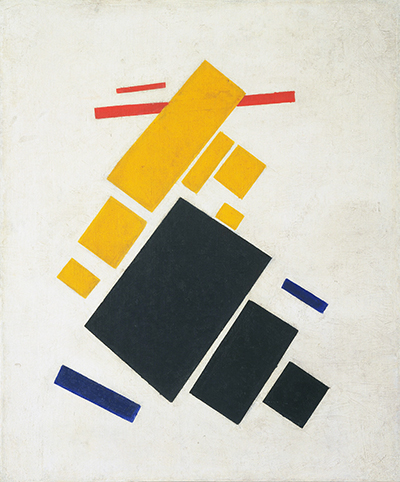
The painting is also useful beside Malevich's Suprematist Composition: Airplane Flying of the same year. Both distribute forms across white, but this canvas has a prominent black square, a ring and a small set of contrasting forms. The word “airplane” in the other title and “self-portrait” here should not be turned into literal depictions. Their titles frame experiments in what painting can suggest when no recognizable object is required. [2] [5]
MoMA's 2012–13 Inventing Abstraction exhibition checklist identifies this work in the Stedelijk collection and lists it as oil on canvas, 80 × 62 cm. The Stedelijk listing establishes its title, date and accession; MoMA supplies the material and size details used here. [1] [2]
Frequently Asked Questions
Is this a portrait of Malevich's face?
Where is the original painting?
What is its medium and size?
MoMA's Inventing Abstraction checklist gives oil on canvas, 80 × 62 cm. [2]
Why do some pictures look upside down?
Was it shown at the 1915 0.10 exhibition?
The scholarly image record notes an orientation for 0.10 and Moscow in 1919, then a reversal in Berlin in 1927. That supports a historical link to the 1915 exhibition, while its exact catalogue details should be traced to the cited exhibition scholarship. [3]
Discussion
What makes this arrangement a self-portrait even though it has no face?
How does the balance change when you imagine the canvas turned around?
Reader Insights
Compare the black square's visual weight with the open white field around it.
Follow the interval between the yellow rectangle, ring and tilted blue form.
Historical installations used different orientations for this one canvas.
Join the Conversation
Share a close observation or a source-backed note about Stedelijk A 7683.
References
- Stedelijk Museum Amsterdam, Zelfportret in twee dimensies, A 7683: owner item for accession, title and 1915 date. View source.
- Museum of Modern Art, Inventing Abstraction, 1910–1925 exhibition checklist: lists this Stedelijk painting under its transliterated Russian title, with oil-on-canvas medium and 80 × 62 cm size. View source.
- A&AePortal, image record for Suprematism: Self-Portrait in Two Dimensions in T. J. Clark, Farewell to an Idea: scholarly publication metadata for accession, material, size and historical orientation; full chapter not consulted. View source.
- Wikimedia Commons, photograph of Stedelijk A 7683 in the museum: installation view used to check the black-square-upper orientation and composition, not a source for historical provenance. View source.
- Museum of Modern Art, Suprematist Composition: Airplane Flying: museum account of the December 1915 presentation of Suprematism and a separate same-year painting. View source.
- Tretyakov Gallery Magazine, illustrated caption for Malevich’s early Self-Portrait: separately identified 1908–1910 work on paper for comparison. View source.