


 Kazimir Malevich.jpg)
 by Tom Gurney
Tom Gurney BSc (Hons) is an art history expert with over 20 years experience
Published on June 19, 2020 / Updated on November 20, 2026
Email: tomgurney1@gmail.com / Phone: +44 7429 011000
Introduction
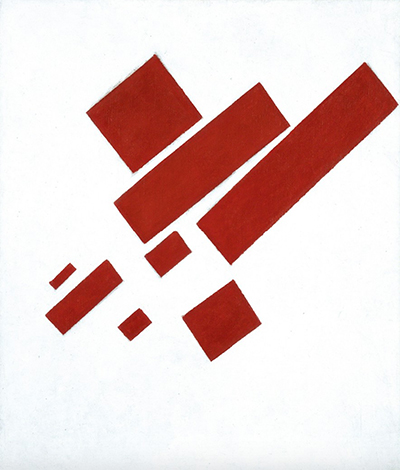
The many coloured forms in Kazimir Malevich's Suprematism seem to move in several directions at once. A large yellow quadrilateral presses into a red and violet arc near the upper left; a black diagonal cuts across the lower half; small bright marks gather at the right edge. The State Russian Museum catalogues the painting as Suprematism, dates it 1915, and gives it inventory number ЖБ-1332. Its object record specifies oil on canvas and 87.5 × 72 cm. The preserved image on this page matches the museum's reproduction of that particular composition. [1] [2]
That inventory number matters because “Suprematism” names both Malevich's art movement and several of his paintings. The Russian Museum itself has another Suprematism dated 1915–16 and numbered ЖБ-1408, with different dimensions. The two titles alone cannot identify a canvas, and facts for one should not migrate to the other. This page concerns the tall, crowded composition numbered ЖБ-1332. [1] [3]
At a Glance
- ArtistKazimir Malevich
- TitleSuprematism; this page's “(1915)” distinguishes the dated work
- Date1915, as catalogued by the State Russian Museum
- MediumOil on canvas
- Dimensions87.5 × 72 cm
- CollectionState Russian Museum, Saint Petersburg, ЖБ-1332
- Recorded museum entry1926, through GINKhUK and the Museum of Artistic Culture collection
- SubjectNonobjective arrangement of coloured geometric forms
Contents
- What do you see first?
- Why the painting is called Suprematism
- 1915 and the first public Suprematist paintings
- Distinguishing other works called Suprematism
- How the white field links the forms
What do you see first?
The yellow shape near the upper centre is one of the picture's largest and brightest. It is angled over a curved red field edged with darker blue-violet. Short black, white and coloured marks cluster around the curve. A long dark bar descends from the upper left, while a black diagonal crosses the middle and points toward a sharp right-hand tip. The crossing shapes make the white ground feel active rather than empty. These are visible relationships in the museum-matched image; they do not require the forms to stand for objects in a landscape. [1] [2]
The lower half changes scale. A broad orange-red rectangle sits above a green vertical and a purple block, while short yellow, red and blue shapes scatter around them. Narrow strips slice between the larger forms. At the far right, tiny angular marks look almost like a separate flurry. The eye moves from the large yellow mass to the diagonal black bar, then to the little marks and back again. This repeated movement is one reason the painting does not settle into a single central motif. [1] [2]
The canvas is taller than it is wide, yet several shapes resist a simple upright hierarchy. Diagonals and arcs pull sideways; overlapping planes can seem to hover above one another; the white spaces open in irregular pockets between them. A viewer can describe an apparent “top” in the reproduction, but the museum's commentary emphasizes that Suprematist constructions do not depend on the conventional top-and-bottom logic of a pictured scene. That is an interpretive description of the art, not proof that this canvas was physically hung in multiple orientations. [1]
Why the painting is called Suprematism
The Russian Museum describes rectangles, squares, circles and crosses as elements of a pictorial language that Malevich developed under the name Suprematism. Its object essay treats the forms as dynamic relationships suspended in white space, rather than representations of a recognizable incident. The large yellow quadrilateral, red arc, black diagonal and small coloured signs on this canvas make that idea concrete: the viewer has shapes, colour and apparent movement to follow, with no stable horizon or named human figure. [1]
The museum also gives a more philosophical reading, connecting the hovering forms with Malevich's idea of an infinite universe. That is useful context from the owning institution, but a literal astronomical diagram is not visible here. The painting does not label planets or assign cosmological values to particular bars and wedges. Its visual energy can be observed directly; the cosmic interpretation should remain attributed to the museum's account of Malevich's aims. [1]
Colour works as structure rather than surface decoration. The yellow, red-orange, blue-violet, green and black passages differ in size and apparent weight, and some seem to press in front of others. The white background separates them while allowing them to interact across gaps. The black diagonal anchors the lower portion and interrupts the small shapes on the right; the curved red area holds together a much denser cluster above. These observations describe the composition, not a measured optical experiment or a documented sequence of brushwork. [1] [2]
1915 and the first public Suprematist paintings
In 1915, Malevich's new nonobjective paintings entered public view at the Last Futurist Exhibition of Painting 0.10 in Petrograd. The Tretyakov Gallery Magazine describes the group of Suprematist works shown there and the central role of Black Square. This establishes the immediate period in which the Russian Museum dates ЖБ-1332. It does not, by itself, prove that this exact numbered canvas hung at 0.10. A verified exhibition claim would need a checklist or installation photograph connected securely to this composition. [1] [4]
Compared with the stark single form of Black Square, this Suprematism painting is densely populated and strongly coloured. The two approaches can be seen within Malevich's broader 1915 exploration: reduction to a few signs in one work, complex relations among many signs in another. That comparison should not be treated as a fixed evolutionary sequence unless a source supplies it. Both paintings belong to the new language he was developing, but this canvas deserves attention for its particular crowded balance. [1] [4]
The museum records the painting's entry in 1926 through GINKhUK, the State Institute of Artistic Culture, from the Museum of Artistic Culture collection. That provenance line is unusually precise for a short online object entry and connects today's collection record to a historical institutional transfer. It does not reveal every earlier movement of the canvas, nor does it establish where or how it was hung in 1915. [1]
Distinguishing other works called Suprematism
The State Russian Museum's separately numbered ЖБ-1408 is dated 1915–16, also oil on canvas, but is listed at 80.5 × 81 cm and entered the museum in 1929 from the State Tretyakov Gallery. Those facts differ from ЖБ-1332's date, 87.5 × 72 cm format and 1926 collection entry. Even a search result with the same artist and bare title can therefore lead to the wrong object. [1] [3]
The site's other route, Suprematism (1916), also uses a different image. This page does not transfer ЖБ-1332's dimensions or provenance to that work. The distinction is made by accession and composition, not by assuming every dated URL corresponds to one museum catalogue number. [1] [2] [3]
How the white field links the forms
Start with the larger dark areas. Their contrasting directions give the viewer a few relatively firm edges to follow. Smaller pieces make the eye change direction again, so the work can be seen as a succession of intervals instead of a collection of separate signs. The white between these shapes can be followed from the middle of the picture towards an edge. As it opens or narrows, it changes how close one shape seems to another even though the forms remain separate on the plane. [1] [2]
The Russian Museum’s separate ЖБ-1408 record makes clear how little the shared title tells us about those relationships. Use the illustrated item to establish which painted forms and proportions belong to which work. An image identified only as Suprematism might give a good example of the movement while telling a reader little about the history of the particular oil shown here. The accession fixes that identification more securely, leaving the visual comparisons to do a different job. [1] [2] [3]
 Kazimir Malevich.jpg)
Frequently Asked Questions
Which painting does this page show?
What is its medium and size?
The owning museum records oil on canvas, 87.5 × 72 cm. [1]
Does it depict anything recognizable?
The museum treats it as a nonobjective arrangement of geometric elements. Viewers can notice apparent motion and layering, but the record does not identify a depicted person, building or landscape. [1]
Was it shown at the 0.10 exhibition?
Is every Russian Museum painting called Suprematism the same work?
Discussion
Follow the long black diagonal across the picture. Which shapes seem to cross above or below it?
How does the small cluster at the right change the balance of the larger forms?
Reader Insights
Which colour or shape first catches your eye, and where does it lead you next?
What does the white ground do between the crowded areas?
How does this busy composition change your picture of Malevich's 1915 Suprematism beside Black Square?
Join the Conversation
Share a close observation or a source-backed detail about this exact Russian Museum canvas.
References
- State Russian Museum, Suprematism, ЖБ-1332: owner date, medium, dimensions, inventory number, 1926 entry and interpretive essay. View source.
- State Russian Museum, illustrated reproduction of ЖБ-1332: image-to-object composition match, used for identification and visual analysis only; no new image-rights decision. View source.
- State Russian Museum, separate Suprematism, ЖБ-1408: different 1915–16 oil painting, measurements and collection entry. View source.
- Tretyakov Gallery Magazine, “Wassily Kandinsky in Norway”: contextual statement on Malevich's Suprematist group at 0.10; no exact ЖБ-1332 exhibition claim. View source.



