


 by Tom Gurney
Tom Gurney BSc (Hons) is an art history expert with over 20 years experience
Published on June 19, 2020 / Updated on November 6, 2025
Email: tomgurney1@gmail.com / Phone: +44 7429 011000
The Prophet Daniel by Michelangelo
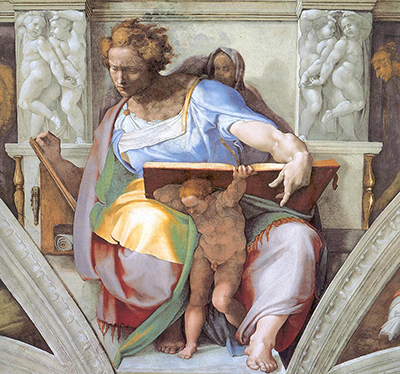
Michelangelo’s Daniel works amid books, supports and assisting bodies. A great open volume stretches across his lap, held up from beneath by a small attendant; the prophet’s muscular arm reaches along its edge while his other hand engages a second object at the side. Daniel’s face is lowered in concentration, but the pose is expansive. Study looks like construction.
The figure is one of seven biblical prophets installed with five ancient sibyls around the Sistine Chapel’s central histories.[1] Daniel’s scriptural book moves through court narratives, dreams, interpretation, deliverance and apocalyptic visions.[7] Michelangelo avoids selecting lions, fiery furnace or one beastly vision. He identifies the prophet through monumental textual labour.
How should Daniel's later print evidence be used? The National Gallery record documents a later print after Fragonard after Michelangelo, useful for reception history but not as direct fresco evidence. This article focuses on Daniel as Michelangelo's Sistine Chapel prophet and keeps copy history clearly labelled.
At a Glance
- FigureThe Prophet Daniel, labelled DANIEL
- Maker and techniqueMichelangelo Buonarroti; fresco
- SettingA painted throne in the Sistine vault’s twelve-seer company
- Patronage and datesJulius II commissioned the vault, whose painting extended from 1508 to 1512[2]
- Ensemble roleOne of seven prophets alternating with five sibyls[1]
- Defining actionStudying a large open book supported by an attendant
- Additional objectA second book, tablet or writing support rises at the side
- CompanionsA small nude assistant beneath the open volume and another partly visible behind
- Visual characterYouthful, powerful body, lowered face, broad arms and strongly divided colour
- Scriptural associationsWisdom, interpretation, faithful endurance and visions of kingdoms[7]
- Object cautionThe exact identity of every writing surface and the words on them remain uncertain
- Chronology cautionThe throne’s architectural location is not a precise painting date
Contents
- Daniel in the Biblical Book
- A Great Book Across the Lap
- The Attendant Supporting the Volume
- Knowledge as Collaborative Labour
- The Secondary Object
- The Lowered Face
- A Young Prophet with a Powerful Body
- Arms Organising the Throne
- Legs, Feet and the Attendant Between
- Colour Dividing Work
- The Tablet DANIEL
- Daniel After Ezekiel
- Daniel Before Jeremiah
- Visions and the Discipline of Interpretation
- Prophecy Is Not Simple Prediction
- Recording What Has Been Seen
- Relation to the Genesis Centre
- Campaign and Dating Limits
- Seeing Daniel from Below
- Restoration and Material Surface
- Why Daniel Matters
- Artist Up Close
Daniel in the Biblical Book
Daniel is presented as a Judean exile at a foreign court, trained in wisdom yet faithful to his God. Narratives include the interpretation of royal dreams, rescue from the lions and conflicts over worship; later chapters contain dense symbolic visions.[7]
Interpretation is therefore central to his identity. Daniel reads signs that powerful rulers cannot understand and receives visions whose meaning can trouble him.
Michelangelo condenses that intellectual role into books and sustained work. No court, lion or king enters the throne.
The choice makes Daniel relevant to the ceiling’s larger concern with reading history. He is a prophet who must turn bewildering images into transmitted knowledge.
A Great Book Across the Lap
The open volume spans most of Daniel’s seated width. Its covers form long straight edges against the curved body and garments.
One hand reaches along or beneath the near side while the other arm coordinates with the secondary object. The book is not placed neatly on a lectern; it becomes part of a complex bodily apparatus.
Scale makes it visible from the chapel floor. It also implies weight large enough to require assistance.
Pages appear as broad pale surfaces rather than a legible quotation. Textual authority is communicated materially.
The Attendant Supporting the Volume
A small nude youth stands beneath or immediately before the book, arms raised to help support its underside. The figure is compressed between Daniel’s knees.
This is practical assistance transformed into monumental design. The book’s weight becomes credible because another body bears it.
The helper also introduces a striking scale relationship. Daniel’s forearm nearly rivals the attendant’s torso, making the prophet colossal.
Yet small size does not mean insignificance. Without the youth’s support, the open text could not occupy its defining position.
Knowledge as Collaborative Labour
Daniel’s throne challenges the image of prophecy as solitary inspiration. Books must be held, writing surfaces prepared and work physically supported.
The attendant’s role makes intellectual activity social. A minor body enables a major seer’s study.
This does not prove a specific historical scribe or angelic identity. The Vatican overview leaves the companions unnamed.[1]
Their function is enough: revelation reaches monumental form through assistance.
The Secondary Object
At Daniel’s other side, a slanted brown object rises toward his hand. It may be described cautiously as another book, tablet, desk-like support or writing surface.
Its hard geometry creates a counterweight to the great volume. Daniel appears to work between two textual stations rather than passively inspect one leaf.
Small implements or rolled forms near its base further suggest study and recording, though exact identification should remain restrained.
The arrangement makes the niche feel like an intellectual workshop compressed into a throne.
The Lowered Face
Daniel’s head inclines toward the objects below. Brow tightens and eyes appear focused, giving a youthful face unusual severity.
The expression is not visionary ecstasy. It suggests calculation, writing or difficult interpretation.
Curled hair expands backward, helping separate head from the painted wall. The broad neck connects concentration to a powerful torso.
Michelangelo makes mental work visible without aging the prophet into a conventional scholar.
A Young Prophet with a Powerful Body
Daniel appears younger than Zechariah, Joel, Ezekiel or Jeremiah. His smooth face and full hair contrast with their beards and lined profiles.
Youth does not produce ease. The book and pose demand muscular effort.
This combination suits the biblical Daniel, whose wisdom is demonstrated from youth in an exilic court.[7] The fresco does not narrate that episode, but age and intellectual action resonate.
Michelangelo again refuses to assign knowledge to one body type. Prophetic authority can be aged endurance or youthful labour.
Arms Organising the Throne
Daniel’s arms spread across the composition. One extends along the great book; the other reaches toward the side object.
Their breadth gives study an almost architectural span. Hands connect separate materials into one working system.
Exposed forearm and upper arm display strength, but no gesture is performed for its own sake. Anatomy explains management of weight and distance.
The throne’s energy lies in this horizontal reach more than in a dramatic twist.
Legs, Feet and the Attendant Between
Daniel’s knees form two large coloured masses, separated by the small assistant. One bare foot projects fully; the other is partly hidden.
This division turns the lower body into a frame around support. The attendant stands where empty space might ordinarily remain.
Feet establish contact with the ledge, preventing upper complexity from making the figure unstable.
The arrangement is bold: colossal legs do not crush the helper visually but create a protected vertical channel.
Colour Dividing Work
Pale blue-violet clothing covers the upper torso; golden-yellow and green cross one knee; lavender and warm rose cover the other. A deeper mantle wraps behind.
Colour separates limbs and objects in a crowded field. The book’s dark edge remains visible against lighter fabric.
The palette also keeps Daniel distinct from neighbouring prophets. Modern conservation renewed the brightness of these contrasts.[4][6]
Digital reproductions vary, so relative structure is more secure than an exact screen hue.
The Tablet DANIEL
The name is unusually familiar across languages and appears clearly on the lower plaque. It distinguishes the prophet from a generic young scholar.
Inscription is necessary because books and attendants recur throughout the ensemble.
Roman capitals place biblical identity inside the ceiling’s classicising architecture.
At distance, the great volume may establish function before the tablet establishes name.
Daniel After Ezekiel
Ezekiel turns away from a scroll toward urgent speech. Daniel returns attention to books and sustained work.
The difference shifts the sequence from conversation to textual production. One open hand becomes two working arms.
Attendants remain active in both thrones, but their roles change from messenger to supporter.
Michelangelo makes shared motifs yield distinct prophetic minds.
Daniel Before Jeremiah
Jeremiah folds inward, head supported by a hand and text largely displaced by grief. Daniel expands across a working apparatus.
Their adjacency creates one of the strongest psychological contrasts among the prophets: energetic interpretation beside immobilised contemplation.
Both are burdened, but burden takes different bodily forms. Daniel carries knowledge through activity; Jeremiah carries it through stillness.
The comparison deepens each without turning the thrones into a shared narrative.
Visions and the Discipline of Interpretation
Daniel’s biblical visions contain symbolic animals, numbered times and changing kingdoms that demand interpretation.[7] The fresco’s books evoke that discipline without illustrating a fixed vision.
His lowered face suggests that revelation can be puzzling, requiring record and study after initial reception.
The great volume may therefore be understood broadly as accumulated meaning rather than one instant of divine speech.
Michelangelo grants intellectual process the same monumentality he gives inspired gesture elsewhere.
Prophecy Is Not Simple Prediction
Daniel is often reduced to a source of predictions, especially when later traditions calculate dates from its symbolic periods. The biblical book is more complex: narrative faithfulness, imperial power, dream interpretation, suffering and divine sovereignty interact across different literary forms.[7]
Michelangelo’s books suit that complexity. Daniel does not point toward one pictured future event. He works among texts whose meaning must be examined.
The posture therefore resists a fortune-teller model of prophecy. Lowered gaze and physical apparatus emphasise disciplined interpretation rather than effortless access to a timetable.
Within the chapel, this matters because the ceiling surrounds narrative images with figures who think. Revelation does not cancel human labour; it creates responsibility for understanding.
Recording What Has Been Seen
Daniel’s secondary writing support raises the possibility of recording as well as reading. Even without fixing the object’s exact type, the throne clearly exceeds one passive encounter with a finished volume.
Visions in the biblical book are narrated, interpreted and preserved. Writing turns an unstable experience into something later communities can revisit.[7]
Michelangelo distributes that preservation across surfaces and helpers. Knowledge passes from vision to hand, from hand to material and from material to future attention.
The figure thus joins prophecy to memory. A great book does not appear by miracle within the composition; bodies maintain the conditions through which revelation endures.
Relation to the Genesis Centre
The central stories narrate the world’s beginnings, first humans and Noah.[3] Daniel belongs to a much later biblical period and another pictorial register.
His place around the centre makes him an interpreter in the chapel’s Christian historical scheme rather than a witness standing inside Genesis.
Books surround events. The ceiling presents history and the labour of understanding it simultaneously.
An isolated crop clarifies Daniel’s workshop-like throne while concealing that wider relation.
Campaign and Dating Limits
The documented vault undertaking began in 1508 and reached completion in 1512 under the patronage of Julius II.[2] Daniel belongs securely to that undertaking.
No institutional source used here gives an exact completion date for the throne. Placement and style can support broad phase study but not a day-by-day claim.
The companions and fictive architecture are part of the fresco field, so production cannot be reduced to the prophet’s body alone.
Chronological restraint keeps attention on evidence rather than confidence generated by sequence.
Seeing Daniel from Below
At chapel distance, broad book, spread arms and multicoloured knees establish the figure. The tiny supporter and secondary implements can disappear.
Smarthistory stresses the height and visual density of the ceiling.[5] Daniel’s large horizontal forms answer those conditions.
Close views reverse scale, making the attendant and fingers newly prominent. A location view restores the throne among twelve.
The work was designed to reward all these levels without being exhausted by any one.
Restoration and Material Surface
The Vatican’s conservation history frames the vivid palette through which Daniel is now widely known.[4][6] Earlier dark images made him appear more uniformly sculptural.
Cracks and repairs become visible under enlargement, especially across broad colour fields.
Photography can shift lavender, green and yellow substantially. Stable interpretation rests in the division of masses and action.
The fresco remains a material wall painting whose age coexists with the immediacy of study.
Why Daniel Matters
Daniel matters because Michelangelo makes interpretation collective and material. Knowledge needs books, hands, support and time.
He matters because youthful strength serves scholarship rather than combat. The body’s power is directed toward text.
Most importantly, the prophet turns a throne into a place of work. Revelation does not end when vision arrives; it begins another labour of understanding.
The distinction is especially valuable beside Jonah, whose body opens toward an unseen vision. Daniel represents what may follow such an encounter: the slower effort to hold, compare and transmit meaning.
Artist Up Close
Michelangelo gives intellectual labour an engineering logic. A small attendant bears the volume, Daniel’s legs frame the support and his arms connect different textual objects. The composition works because forces are distributed. In making a prophet study, the artist also reveals his own design method: no grand result without many solved supports.
Frequently Asked Questions
Discussion
What seems most important in Michelangelo's Daniel: the prophet's reading, the surrounding seer programme, or the later reception evidence that paired Daniel with the Erythraean Sibyl?
Reader Insights
How does Daniel continue the sequence after Ezekiel?
What can Daniel's association with reading suggest without inventing a specific text?
How should later copies shape the way readers understand the fresco?
Join the Conversation
Compare Daniel's prophet role, reading posture and later reception evidence while keeping the route focused on Michelangelo's painted figure.
References
- Vatican Museums, Sibyls and Prophets”:, View source.
- Vatican Museums, Sistine Chapel Ceiling”:, View source.
- Vatican Museums, Central Stories”:, View source.
- Vatican Museums, Sistine Chapel History”:, View source.
- Smarthistory, Michelangelo, Ceiling of the Sistine Chapel”:, View source.
- Vatican Museums, The Sistine Chapel Twenty Years Later: New Breath, New Light”:, View source.
- United States Conference of Catholic Bishops, Daniel, Chapter 1”:, View source.