

 by Tom Gurney
Tom Gurney BSc (Hons) is an art history expert with over 20 years experience
Published on June 19, 2020 / Updated on November 6, 2025
Email: tomgurney1@gmail.com / Phone: +44 7429 011000
Pietà by Michelangelo
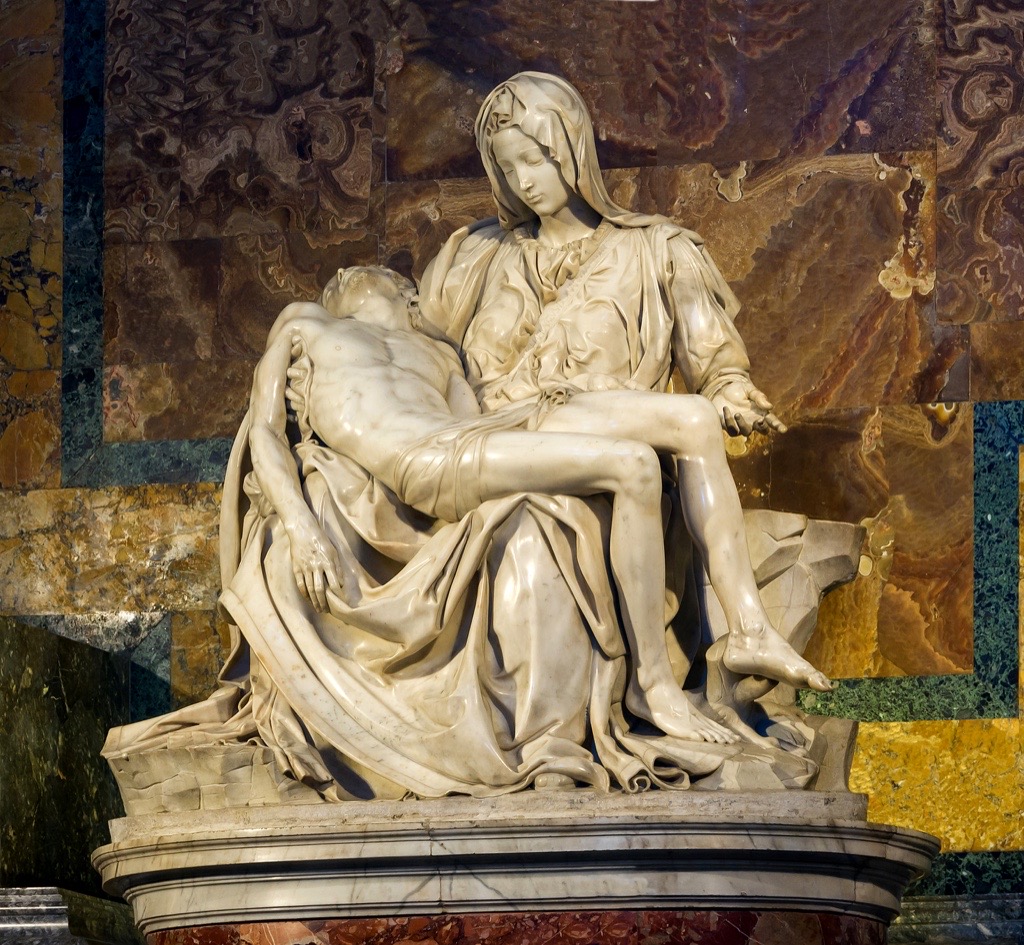
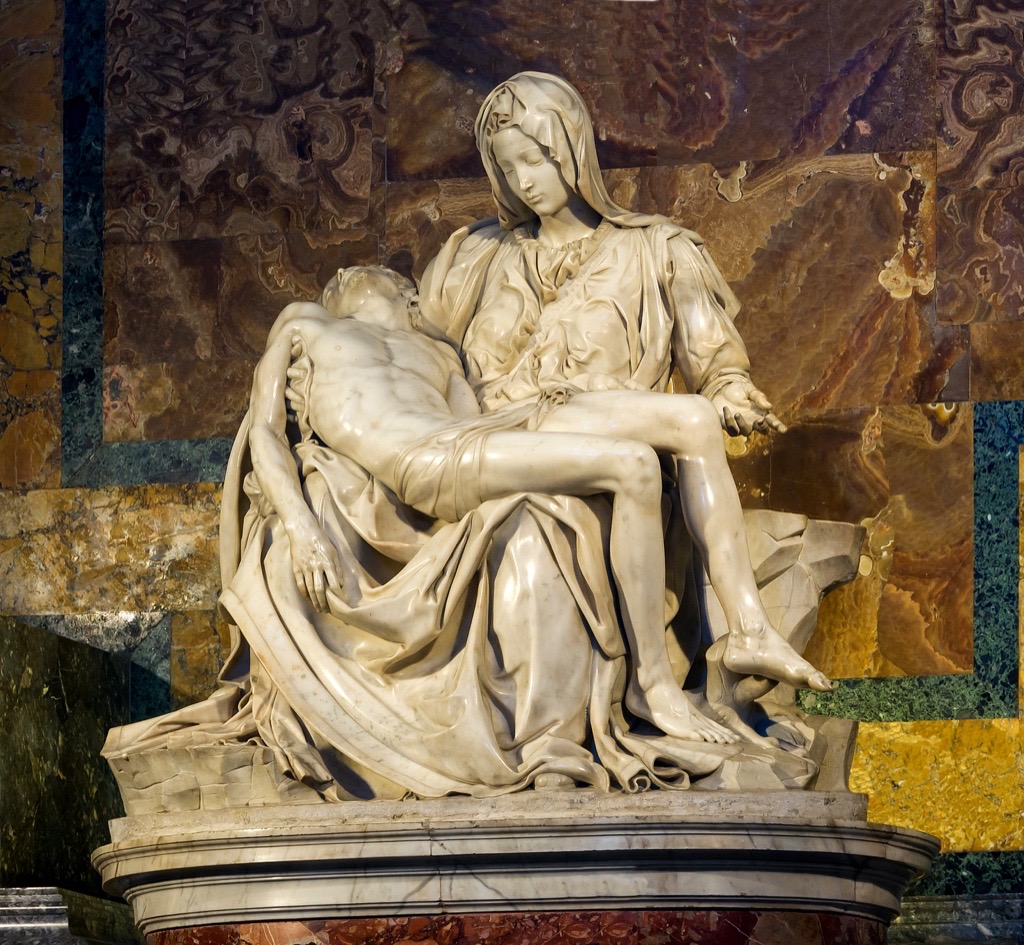
Mary's left hand opens toward us. It does not clutch Christ or close around her grief. The gesture seems to present the body across her lap while also asking how such a death can be understood. Above it, her face is lowered but composed. Below it, folds of marble spread into a broad base, bearing the weight of an adult son who should be far too large for his mother's arms.
Michelangelo carved the Pietà for a tomb in Rome in 1498–1499, when he was still in his early twenties. The group brought a subject with deep northern European devotional roots into the language of Italian Renaissance sculpture. It made a dead body beautiful without denying its death, made maternal grief restrained without making it empty, and transformed a single block of marble into two figures whose physical relationship seems both impossible and inevitable.
At a Glance
- ArtistMichelangelo Buonarroti
- TitlePietà
- Date1498–1499; the contract was signed on 26 August 1498
- MediumWhite Apuan/Carrara marble
- DimensionsApproximately 174 × 195 cm
- CommissionerCardinal Jean de Bilhères-Lagraulas
- Original purposeThe cardinal's tomb in the Chapel of Santa Petronilla beside Old St Peter's
- Current locationFirst chapel on the right, St Peter's Basilica, Vatican City
- Present chapel placementSince 1749
- Distinctive factMichelangelo's only signed work[1][2][4]
Contents
- A Mother Holding Her Adult Son
- The Commission for a French Cardinal
- The Architecture of Grief
- Christ's Body: Beauty, Death and Sacrifice
- Mary's Youth and Composure
- Michelangelo's Signature
- Rome, Reputation and the Young Florentine
- Marble, Polish and the Work of Distinction
- From a Tomb Chapel to St Peter's
- The 1972 Attack and the Protected Sculpture
- The First of Michelangelo's Three Great Pietàs
- Artist Up Close
- Beauty at the Edge of Loss
Annotated Details from Pietà
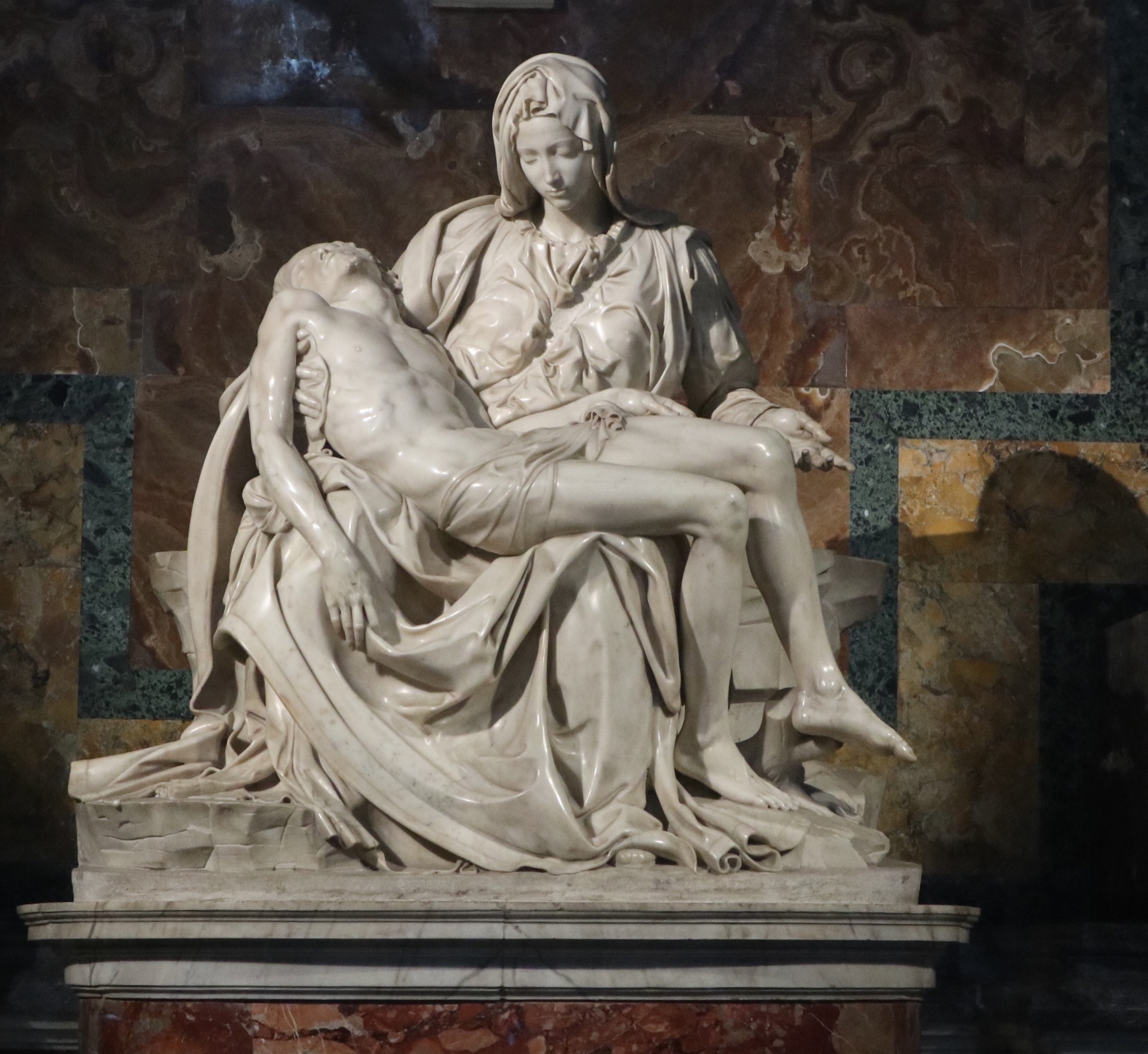
The annotated view focuses on the central group, where the Virgin’s calm face, Christ’s body and the broad field of drapery hold the sculpture together.
Details from PIETÀ
Close looking highlights the visual details that matter most on this Michelangelo page while keeping image-source and rights notes in the references.
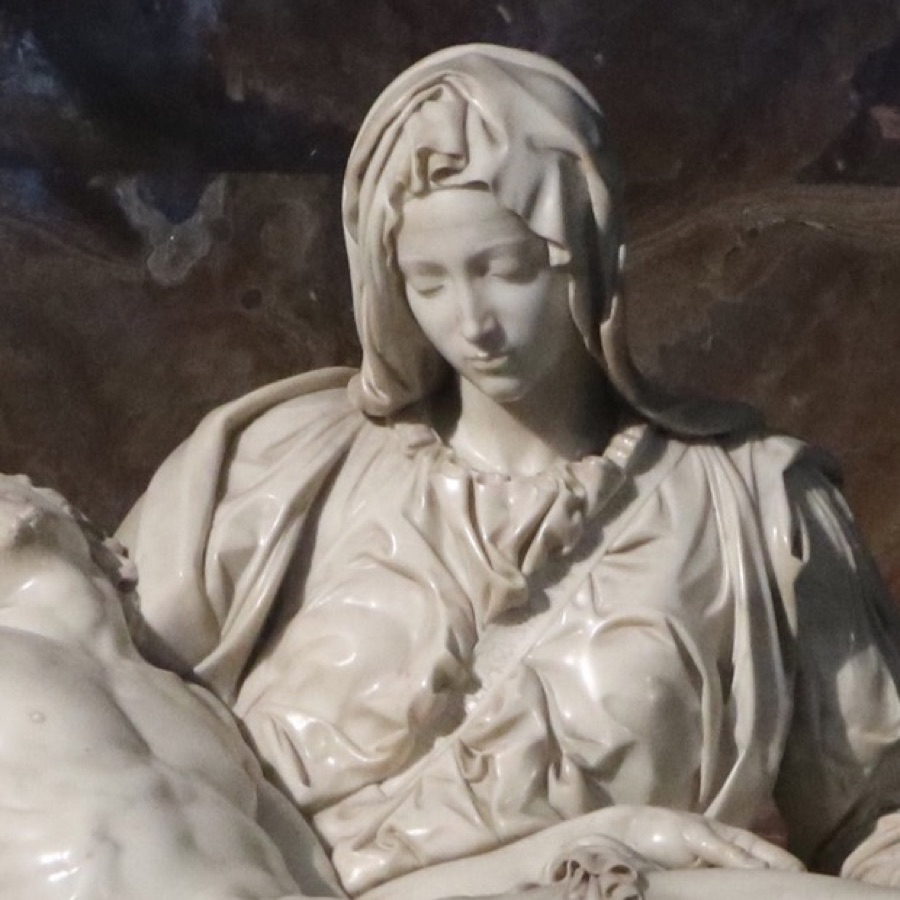
Virgin’s face
Mary’s lowered face is restrained rather than theatrical, guiding the emotional tone of the group.
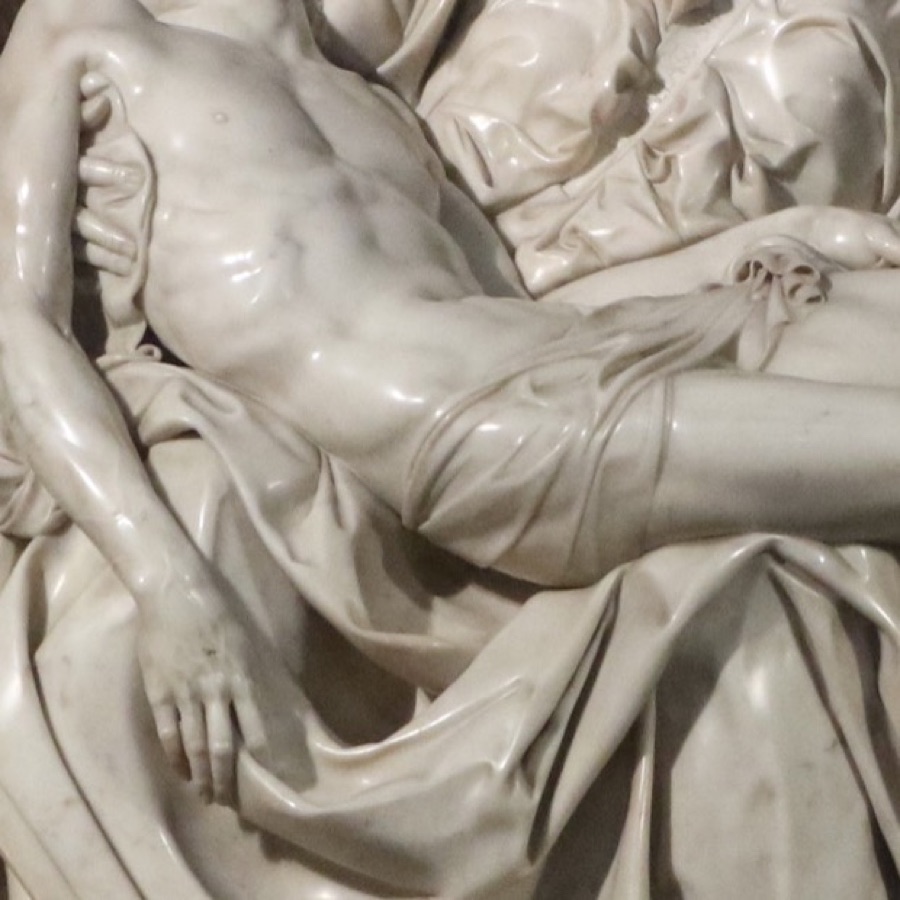
Christ’s body
Christ’s body lies across the composition, creating the sculpture’s central diagonal and its most immediate human weight.
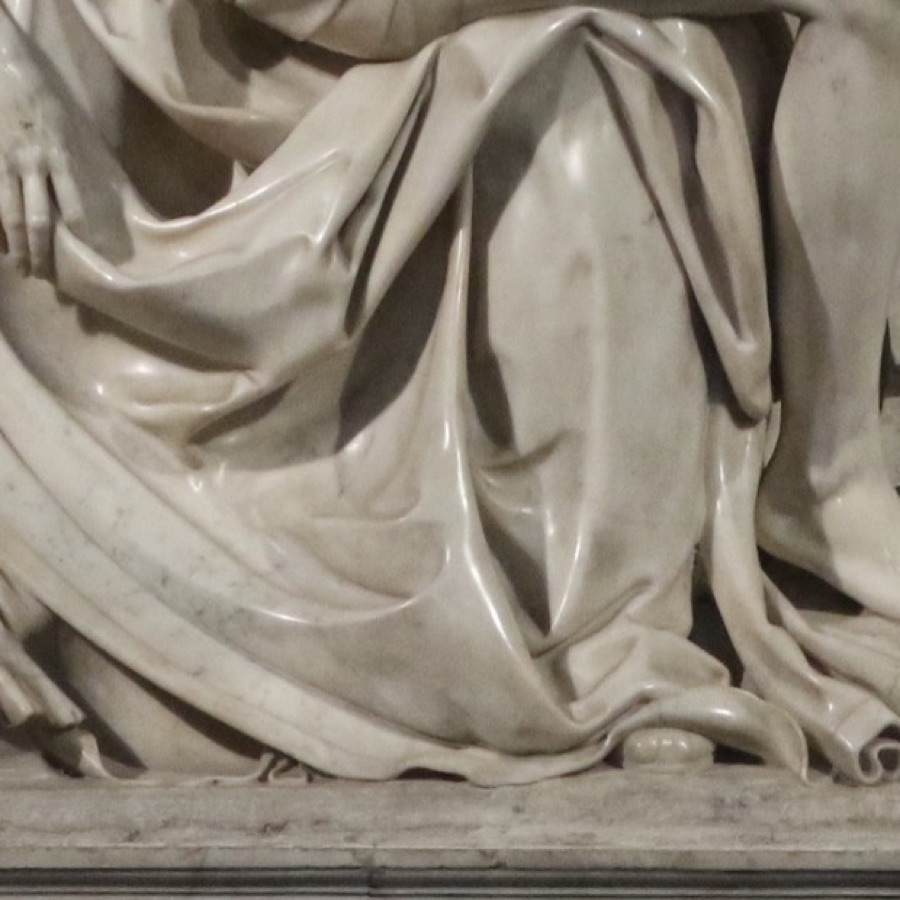
Drapery and support
The deep folds enlarge the seated figure and provide the visual structure that carries the group.
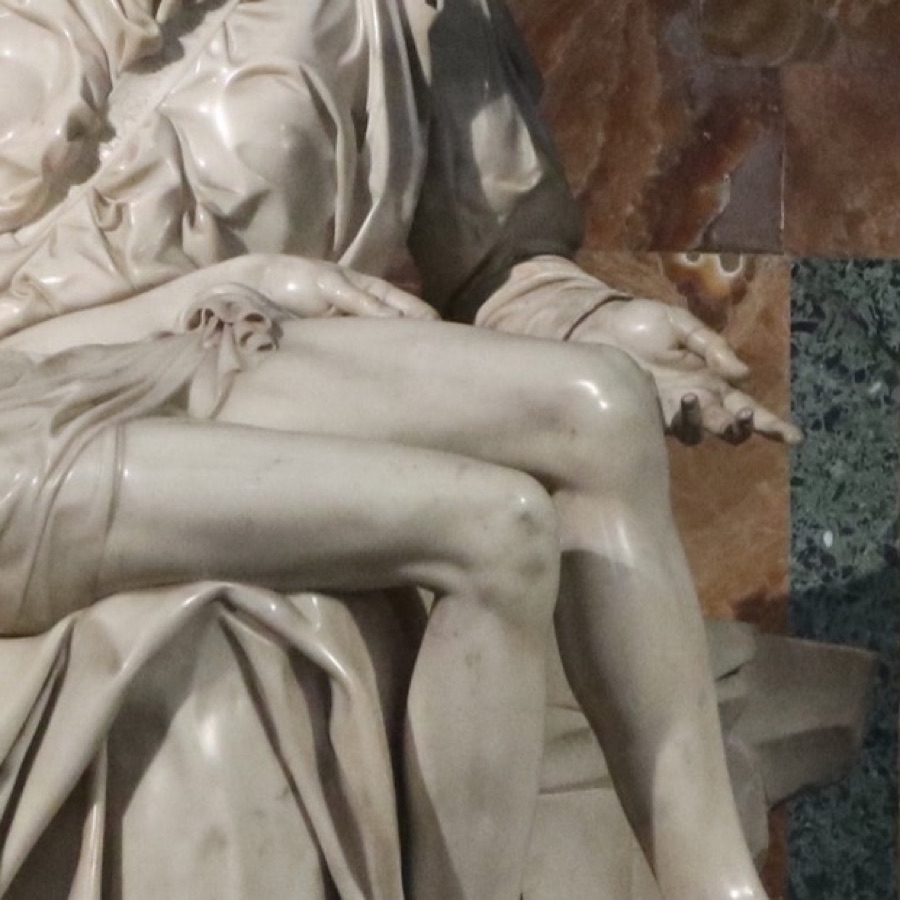
Hands and contact
Hands and points of contact quietly bind the two figures, replacing dramatic gesture with controlled tenderness.
A Mother Holding Her Adult Son
The Italian word pietà carries meanings of pity, compassion and devotion. In art it identifies an image of the Virgin Mary mourning over the dead Christ after his removal from the Cross. The scene is not narrated as a separate episode in the canonical Gospels. It grew from traditions of meditation on the Passion, inviting worshippers to contemplate Christ's sacrifice through Mary's bereavement.
Northern European sculptors had long represented the subject in forms often called Vesperbilder: devotional groups in which the dead Christ lies across Mary's lap. Many make physical suffering harshly explicit. Wounds, rigid limbs and an angular body confront the worshipper with the cost of salvation. Michelangelo retained the central relationship but reshaped it through the study of monumental bodies, antique form and a highly controlled marble finish.[1][3]
The tradition was far from uniform. A Metropolitan Museum publication devoted to French late-Gothic Pietàs surveys 167 examples and emphasises substantial regional variation.[9] Mary might appear aged or youthful, Christ rigid or sagging, the figures compact or dramatically spread. The subject supplied a relationship, not a single design that every sculptor copied.
The Holy See's account highlights the contrast Michelangelo's solution could make. French and German precedents often retain rigor mortis, open wounds and the crown of thorns.[3] Their devotional force comes through confrontation with bodily injury. Michelangelo reduces those harsh signs and shifts attention toward weight, surface and the silent relation between faces and hands.
This change did not make his Pietà less concerned with death. It altered the means by which death becomes present. Rigid anatomy gives way to a body released across Mary's lap; open wounds give way to the cold perfection of flesh that cannot answer; the crown of thorns gives way to the bare head falling back. Idealisation becomes the vehicle of sorrow.
The northern history also explains why the commission suited a French cardinal in Rome. A familiar devotional subject crossed the Alps with patronage, pilgrimage and ecclesiastical culture, then encountered Michelangelo's Florentine and Roman experience. The result belongs to more than one artistic geography.
The basic problem is deliberately difficult. An adult man cannot rest across a seated woman's lap in the compact arrangement Michelangelo creates without overwhelming her. Christ's body is long and exposed; Mary's upper body appears comparatively slender. The sculptor solves the mismatch by enlarging and spreading her lower body beneath abundant drapery. Her lap becomes an immense, almost architectural support.
The disproportion is easy to miss because the composition feels so coherent. Mary's head forms the summit of a pyramid. Her robe descends in widening folds toward the base. Christ crosses that stable structure diagonally, his head and right arm falling toward one side and his lower legs extending toward the other. The two bodies are different in direction but held within one encompassing silhouette.
Mary does not seem to strain under the weight. Her right arm supports Christ's upper body, partly hidden beneath him and the drapery. Her left hand opens beside his torso. The gesture can be read as presentation, lament, acceptance or an invitation to contemplate, but it is not reducible to a single spoken message. Its openness gives the viewer a place in the encounter.
Christ's right arm hangs down, released from living control. His head falls back, the neck exposed. The torso remains beautiful and intact, yet its yielding position communicates death unmistakably. Michelangelo avoids the contortions of an active body. Gravity has become one of the sculpture's principal expressive forces.
The relationship between the figures is therefore carried by support and surrender. Mary is stable enough to receive the body; Christ is heavy enough to make that receiving meaningful. The group does not show an embrace between two living people. One body can no longer return the touch of the other.
The Commission for a French Cardinal
Cardinal Jean de Bilhères-Lagraulas was a French churchman and diplomatic representative in Rome. The Vatican dossier identifies him as Abbot of Saint-Denis, titular cardinal of Santa Sabina and ambassador of King Charles VIII of France to Pope Alexander VI. His offices connected royal, monastic and papal worlds.[1]
On 26 August 1498, a formal contract commissioned Michelangelo to make a marble Virgin holding the dead Christ for the cardinal's funerary monument. The intended site was the Chapel of Santa Petronilla, associated with the French community and standing beside the old Constantinian basilica of St Peter.[1]
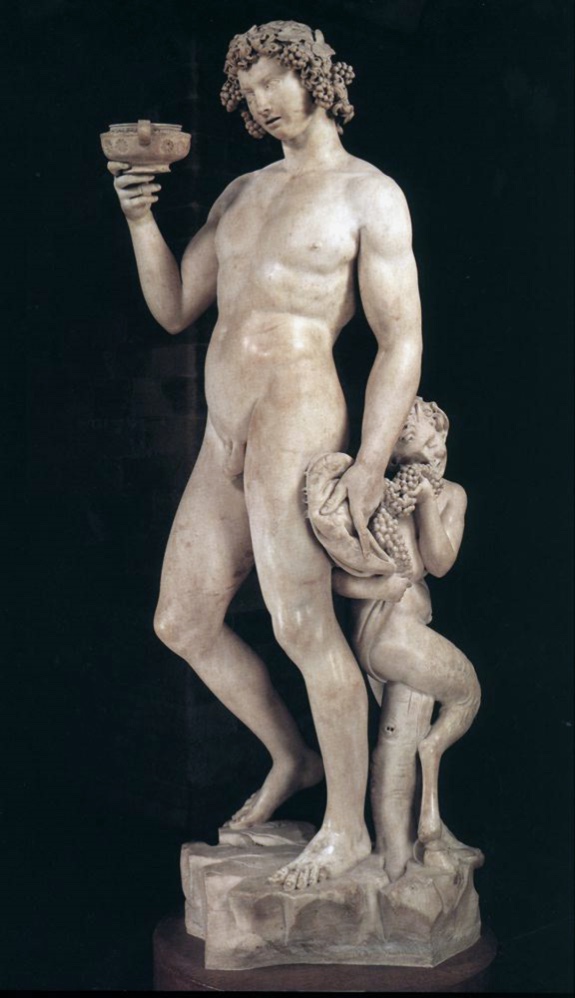
Michelangelo was twenty-three. He had arrived in Rome after his formative Florentine years and had already carved the marble Bacchus, a work deeply engaged with antique sculpture. The Pietà offered a different challenge: a Christian subject charged with grief, a two-figure composition and a prestigious burial setting close to one of Latin Christianity's most important churches.
The Vatican dossier describes Michelangelo travelling personally to Carrara to supervise the quarrying of a high-quality block of Apuan white marble. It also records that he began working the stone there before transport to Rome and completed the group over roughly two years.[1]
The journey reveals how early the sculptural decisions began. Choosing a block meant judging size, veining, integrity and the possibility of cutting two intertwined figures from one mass. Initial work near the quarry could reduce unnecessary weight for transport, but every removal also committed the design further. Rome received a stone already entering the form imagined for the cardinal's chapel.
Selection mattered because the group demanded both structural reliability and a surface capable of taking an exceptionally fine finish. Christ's extended body, Mary's projecting hand and the complex hollows between limbs and drapery all had to remain connected within the strength of the block.
The contract belonged to a world of patrons, agents, deadlines and specified destinations. That setting helps correct the later myth of a youthful genius carving in complete freedom. Michelangelo's invention was extraordinary, but it answered a commission: the identity and ambition of a French cardinal, the expectations of a funerary chapel and the devotional function of the subject.
The sculpture's original role shaped its first encounter. Near a tomb, Mary's presentation of Christ would have connected personal death with the dead and resurrected Saviour. Grief over one body opened toward Christian hope for another. The polished marble was not originally an isolated museum object; it participated in prayer, memorial and the ritual life surrounding burial.
The Santa Petronilla setting later disappeared during the rebuilding of St Peter's. The Pietà moved more than once before reaching its present chapel in 1749.[2] These relocations preserved the sculpture but altered the exact relationship among tomb, altar, architecture and viewer for which it had been conceived.
The Architecture of Grief
The pyramidal arrangement gives the group calm at a moment of devastating loss. Mary's head establishes a vertical axis, while the spreading mantle forms a base almost as wide as the sculpture is high. Christ's body crosses the pyramid without breaking it. The diagonal is absorbed into a larger stability.
This structure is not cold geometry imposed on emotion. It is how Michelangelo makes grief bearable as form. Mary's widened lap supplies physical support; the descending folds slow the eye; the secure base prevents Christ's falling body from becoming visually chaotic. The composition holds together what the story has torn apart.
The contrast between the two principal directions is crucial. Mary is upright, frontal and gathered. Christ is horizontal, oblique and released. Her head bends inward; his falls back. Her left hand turns outward; his right hand drops toward the ground. Their differences make each body legible while binding them more tightly.
The dead Christ is neither a rigid plank nor a limp bundle without structure. His torso arches gently across Mary's knee. One leg lies over the other, directing the lower body diagonally outward. The left arm remains supported near Mary's hand, while the right descends on the opposite side. This alternation prevents the body from forming a single unbroken bar.
Mary's drapery performs several tasks at once. It disguises the enlarged support beneath Christ, joins gaps between the figures, catches deep shadow and gives the base visual weight. Large folds around her knees become architectural masses; finer passages near the face and chest preserve the scale of cloth against flesh. The fabric is both clothing and compositional structure.
A rough rock-like seat appears beneath the polished figures. Its unevenness provides another contrast: natural support below, worked cloth around it, living flesh translated into marble above. Michelangelo does not hide the stone's capacity for multiple identities. He makes one material behave as rock, heavy fabric, fine veil, hair and skin.
The pyramid also governs distance. From far away, the group reads as a unified devotional emblem. At closer range, its apparent simplicity divides into complex crossings: Christ's arm against Mary's robe, the edge of cloth beneath his torso, the hand beneath his shoulder, the folds that widen her lap. Monumental clarity rests on intricate engineering.
Christ's Body: Beauty, Death and Sacrifice
Michelangelo gives Christ an idealised body, but not a living one. The wounds of the Passion are restrained and avoid graphic severity. The torso is smooth, the musculature resolved, the face composed. At first sight, such beauty can appear to soften the reality of execution.
Yet death is communicated through weight more deeply than through injury. The head cannot hold itself up. The right arm hangs beyond Mary's support. The chest no longer rises. The body yields across another body instead of acting on the world. Michelangelo allows the viewer to recognise death through the loss of agency.
The polished surface intensifies the contradiction. Marble made to resemble flesh can seem almost warm under changing light, but its actual coldness belongs to the subject. The sculptor's illusion is never complete enough to restore life. The more persuasive the body becomes, the more affecting its stillness can be.
Christ's beauty also has devotional meaning. The group presents sacrifice without turning the Redeemer into an object of disgust. Renaissance ideals of bodily harmony allow physical perfection to coexist with mortal suffering. The body has been violated, but its dignity remains intact.
That restraint is sometimes misunderstood as an avoidance of emotion. Michelangelo does not eliminate grief; he relocates it. It lies in the distance between Mary's living support and Christ's inability to respond, in the dropped arm, the backward head and the immense drapery required to hold him. The sculpture asks for sustained contemplation rather than immediate shock.
The body is also viewed from a position of uncomfortable intimacy. Christ is presented across the front of the group, available to sight much as he might be offered for devotion at an altar. Mary's open hand does not shield him. His exposure connects the private pain of a mother with the public meaning of the Passion.
The Eucharistic resonance of a body offered to the faithful may arise naturally in a church setting, especially near an altar, but the sculpture does not dictate one ritual equation. It brings the dead Christ close enough for theological meanings to gather around his physical presence.
Mary's Youth and Composure
Mary appears strikingly young—closer in age to her adult son than to the mother of a man in his thirties. The contrast has attracted explanation since Michelangelo's own period. Holy See interpretations connect her unaged beauty with purity, incorruptibility and her role as both mother and ideal figure of the Church.[2][3] Renaissance artistic convention also allowed bodily beauty to express spiritual perfection.
These readings help explain why naturalistic age was not Michelangelo's only concern. The sculpture brings together different times. Mary is the young woman of the Annunciation and the bereaved mother after the Crucifixion. The same figure can carry the memory of receiving the infant Christ while physically holding his adult body.
The visual echo of a mother and child is essential. Christ lies across Mary's lap as an infant might, but the scale and dead weight make the comparison painful. Birth and death occupy the same arrangement. Michelangelo does not need to show a vision or flashback; the body's placement activates the memory.
Mary's face is calm, though not untouched. The eyelids lower, the mouth is closed and the head bends toward Christ. There is no scream and no violent backward recoil. Her grief is internalised, shaped into attention. This restraint suits devotional contemplation and contributes to the group's monumental stability.
Calm here carries action. Mary performs the central act of the sculpture: she holds and presents a body too large for her. Her expanded lower form bears the composition, her right hand supports Christ, and her left opens the encounter toward the worshipper. Stillness becomes an active capacity to endure.
Her scale is part of that capacity. If Michelangelo had made the seated body anatomically proportionate beneath the robes, Christ would look unmanageably large and the pyramid would collapse. The enlarged lap is an intelligent departure from natural proportion. Visible truth—the experience of a mother holding her son—depends on concealed distortion.
The face and body therefore work at different registers. The youthful head offers ideal clarity; the vast clothed form supplies material strength. Between them, the diagonal sash crosses Mary's chest and carries the artist's name.
The Holy See offers a more specifically ecclesial reading. It describes Mary as Mother and Bride, a figure of the Church, holding Christ out to humanity.[10] Within that interpretation, youth expresses resemblance and spiritual identity, while the open hand becomes an act of offering.
This is a valuable account of how the sculpture functions in its living Catholic setting. It does not cancel other responses. A bereaved mother, an image of the Church and a monumental study of bodily support can coexist, provided the theological identification is presented as an articulated tradition rather than the only thought Michelangelo could have intended.
The open palm is especially capable of holding these layers. It can register helplessness because it does not close around Christ; presentation because it turns outward; acceptance because it remains controlled; and appeal because it faces the worshipper. Michelangelo avoids an attribute or inscription that would narrow the gesture to one definition.
Michelangelo's Signature
The Pietà is the only work Michelangelo signed. The inscription runs across the sash on Mary's chest: MICHAEL·ANGELVS·BONAROTVS·FLORENT·FACIEBAT—“Michelangelo Buonarroti, Florentine, made this.”[2]
Its position is impossible to treat as a neutral label. The sash crosses one of the most visible areas of the sculpture, close to Mary's face and Christ's torso. The lettering becomes part of the drapery, announcing authorship across the Virgin's body within a work made for a prominent Roman setting.
The Latin formula resembles signatures used to claim learned, antique authority. Michelangelo identifies himself not only by name but as Florentine. In Rome, that civic origin carried the reputation of a city celebrated for sculpture, drawing and artistic competition. The young artist inscribed both person and place into the marble.
A famous later story says that Michelangelo overheard visitors attributing the group to another sculptor and returned to carve his name in response. The vivid anecdote is not securely documented and remains an unproven explanation for the signature.[4] The inscription itself is evidence; the scene of offended genius belongs to biography and legend.
Why did he never sign another major work? No single answer is known. The Pietà may have been a special act of self-identification by a Florentine newcomer in Rome. Its fame soon made such identification unnecessary. Whatever the motive, the signature fixes the work at a threshold in Michelangelo's career: youthful enough to announce himself, accomplished enough for the announcement to become historic.
The verb faciebat—“was making” or “made”—also belongs to an antique tradition in which completion can be expressed with a suggestive openness. That grammar has invited elaborate interpretations, but the central fact is direct: Michelangelo claimed the object publicly and permanently.
Rome, Reputation and the Young Florentine
The signature's insistence on Florence gains force from its Roman setting. Michelangelo had trained in the city of Donatello and Ghirlandaio, absorbed Medici collections and studied marble as a young man, but Rome offered direct and sustained contact with ancient monuments on a different scale. His Roman Bacchus had already tested his ability to rival antique bodies. The Pietà brought that command into a major Christian commission.
The shift of subject was profound. Bacchus balances an intoxicated pagan god whose body seems unstable under wine. The Pietà uses balance to carry bereavement: one figure spreads into support while another yields. Both demonstrate marble's ability to imitate flesh, but the emotional and devotional demands could hardly be more different.
Official Vatican interpretation stresses that the Pietà was admired early and made Michelangelo a sought-after artist.[10] This success rested on the patronage, earlier work and material labour behind it; the ambitious finish, scale and signature nevertheless succeeded as a declaration of authorship in Rome.
The commission also began Michelangelo's long association with St Peter's, though nobody in 1498 could have foreseen its final extent. More than four decades later he would take responsibility for the architecture of the new basilica. The youthful funerary sculpture survived the destruction of the old church and entered the building the elderly Michelangelo helped shape.
That arc is compelling because the roles differ. The young artist supplied a single marble for a cardinal's tomb; the old architect confronted the mass and structure of Christianity's greatest church. The Pietà was no blueprint for the later basilica, but its continued presence makes one career visible across radically different forms of making.
The Metropolitan Museum's study of Michelangelo as draftsman and designer emphasises the continuity of disegno across sculpture, painting and architecture.[11] In this broader sense, the Pietà already demonstrates conception beyond imitation. No observed pair of bodies could naturally produce this scale and support. Michelangelo designed a bodily truth that required physical impossibility to become persuasive.
Marble, Polish and the Work of Distinction
The dazzling finish of the Pietà can make the carving process disappear. Flesh seems smooth, cloth seems soft and the whole group appears to have emerged without resistance. In reality, the surface required a long progression from major cutting to increasingly fine abrasion and polish.
Michelangelo differentiates materials without changing material. Christ's flesh receives broad, continuous passages of light. Mary's robe breaks into ridges, channels and undercut shadows. Hair is described through repeated locks. The rock below stays comparatively coarse. The eye learns to read texture as substance even while knowing that every passage is marble.
Undercutting deepens the separation between forms. Darkness beneath Christ's arm makes it project from Mary's clothing. Hollows among the folds turn drapery into layered volume. Narrow transitions at hands and limbs preserve the impression of bodily independence while leaving enough stone for strength.
Polish has an emotional role. It idealises the bodies and draws them away from ordinary decay. It also makes light glide across Christ's torso, bringing visual tenderness to a scene of death. The surface invites the imagination of touch while the sculpture's sacred setting and present protection hold actual touch at a distance.
The apparent softness is most powerful where the forms press together. Christ's back settles against Mary's support; his thigh crosses the folds; her fingers meet the body beneath him. Marble cannot compress like flesh or fabric, so Michelangelo creates contact through contour, overlap and shadow. The mind supplies the yielding sensation the stone cannot perform.
The group is carved from a single block, a fact that heightens the achievement without requiring a myth of effortless creation. Two heads, four arms, intertwined bodies and spreading drapery had to remain structurally continuous. Areas that appear open are carefully negotiated around connections. The sculptor makes technical necessity read as an intimate relationship.
Surface condition has changed over centuries of movement, cleaning, damage and restoration. The polish visible today belongs both to Michelangelo's initial finish and to the work's later physical history; it is no sealed instant untouched since 1499.
From a Tomb Chapel to St Peter's
The original Chapel of Santa Petronilla was lost as the old basilica of St Peter gave way to the present church. The Pietà survived the transformation, but its relocation changed the work's frame. A sculpture designed for Cardinal de Bilhères's funerary monument gradually became one of the great devotional and artistic destinations within St Peter's itself.
The group was installed in its present chapel on 3 December 1749.[2] Today it is encountered soon after entering the basilica, in the first chapel on the right. The position gives it extraordinary visibility, but architecture, crowd movement, distance, glazing and illumination shape what can be seen.
The chapel supplies a later devotional programme of its own. Vatican News describes its central theme as the Cross and its saving power. Before the mid-eighteenth century it was dedicated to the Crucifix, and the Pietà was placed in 1749 before a marble crucifix on the altar.[2] Mary and Christ therefore entered an existing field of Passion imagery.
Above, the vault contains the only frescoes in St Peter's, painted by Giovanni Lanfranco between 1629 and 1632. Scenes from Christ's Passion surround an exaltation of the Cross.[2] The polished white group below and the coloured Baroque painting above belong to different centuries, media and styles, but the chapel brings them into a single devotional sequence.
This setting alters emphasis from the lost Santa Petronilla tomb. The original commission joined Christ's death to the memorial of one cardinal. The present chapel joins it to a broad account of the Passion and the Cross addressed to the basilica's worshippers. The marble did not physically change in 1749, yet the visual and theological sentences around it did.
The loss of the tomb setting changes emphasis. Cardinal de Bilhères is no longer the dominant context for most visitors. Michelangelo, Mary and Christ occupy the foreground, while the work's function as a memorial commission requires historical reconstruction. Fame has shifted attention from patron to artist and from private burial identity toward universal masterpiece.
The modern chapel also intensifies frontal viewing. The pyramidal silhouette and Mary's open hand are immediately clear, while the depth of Christ's body and the complex support beneath him can be harder to grasp from a fixed distance. The sculpture was conceived in the round enough for lateral relations to matter, even though its principal address remains frontal.
In 1964–1965, the Pietà travelled to New York for the World's Fair.[2] The journey exposed the tension between global access and the risk of moving an irreplaceable marble. Such a loan is now part of the work's modern biography, but its exceptional nature underscores how firmly the sculpture has since become identified with St Peter's.
The 1972 Attack and the Protected Sculpture
On 21 May 1972, a man attacked the sculpture with a hammer, striking Mary's face and left arm. The assault broke and dislodged marble, transforming an image of sacred bereavement into a physically wounded object.[2][5]
The restoration demanded both technical skill and interpretive restraint. Fragments were recovered; the damage was studied; specialists used photographs, casts and physical evidence to reconstruct lost or displaced forms. Vatican accounts later described the intervention as a landmark in the institution's restoration history.[5][6]
A plaster cast made before the attack proved valuable because it preserved three-dimensional information about the earlier surface. The episode demonstrates why a copy can matter without becoming equivalent to the original. It can record a condition that no longer survives intact and guide decisions when the marble itself has been changed.
Restoration returned visual coherence, but it did not reverse time. The present Pietà includes Michelangelo's carving, the accumulated effects of centuries, the history of violent loss and the work of repair. Its beauty after 1972 is not evidence that damage has vanished from its biography. The repaired passages remain part of the sculpture's authentic material life.
Protective glazing was installed in 1973. In 2024 the previous barrier was replaced with nine panes of highly transparent security glass, accompanied by new lighting.[2] The intervention improves protection and aims to clarify the view, yet any barrier alters the encounter. Reflections, distance and the impossibility of circling closely belong to the modern experience of the sculpture.
There is a painful fitness in this history. The Pietà asks viewers to contemplate an injured body made whole as an image but not restored to life. The sculpture itself has now been broken and repaired. The parallel stops short of providential meaning, but it deepens awareness that material survival is never guaranteed. It also alters the experience of the celebrated finish: visual unity now carries the memory of painstaking reconstruction, even where the joins no longer command attention.
The First of Michelangelo's Three Great Pietàs
Michelangelo returned to Mary and the dead Christ late in life, but the later groups do not repeat the Vatican composition. Comparing them reveals how profoundly the theme changed across more than six decades.
The Bandini Pietà, also known as the Florentine Pietà or Deposition, dates from roughly 1547–1555. It contains four figures rather than two: Christ is supported by Mary, Mary Magdalene and a hooded man generally identified as Nicodemus. Michelangelo worked on it in connection with thoughts of his own burial, damaged the group and abandoned it; Tiberio Calcagni later intervened. It is now in the Museo dell'Opera del Duomo in Florence.[7]
The Rondanini Pietà occupied Michelangelo into the final days before his death in 1564. Its narrow, vertical forms bear the marks of radical recutting. Mary and Christ seem almost to merge, far from the broad, polished pyramid in St Peter's. The unfinished marble is housed in Milan's Castello Sforzesco.[8]
The Bandini group is also much larger, approximately 277 centimetres high. Christ sinks downward among three supporters, creating a broken, serpentine movement that no single lap could contain. The hooded Nicodemus above has Michelangelo's own features according to the Opera del Duomo, placing the artist inside an image he once signed from outside.[7]
Damage and later intervention are inseparable from that marble. Michelangelo broke and abandoned it; Tiberio Calcagni reassembled and completed passages, particularly around Mary Magdalene. Its authorship is therefore layered in a different way from the signed Vatican group.
In the Rondanini Pietà, repeated recutting thins the bodies until Mary and Christ share a narrow vertical axis. The figures appear to rise and collapse at once. Tool marks and unresolved transitions leave revision visible, whereas the Vatican polish works to hide the stages by which one block became two bodies.
These are separate sculptures with different figures, histories and destinations. Together they show that the Pietà was not a single youthful solution Michelangelo carried unchanged. In the Vatican group, bodies are anatomically abundant, surfaces highly finished and grief contained within stable form. In the late works, support becomes more precarious, boundaries more uncertain and completion itself more troubled.
The comparison makes the early work stranger. Its finish answers a particular public commission and a young sculptor's ambition to make marble persuasive in Rome. The late groups arose from different circumstances, including personal meditation and repeated revision; their open surfaces cannot be reduced to a decline in the ability to complete a sculpture.
Across all three, the weight of Christ remains the central problem. Who can support this body, and what does support mean after death? The Vatican Pietà gives the most architecturally confident answer. Mary's seemingly impossible lap becomes a stable world beneath him.
Artist Up Close
Start with the outer silhouette. Mary's head forms the apex; her mantle widens toward the base. Notice how securely the pyramid stands before following Christ's diagonal across it. Stability comes first, then loss.
Look at the places where weight becomes visible. Christ's head falls back, his right arm drops and his torso sinks across Mary's knee. Compare those released forms with Mary's upright head and supporting right arm. One body yields; the other receives.
Move between surfaces. The torso is broadly polished, the robe deeply folded, the hair finely cut and the seat comparatively rough. Michelangelo makes the distinctions legible through light and shadow rather than colour.
Find Mary's left hand. Its palm opens below Christ's torso without closing around him. Then follow the diagonal upward to the signed sash. Gesture and authorship occupy the same frontal zone, one offering the body and the other naming its maker.
Finally, look at Mary's scale. Imagine the clothed body beneath the folds. The enlarged lap is the concealed foundation of the entire emotional effect. Michelangelo alters natural proportion so that the relationship can feel true.
Beauty at the Edge of Loss
The Pietà is sometimes praised as though beauty resolved everything disturbing in its subject. The sculpture is more difficult than that. Its beauty makes the death harder to dismiss. Christ's body is too persuasive to become a remote symbol, while Mary's composure refuses the release of theatrical despair.
Michelangelo's greatest invention may be the way he holds contradiction in a single structure. Christ is weightless in the sense that Mary bears him without visible strain, yet heavy in every dropped limb. Mary is youthful, yet she carries the knowledge of an adult son's death. The marble is hard and cold, yet it suggests skin, cloth and intimate touch. The group is closed into a pyramid, yet her hand opens it toward us.
The sculpture's later history adds further tensions. A tomb monument became a global icon. A surface celebrated for perfection was violently broken. Protective glass now preserves a work whose emotional power depends on imagined proximity. Each change places another layer between Michelangelo's marble and the present viewer.
None of those layers destroys the original encounter. Mary still looks downward. Christ still lies across her. The open hand still refuses to tell us exactly what to feel. It offers the dead body, and with it the question at the centre of the Pietà tradition: how can love continue when the person held can no longer answer?
Frequently Asked Questions
Discussion
Compare the lost Santa Petronilla tomb context with the present St Peter’s chapel. How do burial, pilgrimage, scale, glass and lighting alter the encounter?
Reader Insights
Trace Christ’s body from head to feet. Which points are supported by Mary, and which appear to fall or slide?
List several possible meanings for Mary’s left-hand gesture. Which are visible descriptions, and which depend on interpretation?
Where does the marble appear most like skin, heavy fabric, fine cloth or rock? How do polish, depth and shadow create the differences?
Join the Conversation
Set the Vatican, Bandini and Rondanini groups beside one another. What changes in the number of figures, silhouette, finish, bodily weight and relation between Mary and Christ?
References
- Vatican Museums, The Casts of the Three Pietà, View source.
- Vatican News, Michelangelo's Pietà Shines Again in Saint Peter's Basilica., View source.
- Papal Basilicas / Holy See, Michelangelo's Pietà., View source.
- Smarthistory, Michelangelo, Pietà., View source.
- Vatican Museums, Saint Peter's Pietà: Story of a Restoration., View source.
- Vatican Museums Publications, La Pietà di San Pietro: Storia e restauro 40 anni dopo, View source.
- Opera di Santa Maria del Fiore, Michelangelo Buonarroti, Pietà Bandini., View source.
- Comune di Milano / Castello Sforzesco, Museo Pietà Rondanini Michelangelo., View source.
- The Metropolitan Museum of Art, The Pietà in French Late Gothic Sculpture: Regional Variations, View source.
- Papal Basilicas / Holy See, Papal Basilicas: From Tourist to Pilgrim — Michelangelo., View source.
- The Metropolitan Museum of Art, Michelangelo: Divine Draftsman and Designer, View source.
- Comune di Milano / Castello Sforzesco, Museo Pietà Rondanini Michelangelo, View source.