


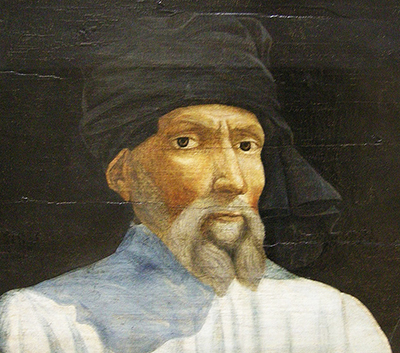
 by Tom Gurney
Tom Gurney BSc (Hons) is an art history expert with over 20 years experience
Published on June 19, 2020 / Updated on November 29, 2026
Email: tomgurney1@gmail.com / Phone: +44 7429 011000
In Florence, Donatello made a marble saint to be seen from the street and a singing gallery whose dancers would pass in and out of sight behind columns high in the cathedral. In Padua, he set a bronze horse and rider above a square. In a slab of marble now in London, he cut a city so faintly that the direction of the light can determine whether you see it at all. The sculptor who made these works understood that a figure's size, the surface it was made from and the place you stood to see it could change what the figure seemed to do. [1] [2] [3] [4]
Donato di Niccolò di Betto Bardi, known as Donatello, was born in Florence around 1386 and died there in 1466. He worked in marble, bronze, wood, terracotta and stucco, often combining materials or adding colour and gilding. That range explains part of his importance to the early Italian Renaissance. Another part lies in how differently he treated the same material from one commission to the next. Marble could carry the weight of a standing man or register the moment when a small face disappears into cloud. Bronze could send a horse's silhouette across an open space or invite someone to hold a devotional image near enough to examine its rim. [1] [3] [5]
The biography of Donatello follows the sculptor from the workshops of Florence to Padua and back. His sculptures can also be approached through a different question. What did Donatello expect a person to be able to see from the street, across a church or from a few steps away, and what did he make of the difference?
Donatello’s connections
Meet the artists whose work intersects with Donatello’s career.
- Lorenzo Ghiberti: A documented employer in Donatello’s early years, Ghiberti managed a large Florentine bronze workshop. [5]
- Filippo Brunelleschi: Brunelleschi worked at the same cathedral complex that commissioned Donatello’s early marbles and singing gallery. [2]
- Michelozzo: Donatello and Michelozzo collaborated on architectural sculpture, including tombs and the external pulpit at Prato. [5]
- Andrea Mantegna: The sculpture and painting shown together in the 2022 retrospective offer a way to examine connections with Mantegna in Padua. [19]
- Andrea del Verrocchio: Verrocchio treated the same biblical subject in a freestanding Florentine bronze with a different costume, silhouette and gaze. [9]
- Michelangelo: The young Michelangelo took up unusually shallow marble relief in his Madonna of the Stairs. [26]
Florence and the view from below
The saints of Orsanmichele still make sense as part of a walk around a building. Florentine guilds commissioned patron saints for the exterior niches, where a figure gave its patrons a visible presence on a busy street. The linen workers and dealers in secondhand goods commissioned Donatello's Saint Mark. The armourers and swordmakers commissioned his Saint George. The building brought works by Donatello, Lorenzo Ghiberti and Nanni di Banco into proximity. A single turn around a corner brought a different sculptor, a different patron and a different treatment of the person standing in the architectural frame. [5] [6] [7]
Mark seems to have paused with his book still in his hand. The cloth hangs into deep folds where his body supports it and breaks differently where the relaxed leg bends. Follow those folds down to his feet and the small shift of weight becomes the basis of the whole figure. The stance is a form of contrapposto, the arrangement of a standing body around a weight-bearing leg and a freer one. Its interest here lies in the time it allows a figure to occupy. Mark could stand that way for a while, absorbed in whatever has caught his attention. It takes only a few principal folds for a passer-by to see that he is standing at ease. [5] [7]
George's shield does a different job. It sets up a strong central line while his feet plant themselves apart and the gaze reaches past the viewer. Seen from a street below, the shield provides a shape the eye can pick out before distinguishing the face. The relief beneath the statue's niche shows George in action against the dragon. The two parts call for different sorts of attention. The statue holds the instant before an action might begin. The relief supplies the horse, dragon and princess, then lets the space spread behind the encounter. A viewer could register the large, still outline and then come closer to follow the story. The marble statue and relief are at the Bargello, where the museum's setting allows a closer examination. The copy outside Orsanmichele keeps the original architectural position intelligible. Mark's original is inside the Orsanmichele museum. [5] [6] [7]
The cathedral posed an even steeper problem. Donatello's seated Saint John the Evangelist stood in a niche near its principal doorway, in an ensemble with three other evangelists. Look at the spread of the knees, the fall of the mantle and the long rise toward the head. The drapery gives definition to a seated body that someone was meant to look up at. The Museo dell'Opera del Duomo brings the statue close enough to notice the turn of the head and the pressure of the hand on the book. Looking at an image taken from below restores something that a frontal gallery photograph can suppress, the weight of the figure above the person looking. The strikingly bare-headed figure known as the Zuccone and the other prophets of the bell tower presented a related problem over a greater distance. Carved faces and emphatic folds had to register within niches on the outside of a tall, patterned building. [2]
Donatello's early marble David was made for a buttress high on the cathedral. A July 1409 record calls for a marble prophet to be taken down from its high position. The figure could have been Donatello's David or Nanni di Banco's Isaiah. [27] In 1416, Florence's government acquired the David and had Donatello adapt it for the municipal palace. The change gave the slender figure a different public life, in a room where viewers could see the sling and the head of Goliath at his feet. The Bargello now houses it alongside the later bronze David, bringing together two statues of the same hero made with different audiences in mind. [8] [9] [27]
Two Davids and a change of audience
Goliath's head underfoot tells you who the young hero is in both versions. From there the sculptures diverge. The marble youth has a mantle whose folds pull the eye along the side of the body and around the turn of the leg. The bronze David stands with his body exposed, wearing a hat and boots, and the long blade makes the hand that holds it seem especially slight. His shadowed face can be difficult to read from straight ahead. Move to the side and the space between the sword and the body opens. The figure's apparent ease depends on a delicate balance of visible shapes, even as the heavy sword and the head beneath him keep the victory in view. [8] [9]
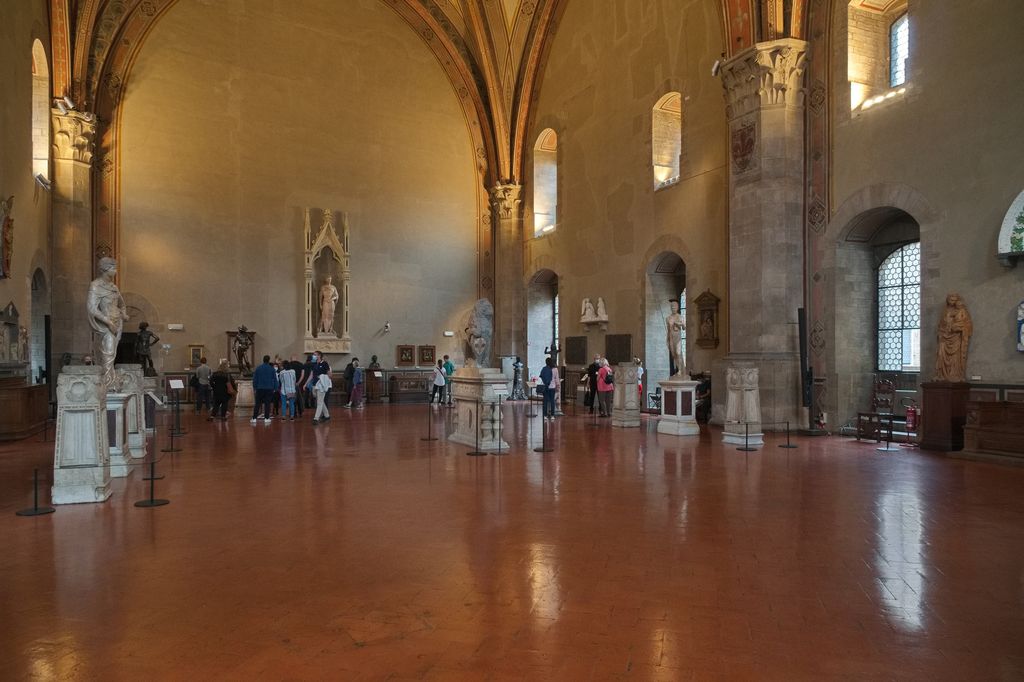
Marble and bronze figures in the Bargello’s Donatello Hall, photographed before its 2025 rearrangement. Armin Kleiner. Image source. CC BY-SA 4.0. Resized for the web.
By 1469 the bronze stood on a column in the Medici palace courtyard, visible even to people passing the entrance. A person stepping inside could walk far enough to see how the body changes in profile. The image would have had a relation to the building, to the family and to other people in the courtyard. Even museum display that allows you to walk around the figure cannot reproduce those relationships. A view from several sides does, however, reveal the extent to which the sculptor let the encounter unfold in stages. In a view from below, the downward angle of David's chin becomes particularly important. In the courtyard it could have brought a face high on a column into a more direct relation to the people beneath it. [9]
Donatello's Judith and Holofernes makes an especially clear companion to those two versions of victory. The upright figure of Judith and the collapsing figure of Holofernes form a single bronze group. From one side her raised weapon gives the composition its strongest line. From another, the drooping head and crossed limbs bring the weight of the general into view. The group stood in the Medici garden before the regime that succeeded the Medici gave it a public position at Palazzo Vecchio in 1495. The Medici had already used an inscription to present Judith as an example to citizens defending the republic. At Palazzo Vecchio a new inscription identified the citizens themselves as the people who had installed the group as an example of public deliverance. The move transferred a familiar story and its political language into different hands. The sculpture outside the palace is a copy. The original is in the Sala dei Gigli inside. [10] [11]
The small comparison the Bargello permits between Donatello and Andrea del Verrocchio makes the point in another way. Verrocchio's bronze David wears a short garment, stands with an elbow out and looks directly into the open space ahead. The head at his feet and the sword in his hand still identify the episode. Donatello's head tilts into the shadow of his hat. In the two works the same familiar story licenses surprisingly different decisions about how much of David's attention the viewer gets to share. It is one reason the history of Renaissance sculpture is easier to see by putting works in conversation than by tracing a succession of famous names. [8] [9]
Space cut into a surface
The shallow carving below Saint George asks the eye to do work that a free-standing figure can do with its outline. Donatello puts a mounted saint and dragon near the front, then lays out architecture and landscape behind them with increasingly fine changes of level. The surface stays close to the plane of the slab even as the space opens. The Italian term rilievo schiacciato describes this very low relief. It rewards a pause because the first view may tell you only where the main action is. Small differences in level then bring parts of the background into and out of visibility as the light falls across the marble. [1] [7]
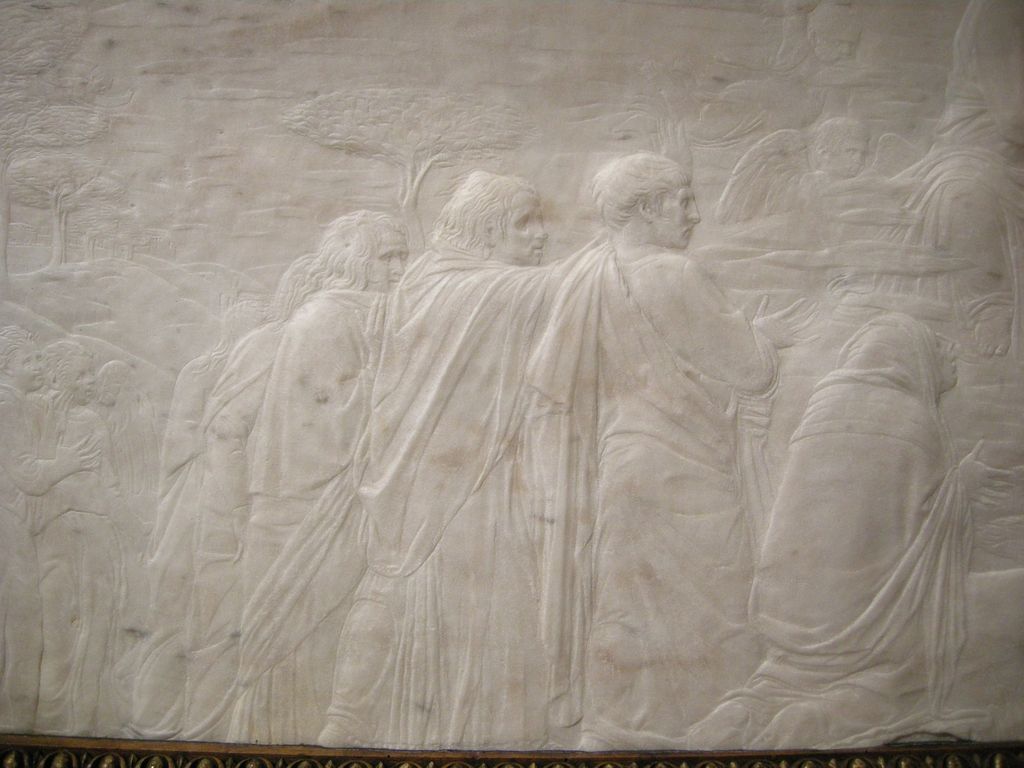
Shallow marble carving in Donatello’s Ascension relief at the V&A. Sailko. Image source. CC BY-SA 3.0. Resized for the web.
In the Pazzi Madonna, now in Berlin, Donatello uses shallow marble for a quieter encounter. The sides of an angular recess recede, and the two faces come forward to meet within it. Mary's forehead presses to the child's. The lines describing the recess are straight and legible, while their profiles touch at a point where the space between them nearly disappears. Look from the architecture to Mary's hand, then back to the faces. Depth exists both as a geometrical illusion and as the minute physical interval in which a mother closes the distance to her child. The present frame is later, and the circumstances of the initial commission are uncertain. The carving provides a firmer starting point for looking than an imagined reconstruction of its first room. [12]
With the Ascension with Christ giving the keys to Saint Peter in the V&A, the eye travels from large figures to cherubs in cloud and down to a distant Jerusalem. Try picking out the city in one photograph and then see how much harder it is to find in another. The museum's interactive study allows the light in a digital view to move across the relief, revealing details through the shadows cast by very slight cuts. It makes clear why an evenly illuminated picture can give so little sense of this particular work. On a page, a drawn line retains much the same definition as you change where you stand. Here the edge of a face or the shape of a cloud can become elusive even when the stone is in front of you. [3]
The gilded bronze Feast of Herod at the Siena Baptistery takes the lesson about depth into a different material and setting. At the front of the relief, the head of John the Baptist is presented and the company recoils. Behind that broken line of bodies, arches and successive spaces carry the eye away from the table. A person facing the panel can piece together separated moments of action within one field. The Siena conservation team identified places where tie rods once crossed the arches, another means of suggesting the built structure of the rooms. Following the reliefs around the font puts the banquet at the end of a larger account of John's life. The surviving gilding helps distinguish the planes, though repeated use and changes to the surface have altered how the metal takes the light. At Siena, the polished marble and gilded metal of the font belonged to an object made for the rite of baptism. The scene was one part of that experience. [5] [13] [14]
Faces close at hand
The Virgin and Child with Four Angels, or Chellini Madonna, is a bronze roundel about the breadth of a dinner plate. The relief crowds the child, the Virgin and the attendant angels into a small circle. An offering of food and the reaching gestures connect the sacred scene with the familiar care of a mother and newborn. In 1456 Donatello gave the roundel to his physician Giovanni Chellini, whose record describes a feature a person looking from the front would miss. The back could serve as a mould for reproducing the design in glass. Experiments in modern times have demonstrated that it was possible. The object was both a personal gift and a means of giving the image another material life. [15]
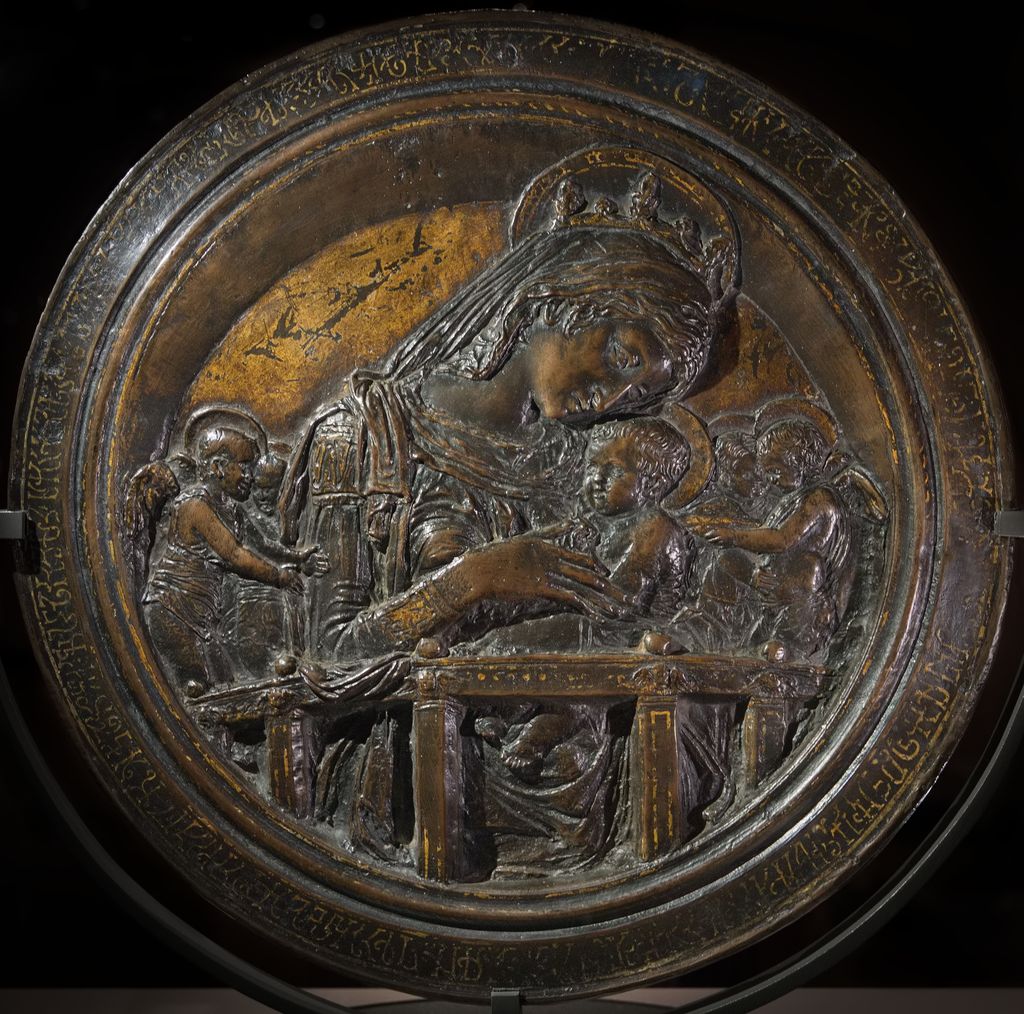
The gilded bronze Chellini Madonna, made on a scale suited to close viewing. Armin Kleiner. Image source. CC BY-SA 4.0. Resized for the web.
That distinction helps when looking at versions of a fifteenth-century sculpture. The Pazzi composition also travelled. The Rijksmuseum catalogues a circular Florentine version in stucco with old paint as a work after Donatello. It shares the enclosing gesture and joined faces of the Berlin marble, while its circular format, modelling and painted surface produce another version of the encounter. The attribution is worth reading past the heading of the collection record, where Donatello's name leads to his design. The description identifies the sculpture as after him. The Louvre also has a low relief called the Pazzi Madonna, which it assigns to Donatello's workshop. The shared title can thus refer to more than one physical object. Compare the shape of the field, the material and the handling of the faces to see what each maker retained and what changed as the design travelled. [12] [16] [17]
There is a different intimacy in the reliquary bust of Saint Rossore, now in Pisa. The young saint is shown at the scale and in the format of a person one might meet, with the head turned slightly and the face framed by armour. Donatello worked the cast bronze and used gilded and silvered surfaces. The different finishes give the face, hair and clothing distinct qualities of light, while the bust itself gave a precious physical presence to the saint whose relic it housed. A close view of the head can make it look like a portrait. Knowing what the object held restores its purpose as a sacred vessel. Donatello used the immediacy of a human face to give form to devotion in both the bust and the roundel, despite the very different situations in which the objects were used. [1] [5] [15]
Two encounters at the Santo in Padua
In Padua, the Basilica of Saint Anthony provided settings for two of Donatello's most ambitious bronze projects. The equestrian Gattamelata stood outside on a stone podium nearly eight metres high. Inside the basilica, the Santo high altar brought larger sacred figures, smaller reliefs and the architecture of the church into relation. Both called for the coordination of many elements, and each had to work across very different viewing distances. An approaching visitor could see the outline of a rider before distinguishing who he was. In the church, the figure of the Virgin and Child could hold the eye from a distance before the narrative scenes became legible. [4] [18]
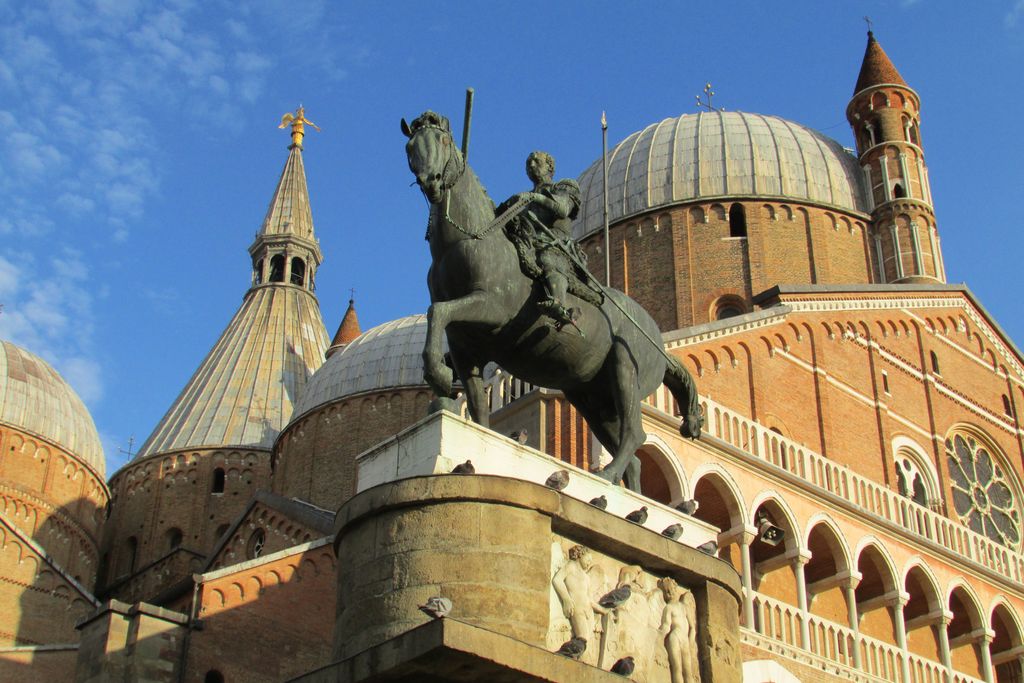
Donatello’s horse and rider above the historic forecourt of the Basilica of Saint Anthony, before removal in 2025. Chris Light. Image source. CC BY-SA 4.0. Resized for the web.
Gattamelata was the name by which the military commander Erasmo da Narni was known. His heirs commissioned the memorial after his death, and the bronze group was installed in 1453 on what had been cemetery ground by the basilica. The baton and the forward step single out the rider's authority without breaking the measured walk of the horse. Approach the work through a photograph that includes the entire podium and the separation of bronze from pavement is striking. Against the sky, the head, baton and raised foreleg remain legible even when the ornament of the armour drops out of sight. Seen close, the horse's open mouth and pricked ears introduce an alertness that the broad silhouette only suggests. The contrast between the far and near views follows from the thing's construction and where it was meant to stand. [4]
The association with Roman equestrian monuments matters because it gives a fifteenth-century soldier a form of public honour familiar from images of imperial rule. Donatello also borrowed the visual language of ancient tombs for the stone podium. Two carved doors, one closed and another ajar, belong to the base beneath the forward-moving horse. The mounted figure announces rank to the square, while the doors return the viewer's attention to death and burial. That dual role makes the basilica's threshold an especially significant setting. The conservation project's account records that the original rider and horse were taken down in October 2025 for examination and treatment. Its photographs preserve a view of the piece as it stood over the piazza and reveal details the historic height kept out of reach. [4]
Inside the Santo, Saint Anthony's miracles ask for a different kind of attention. In the relief usually called the Miracle of the Mule, the animal kneels before the Eucharist. A church interior appears within the scene, and the surrounding figures make the animal's response visible amid a crowd of people. It is possible to follow the architecture inward in the way one might in the Siena Feast of Herod, but the social movement of the figures has changed. In Siena, people shrink away from what has just been brought to the table. In Padua, witnesses gather around the small act of kneeling amid the architecture. The two reliefs show how much a composition depends on the direction in which bodies and attention travel. [14] [18] [19]
The altar also shows what can survive when a sculpture's setting changes. The basilica attributes the present arrangement of the sculptures above and around the main altar to Camillo Boito in 1895. In Boito's arrangement the Madonna seems to rise from her throne to present the child, with three saints on each side. The archives of the Veneranda Arca preserve designs made for the project in the run-up to the 1895 centenary of Saint Anthony's birth. Those drawings belong to the history of the basilica in their own right. They document nineteenth-century decisions about how to bring the figures together again after earlier alterations. The scale and modelling of the bronzes carry evidence of Donatello's design, while their positions in the church also tell a story about the people who inherited it. [18] [19] [20]
Watch the sculpture in context
Survey several works in marble and bronze.
TheHistoryOfArt.org. Survey several works in marble and bronze. Watch on YouTube.
Gold, darkness and rough wood
A high place can suit a broken, flickering surface as well as a clear outline. Donatello's Cantoria was a gallery made for the interior of Florence Cathedral. Behind the small paired columns of its parapet, children dance in a continuous band. You can follow the line of bodies towards a column, lose part of it and pick it up again on the other side. Mosaic in the background catches the light between them. What might look in a photograph like an obstruction becomes part of the movement. A viewer who shifts position gets a slightly different share of the dance, and the spark of mosaic separates a pale limb from the darker recess behind it. [21]
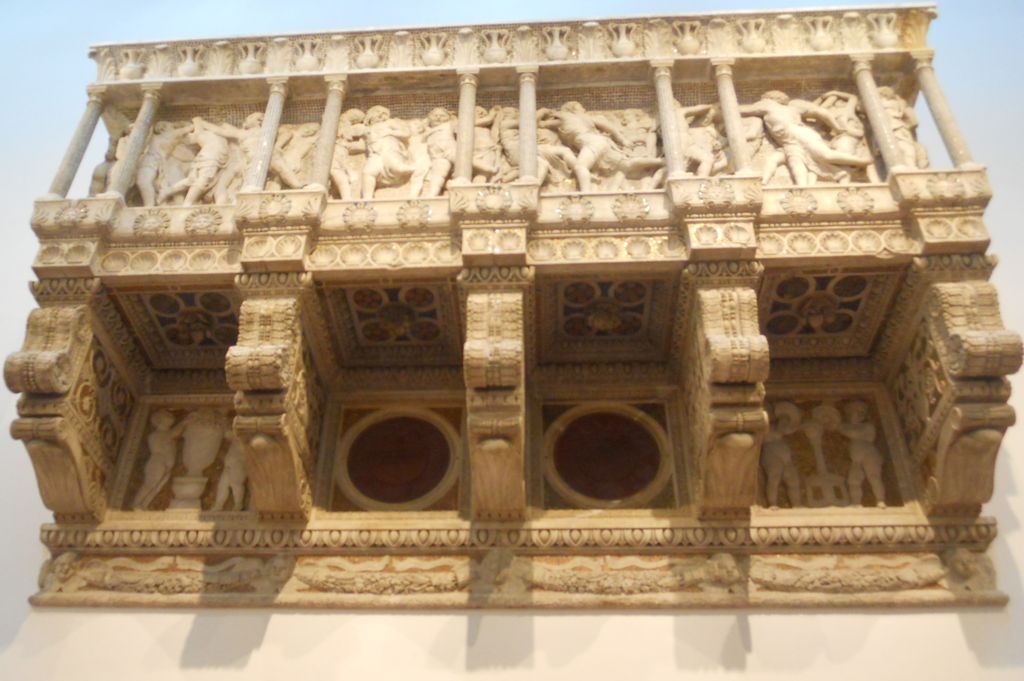
The Donatello Cantoria as seen from below in the Museo dell’Opera del Duomo. Erik Drost. Image source. CC BY 2.0. Resized for the web.
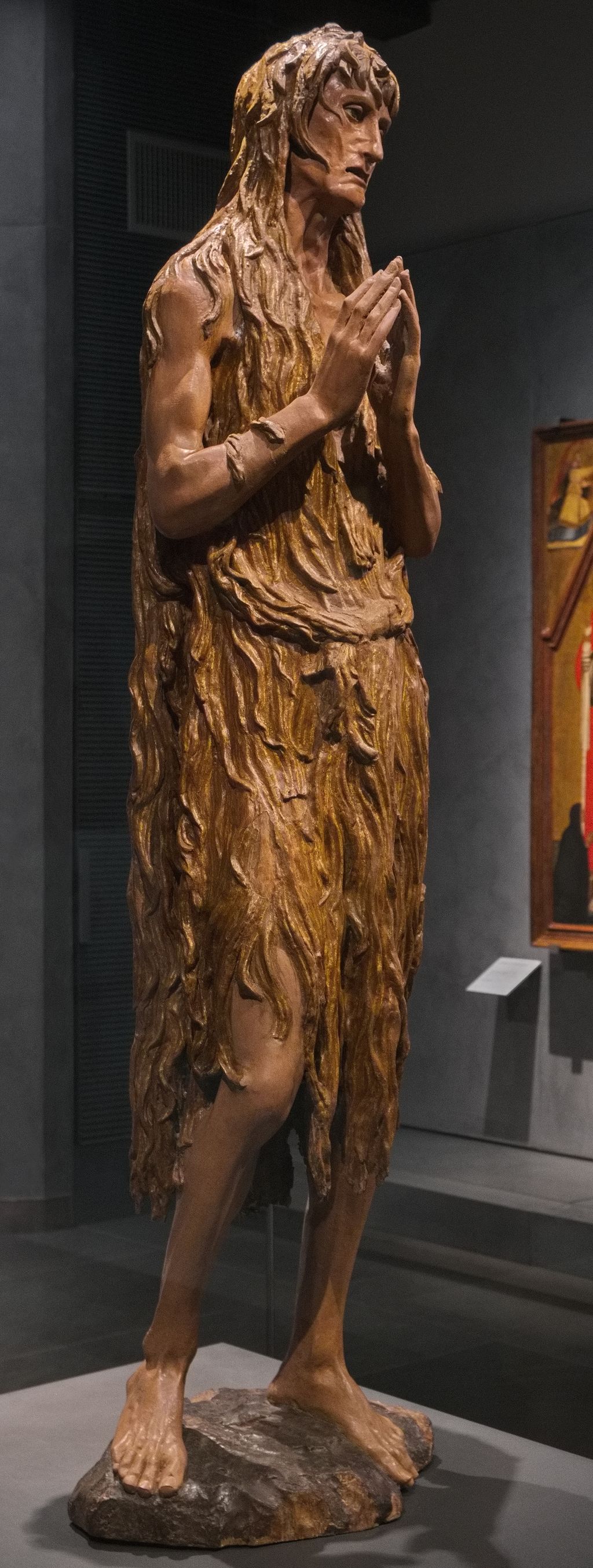
Poplar, polychromy and gilding in Donatello’s Penitent Magdalene. Armin Kleiner. Image source. CC BY-SA 4.0. Resized for the web.
Another way to make a figure visible in architecture was to make the figure itself shine. The Florentine Saint Louis of Toulouse was a commission for an Orsanmichele niche. The figure wears heavy robes, brightened by extensive gilding, and the head appears small above them. Technical study found that the bronze was cast in ten principal pieces, then gilded and assembled. At Santa Croce, where the sculpture is preserved, the decorated mitre and the layered edges have the intricacy of an object made for close study. Seen from farther off, the rising stack of vestments and concentrated brightness gave an otherwise quiet gesture of blessing a presence on the outside of a building. This is the Florentine statue, distinct from the Franciscan saint in the Padua altar ensemble. [18] [22]
Roughness could be equally deliberate. The Penitent Magdalene from the Florence Baptistery, dated about 1455 by the Opera del Duomo, is carved from white poplar with additions in tow and plaster. The surface was painted and partly gilded. Her long hair hangs down as a ragged covering. The ridges of the face and the thin fingers nearly meeting in prayer stand out against that broken texture. A person walking across the museum room sees first the tall figure and the hands raised against the chest. The close view makes the cheeks and the unstable edges of the hair stand out. The sculpture's image of penitence depends on how independently those elements register, even within a single narrow silhouette. [23]
Much later research has recovered evidence of finish that the present appearance alone would scarcely disclose. Conservators studying the Passion Pulpit at San Lorenzo identified small traces of gilding after successive past cleanings had damaged the first finishes. The reliefs are part of a pair with the Resurrection Pulpit. Their size, dense groups and deep accents take a viewer back to the problem of looking upward from a church floor. The traces of gilding add another question about how much more differentiation the surface might once have provided. They also explain why comparing the brown of one bronze to the gold of another without taking account of their histories can be misleading. [24]
What later artists could take from Donatello
At the 2022 exhibitions in Florence and Berlin, Donatello's sculpture appeared alongside paintings by Masaccio and Andrea Mantegna. Exchanging ideas across painting and sculpture was a feature of Donatello's world. The perspective of the Pazzi recess and the architecture of the Siena relief show ways in which carving could take up questions associated with painting. Conversely, a painter could give a body the balance of a standing marble figure or make a group in an altarpiece feel present in the space of a church. Set beside painting, Donatello's reliefs make it particularly easy to see how much apparent depth an artist could achieve on a shallow surface. [12] [14] [19] [25]
By about 1490, the young Michelangelo was using shallow marble relief in his Madonna of the Stairs. Mary occupies almost the whole height of the carving. The stairs and the figures behind her establish space around a seated body that can feel monumental despite the size of the panel. Vasari recognised the kinship with Donatello in 1568. Look at the tilt of the heads, though, and a difference emerges. In the Pazzi relief Mary bends towards her child's face. In Michelangelo's relief her gaze goes out of the picture, beyond the child cradled against her. A sculptor could work in the same shallow depth and give a mother and child a very different emotional distance. [12] [19] [26]
A good first encounter with Donatello can begin with a detail as simple as Mark's supporting leg or the shadow between the faces of the Pazzi Madonna. Then look outward to see what else has been made to depend on it. A fold draws the eye up the body, a frame presses two figures closer together, or the height of a pedestal lets a moving horse appear against the sky. Few of his works ask for precisely the same kind of looking. The variety makes it possible to come back to a sculpture that already seems familiar and see something the first position, the first light or the first photograph left out.
Four stages of Donatello’s career
From the workshop to the street
Early employment in Ghiberti’s workshop preceded commissions for the cathedral and the Florentine guilds. Saint Mark and Saint George give two ways to make a marble figure visible from below. [5]
Collaboration, relief and public sculpture
Projects in Florence, Siena and Prato put Donatello’s reliefs into distinct settings. Partnerships and changing patrons shaped both what could be undertaken and how the work reached its setting. [5]
An altar and a monument
At the Santo, Donatello made sculptures for both the high altar and an equestrian memorial outside. The bronze projects address different settings within the same place. [4]
A return to Florence and work left unfinished
The Penitent Magdalene and the late bronze reliefs show different ways to shape bodies and surfaces. The San Lorenzo pulpits also preserve the work of collaborators and later installers. [24]
Essential works by Donatello
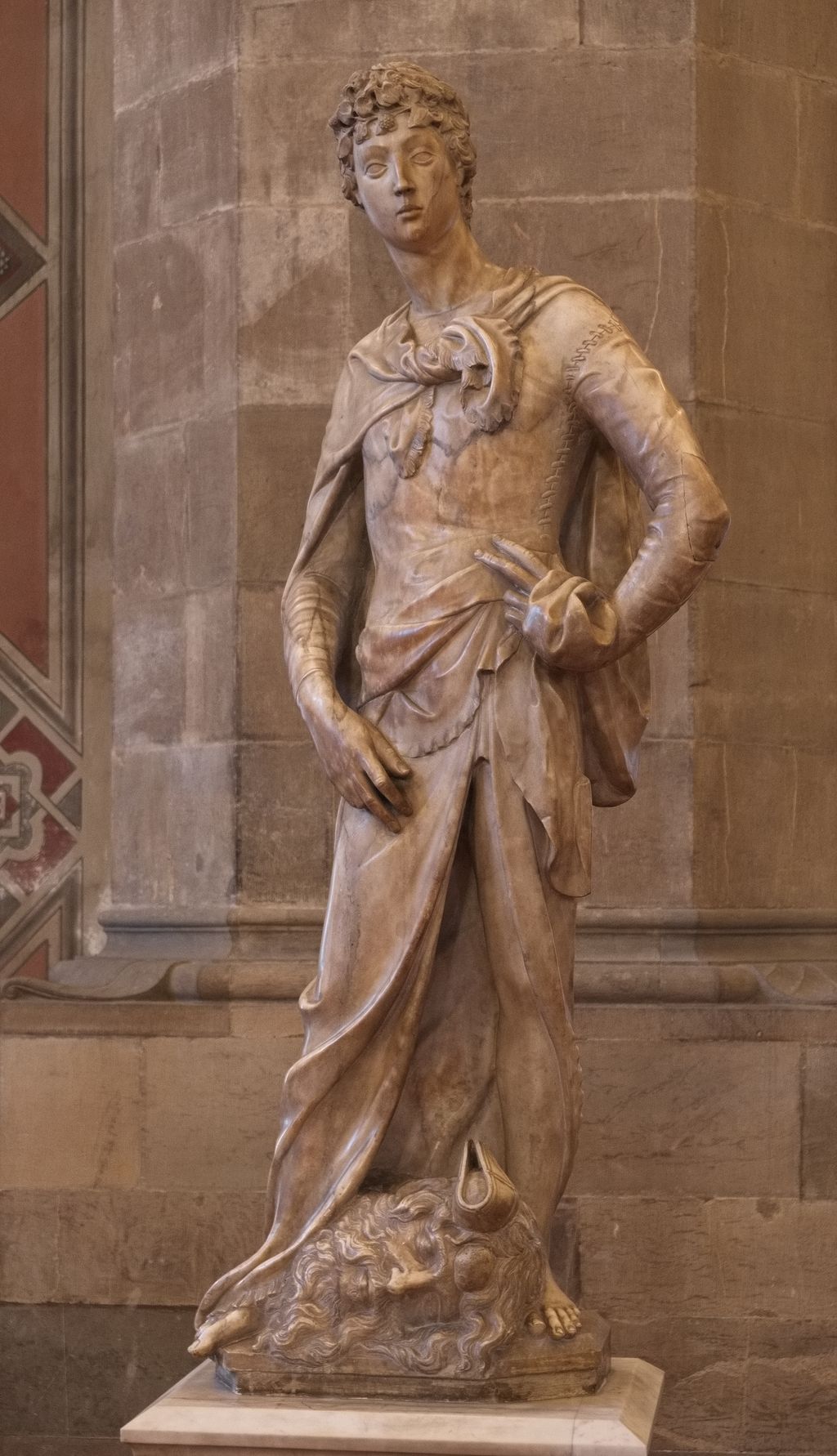
Marble David
1408–09 and 1416 · An early clothed David acquired and adapted for the Florentine government.
Armin Kleiner · Image source · Image licence
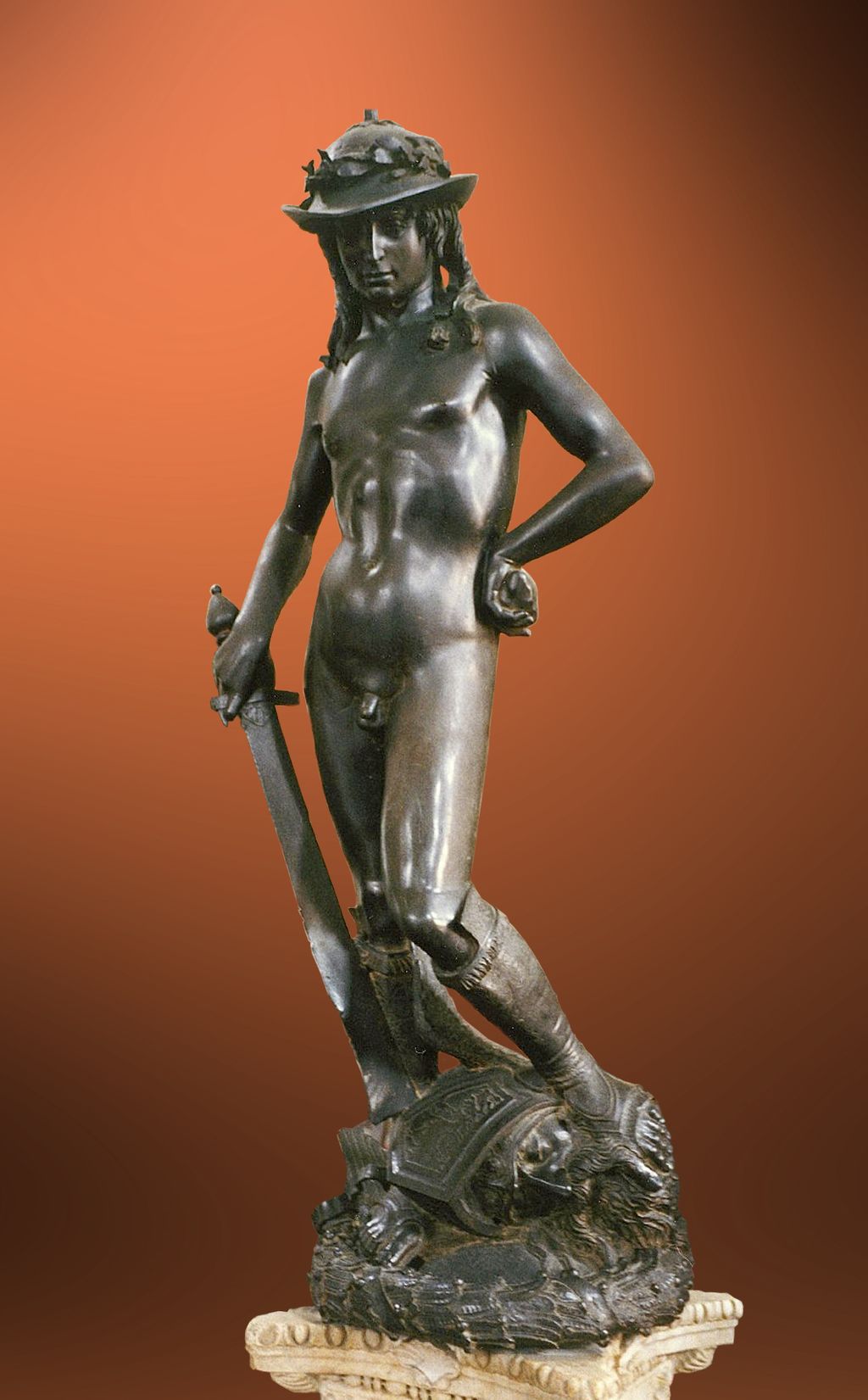
Bronze David
c. 1435–40 · A partly gilded figure documented in the Medici palace courtyard in 1469.
Patrick A. Rodgers · Image source · Image licence
Cantoria
1433–39 · Dancers move through a sculpted colonnade on a gallery made for Florence Cathedral.
Erik Drost · Image source · Image licence
Gattamelata
Installed 1453 · A bronze rider and horse made for the forecourt of the Santo in Padua.
Chris Light · Image source · Image licence
Penitent Magdalene
c. 1453–55 · Carved poplar, colour and surviving gilding give the penitent saint a striking presence.
Armin Kleiner · Image source · Image licence
Chellini Madonna
Given in 1456 · A bronze gift to Donatello’s physician, with a reverse that could act as a mould.
Armin Kleiner · Image source · Image licence
Donatello sculpture directory
| Name | Date | Medium and record |
|---|---|---|
| Marble David | 1408–09, adapted 1416 | Carved Carrara marble Catalogue. |
| Saint John the Evangelist | c. 1409–15 | Carved marble Catalogue. |
| Saint Mark | 1411–13 | Carved Carrara marble Catalogue. |
| Saint George and its dragon relief | c. 1415–17 | Marble statue and marble relief Catalogue. |
| Marzocco | c. 1417–20 | Carved sandstone Catalogue. |
| Saint Louis of Toulouse, Florence | 1418–25 | Gilt bronze and mixed media Catalogue. |
| Pazzi Madonna | c. 1420s | Marble relief Catalogue. |
| Reliquary Bust of Saint Rossore | c. 1420s | Gilt bronze Catalogue. |
| The Prophet Jeremiah | 1420s–30s, disputed | Marble Catalogue. |
| Zuccone | c. 1420s–30s | Marble Catalogue. |
| Feast of Herod, Siena | 1420s | Gilded bronze relief Catalogue. |
| Ascension with Christ Giving the Keys to Saint Peter | c. 1428–30 | Marble relief Catalogue. |
| Cantoria | 1433–39 | Marble and mosaic Catalogue. |
| Amor-Atys | c. 1435–40 | Partly gilded bronze Catalogue. |
| Bronze David | c. 1435–40, disputed | Partly gilded bronze Catalogue. |
| Gattamelata | Installation agreement, 1453 | Bronze and stone Catalogue. |
| Santo altar | Mid-fifteenth century | Bronze and limestone ensemble Catalogue. |
| Chellini Madonna | Given in 1456 | Partly gilded bronze tondo Catalogue. |
| Penitent Magdalene | c. 1453–55 (Opera) | Poplar, stucco, pigments and gold Catalogue. |
| Judith and Holofernes | Late 1450s–early 1460s | Bronze with surviving gilding Catalogue. |
| Pulpit of the Passion | Late work and later assembly | Bronze reliefs, Donatello and collaborators Catalogue. |
| Bust traditionally called Niccolò da Uzzano | Fifteenth century | Painted terracotta, attribution disputed Catalogue. |
| Prato Cathedral exterior pulpit | Commissioned 1428; carved 1430s | Marble reliefs, Donatello and Michelozzo Catalogue. |
| Cavalcanti Annunciation | c. 1433–35 | Gilded sandstone and terracotta Catalogue. |
| Crucifix at Santa Croce | Early fifteenth century | Painted wood Catalogue. |
| Madonna of the Clouds | c. 1425–35 | Marble relief Catalogue. |
| Old Sacristy Doors | Fifteenth century | Two paired bronze doors Catalogue. |
| Resurrection Pulpit | Late work and later assembly | Bronze reliefs, Donatello and collaborators Catalogue. |
| Brancaccio tomb | 1420s | Donatello, Michelozzo and assistants, mixed materials Catalogue. |
| Saint John the Baptist, Venice | 1438 | Polychromed and gilded wood Catalogue. |
| Sacrifice of Isaac | Early fifteenth century | Donatello and Nanni di Bartolo, marble Catalogue. |
| Madonna of Via Pietrapiana | Mid-fifteenth century | Terracotta Catalogue. |
| Miracle of the Mule | Mid-fifteenth century | Gilded bronze panel for the Santo altar Catalogue. |
| Padua Crucifix | Mid-fifteenth century | Cast bronze Catalogue. |
| Dancing Spiritello, Bargello | Fifteenth century | Bronze Catalogue. |
| Young Prophet from the Porta della Mandorla | c. 1404–09 | White marble, attributed to Donatello Catalogue. |
| Prophet or Apostle from the Duomo north tribune | Early fifteenth century | White marble, possibly Donatello Catalogue. |
| Beardless Prophet | 1415–18 | White marble Catalogue. |
| Sibyl and Prophet of the Porta della Mandorla | 1422 | Carved marble heads for the portal Catalogue. |
| Faith, Siena baptismal font | 1420s | Gilded bronze figure Catalogue. |
| Hope, Siena baptismal font | 1420s | Gilded bronze figure Catalogue. |
| Feast of Herod, Lille | c. 1430 | Carrara marble relief Catalogue. |
| Piot Madonna | c. 1440–60 | Polychrome terracotta with glass and wax inlays Catalogue. |
| Carafa Horse Head | c. 1456–58 | Cast bronze Catalogue. |
| Pazzi Madonna workshop version, Louvre | c. 1450 | Polychrome gesso, Donatello’s workshop Catalogue. |
| Pazzi Madonna tondo, Rijksmuseum | c. 1425–50 | Plaster and stucco, after Donatello Catalogue. |
| Sprite | c. 1430–40 | Bronze, sculptor or metalsmith close to Donatello Catalogue. |
Discussion
Look again at the images and ideas explored in Donatello. These editorial prompts invite your observations.
Reader Insights
Choose one sculpture designed to be seen from below. What details register first when you look up at it?
Compare the space in a shallow relief with the silhouette of a freestanding statue. How does each ask you to move or pause?
Join the Conversation
Share a detail, comparison or question about Donatello below.
References
- Victoria and Albert Museum, Donatello – a master at work. View source.
- Opera di Santa Maria del Fiore, Donatello and the Opera del Duomo. View source.
- Victoria and Albert Museum, Explore Donatello's masterpiece: ‘The Ascension’. View source.
- Save Venice, Donatello’s Equestrian Monument to Gattamelata, Padua, history and conservation account. View source.
- Horst W. Janson, Bardi, Donato, detto Donatello, Dizionario Biografico degli Italiani, vol. 6, Treccani, 1964. View source.
- Musei del Bargello, Orsanmichele: Museum First Floor. View source.
- Comune di Firenze, Orsanmichele, le statue in mostra al Museo Nazionale del Bargello. View source.
- Musei del Bargello, Donatello and the Dawn of Renaissance. View source.
- Victoria and Albert Museum, Donatello's ‘David’. View source.
- Comune di Firenze, Giuditta e Oloferne: relazione tecnica, conservation and object history. View source.
- Comune di Firenze, Il restauro delle grandi sculture simbolo di Firenze. View source.
- Staatliche Museen zu Berlin, Madonna und Kind (Die Pazzi Madonna), inv. SKS 51. View source.
- Opera della Metropolitana di Siena, Il Fonte Battesimale di Siena: Il Restauro. View source.
- Opera della Metropolitana di Siena, Il Restauro del Fonte Battesimale di Jacopo della Quercia. View source.
- Art Fund, Madonna and Child with Four Angels (‘The Chellini Madonna’), acquisition record and account of Chellini’s testimony. View source.
- Rijksmuseum, Maria met kind, type ‘Madonna dei pazzi’, tondo, inv. BK-NM-11935. View source.
- Musée du Louvre, La Vierge et l'Enfant, dite la Madone des Pazzi, inv. RF 744. View source.
- Basilica di Sant'Antonio di Padova, Presbiterio e altare maggiore. View source.
- Fondazione Palazzo Strozzi and Musei del Bargello, Donatello, il Rinascimento, exhibition curated by Francesco Caglioti, 2022. View source.
- Archivio della Veneranda Arca di Sant'Antonio, Boito 01, drawings and projects for the Antonian centenary. View source.
- Opera di Santa Maria del Fiore, Donatello, Cantoria. View source.
- Opera di Santa Croce, San Ludovico di Tolosa. View source.
- Opera di Santa Maria del Fiore, Donatello, Maddalena. View source.
- Maria Donata Mazzoni, ed., L’ultimo Donatello. I pulpiti di San Lorenzo: studi e restauro, Opificio delle Pietre Dure. View source.
- Staatliche Museen zu Berlin, Donatello: Inventor of the Renaissance, exhibition, 2022–23. View source.
- Casa Buonarroti, Madonna della scala, inv. 190. View source.
- Francesco Caglioti, Laura Cavazzini, Aldo Galli and Neville Rowley, ‘Reconsidering the Young Donatello’, Jahrbuch der Berliner Museen 57, 2015 (published 2018), pp. 18–19, including note 19. View source.
- The Metropolitan Museum of Art, Florence and Central Italy, 1400–1600. View source
- Ministero della Cultura, David with the Head of Goliath, Bargello bronze. View source
More DONATELLO Sculptures
Marble David
Armin Kleiner. Image source. CC BY-SA 4.0. Resized for the web.
Bronze David
Patrick A. Rodgers. Image source. CC BY-SA 2.0. Resized for the web.
Cantoria
Erik Drost. Image source. CC BY 2.0. Resized for the web.
Gattamelata
Chris Light. Image source. CC BY-SA 4.0. Resized for the web.
Penitent Magdalene
Armin Kleiner. Image source. CC BY-SA 4.0. Resized for the web.
Chellini Madonna
Armin Kleiner. Image source. CC BY-SA 4.0. Resized for the web.


