


 by Tom Gurney
Tom Gurney BSc (Hons) is an art history expert with over 20 years experience
Published on June 19, 2020 / Updated on November 29, 2026
Email: tomgurney1@gmail.com / Phone: +44 7429 011000
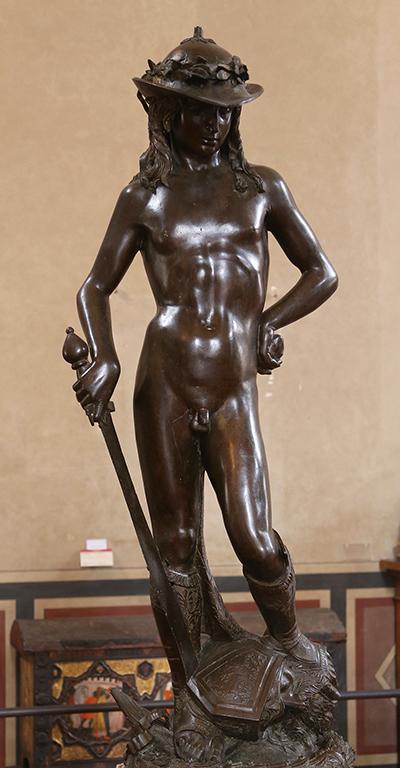
At Florence’s Bargello, two sculptures of David show how differently Donatello could approach the same figure. In marble, the young victor stands clothed, with a knot of fabric gathering the cloak across his body. In bronze, the broad hat and boots frame a largely bare figure whose stance becomes clearer from the side. Goliath’s head is low in both compositions. From some positions it takes a moment to find it, and that moment changes the way you read the victor above. The museum now places the marble near Saint George and the bronze in the centre of the hall. The arrangement invites a side-by-side comparison of the clothed marbles and a walk around the bronze. [1] [2] [3]
That change of position is a good way into Donatello’s sculpture. A figure designed for a street niche needs to read above a passer-by’s head. A relief set into a font shares its light with adjacent panels. Some lines on a small marble become legible only when the light falls almost parallel to its face. Look first for where the work asks you to stand, then for how its material makes that view possible. It helps to distinguish the object’s intended setting, the place where it is kept today and the conditions under which it was photographed. [2] [4]
Style and technique
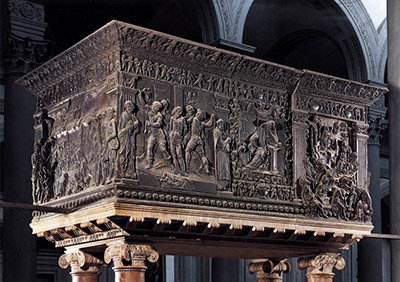
A freestanding sculpture gives the figure volume that you can follow around its sides. A relief holds the figures and their setting together on a backing surface. In high relief, parts project far enough to cast substantial shadows or reveal a suggestion of the space behind a limb. At the shallower end, Donatello could use extremely slight gradations of height, a method called rilievo schiacciato. From the edge of such a panel the land, buildings and bodies occupy a remarkably thin layer. Seen head-on, overlapping contours, differences in scale and changing shadows can send the eye a long way into the scene. Reliefs can combine several depths within the same composition. [2] [4]
Where a sculpture seems to change from one view to another, ask whether the effect comes from its contour, the carving or modelling within that contour, or the finish of the surface. A line along the cheek of a polished marble reads differently from a fold cut deeply enough to remain dark in bright light. In bronze, details made or sharpened after casting and the selective application of gold can separate passages that are close in depth. Paint on wood or fired clay can draw attention to a detail independently of its projection. Even the difference between a matt patch and a reflective one can determine which part of the work you notice first. [2] [4]
Donatello’s sculptures
Marble figures for niches and rooms
Begin at the Bargello with the marble David. Commissioned for Florence Cathedral and modified in 1416, it belongs to a different project from the later bronze. The cloak gathers at the front in a knot that reads clearly even when the folds below it begin to merge from a distance. Move a little off-centre to follow the turn from the chest towards the head and the way the weight is carried on one leg. Next to the nearby Saint George, the gestures seem relatively understated. Both figures keep their principal shapes within a narrow field, which helps explain why a front view is such a productive place to begin with either work. [1] [2] [3]
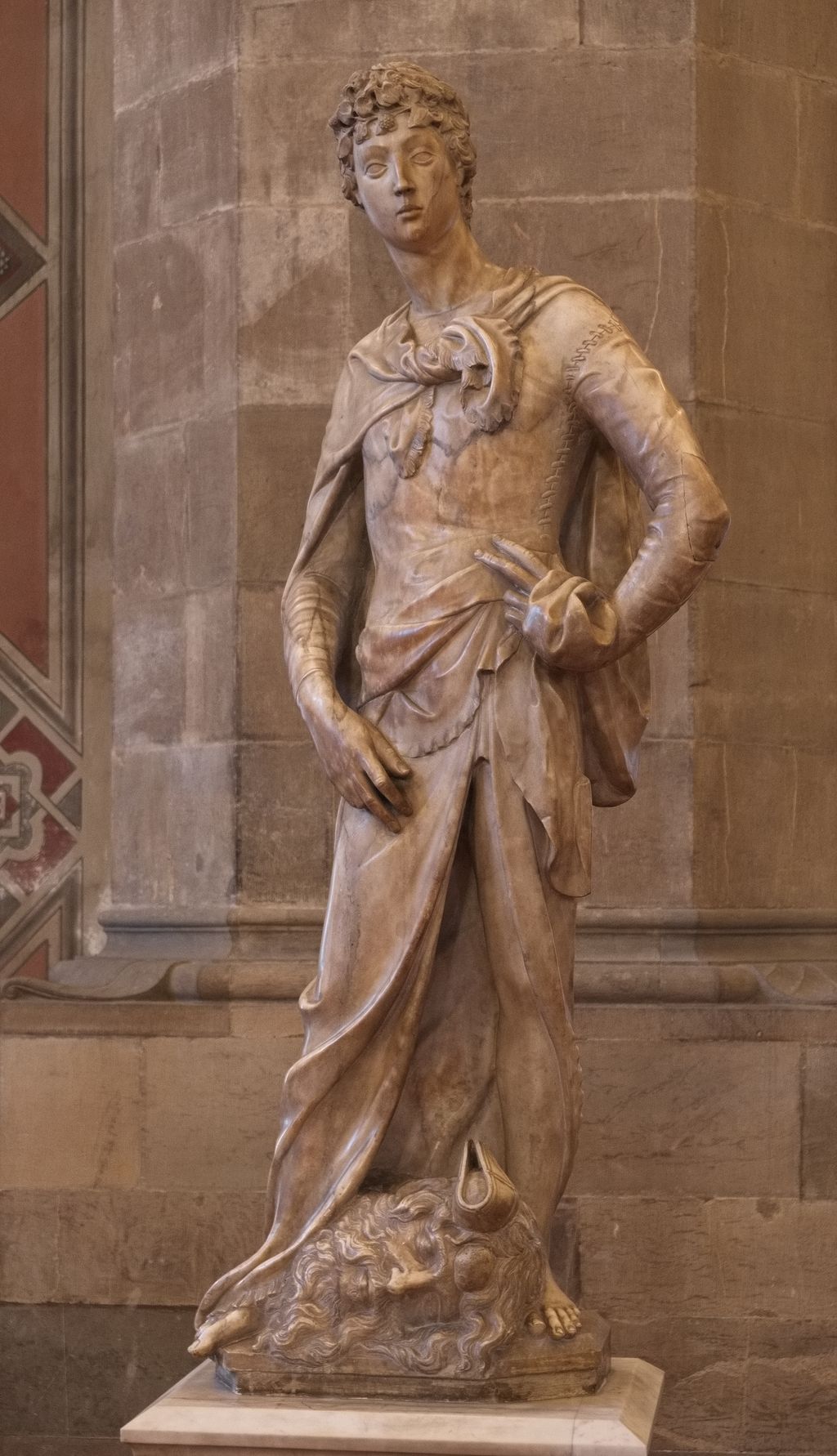
The weight shift and mantle in Donatello’s marble David. Armin Kleiner. Image source. CC BY-SA 4.0. Resized for the web.
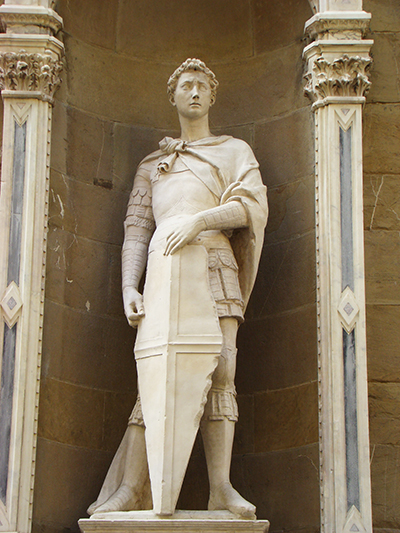
Saint George was made for the armourers’ and swordmakers’ guild at Orsanmichele. The shield pulls the front of the statue into a firm vertical, while the turn of the head directs attention outward. Compare that direct presentation with the story beneath the statue, where George encounters the dragon in a shallow landscape. A photograph of the statue alone misses the change of scale between the two. A passer-by could register the patron saint at a glance and then step closer to see the action below. The architecture at the side of the relief offers an especially clear line into the distance. [1] [4] [5]
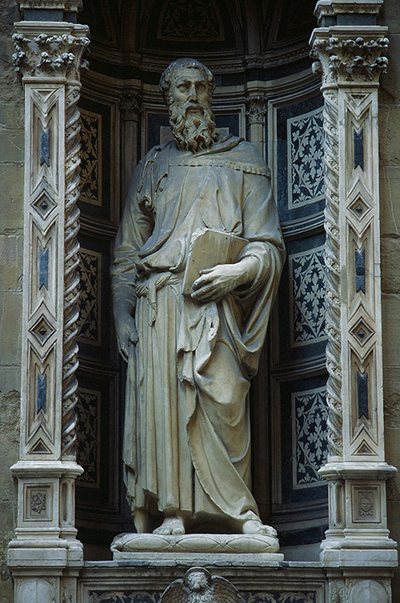
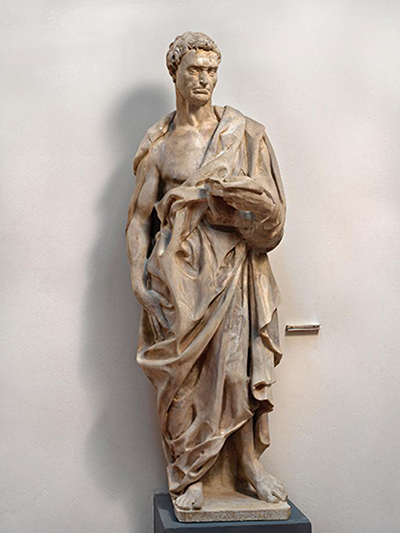
At Orsanmichele itself, compare the church exterior with the original Saint Mark inside the museum. The outdoor niche lets you judge the height and angle at which a guild’s sculpture met the street. Indoors, you can see how the shifting weight of Mark’s stance reaches the surface through the folds. Look for the relation between the cloak and the knee, then for the points at which the cloth hangs free of the body. The modern setting also brings the present condition of the marble into view. The restoration project investigated uneven brown patches whose origin may lie in an earlier surface treatment. That example is worth keeping in mind when interpreting colour in a photograph of any once-exposed statue. [1] [6]
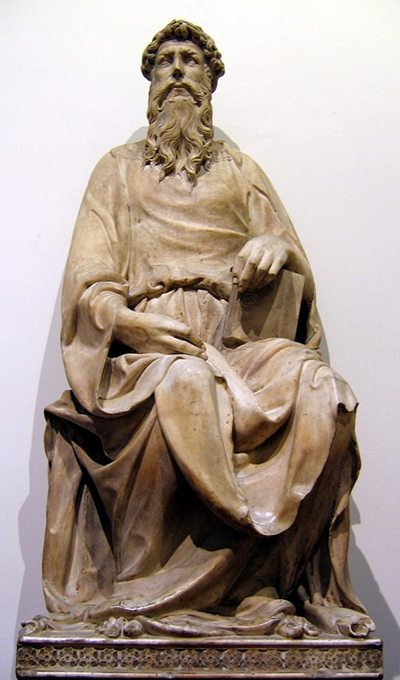
At the Museo dell’Opera del Duomo, the seated Saint John the Evangelist offers another test of viewpoint. He once occupied a niche beside the cathedral portal as one of four Evangelists. The book lies open on John’s thigh, with one hand resting on it amid the heavy folds across his lap. From a low viewpoint, those folds conduct the eye up to the face. The museum’s Sala del Paradiso gives the figure an architectural context among sculptures from the old cathedral front. The tall niche commissions from Giotto’s bell tower can then be seen together in the Campanile gallery. [7] [8]
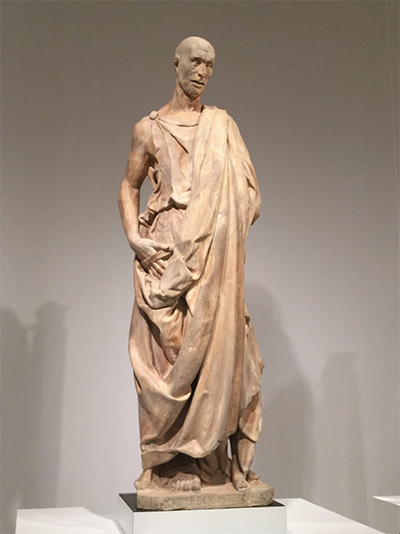
Look at the lower edge of the Prophet Jeremiah and then the head of the figure called Zuccone. Jeremiah’s scroll carries the inscription used to identify him, though the museum catalogue notes that it may have been added later. His heavy mantle, exposed arm and turned head give you different ways to follow the form from one part of the figure to the next. The bald head and hollowed features of Zuccone, often identified as Habakkuk, stand out even at a distance. Each figure is individually recognisable in the gallery, where you can see how much responsibility Donatello gave to the silhouette and the distribution of shadow across the face. The identities also illustrate the difference between a conventional museum title and a secure biblical identification. [9] [10]
Sandstone, terracotta, stucco and wood in Florence
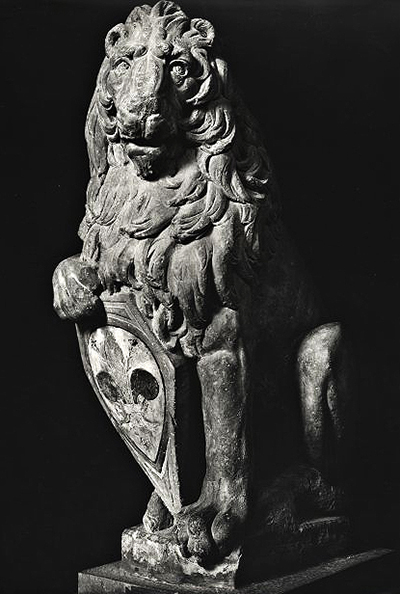
The Bargello’s Marzocco is a stone lion holding Florence’s shield. Standing near the two Davids, it lets you compare how an animal’s weight is conveyed through broad surfaces, the tucked body and the forepaw braced against the shield. The outlines of the lily and the heraldic field must remain readable even if the finer marks on the mane fall out of view. The original was made for a stair at Santa Maria Novella, later moved to Piazza della Signoria and taken indoors in the nineteenth century after exposure damaged it. The outdoor copy makes sense of the lion’s role in the civic space. The Bargello is the place to look for the original’s surface. [1] [11]
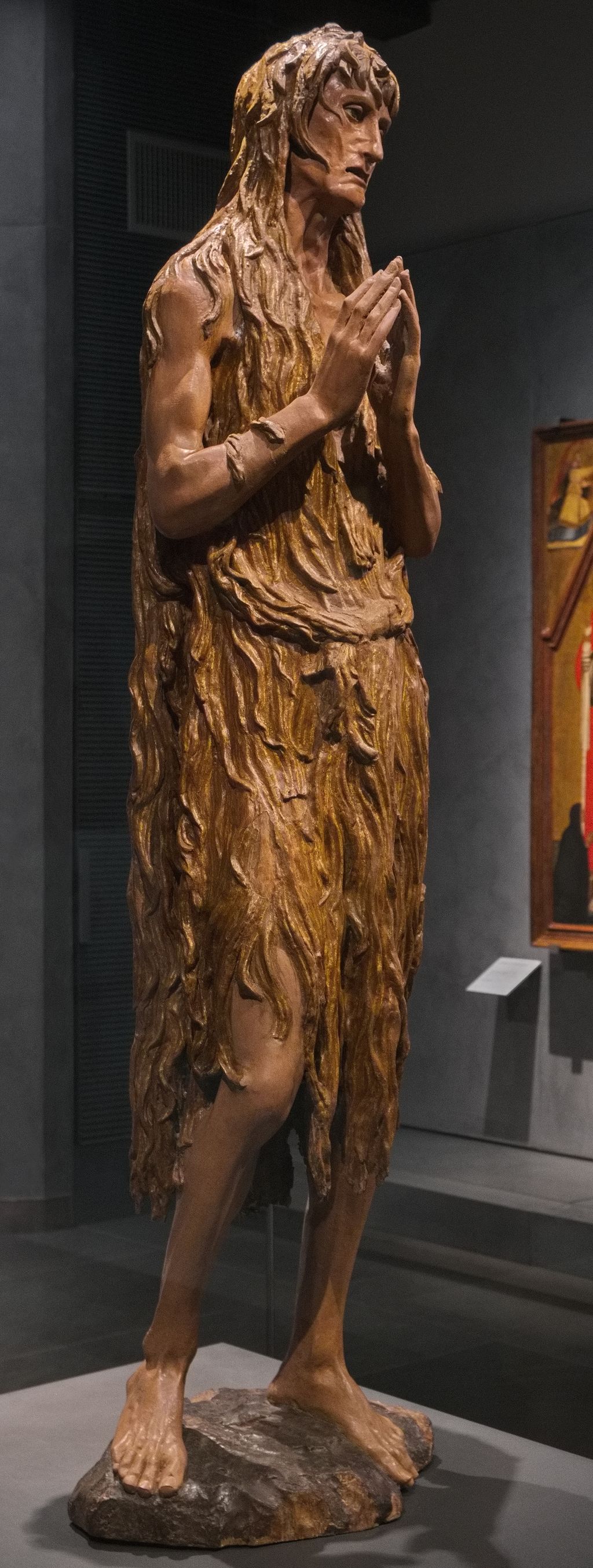
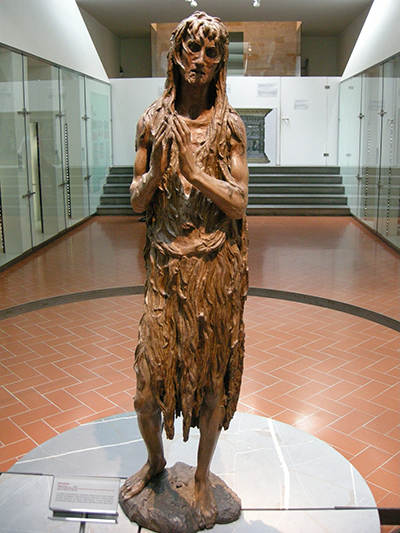
The rough carving and worked surface of the Penitent Magdalene in Florence. Armin Kleiner. Image source. CC BY-SA 4.0. Resized for the web.
In Santa Croce, the Cavalcanti Annunciation shows what Donatello could do with grey sandstone where he wanted the surface to catch the light. The church identifies the principal relief as pietra serena with touches of gold and the figures above it as terracotta and stucco. Watch the way Mary’s body turns away from Gabriel while the architecture around the two pulls the scene together. The points of gold draw attention across the now muted stone. Here the carved setting and the figures can be seen in relation to the wall, at the scale of a chapel furnishing, even when a photograph isolates the two principal figures. [2] [12]
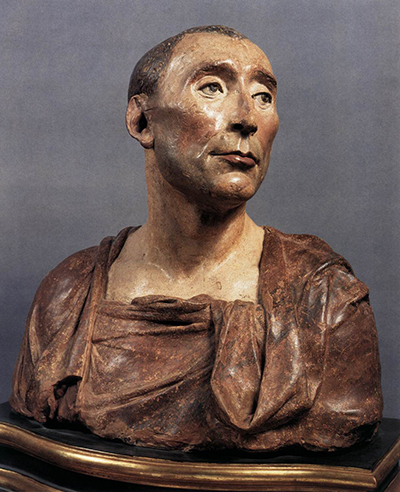
Terracotta is fired clay. A head modelled in clay can retain the transitions around a cheek, chin or neckline, and a painted finish can give the eyes and lips much of their expression. The Bargello’s bust traditionally called Niccolò da Uzzano is a useful case because the moulding of the features is there to study whatever attribution you accept. Look at the head against the turn of the shoulders and at where the paint reinforces the underlying form. Both the sitter’s name and the longstanding attribution to Donatello have been questioned. Francesco Caglioti assigns the bust to Desiderio da Settignano’s workshop. [13] [14]
For a terracotta relief catalogued under Donatello’s name, look at the Louvre’s Piot Madonna. The Virgin’s hands meet in prayer, while the small roundels in the background interrupt the clay with different textures and colours. The Louvre records traces of gilding and wax medallions set under glass. Look at what these inserts would have done beside the gilded clay. Each little circle could pick up light independently of the main figures, giving the background its own activity even at points where the modelling is shallow. [2] [15]
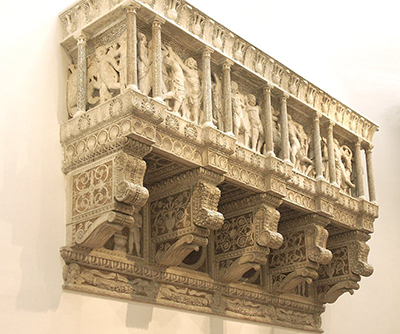
At San Lorenzo’s Old Sacristy, Donatello used stucco as part of the building’s interior. The V&A describes relief material worked in place around nails that helped support it while wet. Paint and crushed brick supplied colour alongside the pale material. Look up and consider what survives visually when you take several steps back. Large divisions of colour and the outline of the frame lead the eye before small marks on the figure can be made out. At the Duomo museum, the Cantoria answers a similar problem at another scale. The dancers pass behind paired columns, a fixed rhythm in front of a continuous frieze. Glass mosaic reflects light through the gaps. The organ loft was installed high in the cathedral, so it is worth looking from below before examining the frieze at close range. Compare Luca della Robbia’s nearby loft, which divides the activity of its performers into separate panels. [2] [16] [17]
Donatello’s Penitent Magdalene, also in the Duomo museum, is made of poplar with stucco, pigments and gold. The hair makes its own strong contour down the whole length of the body. Come closer and the material is less easily read as a single block. Thickly applied gesso was modelled to build up passages of hair, with nails helping to support it. Traces of colour and gold help reconstruct a brighter surface than the one visible today. The space between the hands, held close in prayer, does much of the work of focusing attention. Seen at a distance, that small interval stays clear against the long dark strands. [2] [18]
Shallow relief in Berlin, London and Siena
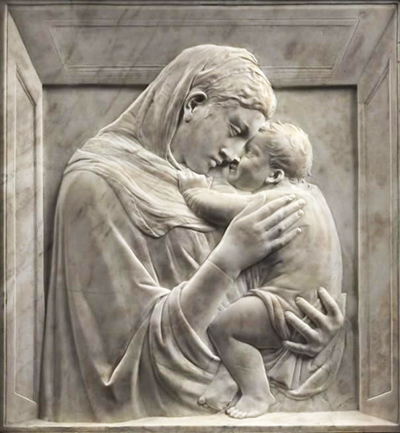
At Berlin’s Bode-Museum, stand square to the Pazzi Madonna. The fictive recess in the marble gives mother and child room to turn towards one another. Follow one of its receding lines, then look at how the profiles meet. The physical projection is small enough that the near contact of foreheads does more to bring the faces forward than any deep hollow behind them. Berlin identifies the outer frame as later and treats the link with the Pazzi palace as uncertain. The recess carved into the slab belongs to the image itself. It gives you a reliable starting point even when the original setting is open to question. [4] [19]
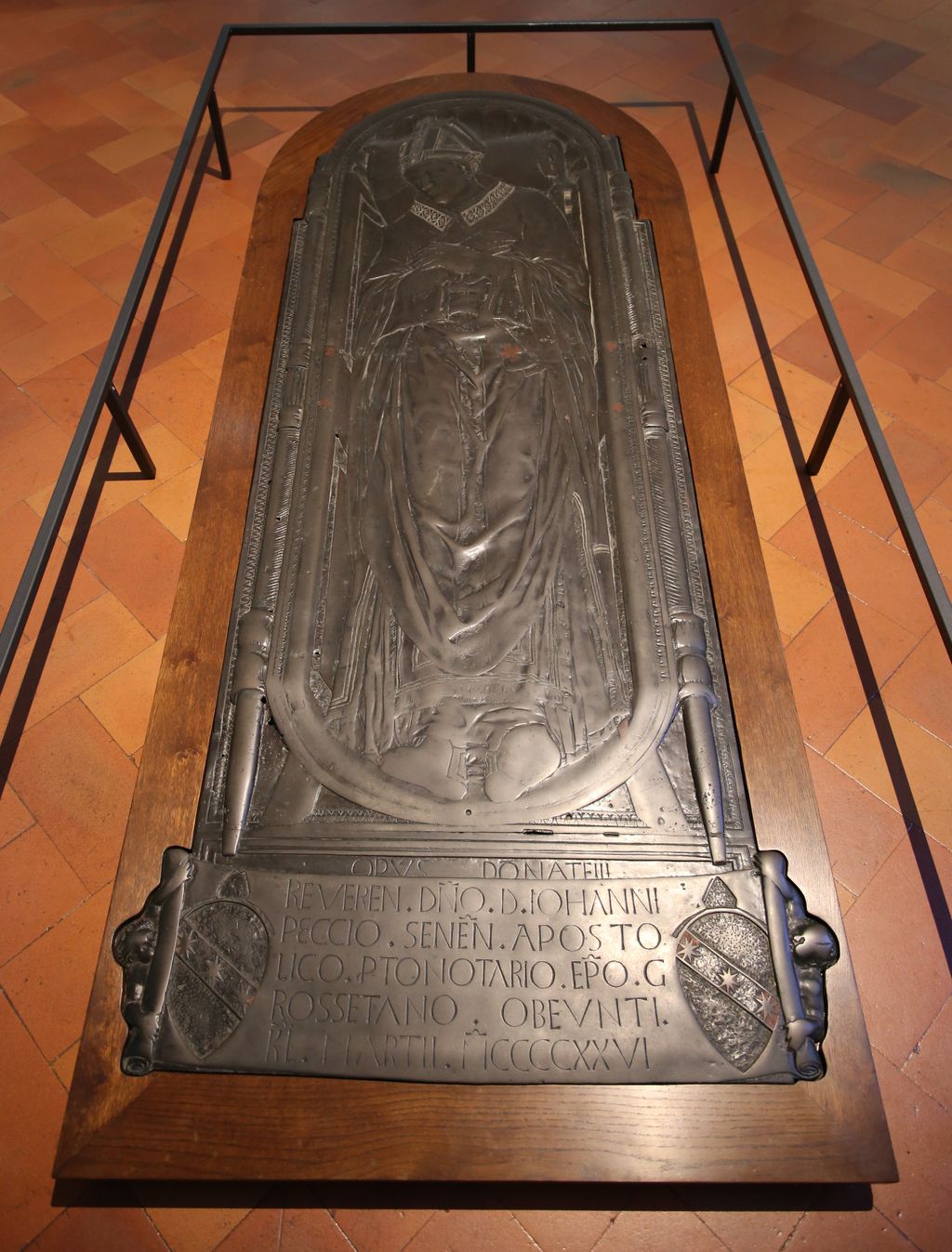
The bronze tomb slab of Bishop Giovanni Pecci in Siena Cathedral. Francesco Bini. Image source. CC BY-SA 4.0. Resized for the web.
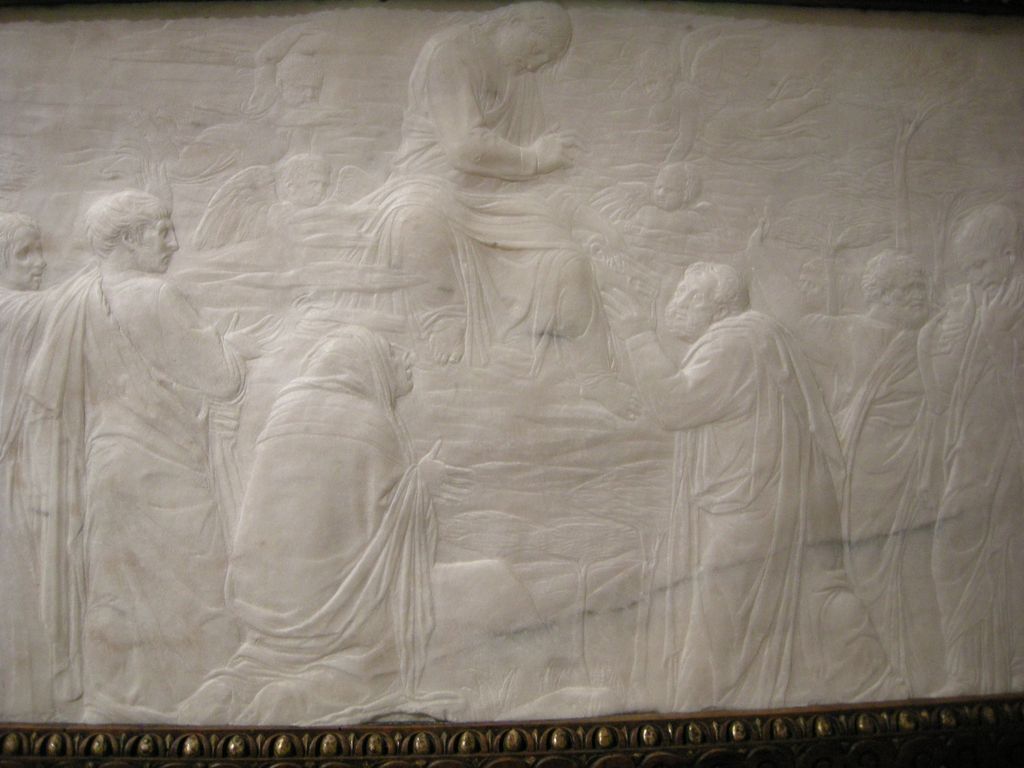
One area of the V&A’s Ascension relief, where the marble’s slight changes of level create figures and clouds. Sailko. Image source. CC BY-SA 3.0. Resized for the web.
The V&A’s Ascension with Christ Giving the Keys to Saint Peter stretches that shallow space to include landscape, clouds and several groups of figures. Begin with the fuller forms of the figures, then locate the little city and the cherubs in the clouds. Look for the points at which a form gradually seems to fade into its surroundings. The museum photographed the relief under lighting from several directions so that it can be explored interactively. Light skimming the panel from above makes a different network of shadows than light skimming it from below. Try both and look again at the same cloud or distant building. The effect is easier to grasp by holding the position of the camera constant. [4] [20] [21]
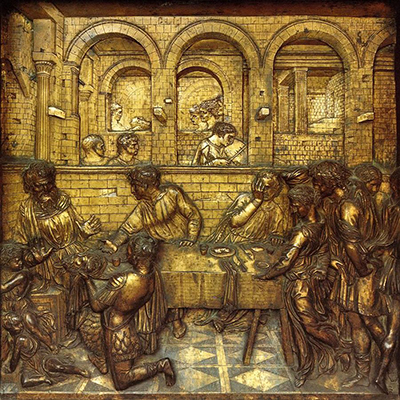
In Siena’s Baptistery, The Feast of Herod uses a shallow bronze panel to make a room appear to continue far behind its front surface. Start at the presentation of John the Baptist’s head and follow the space opened up by the recoiling figures. Through the arches further back, other figures can be seen on a smaller scale and at a shallower depth. The shifting height of figures and the spacing of the architecture guide the eye between episodes. The panel was designed for a font with neighbouring scenes by other sculptors, including Lorenzo Ghiberti and Jacopo della Quercia. With the complete ensemble in view, you can see how Donatello uses the edges and centre of a single compartment to sustain the story. The restoration of the font addressed its gilded bronze, marble and enamelled copper as related parts of that ensemble. [22] [23]
Siena Cathedral’s bronze floor slab for Bishop Giovanni Pecci makes use of a view from one end. In an overhead photograph, the effigy is most easily read as a figure spread across the slab. Art historian Geraldine A. Johnson calls attention to the view from its foot, where the foreshortened representation helps the body appear to lie before the viewer in depth. A photograph taken at that end shows why the feet are a telling detail. The comparison with the font is revealing. At the Baptistery, the scene recedes beyond a vertical face. At the tomb the illusion depends on a viewer looking down and along a horizontal object. [24]
Bronze statues, doors and altars
In lost-wax casting, a wax model gives its shape to a mould. Heating removes the wax so that molten bronze can fill the space it leaves. Working in wax and casting in metal make it possible to develop complex forms, but the sculpture still needs work after casting. Edges and textures can be sharpened with tools, separately cast pieces joined and selected areas gilded. Compare the patterned skin of a belt or a fine line on a face with the broad silhouette. Both may belong to the same sculpture, yet they record different stages of making. Donatello worked with specialist foundrymen, particularly important on commissions whose scale or assembly made casting a substantial task in its own right. [2]
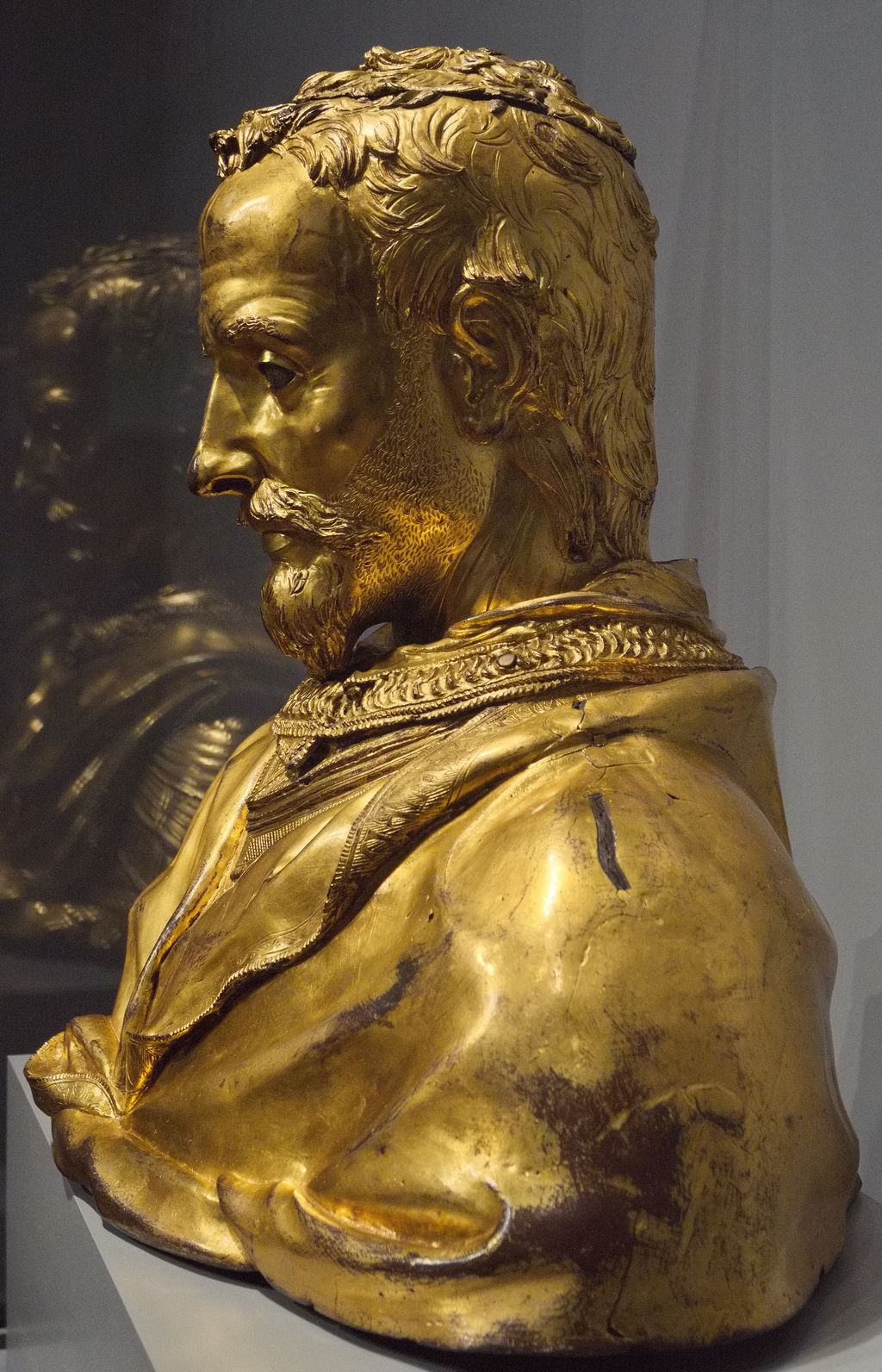
Worked and gilded bronze in Donatello’s reliquary bust of Saint Rossore in Pisa. Armin Kleiner. Image source. CC BY-SA 4.0. Resized for the web.
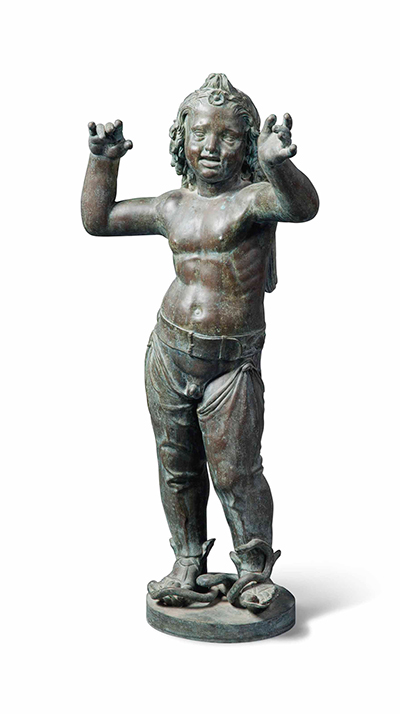
Back at the Bargello, circle the bronze David and pay attention to the sword. From the front it makes a strong slant near the line of the leg. Move sideways and the opening around the arm, weapon and torso helps you read the stance. The turned head and low hat brim also change the expression from different sides. The bronze Amor-Atys in the same collection repays the same treatment. Its raised arms, expressive face and small attributes emerge in stages as you move. The V&A points out the contrast in finish between the belt and the skin. The conventional name encompasses competing identifications, so start with the pose and details before trying to read all the attributes as one mythological story. [1] [2] [3]
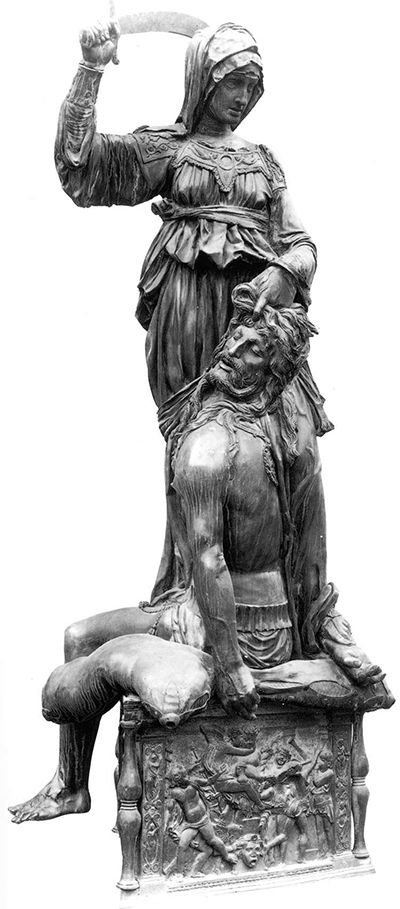
In the Sala dei Gigli at Palazzo Vecchio, Judith and Holofernes takes movement around a bronze further. Look for the angles formed by the sword arm, Judith’s drapery and the man’s collapsing limbs. With two bodies sharing one narrow space, a detail concealed from one side can clarify the scene from the next. The group went from Medici possession to the seat of the Florentine republic, where the episode was given a public political meaning. The shift in setting is part of the sculpture’s history. Compare how you approach the indoor original with how the group reads across the open space of the piazza. [25] [26]
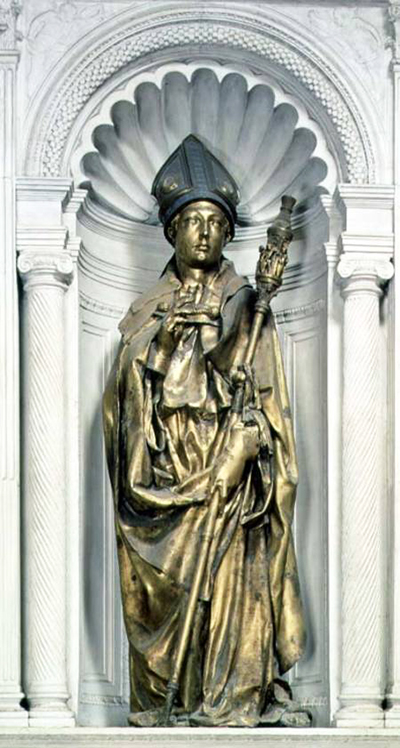
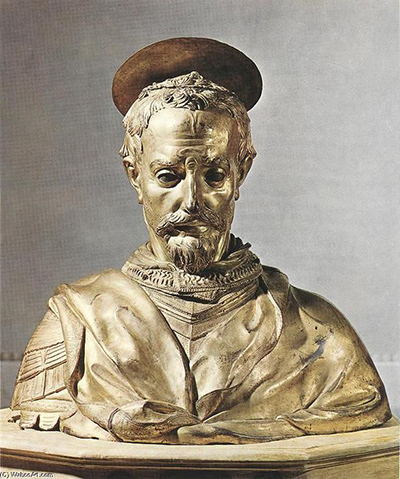
For bronze brought to a bright finish, visit Santa Croce’s Saint Louis of Toulouse. The statue was made for a niche at Orsanmichele and is now displayed in a cast of its original architectural setting. Conservation established that the figure was cast in ten principal pieces before gilding. Look across the cloak from its outer edge into the darker folds. The patterned outlines and changes of plane make the richly clothed body legible from below, and the large surfaces give the gold room to operate over the height of the figure. That long-distance effect differs from what gilding does on a small bust. The Reliquary Bust of Saint Rossore in Pisa’s Museo Nazionale di San Matteo was chased, gilded and silvered. Its concentrated contrasts belong to a container for a relic, with the face close enough to reward attention to the brow, eyelids and mouth. [2] [27] [28]
The two bronze doors of the Old Sacristy in San Lorenzo show how Donatello varied gestures within the regular limits of a grid. There are two leaves to each of the Medici-commissioned doors. From the entrance, the Door of the Apostles is on the right and the Door of the Martyrs on the left. Look from panel to panel for the space between the two figures, which shifts as characters turn, approach or draw away. During conservation, three-dimensional recording and diagnostic examination helped the Opificio delle Pietre Dure study the surfaces. Deposits low on the doors had dulled some of the modelling. The contrast between an upper panel and one closer to the floor is a reminder that parts of the same work can age differently. [29] [30]
In the church proper, the Passion Pulpit and the companion Resurrection Pulpit belong to a later project. The conservators at the Opificio describe a unified scheme for the episodes even though the arrangement into two distinct pulpits was probably completed after Donatello’s death. From below, see how a crowd or an architectural line builds up across a panel before trying to separate individual figures. A frontal photograph aids that separation, while the church view reveals how the strong shapes of the relief and the height of the surrounding structure affect legibility. Conservation evidence and the history of assembly are reasons to be precise about which parts are securely Donatello’s design and where the work of collaborators and later fitters comes into view. [31]
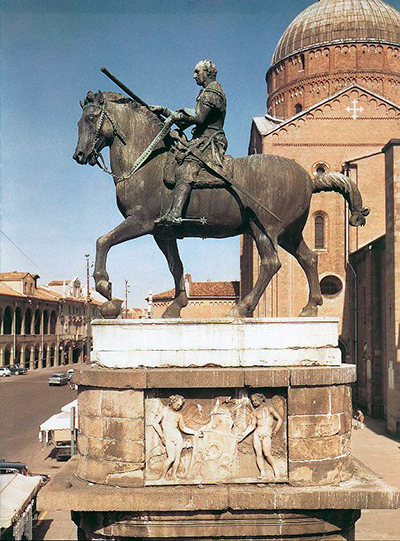
Padua brings two very different bronze projects together. For the equestrian monument to Gattamelata, the piazza in front of the Basilica of Saint Anthony supplied long views and an elevated base. Historical views from the side make it easy to read the horse’s extended step and the rider’s bearing. Save Venice records that the horse and rider were formed from 36 cast components. Think about that assembly when comparing the profile across the square with a close photograph of the metal. Joints and a large exposed surface have implications for the sculpture’s condition as well as for how it was made. The basilica and conservation partners are the appropriate sources for current viewing arrangements. [32]
Inside the basilica, the Santo altar places freestanding figures and narrative reliefs around the Virgin and Child. The arrangement seen today is Camillo Boito’s reconstruction of 1895, with a separate crucifix incorporated into it. Look for differences of scale between the saints and the groups of small figures across the miracle panels. In The Miracle of the Mule, gilding and inlay help articulate the architecture and lead the eye toward the act of devotion at the centre. The panels are hard to inspect from where visitors typically stand in the church. The Museo Antoniano’s photographs and plaster casts let you examine the individual parts from close range, then look back at how those parts work in the presbytery as a whole. [2] [33] [34]
Watch the sculpture in context
Compare several sculptures by Donatello.
TheHistoryOfArt.org. Compare several sculptures by Donatello. Watch on YouTube.
Sculptural reproductions, casts and photographs
A good reproduction label tells you what was copied, how the new object was made and which collection holds it. A nineteenth-century plaster cast of Saint George at the Fitzwilliam Museum is catalogued as after Donatello. Its own object number is M.1-1891. The marble it copies is at the Bargello. The cast allows viewers in Cambridge to study the stance and proportions at close range. The material line in the catalogue distinguishes the plaster surface from the marble and clarifies what the attribution means. With an outdoor replica such as the Marzocco in Piazza della Signoria, the setting is part of what the copy preserves. A separate nineteenth-century sandstone copy in Berlin, AE 38, served another purpose. It brought the emblem of Florence into a museum whose collections presented the city as a centre of Renaissance art. The same shape could stand for Florence in its own civic square and represent Florentine sculpture in a foreign collection. [5] [11] [35]
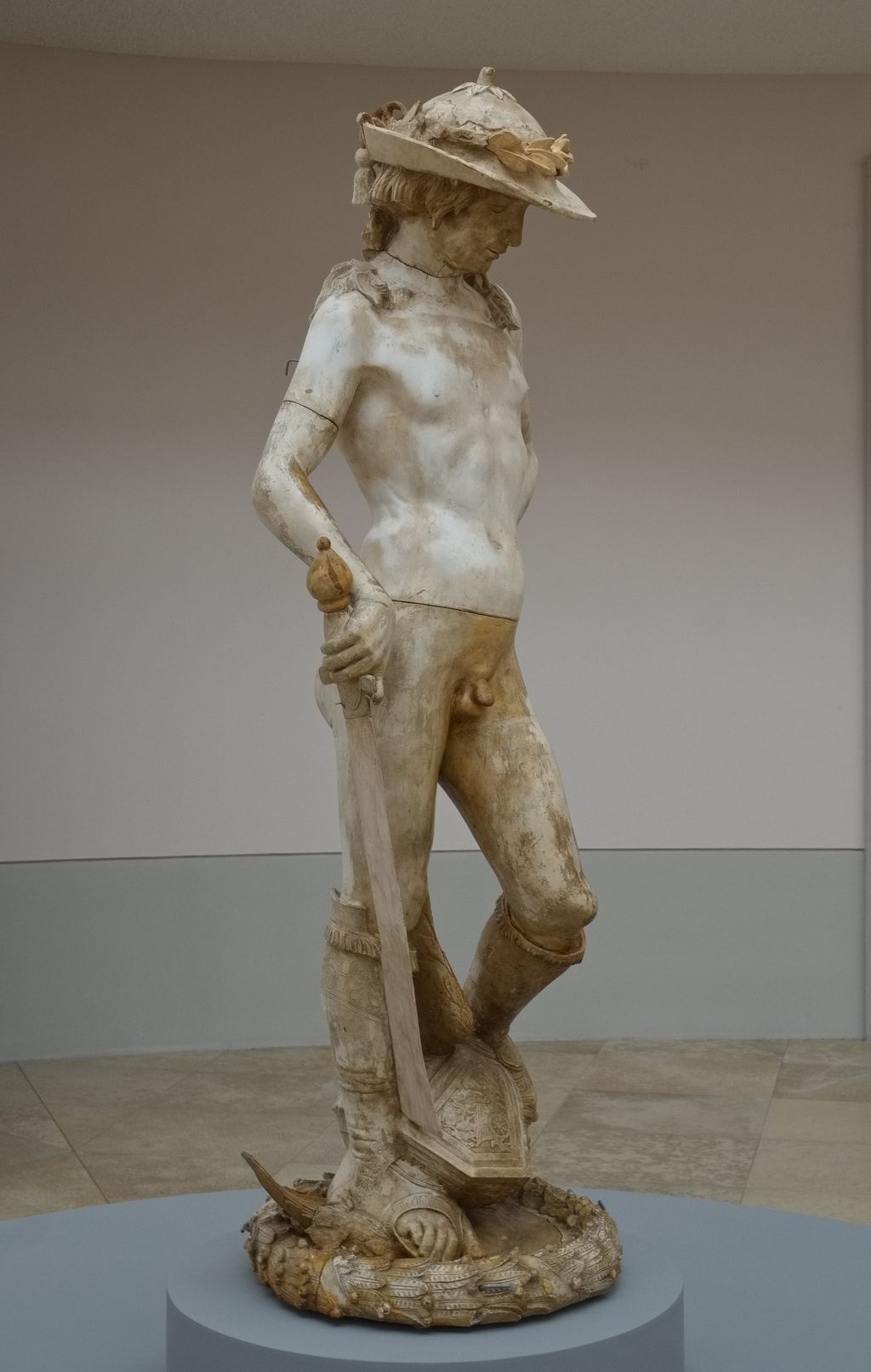
A plaster cast in Berlin after Donatello’s bronze David. Armin Kleiner. Image source. CC BY-SA 4.0. Resized for the web.
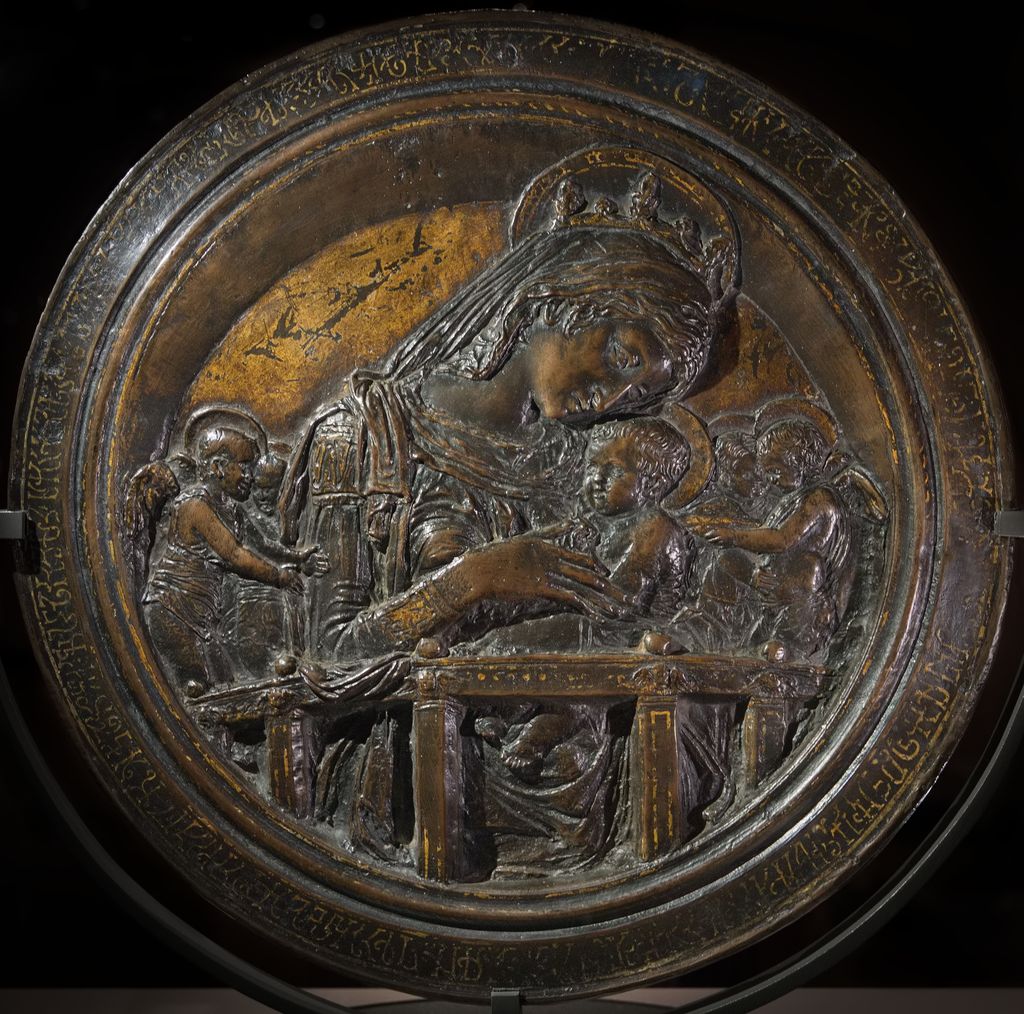
The original bronze Chellini Madonna at the V&A. Its reverse was designed to permit further impressions. Armin Kleiner. Image source. CC BY-SA 4.0. Resized for the web.
A Renaissance replica can also be a historic object with a different surface and scale. The Louvre’s Pazzi Madonna, RF 744, is catalogued as a workshop replica in coloured gesso, dated around 1450. Compare the distribution of colour and its framing with the marble in Berlin, inventory 51. A shared subject and a close resemblance between the two compositions say something about the circulation of an image. The inventory number and medium identify the particular object in front of you. For a work labelled workshop of, keep the museum’s attribution wording, just as you would keep after where the maker took an earlier piece as a model. Both labels allow a reader to trace the relationship without assigning the same authorship to every version. [19] [36]
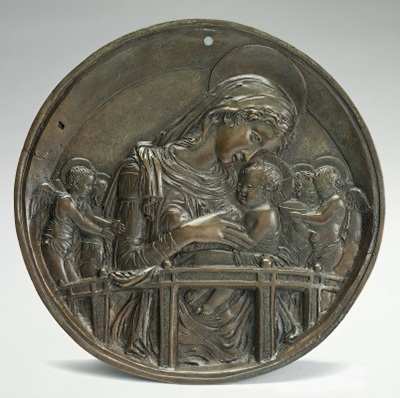
The V&A’s Virgin and Child with Four Angels, known as the Chellini Madonna, makes the process especially clear. The bronze roundel was also designed to serve as a mould for a glass version. Its reverse makes sense when you have seen the picture on the front. In 1976 Frederick George Daden made a glass replica for the Royal College of Art, documenting what the roundel could do as both an image and a tool. Compare how the works handle light. The relief on the bronze is revealed by reflections and shadows on its surface. In the glass, light can pass through the image, bringing the thinner parts into play. A catalogue entry should give each object its own date, medium and maker. [2]
Photographs and prints fix the viewpoint. For a statue with a complicated silhouette, such as Judith and Holofernes, a three-quarter view often shows the relationship between the figures more clearly than a single frontal image. An installation view then puts the height and base back into the picture. With a shallow panel such as the Ascension, a photograph lit from one side may reveal the faintest edges better than a uniformly lit view, while the latter shows all the parts at an even level. When looking at a print of any of these works, check whether the photograph shows the original or a replica, whether the base or frame is in view, and whether the angle suits the detail you want to see. The collection name, catalogue number and photographer or image provider are good starting points for tracing the image back to its source. [20] [21] [25]
from Amazon
* As an Amazon Associate I earn from qualifying purchases.
Donatello sculpture directory
| Name | Date | Medium and record |
|---|---|---|
| Marble David | 1408–09, adapted 1416 | Carved Carrara marble Catalogue. |
| Saint John the Evangelist | c. 1409–15 | Carved marble Catalogue. |
| Saint Mark | 1411–13 | Carved Carrara marble Catalogue. |
| Saint George and its dragon relief | c. 1415–17 | Marble statue and marble relief Catalogue. |
| Marzocco | c. 1417–20 | Carved sandstone Catalogue. |
| Saint Louis of Toulouse, Florence | 1418–25 | Gilt bronze and mixed media Catalogue. |
| Pazzi Madonna | c. 1420s | Marble relief Catalogue. |
| Reliquary Bust of Saint Rossore | c. 1420s | Gilt bronze Catalogue. |
| The Prophet Jeremiah | 1420s–30s, disputed | Marble Catalogue. |
| Zuccone | c. 1420s–30s | Marble Catalogue. |
| Feast of Herod, Siena | 1420s | Gilded bronze relief Catalogue. |
| Ascension with Christ Giving the Keys to Saint Peter | c. 1428–30 | Marble relief Catalogue. |
| Cantoria | 1433–39 | Marble and mosaic Catalogue. |
| Amor-Atys | c. 1435–40 | Partly gilded bronze Catalogue. |
| Bronze David | c. 1435–40, disputed | Partly gilded bronze Catalogue. |
| Gattamelata | Installation agreement, 1453 | Bronze and stone Catalogue. |
| Santo altar | Mid-fifteenth century | Bronze and limestone ensemble Catalogue. |
| Chellini Madonna | Given in 1456 | Partly gilded bronze tondo Catalogue. |
| Penitent Magdalene | c. 1453–55 (Opera) | Poplar, stucco, pigments and gold Catalogue. |
| Judith and Holofernes | Late 1450s–early 1460s | Bronze with surviving gilding Catalogue. |
| Pulpit of the Passion | Late work and later assembly | Bronze reliefs, Donatello and collaborators Catalogue. |
| Bust traditionally called Niccolò da Uzzano | Fifteenth century | Painted terracotta, attribution disputed Catalogue. |
| Prato Cathedral exterior pulpit | Commissioned 1428; carved 1430s | Marble reliefs, Donatello and Michelozzo Catalogue. |
| Cavalcanti Annunciation | c. 1433–35 | Gilded sandstone and terracotta Catalogue. |
| Crucifix at Santa Croce | Early fifteenth century | Painted wood Catalogue. |
| Madonna of the Clouds | c. 1425–35 | Marble relief Catalogue. |
| Old Sacristy Doors | Fifteenth century | Two paired bronze doors Catalogue. |
| Resurrection Pulpit | Late work and later assembly | Bronze reliefs, Donatello and collaborators Catalogue. |
| Brancaccio tomb | 1420s | Donatello, Michelozzo and assistants, mixed materials Catalogue. |
| Saint John the Baptist, Venice | 1438 | Polychromed and gilded wood Catalogue. |
| Sacrifice of Isaac | Early fifteenth century | Donatello and Nanni di Bartolo, marble Catalogue. |
| Madonna of Via Pietrapiana | Mid-fifteenth century | Terracotta Catalogue. |
| Miracle of the Mule | Mid-fifteenth century | Gilded bronze panel for the Santo altar Catalogue. |
| Padua Crucifix | Mid-fifteenth century | Cast bronze Catalogue. |
| Dancing Spiritello, Bargello | Fifteenth century | Bronze Catalogue. |
| Young Prophet from the Porta della Mandorla | c. 1404–09 | White marble, attributed to Donatello Catalogue. |
| Prophet or Apostle from the Duomo north tribune | Early fifteenth century | White marble, possibly Donatello Catalogue. |
| Beardless Prophet | 1415–18 | White marble Catalogue. |
| Sibyl and Prophet of the Porta della Mandorla | 1422 | Carved marble heads for the portal Catalogue. |
| Faith, Siena baptismal font | 1420s | Gilded bronze figure Catalogue. |
| Hope, Siena baptismal font | 1420s | Gilded bronze figure Catalogue. |
| Feast of Herod, Lille | c. 1430 | Carrara marble relief Catalogue. |
| Piot Madonna | c. 1440–60 | Polychrome terracotta with glass and wax inlays Catalogue. |
| Carafa Horse Head | c. 1456–58 | Cast bronze Catalogue. |
| Pazzi Madonna workshop version, Louvre | c. 1450 | Polychrome gesso, Donatello’s workshop Catalogue. |
| Pazzi Madonna tondo, Rijksmuseum | c. 1425–50 | Plaster and stucco, after Donatello Catalogue. |
| Sprite | c. 1430–40 | Bronze, sculptor or metalsmith close to Donatello Catalogue. |
Discussion
Look again at the images and ideas explored in Sculptures. These editorial prompts invite your observations.
Reader Insights
Which passage of a carved surface becomes easier to read when the direction of light changes?
What can you learn from a cast or a photograph that is difficult to see in front of the original sculpture?
Join the Conversation
Share a detail, comparison or question about Sculptures below.
References
- Musei del Bargello, Donatello e l’alba del Rinascimento. View source.
- Victoria and Albert Museum, Donatello – a master at work. View source.
- Musei del Bargello, Museo Nazionale del Bargello: riapre al pubblico il Salone di Donatello. View source.
- Frank Fehrenbach, Rilievo schiacciato: Donatello and the Forces of Sculpture, in Donatello: Inventor of the Renaissance, 2022, pp. 59–67. View source.
- The Fitzwilliam Museum, St George, plaster cast, M.1-1891. View source.
- Ministero della Cultura, Avviati i lavori per il restauro del San Marco di Donatello al Museo di Orsanmichele di Firenze. View source.
- Opera di Santa Maria del Fiore, Donatello in the monumental complex of Opera di Santa Maria del Fiore. View source.
- Opera di Santa Maria del Fiore, Donatello, Saint John the Evangelist. View source.
- Opera di Santa Maria del Fiore, Geremia (lato ovest). View source.
- Opera di Santa Maria del Fiore, Donatello, Profeta Zuccone (Abacuc?). View source.
- Catalogo generale dei Beni Culturali, Marzocco con lo stemma della città di Firenze, 0900287038. View source.
- Opera di Santa Croce, Donatello, alla ricerca dell’Uomo. View source.
- Catalogo generale dei Beni Culturali, bust traditionally identified as Niccolò da Uzzano, 0900287031. View source.
- Francesco Caglioti, Le mostre donatelliane del 2022 e i mal di pancia della critica accademica austro-tedesca, Studi di Scultura 6, 2024, p. 12 and note 5. View source.
- Musée du Louvre, La Vierge adorant l’Enfant, dite Madone Piot, RF 3967. View source.
- Opera di Santa Maria del Fiore, Donatello, Cantoria. View source.
- Opera di Santa Maria del Fiore, Luca della Robbia, Cantoria. View source.
- Opera di Santa Maria del Fiore, Donatello, Maddalena. View source.
- Staatliche Museen zu Berlin, Madonna und Kind (Die Pazzi Madonna), inv. 51. View source.
- Victoria and Albert Museum, Explore Donatello’s masterpiece: ‘The Ascension’, museum no. 7629-1861. View source.
- Victoria and Albert Museum, Photographing the Ascension. View source.
- Opera della Metropolitana di Siena, Il Restauro del Fonte Battesimale di Jacopo della Quercia. View source.
- Opificio delle Pietre Dure, Fonte di vita nuova. Il Fonte battesimale del Duomo di Siena restaurato. View source.
- Geraldine A. Johnson, Activating the Effigy: Donatello’s Pecci Tomb in Siena Cathedral, The Art Bulletin 77, 1995. View source.
- MUS.E and the Comune di Firenze, La Giuditta di Artemisia Gentileschi in Sala dei Gigli. View source.
- MUS.E, Jeff Koons in Florence, identifying the original bronze in the Sala dei Gigli. View source.
- Opera di Santa Croce, Donatello – San Ludovico di Tolosa. View source.
- Ministero della Cultura and Museo Nazionale di San Matteo, Busto reliquiario di San Rossore di Donatello. View source.
- Opificio delle Pietre Dure, Presentate le Porte bronzee di Donatello della Sagrestia Vecchia della Basilica di San Lorenzo dopo l’accurato restauro dell’Opificio delle Pietre Dure. View source.
- Direzione Generale Archeologia, Belle Arti e Paesaggio, Restauro delle porte bronzee di Donatello della Sagrestia Vecchia di San Lorenzo a Firenze. View source.
- Opificio delle Pietre Dure, Donatello, Pulpiti della Passione e della Resurrezione, 1456–1466, Basilica di San Lorenzo, Firenze. View source.
- Save Venice, Donatello’s Equestrian Monument to Gattamelata, Padua. View source.
- Basilica di Sant’Antonio di Padova, Presbiterio e altare maggiore. View source.
- Basilica di Sant’Antonio di Padova, Museo antoniano e «Donatello al Santo». View source.
- Staatliche Museen zu Berlin, After Donatello: Lion (“Marzocco”), AE 38, Bode-Museum collection interpretation. View source.
- Musée du Louvre, La Vierge et l’Enfant, dite la Madone des Pazzi, RF 744. View source.
More DONATELLO Sculptures
Marble David
Armin Kleiner. Image source. CC BY-SA 4.0. Resized for the web.
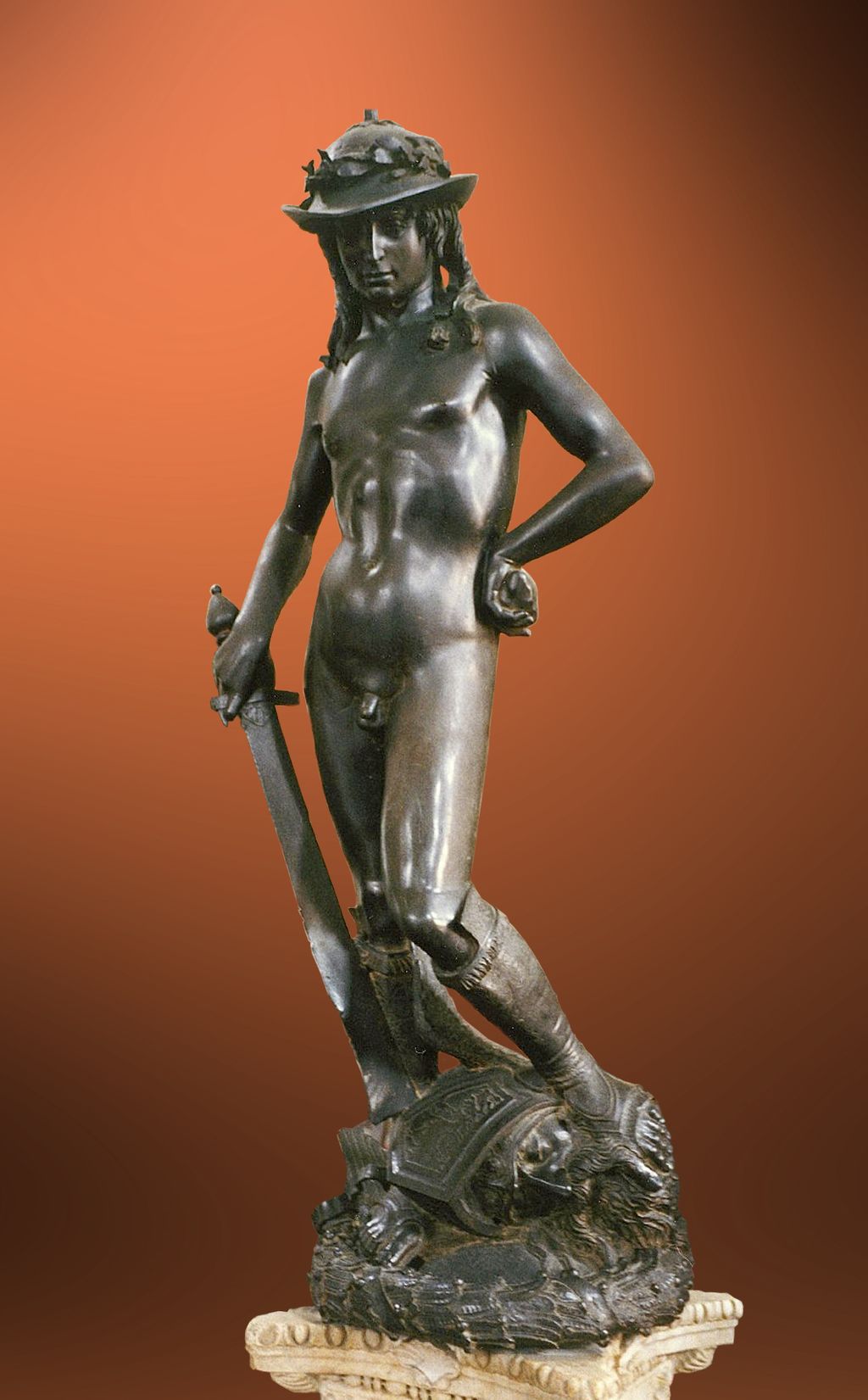
Bronze David
Patrick A. Rodgers. Image source. CC BY-SA 2.0. Resized for the web.
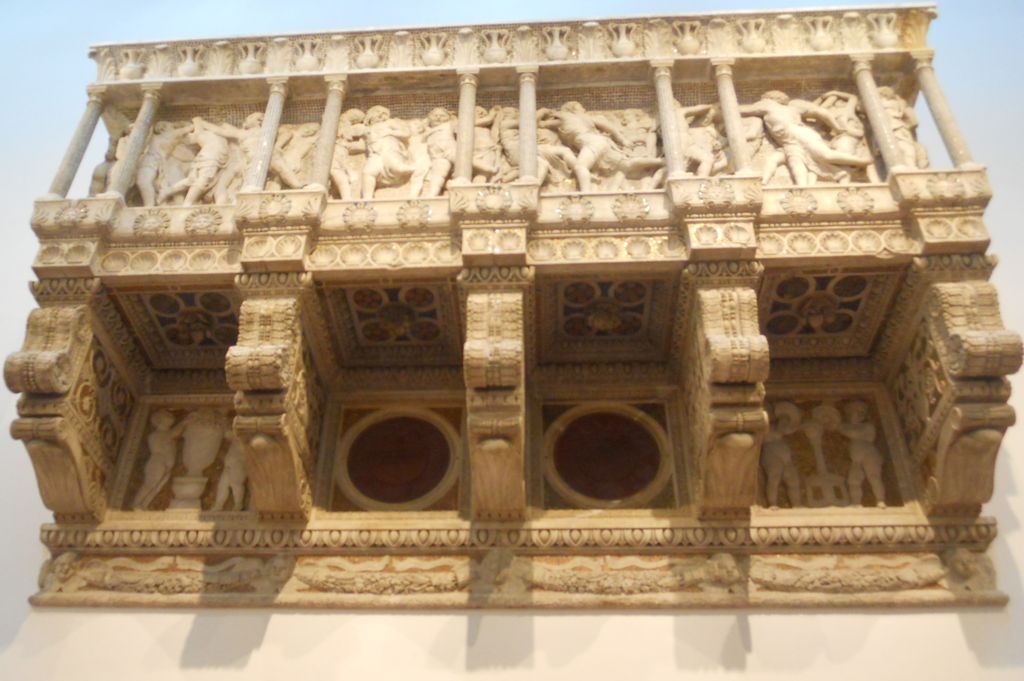
Cantoria
Erik Drost. Image source. CC BY 2.0. Resized for the web.
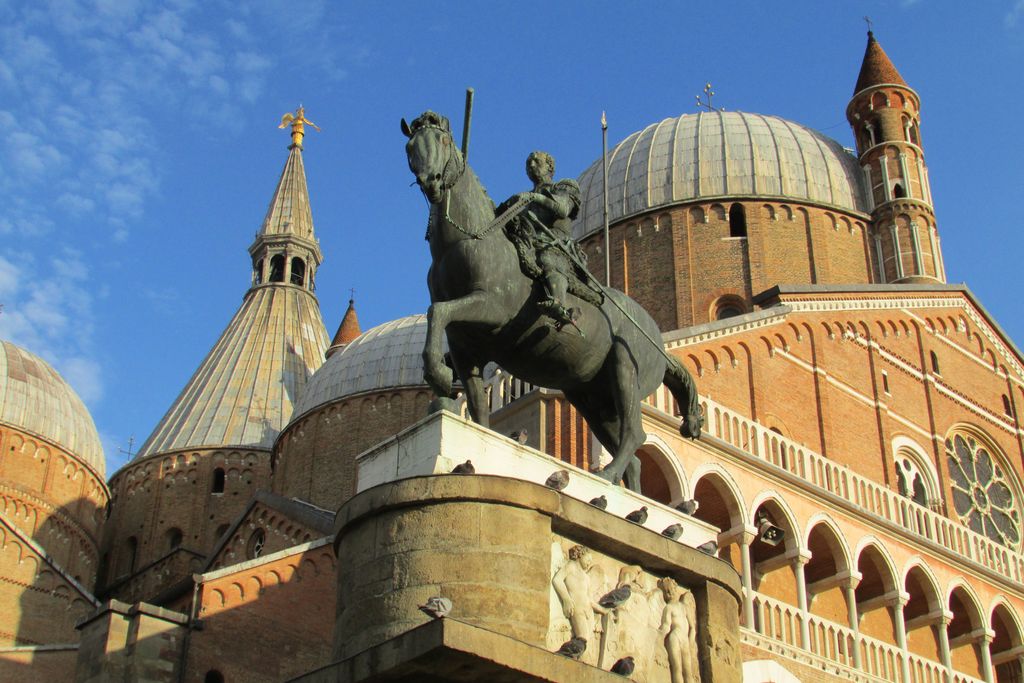
Gattamelata
Chris Light. Image source. CC BY-SA 4.0. Resized for the web.
Penitent Magdalene
Armin Kleiner. Image source. CC BY-SA 4.0. Resized for the web.
Chellini Madonna
Armin Kleiner. Image source. CC BY-SA 4.0. Resized for the web.
