


 by Tom Gurney
Tom Gurney BSc (Hons) is an art history expert with over 20 years experience
Published on June 19, 2020 / Updated on November 29, 2026
Email: tomgurney1@gmail.com / Phone: +44 7429 011000
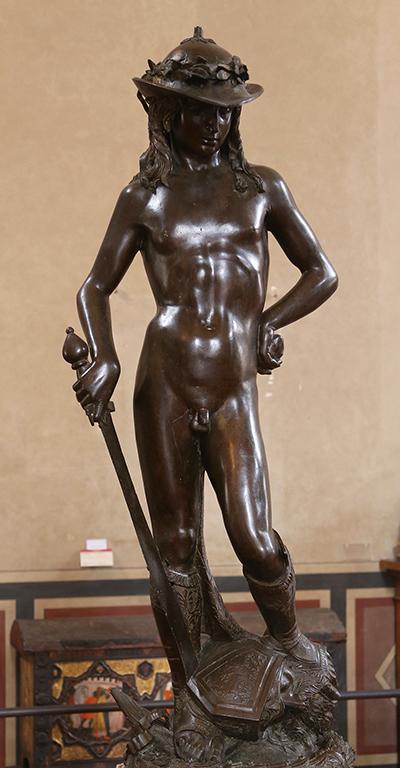
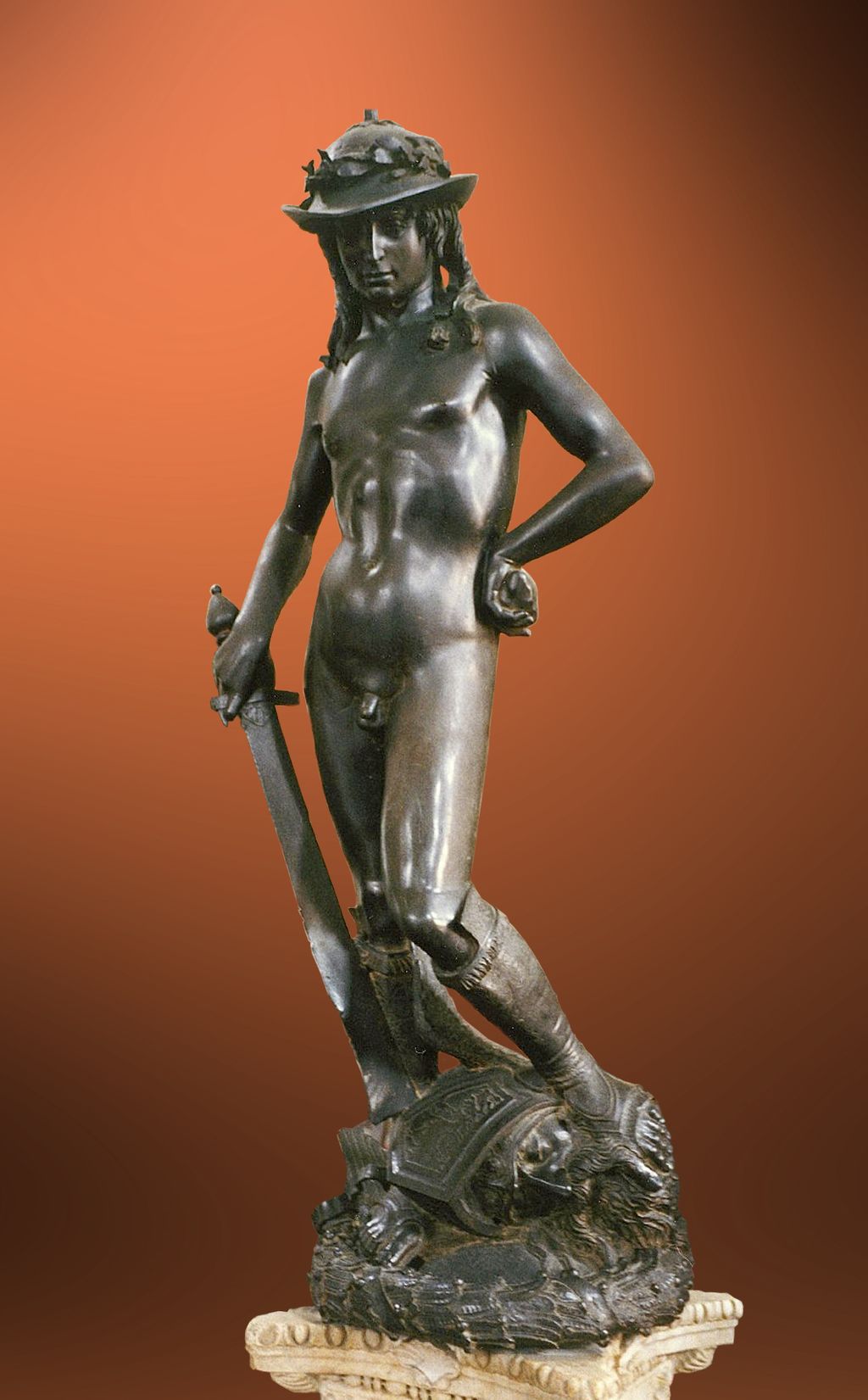
David lowers his eyes beneath a broad, wreath-trimmed hat. His left hand rests against his hip, a stone tucked into his fingers. His right hand holds a broad sword down beside his body, its point at the base. He stands on his right leg and sets his left foot on Goliath’s helmeted head. The youth wears elaborate boots, but his torso and limbs are bare. Donatello brought the sword, the head and the boy together in an unusually quiet image of victory. [1] [2]
The partly gilded bronze stands about 1.6 metres tall and belongs to the Museo Nazionale del Bargello in Florence. It was already on a column in the Medici palace courtyard in 1469, when a letter describing a wedding recorded it there. Its casting date and original commission are open questions. The earlier marble David, also in the Bargello, tells the same story through a clothed youth with different weapons and a different bearing. [1] [2]
The stone, the sword and Goliath
In the account in 1 Samuel 17, Goliath challenges the Israelites to settle the conflict with the Philistines by sending out one champion. David has come to the camp from tending his father’s sheep. He tries on Saul’s armour and gives it back when he finds that it hampers him. He chooses stones, hits Goliath in the forehead with a sling, then draws the fallen champion’s own sword and cuts off his head. David attributes the victory to God, and the story makes his relative lack of equipment part of the point. [3]
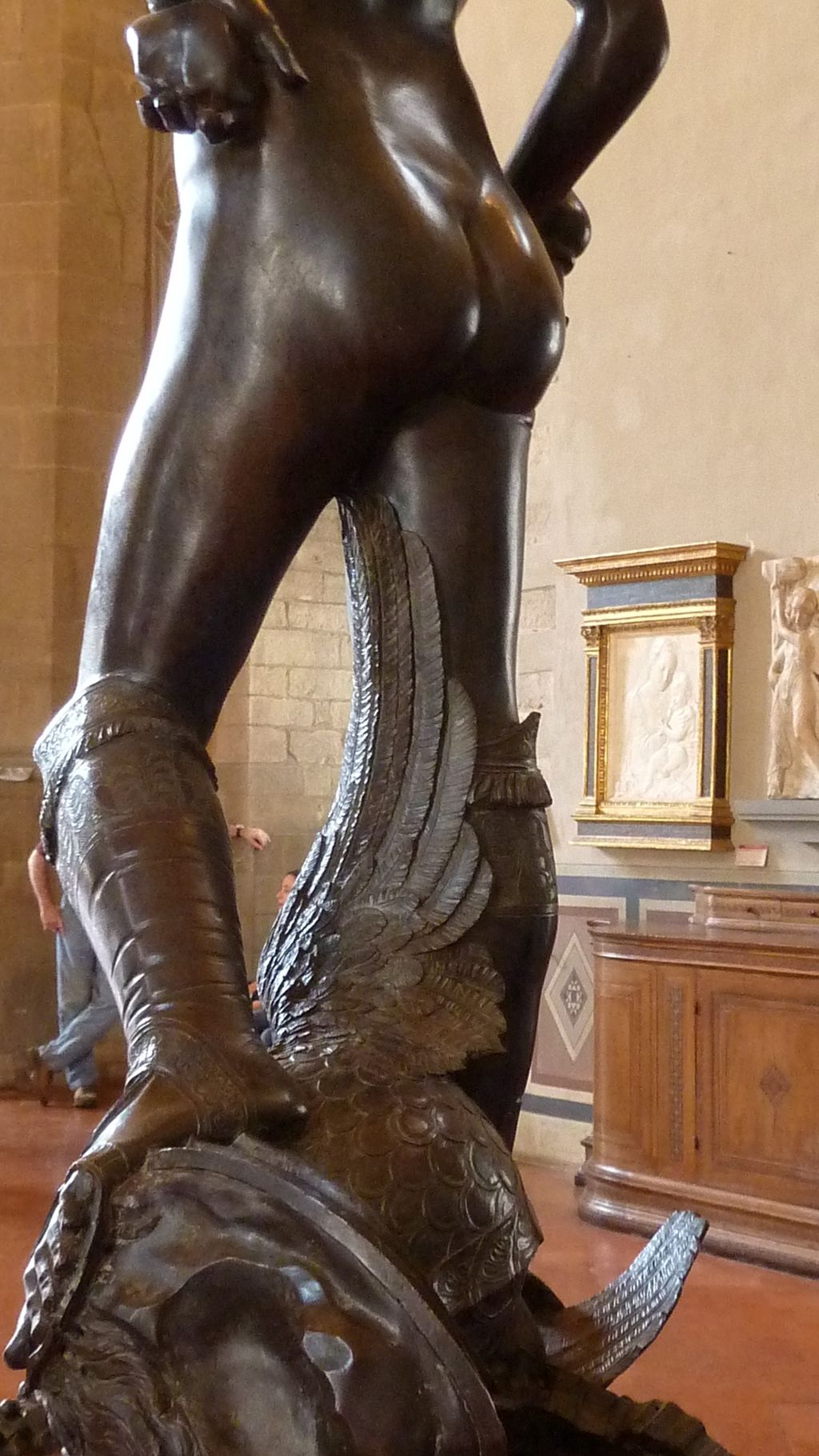
David’s boots, Goliath’s helmet and a long plume on Donatello’s bronze. RenArt88. Image source. CC BY-SA 3.0. Resized for the web.
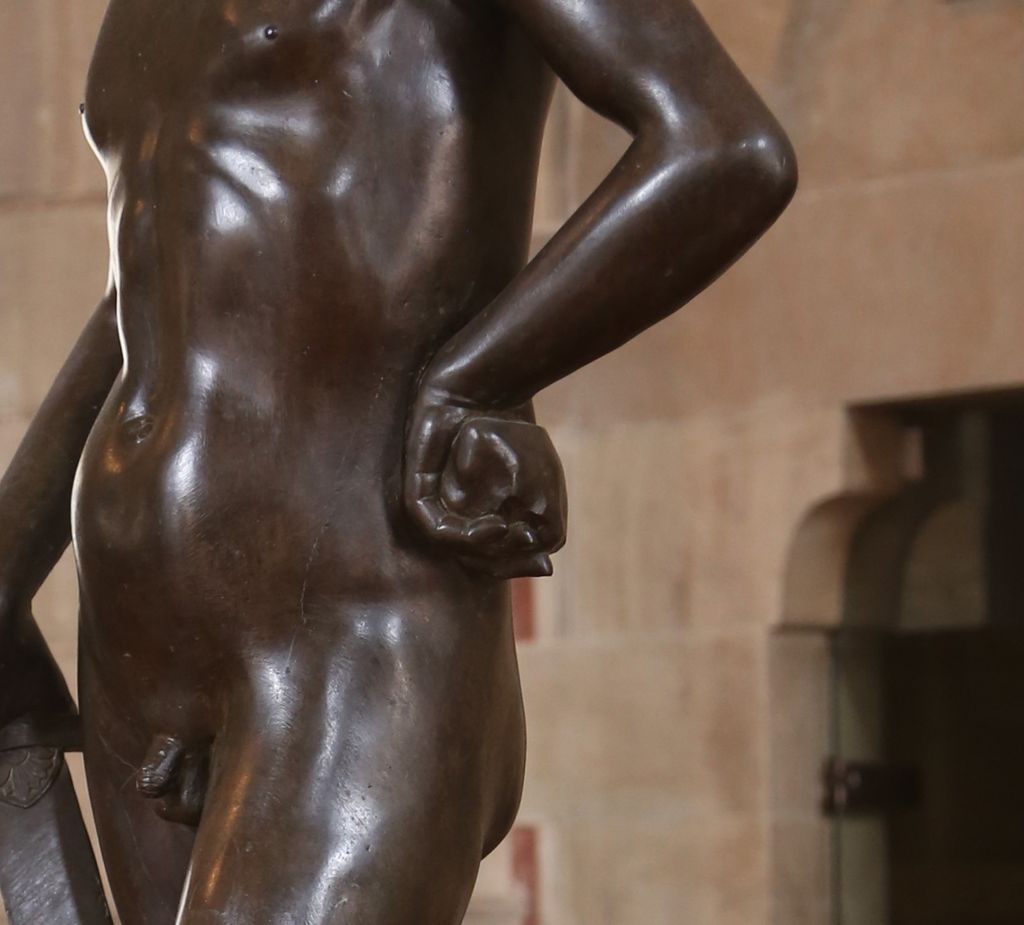
Donatello shows the encounter after it is over. Read together, the accessories recover the sequence. The stone recalls the weapon that brought the giant down. The sword recalls the second and decisive act. The head verifies the result. The bronze leaves out the troops and the valley, so that David’s hands and feet carry almost the whole episode. The stone is especially easy to overlook because the hand that holds it also seems simply to rest at the hip. Once it is spotted, the sword looks less like a weapon the youth carried into combat and more like the one he seized. [1] [2] [3] [4]
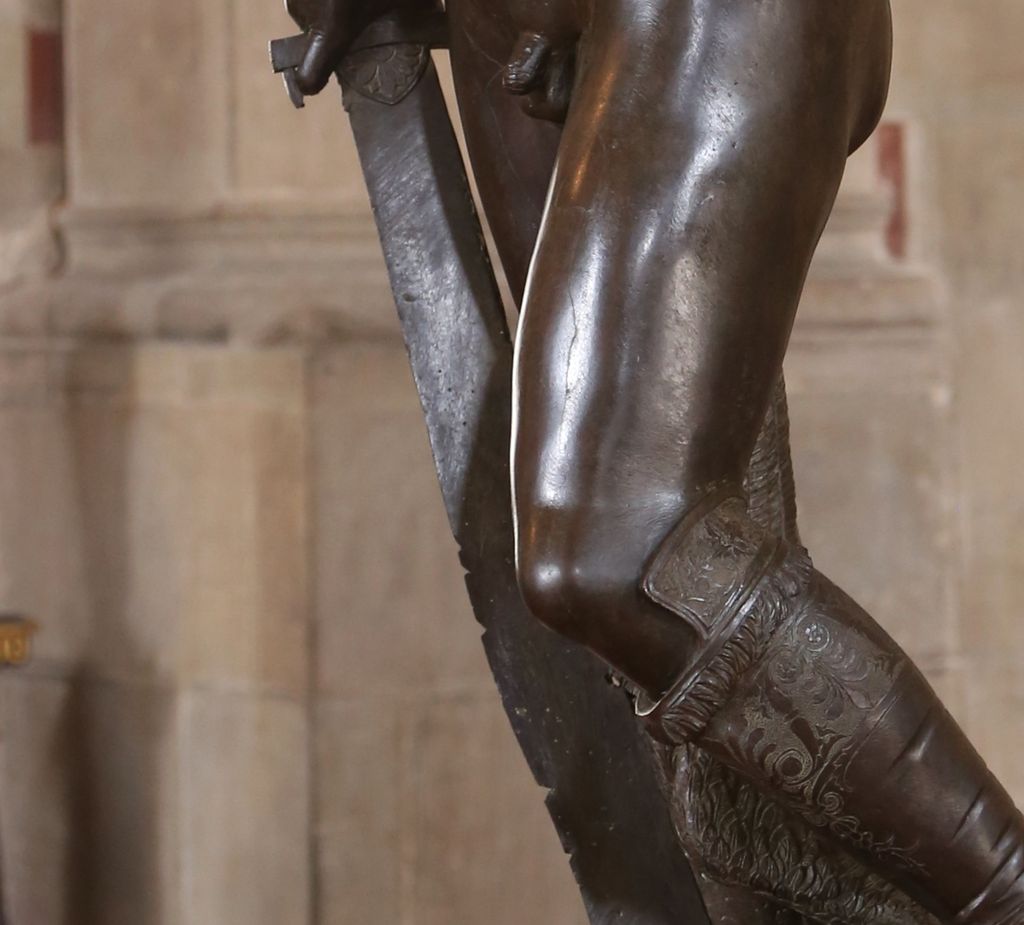
The blade is strikingly wide beside David’s lower arm. Because he holds it tip-down, the eye can gauge its size against the length of his leg. Goliath’s weapons and armour were meant to advertise superiority when he stood before the Israelite army. Here, the sword is under the boy’s hand and the helmet under his foot. Their weight and ornament are still impressive. Their disposition tells the viewer who commands them now. [1] [3] [4]
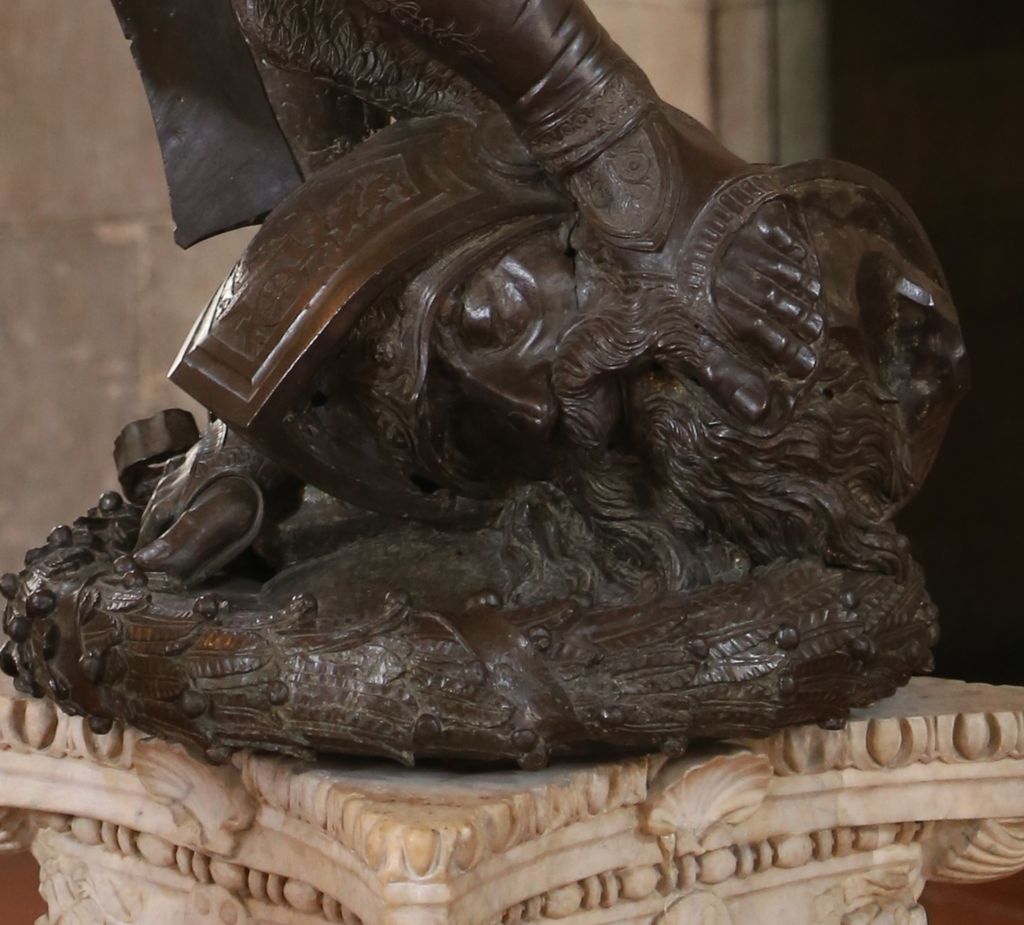
The sculpture also makes Goliath harder to take in than David. The dead man’s face sits at the lowest level, partly screened by armour and the surrounding bronze forms. From some positions the helmet’s decoration or the feathers register before the face does. David’s stance can thus be read twice, first as an almost casual shift of weight and then as a deliberate occupation of the space above the enemy. The victory becomes clearer as the viewer works out what the raised foot is touching. [1] [2] [4]
The stance in the round
The right leg carries the body. On the left, the knee bends and advances, the hip rises, and the hand at the waist follows the change of angle. The shoulders and head adjust in turn. This distribution of weight, known as contrapposto, links the bronze to ancient standing figures. Its effect here depends on a narrative detail. Goliath’s head supplies the step that raises David’s foot and tips the pelvis. The event of the story sets the whole body in motion, even in a pose that can look remarkably still. [2] [4] [5]
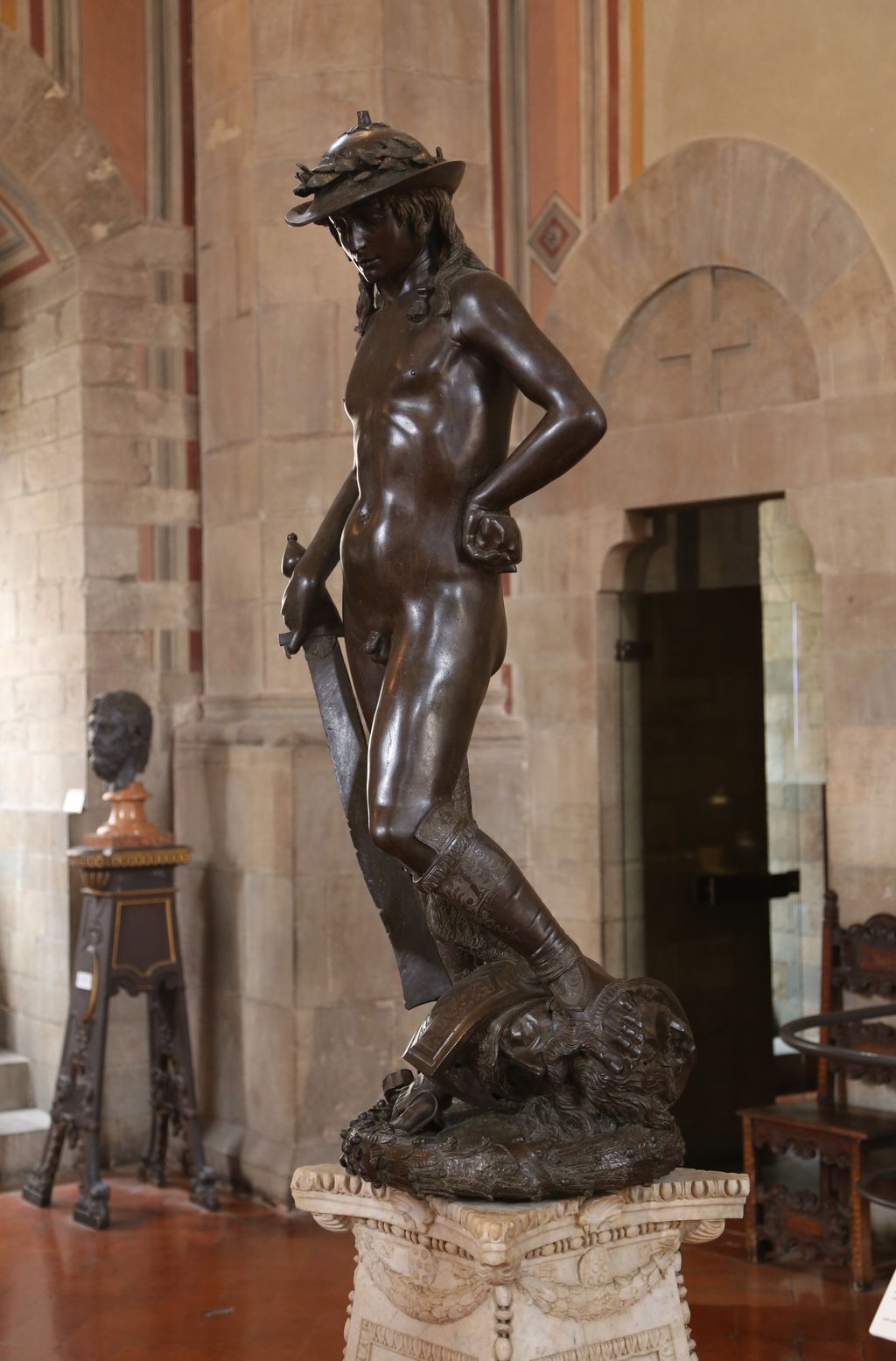
A side view of the bronze David in the Bargello, showing the stance and the separation between sword and body. Rufus46. Image source. CC BY-SA 3.0. Resized for the web.
Look first at the outer contour from the front. The sword gives one side a firm descending line. Across the figure, the bent elbow and knee widen the silhouette, leaving intervals of open air beside the waist and between the legs. From the side, the line of the torso over the weight-bearing leg is easier to trace. The sword and the different depths of the feet become more apparent. From behind, locks of hair cover part of the upper back, the lifted foot reads at a different angle, and a long feather carries the eye up from Goliath’s helmet. The pose takes much of its effect from changes like these as the viewer moves. [2] [4]
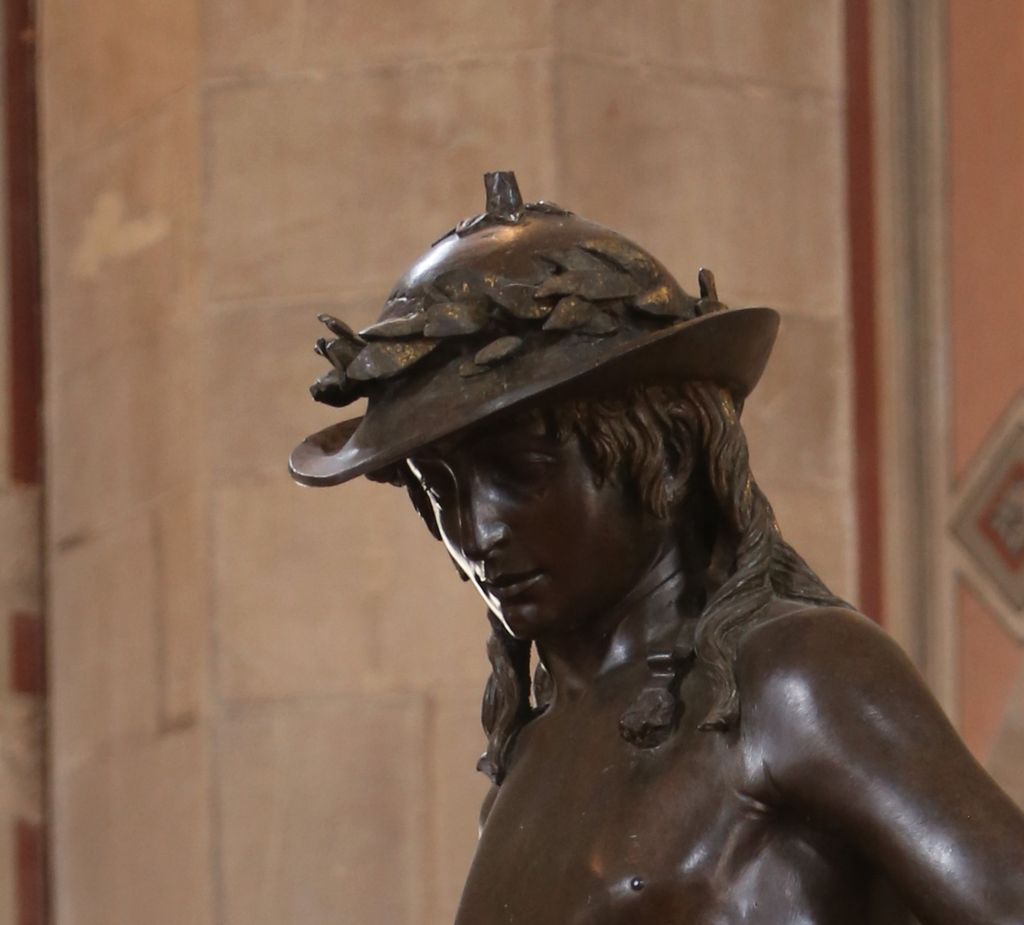
Height matters as much as direction. In a close frontal photograph, the rim of the hat can obscure the eyes and make the head seem bowed in contemplation. The V&A draws attention to the more assured impression the youth can make from below. A viewer standing in the courtyard could see the tilted chin against the hat and the outline of the leg and sword against the spaces beyond. The downward face could also appear to look towards a person below it. Both readings have a foothold in the bronze. The apparent reserve of the face depends in part on where the viewer stands. [2] [4] [6]
The low view also gives the sculpture’s successive levels a purpose. Goliath and the circular wreath at the base come into view below the youth’s bare torso, and a second wreath sits at the hat. Seen across a space, that repetition helps frame the figure. Up close, the materials represented at each level become more distinct. The base is a wreath cast in bronze, the helmet simulates metal worked into ornament, and the raised lines of feathers, boots and hair evoke softer materials. Donatello used a single metal to give these surfaces markedly different textures. [1] [2] [4]
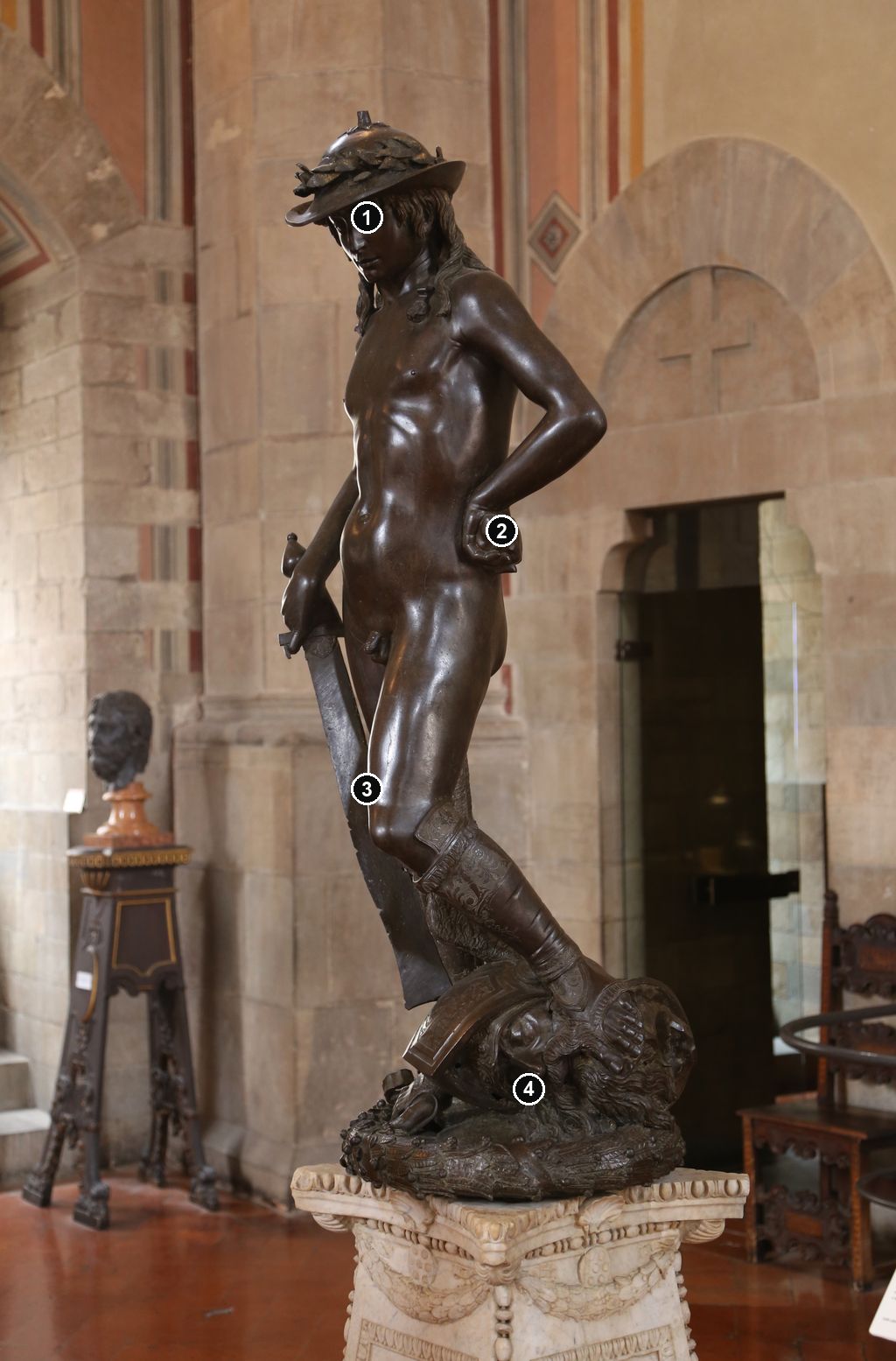
Annotated Details from Bronze David
Select a number to jump to a detail of the sculpture.
Details from BRONZE DAVID
Open a detail image to examine the surface more closely.
Hat and downward gaze
The projecting brim casts the face into shadow. This view from the side shows how sharply the brim and head bend away from the upright chest.
Hand at the hip
The hand comes back toward the waist. The bent elbow leaves a clear triangle of air beside the torso.
Blade beside the leg
The sword hangs past the lowered hand. Its firm edge runs close to the thigh before the blade and the figure separate toward the base.
Goliath and the raised foot
David’s foot rests among the mass of forms around Goliath’s head. The helmet and the giant’s hair make the base far more crowded than the outline of the torso.
Annotated photograph and detail crops. Rufus46. Image source. CC BY-SA 3.0. Resized, annotated and cropped from the original photograph.
The helmet, the feathers and the nude
Goliath’s headgear deserves a close look. Its front bears a small figural scene with a chariot in an antique style. On the other surfaces the plume works on a larger scale. A feather rises from the headgear along the inside of David’s raised leg, almost to the top of the thigh. It can be seen especially clearly from the rear and from oblique angles. The edge of the feather catches light beside the smoother surface of the leg. A form that belongs to a piece of armour thereby draws attention from the defeated man to the living body above him. [1] [2] [4] [22]
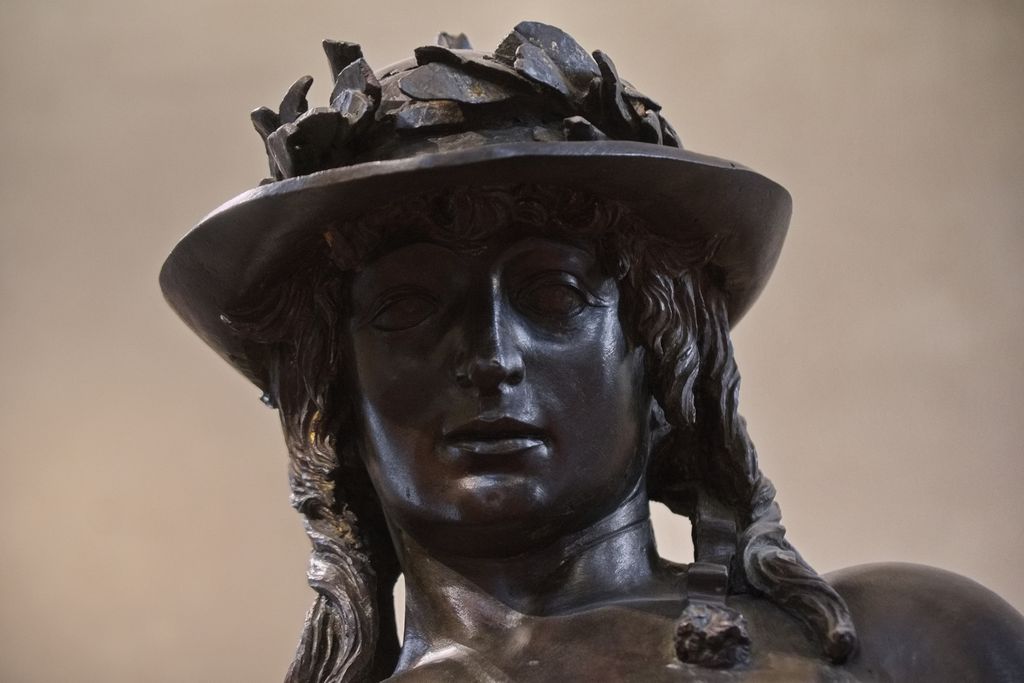
The hat and face of the bronze David. Deep shade under the brim changes the expression with the angle of view. Armin Kleiner. Image source. CC BY-SA 4.0. Resized for the web.
Ancient art supplied a language in which an unclothed body could carry the dignity of a hero. Donatello gave those associations to a figure whose body is slight and youthful. Earlier in the biblical account, Goliath despises David on sight because he sees a boy of pleasing appearance, an assessment that proves disastrously superficial. The bronze makes David’s youth just as plain, especially where the broad hat and heavy sword accentuate the small scale of face and wrist. It is widely recognised as an early surviving Renaissance example of a freestanding, near-life-size male nude in bronze. That distinction refers to the scale, medium and independent stance of the figure. [2] [3] [5]
The hat can look like a shepherd’s sunhat and also evoke the broad-brimmed hat associated with Mercury. The elaborate footwear and the fallen head have helped prompt a mythological reading of the figure as Mercury over Argus. Yet the stone and the giant’s own sword make a closely joined set of signs for the David story, and the verse recorded from the Medici display identifies a boy who overcomes a tyrant with God’s aid. The antique associations show how freely Donatello could work across visual traditions. There is firmer evidence for the subject of the statue than for the origin of every motif. [2] [3] [4] [6] [8]
The feather has also figured in debates about the bronze’s sensuality. Adrian W. B. Randolph puts the detail in the context of movement around the statue and the social life of the palace, asking how a youth’s body might engage men who visited or gathered there. The tactile suggestion matters to his reading because it emerges from a succession of views. Peter Weller, reviewing the history of those arguments, challenges the inference that the appearance of the figure establishes a deliberate homoerotic programme. The hand at the hip, the contours of the body and the proximity of feather to skin have sustained both discussion of the bronze’s erotic appeal and arguments about the limits of reconstructing fifteenth-century intention. [2] [4] [8]
The Medici courtyard in 1469
The first explicit written record of the bronze’s position places it at the centre of the Medici palace courtyard during the festivities for the marriage of Lorenzo de’ Medici and Clarice Orsini. Marco Parenti mentions it in a letter to Filippo Strozzi. This fixes the statue in a specific setting on a specific occasion. It gives historians a date by which the work had to exist, and evidence that the Medici made it a prominent part of the palace display. [1] [6]
The bronze stood on a column of coloured marbles. The Italian state record associates the support with Desiderio da Settignano and describes carved foliage and harpies at its base. The column assembly has been lost. The record identifies surviving harpies in the Chigi-Saracini collection in Siena and the Museo Horne in Florence. The loss matters because the height and colour of the column were part of the encounter with the sculpture. The dark figure was set against polychrome stone below and stood high enough to be glimpsed through the entrance from Via Larga when the doors were open. [1] [2] [6]
A visitor admitted to Michelozzo’s courtyard would have had time to see the figure obliquely and in passing. A person in the street had a more restricted sightline. During a wedding, guests encountered the bronze in a building arranged to receive them on the family’s behalf. The same youth could therefore address different audiences through the architecture around him. The courtyard was a place of passage and reception within a home with enormous political importance. Its position between street and household helps explain why the sculpture’s civic implications could matter there. [4] [5] [6]
The family’s ownership and use of the bronze have led many scholars to propose Cosimo de’ Medici as the patron. A possible early home is the family’s older residence on Via Larga. The later palace setting is documented decades after some proposed dates for the bronze, leaving room for a prior arrangement. The V&A presents Cosimo as the likely commissioner, while Martina Mrázová surveys the difficulties of assigning the work to an exact year or reconstructing its first setting. The 1469 letter describes a wedding and the setting in which it took place. The circumstances of the casting have to be approached by other means. [1] [2] [5] [6]
Why the casting date is debated
The 2022 exhibition Donatello, the Renaissance dated the bronze to about 1435–40. As the national catalogue explains, Francesco Caglioti drew a comparison between its metalworking and the Spiritelli, two bronze candle-bearing figures in the Musée Jacquemart-André in Paris dated to about 1436–38. Caglioti associates them with the marble singing gallery made by Luca della Robbia for Florence Cathedral, whose building history provides a basis for dating the figures. He draws attention to details Donatello modelled across the group, including the curls, feathers, ribbons and other small forms that come alive at different angles. The comparison concerns both the rendering of those forms and techniques of working metal associated with ancient practice. It gives a reason to place the bronzes close together in time. [1] [7] [24]
The Bargello foundation’s account of the restoration discusses a pre-Padua date too, placing the bronze in the years before Donatello’s departure in 1443 while recognising opinions that range from the late 1420s to after the middle of the century. Among the difficulties is the work’s relationship to bronzes dated later than that departure. Similarities can show that Donatello returned to a solution and developed it across different projects. They give less direct evidence about which solution came first. The Amor-Atys, exhibited with an approximate date of 1435–40, is another partly gilt Bargello bronze in which classical associations coexist with an unusual treatment of a youthful figure. [1] [7] [12]
Chronology also conditions the story one tells about the patron. An early date leaves a substantial interval before the documented display and gives force to the question of an earlier home. A later date brings the statue closer to the years in which the new palace took shape. Either proposal needs to account for the material evidence and the absence of an execution record. About 1435–40 is a well-supported exhibition dating. By 1469 the sculpture was demonstrably installed on the new palace’s central axis. Those two dates answer different historical questions. [1] [5] [6] [7]
David and Judith in the palace
A Latin inscription recorded in manuscript tradition once accompanied the bronze in the Medici house. The Palazzo Medici’s account attributes it to Gentile Becchi, a humanist and educator with ties to the family. The verse praises whoever defends the fatherland, credits God with overcoming the enemy, and calls on citizens to emulate the boy who has subdued a great tyrant. The address makes a particular demand of the viewer. Someone looking at a work in a family palace is invited to think and act as a citizen. The setting gives the civic language a Medici association, and the text makes a public claim about the family’s place in Florence. [5] [6] [9]
The design was adaptable even while the bronze stood in the palace. Caglioti identifies a contemporary miniature by Mariano del Buono that borrows the sculpture and accompanies it with Becchi’s verse. It appears in a manuscript presented to Piero de’ Medici, with texts aimed against the Ottoman Turks. The miniature gives David a short tunic, giving him a different silhouette even as it carries the political language of the bronze into a new setting. This example shows how a viewer in the 1460s could apply the figure’s imagery of deliverance to the concerns of the day. [24]
Donatello’s bronze Judith and Holofernes stood in the adjacent garden. In that group Judith stands over the Assyrian general with the sword raised. David has already used his sword and lowered it. The two heroes’ stories turn on the defeat of an enemy who appears to command far greater force. Both subdue him by using his own weapon against him. The earlier statue conveys this through the gap between the boy’s hand and Goliath’s collapsed head. The group in the garden shows the heavier mass of Holofernes still present beneath Judith and the sword still poised for action. [3] [6] [9] [10] [26]
Sarah Blake McHam argues that the sculptures functioned as a pair in the Medici palace. She reads the inscriptions and their shared theme alongside two historical models of resistance to tyranny, John of Salisbury’s political writing and the Athenian Tyrannicides. Such associations, she argues, helped the Medici identify themselves with the defence of Florentine liberty. The courtyard and garden gave the family room to stage related messages in distinct spaces. The case rests on what the statues could mean together in that setting. It leaves open the origins and first destination of the David. [6] [9] [10]
Mrázová follows the statue’s movement to see how its political force changed with its setting. The invitation to defend the city could fit Medici influence at the family palace, where it made privilege look compatible with republican virtue. At the seat of government, the same associations could be pressed into service by a republic that had expelled them. The change is easier to see if the term “tyrant” is left as wide as the inscription makes it. A reader could think of a foreign enemy, an enemy within the city, or any power that endangered Florentine liberty. The bronze gives that adversary the name of Goliath, while the inscription gives citizens latitude to make the story their own. [5] [6] [9]
Watch the sculpture in context
See the marble and bronze figures discussed together.
TheHistoryOfArt.org. See the marble and bronze figures discussed together. Watch on YouTube.
From Palazzo Vecchio to the Bargello
The Medici were expelled in 1494. In 1495, the republican authorities appropriated the two bronzes. David went to the first courtyard of the Palazzo della Signoria, now Palazzo Vecchio. Judith was set outside the entrance on the raised platform known as the ringhiera. Coming out of the Medici residence, the two works acquired different public approaches. Anyone coming through the government palace courtyard could encounter David. Judith addressed the square and the approach to the door. Their separation is part of the story of their appropriation. The sculptures could still speak of the defeat of tyranny, but they now did so in the city’s official spaces. [1] [6] [10]
The bronze subsequently moved through several positions in Palazzo Vecchio, including a niche and the second courtyard. In the seventeenth century it was recorded above a fireplace in a room of state at Palazzo Pitti. That placement again raised the figure, but a wall behind it would have conditioned the views available to a spectator. The statue then went to the Uffizi in the late eighteenth century and to the Bargello in the nineteenth. The Italian state entry distinguishes the fifteenth-century marble support used for the museum display from the lost Medici courtyard column. [1] [6]
The Salone di Donatello took its name from an exhibition mounted in 1887. It has since been rearranged repeatedly. In its April 2025 rehang, the Bargello placed the bronze David in the centre of the hall, while the early marble was set alongside Saint George. Displaying the bronze in the middle gives viewers room to examine the pose and the plume from several sides. The two Davids are also close enough to compare the rendering of the face, the treatment of the weapons, and the position and visibility of Goliath. In the Medici courtyard, variations in view were governed by the portico, the street entrance and the column. The museum gives visitors closer control over their distance and angle. [2] [6] [13]
What the restoration revealed
Gold survives in fields of detail. The state catalogue records traces in David’s hair, on the hat’s ribbons, tassel and laurel leaves, on the footwear and on parts of Goliath’s helmet and its wings. The surface invites different kinds of looking at different distances. The hair and foliage mark out the head. Glints lower down pick out the boots, plume and helmet. The largest surfaces of the figure are read by the way light falls on bronze, with the gold concentrated around forms that a viewer could otherwise miss. The uneven survival of the gold limits how precisely anyone can reconstruct its first effect. [1] [12]
The gold was applied as leaf with a binding layer, a method known in Italian as doratura a missione. Remnants of such leaf are delicate, and the depth of earlier deposits and the refinement of the modelling made cleaning a difficult proposition. The Ministry’s treatment notice describes a plan that used mechanical cleaning with a scalpel and microscope on ungilded areas and a carefully calibrated laser where traces of gold required it. Experience working with other Renaissance bronzes, including Donatello’s Amor-Atys and Ghiberti’s Gates of Paradise, helped inform the approach. Different areas of one statue called for different treatment. [11] [12]
Work ran from June 2007 to November 2008 at the Bargello, where the public could see the conservators at work. The restored statue returned to public view on 29 November 2008. The foundation’s account highlights the gold made visible again, particularly in the hair, along with the colour of the patinated bronze. The Italian National Research Council published a photograph of a gilded area in the hair after laser cleaning. The work on that area reveals a surface decoration that would be all but invisible in a photograph of the whole statue. [1] [11] [12] [23]
Find the hair where it emerges below the hat, then look lower, where the plume edges rise from the helmet. These separated passages are better places to judge the interplay of gold and bronze than the broad chest, where the fall of light defines the modelling. [1] [12]
The other Davids
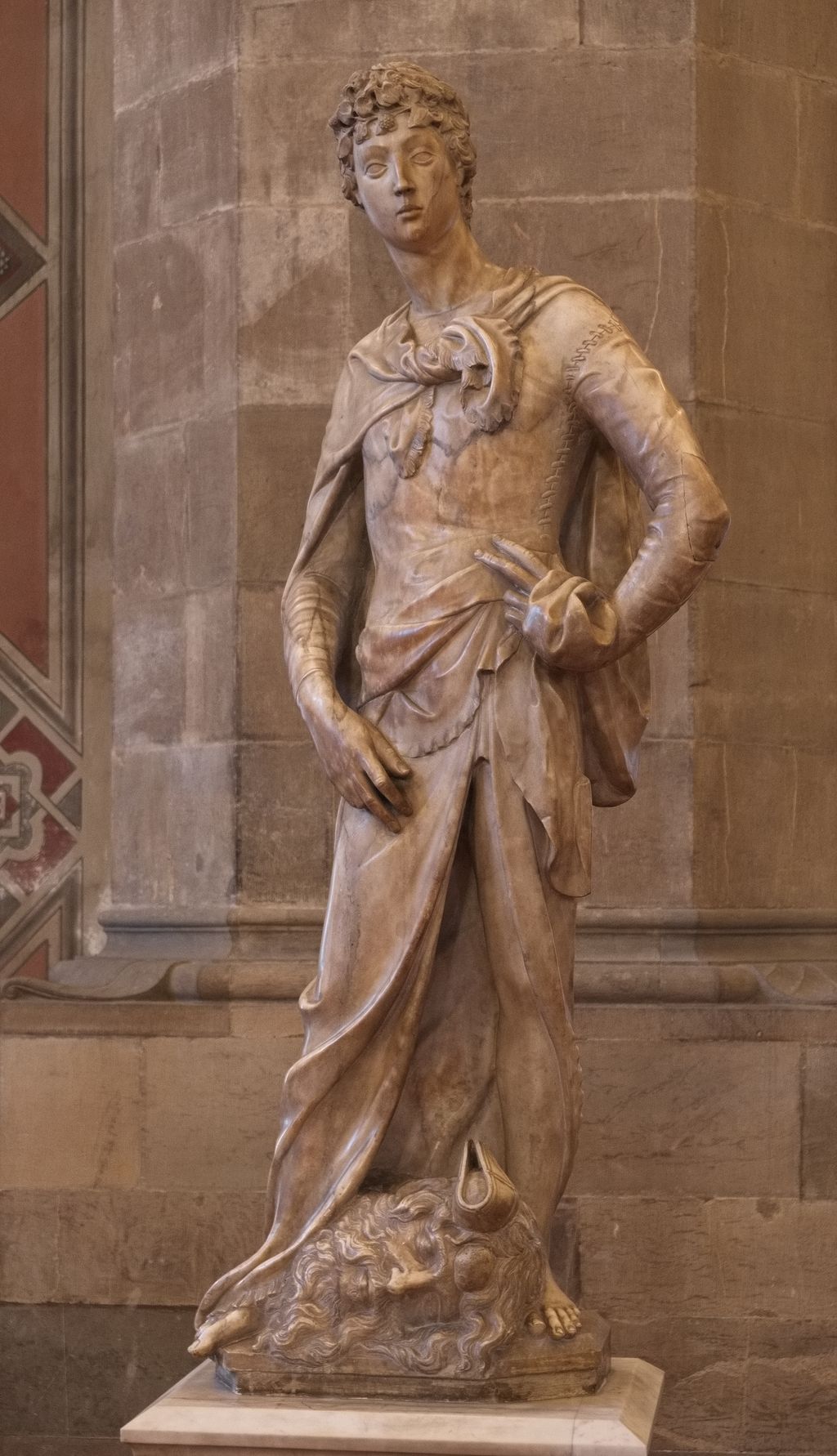
The early Bargello marble portrays David clothed, his figure rising above the giant’s head. Its documented history begins with a cathedral commission, and the work later passed to the Florentine government. The stone embedded in Goliath’s forehead carries a detail of the biblical encounter into the marble itself. In the bronze, the stone is held at the boy’s waist and the outsize sword marks the second part of the action. The two works help show how a sculptor can tell the same story by distributing its evidence differently across the figure and base. [2] [14]
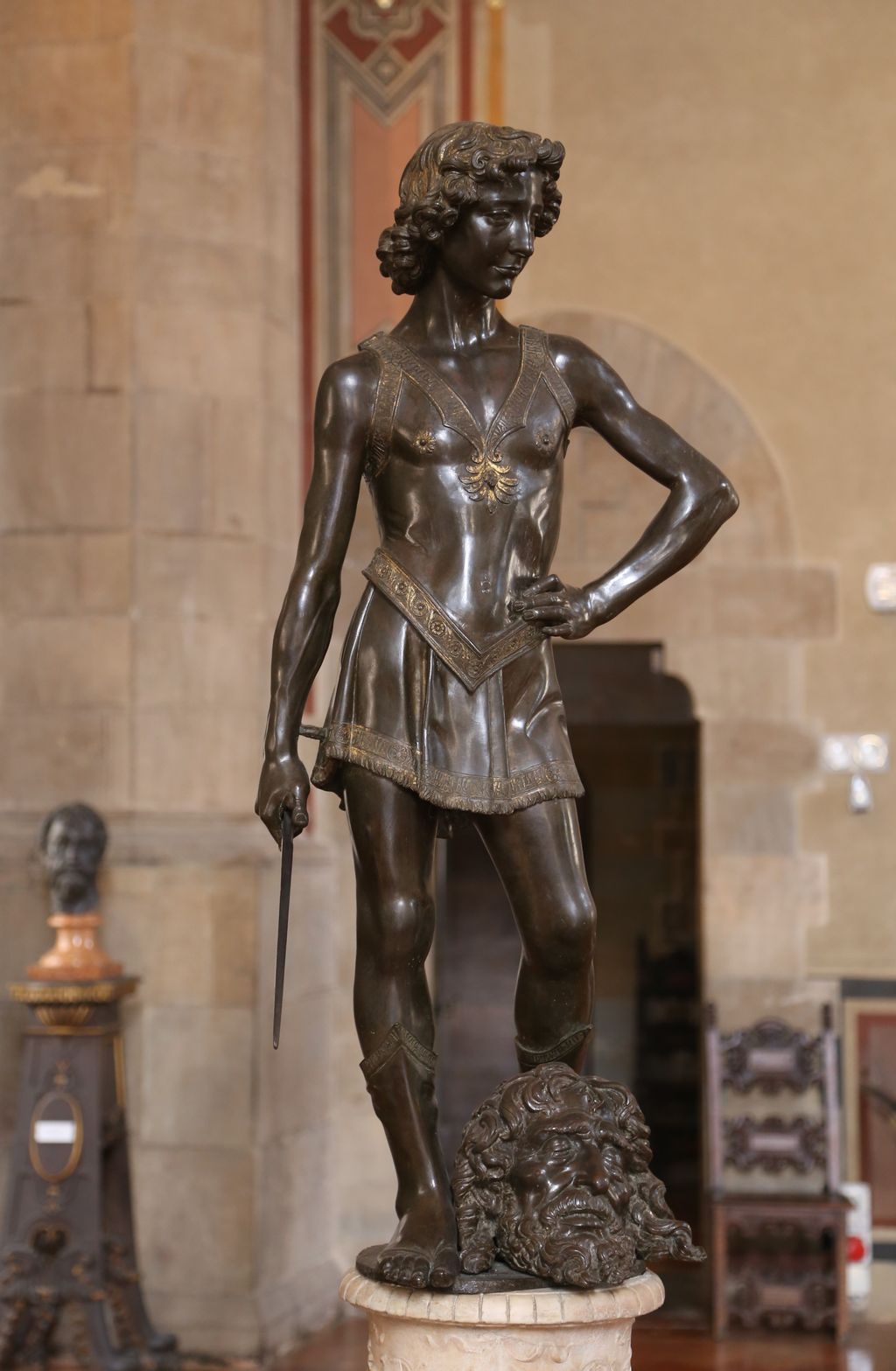
Andrea del Verrocchio’s separate bronze David, with a short garment and an outward gaze. Rufus46. Image source. CC BY-SA 3.0. Resized for the web.
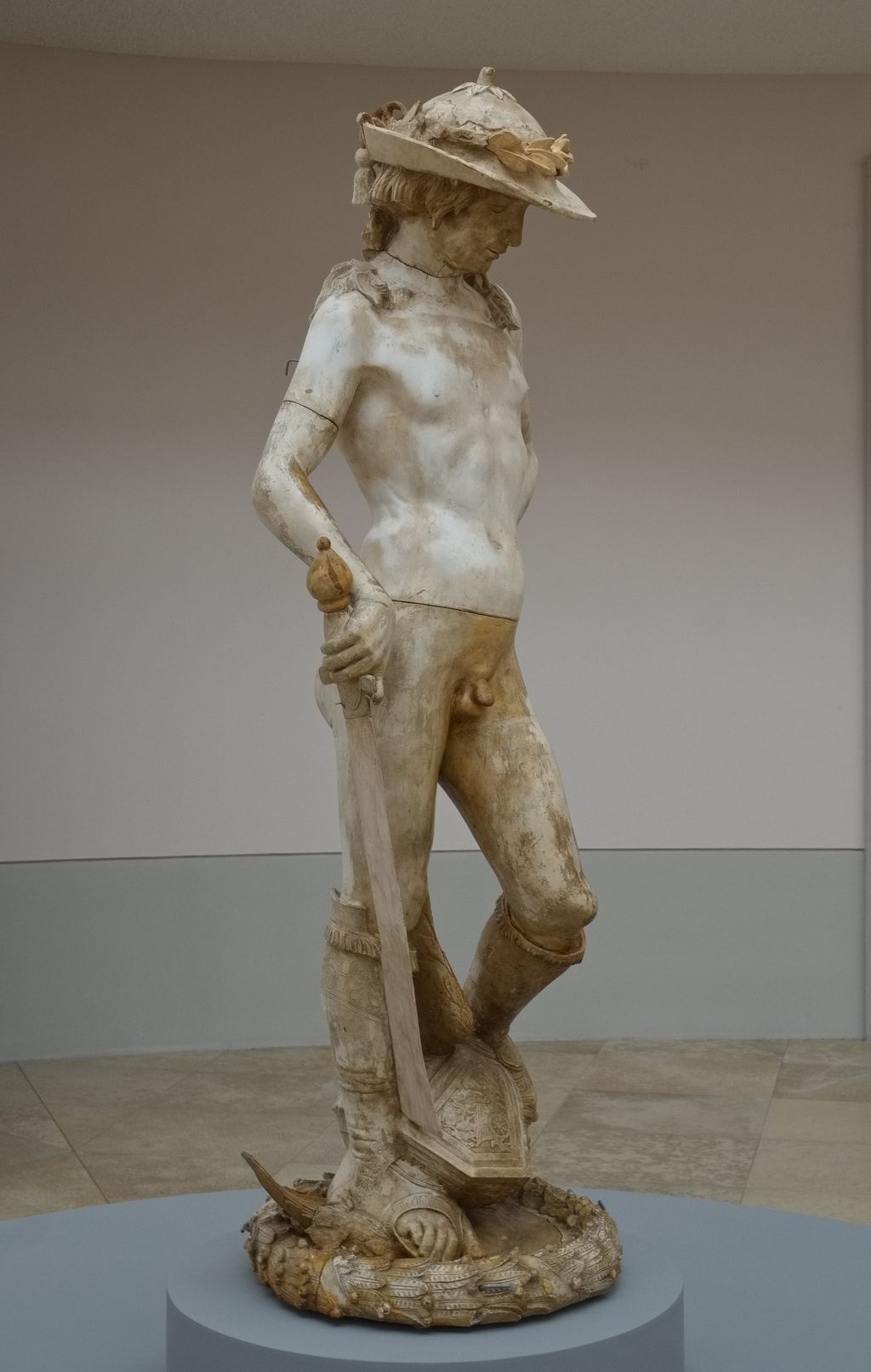
The Berlin plaster cast after Donatello’s bronze David, listed as 1882 in the exhibition checklist. Armin Kleiner. Image source. CC BY-SA 4.0. Resized for the web.
The David of the Casa Martelli is a separate marble in the National Gallery of Art in Washington. David is dressed in a short garment with a bag slung over his shoulder and holds a long sling. One foot rests against the side of Goliath’s face. The museum’s provenance traces the work to the Martelli family. Its catalogue names Donatello and Antonio and Bernardo Rossellino, and its exhibition history records differing attributions, including to Desiderio da Settignano and followers in 2022 and to followers of Donatello in London in 2023. Its distinct provenance, costume and sling make it a valuable comparison independently of the question of which sculptors worked on it. [2] [7] [15]
Andrea del Verrocchio’s Bargello David, dated about 1468–70 in the Italian state catalogue, is an independent, later bronze. The youth wears a fitted tunic and raises his head, looking out to one side. Goliath’s head and the standing figure were cast separately, a detail that has practical consequences for display. The National Gallery of Art’s annual report describes how the 2004 exhibition set the head beside David’s right foot, following the conservators’ interpretation of its original position. The Palazzo Medici account also gives that position as probable. In either position the head can tell the same story, but at the side it draws the eye out from the figure and changes the width of the composition. In Donatello’s bronze, the foot, helmet and rising feather establish the relation between the two figures in the sculpture itself. The Florentine government’s documented purchase of Verrocchio’s bronze from Lorenzo and Giuliano de’ Medici in 1476 is a separate transaction from its appropriation of Donatello’s bronze in 1495. [1] [2] [16] [17] [18]
There are also casts after Donatello’s bronze. The shellacked plaster photographed at the 2022 Berlin exhibition is Gipsformerei inventory R-02204. The exhibition checklist dates it to 1882. The Berlin workshop records a direct moulding of the original in 1875 for its master model, the reference from which further moulds could be made. The two dates record different stages of reproduction. The original early marble travelled to the same exhibition as a loan from the Bargello. The V&A has its own nineteenth-century plaster cast of the bronze. Casts make it possible to study the relation of the head, the raised foot and the sword far from Florence. The look of a coated plaster surface belongs to the history of that reproduction. Donatello’s metalwork and the surviving traces of gold have to be studied in the original or in photographs that record its surface. [1] [2] [19] [20] [21] [25]
Donatello sculpture directory
| Name | Date | Medium and record |
|---|---|---|
| Marble David | 1408–09, adapted 1416 | Carved Carrara marble Catalogue. |
| Saint John the Evangelist | c. 1409–15 | Carved marble Catalogue. |
| Saint Mark | 1411–13 | Carved Carrara marble Catalogue. |
| Saint George and its dragon relief | c. 1415–17 | Marble statue and marble relief Catalogue. |
| Marzocco | c. 1417–20 | Carved sandstone Catalogue. |
| Saint Louis of Toulouse, Florence | 1418–25 | Gilt bronze and mixed media Catalogue. |
| Pazzi Madonna | c. 1420s | Marble relief Catalogue. |
| Reliquary Bust of Saint Rossore | c. 1420s | Gilt bronze Catalogue. |
| The Prophet Jeremiah | 1420s–30s, disputed | Marble Catalogue. |
| Zuccone | c. 1420s–30s | Marble Catalogue. |
| Feast of Herod, Siena | 1420s | Gilded bronze relief Catalogue. |
| Ascension with Christ Giving the Keys to Saint Peter | c. 1428–30 | Marble relief Catalogue. |
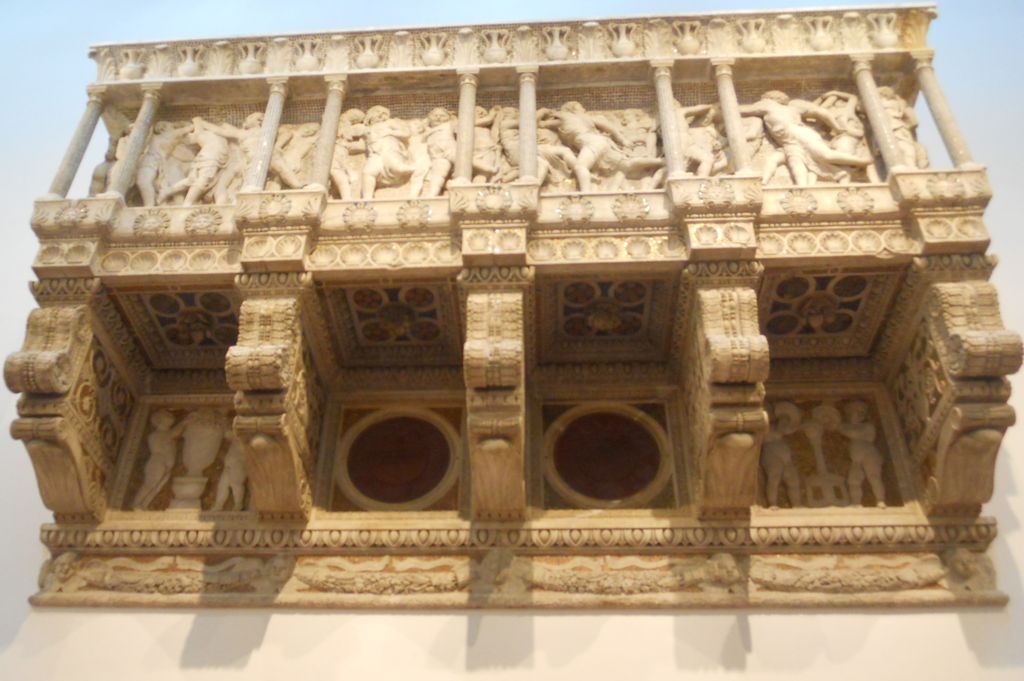
| Cantoria | 1433–39 | Marble and mosaic Catalogue. |
| Amor-Atys | c. 1435–40 | Partly gilded bronze Catalogue. |
| Bronze David | c. 1435–40, disputed | Partly gilded bronze Catalogue. |
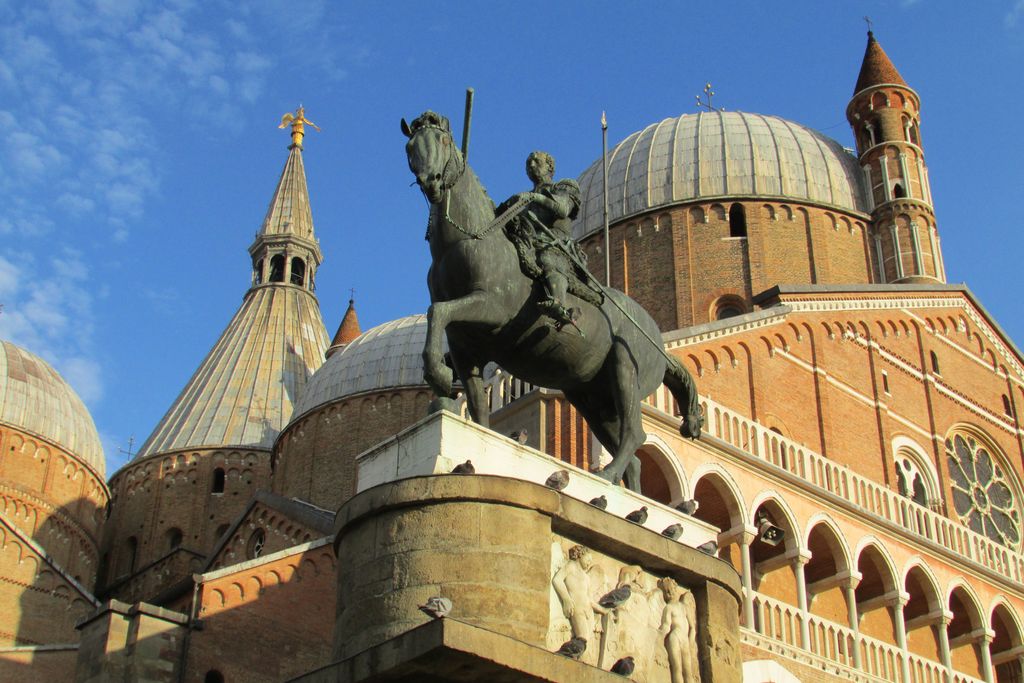
| Gattamelata | Installation agreement, 1453 | Bronze and stone Catalogue. |
| Santo altar | Mid-fifteenth century | Bronze and limestone ensemble Catalogue. |
| Chellini Madonna | Given in 1456 | Partly gilded bronze tondo Catalogue. |
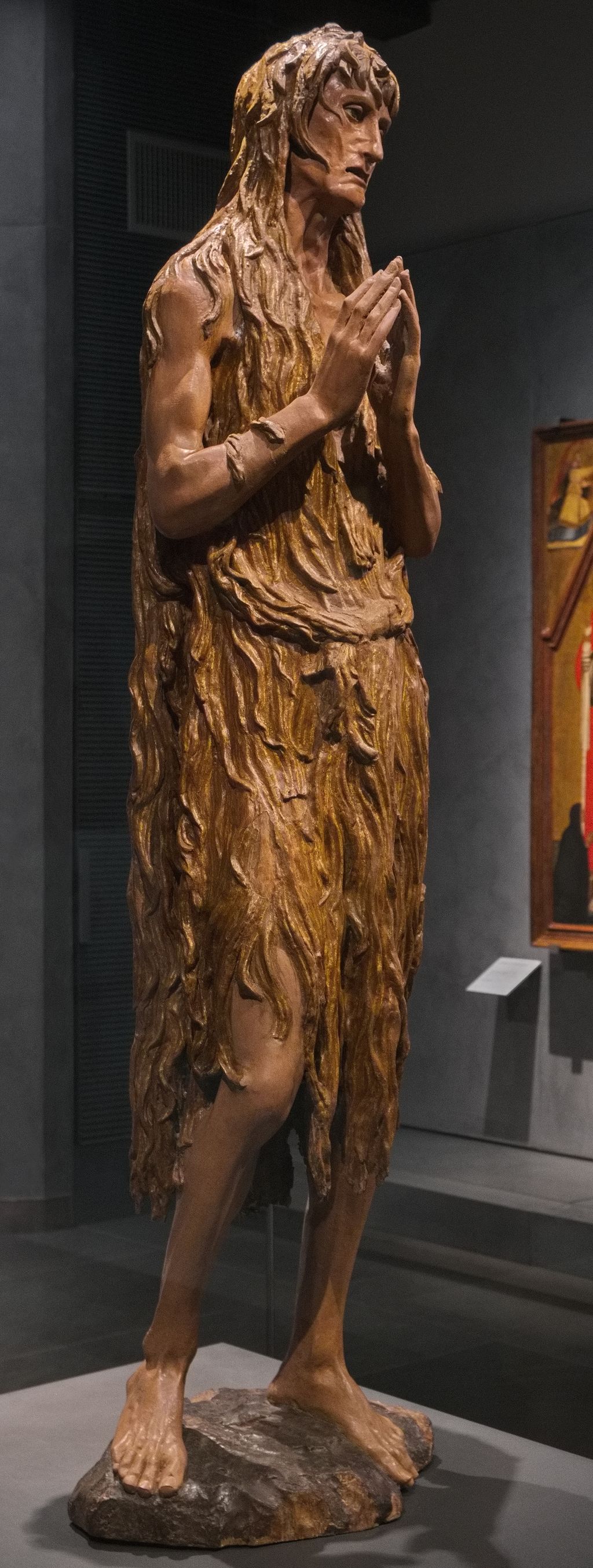
| Penitent Magdalene | c. 1453–55 (Opera) | Poplar, stucco, pigments and gold Catalogue. |
| Judith and Holofernes | Late 1450s–early 1460s | Bronze with surviving gilding Catalogue. |
| Pulpit of the Passion | Late work and later assembly | Bronze reliefs, Donatello and collaborators Catalogue. |
| Bust traditionally called Niccolò da Uzzano | Fifteenth century | Painted terracotta, attribution disputed Catalogue. |
| Prato Cathedral exterior pulpit | Commissioned 1428; carved 1430s | Marble reliefs, Donatello and Michelozzo Catalogue. |
| Cavalcanti Annunciation | c. 1433–35 | Gilded sandstone and terracotta Catalogue. |
| Crucifix at Santa Croce | Early fifteenth century | Painted wood Catalogue. |
| Madonna of the Clouds | c. 1425–35 | Marble relief Catalogue. |
| Old Sacristy Doors | Fifteenth century | Two paired bronze doors Catalogue. |
| Resurrection Pulpit | Late work and later assembly | Bronze reliefs, Donatello and collaborators Catalogue. |
| Brancaccio tomb | 1420s | Donatello, Michelozzo and assistants, mixed materials Catalogue. |
| Saint John the Baptist, Venice | 1438 | Polychromed and gilded wood Catalogue. |
| Sacrifice of Isaac | Early fifteenth century | Donatello and Nanni di Bartolo, marble Catalogue. |
| Madonna of Via Pietrapiana | Mid-fifteenth century | Terracotta Catalogue. |
| Miracle of the Mule | Mid-fifteenth century | Gilded bronze panel for the Santo altar Catalogue. |
| Padua Crucifix | Mid-fifteenth century | Cast bronze Catalogue. |
| Dancing Spiritello, Bargello | Fifteenth century | Bronze Catalogue. |
| Young Prophet from the Porta della Mandorla | c. 1404–09 | White marble, attributed to Donatello Catalogue. |
| Prophet or Apostle from the Duomo north tribune | Early fifteenth century | White marble, possibly Donatello Catalogue. |
| Beardless Prophet | 1415–18 | White marble Catalogue. |
| Sibyl and Prophet of the Porta della Mandorla | 1422 | Carved marble heads for the portal Catalogue. |
| Faith, Siena baptismal font | 1420s | Gilded bronze figure Catalogue. |
| Hope, Siena baptismal font | 1420s | Gilded bronze figure Catalogue. |
| Feast of Herod, Lille | c. 1430 | Carrara marble relief Catalogue. |
| Piot Madonna | c. 1440–60 | Polychrome terracotta with glass and wax inlays Catalogue. |
| Carafa Horse Head | c. 1456–58 | Cast bronze Catalogue. |
| Pazzi Madonna workshop version, Louvre | c. 1450 | Polychrome gesso, Donatello’s workshop Catalogue. |
| Pazzi Madonna tondo, Rijksmuseum | c. 1425–50 | Plaster and stucco, after Donatello Catalogue. |
| Sprite | c. 1430–40 | Bronze, sculptor or metalsmith close to Donatello Catalogue. |
Discussion
Look again at the images and ideas explored in Bronze David. These editorial prompts invite your observations.
Reader Insights
How does the relationship between the sword and the body change when you move around the statue?
What might have changed for someone looking at the statue on its palace column and someone seeing it at the Bargello?
Join the Conversation
Share a detail, comparison or question about Bronze David below.
References
- Catalogo generale dei Beni Culturali, David, national record 0900007363, Bargello Bronzi 95. View source.
- Victoria and Albert Museum, Donatello’s “David”. View source.
- United States Conference of Catholic Bishops, 1 Samuel 17, New American Bible, Revised Edition. View source.
- Adrian W. B. Randolph, “Homosocial Desire and Donatello’s Bronze David,” in Engaging Symbols: Gender, Politics, and Public Art in Fifteenth-Century Florence (2002), pp. 139–192. View source.
- Martina Mrázová, “Donatello’s David and the Medici. Reflections and Interpretations,” Ars 55, no. 2 (2022), pp. 143–151. View source.
- Mediateca di Palazzo Medici Riccardi, David, Donatello. View source.
- Fondazione Palazzo Strozzi and Museo Nazionale del Bargello, Donatello, the Renaissance, 2022 exhibition press kit, checklist nos. 5.6, 12.3, 12.7 and 12.9. View source.
- Peter Weller, “A Reassessment in Historiography and Gender: Donatello’s Bronze David in the Twenty-First Century,” Artibus et Historiae 33, no. 65 (2012). View source.
- Sarah Blake McHam, “Donatello’s Bronze ‘David’ and ‘Judith’ as Metaphors of Medici Rule in Florence,” The Art Bulletin 83, no. 1 (2001), pp. 32–47. View source.
- Mediateca di Palazzo Medici Riccardi, Giuditta e Oloferne, Donatello. View source.
- Ministero della Cultura, Restauro del David di Donatello, project notice. View source.
- Fondazione il Bargello, The David Restored, exhibition archive, 2008–09. View source.
- Musei del Bargello, Museo Nazionale del Bargello: riapre al pubblico il Salone di Donatello, 18 April 2025. View source.
- Catalogo generale dei Beni Culturali, David con la testa di Golia, marble, national record 0900287035. View source.
- National Gallery of Art, The David of the Casa Martelli, Widener Collection, 1942.9.115. View source.
- Catalogo generale dei Beni Culturali, David con la testa di Golia, Andrea del Verrocchio, national record 0900006745. View source.
- National Gallery of Art, Annual Report 2004, account of the installation of Verrocchio’s David Restored. View source.
- Mediateca di Palazzo Medici Riccardi, David, Andrea del Verrocchio. View source.
- Image source, Armin Kleiner, photograph of After Donatello, David, shellacked plaster cast, Gipsformerei inventory 2204, on display at the Gemäldegalerie in 2022. View source.
- Staatliche Museen zu Berlin, Werkliste – Donatello. Erfinder der Renaissance, 2022–23 exhibition checklist, plaster cast R-02204 and early marble David. View source.
- Victoria and Albert Museum, Donatello, Michelangelo and David, note on the plaster cast in the Cast Courts. View source.
- Smarthistory, Donatello, David, discussion and photographs of the helmet and feather. View source.
- Consiglio Nazionale delle Ricerche, “Visible to the Naked Eye: Advances in Laser Cleaning of Artworks,” Highlights CNR 2009–2010, p. 192. View source.
- Francesco Caglioti, “Il David bronzeo di Donatello,” in Beatrice Paolozzi Strozzi, ed., Donatello: il David restaurato (2008), pp. 26–85. View source.
- Staatliche Museen zu Berlin, “Zehnerpack: 10 Gipsmodelle, die Kunstgeschichte erzählen,” no. 6, on the Gipsformerei master model. View source.
- United States Conference of Catholic Bishops, Judith 13, New American Bible, Revised Edition. View source.
- Opera del Duomo, Donatello and the Opera del Duomo. View source
- Save Venice, Donatello’s Equestrian Monument to Gattamelata. View source
- Opificio delle Pietre Dure, L’ultimo Donatello. View source
More DONATELLO Sculptures
Marble David
Armin Kleiner. Image source. CC BY-SA 4.0. Resized for the web.
Bronze David
Patrick A. Rodgers. Image source. CC BY-SA 2.0. Resized for the web.
Cantoria
Erik Drost. Image source. CC BY 2.0. Resized for the web.
Gattamelata
Chris Light. Image source. CC BY-SA 4.0. Resized for the web.
Penitent Magdalene
Armin Kleiner. Image source. CC BY-SA 4.0. Resized for the web.
Chellini Madonna
Armin Kleiner. Image source. CC BY-SA 4.0. Resized for the web.
