


 by Tom Gurney
Tom Gurney BSc (Hons) is an art history expert with over 20 years experience
Published on June 19, 2020 / Updated on November 29, 2026
Email: tomgurney1@gmail.com / Phone: +44 7429 011000
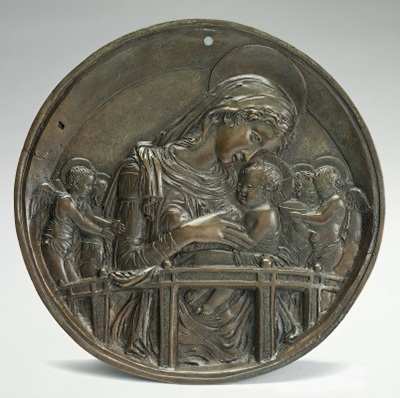
Mary bends her crowned head towards the child on her arm. Four angels crowd in on either side, their gestures passing across a curved railing that seems to run just in front of them. Turn the bronze over and the scene is still there in reverse. The raised figures give way to hollows, and the hand that seemed to project towards us is sunk into the metal. Donatello made the back as a mould that could give the scene another life in glass. [1]
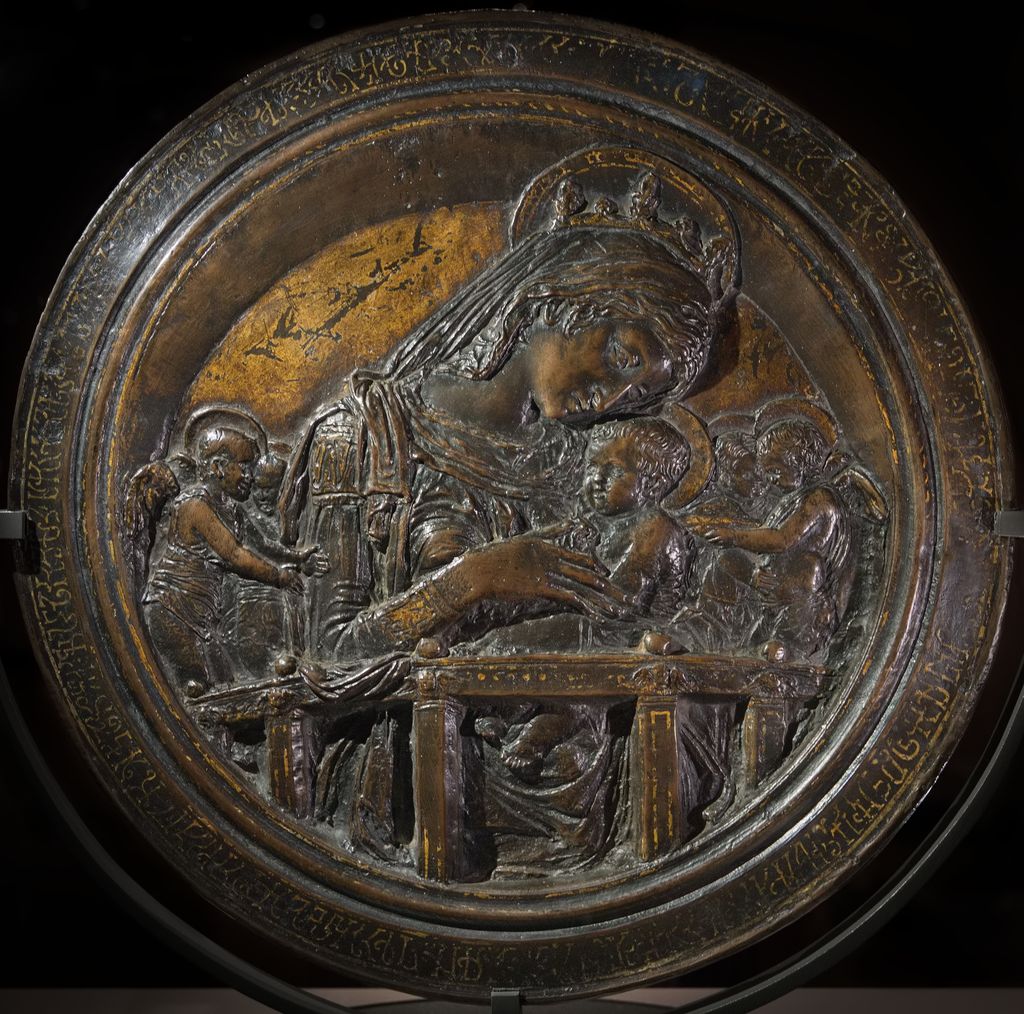
The Virgin and Child with Four Angels, better known as the Chellini Madonna, is a partly gilded bronze about 28.5 centimetres across and 2.7 centimetres deep. The Victoria and Albert Museum in London catalogues it as A.1-1976 and dates it to about 1450, probably made in Padua, with Florence also possible. The name comes from Giovanni Chellini, the Florentine physician who received it from Donatello on 27 August 1456 and described both of its faces. [1] [2]
A mother and child behind a railing
Mary’s tilted head occupies the upper part of the circle, leaving just enough room for the crown and halo above the folds of her veil. Her hand stretches across the centre and steadies the child against her body. The fine folds across her shoulder and breast give the light a succession of little ridges to catch, while the surface of her face turns more gradually from light to shadow. Below, the railing sweeps across the bronze. Drapery spills over it, and a small bare foot peeks out between its posts. The view feels low enough for the railing to make a real barrier, even though the child is close enough to seem within reach. [1] [3]
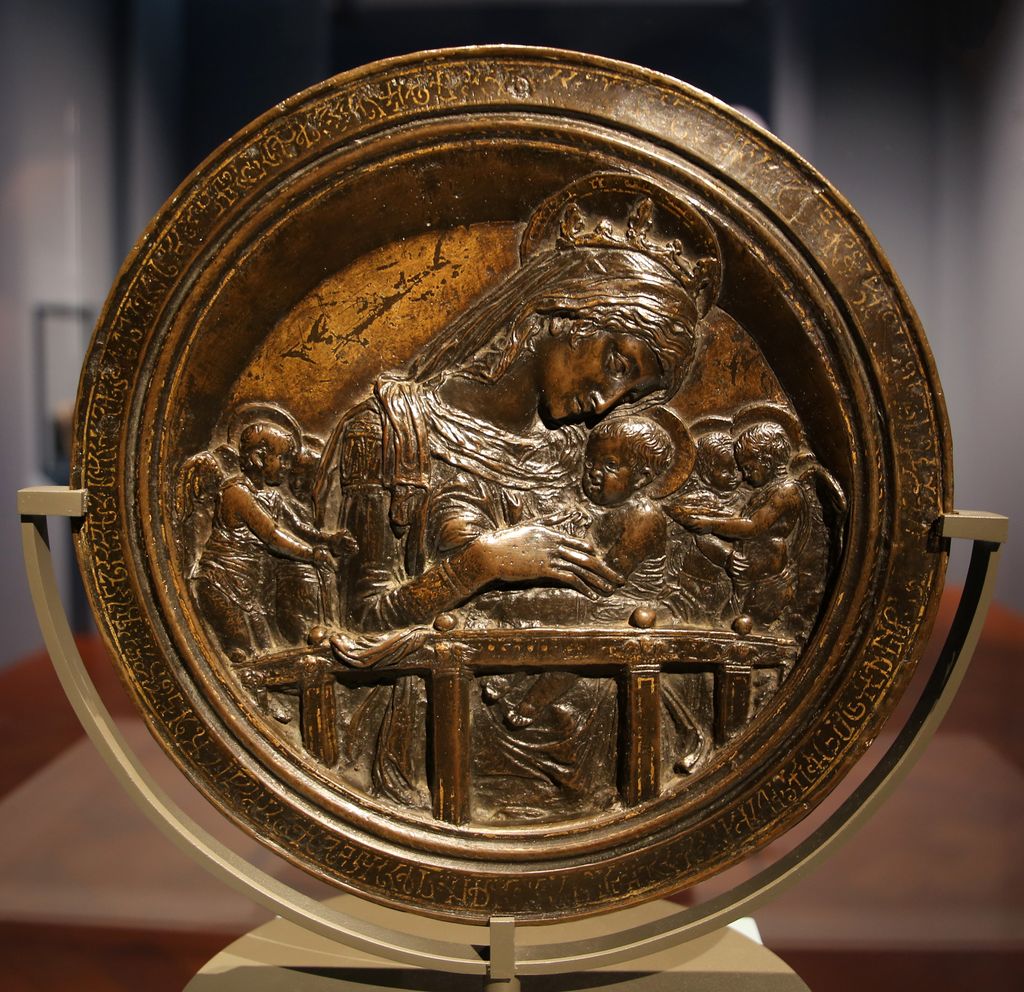
The V&A bronze, with traces of gilding and the railing visible across the front of the figures. Francesco Bini. Image source. CC BY-SA 4.0. Resized for the web.
The count of four angels is easier to see once you find the two at the edges. The leftmost leans in with both hands extended, partly screening the small face behind him. On the other side, the angel nearest the rim offers a bowl, while a second head appears between him and the child’s halo. The V&A reads the bowl as an offering of sweetmeats, a customary gift for a new mother in Renaissance Italy. The crown and haloes identify the sacred company, and the small act of bringing food makes it possible to picture them as visitors attending a mother and baby. [1] [3] [4]
The gold makes a different kind of space. Patches survive behind the heads, on parts of the railing and around the edge, where the V&A identifies a band of pseudo-Kufic ornament. Its shapes recall Arabic calligraphy. Follow them around the rim and they draw the eye back to the fact that this is a worked metal object with a decorated edge, as well as a scene that seems to open up behind the railing. Much of the original gilding has been lost. The contrast between dark bronze and the remaining glints gives some idea of how the highlights once picked out small details across the surface. [1] [3]
In the earlier marble Pazzi Madonna, Donatello centres the encounter on the close meeting of two profiles. Here he gives a similarly intimate gesture a company of witnesses and sets all six figures just beyond the curve of the rail. The tightly folded drapery, the foreshortened barrier and the lively angels also led the art historian Laura Cavazzini to compare the roundel with the bronzes of the Santo altar in Padua. The comparison helps explain the museum’s dating, even though Chellini’s entry gives neither the place nor the year of manufacture. [1] [5]
Annotated Details from the Chellini Madonna
Select a number to jump to a detail of the sculpture.
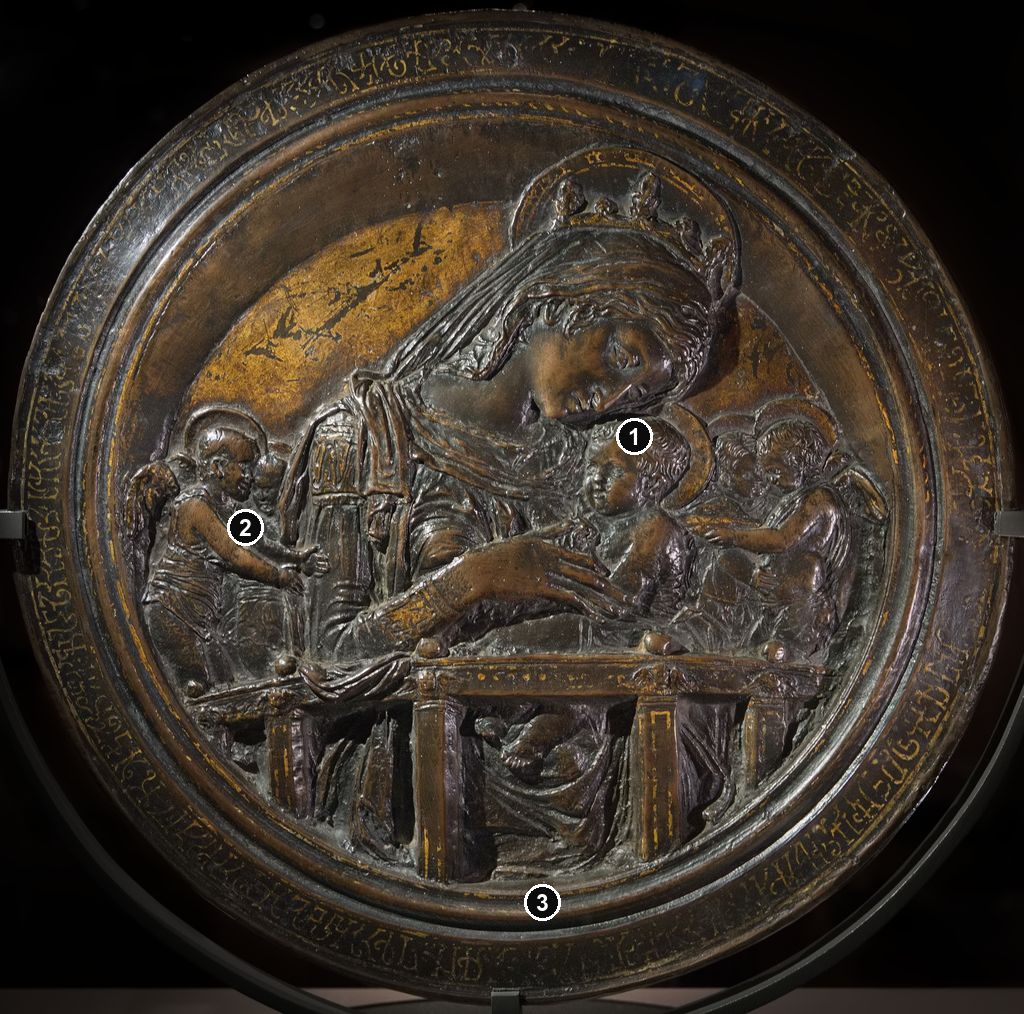
Details from THE CHELLINI MADONNA
Open a detail image to examine the surface more closely.
The Madonna and Child
The mother’s inclined head brings her face very close to the child’s. The brighter and darker passages help separate their profiles.
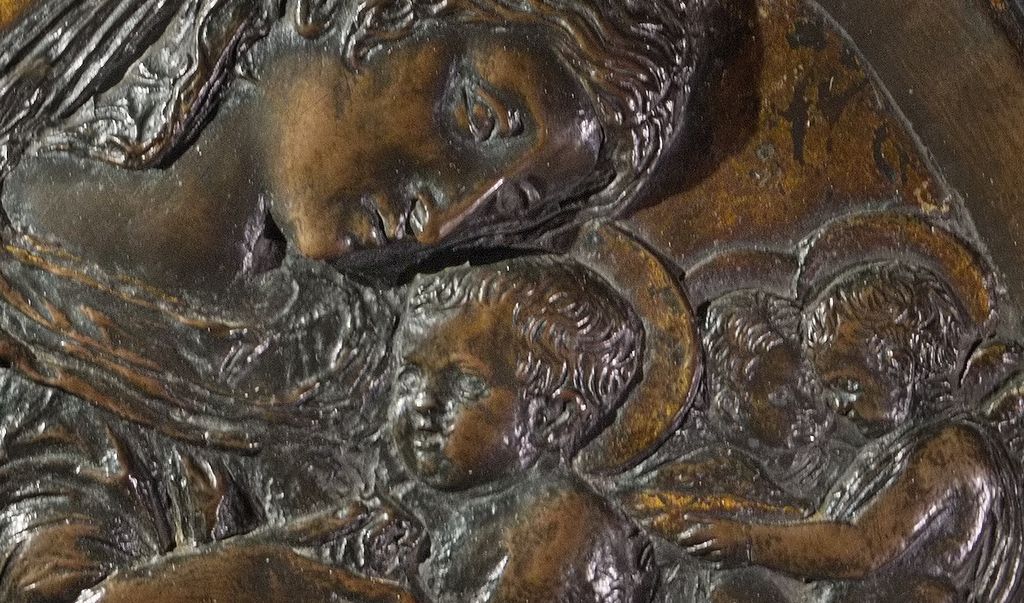
An angel at the left
The angel fits into the curve beside the Madonna. Shallower features and overlapping edges imply a small space behind the main figures.
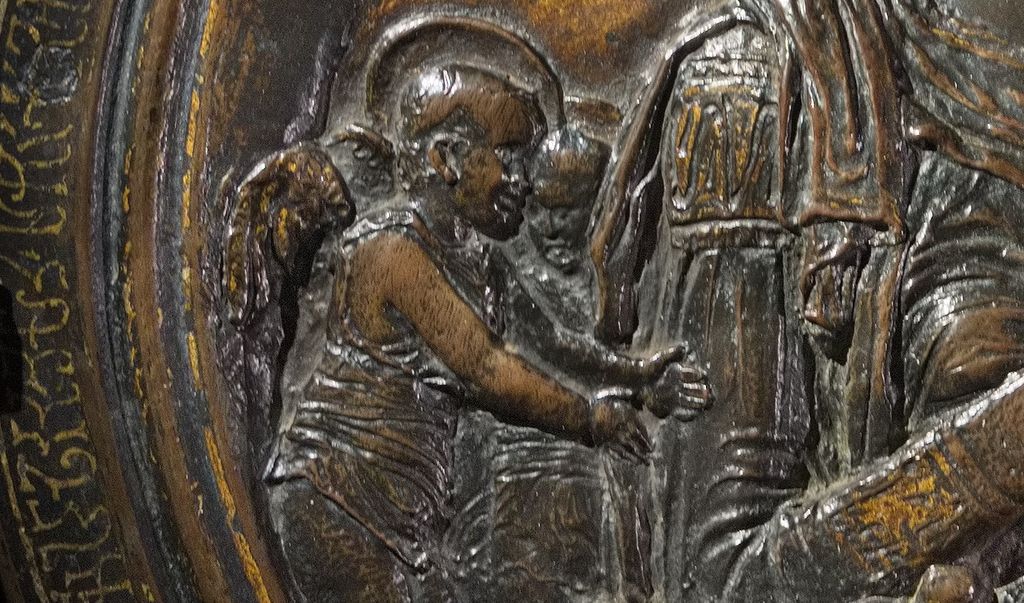
The patterned rim
A continuous rim closes the circle around the relief. Small repeated marks become legible as the light travels around the bronze.
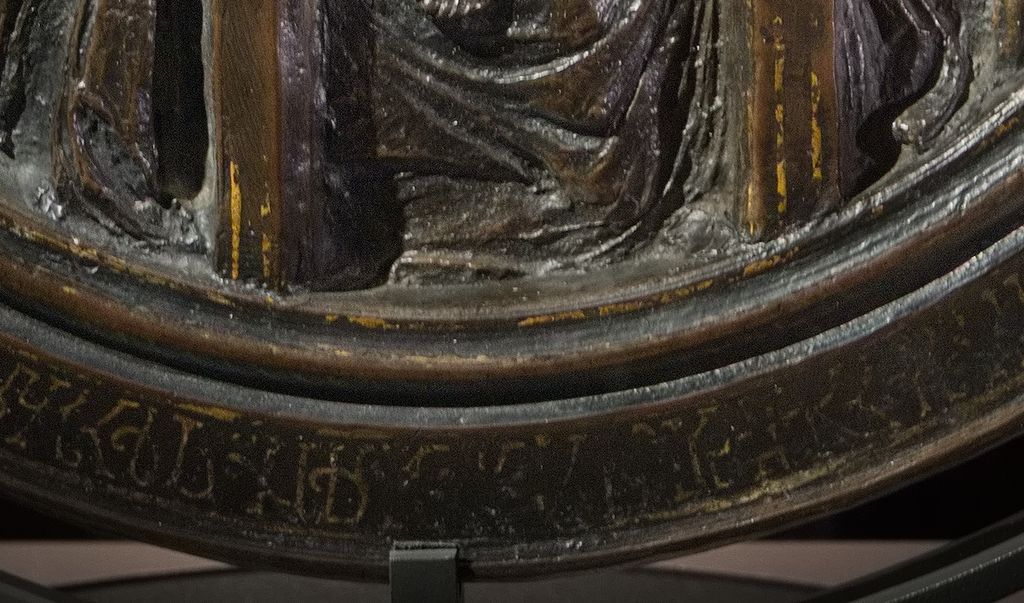
Annotated photograph and detail crops. Armin Kleiner. Image source. CC BY-SA 4.0. Resized, annotated and cropped from the original photograph.
Giovanni Chellini’s record of the gift
Chellini kept a book of accounts and memoranda. In the entry at folio 199 recto, now in the Saminiati-Pazzi archive at Bocconi University in Milan, he says he had been treating Donato, called Donatello, and that the sculptor gave him the roundel out of courtesy and in recognition of the care he had received. Chellini describes the relief in everyday terms, comparing its size to a serving platter. He also singles out Donatello’s ability to make figures in bronze, wood and fired clay. The specificity of those remarks gives the entry the character of a recollection of the man as well as a record of what changed hands. [2]
The two names preserve different details. Chellini Madonna remembers the first documented recipient. Virgin and Child with Four Angels gives the count visible on the bronze. The Italian phrase due angeli da lato is read by the V&A as two angels to each side, which fits the two overlapping pairs. Chellini then records the most unusual feature of the gift. Its back was hollowed so that molten glass could take the shape of the figures on the front. His wording describes what the mould would do. The date is firm evidence that the bronze existed by August 1456, while the occasion of its manufacture and any earlier use are still open. [1] [2]
Chellini has a second presence in the V&A in the form of a signed marble portrait bust by Antonio Rossellino, also dated 1456. The bust gives a face to the physician whose description made it possible to identify the bronze. The closeness of the dates gives a glimpse of two very different relationships with sculpture. Rossellino put Chellini’s own features into marble, while Donatello’s gift entered the doctor’s household through an exchange of art for care. [1] [6]
How the reverse could make a second image
On the back, look for a detail you can recognise from the front, such as the outline of Mary’s crown or the rhythm of the railing posts. The features trade sides when you turn the disc over, and each projection of the design has a corresponding recess. The deeper a hollow, the higher that part can rise in a cast taken from it. This relationship between a negative and a positive is what makes the back usable. Even a faithful impression would transfer the modelling of the figures and leave behind the gold ornament and the light it reflects. [1] [3] [7]
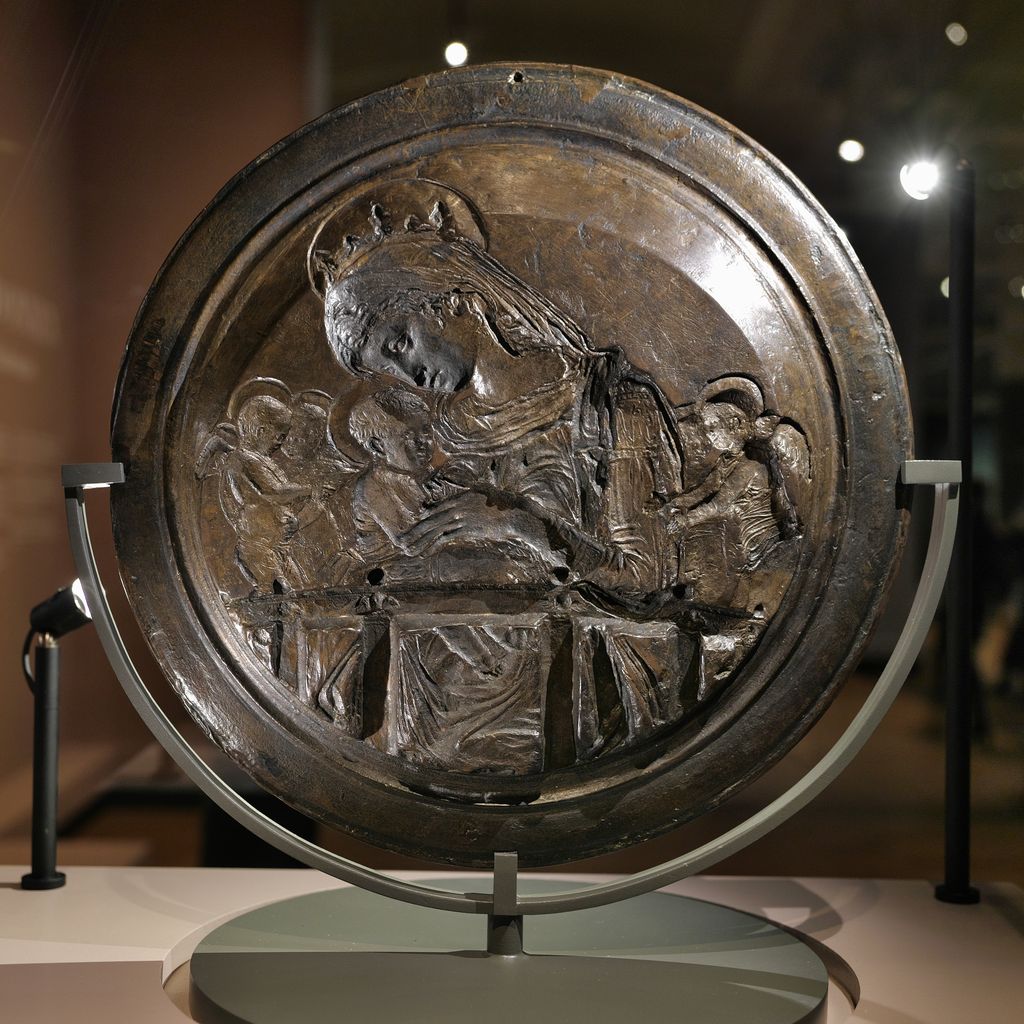
The hollow reverse of the original roundel, photographed on loan at the 2022 Berlin exhibition. Bautsch. Image source. CC0 / Public domain. Resized for the web.
Art historian Amy R. Bloch describes how the unusually regular circular field may have begun with a turned wooden support and how a paired mould could have produced a wax model for casting the two-sided bronze. This is a reconstruction of workshop practice from the surviving object. The care it implies is visible on the back. The positions of the halos, faces and hands all had to correspond to the forms on the front, a demand beyond the ordinary task of leaving a relief hollow behind. The finished bronze could thus serve as the starting point for another cast without first taking an impression of its face. [3] [7]
The V&A tested Chellini’s description around the time of the 1976 acquisition. To protect the original, the experimenters took the negative into two new bronze moulds. At the Royal College of Art in London, workers heated the mould and pressed the hot glass into it with a wet wooden tool. At the Venini glassworks on Murano, the glass went into a cold mould. Both experiments used cobalt-blue glass and yielded casts. The V&A identifies its roundel NCOL.277-2018 as the work of Frederick George Daden for the Royal College of Art in 1976, and illustrates another twentieth-century glass roundel under the number REPRO.A.1976-1. The experiments establish that the procedure was workable with the tools and materials available in the fifteenth century. No Renaissance glass impression of this particular bronze has been securely identified, and it remains unclear whether Donatello or Chellini actually had one made. [5] [7] [8]
A glass impression changes the way the scene is seen. On the metal, movement and depth depend on light falling across the surface. In the blue replicas, light can also pass through, and the thinner and thicker parts of the disc vary in colour and brightness. The V&A draws a connection with a medieval comparison in which light passing through a window leaves the glass intact, just as divine light could enter Mary without compromising her virginity. That comparison gives the choice of glass a possible devotional resonance. Chellini’s note leaves the reasons for the choice unstated. [7] [8]
Donatello’s idea belongs to a wider Renaissance interest in shaping glass. In his architectural treatise, written after the gift to Chellini, the sculptor and architect Filarete imagined glass tiles for a palace that would show figures and animals beneath a smooth upper surface. Surviving Venetian glass plaques bearing the profile of Doge Andrea Gritti offer a later example of moulded glass used for relief. They help place Chellini’s description in a credible technical tradition while leaving the question of how the Chellini Madonna itself was used open. [12]
The bronze, the copies and the museum
The route from Chellini’s household to England has gaps. By the eighteenth century the bronze belonged to the Marquess of Rockingham at Wentworth Woodhouse. It passed to his nephew, the fourth Earl Fitzwilliam, and remained in the family until it was sold in 1954. The date and circumstances of its arrival in England are uncertain. In the meantime the painting and sculpture collector Sir John Soane received a plaster cast from the painter Henry Howard around 1832–35. It survives in a circular glazed wooden frame, and Soane’s 1835 description already identified the design as after Donatello. Another version with nearly the same title, at the National Gallery of Art in Washington, is a smaller bronze by an anonymous sculptor after Donatello. Between them, the two copies show how widely the composition could travel in materials other than glass. [9] [10]
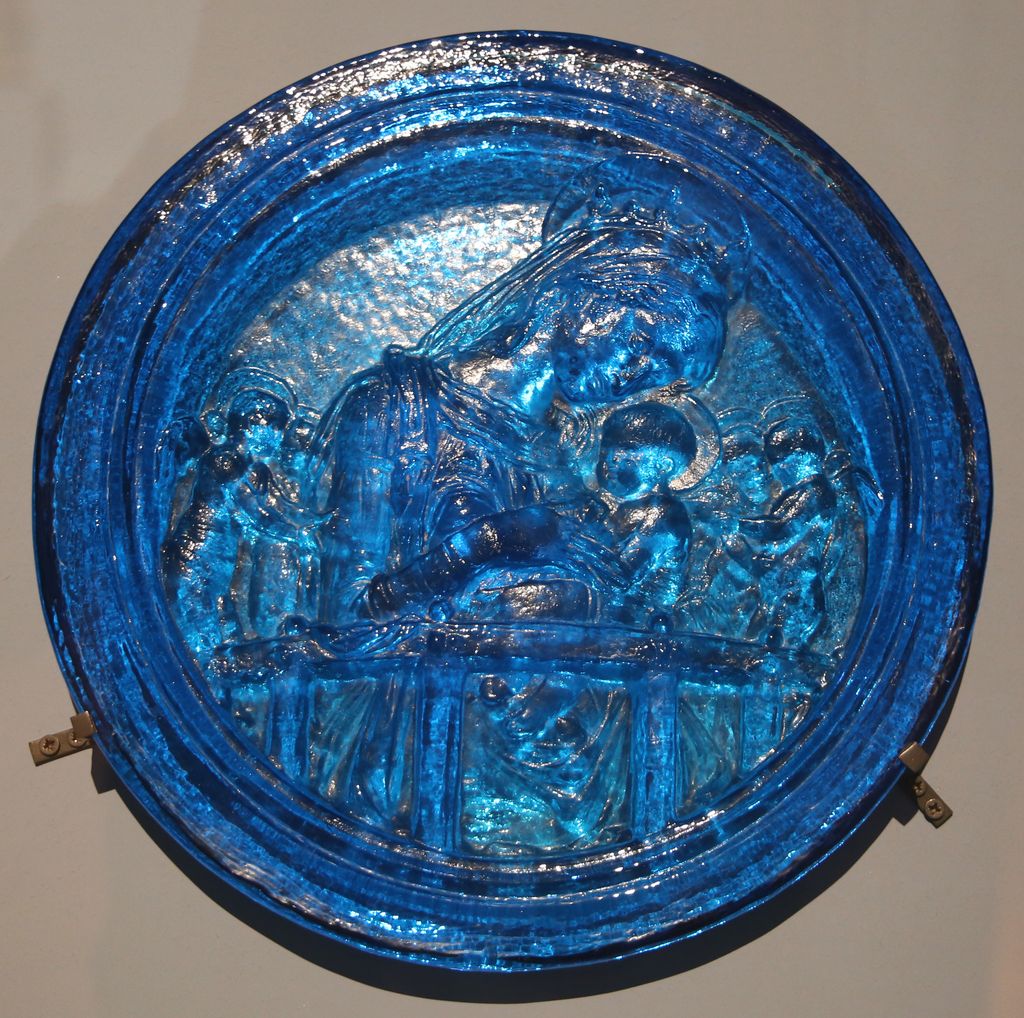
Blue glass taken from the Chellini Madonna in a twentieth-century casting trial. Francesco Bini. Image source. CC BY-SA 4.0. Resized for the web.
The original bronze came into the V&A on an Opinions Day in 1966. In 1975 the dealer David Carritt brought it to the attention of John Pope-Hennessy, a former director of the museum, who later recalled hearing that it had been used as an ashtray. Pope-Hennessy recognised the subject from other reliefs. The recessed design on the back matched Chellini’s account and secured the identification. The prospect of the bronze going to an American dealer prompted an export stop and a public appeal. The V&A bought it in 1976 after raising the required £175,000, with support from public subscribers, the Art Fund and the Pilgrim Trust. [1] [7] [9] [11]
The appeal itself put the image back into circulation. The Pobjoy Mint made an edition of silver roundels from an intermediate mould, and early donors were offered the chance to buy one. The silver editions belong to the story of how the museum acquired the bronze, just as the blue glass casts belong to the test of how it could work. They make different things visible about the same object. The arm that gathers the child in still brings the two purposes of the bronze together. Its folds animate a gesture on the front. On the back those same lines define a space into which glass could flow. [7] [8]
Donatello sculpture directory
| Name | Date | Medium and record |
|---|---|---|
| Marble David | 1408–09, adapted 1416 | Carved Carrara marble Catalogue. |
| Saint John the Evangelist | c. 1409–15 | Carved marble Catalogue. |
| Saint Mark | 1411–13 | Carved Carrara marble Catalogue. |
| Saint George and its dragon relief | c. 1415–17 | Marble statue and marble relief Catalogue. |
| Marzocco | c. 1417–20 | Carved sandstone Catalogue. |
| Saint Louis of Toulouse, Florence | 1418–25 | Gilt bronze and mixed media Catalogue. |
| Pazzi Madonna | c. 1420s | Marble relief Catalogue. |
| Reliquary Bust of Saint Rossore | c. 1420s | Gilt bronze Catalogue. |
| The Prophet Jeremiah | 1420s–30s, disputed | Marble Catalogue. |
| Zuccone | c. 1420s–30s | Marble Catalogue. |
| Feast of Herod, Siena | 1420s | Gilded bronze relief Catalogue. |
| Ascension with Christ Giving the Keys to Saint Peter | c. 1428–30 | Marble relief Catalogue. |
| Cantoria | 1433–39 | Marble and mosaic Catalogue. |
| Amor-Atys | c. 1435–40 | Partly gilded bronze Catalogue. |
| Bronze David | c. 1435–40, disputed | Partly gilded bronze Catalogue. |
| Gattamelata | Installation agreement, 1453 | Bronze and stone Catalogue. |
| Santo altar | Mid-fifteenth century | Bronze and limestone ensemble Catalogue. |
| Chellini Madonna | Given in 1456 | Partly gilded bronze tondo Catalogue. |
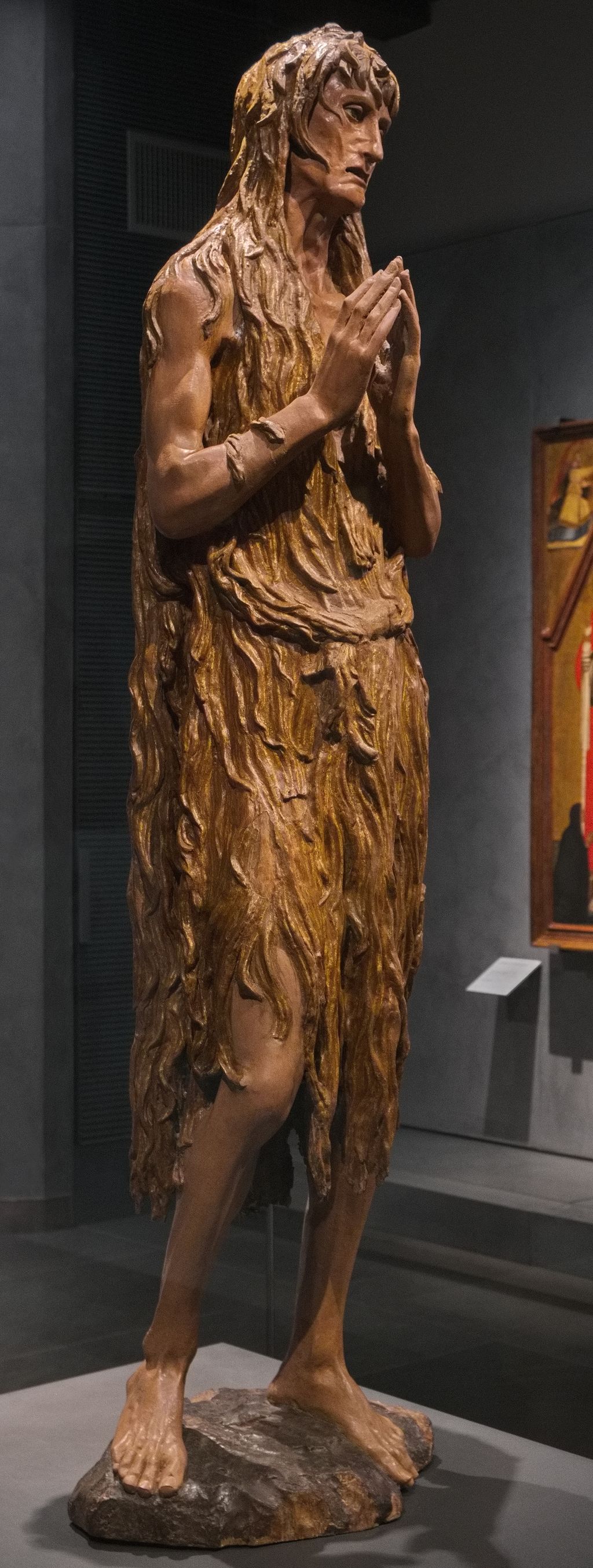
| Penitent Magdalene | c. 1453–55 (Opera) | Poplar, stucco, pigments and gold Catalogue. |
| Judith and Holofernes | Late 1450s–early 1460s | Bronze with surviving gilding Catalogue. |
| Pulpit of the Passion | Late work and later assembly | Bronze reliefs, Donatello and collaborators Catalogue. |
| Bust traditionally called Niccolò da Uzzano | Fifteenth century | Painted terracotta, attribution disputed Catalogue. |
| Prato Cathedral exterior pulpit | Commissioned 1428; carved 1430s | Marble reliefs, Donatello and Michelozzo Catalogue. |
| Cavalcanti Annunciation | c. 1433–35 | Gilded sandstone and terracotta Catalogue. |
| Crucifix at Santa Croce | Early fifteenth century | Painted wood Catalogue. |
| Madonna of the Clouds | c. 1425–35 | Marble relief Catalogue. |
| Old Sacristy Doors | Fifteenth century | Two paired bronze doors Catalogue. |
| Resurrection Pulpit | Late work and later assembly | Bronze reliefs, Donatello and collaborators Catalogue. |
| Brancaccio tomb | 1420s | Donatello, Michelozzo and assistants, mixed materials Catalogue. |
| Saint John the Baptist, Venice | 1438 | Polychromed and gilded wood Catalogue. |
| Sacrifice of Isaac | Early fifteenth century | Donatello and Nanni di Bartolo, marble Catalogue. |
| Madonna of Via Pietrapiana | Mid-fifteenth century | Terracotta Catalogue. |
| Miracle of the Mule | Mid-fifteenth century | Gilded bronze panel for the Santo altar Catalogue. |
| Padua Crucifix | Mid-fifteenth century | Cast bronze Catalogue. |
| Dancing Spiritello, Bargello | Fifteenth century | Bronze Catalogue. |
| Young Prophet from the Porta della Mandorla | c. 1404–09 | White marble, attributed to Donatello Catalogue. |
| Prophet or Apostle from the Duomo north tribune | Early fifteenth century | White marble, possibly Donatello Catalogue. |
| Beardless Prophet | 1415–18 | White marble Catalogue. |
| Sibyl and Prophet of the Porta della Mandorla | 1422 | Carved marble heads for the portal Catalogue. |
| Faith, Siena baptismal font | 1420s | Gilded bronze figure Catalogue. |
| Hope, Siena baptismal font | 1420s | Gilded bronze figure Catalogue. |
| Feast of Herod, Lille | c. 1430 | Carrara marble relief Catalogue. |
| Piot Madonna | c. 1440–60 | Polychrome terracotta with glass and wax inlays Catalogue. |
| Carafa Horse Head | c. 1456–58 | Cast bronze Catalogue. |
| Pazzi Madonna workshop version, Louvre | c. 1450 | Polychrome gesso, Donatello’s workshop Catalogue. |
| Pazzi Madonna tondo, Rijksmuseum | c. 1425–50 | Plaster and stucco, after Donatello Catalogue. |
| Sprite | c. 1430–40 | Bronze, sculptor or metalsmith close to Donatello Catalogue. |
Discussion
Look again at the images and ideas explored in Chellini Madonna. These editorial prompts invite your observations.
Reader Insights
How do the angels and the railing change the sense of depth in the small roundel?
Which part of the image looks different when you compare the bronze and the blue glass?
Join the Conversation
Share a detail, comparison or question about Chellini Madonna below.
References
- Victoria and Albert Museum, Virgin and Child with Four Angels (Chellini Madonna), collection record A.1-1976. View source.
- Giovanni Chellini, Libro di ricordanze di Maestro Giovanni del Maestro Antonio di Iacopo da San Miniato, fol. 199r, entry for 27 August 1456, Archivi Storici Università Bocconi, transcription through MuseoCity. View source.
- Amy R. Bloch, Donatello’s Chellini Madonna, Light, and Vision, in Renaissance Theories of Vision, 2016, pp. 63–88. View source.
- Victoria and Albert Museum, Donatello: Sculpting the Renaissance, teachers’ resource, Chellini Madonna entry. View source.
- Laura Cavazzini, Virgin and Child (Chellini Madonna) and Replica Cast from the Chellini Madonna, in Donatello: Inventor of the Renaissance, 2022, pp. 246–249, nos. 56–57. View source.
- Victoria and Albert Museum, Twenty Objects for Twenty Years: Bust of Giovanni Chellini, 1456, on Antonio Rossellino’s portrait, 7671-1861. View source.
- Jan Stellmann and Daniela Wagner, Materialität und Medialität. Zur Einführung, 2023, pp. XIII–XX, with reference to Anthony Radcliffe and Charles Avery’s 1976 account of the casting trials. View source.
- Victoria and Albert Museum, Donatello – a Master at Work, section on glass. View source.
- Sir John Soane’s Museum, Cast of the ‘Chellini’ Madonna by Donatello, in a Circular Glazed Frame, collection record BR30. View source.
- National Gallery of Art, Madonna and Child with Four Angels, bronze by an anonymous artist after Donatello, collection record 1957.14.132. View source.
- Art Fund, Madonna and Child with Four Angels (‘The Chellini Madonna’), acquisition record. View source.
- Rosa Barovier Mentasti and Cristina Tonini, Venetian Sixteenth Century Filigrana, pp. 14–16, on relief glass, the Chellini Madonna and Filarete’s treatise. View source.
- Victoria and Albert Museum, Donatello’s David. View source
- Opera del Duomo, Donatello and the Opera del Duomo. View source
- Ministero della Cultura, David with the Head of Goliath, Bargello bronze. View source
- Save Venice, Donatello’s Equestrian Monument to Gattamelata. View source
- Opificio delle Pietre Dure, L’ultimo Donatello. View source
More DONATELLO Sculptures
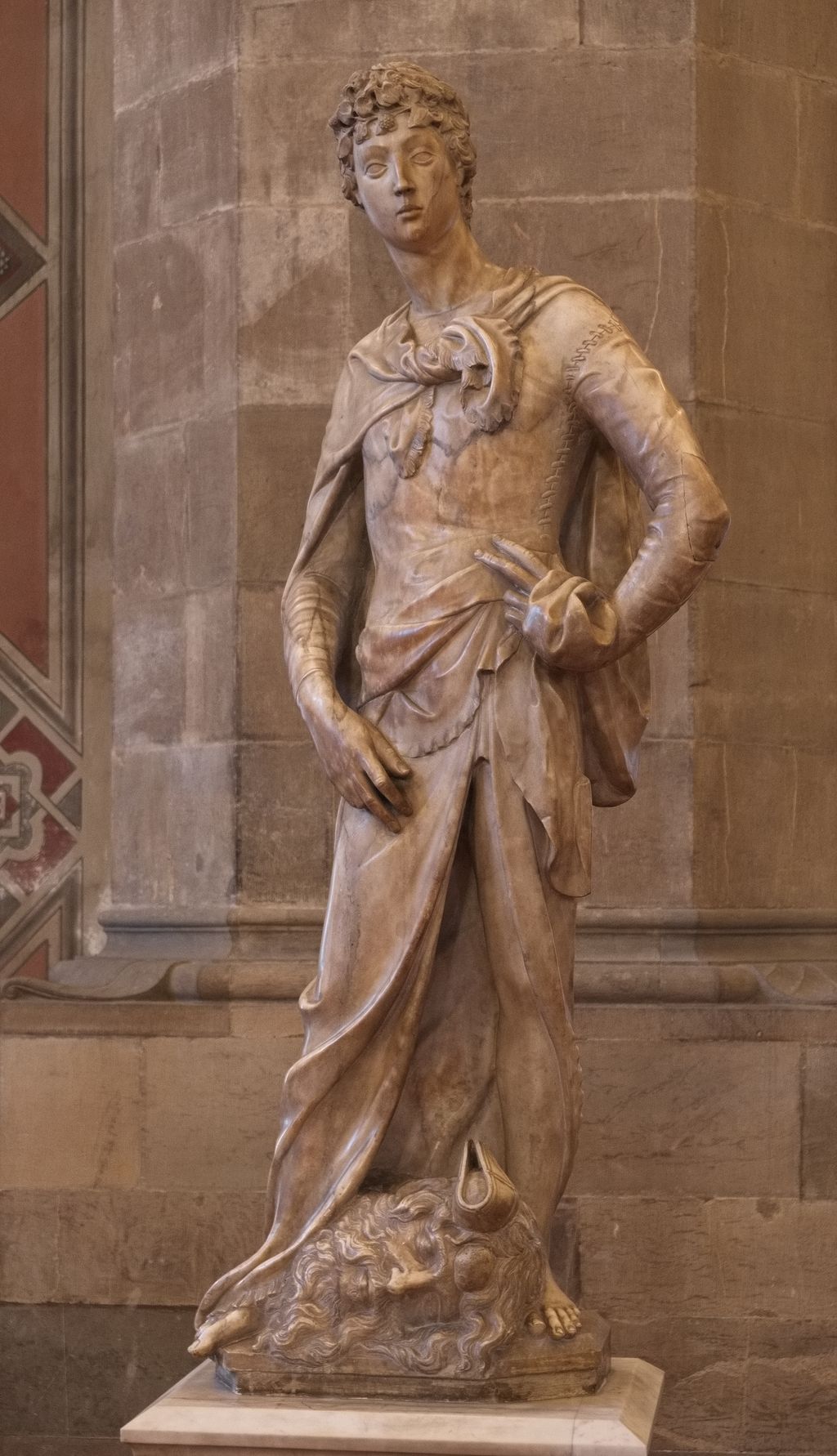
Marble David
Armin Kleiner. Image source. CC BY-SA 4.0. Resized for the web.
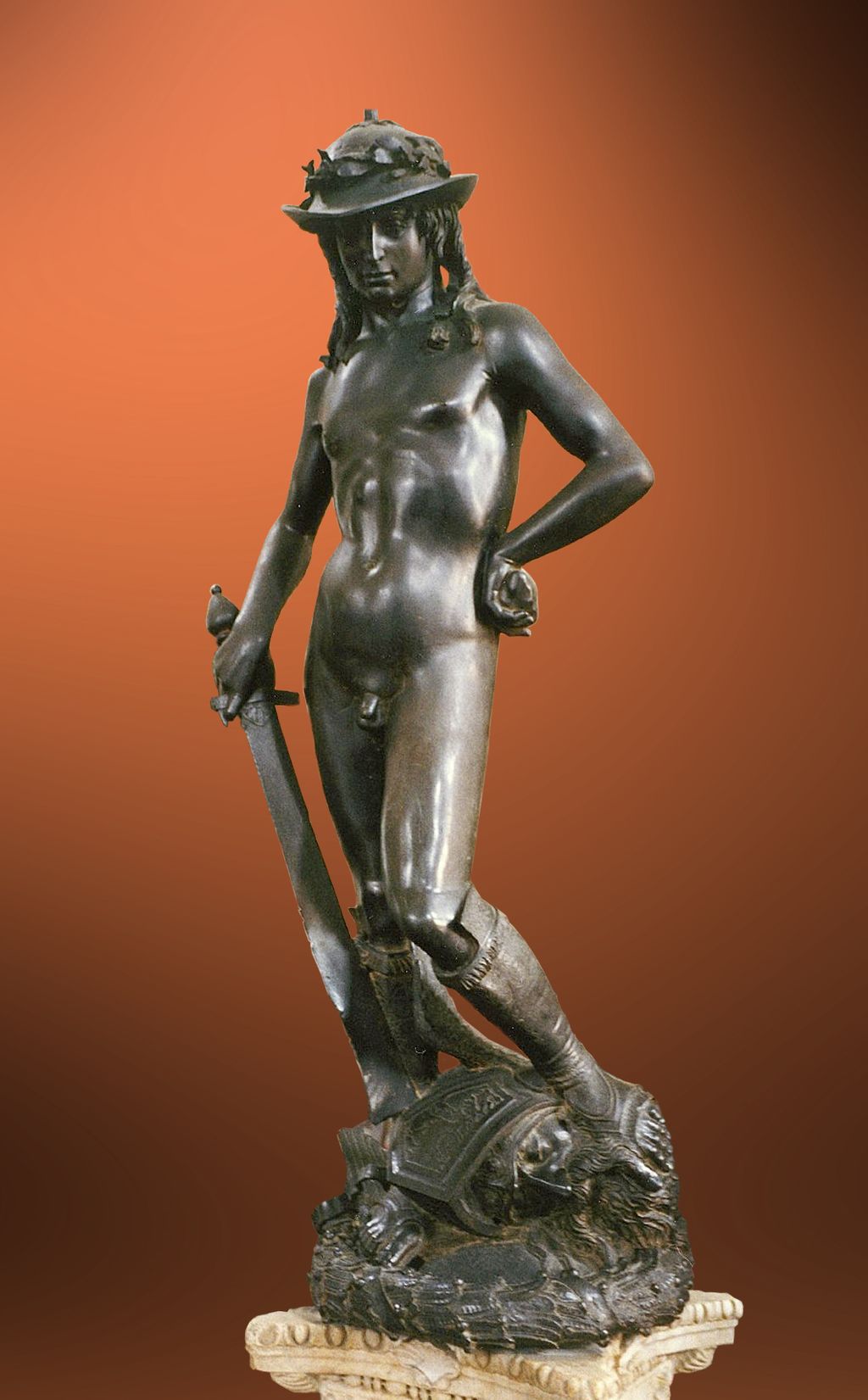
Bronze David
Patrick A. Rodgers. Image source. CC BY-SA 2.0. Resized for the web.
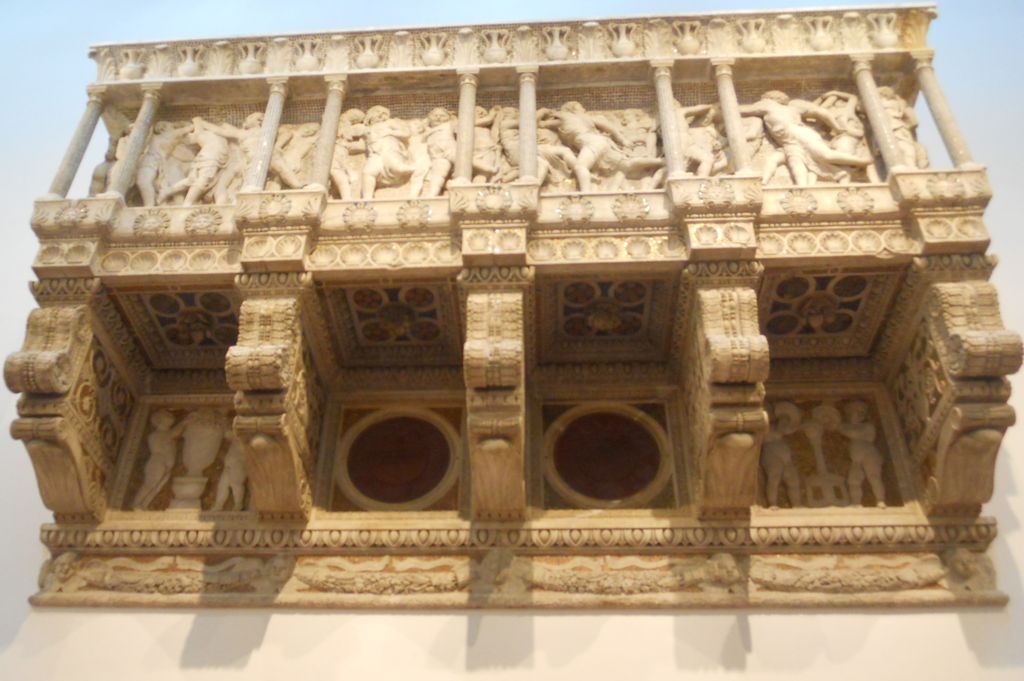
Cantoria
Erik Drost. Image source. CC BY 2.0. Resized for the web.
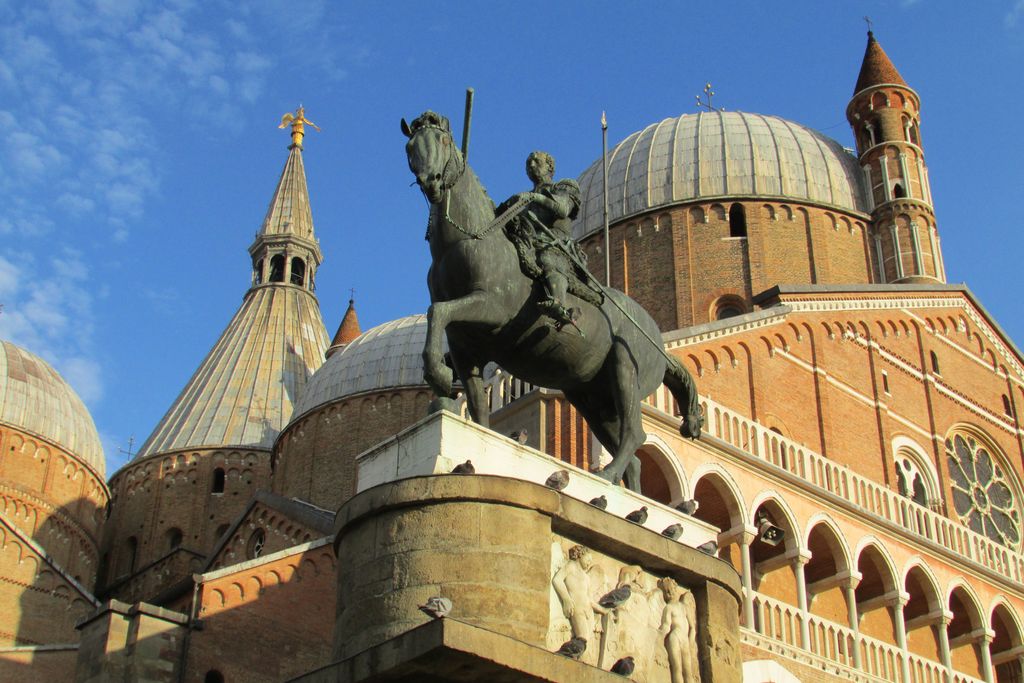
Gattamelata
Chris Light. Image source. CC BY-SA 4.0. Resized for the web.
Penitent Magdalene
Armin Kleiner. Image source. CC BY-SA 4.0. Resized for the web.
Chellini Madonna
Armin Kleiner. Image source. CC BY-SA 4.0. Resized for the web.
