


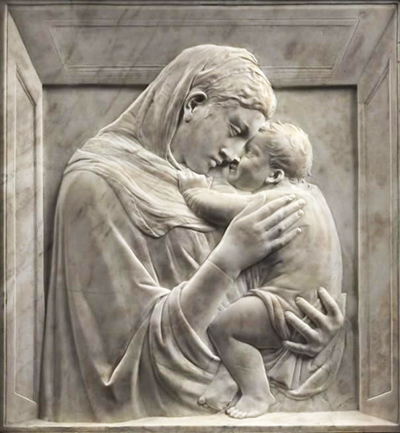
 by Tom Gurney
Tom Gurney BSc (Hons) is an art history expert with over 20 years experience
Published on June 19, 2020 / Updated on November 29, 2026
Email: tomgurney1@gmail.com / Phone: +44 7429 011000
“Speak, speak!” is often quoted as Donatello’s command to a statue. In Giorgio Vasari’s telling, the sculptor addresses it to the marble prophet he is carving for Florence Cathedral’s bell tower. A very different witness, the physician Giovanni Chellini, describes Donatello in his account book as a master of bronze, wood and fired clay. Chellini knew the sculptor and wrote during his lifetime. Vasari’s first printed account appeared in 1550, more than eighty years after Donatello’s death. The two sources tell us different things about his reputation, from the skills a contemporary admired to the way later readers imagined an artist at work. [1] [2] [3]
“Speak, speak!” The two sayings about Zuccone
“Speak, speak!” — Donatello, as reported by Vasari in 1550 and 1568. [1] [4]
“By the faith I place in my Zuccone.” — Donatello’s oath, as reported in the same passage. [1] [4]
Vasari puts these sayings to different uses. Donatello is supposed to swear by the Zuccone when he wants someone to believe him. The command, by contrast, is directed at the marble as he looks at it and works. Both sayings already appear together in the 1550 Florence edition printed by Lorenzo Torrentino, on page 340. Vasari retains them on page 330 of the expanded Giunti edition of 1568. The second appearance shows that the story survived his revisions. Its authority still rests on the same author. [1] [2] [4]
The English lines above are translations from Vasari’s Italian. The short “Favella, favella” leaves out a coarse curse in the next breath, in which the sculptor wishes a bloody flux on the stone. A selection introduced by Havelock Ellis renders the outburst as a demand followed by a question about why the figure will not speak. Léopold Leclanché’s French translation urges it along with a repeated allons. Both versions keep the impatience while dropping the curse. A short English quotation can therefore be faithful as an excerpt even when it gives a milder impression of the speaker than the full passage does. [1] [4] [5] [6]
The cathedral museum calls the figure a prophet, possibly Habakkuk, and explains the nickname through the conspicuously bald head. Vasari supplies the name of a Florentine he believed the figure portrayed. That identification belongs to his account, while the museum keeps the biblical identification open. Look at the hollows around the eyes, the strained neck and the half-open mouth. The figure gives a viewer reasons to imagine a voice before reading a word of Vasari. In 1596 Bernardo Davanzati drew attention to how deeply the eyes were cut and argued that details suited to a close view would disappear at that height. His observation supplies a different explanation for the force of the face. What the biography dramatizes as a sculptor demanding speech can also be seen as a carver arranging for an expression to carry down to the street. [2] [4] [7] [8]
“If making were as easy as judging” and the two Crucifixes
“If making were as easy as judging, my Christ would look like Christ to you.” — Donatello’s reply to Brunelleschi in Vasari’s 1568 account, excerpted in translation. [9]
The earliest account located here that pairs the Crucifixes is the early sixteenth-century Libro di Antonio Billi. Its Petrei version says Brunelleschi made the crucifix at Santa Maria Novella in competition with Donatello, who had made one at Santa Croce. The Anonimo Magliabechiano, compiled around 1540, gives the rivalry a motive and a reply. It says Brunelleschi criticised parts of the work and that Donatello wanted to see him make a sculpture himself before finding fault. This earlier account conveys the gist of the challenge in indirect speech. Vasari’s 1550 edition supplies a scene, direct dialogue and the comparison with a contadino, a peasant or farm worker. In 1568 he shortens the opening, cutting Donatello’s discussion on the way home about how few people tackle the difficulties of making a work worthy of praise. [2] [9] [10] [11]
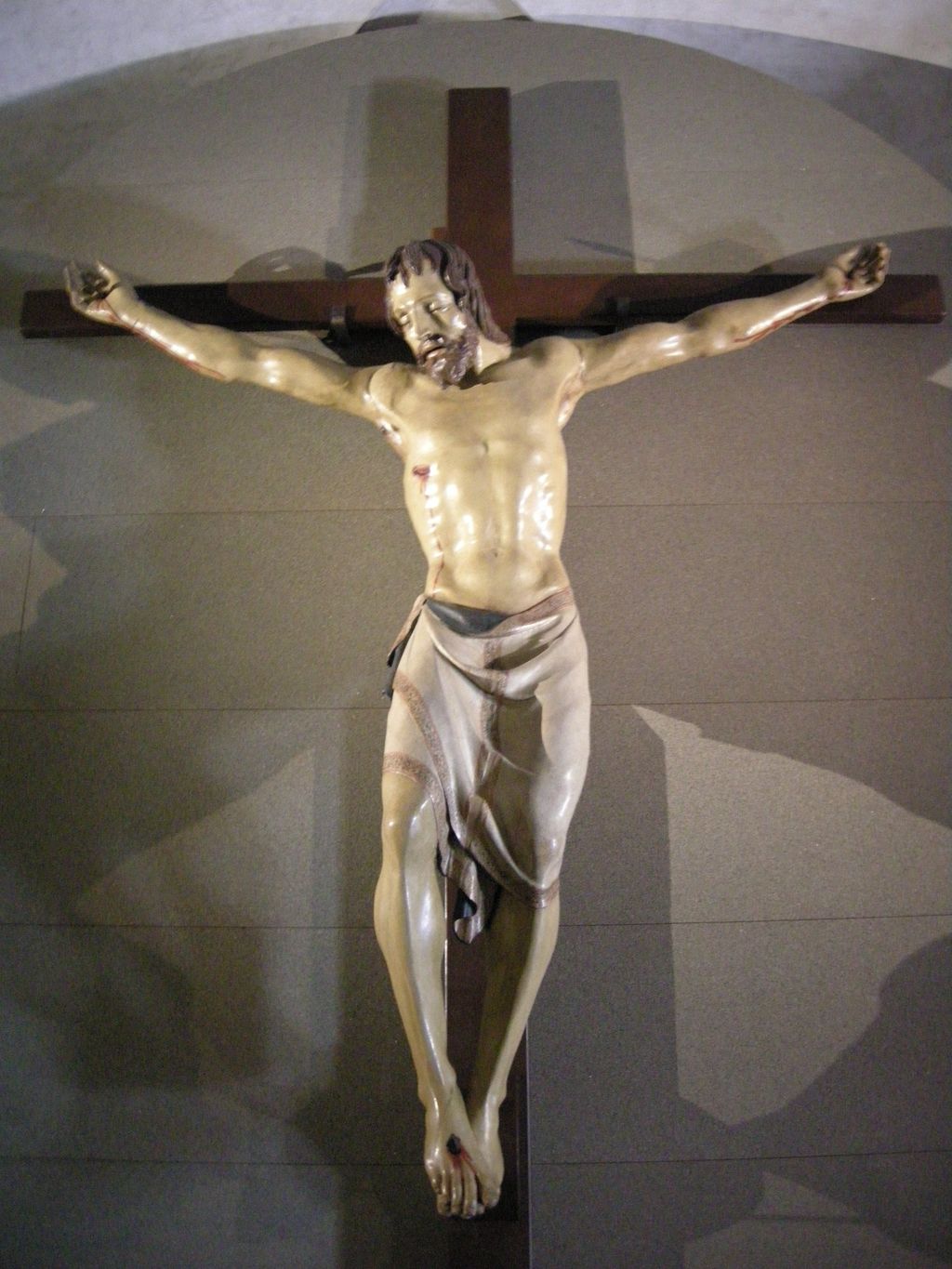
Donatello’s wooden Crucifix in Santa Croce, the work paired with Brunelleschi’s crucifix in the early sources. I, Sailko. Image source. CC BY-SA 3.0. Resized for the web.
In both editions Brunelleschi makes his own Crucifix in secret. The second viewing takes place in good light, with Donatello carrying the food for their meal in his apron. The eggs and cheese fall as his hands open. Vasari gives him the last word, a joke about having had his share of the meal and a concession that Brunelleschi can make Christs while he can make peasants. The stronger the challenge at the beginning, the funnier the reversal at the end. The memorable details are also a reason to read the passage as a shaped story. The earlier accounts preserve a rivalry and a disagreement, while the first text located here to give this full sequence and the two speeches is Vasari’s 1550 printing, pages 336–37. [1] [2] [9] [10] [11]
Santa Croce identifies its carved wooden Crucifix with the work traditionally credited to Donatello in the story. The basilica’s catalogue directs attention to the physical suffering in the figure, against the ideal proportions of the one at Santa Maria Novella. Ulrich Pfisterer has questioned the Donatello attribution and notes that Francesco Albertini first associated the Santa Croce work with the artist in print in 1510, about a century after its presumed carving. The debate gives the surviving objects and the anecdotes separate jobs. Comparing the figures can make sense of what later writers meant by the peasant and the ideal body. It cannot establish the wording, circumstances or even the occurrence of a private conversation. [10] [12] [13]
What Vasari saw in Saint George
In the 1550 edition Vasari calls Saint George vivissima e fierissima, exceptionally lifelike and fierce. In 1568 he drops the second adjective in that opening description, but keeps the praise of the fearsome vitality in the head and the suggestion of movement within the stone. The words are Vasari’s own appraisal. At the Bargello, where the marble stands above its original dragon relief in a reconstructed niche, the shield and planted stance read as steady, while the turned head directs the eye outward. Vasari’s emphasis on imminent movement gives a way to look at a figure whose pose is largely still. [1] [2] [4] [14]
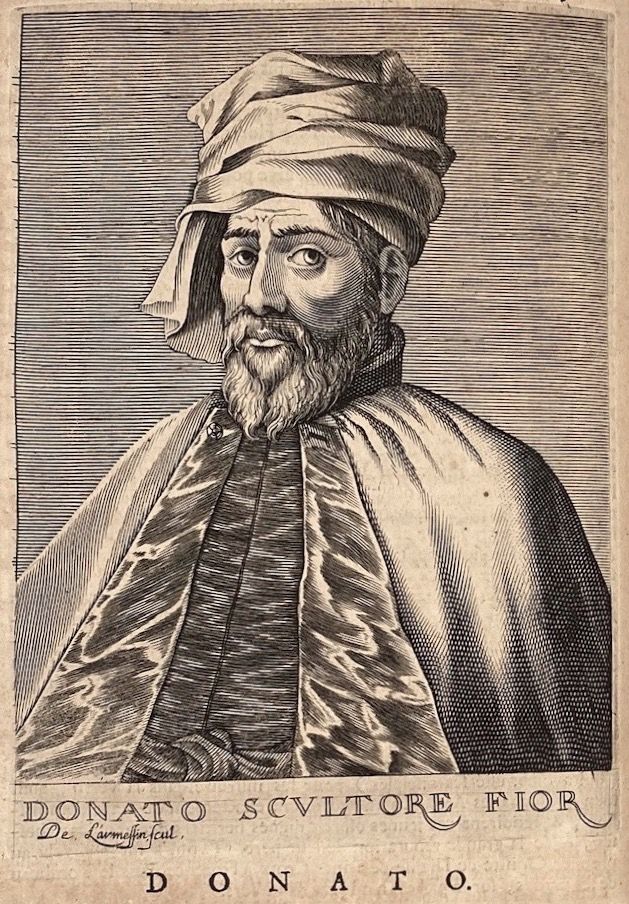
A later engraved likeness of Donatello by Nicolas de Larmessin. It belongs to the history of the artist’s reputation. Nicolas I de Larmessin and Esme de Boulonois. Image source. Public domain. Resized for the web.
Francesco Bocchi made the statue the subject of an entire treatise published in 1584. He used the term costume for the disposition that sculpture could make visible, tracing the saint’s courage across the face and body. In his account even the silent marble seems ready to move and speak. Vasari had used a version of the same conceit in the epitaphs he printed for Donatello. One asks what else nature could provide once marble already had life, feeling and movement, except speech. At the end of both Lives the biographer argues that the excellence many hands had achieved in antiquity returned through the efforts of Donatello alone, such was the number and range of the works he left behind. These are judgements about which artist deserved to be remembered and what sculpture could do. The image of stone on the verge of speaking helped make the case. [2] [4] [15] [16]
A physician’s account and the sculptor’s signatures
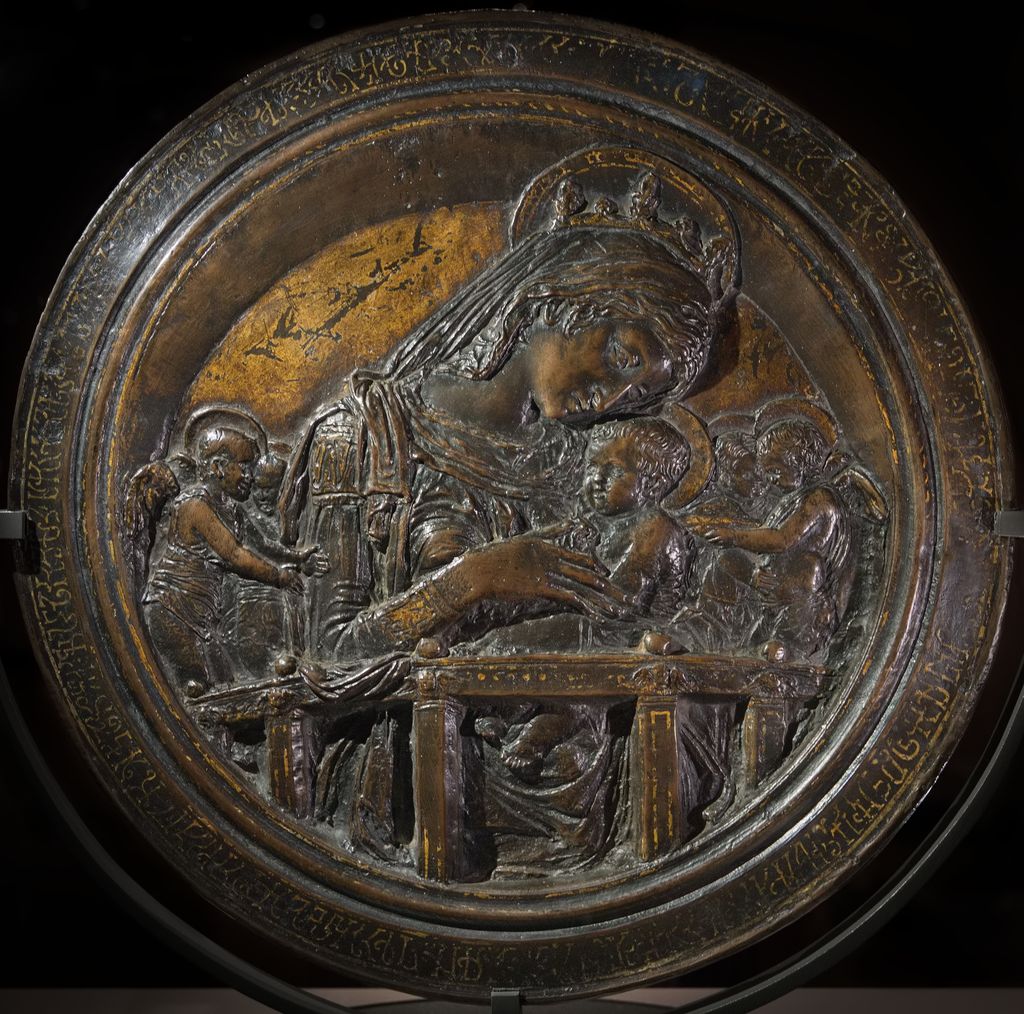
On 27 August 1456, Giovanni Chellini recorded treating Donatello and receiving a round bronze with the Virgin, Child and angels. The entry survives on folio 199 recto of his Ricordanze in the Saminiati-Pazzi archive. Chellini specifies why the Chellini Madonna mattered as a piece of workmanship. The reverse was hollowed so molten glass could reproduce the design. He describes the exchange as both a courtesy and a return for his medical care. Chellini calls him a “singular and foremost master” in the same sentence that names the materials he worked. The grounds for Chellini’s admiration are specific enough to link his praise to the sculpture he held in his hands. A letter, contract or entry in an account book can preserve a detail this precise even when it leaves the sculptor’s side of the conversation entirely unrecorded. [3] [17] [18]
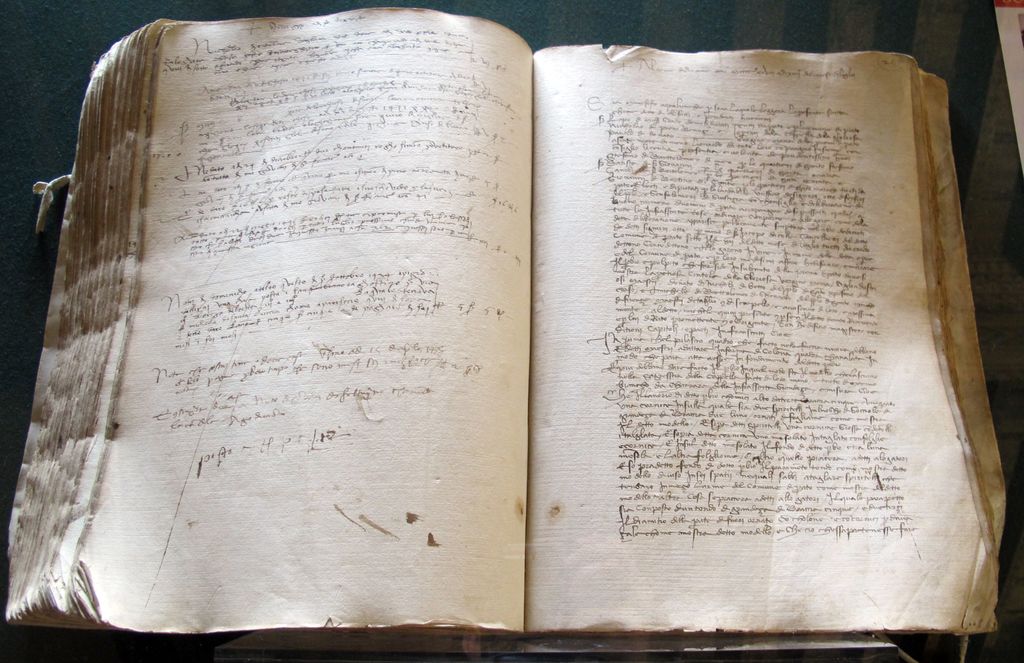
The 1428 record of the Prato pulpit commission for Donatello and Michelozzo. Sailko. Image source. CC BY-SA 3.0. Resized for the web.
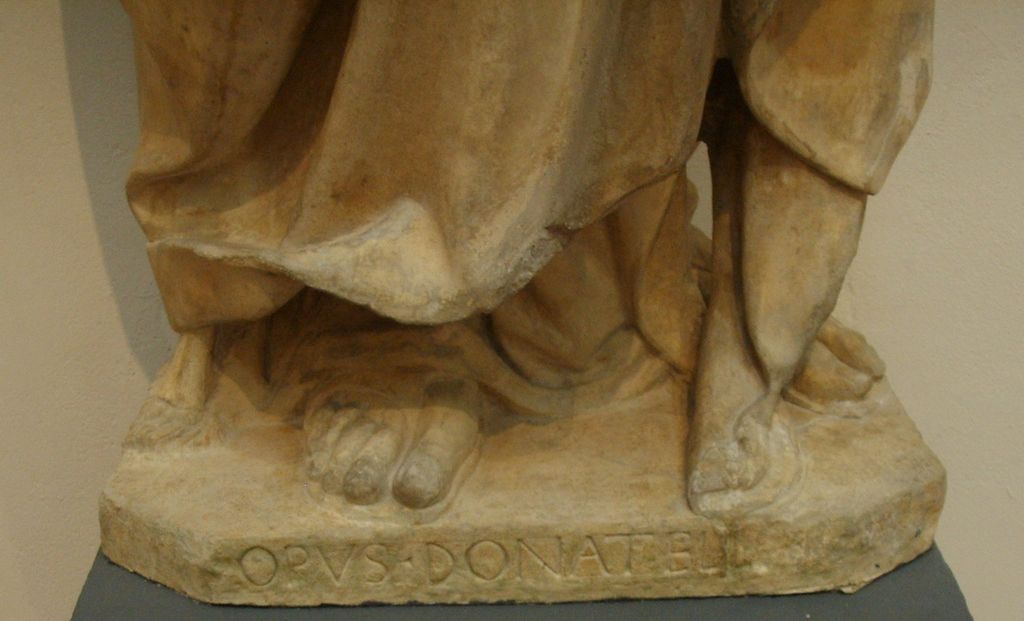
Donatello’s name is cut into the marble base of the figure known as the Zuccone. I, Sailko. Image source. CC BY-SA 3.0. Resized for the web.
The Prato contract of 14 July 1428 gives another kind of contemporary evidence. It specifies Carrara marble and refers to a model kept in the sacristy for the pulpit from which the Virgin’s girdle would be displayed. Michelozzo undertook the agreement for both partners in Donatello’s absence. The contract gives us the language in which a collaborator committed Donatello to a commission. [17]
The words on Donatello’s sculptures give us another kind of record. The Zuccone’s plinth bears Opus Donatelli, “Work by Donatello”. On Judith and Holofernes, letters on Holofernes’ cushion identify the maker as part of the bronze itself. Vasari’s 1550 account says Donatello thought it particularly fitting to sign that work. The version printed in 1568 calls it something he had done on no other work, despite also saying at the start of that biography that Donatello signed some of his works. The Zuccone’s inscription and the dated signature on the wooden Saint John the Baptist in Venice give independent reasons to doubt the stronger claim. The documentary trail can establish where a name appears and how it was used, while Vasari supplies a later interpretation of the sculptor’s pride. [1] [2] [4] [7] [17] [19]
A free-standing saying about art or talent needs its own traceable source before it can carry Donatello’s name. Even a line genuinely taken from Vasari can lose much of its meaning when detached from the scene or passed off as the sculptor’s own writing. Read the attribution with the words, and follow the biography for the chronology that places each witness in relation to the artist. [1] [2] [3] [4]
Donatello sculpture directory
| Name | Date | Medium and record |
|---|---|---|
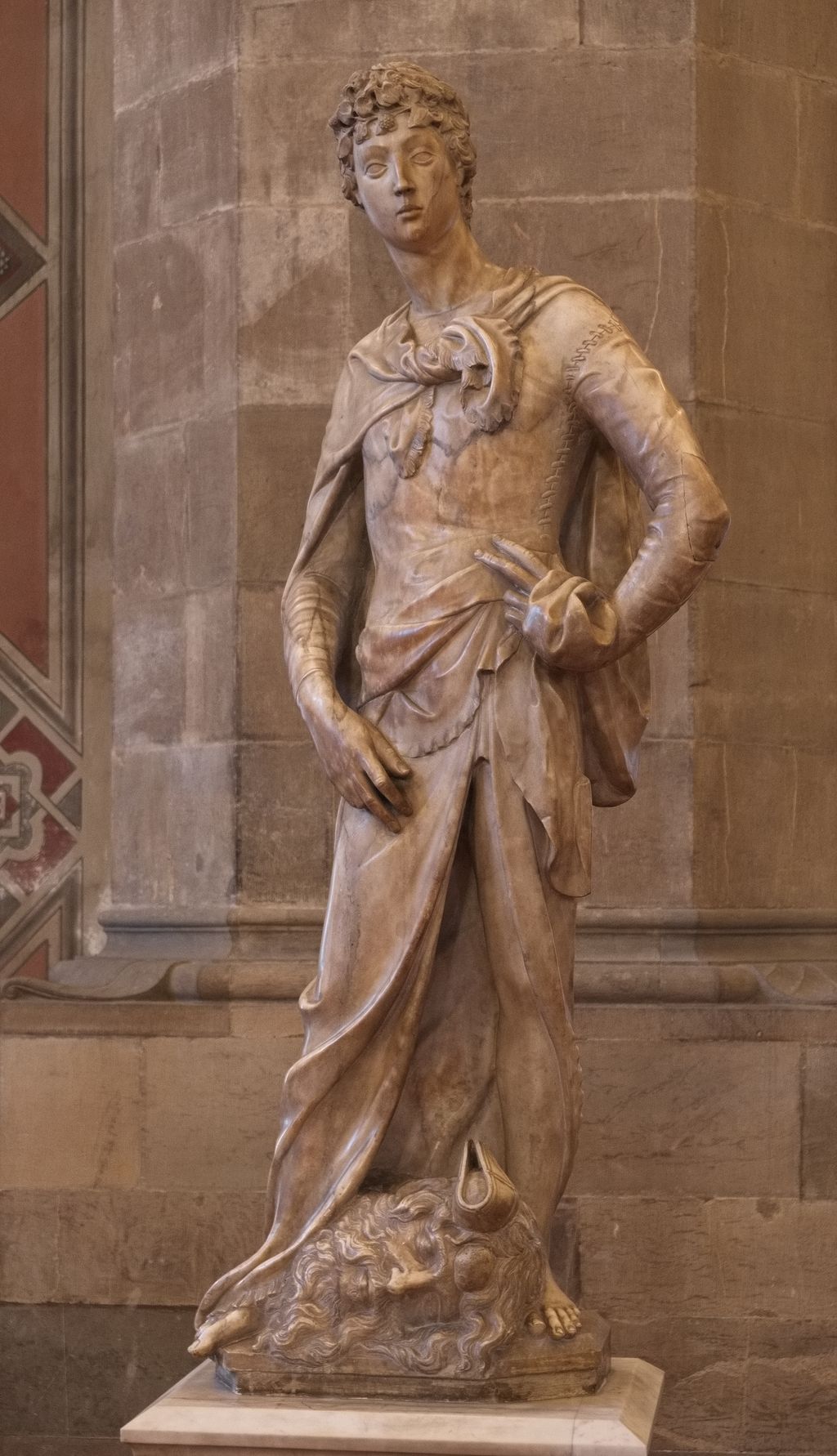
| Marble David | 1408–09, adapted 1416 | Carved Carrara marble Catalogue. |
| Saint John the Evangelist | c. 1409–15 | Carved marble Catalogue. |
| Saint Mark | 1411–13 | Carved Carrara marble Catalogue. |
| Saint George and its dragon relief | c. 1415–17 | Marble statue and marble relief Catalogue. |
| Marzocco | c. 1417–20 | Carved sandstone Catalogue. |
| Saint Louis of Toulouse, Florence | 1418–25 | Gilt bronze and mixed media Catalogue. |
| Pazzi Madonna | c. 1420s | Marble relief Catalogue. |
| Reliquary Bust of Saint Rossore | c. 1420s | Gilt bronze Catalogue. |
| The Prophet Jeremiah | 1420s–30s, disputed | Marble Catalogue. |
| Zuccone | c. 1420s–30s | Marble Catalogue. |
| Feast of Herod, Siena | 1420s | Gilded bronze relief Catalogue. |
| Ascension with Christ Giving the Keys to Saint Peter | c. 1428–30 | Marble relief Catalogue. |
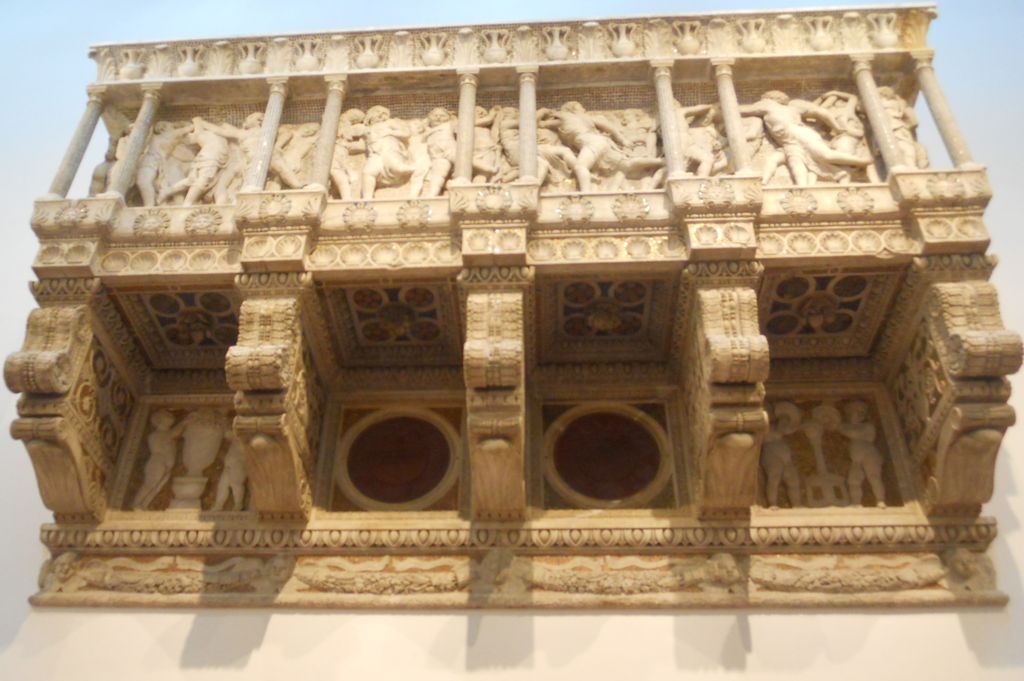
| Cantoria | 1433–39 | Marble and mosaic Catalogue. |
| Amor-Atys | c. 1435–40 | Partly gilded bronze Catalogue. |
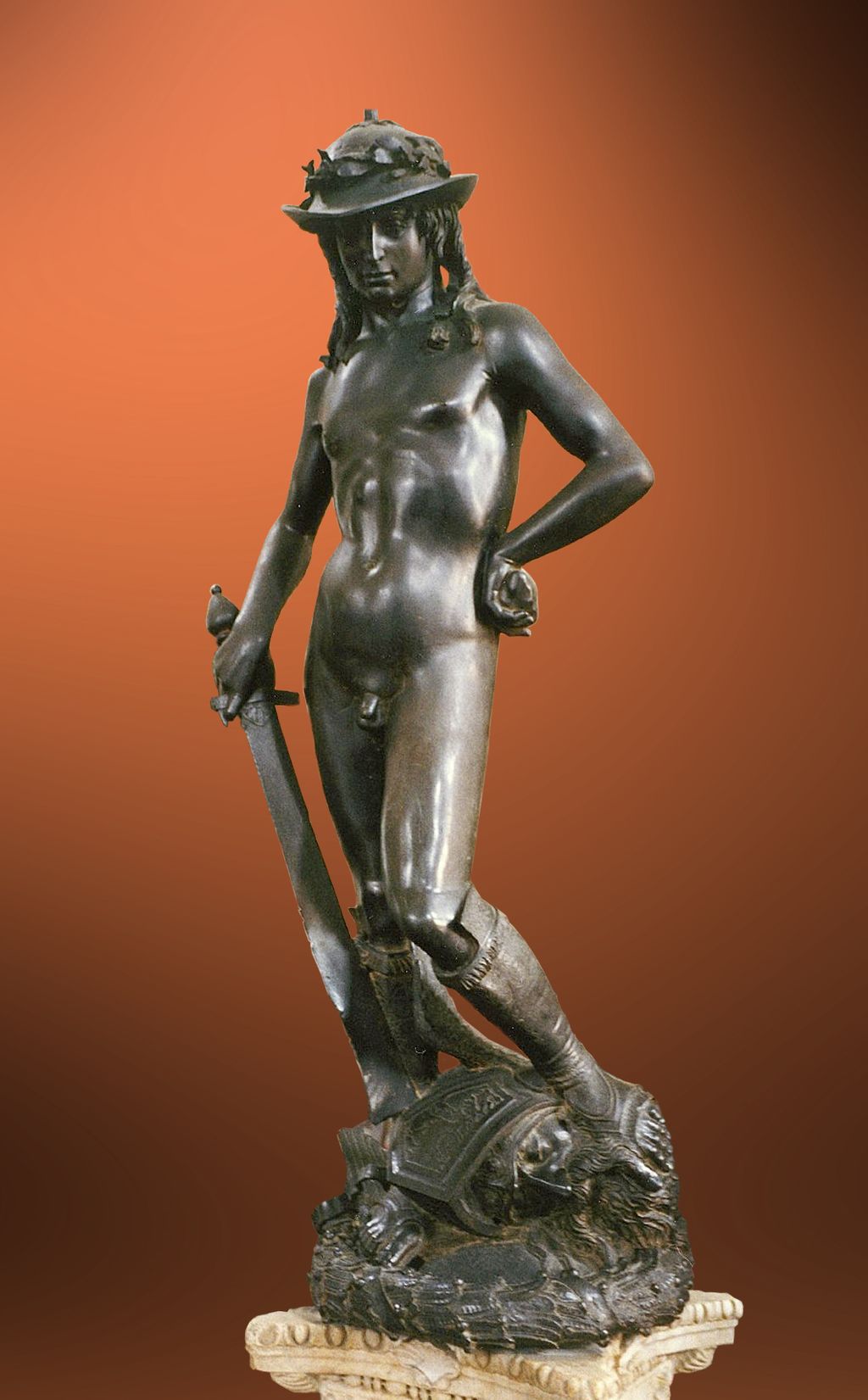
| Bronze David | c. 1435–40, disputed | Partly gilded bronze Catalogue. |
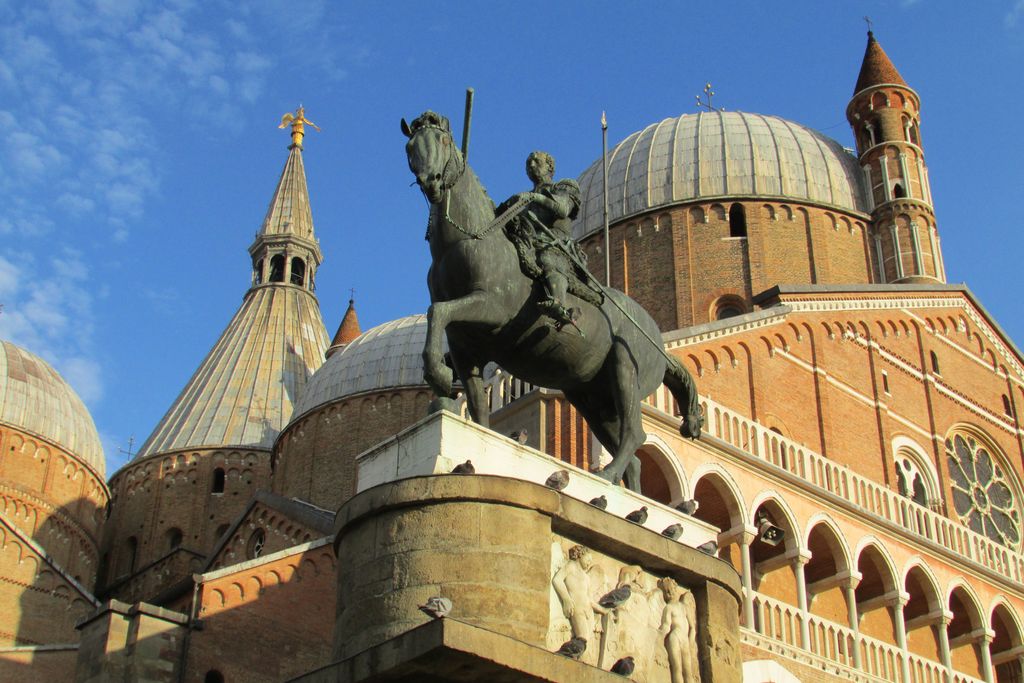
| Gattamelata | Installation agreement, 1453 | Bronze and stone Catalogue. |
| Santo altar | Mid-fifteenth century | Bronze and limestone ensemble Catalogue. |
| Chellini Madonna | Given in 1456 | Partly gilded bronze tondo Catalogue. |
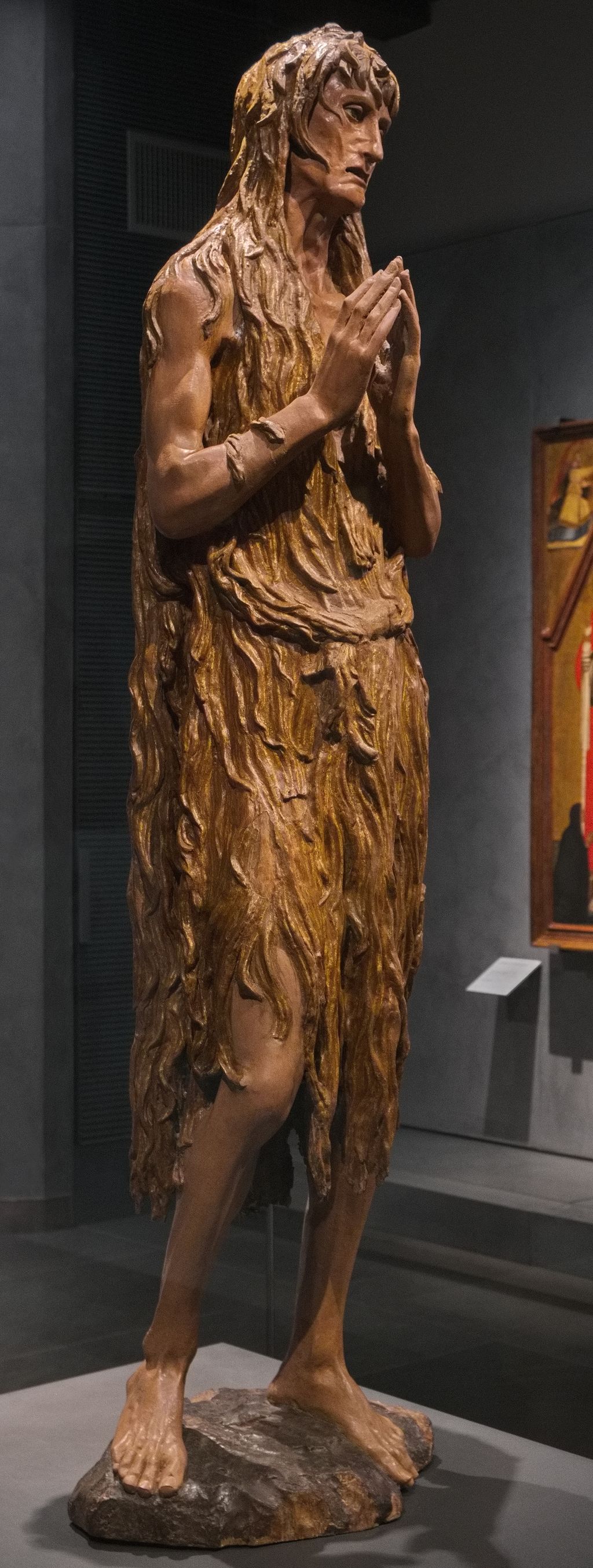
| Penitent Magdalene | c. 1453–55 (Opera) | Poplar, stucco, pigments and gold Catalogue. |
| Judith and Holofernes | Late 1450s–early 1460s | Bronze with surviving gilding Catalogue. |
| Pulpit of the Passion | Late work and later assembly | Bronze reliefs, Donatello and collaborators Catalogue. |
| Bust traditionally called Niccolò da Uzzano | Fifteenth century | Painted terracotta, attribution disputed Catalogue. |
| Prato Cathedral exterior pulpit | Commissioned 1428; carved 1430s | Marble reliefs, Donatello and Michelozzo Catalogue. |
| Cavalcanti Annunciation | c. 1433–35 | Gilded sandstone and terracotta Catalogue. |
| Crucifix at Santa Croce | Early fifteenth century | Painted wood Catalogue. |
| Madonna of the Clouds | c. 1425–35 | Marble relief Catalogue. |
| Old Sacristy Doors | Fifteenth century | Two paired bronze doors Catalogue. |
| Resurrection Pulpit | Late work and later assembly | Bronze reliefs, Donatello and collaborators Catalogue. |
| Brancaccio tomb | 1420s | Donatello, Michelozzo and assistants, mixed materials Catalogue. |
| Saint John the Baptist, Venice | 1438 | Polychromed and gilded wood Catalogue. |
| Sacrifice of Isaac | Early fifteenth century | Donatello and Nanni di Bartolo, marble Catalogue. |
| Madonna of Via Pietrapiana | Mid-fifteenth century | Terracotta Catalogue. |
| Miracle of the Mule | Mid-fifteenth century | Gilded bronze panel for the Santo altar Catalogue. |
| Padua Crucifix | Mid-fifteenth century | Cast bronze Catalogue. |
| Dancing Spiritello, Bargello | Fifteenth century | Bronze Catalogue. |
| Young Prophet from the Porta della Mandorla | c. 1404–09 | White marble, attributed to Donatello Catalogue. |
| Prophet or Apostle from the Duomo north tribune | Early fifteenth century | White marble, possibly Donatello Catalogue. |
| Beardless Prophet | 1415–18 | White marble Catalogue. |
| Sibyl and Prophet of the Porta della Mandorla | 1422 | Carved marble heads for the portal Catalogue. |
| Faith, Siena baptismal font | 1420s | Gilded bronze figure Catalogue. |
| Hope, Siena baptismal font | 1420s | Gilded bronze figure Catalogue. |
| Feast of Herod, Lille | c. 1430 | Carrara marble relief Catalogue. |
| Piot Madonna | c. 1440–60 | Polychrome terracotta with glass and wax inlays Catalogue. |
| Carafa Horse Head | c. 1456–58 | Cast bronze Catalogue. |
| Pazzi Madonna workshop version, Louvre | c. 1450 | Polychrome gesso, Donatello’s workshop Catalogue. |
| Pazzi Madonna tondo, Rijksmuseum | c. 1425–50 | Plaster and stucco, after Donatello Catalogue. |
| Sprite | c. 1430–40 | Bronze, sculptor or metalsmith close to Donatello Catalogue. |
Discussion
Look again at the images and ideas explored in Quotes. These editorial prompts invite your observations.
Reader Insights
Which reported saying changes most when you compare the two versions?
What can an inscription or a payment record establish about Donatello that a story told a century later cannot?
Join the Conversation
Share a detail, comparison or question about Quotes below.
References
- Giorgio Vasari. Le vite, Florence, Lorenzo Torrentino, 1550, part II, “Donato scultore fiorentino,” pp. 336–37 and 339–40. Getty Research Institute facsimile. View source.
- Giorgio Vasari. Le vite, Torrentiniana, 1550, “Donato scultore fiorentino.” Rosanna Bettarini and Paola Barocchi edition, Accademia della Crusca and Fondazione Memofonte. View source.
- Giovanni Chellini. Libro di ricordanze, 27 August 1456, fol. 199r. Archivio Saminiati-Pazzi, Università Bocconi, transcription presented by MuseoCity. View source.
- Giorgio Vasari. Le vite, Giuntina, 1568, “Vita di Donato scultore fiorentino.” Rosanna Bettarini and Paola Barocchi edition, Accademia della Crusca and Fondazione Memofonte. View source.
- Giorgio Vasari. Vasari’s Lives of Italian Painters, selected and prefaced by Havelock Ellis, London, Walter Scott, p. 82. View source.
- Giorgio Vasari and Léopold Leclanché. “Donato, sculpteur florentin,” in Vies des peintres, sculpteurs et architectes, vol. 2, Paris, Just Tessier, 1841, pp. 210–57. View source.
- Opera di Santa Maria del Fiore. “Donatello, Prophet (Habakkuk?).” View source.
- Daniel M. Zolli. “Donatello’s Visions: The Sculptor at Florence Cathedral,” in Sculpture in the Age of Donatello, Museum of Biblical Art, 2015, especially pp. 64–67. View source.
- Giorgio Vasari. Le vite, Florence, Giunti, 1568, part II, p. 328, facsimile and transcription. View source.
- Il Libro di Antonio Billi. Codice Petrei, Filippo Brunelleschi entry, ed. Cornelio von Fabriczy, 1891. View source.
- Anonimo Magliabechiano. Il Codice Magliabechiano cl. XVII. 17, ed. Carl Frey, Berlin, 1892, pp. 65–66. View source.
- Opera di Santa Croce. “Crucifix, Donatello.” View source.
- Ulrich Pfisterer. “Capolinea Donatello?” 2023, Heidelberg University Library repository. View source.
- Musei del Bargello. “Donatello e l’alba del Rinascimento.” View source.
- Francesco Bocchi. Eccellenza della statua del San Giorgio di Donatello, Florence, Marescotti, 1584, “Del costume.” Fondazione Memofonte. View source.
- Giorgio Vasari. Le vite, Florence, Giunti, 1568, part II, p. 336, facsimile and transcription. View source.
- Volker Herzner. “Regesti donatelliani,” Rivista dell’Istituto Nazionale d’Archeologia e Storia dell’Arte, 1979, nos. 103, 234 and 352. View source.
- Victoria and Albert Museum. “Twenty Objects for Twenty Years: Bust of Giovanni Chellini, 1456,” identifying Chellini’s connection to Donatello and the bronze relief. View source.
- Daniel M. Zolli. Donatello’s Promiscuous Technique, Harvard University, 2017, pp. 163–65. View source.
More DONATELLO Sculptures
Marble David
Armin Kleiner. Image source. CC BY-SA 4.0. Resized for the web.
Bronze David
Patrick A. Rodgers. Image source. CC BY-SA 2.0. Resized for the web.
Cantoria
Erik Drost. Image source. CC BY 2.0. Resized for the web.
Gattamelata
Chris Light. Image source. CC BY-SA 4.0. Resized for the web.
Penitent Magdalene
Armin Kleiner. Image source. CC BY-SA 4.0. Resized for the web.
Chellini Madonna
Armin Kleiner. Image source. CC BY-SA 4.0. Resized for the web.
