


 by Tom Gurney
Tom Gurney BSc (Hons) is an art history expert with over 20 years experience
Published on June 19, 2020 / Updated on November 29, 2026
Email: tomgurney1@gmail.com / Phone: +44 7429 011000
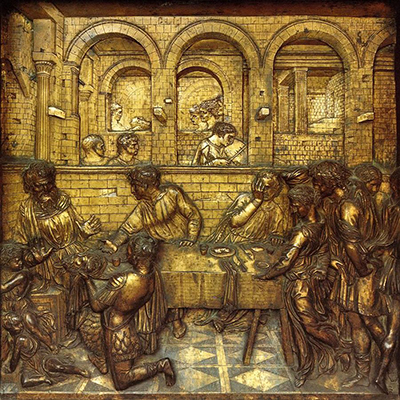
Herod pulls away from the table, one hand lifted towards the platter he has just been shown. The man kneeling before him has brought the head of John the Baptist. Some of the guests turn towards the disturbance, while others press back into the crowd. Above them, through the arches of the palace, everyday life seems to continue. A musician still holds a bow against the strings.
Donatello made The Feast of Herod between 1423 and 1427 for the baptismal font of San Giovanni in Siena. The gilded bronze panel measures about 60 centimetres on each side. It closes a cycle of six reliefs on the life of Saint John the Baptist and remains part of the font. The presentation of the head fills the foreground, while the palace behind the guests opens onto other moments in the story. The shock registers at once. It takes longer to see how far back the story goes. [1] [2]
A birthday feast and its aftermath
In the Gospels, John condemns Herod Antipas’s marriage to Herodias, his brother’s wife, and is imprisoned. Herodias’s daughter, known as Salome although the Gospel accounts do not name her, dances at Herod’s birthday feast. Pleased with her dancing, he promises her a reward. Prompted by her mother, she asks for John’s head on a platter. Mark makes much of Herod’s distress and of his reluctance to go back on an oath made in front of his guests. The execution takes place in prison. The platter is brought to the girl, who gives it to her mother. [3]
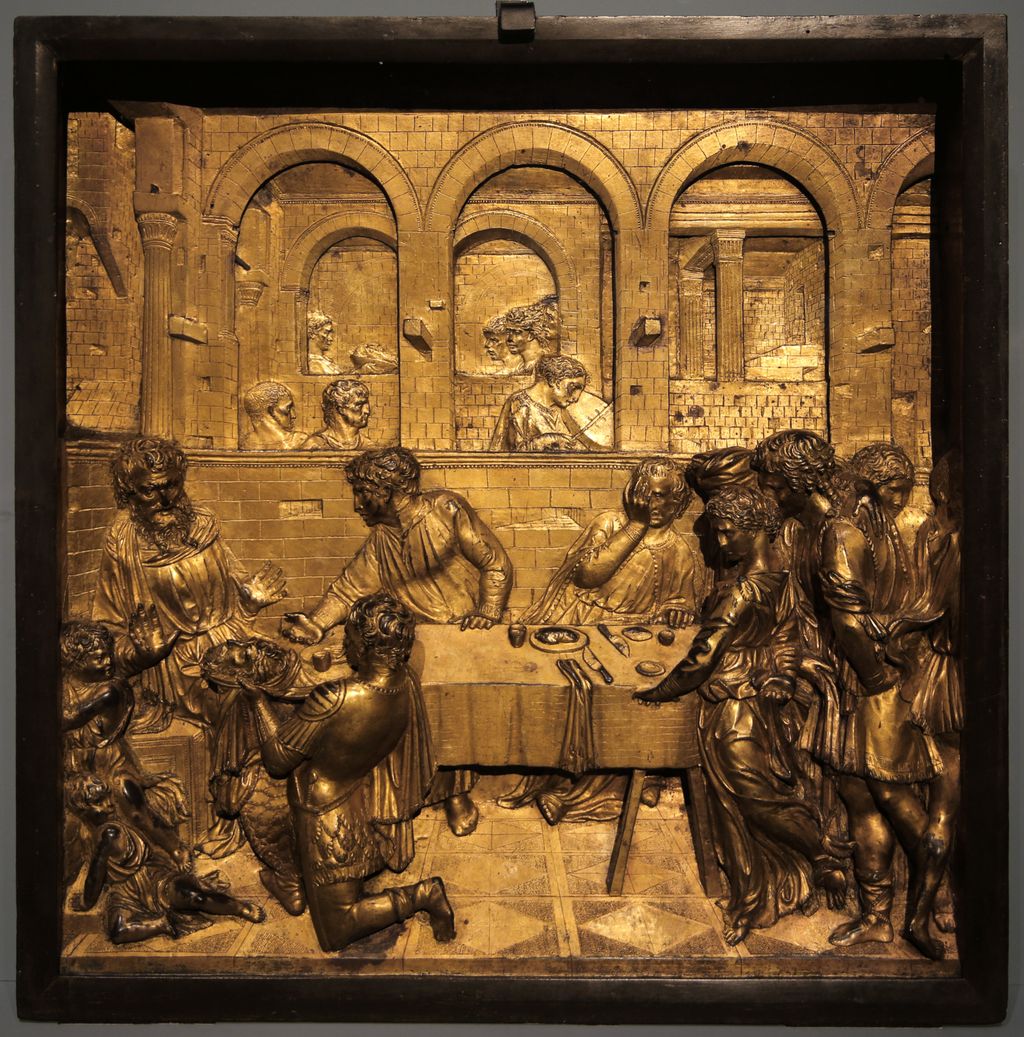
The complete Siena bronze, photographed at the 2022 exhibition in Florence. Francesco Bini. Image source. CC BY-SA 4.0. Resized for the web.
Donatello puts the dish directly before Herod. The figure at the left end of the table pulls his upper body back and raises his open hand. The man offering the platter stays on one knee, his back towards us, his other knee rising under the folds of his clothes. The presentation has the form of a courtly service, which makes the contents of the dish all the more appalling. The open triangle between the two bodies fixes the eye on the platter. Lower down, two small figures close to the edge of the relief move away from the disturbance, bringing an adult crisis down to the level of the floor. [4]
Across the table a guest twists towards Herod, bracing himself against the tabletop. Further along, another raises a hand to his face. Dishes and knives lie scattered across the cloth. Their small, familiar shapes make the object on the platter unmistakable as it enters the ordinary traffic of a meal. The group at the right is packed shoulder to shoulder. The woman with the swinging drapery at the front of that group is generally read as Salome. Her turning pose can still be seen as part of the dance, even as the bodies behind her bunch up and the banquet breaks apart. [4]
Then the eye rises to a second space. Through the openings beyond the table are two men and a musician bent over a bowed instrument. Further back, under the smaller arches, another presentation seems to be taking place. A figure holds something out towards a group that may include Herodias. The details grow too shallow to name everyone with confidence. The important distinction is between a court stunned by the sight of the head, a middle room where music belongs to the festivities, and a further space where a handover connected with the execution appears to unfold. [2] [4] [5]
Looking from near to far therefore takes us between episodes without supplying a simple clock. The dance that set events in motion lingers in Salome’s figure and in the musician beyond her, while the platter appears in two places. The different rooms make those shifts legible. A viewer can take in the guests’ first recoil, follow the architecture back to look for its cause, then return to the table with a clearer sense of how the fatal promise was carried out.
How the palace opens up
The front of the scene is strikingly bare at its centre. Between the kneeling man and the crowd at the right, a patch of tiled floor leads the eye beneath the table. The tiles narrow as they recede. Brick courses, the sides of the piers and the successive openings take over higher up. Follow the pavement for a sense of the distance between the table and the front edge of the relief, then look through the arches to see how much further the palace seems to extend beyond it. The depth comes partly from the way one wall hides part of the next. Only portions of the innermost rooms are visible through the openings. The round arches and coursed masonry give the palace an antique character. In his study of Donatello’s influence in Siena, Kiyoo Uemura compares the organisation of the three planes to ancient Roman narrative relief, pointing to Trajan’s Column as a precedent. [2] [4] [5]
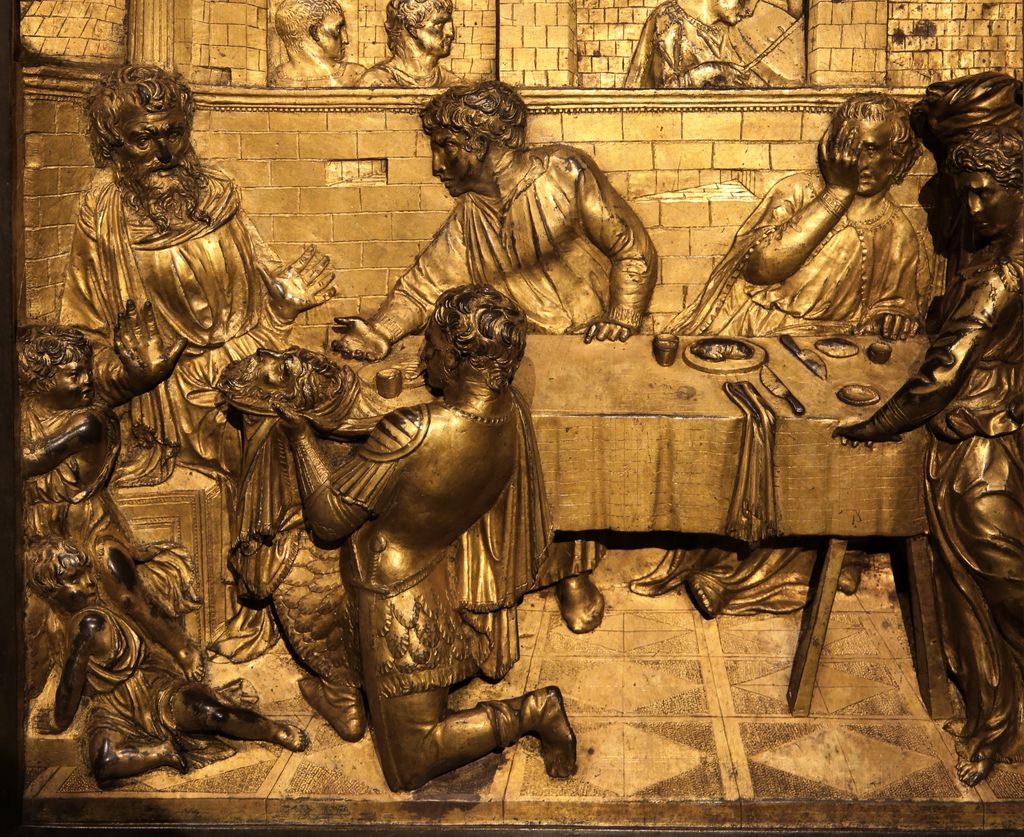
At the front of the Siena relief, the bearer of the platter and the guests mark the nearest space. Francesco Bini. Image source. CC BY-SA 4.0. Resized for the web.
Perspective also depends on how far the bronze actually projects. Donatello gave the nearest figures rounded heads, shoulders and knees that catch light along their edges and cast shadows into the ground. Further back he could suggest a face or a fold with far less projection. The distant masonry approaches the thinness of a drawing. Art historian Frank Fehrenbach uses the Siena relief to show how rounded foreground sculpture and exceptionally shallow modelling can coexist. The change between them is part of the illusion: the room seems deeper because tangible bodies gradually give way to marks that the eye reads as figures and walls in the distance. [6]
The architecture keeps its measured pace while the people lose theirs. Piers rise at regular intervals and the principal arches repeat the same rounded shape. Below them, raised hands and tilted heads interrupt almost every line formed by the table and the guests. Donatello gains much of that contrast by leaving a clear strip of masonry between the edge of the table group and the rooms beyond. The strip lets the building read as solid and calm while the guests begin to scatter.
A photograph taken square to the bronze gives a good view of the small events at the back. At the font, an adult visitor normally looks down on the panel. Art historians Robert Munman and Martha Dunkelman have called attention to what changes from that higher viewpoint. The floor appears to recede more readily, the tabletop looks less steeply tilted and Herod seems to look more directly at the head. Dunkelman relates this difference to Donatello’s treatment of the relief for a specific setting. The exact geometry has been debated, but the variation between the two views is something a visitor can test by changing position. [7]
Annotated Details from The Feast of Herod
Select a number to jump to a detail of the sculpture.
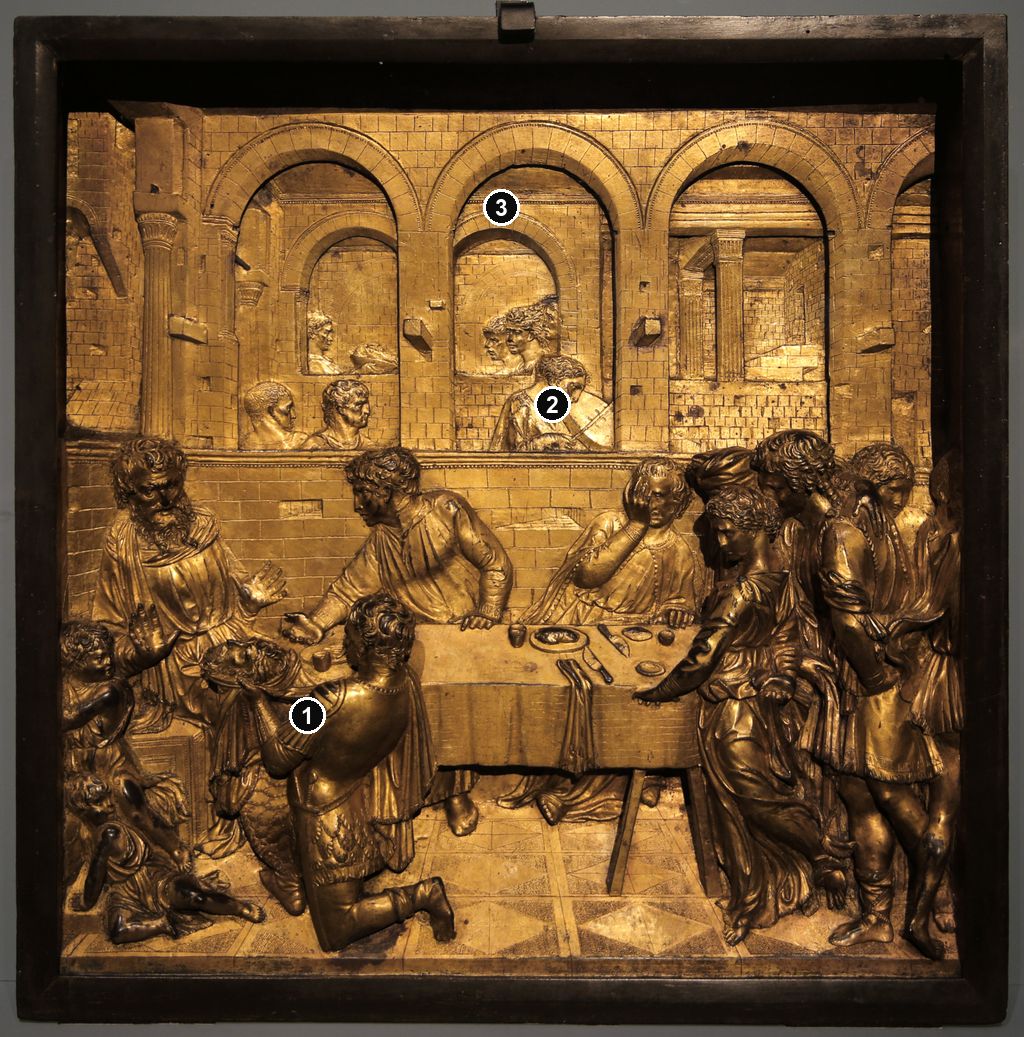
Details from THE FEAST OF HEROD
Open a detail image to examine the surface more closely.
The nearest group
The kneeling bearer presents the head where bodies can react across the front of the relief. The turnout of figures makes space around the gesture.
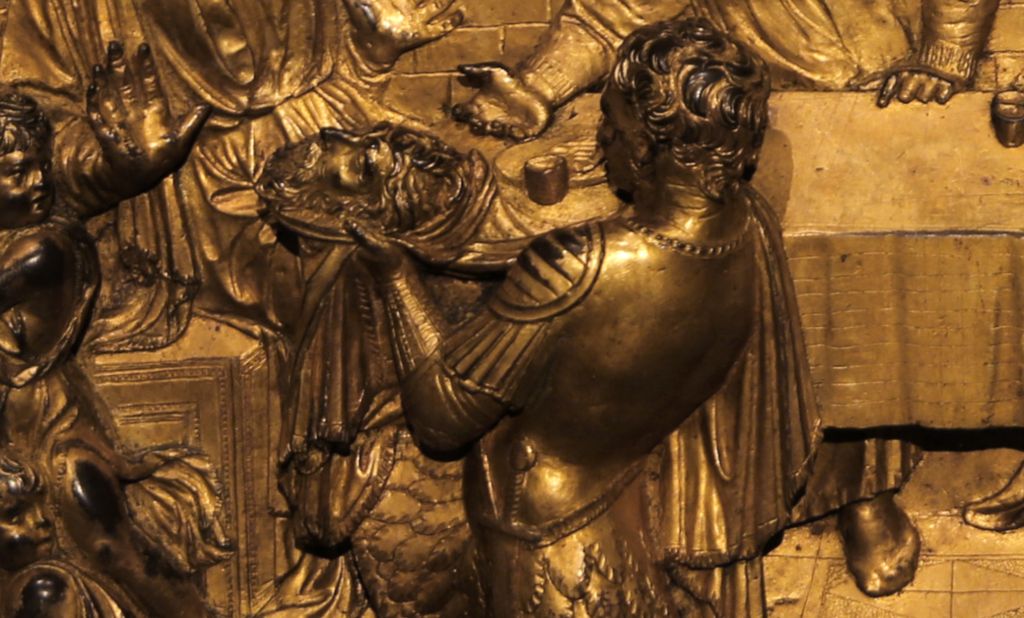
The figures beyond the banquet
Smaller figures continue the story behind the principal gathering. Lower relief makes the second scene appear farther from the viewer.
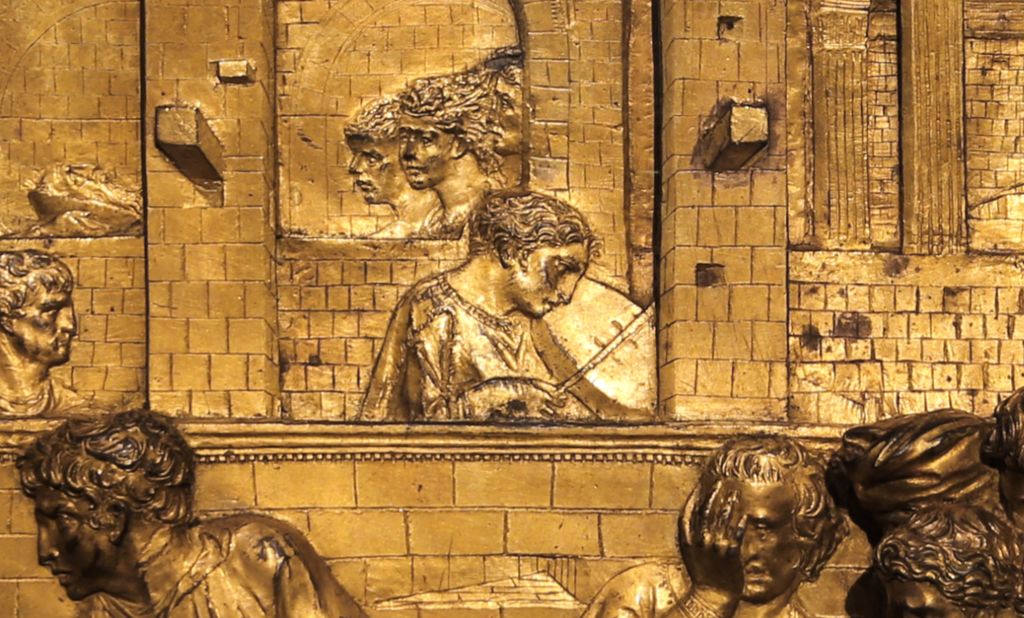
The receding arches
The arches set up a rhythm that continues through finer marks. Compare the projecting first frame with the quieter lines visible through its opening.
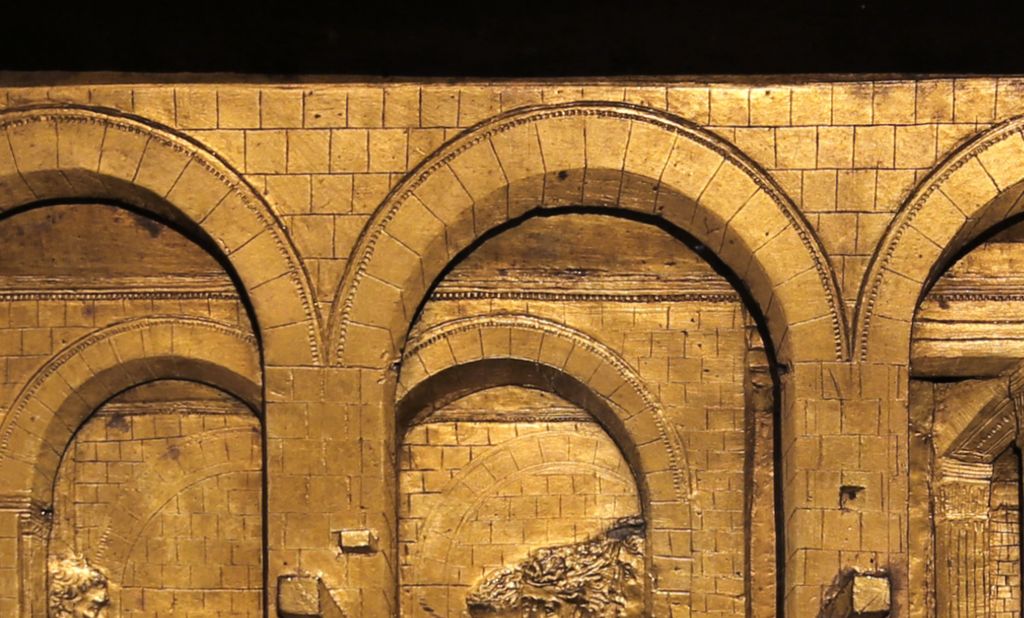
Annotated photograph and detail crops. Francesco Bini. Image source. CC BY-SA 4.0. Resized, annotated and cropped from the original photograph.
How the commission reached Donatello
The Opera del Duomo commissioned the font, and the surviving accounts make it possible to follow the Feast from an agreement with one sculptor to delivery by another. The Opera first allocated the subject to Jacopo della Quercia as one of two bronze scenes. It passed to Donatello as the larger programme was taking shape. A 1423 payment to Donatello was entered against money due to Jacopo. In August 1425 the Opera credited the sum to Donatello himself because he had made one of the scenes allotted to Jacopo. The reassignment involved settling an earlier account as well as finding an artist for the panel. [8] [9]
Between 7 and 11 April 1427 the Opera’s treasurer went to Florence to collect the bronze. On 13 April the relief was transferred from the Siena customs office to the Opera. The account book known as the Libro Giallo records a second milestone on 8 October. Its entry names the subject as the delivery of John’s head to the king’s table and credits Donatello with 180 florins, equivalent to 720 lire. The April entry establishes the bronze’s physical arrival. The October entry records the formal handover and the price, with payments in instalments recorded through 30 October. [8] [9]
Other makers appear in the paperwork. The archival inventory prepared by Stefano Moscadelli lists a letter from Donatello and his business partner Michelozzo concerning payment for a narrative panel for the font. In his 1427 tax return, Donatello listed 48 florins owed to Jacopo in connection with the Siena scene, ten to the Sienese goldsmith Giovanni di Turino for time spent on it, and 26 to be spent gilding it at the Opera’s request. The price entered against the relief thus covered obligations to other makers and further work on the bronze. The National Gallery’s caption credits Donatello and Giovanni together. The Siena Opera names the panel for Donatello. Which parts Giovanni worked on remains unclear. [1] [8] [10] [11]
The other faces of the font
The commission extended from 1417 to 1431. Six gilded scenes fit into the sides of the marble basin, with small statues of the Virtues set between them. Jacopo della Quercia contributed the relief of the annunciation to Zacharias and made the marble Saint John at the top of the structure. Giovanni di Turino’s relief of John’s birth brings the story indoors to a room furnished with a bed. Lorenzo Ghiberti supplied The Baptism of Christ and The Arrest of Saint John the Baptist. Donatello also made the personifications of Faith and Hope for two of the niches. [1] [2] [11] [12]
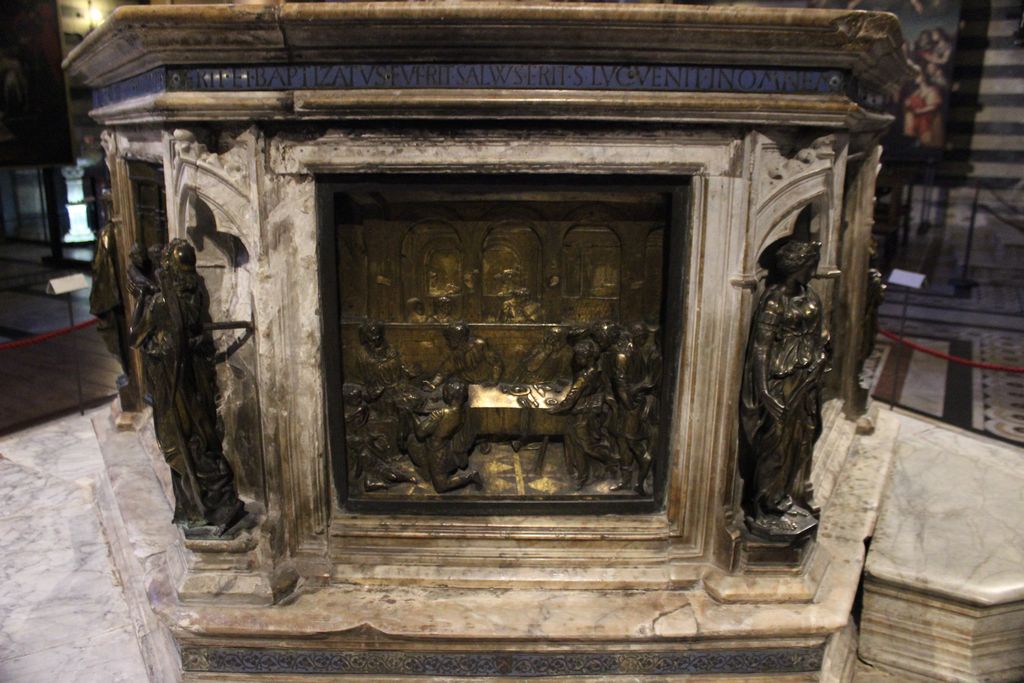
The font in the Baptistery of San Giovanni, Siena, photographed before the 2021–24 conservation. Miguel Hermoso Cuesta. Image source. CC BY-SA 4.0. Resized for the web.
Ghiberti’s Baptism makes a particularly revealing comparison. It draws attention to the meeting of Christ and John in the river, with the surrounding figures and landscape modelled more gently. Donatello puts a difficult gap between his main figures, where a dreadful object is held out and the person who ordered the deed will scarcely draw near it. Both sculptors had to fit their scenes into faces of the same basin. The reliefs show how differently an artist could distribute attention within a square field of gilded bronze. [1] [11]
The font also helps explain why the Feast is here. It stood at the centre of the baptistery, where water was administered in a rite associated with spiritual rebirth. The stories on the basin run from the announcement of John’s birth to his death, with the baptism of Christ at the centre of his ministry. As a viewer moves around the basin, the source of the rite and the fate of the person who performed it are encountered in different places. Above the bronze episodes, the standing figure of John gives the baptistery’s patron a continuous presence. [1] [13]
Dillian Gordon’s catalogue for the National Gallery identifies the Feast as the model for the Sienese painter Giovanni di Paolo’s Head of John the Baptist Brought to Herod. The painting retains the kneeling bearer and the recoiling ruler. The force of those two contrasting poses carries over into a much smaller painted panel. That borrowing shows how readily the gestures could travel, even though Donatello developed them for the side of a font in a particular building. [11]
What the restoration uncovered
In February 2021 conservators began dismantling bronze elements of the font under an agreement between the Opera della Metropolitana, the regional heritage authority and Florence’s Opificio delle Pietre Dure. The bronze and enamel components could then be examined in the Opificio’s workshops, while the stone work took place inside the baptistery. Humidity, residues from older maintenance and copper corrosion had obscured parts of the gilt surfaces or damaged them outright. On Donatello’s panel the corrosion had led to local losses of metal. [12] [14]
The technical study found that the relief had been made by lost-wax casting in a single pour. On the back, cleaning exposed patches and remnants of the mould. Two of Giovanni di Turino’s scenes, the Birth and the Preaching of John the Baptist, turned out to have been assembled from separately cast portions. The techniques used to make the panels could differ even when they were destined to fit into the same basin. At the front, the cleaning helped distinguish the modelling from the deposits that had gathered over it. The gilding was applied using an amalgam of gold and mercury. It survives unevenly, with abrasion and gaps, especially where surfaces project. That unevenness is part of the object’s history and affects the way light now picks out details on the figures and in the architecture. [12] [14]
The smallest discovery changed the reading of the largest feature. Inside the left background arch, the team identified the remains of a small, rectangular, ungilded metal insert attached from the front. On closer examination they found signs of attachments in the other arches. The conservators proposed that thin metal rods once crossed the openings, evoking the ties that braced real buildings. Antonio Mignemi made dark-patinated copper rods to try out the effect. The horizontal lines helped separate one opening from the space beyond it, reinforcing the succession of rooms. The trial was photographed and the new rods were removed. It remains a test of how the shadow lines might have worked in Donatello’s architecture. [12] [14]
The restoration also briefly changed how the original could be seen. The Feast and the two Virtues went to the 2022 Donatello: The Renaissance exhibition at Palazzo Strozzi, where the panel could be seen face-on, apart from its marble surround. Other conserved bronzes were shown in cases beside the scaffold in Siena as work continued. During reassembly, new supports and fixings were introduced so that conservators could inspect the backs of the panels in future. Finishing work continued to 14 June 2024, and the restored font was presented on 25 June. The panel can again be seen within its marble frame at the height for which it was designed. [2] [13] [14]
A full-size plaster cast at the Bode-Museum in Berlin preserves the arrangement of the Siena reliefs and figures in a different material. The Berlin workshop made the 59-part cast in 1876 from moulds taken directly from the font in Siena. Restored in 2023, the cast shows how nineteenth-century museums made works fixed in buildings available for study elsewhere. The Berlin restoration concerned the plaster model, while the newly conserved bronze returned to the original font in Siena. [15]
Other ways to tell the story
About a century before the Siena relief, Giovanni Baronzio painted the feast and the beheading for an altarpiece. In his picture, now at the Metropolitan Museum of Art, Salome dances in a red and white costume and appears again with the platter. Both artists put successive actions before the eye at once. Baronzio gives the dancer a place of her own in front of the table and makes her movements easy to follow through colour. Donatello sets the life of the palace on either side of a wall, so that the smaller actions are partly hidden and the viewer has to look through the building to discover them. [16]
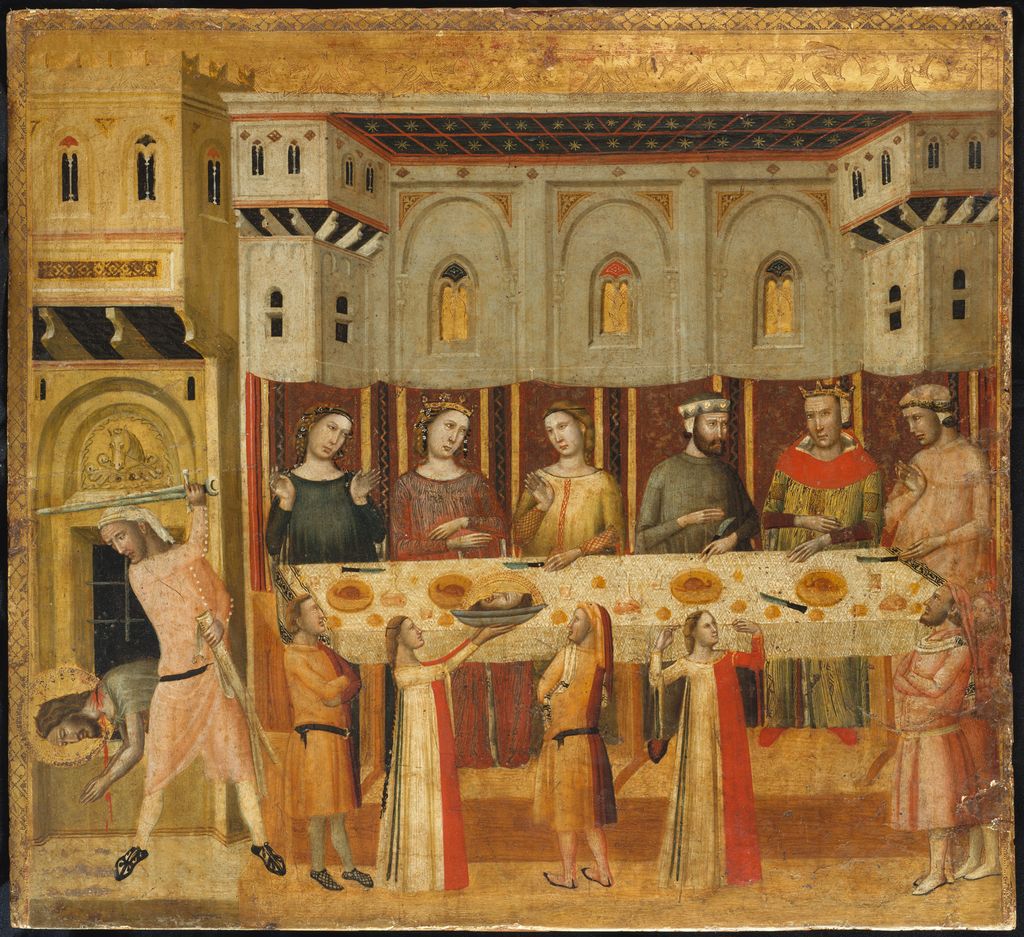
Giovanni Baronzio’s earlier painted account of the feast and the Baptist’s death, at the Metropolitan Museum of Art. The Metropolitan Museum of Art, Robert Lehman Collection, 1975. Image source. CC0 / Public domain. Resized for the web.
The marble Feast of Herod in Lille
The Palais des Beaux-Arts in Lille holds a different relief of the same subject by Donatello. The museum catalogues it as Le Festin d’Hérode, about 1430, a slab of white Carrara marble about 50 centimetres high and 71 centimetres wide. At Lille, Salome appears twice. She dances in a palace courtyard with spectators looking on from the stair to the right, then appears seated in the group at the left where the head is presented. Its broad format gives the dance and the presentation room to unfold side by side. The museum tentatively identifies the marble with one recorded in Lorenzo de’ Medici’s inventory in 1492. [17]
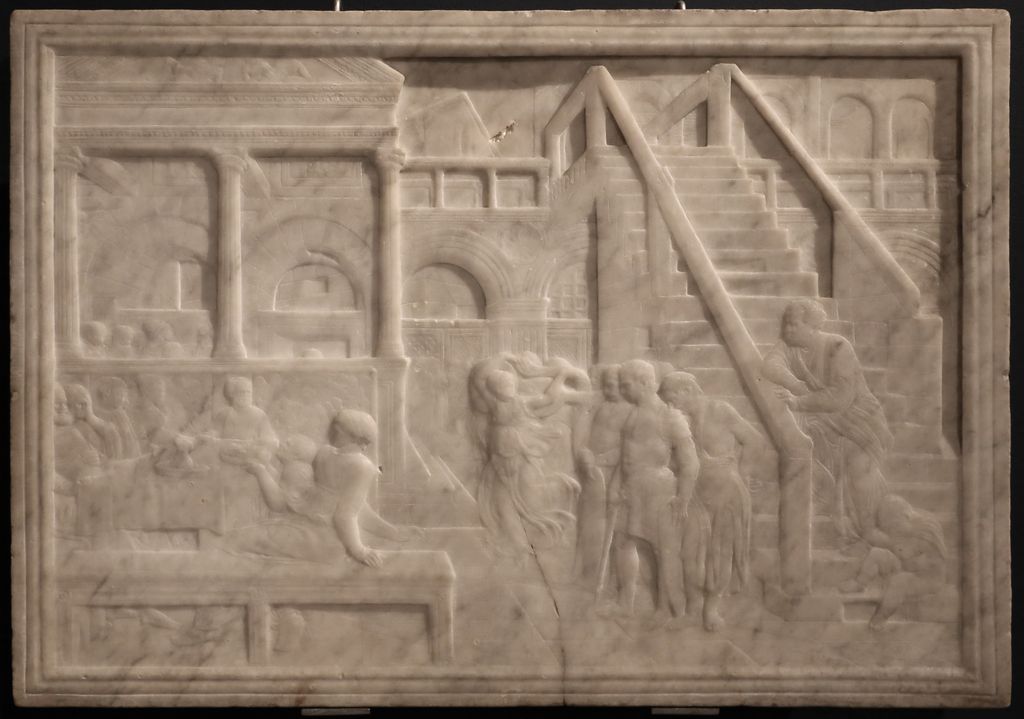
Donatello’s separate marble treatment of the feast, about 1430 according to the Palais des Beaux-Arts de Lille. Sailko. Image source. CC BY 3.0. Resized for the web.
The marble’s minute changes of level let Donatello draw out the architecture across a wide, pale surface. In Siena, the space drives back through closely nested arches and the bodies closest to the viewer project in bronze. The two works share a subject and a fascination with how to make successive events visible at once. Standing by the basin in Siena, the contrast is especially pronounced between the bronze figures almost within reach and the small forms at the back, where the story seems to continue behind the wall. [6] [17]
Donatello sculpture directory
| Name | Date | Medium and record |
|---|---|---|
| Marble David | 1408–09, adapted 1416 | Carved Carrara marble Catalogue. |
| Saint John the Evangelist | c. 1409–15 | Carved marble Catalogue. |
| Saint Mark | 1411–13 | Carved Carrara marble Catalogue. |
| Saint George and its dragon relief | c. 1415–17 | Marble statue and marble relief Catalogue. |
| Marzocco | c. 1417–20 | Carved sandstone Catalogue. |
| Saint Louis of Toulouse, Florence | 1418–25 | Gilt bronze and mixed media Catalogue. |
| Pazzi Madonna | c. 1420s | Marble relief Catalogue. |
| Reliquary Bust of Saint Rossore | c. 1420s | Gilt bronze Catalogue. |
| The Prophet Jeremiah | 1420s–30s, disputed | Marble Catalogue. |
| Zuccone | c. 1420s–30s | Marble Catalogue. |
| Feast of Herod, Siena | 1420s | Gilded bronze relief Catalogue. |
| Ascension with Christ Giving the Keys to Saint Peter | c. 1428–30 | Marble relief Catalogue. |
| Cantoria | 1433–39 | Marble and mosaic Catalogue. |
| Amor-Atys | c. 1435–40 | Partly gilded bronze Catalogue. |
| Bronze David | c. 1435–40, disputed | Partly gilded bronze Catalogue. |
| Gattamelata | Installation agreement, 1453 | Bronze and stone Catalogue. |
| Santo altar | Mid-fifteenth century | Bronze and limestone ensemble Catalogue. |
| Chellini Madonna | Given in 1456 | Partly gilded bronze tondo Catalogue. |
| Penitent Magdalene | c. 1453–55 (Opera) | Poplar, stucco, pigments and gold Catalogue. |
| Judith and Holofernes | Late 1450s–early 1460s | Bronze with surviving gilding Catalogue. |
| Pulpit of the Passion | Late work and later assembly | Bronze reliefs, Donatello and collaborators Catalogue. |
| Bust traditionally called Niccolò da Uzzano | Fifteenth century | Painted terracotta, attribution disputed Catalogue. |
| Prato Cathedral exterior pulpit | Commissioned 1428; carved 1430s | Marble reliefs, Donatello and Michelozzo Catalogue. |
| Cavalcanti Annunciation | c. 1433–35 | Gilded sandstone and terracotta Catalogue. |
| Crucifix at Santa Croce | Early fifteenth century | Painted wood Catalogue. |
| Madonna of the Clouds | c. 1425–35 | Marble relief Catalogue. |
| Old Sacristy Doors | Fifteenth century | Two paired bronze doors Catalogue. |
| Resurrection Pulpit | Late work and later assembly | Bronze reliefs, Donatello and collaborators Catalogue. |
| Brancaccio tomb | 1420s | Donatello, Michelozzo and assistants, mixed materials Catalogue. |
| Saint John the Baptist, Venice | 1438 | Polychromed and gilded wood Catalogue. |
| Sacrifice of Isaac | Early fifteenth century | Donatello and Nanni di Bartolo, marble Catalogue. |
| Madonna of Via Pietrapiana | Mid-fifteenth century | Terracotta Catalogue. |
| Miracle of the Mule | Mid-fifteenth century | Gilded bronze panel for the Santo altar Catalogue. |
| Padua Crucifix | Mid-fifteenth century | Cast bronze Catalogue. |
| Dancing Spiritello, Bargello | Fifteenth century | Bronze Catalogue. |
| Young Prophet from the Porta della Mandorla | c. 1404–09 | White marble, attributed to Donatello Catalogue. |
| Prophet or Apostle from the Duomo north tribune | Early fifteenth century | White marble, possibly Donatello Catalogue. |
| Beardless Prophet | 1415–18 | White marble Catalogue. |
| Sibyl and Prophet of the Porta della Mandorla | 1422 | Carved marble heads for the portal Catalogue. |
| Faith, Siena baptismal font | 1420s | Gilded bronze figure Catalogue. |
| Hope, Siena baptismal font | 1420s | Gilded bronze figure Catalogue. |
| Feast of Herod, Lille | c. 1430 | Carrara marble relief Catalogue. |
| Piot Madonna | c. 1440–60 | Polychrome terracotta with glass and wax inlays Catalogue. |
| Carafa Horse Head | c. 1456–58 | Cast bronze Catalogue. |
| Pazzi Madonna workshop version, Louvre | c. 1450 | Polychrome gesso, Donatello’s workshop Catalogue. |
| Pazzi Madonna tondo, Rijksmuseum | c. 1425–50 | Plaster and stucco, after Donatello Catalogue. |
| Sprite | c. 1430–40 | Bronze, sculptor or metalsmith close to Donatello Catalogue. |
Discussion
Look again at the images and ideas explored in The Feast of Herod. These editorial prompts invite your observations.
Reader Insights
Which detail first drew your eye to the platter, and what did you find when you followed the arches into the distance?
How does the action change when you compare the Siena dancer’s place beside the table with Salome’s separate appearance in the Lille courtyard?
Join the Conversation
Share a detail, comparison or question about The Feast of Herod below.
References
- Opera della Metropolitana di Siena, Baptistry of San Giovanni, Baptismal Font section. View source.
- Fondazione Palazzo Strozzi and Musei del Bargello, Donatello: The Renaissance, 2022 exhibition press kit and room text, “Sculpted Space, Painted Space.”. View source.
- Gospel of Mark, 6:17–29, New American Bible, Revised Edition. View source.
- Beth Harris and Steven Zucker, Donatello, Feast of Herod, Smarthistory, 2022. View source.
- Kiyoo Uemura, The Sculpture of Antonio Federighi: The Diffusion of the Art of Donatello in Siena in the Fifteenth Century, KAKEN research report, 2012. View source.
- Frank Fehrenbach, “Rilievo Schiacciato: Donatello and the Forces of Sculpture,” in Neville Rowley, ed., Donatello: Inventor of the Renaissance, 2022, pp. 59–67. View source.
- Martha Dunkelman, “Looking Down on Renaissance Reliefs,” Notes on Early Modern Art 1, no. 2, 2014, citing Robert Munman’s Optical Corrections in the Sculpture of Donatello. View source.
- Volker Herzner, “Regesti donatelliani,” 1979, nos. 76, 86, 95–98 and 101–102. View source.
- Gaetano Milanesi, Documenti per la storia dell’arte senese, vol. II, pp. 134–135, transcription of the Opera del Duomo’s Libro Giallo Debitori e Creditori, fol. 240. View source.
- Stefano Moscadelli, L’Archivio dell’Opera Metropolitana di Siena. Inventario, 1995, “Libro di documenti artistici,” doc. 64. View source.
- Dillian Gordon, “Baptist Predella,” The Fifteenth Century Italian Paintings, vol. I, The National Gallery, 2003, figs. 22–23 and entry for NG5452. View source.
- Maria Baruffetti, Stefania Agnoletti, Annalena Brini, Alessandro Pacini, Elisa Pucci and Laura Speranza, “Donatello’s pulpits from the Basilica of San Lorenzo in Florence and bronze sculptures from Siena’s baptistery font: technical findings from recent conservation projects,” Sculpture Journal 34, no. 1, 2025, Siena section and figs. 9–12. View source.
- Opificio delle Pietre Dure, Fonte di vita nuova. Il Fonte battesimale del Duomo di Siena restaurato, 25 June 2024. View source.
- Opera della Metropolitana di Siena, Il Fonte Battesimale di Siena: Il Restauro, technical report and project credits, 2024. View source.
- Staatliche Museen zu Berlin, The Baptismal Font from Siena: History, Restoration and Reinstallation of a Plaster Cast Model, Bode-Museum exhibition record. View source.
- Metropolitan Museum of Art, Giovanni Baronzio, The Feast of Herod and the Beheading of the Baptist, object no. 1975.1.103. View source.
- Palais des Beaux-Arts de Lille, Le Festin d’Hérode, collection notice Pl. 1912. View source.
- Victoria and Albert Museum, Donatello’s David. View source
- Opera del Duomo, Donatello and the Opera del Duomo. View source
- Ministero della Cultura, David with the Head of Goliath, Bargello bronze. View source
- Save Venice, Donatello’s Equestrian Monument to Gattamelata. View source
- Opificio delle Pietre Dure, L’ultimo Donatello. View source
More DONATELLO Sculptures
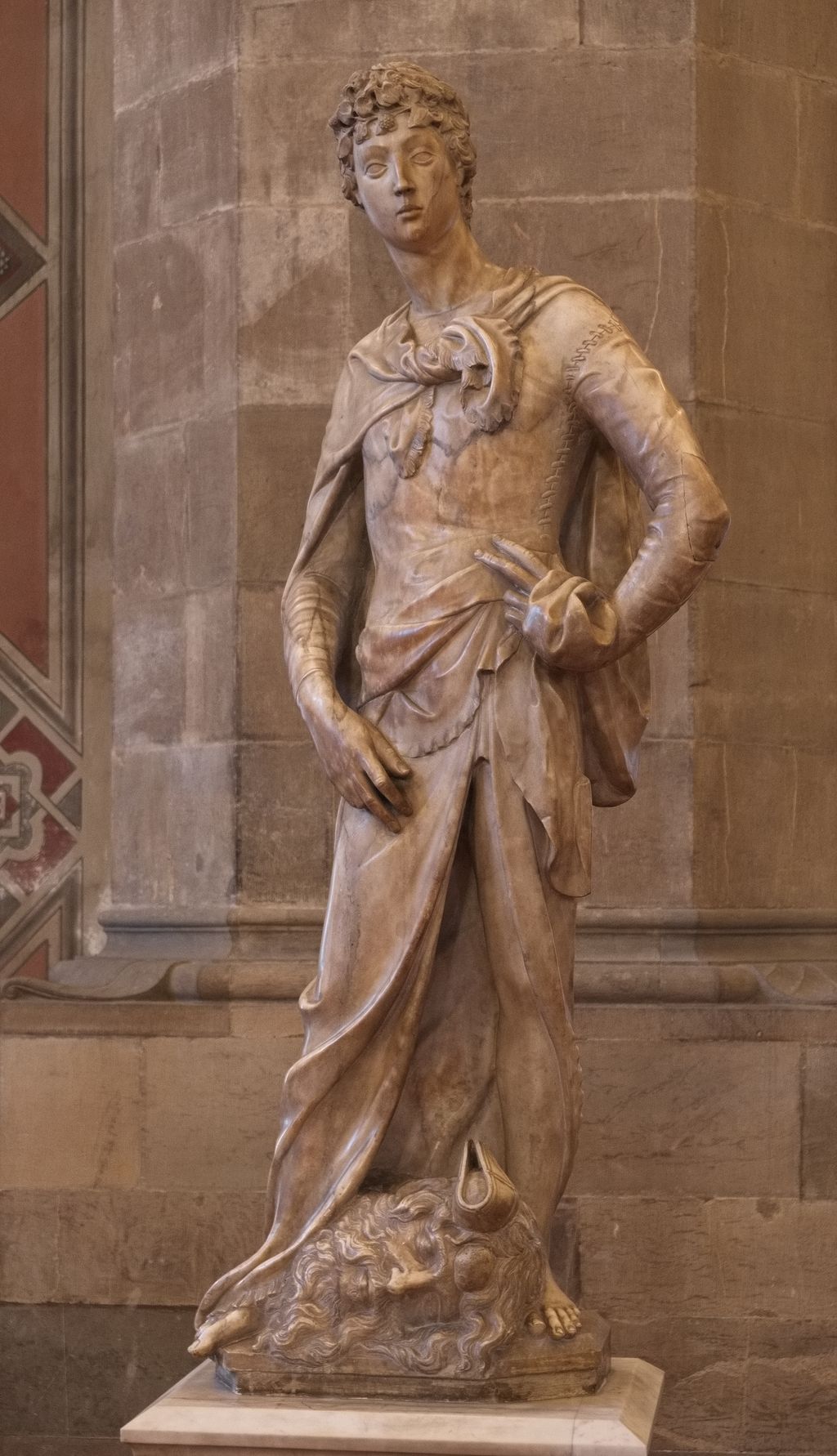
Marble David
Armin Kleiner. Image source. CC BY-SA 4.0. Resized for the web.
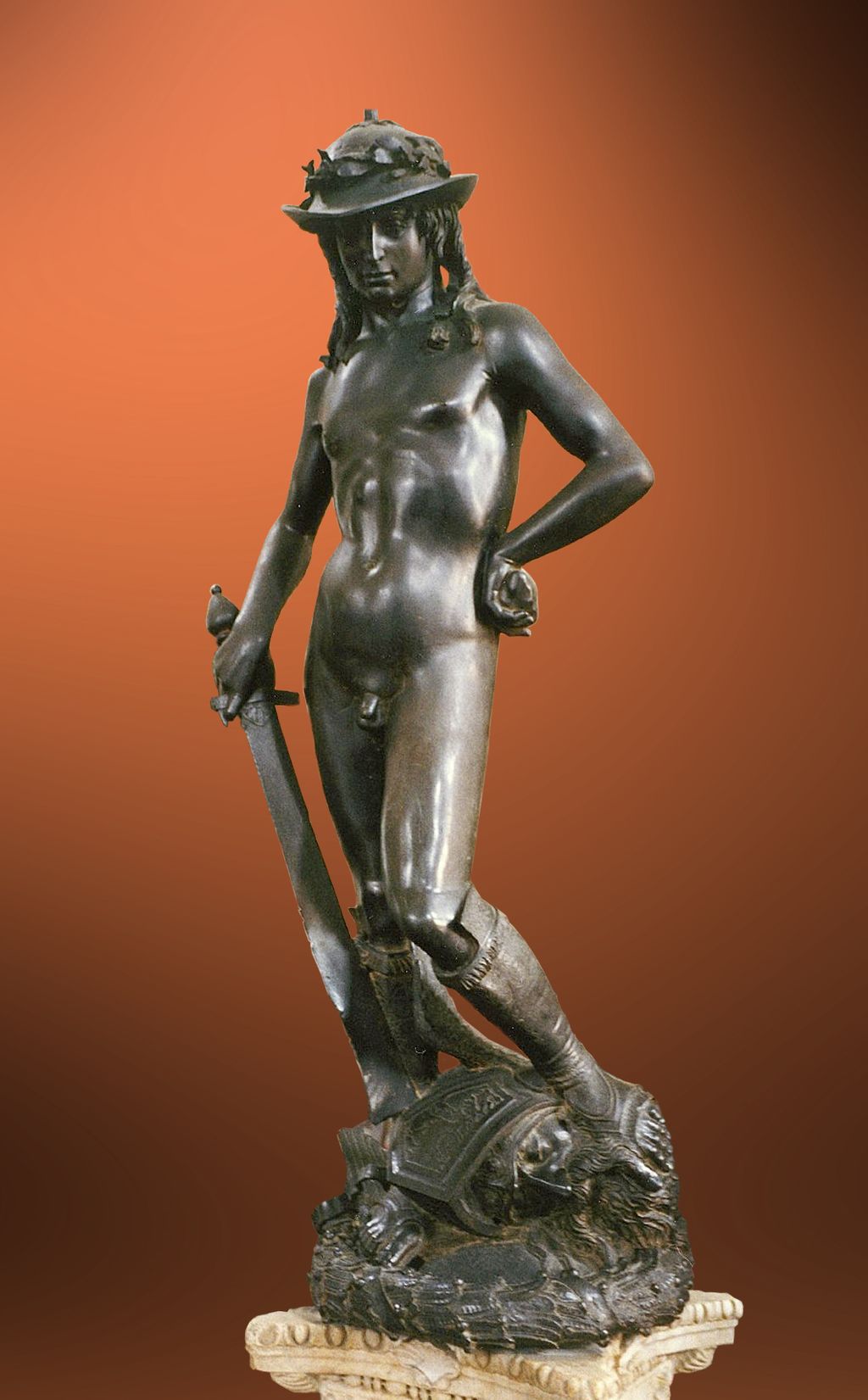
Bronze David
Patrick A. Rodgers. Image source. CC BY-SA 2.0. Resized for the web.
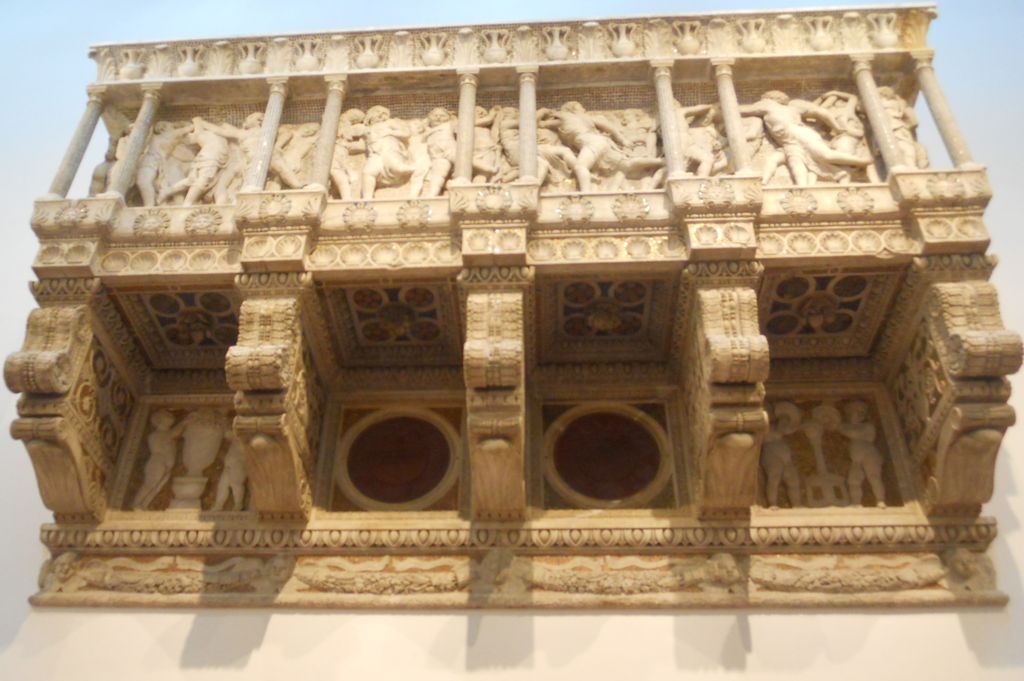
Cantoria
Erik Drost. Image source. CC BY 2.0. Resized for the web.
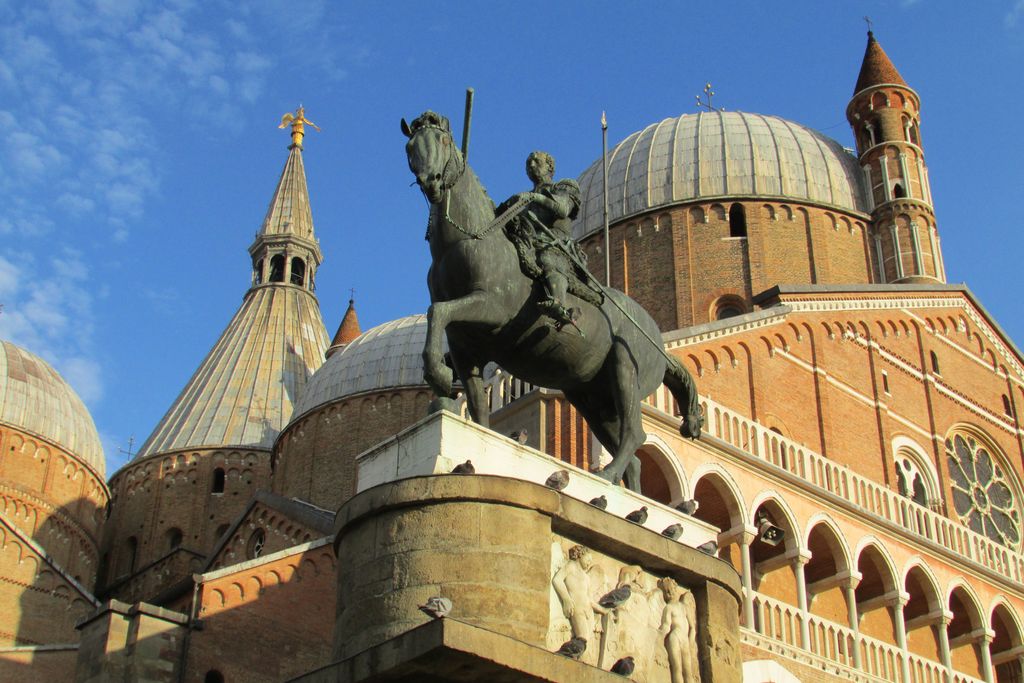
Gattamelata
Chris Light. Image source. CC BY-SA 4.0. Resized for the web.
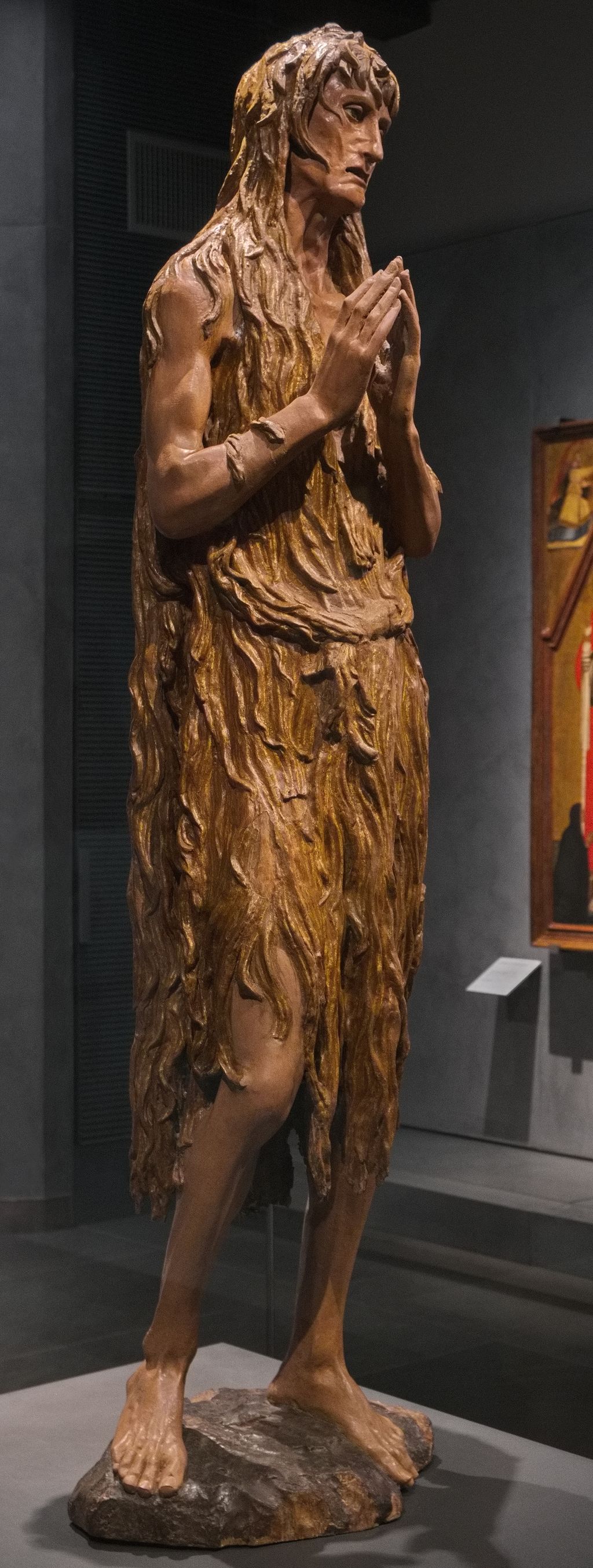
Penitent Magdalene
Armin Kleiner. Image source. CC BY-SA 4.0. Resized for the web.
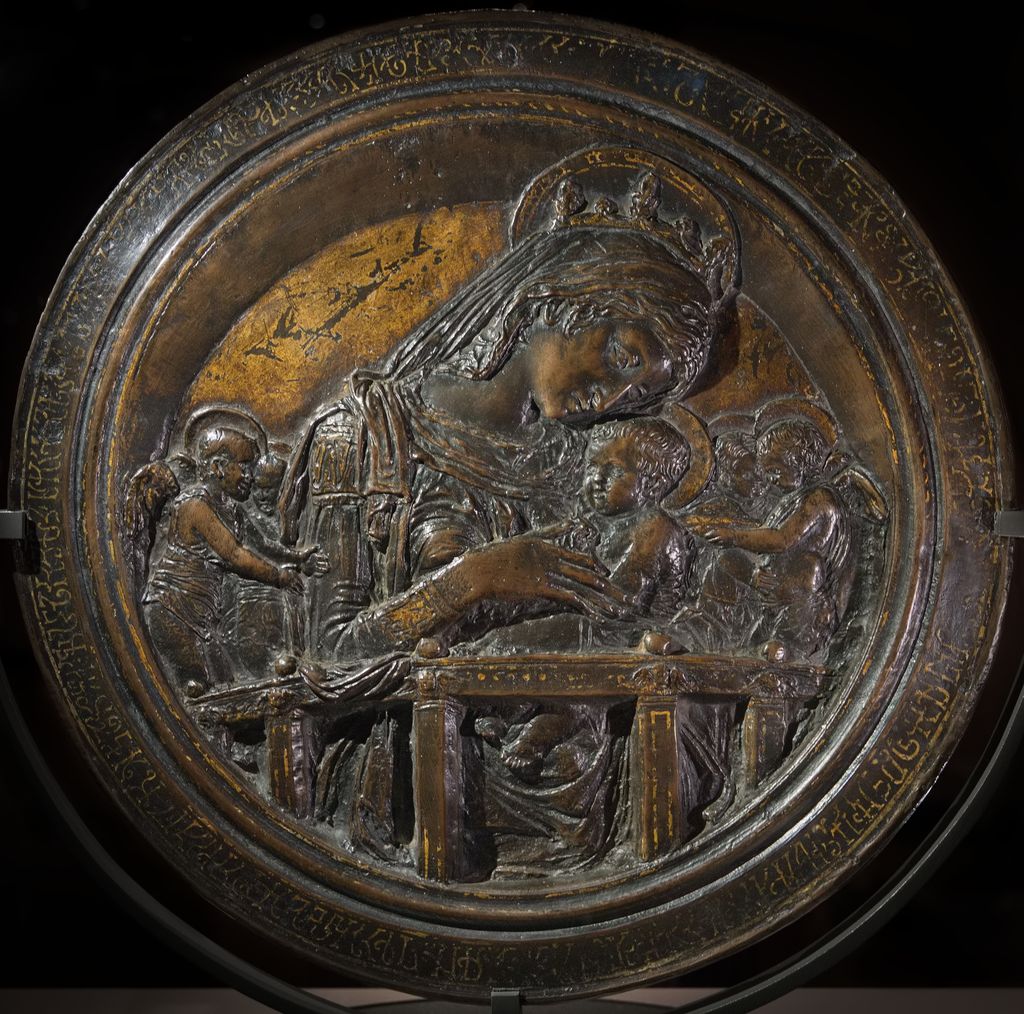
Chellini Madonna
Armin Kleiner. Image source. CC BY-SA 4.0. Resized for the web.
