


 by Tom Gurney
Tom Gurney BSc (Hons) is an art history expert with over 20 years experience
Published on June 19, 2020 / Updated on November 29, 2026
Email: tomgurney1@gmail.com / Phone: +44 7429 011000
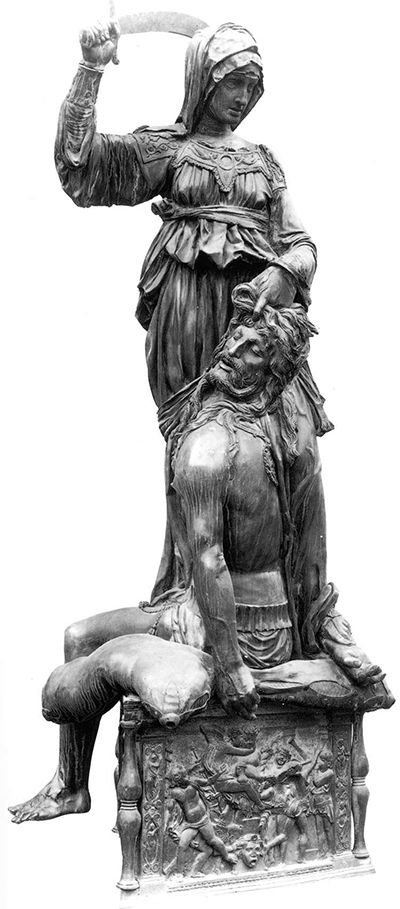
Judith has raised the sword, but the blow has yet to fall. Her other hand holds Holofernes by the hair. He is still upright enough for us to see the breadth of his chest, although his arms and legs are giving way beneath him. In Donatello’s bronze, an instant from the Book of Judith takes the form of two bodies precariously fitted together. From one side you can follow the blade above Judith’s head. Move around the group and the blade narrows while a hanging leg or the buckle of a fold comes into view. [1] [2] [3]
Usually dated about 1457–1464, the bronze stands in the Sala dei Gigli, or Hall of Lilies, inside Florence’s Palazzo Vecchio. The figure group and its bronze base measure about 2.36 metres high, before the tall stone support beneath them. In the fifteenth century the bronze stood in the Medici palace garden. In 1495, a year after the Medici were expelled from Florence, the republic placed it outside its seat of government and gave it a new inscription. A bronze copy now stands on the platform outside the palace. [1] [2] [4]
The moment between two blows
In the biblical story, Judith is a Jewish widow whose town, Bethulia, is under siege. She enters the Assyrian camp under the pretext of helping Holofernes, the commander of the besieging army. At the banquet he drinks himself into a stupor. Her attendant waits outside the bedchamber while Judith prays, takes Holofernes’ own sword and strikes twice. The women carry his head back to Bethulia, where Judith shows it to the people. The narrative moves from a private encounter to an act whose meaning depends on who sees its result. [5] [6]
Donatello stops the story before Judith can display any trophy. Florence’s technical account reads the lifted weapon as preparation for the final blow. The head remains part of the figure below, even as the angle of the neck suggests a blow already delivered. Judith’s attention is directed downwards. The movement of the sword arm reads as a pause because the rest of her body is so firmly held. In the scriptural account Holofernes is sprawled on a bed. The sculptor gives him a cushion and props him up between Judith’s legs, bringing his face, shoulder and torso into the same space as her hand and sword. There is no servant beside the group to receive the head, and the tent stays outside the sculpture altogether. [1] [2] [3] [6] [7]
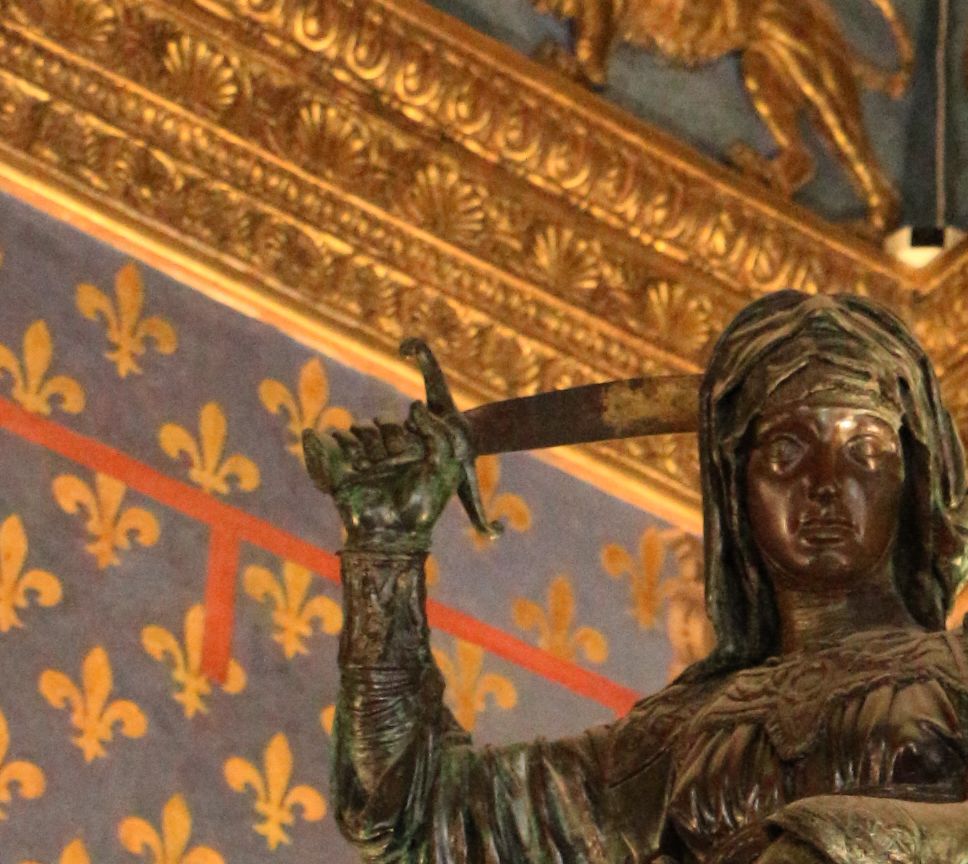
Look for the way the blade sits in relation to Judith’s veil. From an oblique angle a broad portion of the sword is visible beside the head. As the angle changes, the weapon can look like a short extension of the hilt or almost merge into the figure. The elbow, held well away from her body, often makes the gesture legible even when the blade is hard to see. The cut-out space under the raised arm helps give the upper figure a clear outline. Below it the opposite happens. Drapery, fingers and hair overlap so densely that it takes a change of viewpoint to see where one figure ends and the other begins. [2] [3]
How the two figures balance
Judith’s upright stance gives the bronze its main axis. Her head and shoulders stay over the crowded lower group as she turns her attention towards Holofernes. The weapon and free elbow extend to the side while the opposite arm reaches back into the centre. Follow that reach to the hand in his hair, then down to the sleeve and over his exposed shoulder. The body that looked like a single column from a distance divides into two figures once the hand connecting them becomes clear. [1] [2] [3]
Holofernes’ limbs make a different pattern. In one view his torso has the forward bulk of a man trying to sit upright, but the head is drawn away from the line of the chest and an open hand droops by the cushion. In another view a bent leg projects across the edge of the triangular base, with the foot hanging out beyond it. From the back, the downward pull of that leg is clearer than the expression on his face. The Palazzo Medici Riccardi catalogue identifies an additional point of contact in the figure group. Judith pins one of his wrists beneath her foot. Judith’s planted foot steadies her own stance and holds a limb that would otherwise fall away from the group. [1] [3]
A drooping hand, a bent knee and the cushion’s projecting corners can seem to belong to separate planes, especially in close photographs. Seen together they lead the eye towards the solid triangular base. It is worth looking along an edge of that base and then trying the next one. The same hanging leg that dominated the first view may now cross in front of a panel of relief. Donatello uses that shift to take our attention from a general’s collapsing body to small scenes that explain the role of wine in his defeat. [2] [3] [8]
Annotated Details from Judith and Holofernes
Select a number to jump to a detail of the sculpture.
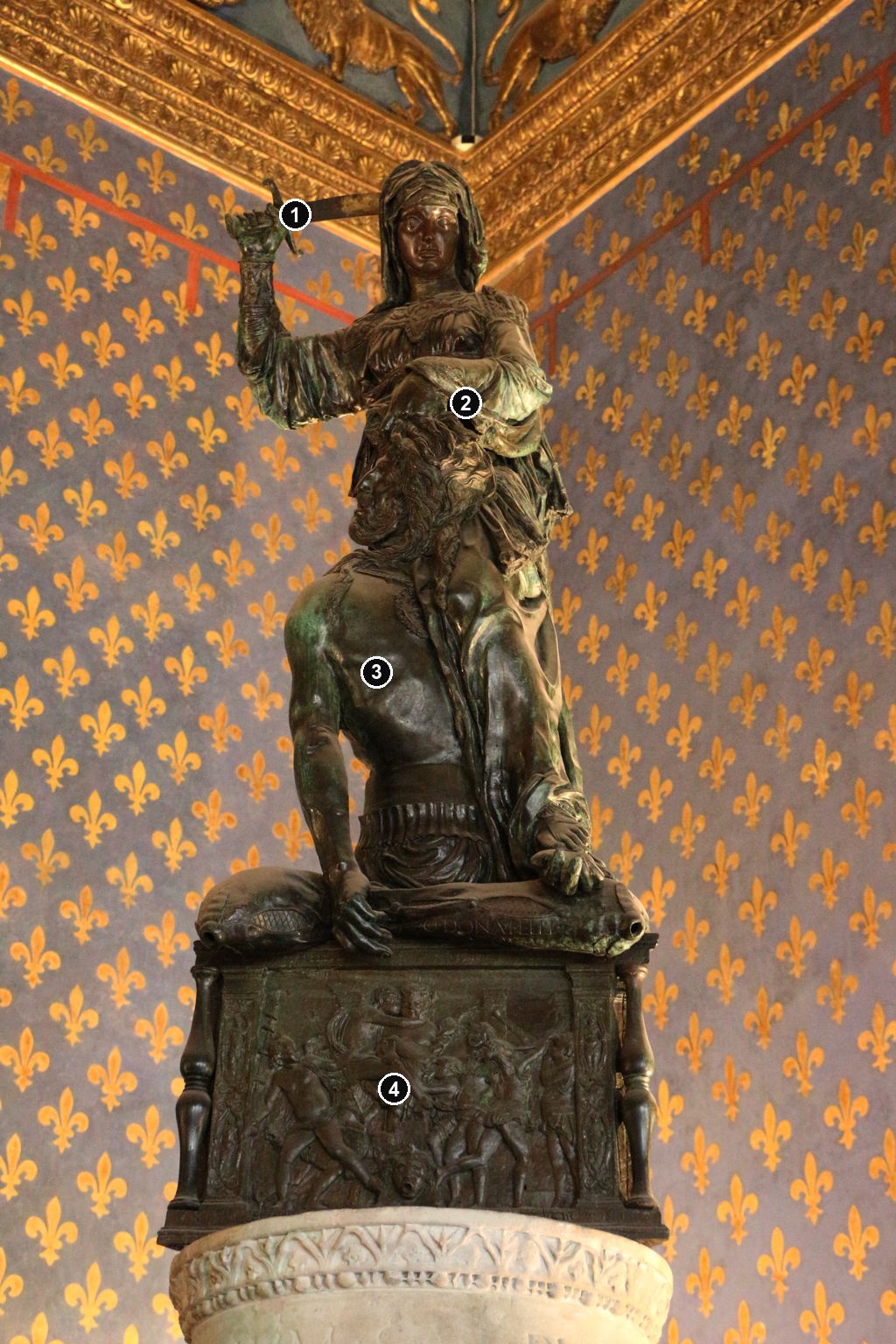
Details from JUDITH AND HOLOFERNES
Open a detail image to examine the surface more closely.
Raised sword
The blade projects beyond Judith’s hand. Its nearly horizontal edge gives the eye a direction through the space above the group.
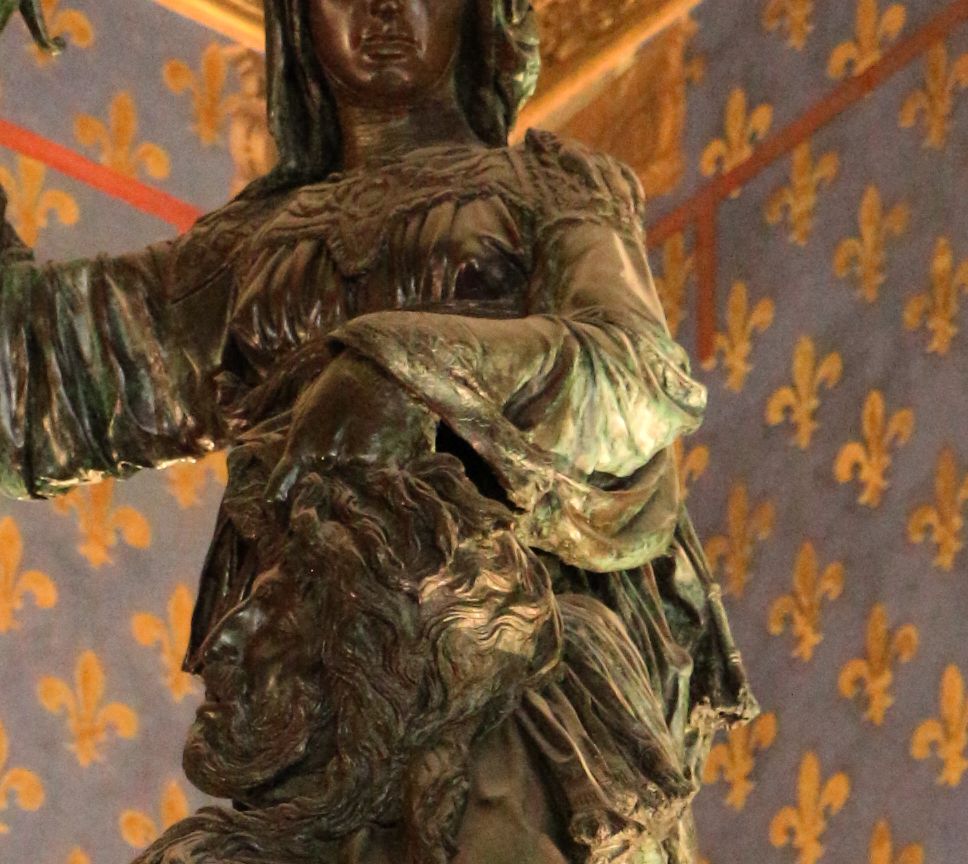
Judith’s sleeves and veil
Folded cloth surrounds the face and arms. It catches the light in small areas as the heavier drapery carries the eye down toward the other figure.
Holofernes and the support
The bend of the falling body draws an oblique line under Judith. Leg, cloth and support become easier to separate in the closer view.
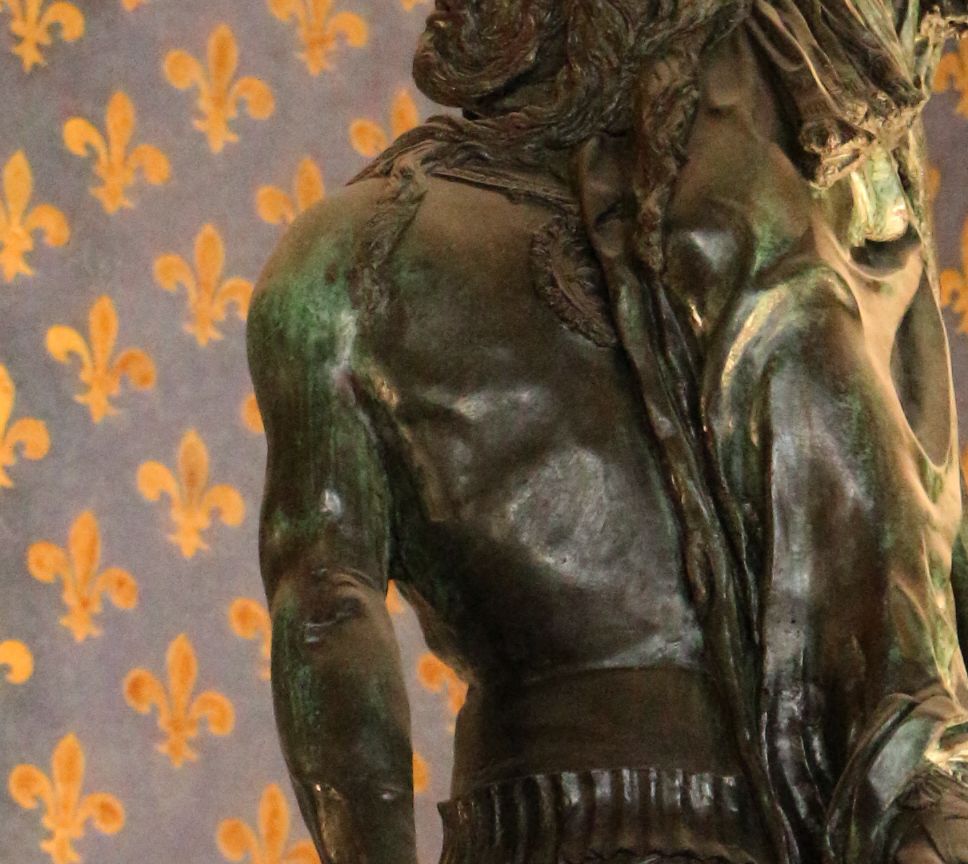
A relief on the bronze base
The relief sits below the freestanding group. The figures project from a surface and ask to be read at a different distance from the main figures.
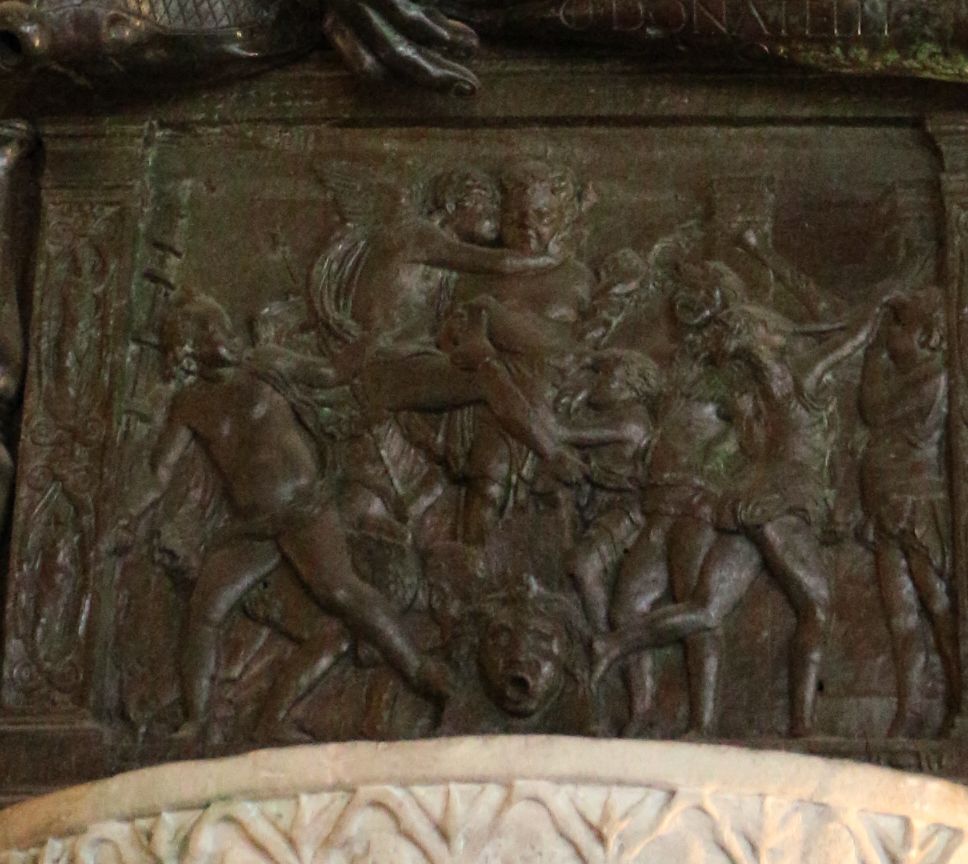
Annotated photograph and detail crops. Sailko. Image source. CC BY 3.0. Resized, annotated and cropped from the original photograph.
The veil, the folds and the gilt details
Judith prepares for her visit to the Assyrian camp by putting on festive clothes and jewellery in the Book of Judith. In the bronze she is clothed from head to foot, with a veil framing the face and a decorated band crossing the forehead. The folds vary with the task of each part of the body. Broad surfaces gather around the bent elbows and the arm that reaches forward. Longer channels descend from the waist. Lower down, the fabric catches and bunches where Judith’s legs meet Holofernes. Dress gives the eye a way to find her movement within a very compressed group. [2] [3] [9]
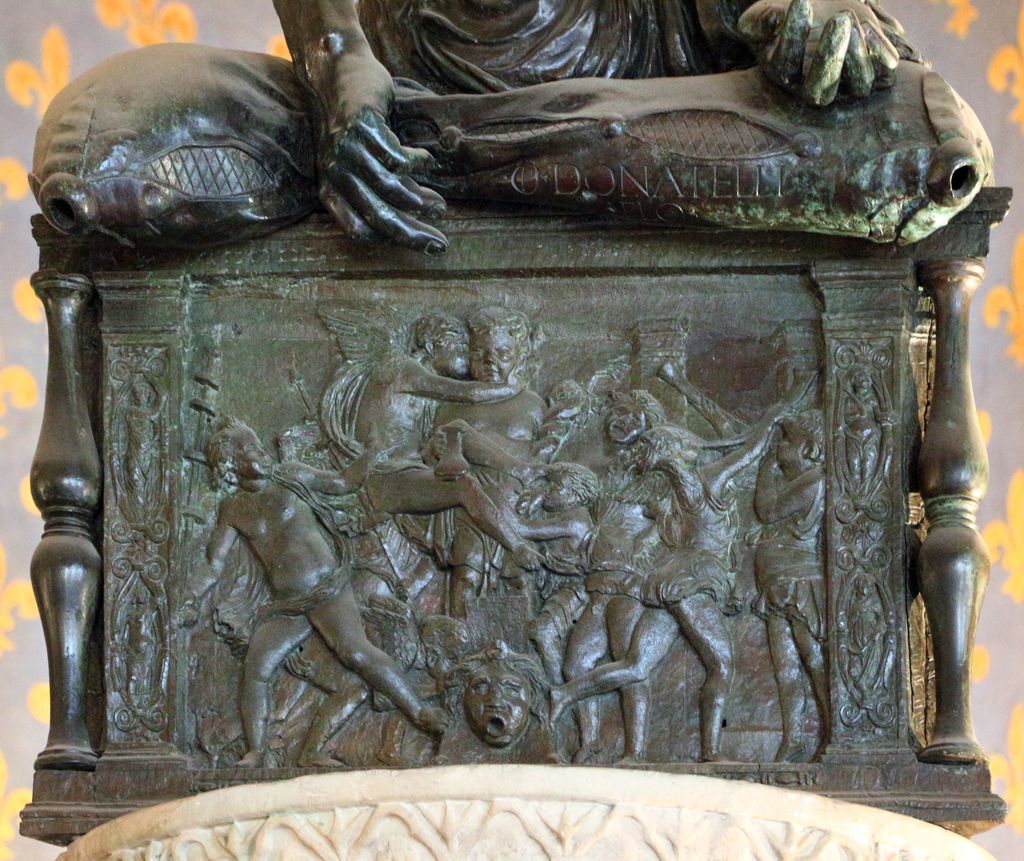
The cushion and legs in a close view of the original bronze. Sailko. Image source. CC BY 3.0. Resized for the web.
Small ornaments repay closer inspection. The municipal technical study identifies tiny winged figures among scrolls and candelabra on parts of Judith’s costume, including the chest, shoulder pieces and cuffs. A centaur appears on a medallion barely visible on Holofernes’ back. These details share the scale of work a viewer might expect on a piece of jewellery or metalwork held in the hand, although they belong to a figure group carried high on a stone base. On Judith, knotted folds cast deep shadows across the gown, while her face is contained by the fine line of the veil. Those two scales of finish give her clothing a different effect from the few smooth, broad areas of exposed skin on Holofernes. [2] [3]
Traces of gold leaf survive. The technical report identifies the sword, parts of Judith’s dress and the bronze base among the locations where gilding was present. A patch beside a fold or an ornament would have changed the way that detail caught the light. The relationship between broad silhouette and fine ornament would also have varied as people approached the original garden display. The surviving surface establishes the use of gold in several places. The full pattern and visual intensity of the gilding remain uncertain. [2] [10]
The three bronze reliefs and the stone pedestal
The cushion directly below the figures is itself bronze. Near Holofernes’ hanging hand, Donatello signed it with Latin lettering that identifies him by name and as a Florentine. Beneath the cushion are three bronze reliefs. The stone pedestal under them has a separate history and carries the civic inscription. Looking at a picture cropped just above the stone can make it easy to miss how these different parts of the work used to address different distances. The standing figure and her lifted arm could be seen across a space, whereas text and relief called for a closer view. [1] [2] [3] [14]
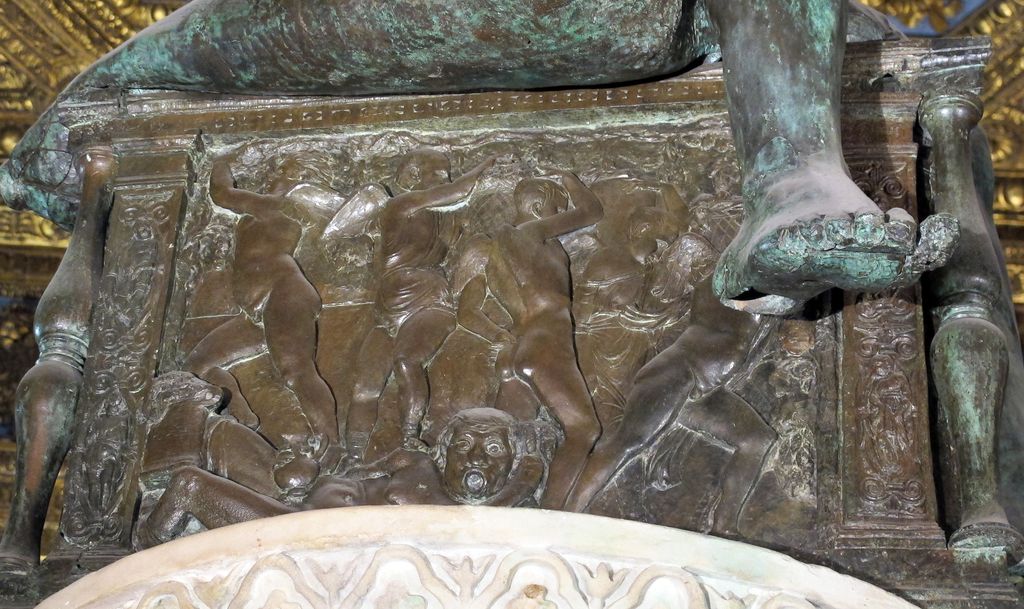
A close view of the small figures cast in relief below the two principal figures. Sailko. Image source. CC BY-SA 3.0. Resized for the web.
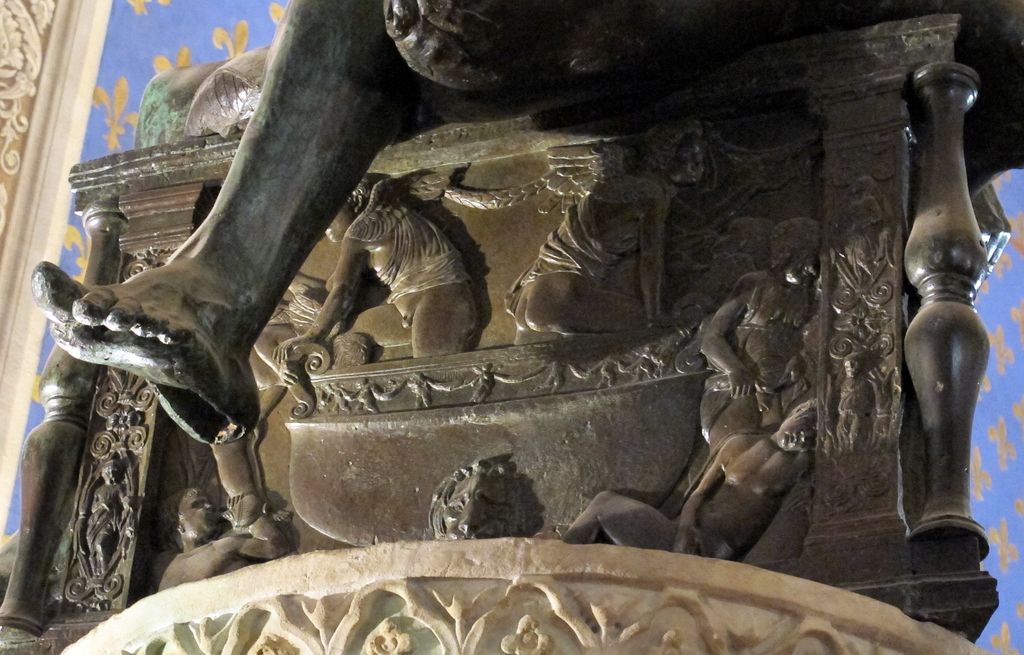
A second face of the bronze base, with bodies clustered around the large vat. Sailko. Image source. CC BY-SA 3.0. Resized for the web.
The reliefs depict a vintage and scenes of revelry. The Palazzo Medici Riccardi record describes the gathering and treading of grapes and a bacchanal of small figures. The Fondazione Federico Zeri’s photographic catalogue identifies putti accompanying an image of Bacchus on one face. In the grape-treading scene, the lip of a large vat curves below the rim of the real cushion. The figures within the relief have their own ledge to sit or stand on, just as Holofernes has his. These classical subjects supply a vocabulary for the wine, excess and loss of control that the biblical story gives Holofernes. Their small, active figures supply a change of pace from the great figure above them, whose power seems to be draining away. [1] [2] [8] [11]
Some of the cushion’s corners have conspicuous round holes. They helped encourage the idea that the bronze once served as a garden fountain. The Palazzo Medici Riccardi record reports no trace of internal water conduits and connects the holes to the fittings for lost decorative tassels. Francesco Caglioti’s reconstruction, described by the same institution, places the statue and a separate fountain along a shared sightline in the garden. It is easy to see how the visible holes and the remembered presence of water encouraged the older explanation. The distinction matters when imagining Donatello’s design. The tall stone support gave the story a different scale from that of an ornament at the centre of a basin. [1] [2]
Florence’s technical study describes a lost-wax casting in sections that were joined after they cooled. The cushion with the figures and the triangular relief base can be separated. Judith’s upper body, her arms, the right hand, the weapon and parts of the dress were among the separately made components. One cast brings together Holofernes, the cushion and the lower part of Judith’s garment. Each relief was cast separately. At the place where folds gather around the defeated man, both bodies belong to part of the same cast. [1] [2]
In the Medici garden
The date range about 1457–1464 describes a likely period of work, with the garden installation generally placed around the end of it. Identifying the original commissioner is less straightforward. Florence’s technical account favours Piero de’ Medici. The Palazzo Medici Riccardi catalogue discusses a proposal involving Piero and his father, Cosimo the Elder. It also points to a payment made in Siena in 1457 for enough bronze to cast half a figure of Judith. That document has been read as evidence for a Sienese commission. Caglioti’s interpretation connects it to the Florentine bronze while treating the payment as part of an arrangement to secure Donatello’s services in Siena. The bronze’s later presence in the Medici garden is more firmly established than those first arrangements. [1] [2] [7]
The pedestal in the garden bore two inscriptions whose texts survive in historical sources. One drew a moral from the encounter. Kingdoms succumb to luxury, cities rise through virtue, and a humble hand brings down a proud neck. In another inscription Piero, explicitly identified as Cosimo’s son, dedicated the statue to fortitude and liberty and called on citizens to defend the republic. The first draws the viewer down from Judith’s composed expression to Holofernes’ tilted head. The second raises the question of who in Florence was entitled to speak on behalf of the citizens. A prominent family was using the language of public duty in its own garden. [1] [2] [7] [12]
Donatello’s bronze David stood in the nearby courtyard. The boy’s lowered sword and Goliath’s severed head gave the visitor there the aftermath of a victory. Judith’s raised sword kept the resolution in suspense. Art historian Sarah Blake McHam treats the two works as a pair by virtue of where and how they were displayed and reads their shared defeat of overbearing enemies against Medici claims to protect the city. Her argument draws force from the themes of the inscriptions and the relationship between the two spaces. It leaves open whether the statues were initially conceived together. [1] [12] [13]
The heroine also belonged to the household’s literary world. Piero’s wife Lucrezia Tornabuoni told Judith’s story in a verse work. Art historian Allie Terry-Fritsch reads the poem and the garden sculpture together as ways of giving a woman’s authority an explicit part in the well-being of the family and the city. This interpretation depends on their common setting and the actions each gives to Judith. The evidence for Lucrezia’s authorship of the poem and the evidence about the commission of the bronze are separate. [7]
From a family possession to a civic example
After the Medici were expelled in 1494, the Florentine authorities decreed on 9 October 1495 that the bronze and Donatello’s David should be confiscated and brought to the Palazzo della Signoria, now Palazzo Vecchio. A visitor could encounter David in the first courtyard. Judith was unveiled on 21 December on the platform to the left of the main entrance, where she faced across the Piazza della Signoria. That raised forecourt, called the ringhiera or arengario, put her in the setting of public ceremony and government business. [1] [2] [12]
The two Medici inscriptions gave way to words that can still be read on the stone, Exemplum salutis publicae cives posuerunt, followed by 1495 in Roman numerals. The sense is that the citizens erected the statue as an example of public deliverance. A viewer looking up at Judith now encountered the declared act of the citizens where the garden inscriptions had named Piero. The idea of public salvation lived through the move, but the people credited with putting it on display changed. The confiscation made that change legible both in the text and in the passage from a family residence to the public entrance of the city’s government. [1] [2] [12] [14]
This new meaning could itself be challenged. In the 1504 debate over the placement of Michelangelo’s marble David, the herald Francesco Filarete spoke against Judith’s position. He objected to the city being represented by a woman killing a man and associated the bronze with the ill fortune of Florence’s loss of control over Pisa. His remarks survive as part of a discussion with several participants and proposals. A gesture which had publicly stood for deliverance could also be made to signify civic misfortune. [2] [14]
The loggia, the wars and the return to Palazzo Vecchio
Michelangelo’s David took the position at the palace entrance in 1504. Donatello’s bronze spent the next two years inside the palace precinct. On 10 June 1506 it went under the western front arch of the Loggia della Signoria, now called the Loggia dei Lanzi, across from the palace. By 1554 Benvenuto Cellini’s bronze Perseus, commissioned by Duke Cosimo I de’ Medici, stood at the other end of the front arcade. Visitors could now look from a woman who defeats a man with his own weapon to a man who raises the severed head of Medusa. The pairing belonged to a later political and artistic setting than the juxtaposition with David in the Medici palace. [1] [2] [14]
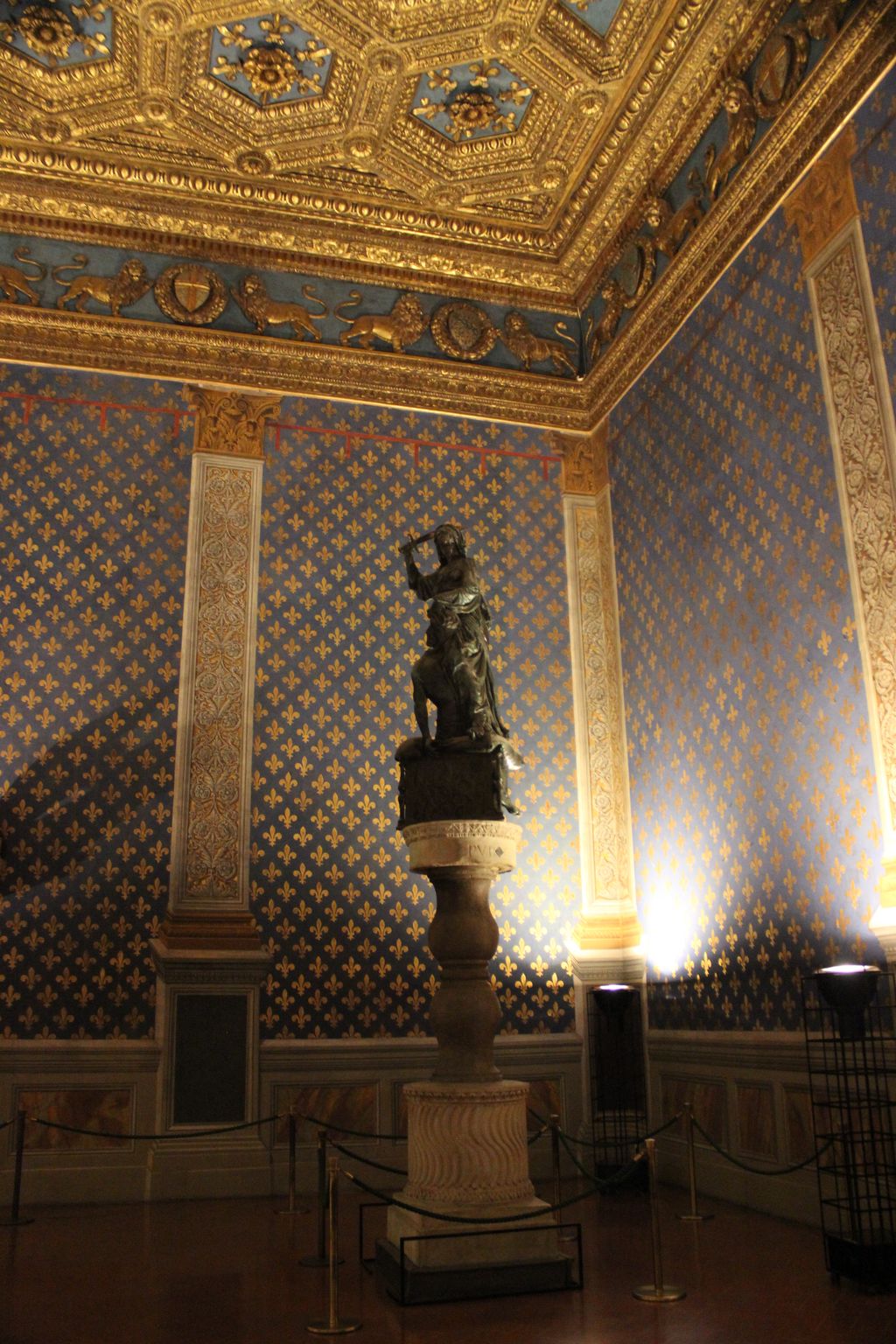
The original in the Sala dei Gigli inside Palazzo Vecchio, with its stone support visible below the bronze. Miguel Hermoso Cuesta. Image source. CC BY-SA 4.0. Resized for the web.
In 1582 Giambologna’s marble Rape of the Sabine Women took the western position, and Donatello’s group moved under the side arch facing what is now Via della Ninna. It stayed at that end of the loggia until it was taken into protective storage during the First World War. It returned to the front of Palazzo Vecchio in 1919, spent part of the Second World War in storage, and went back outside in 1946. Florence’s account also records treatment by Bruno Bearzi during the wartime removal. In 1980 the city brought the deteriorating original indoors. Following work by the Opificio delle Pietre Dure in 1986–1988, it went on display in the Sala dei Gigli. [1] [2] [10]
The outdoor bronze now gives a sense of the work’s scale in relation to the palace façade and of the height at which it meets a passer-by. For the surface modelled and finished by Donatello and his collaborators, go inside. The square shows how far an overhanging limb or raised blade carries against masonry. In the Sala dei Gigli, the reliefs and the folds can be examined at closer range, and the exposed green and brown passages belong to the original bronze and its long history of display, cleaning and protection. [3] [4] [10]
What restorers found on the original
Work in the 1980s established much of what is known about the making of the bronze and its condition after centuries of outdoor exposure. Maintenance in 2004 located three minute traces of gilding. For the first phase of the next project, before the 2022 Palazzo Strozzi exhibition, the conservators repeated the dust removal, documented the bronze at close range and revisited part of the earlier diagnostic campaign. The original formed part of the exhibition’s related itinerary across Florence in its existing museum setting. The second phase drew on the diagnostic results, and Florence presented the treated bronze in the Sala dei Gigli in June 2024. [2] [10] [15]
Specks of gold are difficult to distinguish from surface deposits at the scale of the whole figure. The team worked over the surface with a contact microscope and mapped promising areas, comparing them with previous observations. Analysis supported the presence of additional gold remnants. Laser cleaning was used in selected areas, allowing conservators to expose fragile fragments where coarser treatment risked removing evidence. According to Florence’s report, the newly revealed pieces amounted to roughly 13 square centimetres of gold leaf. In some places traces also showed a boundary or the course of a gilded area. The total measures the fragments uncovered in the treatment. Their original extent is still open. [10] [16]
The project also addressed mineral deposits and damaging corrosion products and reassessed abrupt colour changes across the bronze. Conservation indoors had slowed deterioration, and the team identified past direct mould-making for the outdoor copy among the sources of surface alteration. The renewed protective finish consists of an acrylic coating with a sacrificial layer of wax above it, designed to take wear before the layer below. The conservators recorded additional details of how the bronze sections were joined and carried out maintenance on the stone base and the cladding of its metal support. The outdoor replica underwent its own conservation and was returned to the platform in a separate project. [4] [10] [16]
Other artists, other moments in Judith’s story
The National Gallery of Art in Washington dates its Judith with the Head of Holofernes to about 1495–1500. Its current display heading names Andrea Mantegna and the object record also lists Giulio Campagnola among the associated painters. The gallery’s published attribution history records the possibility that a follower, possibly Campagnola, painted it. Judith’s pale gown gives her a statue-like bearing in the small tempera panel. The event is already over. The maid holds open a sack, and the bed and a bare foot are just visible in the dark tent. The story’s violence survives in those understated details while the two women concentrate on leaving. Donatello’s Judith has reached an earlier moment, where carrying out the act still absorbs her entire body. [17] [18]
Andrea Briosco, called Riccio, used the same metal as Donatello for another Judith with the Head of Holofernes, on a bronze plaquette about eleven centimetres high. The small scale lets us read the balance of the two women and the head between them in a single close view. The reverse bears a cast inscription identifying Riccio as the inventor of the design. At monumental scale Donatello keeps the maid beyond the edges of the story and gives her place in the composition to the entire body of Holofernes. In Giulio Bonasone’s later engraving after Michelangelo, both the passing of the head to the maid and the body inside the tent can be seen because the print gives each part of the story a separate area on the sheet. [3] [19] [20]
Sandro Botticelli also separated the aftermath into two small panels. In The Return of Judith to Bethulia, Judith and her maid are already on the move, with the head carried high. In The Discovery of the Body of Holofernes, members of the Assyrian camp discover the body. There is room on each panel for a different group of people to respond to the act. Botticelli’s two panels unfold a sequence of public consequences. In the bronze the public meaning of the act is left to the pedestal’s inscription. [2] [21]
In November 2016 visitors could see a later interpretation in the same room when the Uffizi’s Judith Slaying Holofernes by Artemisia Gentileschi was displayed beside the bronze. The painting sets the viewer close to the bed, where Judith’s companion helps hold down the struggling Holofernes. In Donatello’s group Judith alone is responsible for the other figure’s weight. Seen in the round, his raised sword, the unsteady head at the centre and the foot hanging down beyond the cushion mark the full height of that brief pause before the last blow. [3] [22] [23]
Donatello sculpture directory
| Name | Date | Medium and record |
|---|---|---|
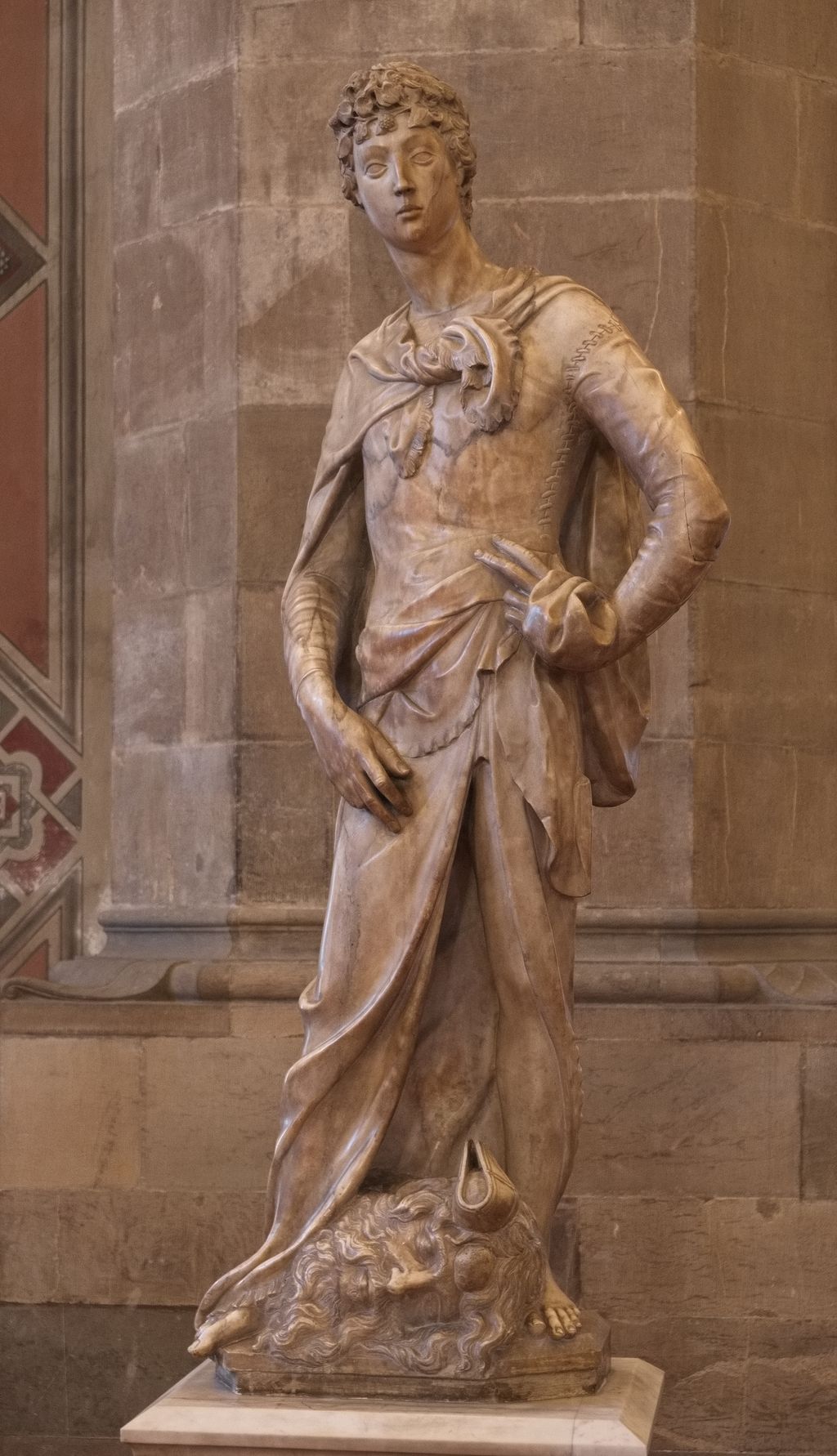
| Marble David | 1408–09, adapted 1416 | Carved Carrara marble Catalogue. |
| Saint John the Evangelist | c. 1409–15 | Carved marble Catalogue. |
| Saint Mark | 1411–13 | Carved Carrara marble Catalogue. |
| Saint George and its dragon relief | c. 1415–17 | Marble statue and marble relief Catalogue. |
| Marzocco | c. 1417–20 | Carved sandstone Catalogue. |
| Saint Louis of Toulouse, Florence | 1418–25 | Gilt bronze and mixed media Catalogue. |
| Pazzi Madonna | c. 1420s | Marble relief Catalogue. |
| Reliquary Bust of Saint Rossore | c. 1420s | Gilt bronze Catalogue. |
| The Prophet Jeremiah | 1420s–30s, disputed | Marble Catalogue. |
| Zuccone | c. 1420s–30s | Marble Catalogue. |
| Feast of Herod, Siena | 1420s | Gilded bronze relief Catalogue. |
| Ascension with Christ Giving the Keys to Saint Peter | c. 1428–30 | Marble relief Catalogue. |
| Cantoria | 1433–39 | Marble and mosaic Catalogue. |
| Amor-Atys | c. 1435–40 | Partly gilded bronze Catalogue. |
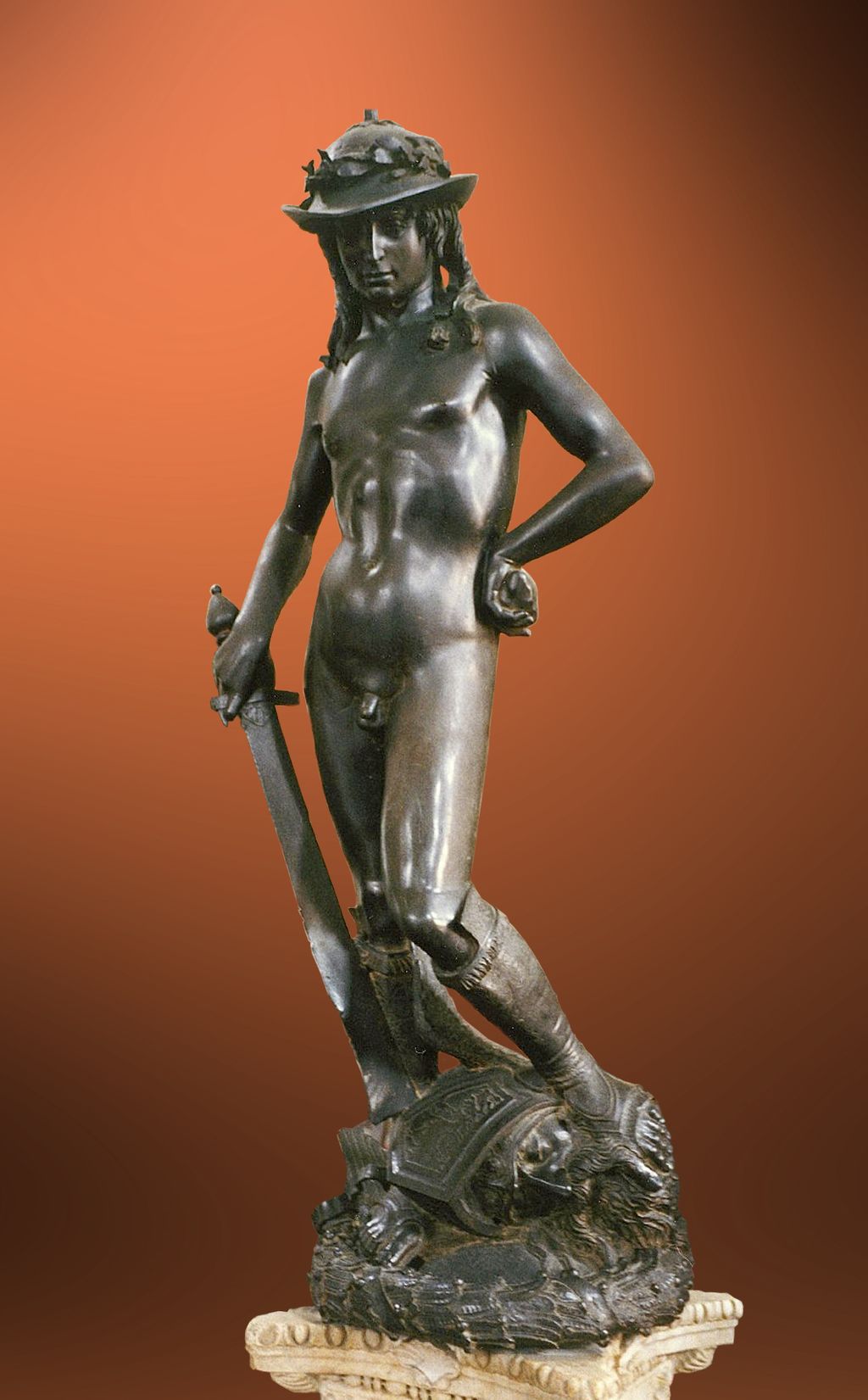
| Bronze David | c. 1435–40, disputed | Partly gilded bronze Catalogue. |
| Gattamelata | Installation agreement, 1453 | Bronze and stone Catalogue. |
| Santo altar | Mid-fifteenth century | Bronze and limestone ensemble Catalogue. |
| Chellini Madonna | Given in 1456 | Partly gilded bronze tondo Catalogue. |
| Penitent Magdalene | c. 1453–55 (Opera) | Poplar, stucco, pigments and gold Catalogue. |
| Judith and Holofernes | Late 1450s–early 1460s | Bronze with surviving gilding Catalogue. |
| Pulpit of the Passion | Late work and later assembly | Bronze reliefs, Donatello and collaborators Catalogue. |
| Bust traditionally called Niccolò da Uzzano | Fifteenth century | Painted terracotta, attribution disputed Catalogue. |
| Prato Cathedral exterior pulpit | Commissioned 1428; carved 1430s | Marble reliefs, Donatello and Michelozzo Catalogue. |
| Cavalcanti Annunciation | c. 1433–35 | Gilded sandstone and terracotta Catalogue. |
| Crucifix at Santa Croce | Early fifteenth century | Painted wood Catalogue. |
| Madonna of the Clouds | c. 1425–35 | Marble relief Catalogue. |
| Old Sacristy Doors | Fifteenth century | Two paired bronze doors Catalogue. |
| Resurrection Pulpit | Late work and later assembly | Bronze reliefs, Donatello and collaborators Catalogue. |
| Brancaccio tomb | 1420s | Donatello, Michelozzo and assistants, mixed materials Catalogue. |
| Saint John the Baptist, Venice | 1438 | Polychromed and gilded wood Catalogue. |
| Sacrifice of Isaac | Early fifteenth century | Donatello and Nanni di Bartolo, marble Catalogue. |
| Madonna of Via Pietrapiana | Mid-fifteenth century | Terracotta Catalogue. |
| Miracle of the Mule | Mid-fifteenth century | Gilded bronze panel for the Santo altar Catalogue. |
| Padua Crucifix | Mid-fifteenth century | Cast bronze Catalogue. |
| Dancing Spiritello, Bargello | Fifteenth century | Bronze Catalogue. |
| Young Prophet from the Porta della Mandorla | c. 1404–09 | White marble, attributed to Donatello Catalogue. |
| Prophet or Apostle from the Duomo north tribune | Early fifteenth century | White marble, possibly Donatello Catalogue. |
| Beardless Prophet | 1415–18 | White marble Catalogue. |
| Sibyl and Prophet of the Porta della Mandorla | 1422 | Carved marble heads for the portal Catalogue. |
| Faith, Siena baptismal font | 1420s | Gilded bronze figure Catalogue. |
| Hope, Siena baptismal font | 1420s | Gilded bronze figure Catalogue. |
| Feast of Herod, Lille | c. 1430 | Carrara marble relief Catalogue. |
| Piot Madonna | c. 1440–60 | Polychrome terracotta with glass and wax inlays Catalogue. |
| Carafa Horse Head | c. 1456–58 | Cast bronze Catalogue. |
| Pazzi Madonna workshop version, Louvre | c. 1450 | Polychrome gesso, Donatello’s workshop Catalogue. |
| Pazzi Madonna tondo, Rijksmuseum | c. 1425–50 | Plaster and stucco, after Donatello Catalogue. |
| Sprite | c. 1430–40 | Bronze, sculptor or metalsmith close to Donatello Catalogue. |
Discussion
Look again at the images and ideas explored in Judith and Holofernes. These editorial prompts invite your observations.
Reader Insights
Which details of the bronze make you think the sculpture shows a pause between the two blows?
How does the view from the side change the way you read Judith’s stance or the position of Holofernes?
Join the Conversation
Share a detail, comparison or question about Judith and Holofernes below.
References
- Palazzo Medici Riccardi, Mediateca, Giuditta e Oloferne, object record, technical description, inscriptions and provenance. View source.
- Comune di Firenze, Museo di Palazzo Vecchio, Giuditta e Oloferne di Donatello: Relazione tecnica di progetto, 2022, pp. 3–6. View source.
- The Warburg Institute, Statue of Judith, Iconographic Database, photographic record and associated views. View source.
- Comune di Firenze, Restaurata la Giuditta di Piazza della Signoria, conservation and reinstallation of the outdoor copy. View source.
- United States Conference of Catholic Bishops, Judith 12, New American Bible, Revised Edition. View source.
- United States Conference of Catholic Bishops, Judith 13, New American Bible, Revised Edition. View source.
- Allie Terry-Fritsch, “Embodied Temporality: Lucrezia Tornabuoni de’ Medici’s Sacra Storia, Donatello’s Judith, and the Performance of Gendered Authority in Palazzo Medici, Florence,” in Gendered Temporalities in the Early Modern World. View source.
- Fondazione Federico Zeri, Università di Bologna, Bardi Donato (Donatello), Giuditta e Oloferne, photograph index and relief subject labels. View source.
- United States Conference of Catholic Bishops, Judith 10, New American Bible, Revised Edition. View source.
- Comune di Firenze, Giuditta e Oloferne tornano a splendere nella sala dei Gigli di Palazzo Vecchio, 3 June 2024, conservation findings. View source.
- Ministero della Cultura, Vendemmia, state catalogue entry for a plaster cast of a relief from the bronze base. View source.
- Sarah Blake McHam, “Donatello’s Judith as the Emblem of God’s Chosen People,” in The Sword of Judith: Judith Studies Across the Disciplines (2010), pp. 307–324. View source.
- Sarah Blake McHam, “Donatello’s Bronze David and Judith as Metaphors of Medici Rule in Florence,” The Art Bulletin 83, no. 1 (2001), pp. 32–47. View source.
- Ulrich Pfisterer, “Bildkonzepte im Widerstreit. Donatellos Judith als ‘naturalisierte Allegorie’,” in How Do Images Work? Strategies of Visual Communication in Medieval Art (2021), pp. 199–211. View source.
- Fondazione Palazzo Strozzi, Donatello in Tuscany, itinerary associated with the 2022 exhibition. View source.
- Friends of Florence, Donatello: Judith & Holofernes Bronze Sculpture, conservation project. View source.
- National Gallery of Art, Washington, Judith with the Head of Holofernes, tempera on poplar, accession 1942.9.42. View source.
- National Gallery of Art, Washington, Annual Report 2004, p. 60, changes of attribution including accession 1942.9.42. View source.
- National Gallery of Art, Washington, Judith with the Head of Holofernes, Andrea Briosco, called Riccio, bronze, accession 1957.14.249. View source.
- The Metropolitan Museum of Art, Giulio Bonasone after Michelangelo, Judith passing the head of Holofernes to her maidservant, the decapitated Holofernes inside the tent at left, accession 53.600.4229. View source.
- Uffizi Galleries, The Stories of Judith: the Return of Judith to Bethulia; the Discovery of the Body of Holofernes, Sandro Botticelli. View source.
- MUS.E Firenze, La Giuditta di Artemisia Gentileschi in Sala dei Gigli, 25–27 November 2016, exhibition notice. View source.
- Uffizi Galleries, Judith Beheading Holofernes, Artemisia Gentileschi, inventory 1890 no. 1567. View source.
- Victoria and Albert Museum, Donatello’s David. View source
- Opera del Duomo, Donatello and the Opera del Duomo. View source
- Ministero della Cultura, David with the Head of Goliath, Bargello bronze. View source
- Save Venice, Donatello’s Equestrian Monument to Gattamelata. View source
- Opificio delle Pietre Dure, L’ultimo Donatello. View source
More DONATELLO Sculptures
Marble David
Armin Kleiner. Image source. CC BY-SA 4.0. Resized for the web.
Bronze David
Patrick A. Rodgers. Image source. CC BY-SA 2.0. Resized for the web.
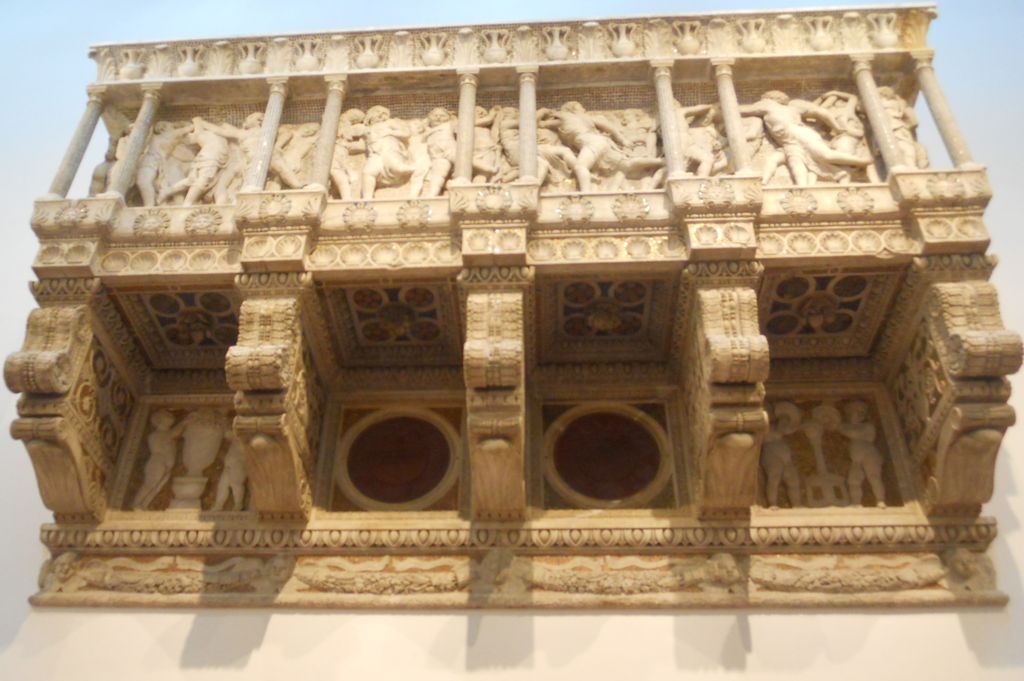
Cantoria
Erik Drost. Image source. CC BY 2.0. Resized for the web.
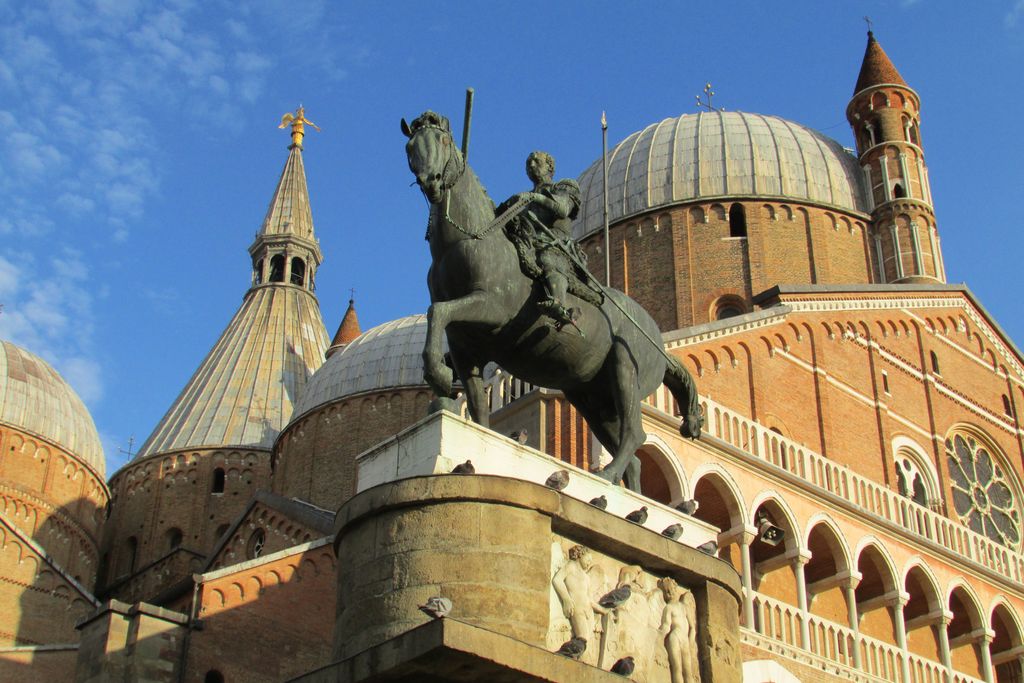
Gattamelata
Chris Light. Image source. CC BY-SA 4.0. Resized for the web.
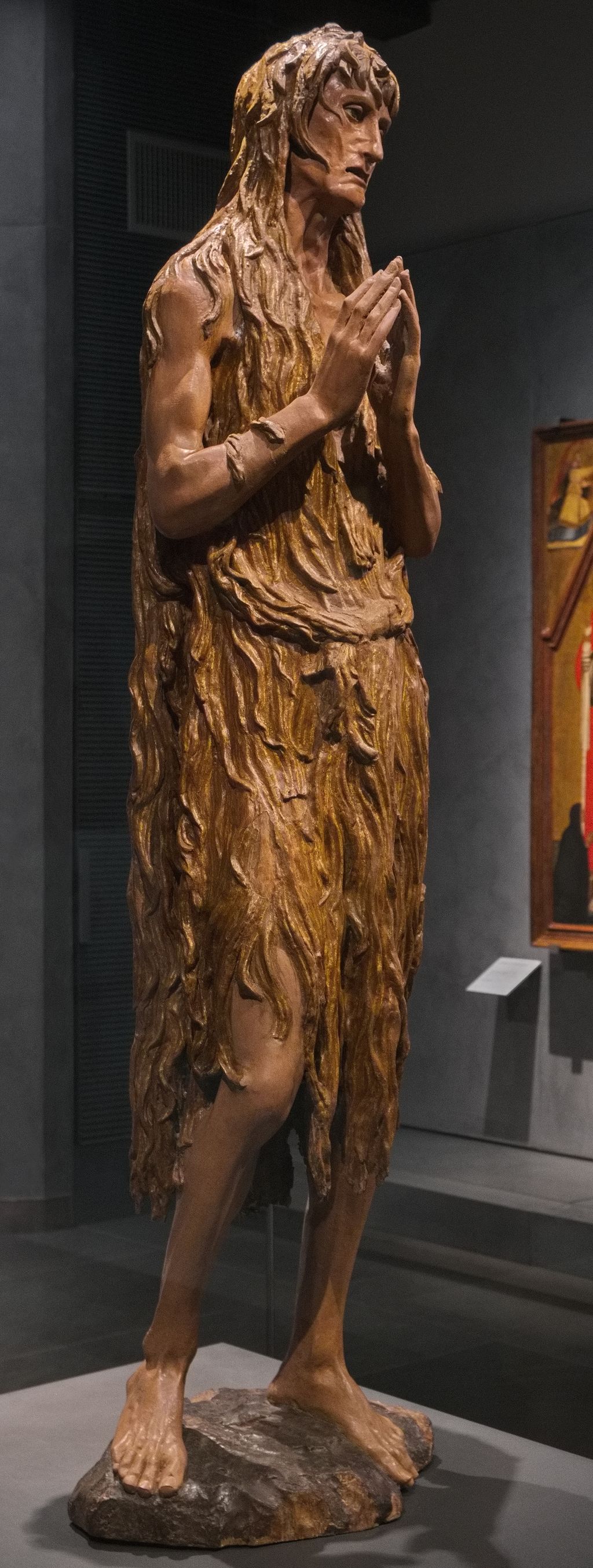
Penitent Magdalene
Armin Kleiner. Image source. CC BY-SA 4.0. Resized for the web.
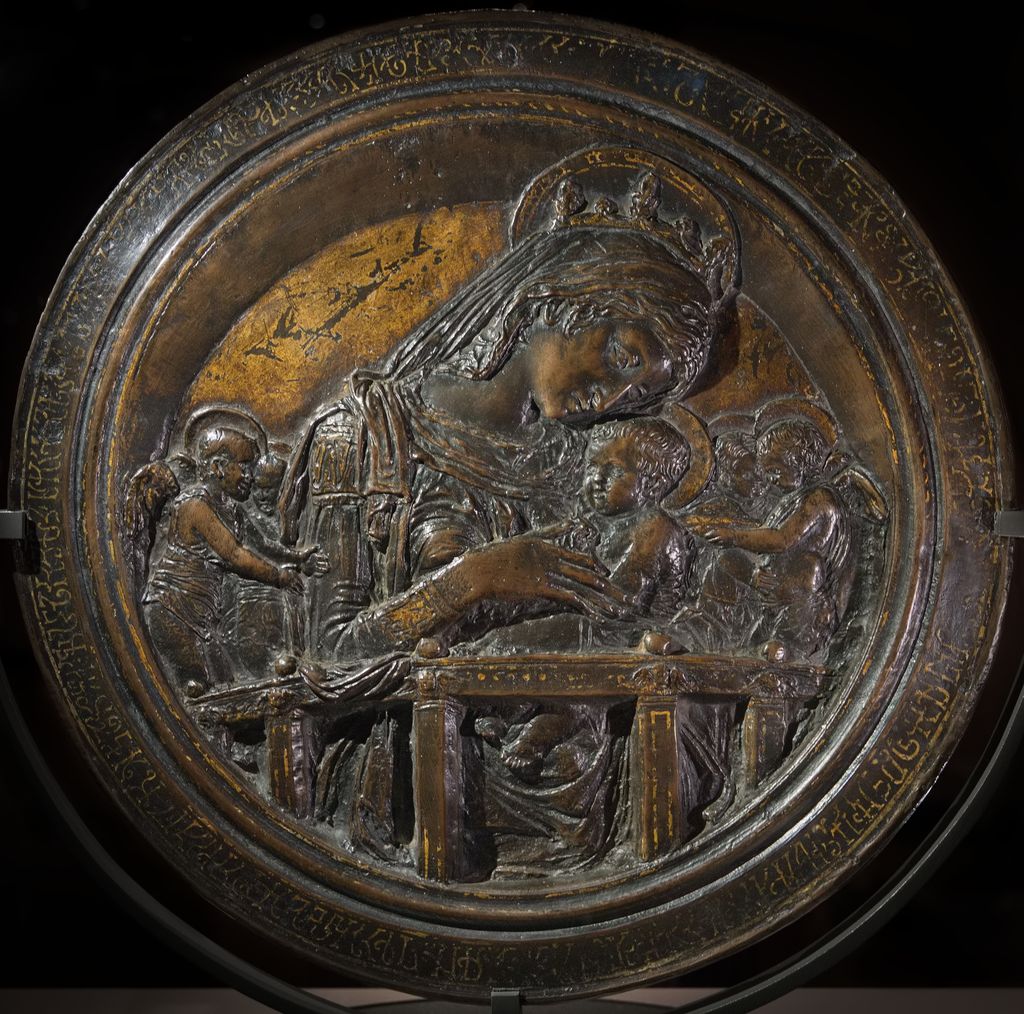
Chellini Madonna
Armin Kleiner. Image source. CC BY-SA 4.0. Resized for the web.
