


 by Tom Gurney
Tom Gurney BSc (Hons) is an art history expert with over 20 years experience
Published on June 19, 2020 / Updated on November 29, 2026
Email: tomgurney1@gmail.com / Phone: +44 7429 011000
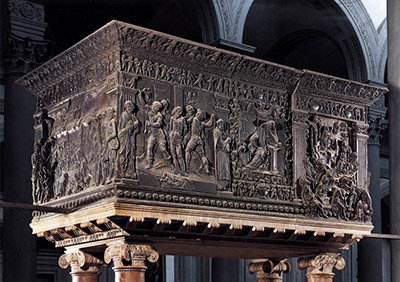
The three crosses in Donatello’s Crucifixion rise above a crowd of mourners, soldiers and horses. A few steps along the nave of San Lorenzo in Florence, the same hill appears again. Christ has been taken down, and the ladder and truncated cross shafts lean over a mass of grieving figures. Those two bronze reliefs share the long face of the Pulpit of the Passion. Follow the sculpture around its corners and the story runs from Christ’s prayer on the Mount of Olives to the lowering of his body into a tomb. [1] [2]
The bronzes belong to the last years of Donatello’s career. The Opificio delle Pietre Dure gives a broad date of around 1456–66, while the art historian Francesco Caglioti argues for a start around 1461. The wooden carvings and the marble columns belong to later campaigns. In the assembled pulpit, reliefs made by Donatello and his workshop became part of a furnishing that acquired its familiar form and position over generations. [1] [3] [4]
Finding the scenes at San Lorenzo
Face the high altar from the central nave. The Passion Pulpit is on the left beneath the final arches of the nave. Its companion, the Pulpit of the Resurrection, stands opposite. The Passion Pulpit’s long face towards the central nave carries the Crucifixion and the Lamentation. The short end towards the entrance carries the double hearing before Pilate and Caiaphas. At the other short end, towards the altar, is the Entombment. The Agony in the Garden begins the story on the long face towards the side aisle. From there the Renaissance scenes go around the four sides, ending at the tomb. [1] [2] [5]
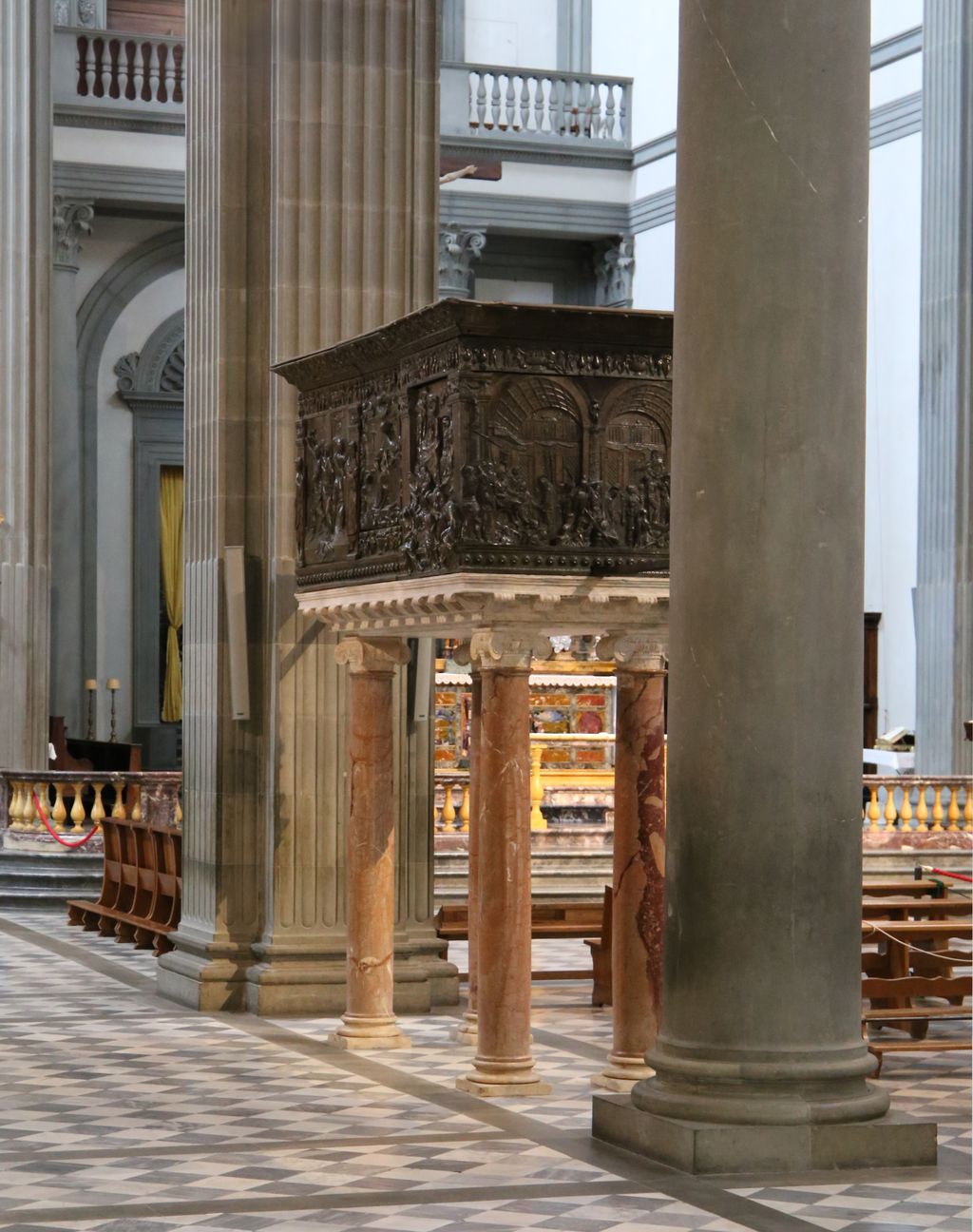
The assembled Passion Pulpit as seen among the columns at San Lorenzo. Francesco Bini. Image source. CC BY-SA 4.0. Resized for the web.
That outer face also carries a Flagellation and a carving of Saint John the Evangelist on the access door. These are early seventeenth-century wooden additions. The dark finish lets the carvings take their place beside the bronzes at a distance. At the level of the story, the Flagellation depicts an episode that would come after the hearing before Pilate. Its position beside the Agony reflects the later assembly. The corresponding wooden subjects across the nave are the Mocking of Christ and Saint Luke. [1] [2] [3]
Above the scenes, a projecting cornice and a frieze of small figures run around the parapet. Fluted pilasters mark divisions between episodes, and little figures hold garlands at their capitals. These architectural details give a consistent scale to the border. Inside it, the scale can change abruptly. A figure with the projection of a small statuette may sit in the same field as a horse barely raised from the surface. In several places, the biggest figures occupy the frame itself. [2] [5] [6]
The Agony in the Garden
The scene follows Christ’s withdrawal to pray before his arrest. The sculptor makes the distance between Christ and the sleeping disciples palpable. Christ kneels high up among the rocks, while the disciples lie and sit in uneven groups below. As the eye comes down the slope, faces and limbs grow more distinct. At the bottom, some of the sleeping men drape themselves over the boundary of the image. Their legs and clothing give the bronze ledge the appearance of a seat. [2] [7]
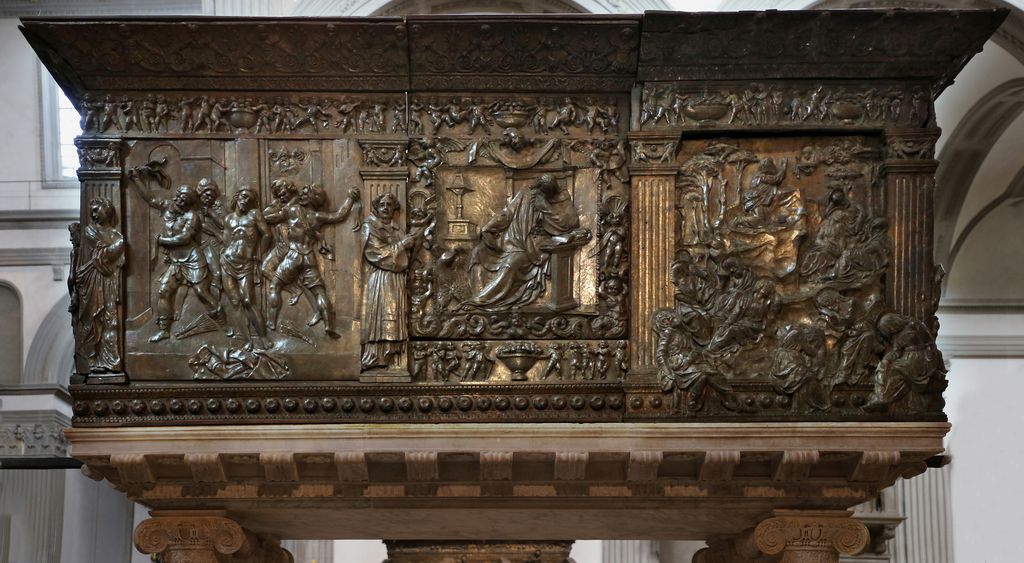
The Agony in the Garden with the distinct seventeenth-century additions on the same side. Sailko. Image source. CC BY 3.0. Resized for the web.
Irving Lavin drew attention to the number of disciples. Donatello includes all eleven still with Christ, following a convention found in earlier Tuscan art. Fifteenth-century artists such as Ghiberti and Fra Angelico often concentrated on the three whom Christ took farther into the garden. The extra bodies matter here because they give the scene its descent from the quiet, shallow modelling at the top to the physical weight of the sleepers at the bottom. The viewer sees a man praying above a landscape and, at the same time, a row of figures apparently resting on the very object above their head. [2]
Christ before Pilate and Caiaphas
Two deep, coffered vaults occupy the short end towards the entrance. Pilate’s hearing takes the left bay as you face the relief and Caiaphas’s the right. Two moments of the story thus share the same architectural setting, with the order of the hearings reversed from the Gospel sequence if you read the panel left to right. A column with a band curling around the shaft marks the division. Look lower and the column seems to dissolve into a crowd that crosses the centre. The vaults pull the eye into depth while the large figures press forward across the lower edge. [2] [6] [8]
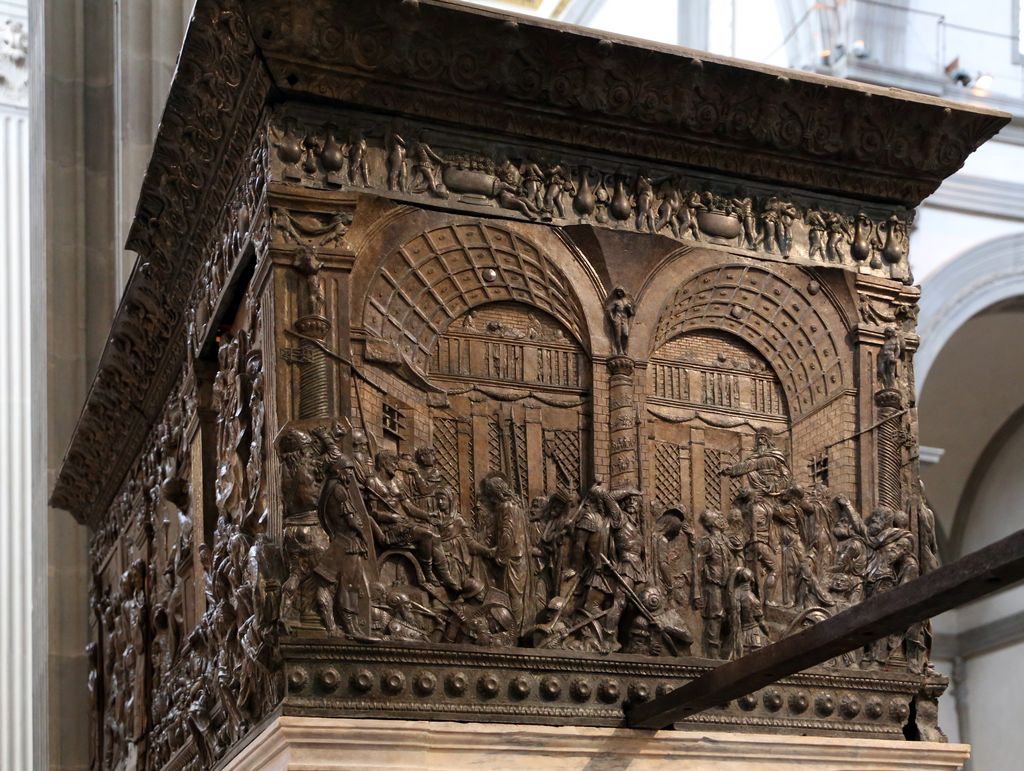
The trial scenes from an oblique viewpoint, with the arches above the relief and pulpit moulding. Sailko. Image source. CC BY 3.0. Resized for the web.
In the Pilate episode, Lavin saw an echo of Roman scenes of judgement, especially an imperial relief on the Arch of Constantine. The bench and the crowd give the event the character of a public hearing. The paired vaults also recall buildings and architectural imagery that Donatello could have seen in Rome. Lavin noted Roman terracotta reliefs with comparable arches and spiral columns. Dagmar Maria Schumacher drew attention to the large vaults of the Basilica of Maxentius as a possible architectural source. The differences between the proposals are worth keeping in view. The relief has the scale of a Roman public building and the intricacy of a carved frame, while its figures close off much of the floor that would make the imagined rooms easy to map. [2] [6]
Donatello had used architecture to manage a crowd long before San Lorenzo. In the Siena Feast of Herod, a sequence of smaller figures and openings carries the eye into a distant room. At San Lorenzo, the crowded foreground competes with the depth promised by the arches. The projecting soldier near the edge brings this tension into focus. His figure occupies the boundary between the carved hall and the space in front of the pulpit. [2] [5]
The Crucifixion and the Lamentation
The nave-facing Crucifixion presses its action close to the surface. Christ and the two thieves hang from crosses with their arms set parallel to the plane of the relief. Below, overlapping helmets, horses and weapons leave little open space. Lavin compared this combination of frontal crosses and a tightly packed crowd to fourteenth-century Tuscan precedents. The three crosses register clearly from across the nave, while the crowd takes longer to read. A lifted arm or the head of a horse catches the light before the figures below Christ resolve into separate groups. [2] [9]
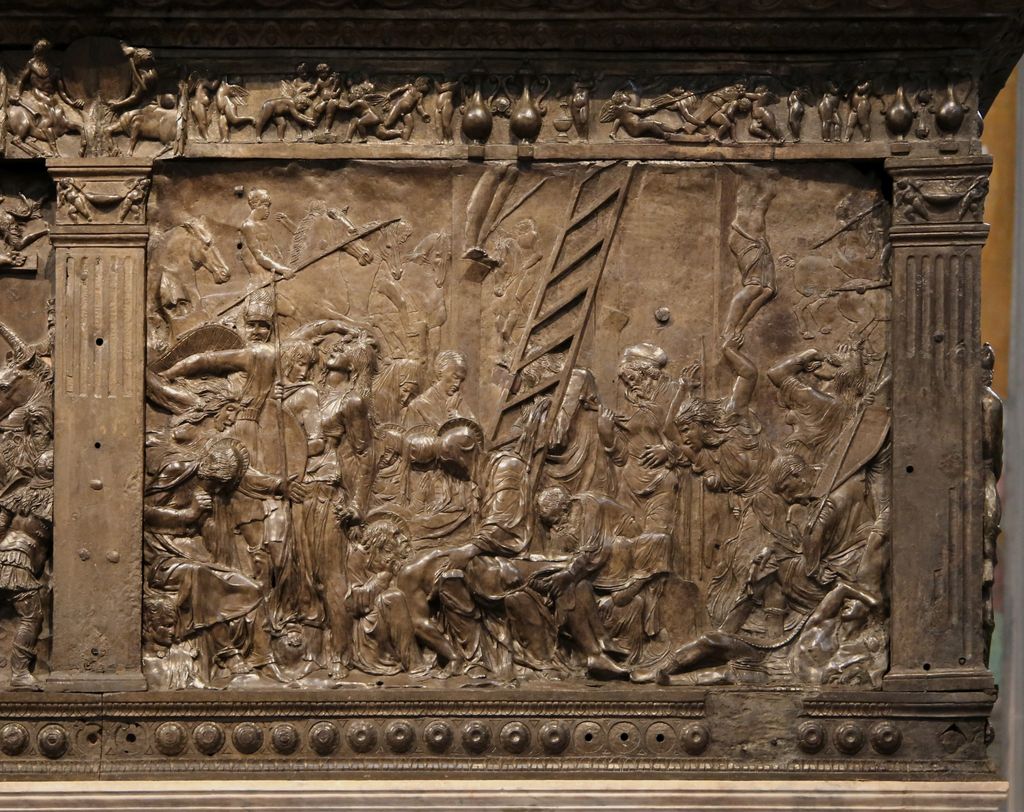
A closer view of the descent and lamentation beside the Crucifixion. Francesco Bini. Image source. CC BY-SA 4.0. Resized for the web.
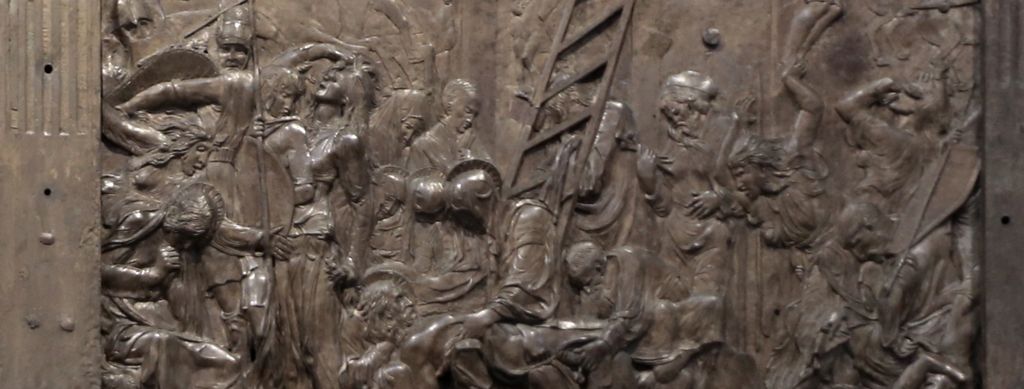
The adjacent bronze appears as Compianto in the Opificio’s account and as Deposition from the Cross in Italy’s national catalogue. Both titles refer to the same relief. The ladder and crosses preserve the setting of the Descent, and the fallen body and the people gathered around it make the work a Lamentation. The tops of the crosses are cut off by the frame. The shafts and ladder appear at oblique angles, leaving the foreground free for upright, bending and collapsing bodies. A shallow group of riders high in the composition becomes easier to see at close range. The difference between their faint forms and the forcefully projected mourners is especially clear after cleaning. [1] [2] [5] [10]
Seen side by side, the reliefs keep the execution and its aftermath in view together. Their positions invite the eye to cross the pilaster and compare how much space the crosses occupy. In the first scene their arms span the upper field. In the second they run out of the frame, and the strongest lines come from the mourners’ bodies. Faces turn toward the dead Christ, towards one another and upwards. The spread of attention gives the group a sense of movement even where the figures have dropped to their knees or sunk to the ground. [2] [5] [10]
Annotated Details from the Passion Pulpit
Select a number to jump to a detail of the sculpture.
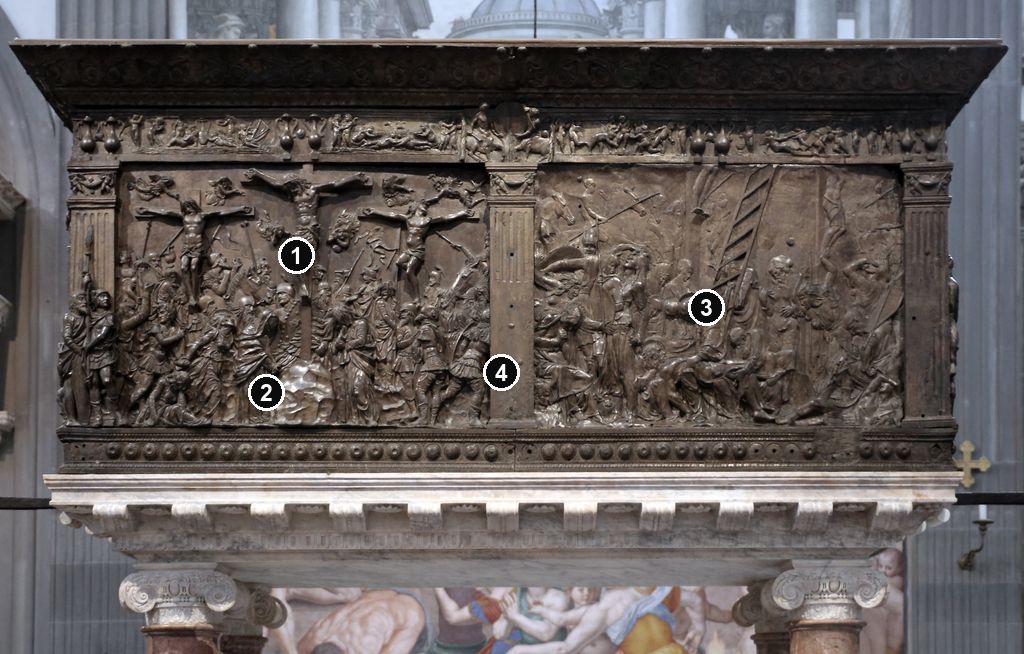
Details from THE PASSION PULPIT
Open a detail image to examine the surface more closely.
Crosses above the crowd
The uprights continue through the overlap of bodies in the lower part of the Crucifixion. Their rising lines help the central figures read against the dense bronze.
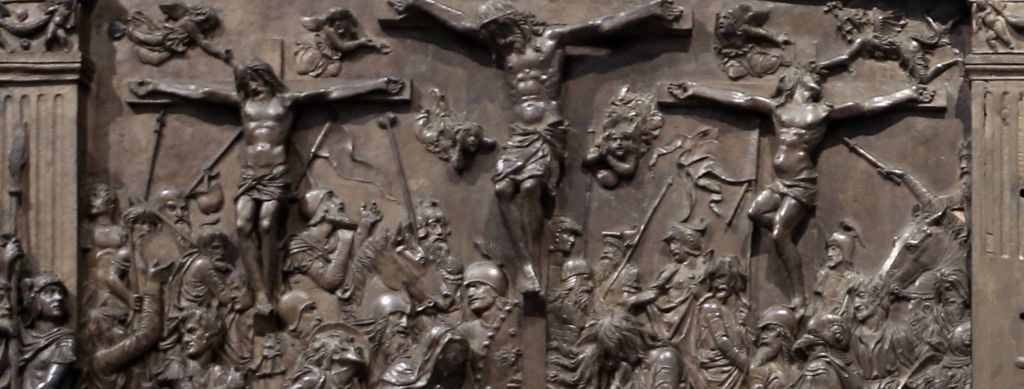
Mourners below
Faces, limbs and pieces of clothing cross within a shallow space. Several faces turn away from the lines of the crosses.
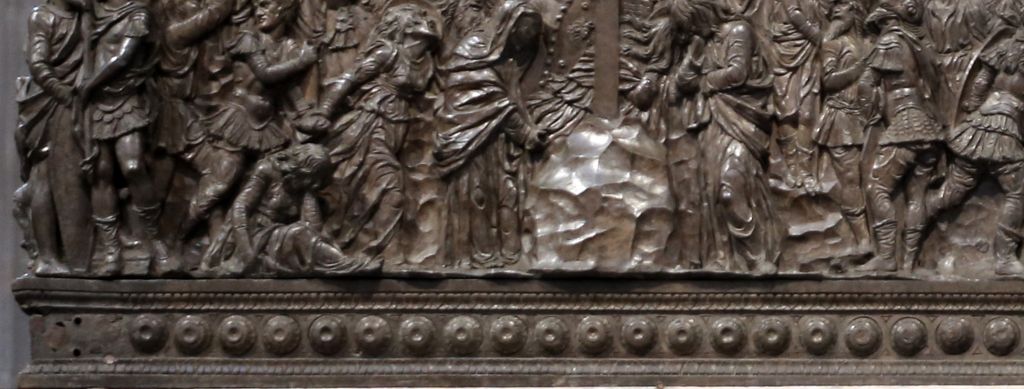
The lowering of Christ
Steps, ladders and bodies establish changes in level on the bronze to the right. The clustered figures direct attention towards Christ.
The division between scenes
An upright boundary breaks the action into separate fields. The assembled wood and metal structure around the scenes belongs to the pulpit’s later history.
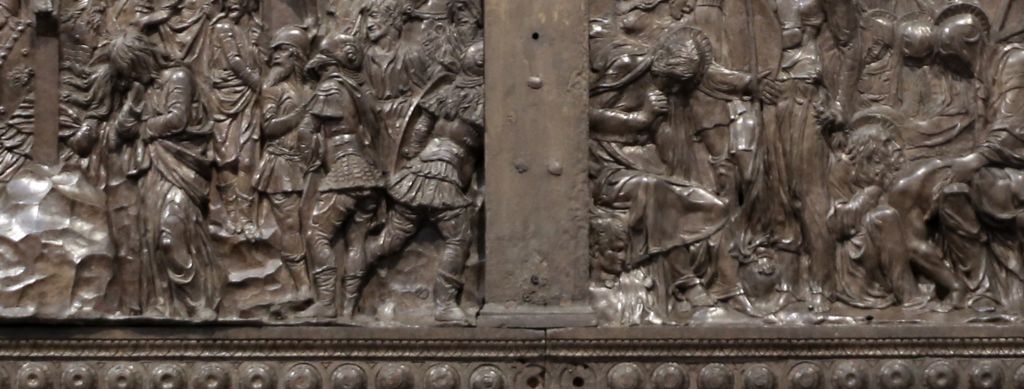
Annotated photograph and detail crops. Sailko. Image source. CC BY 3.0. Resized, annotated and cropped from the original photograph.
The Entombment
At the altar end, a stone sarcophagus gives the figures a solid shape to gather around. Joseph of Arimathea and Nicodemus are among the figures identified in the national catalogue. The body is lowered at the centre, with women seated on the ground in front and taller figures overlapping the edges of the scene. The cross had lifted Christ above the crowd. Here the alignment of bodies and gestures draws the eye down to the rim of the tomb. [2] [11]
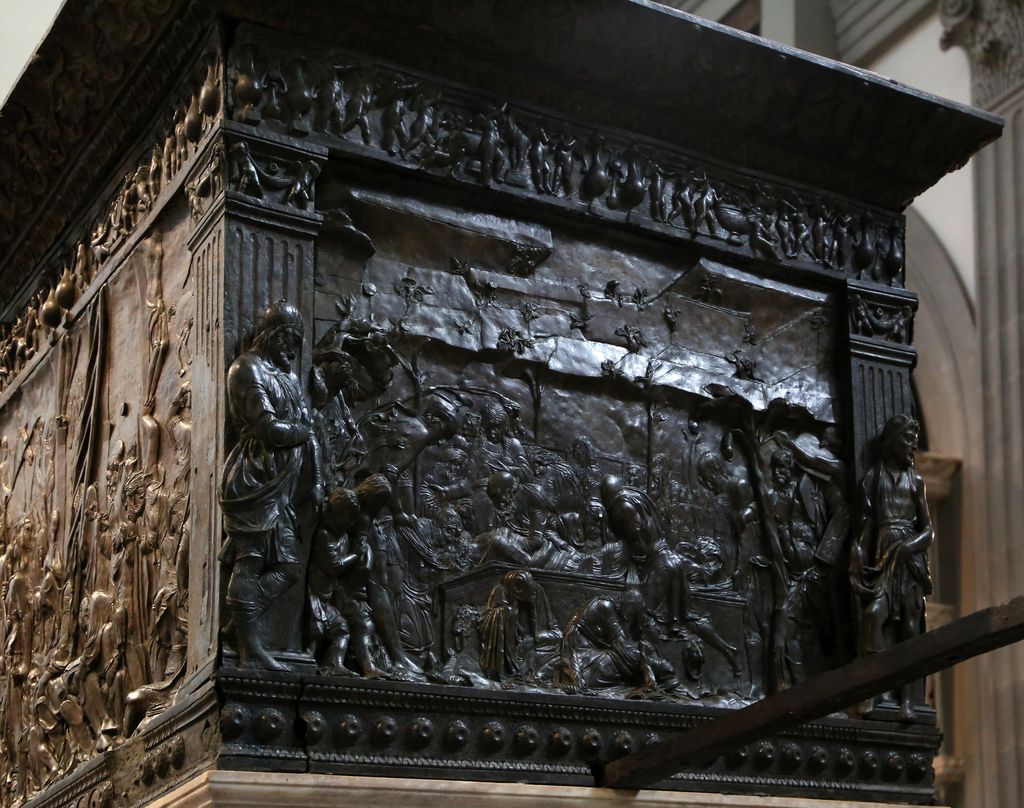
The Entombment occupies the altar-facing end of the Passion Pulpit. Sailko. Image source. CC BY 3.0. Resized for the web.
The corner changes the way the story is seen. In the nave, the execution and mourning occupy a single long view. To see the burial squarely, the viewer has to go around the end. From an oblique position both the Lamentation and the Entombment can be seen, one retreating into the distance as the other comes into view. They have different centres of gravity even though the same dead body draws the people together. Lavin noted the unusually prominent role of the seated women and compared their poses with Simone Martini’s painted Entombment in Berlin. The resemblance helps explain how an older image of grief could work on a bronze surface intended to be seen from below. [2] [11]
Making the bronze reliefs
The documentary evidence places a large bronze operation in Donatello’s Florentine workshop late in his career. In the autumn of 1456 he bought copper and bronze, charcoal, wax and iron. Bank records published by Frederick Hartt and Gino Corti also name Bartolomeo Bellano among those receiving payments. The account gives no title for the work. Caglioti argues that the supplies were connected with the equestrian monument commissioned by Alfonso of Aragon, of which the bronze horse head in Naples survives. A document from March 1466 links the prospect of Bertoldo di Giovanni working in bronze with Donatello to a repayment agreement. Vasari’s later account goes further, crediting Bertoldo with work on the pulpits specifically. The surviving records leave the division of labour within individual scenes open to interpretation. [1] [4] [12]
Italy’s national catalogue credits Donatello with the design and Bellano with the execution of the Agony. In its entry for the Entombment, it assigns the execution to Bertoldo. The catalogue also credits Donatello and Bellano with partial execution of the Crucifixion. These are scholarly attributions to particular parts of the work. The bronzes themselves preserve evidence of several stages, including modelling in wax, casting, joining and working the cooled metal. It is possible for one person’s modelling and another person’s finishing to survive on the same figure. [5] [7] [9] [11]
Conservators looking at the backs of the reliefs found casting channels, joins between sheets of wax that carried through into the bronze, and traces of the clay-and-sand investment used to surround the model. X-rays and inspection also revealed evidence of repairs and fastenings. The close technical study of the two pulpits found copper, tin and variable quantities of lead. Differences in alloy composition, surface finish or repair can help distinguish separate operations. They give no simple means of attaching a name to a surface, especially where the joining could belong to a later remounting. [5]
How the reliefs became a pulpit
Cosimo de’ Medici is associated with the commission in the accounts of Vespasiano da Bisticci and Giorgio Vasari. The present placement took shape well after Cosimo’s death in 1464 and Donatello’s in 1466. Francesco Albertini, writing in 1510, described bronze pulpits for the Gospel and Epistle readings. The Opificio also records an early use as singers’ galleries. It cites wooden supports for Leo X’s visit in 1515. Caglioti points to a diary entry dating the mounting of the Passion Pulpit on marble columns to March 1559, and places the corresponding work on the pair within 1559–65. Prints showing the funeral commemorations for Henri IV in 1610 and Emperor Matthias in 1619 depict column-supported furnishings in the church. The Opificio places the move to their current position after the second of these events. Caglioti places it by 1634. [1] [2] [13] [14] [15] [4]
The original purpose of the bronzes has been debated. Lavin made the case for a planned pair of reading platforms, or ambos, recalling arrangements in early Christian and medieval churches. On that reading, the separation of the Passion from the events that follow it gave each side of the church its own role in the story. Other scholars have considered whether at least some of the bronzes were meant for the high altar or for a funerary setting. The national catalogue records the high altar proposal especially in connection with the Resurrection reliefs. The rectangular form and decoration recalling antique sarcophagi help explain the appeal of a funerary reading. Caglioti’s reconstruction places the paired platforms nearer the high altar, making them part of a setting that included Cosimo’s grave in front of it. The altar would then occupy the space between the episodes before and after Christ’s burial. That arrangement would give the story a liturgical centre and account for the absence of a Last Supper relief. The early uses remain better documented than any reconstruction of the proposed arrangement. [6] [13] [16] [4]
Across the nave, the Resurrection Pulpit includes the women finding the tomb, Christ’s Descent into Limbo, the Resurrection, the Ascension and Pentecost, as well as the Martyrdom of Saint Lawrence, the church’s patron. An inscription with a date in June 1465 belongs to the Martyrdom, on the companion pulpit. Its date has sometimes entered accounts of the pair as a whole. The conservators note that the inscription was cut into the metal and discuss the possibility that it was added after Donatello’s death. It cannot securely date either the completion of the Passion bronzes or their installation. [1] [5]
Conservation at San Lorenzo
The Opificio delle Pietre Dure restored both pulpits in the basilica. Work on the Passion ensemble began in September 2014, following the treatment of its companion, and the overall campaign concluded in April 2017. The conservators tailored cleaning to the condition and material of each part, recovering the legibility of small details and surviving traces of gold leaf. The historic structure of the Passion Pulpit also had serious stability problems, addressed with a new internal support. A viewer sees the inherited placement and marble columns, while the modern intervention that helps carry the bronzes remains concealed. [1] [3] [5] [17]
Donatello and Michelozzo’s earlier pulpit at Prato Cathedral served a different purpose. It was built on the outside of the cathedral so the Sacred Girdle could be shown to people in the square. Its marble parapet carries dancing figures, and the originals are now in the cathedral museum. In Florence the Passion Pulpit remains a work to see in the round inside the church. From the centre of the nave the high relief makes the crosses and bodies distinct. From the sides, the difference between the rear, barely raised figures and the bodies that extend beyond the frame shows just how far the workshop could vary the depth of bronze within a single scene. [2] [5] [18]
Donatello sculpture directory
| Name | Date | Medium and record |
|---|---|---|
| Marble David | 1408–09, adapted 1416 | Carved Carrara marble Catalogue. |
| Saint John the Evangelist | c. 1409–15 | Carved marble Catalogue. |
| Saint Mark | 1411–13 | Carved Carrara marble Catalogue. |
| Saint George and its dragon relief | c. 1415–17 | Marble statue and marble relief Catalogue. |
| Marzocco | c. 1417–20 | Carved sandstone Catalogue. |
| Saint Louis of Toulouse, Florence | 1418–25 | Gilt bronze and mixed media Catalogue. |
| Pazzi Madonna | c. 1420s | Marble relief Catalogue. |
| Reliquary Bust of Saint Rossore | c. 1420s | Gilt bronze Catalogue. |
| The Prophet Jeremiah | 1420s–30s, disputed | Marble Catalogue. |
| Zuccone | c. 1420s–30s | Marble Catalogue. |
| Feast of Herod, Siena | 1420s | Gilded bronze relief Catalogue. |
| Ascension with Christ Giving the Keys to Saint Peter | c. 1428–30 | Marble relief Catalogue. |
| Cantoria | 1433–39 | Marble and mosaic Catalogue. |
| Amor-Atys | c. 1435–40 | Partly gilded bronze Catalogue. |
| Bronze David | c. 1435–40, disputed | Partly gilded bronze Catalogue. |
| Gattamelata | Installation agreement, 1453 | Bronze and stone Catalogue. |
| Santo altar | Mid-fifteenth century | Bronze and limestone ensemble Catalogue. |
| Chellini Madonna | Given in 1456 | Partly gilded bronze tondo Catalogue. |
| Penitent Magdalene | c. 1453–55 (Opera) | Poplar, stucco, pigments and gold Catalogue. |
| Judith and Holofernes | Late 1450s–early 1460s | Bronze with surviving gilding Catalogue. |
| Pulpit of the Passion | Late work and later assembly | Bronze reliefs, Donatello and collaborators Catalogue. |
| Bust traditionally called Niccolò da Uzzano | Fifteenth century | Painted terracotta, attribution disputed Catalogue. |
| Prato Cathedral exterior pulpit | Commissioned 1428; carved 1430s | Marble reliefs, Donatello and Michelozzo Catalogue. |
| Cavalcanti Annunciation | c. 1433–35 | Gilded sandstone and terracotta Catalogue. |
| Crucifix at Santa Croce | Early fifteenth century | Painted wood Catalogue. |
| Madonna of the Clouds | c. 1425–35 | Marble relief Catalogue. |
| Old Sacristy Doors | Fifteenth century | Two paired bronze doors Catalogue. |
| Resurrection Pulpit | Late work and later assembly | Bronze reliefs, Donatello and collaborators Catalogue. |
| Brancaccio tomb | 1420s | Donatello, Michelozzo and assistants, mixed materials Catalogue. |
| Saint John the Baptist, Venice | 1438 | Polychromed and gilded wood Catalogue. |
| Sacrifice of Isaac | Early fifteenth century | Donatello and Nanni di Bartolo, marble Catalogue. |
| Madonna of Via Pietrapiana | Mid-fifteenth century | Terracotta Catalogue. |
| Miracle of the Mule | Mid-fifteenth century | Gilded bronze panel for the Santo altar Catalogue. |
| Padua Crucifix | Mid-fifteenth century | Cast bronze Catalogue. |
| Dancing Spiritello, Bargello | Fifteenth century | Bronze Catalogue. |
| Young Prophet from the Porta della Mandorla | c. 1404–09 | White marble, attributed to Donatello Catalogue. |
| Prophet or Apostle from the Duomo north tribune | Early fifteenth century | White marble, possibly Donatello Catalogue. |
| Beardless Prophet | 1415–18 | White marble Catalogue. |
| Sibyl and Prophet of the Porta della Mandorla | 1422 | Carved marble heads for the portal Catalogue. |
| Faith, Siena baptismal font | 1420s | Gilded bronze figure Catalogue. |
| Hope, Siena baptismal font | 1420s | Gilded bronze figure Catalogue. |
| Feast of Herod, Lille | c. 1430 | Carrara marble relief Catalogue. |
| Piot Madonna | c. 1440–60 | Polychrome terracotta with glass and wax inlays Catalogue. |
| Carafa Horse Head | c. 1456–58 | Cast bronze Catalogue. |
| Pazzi Madonna workshop version, Louvre | c. 1450 | Polychrome gesso, Donatello’s workshop Catalogue. |
| Pazzi Madonna tondo, Rijksmuseum | c. 1425–50 | Plaster and stucco, after Donatello Catalogue. |
| Sprite | c. 1430–40 | Bronze, sculptor or metalsmith close to Donatello Catalogue. |
Discussion
Look again at the images and ideas explored in Pulpit of the Passion. These editorial prompts invite your observations.
Reader Insights
Which figures help you see the difference between the Crucifixion and the Lamentation across the long face?
How does the architecture guide the eye through the trials when you see the pulpit from the floor?
Join the Conversation
Share a detail, comparison or question about Pulpit of the Passion below.
References
- Opificio delle Pietre Dure, “Donatello, Pulpiti della Passione e della Resurrezione, 1456–1466, Basilica di San Lorenzo, Firenze.” View source.
- Irving Lavin, “The Sources of Donatello’s Pulpits in San Lorenzo,” The Art Bulletin, vol. 41, no. 1, 1959, pp. 19–38. View source.
- Opera Medicea Laurenziana and Opificio delle Pietre Dure, presentation of the restoration of the Pulpit of the Passion, May 2017. View source.
- Francesco Caglioti, “I pergami donatelliani di San Lorenzo nel contesto: architettura, liturgia, committenza,” in L’ultimo Donatello. I Pulpiti di San Lorenzo: studi e restauro, 2022, pp. 39–90. View source.
- Maria Baruffetti, Stefania Agnoletti, Annalena Brini, Alessandro Pacini, Elisa Pucci and Laura Speranza, “Donatello’s pulpits from the Basilica of San Lorenzo in Florence and bronze sculptures from Siena’s baptistery font,” Sculpture Journal, vol. 34, no. 1, 2025, pp. 33–45. View source.
- Dagmar Maria Schumacher, Von der Basilica Nova zum Templum Pacis, Universität Heidelberg, 2004, pp. 151–156. View source.
- Catalogo generale dei Beni Culturali, “Orazione di Cristo nell’orto di Getsemani,” record 0900281318-5. View source.
- Catalogo generale dei Beni Culturali, “Episodi della vita di Cristo,” record 0900281318-7. View source.
- Catalogo generale dei Beni Culturali, “Crocifissione di Cristo,” record 0900281318-1. View source.
- Catalogo generale dei Beni Culturali, “Deposizione di Cristo dalla croce,” record 0900281318-2. View source.
- Catalogo generale dei Beni Culturali, “Deposizione di Cristo nel sepolcro,” record 0900281318-3. View source.
- Lorenz Böninger and Luca Boschetto, “Bertoldo di Giovanni: nuovi documenti sulla sua famiglia e i suoi primi anni fiorentini,” Mitteilungen des Kunsthistorischen Institutes in Florenz, vol. 49, 2005, especially p. 238. View source.
- Irving Lavin, “Donatello’s Bronze Pulpits in San Lorenzo and the Early Christian Revival,” in Past-Present: Essays on Historicism in Art from Donatello to Picasso, 1993. View source.
- Wellcome Collection, “The church of San Lorenzo, Florence, with funerary decorations to mark the death of King Henri IV of France,” etching catalogued to about 1610. View source.
- Cooper Hewitt, Smithsonian Design Museum, Exequies celebrated in Florence for the Death of Emperor Matthias, 1619, accession 1946-35-1. View source.
- Catalogo generale dei Beni Culturali, “Storie della passione di Cristo,” ensemble record 0900281318-0. View source.
- Opificio delle Pietre Dure, L’ultimo Donatello. I pulpiti di San Lorenzo: studi e restauro, edited by Maria Donata Mazzoni. View source.
- Diocesi di Prato, “Il pulpito di Donatello.” View source.
- Victoria and Albert Museum, Donatello’s David. View source
- Opera del Duomo, Donatello and the Opera del Duomo. View source
- Ministero della Cultura, David with the Head of Goliath, Bargello bronze. View source
- Save Venice, Donatello’s Equestrian Monument to Gattamelata. View source
More DONATELLO Sculptures
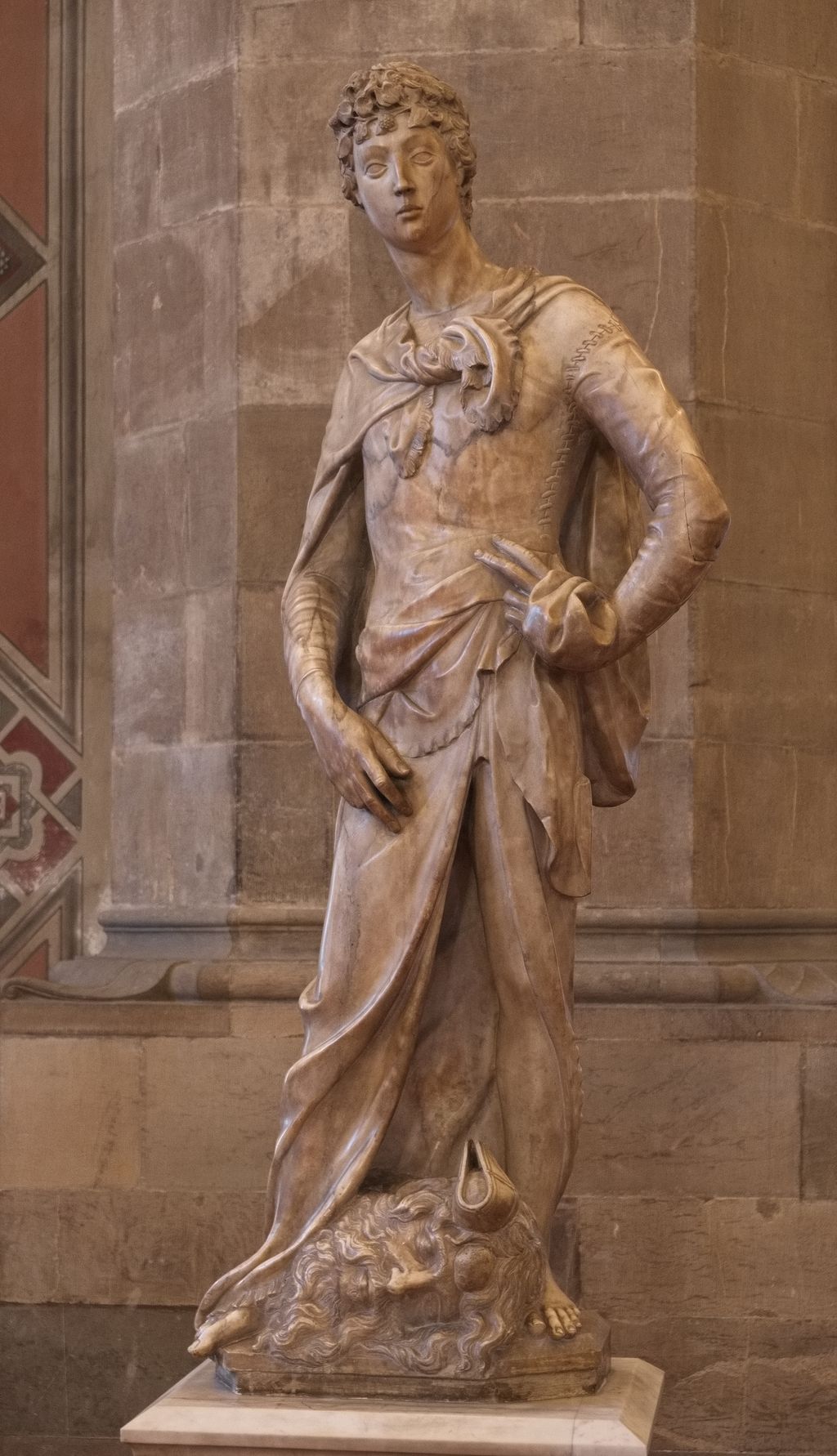
Marble David
Armin Kleiner. Image source. CC BY-SA 4.0. Resized for the web.
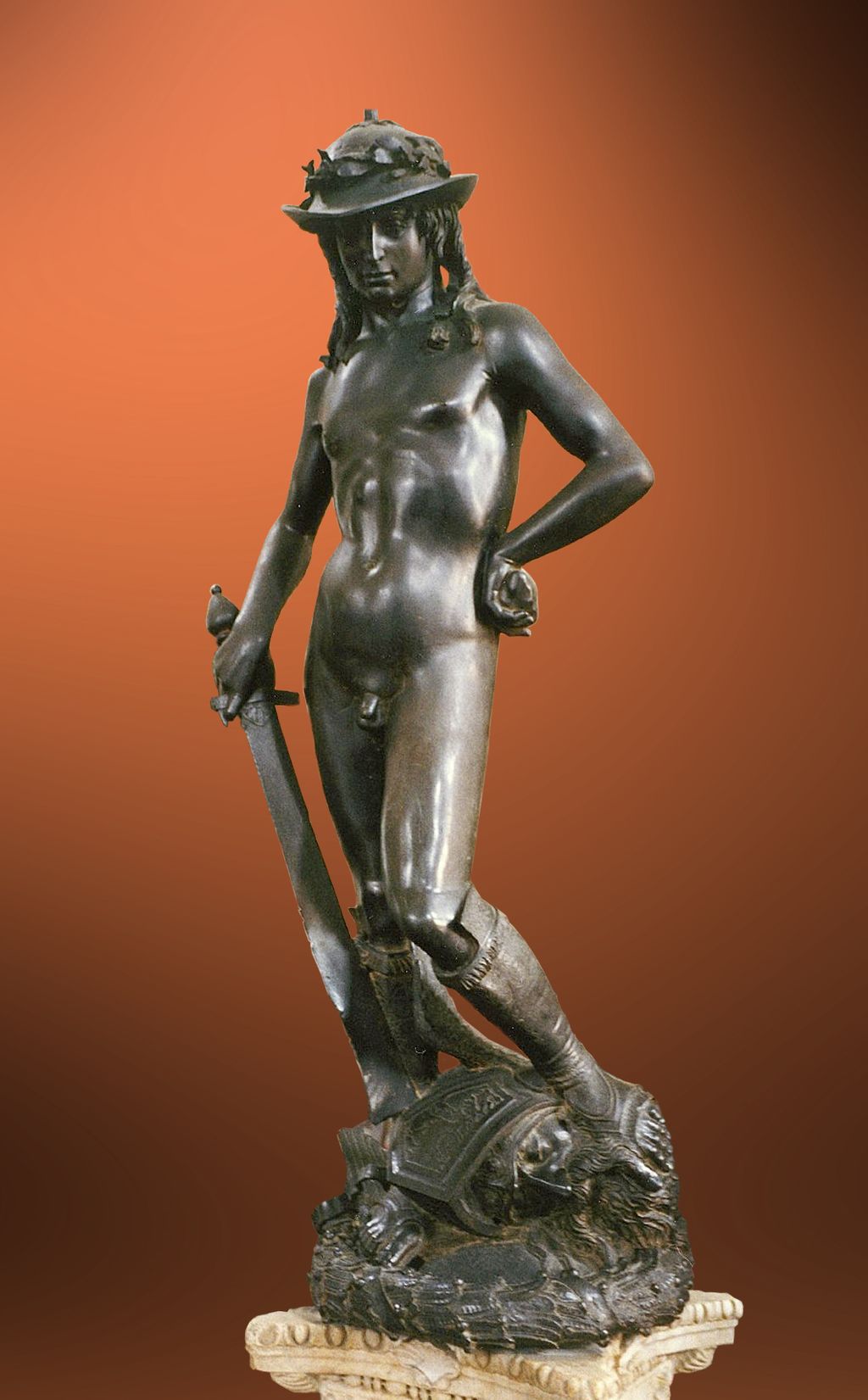
Bronze David
Patrick A. Rodgers. Image source. CC BY-SA 2.0. Resized for the web.
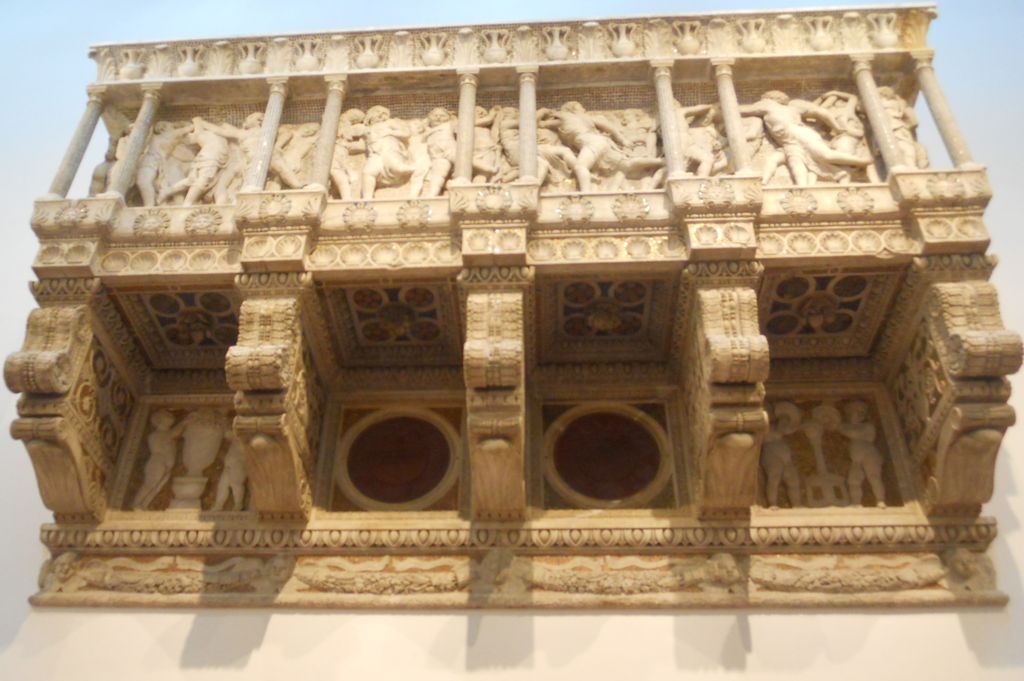
Cantoria
Erik Drost. Image source. CC BY 2.0. Resized for the web.
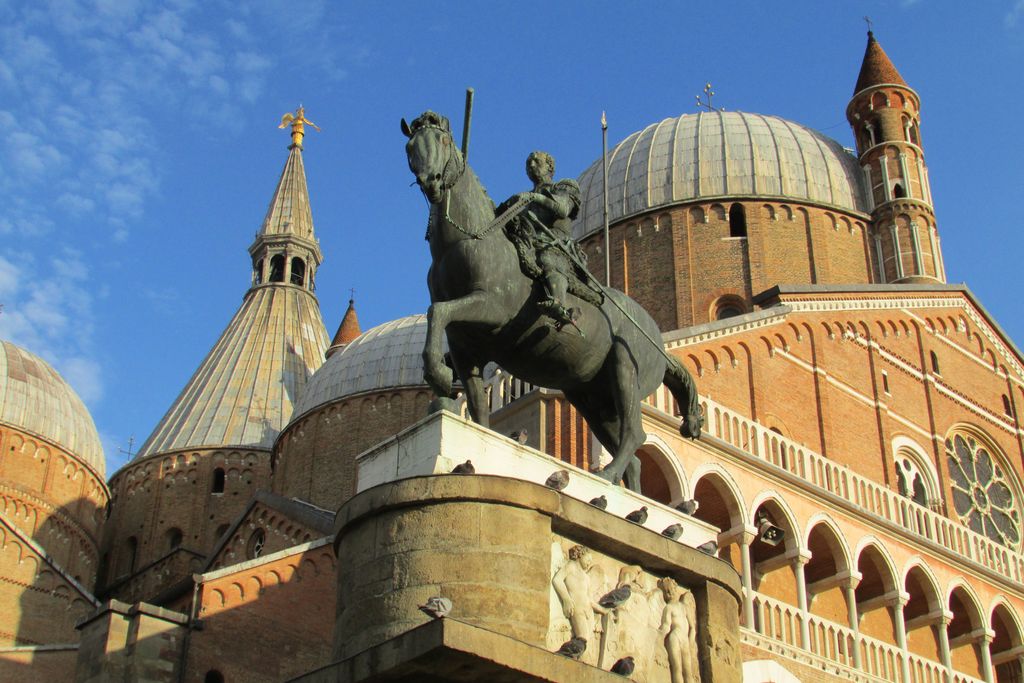
Gattamelata
Chris Light. Image source. CC BY-SA 4.0. Resized for the web.
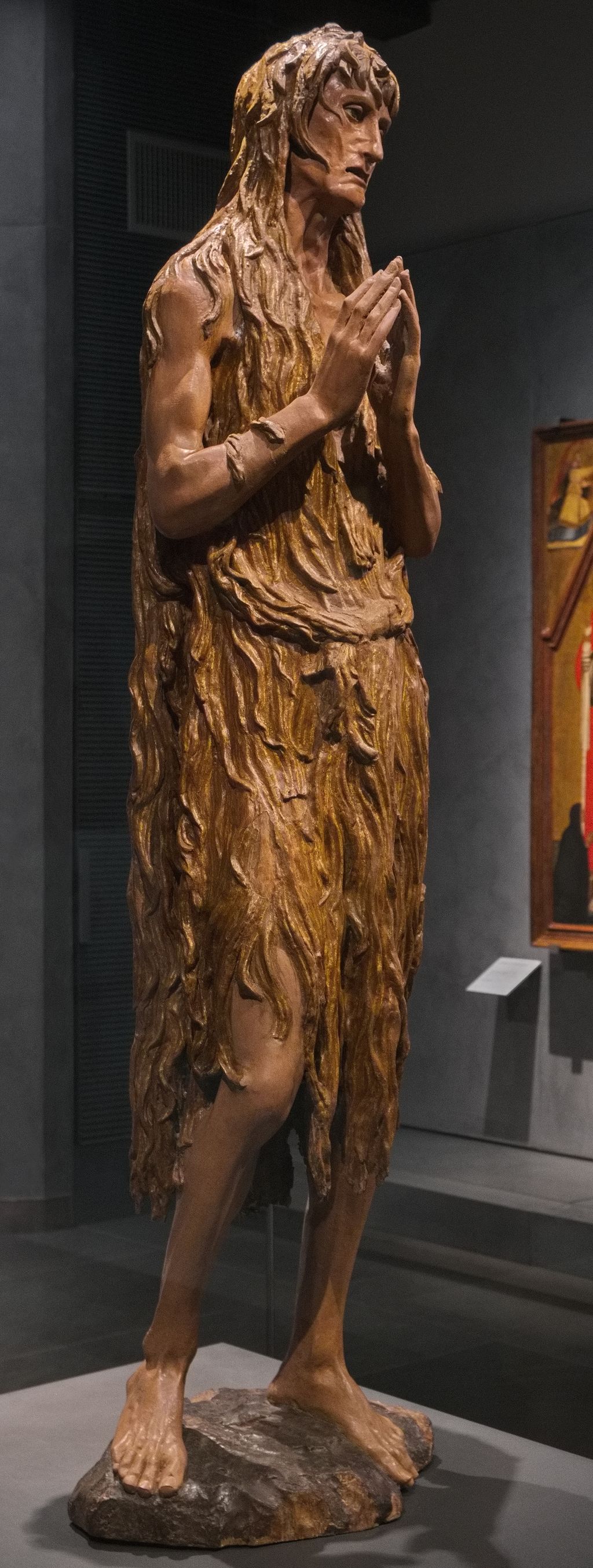
Penitent Magdalene
Armin Kleiner. Image source. CC BY-SA 4.0. Resized for the web.
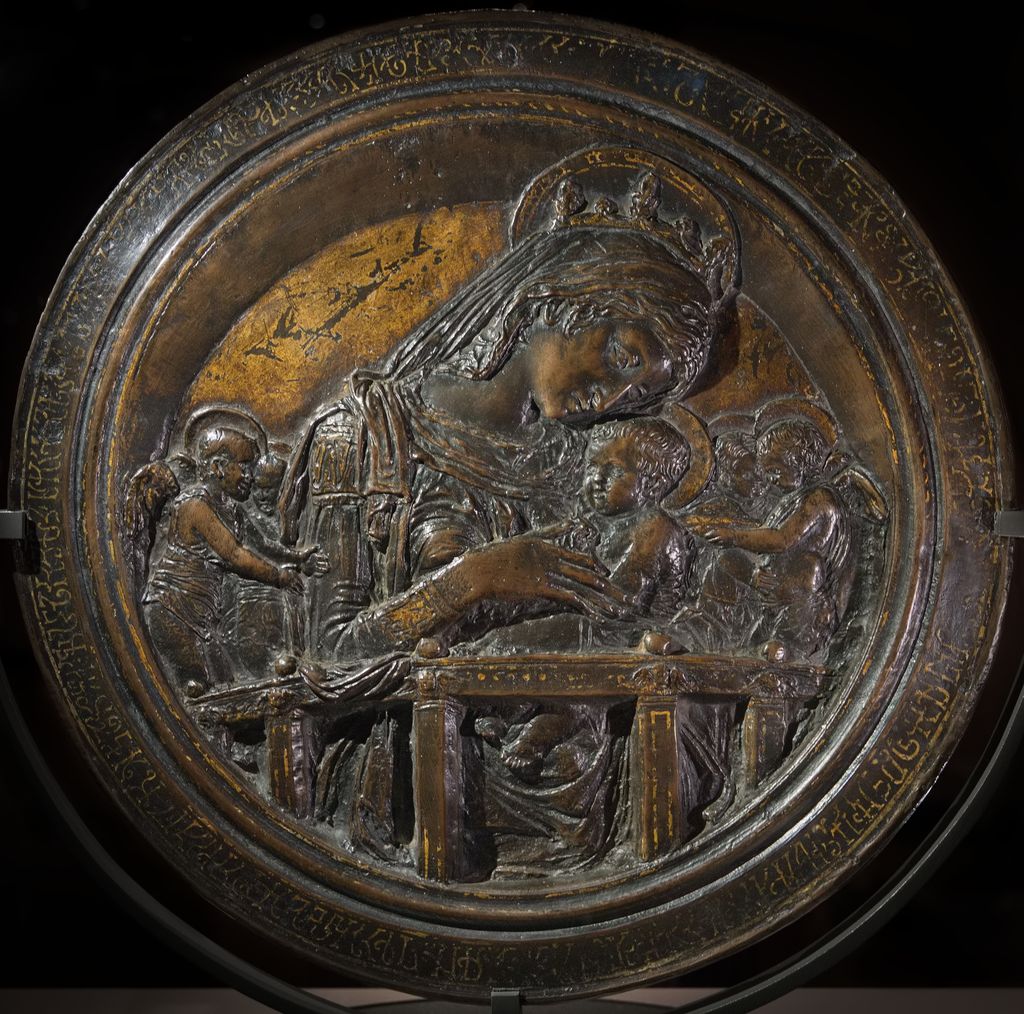
Chellini Madonna
Armin Kleiner. Image source. CC BY-SA 4.0. Resized for the web.
