


 by Tom Gurney
Tom Gurney BSc (Hons) is an art history expert with over 20 years experience
Published on June 19, 2020 / Updated on November 29, 2026
Email: tomgurney1@gmail.com / Phone: +44 7429 011000
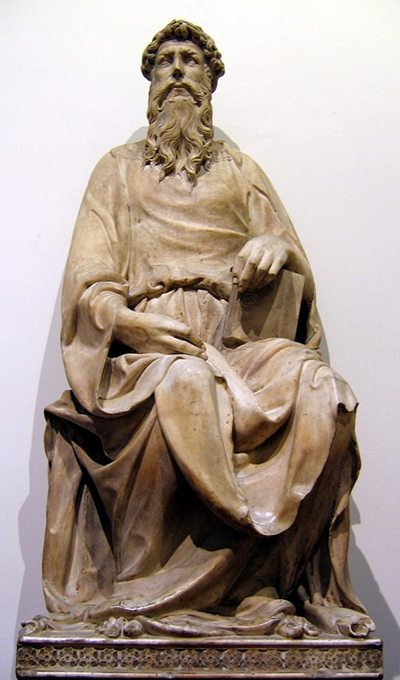
A thick book lies open on Saint John's left thigh. One hand steadies it and the other rests against his right knee. His head has already turned away, and the gaze under his knitted brow seems to have travelled still farther. That small movement carries across the broad folds of the mantle and up to the face of a figure more than two metres tall. Donatello carved the seated Evangelist in Carrara marble for the old façade of Florence Cathedral. The statue occupied the first niche to the right of the main doorway as one approached from the square. It is now in the Sala del Paradiso at the Museo dell'Opera del Duomo. [1] [2]
Four writers at the cathedral door
Imagine approaching Santa Maria del Fiore before the front of the church had its present appearance. Above the central entrance was a Madonna and Child by Arnolfo di Cambio. The seated authors of the four Gospels faced the square in pairs, two to either side of the doorway. They belonged to a fifteenth-century campaign on a façade that had been taking shape since Arnolfo's time. As the building acquired new sculptures, the four standing Doctors of the Church were moved to a higher register, leaving the lower one for the Evangelists. Francesco Caglioti notes that the Opera del Duomo specified the same height of four Florentine braccia for the seated figures as for the standing ones they replaced. The actual statues differ in height by as much as seventeen centimetres. [1] [3] [4] [5]
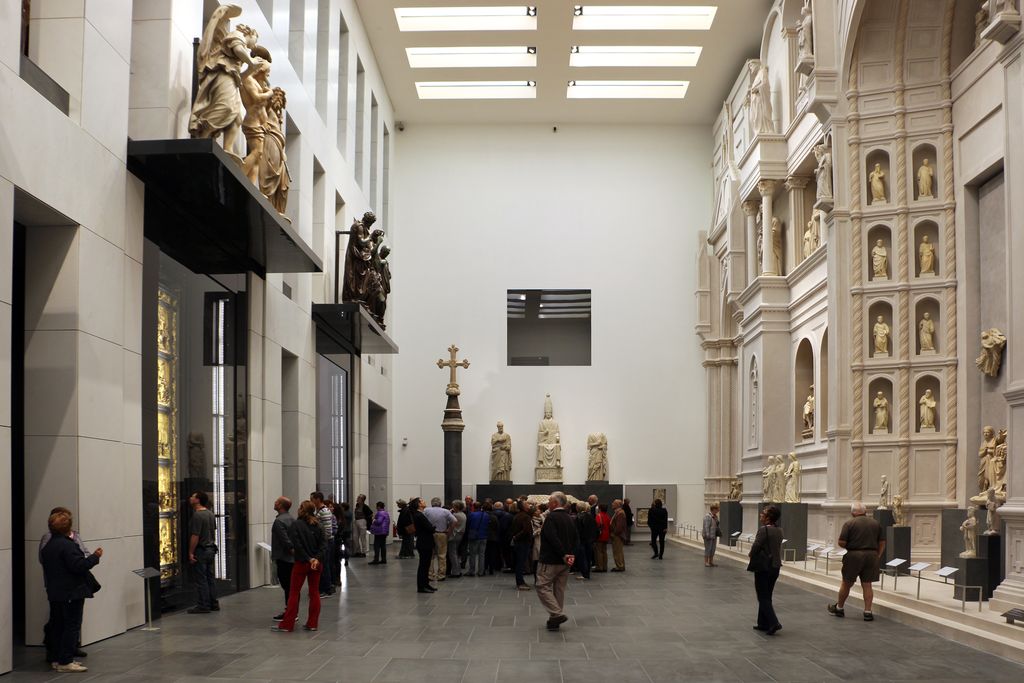
The reconstruction of Florence Cathedral’s former façade in the Sala del Paradiso, Museo dell’Opera del Duomo. Sailko. Image source. CC BY 3.0. Resized for the web.
The cathedral works administration allotted blocks to Donatello, Niccolò di Pietro Lamberti and Nanni di Banco on 19 December 1408. They were to make one Evangelist each. The fourth was originally promised to the maker of the finest of the three. On 29 May 1410, the Opera assigned it to Bernardo Ciuffagni, who carved Matthew. This early decision changed the terms of the commission before the finished group could be judged together. It also left the cathedral with four distinct answers to the same problem of giving a seated figure presence in a shallow, elevated niche. [3] [6] [14]
The current museum arrangement places Ciuffagni's Matthew and Nanni's Luke to the spectator's left, with Donatello's John and Lamberti's Mark to the right. Luke and John are nearest the central doorway. The evidence for the disposition includes Bernardino Poccetti's late sixteenth-century drawing of the old façade and a manuscript miniature showing the 1436 consecration of the cathedral. The Opera's detailed catalogue identifies John in the miniature and draws attention to his turn towards the entrance. Caglioti considers the current order the most plausible reconstruction of the four statues, whose relative positions have been debated. [2] [3] [5]
What the accounts tell us about the carving
The December 1408 commission explains why the statue often appears under the date 1408–15. The museum catalogues the carving as 1409–15. The records give us several points in that span, beginning with the allocation of the block and ending with the installed sculpture. They cannot supply a date for the cutting of each part of the figure. Some early entries refer simply to a figure or to several figures at a time when Donatello was working on multiple cathedral commissions. Caglioti has proposed that several payments once read in connection with the façade should instead be assigned to the artist's large terracotta Joshua. [1] [2] [3] [6]
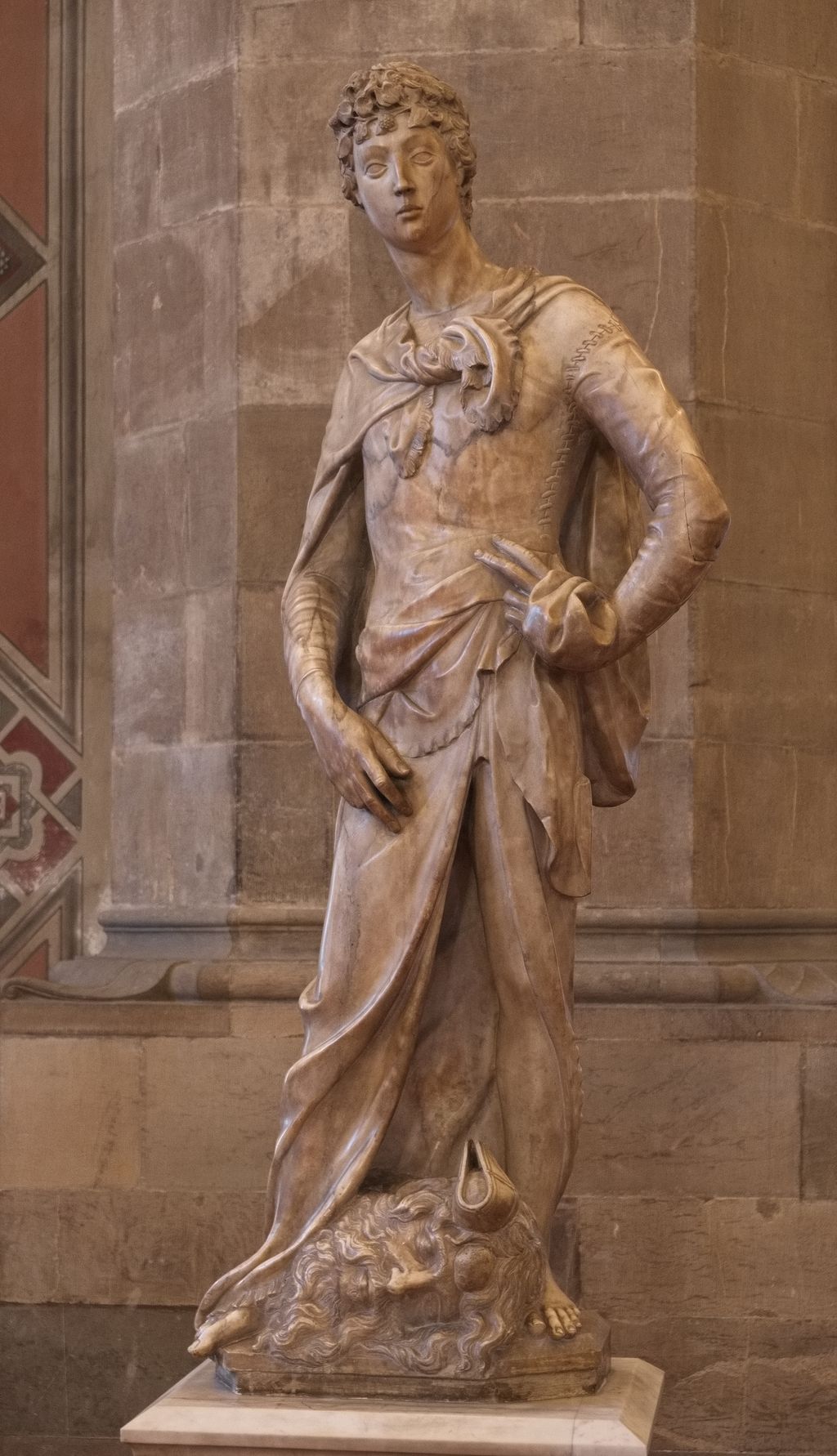
One unusually revealing entry is the provision of fifty florins on 12 August 1412 for painted decoration on John and Donatello's marble David. It specifies that the sum was separate from payment for the marble and carving. The document attests to a plan to add colour, while the appearance and extent of any decoration on John are harder to recover. In April 1413 the Opera recorded an instalment of thirty florins specifically for John. The accounts also show the Opera paying for a key in January 1415 to close the cathedral chapel where Donatello worked. In April the officials threatened a fine of twenty-five florins if he failed to complete the figure, and in May and June they continued to make instalment payments. By 8 October the Evangelist was in place beside the central door and had been valued at 160 florins, with 60 still due. [3] [6]
A figure carved for the view from below
In profile the economy of the block is striking. John measures 210 centimetres high by 88 wide, with a maximum depth of 54. The niche hid the back, so the sculptor concentrated his work on the exposed surfaces. The art historian Daniel M. Zolli notes that the stone is less than nine inches thick at the abdomen. The silhouette from the side is scarcely that of a seated body. From the front, the shifts in depth between the hands, knees and chest give the impression of a figure occupying considerably more space. Deep cuts beneath the drapery and beard darken those recesses and make the adjoining forms project. [1] [2] [7]
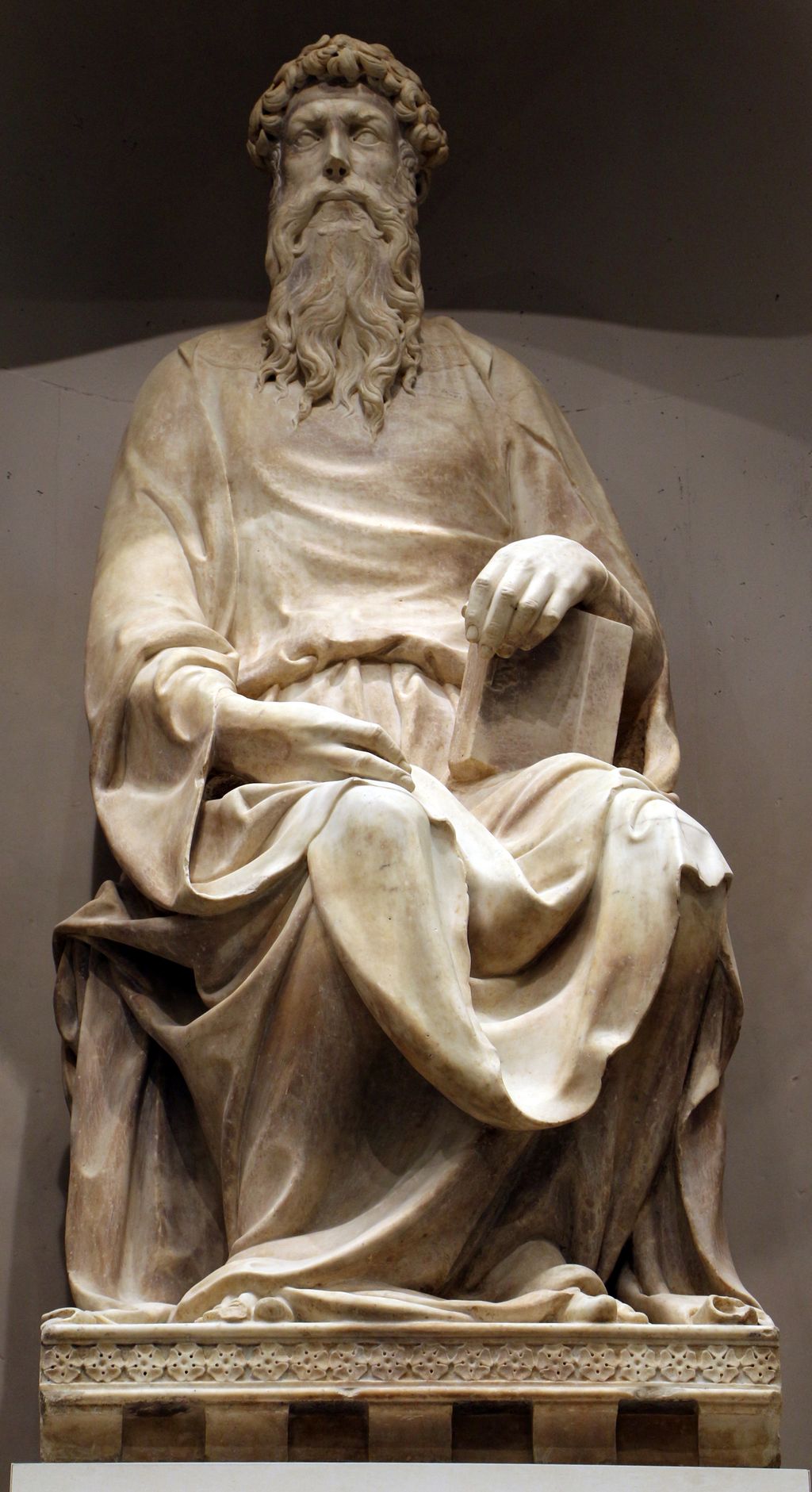
The seated Evangelist in the Museo dell’Opera del Duomo. The hands and folds span the shallow profile. Sailko. Image source. CC BY 3.0. Resized for the web.
Compare the long upper body with the relatively shallow projection of the knees. At eye level the saint's torso can seem stretched. Viewed from lower down, the upper half appears shorter, and the knees and seat form a broad base. In the low-angle view discussed by Zolli, a triangular outline is especially clear, rising from the base through the folds to the head. Look at where the figure turns within that outline: the knees largely keep their position while the shoulders and head carry the motion towards the entrance. [2] [7]
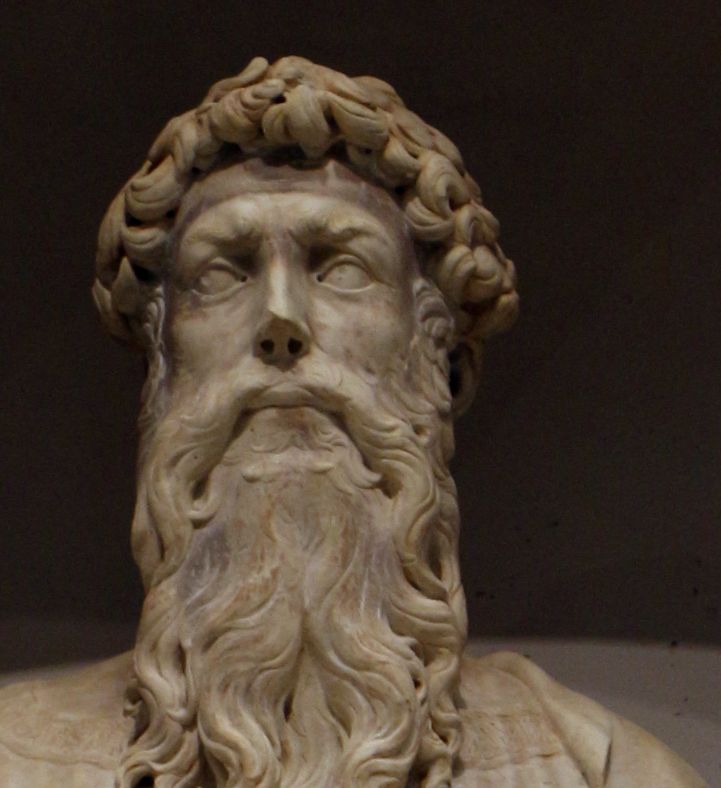
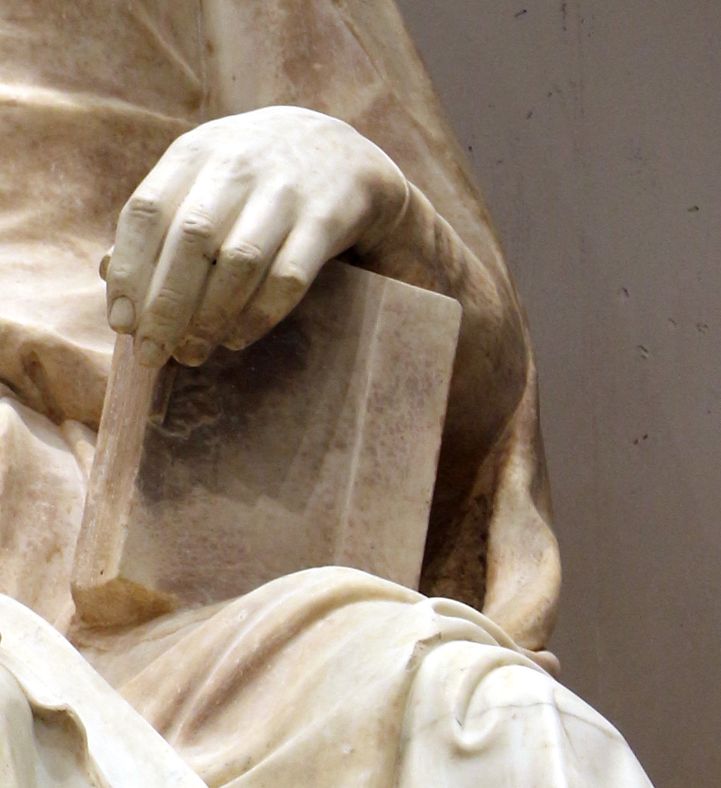
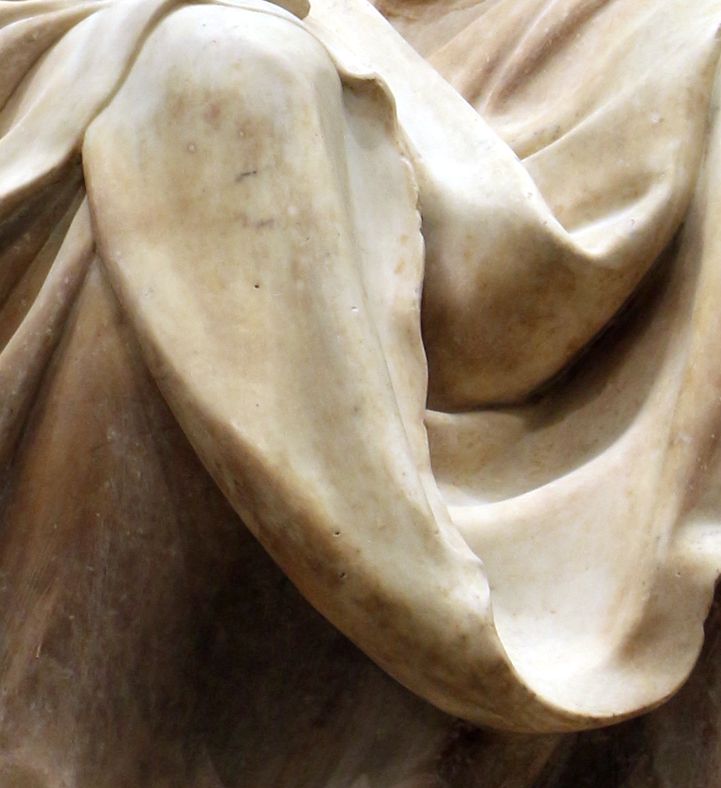
The carving guides the eye through differences in finish as well as differences in depth. Zolli points out the smooth surface of the hands, the incisions that follow the strands of the beard and the short cuts defining the eyebrows. The hand over the book looks supple against its straight edge. Across the lap, folds gather and drop, leaving broad stretches of mantle where the eye can follow the pressure of the fabric over the legs. From a distance the strongest shadows articulate the pose. Up close, the marks and varying polish give skin, hair and cloth different textures within one kind of stone. [2] [7]
The three companions help make these choices legible. Nanni's Luke, opposite John across the doorway, also holds an open volume, but lowers his attention towards it. His close beard and composed pose have been compared to ancient Roman portraiture. Lamberti gives his Mark a more elaborately patterned surface, down to the straps of the book. Ciuffagni's Matthew commands space through scale: he is the tallest of the four. Donatello also carved a Saint Mark during the same period, a standing figure for the linen guild at Orsanmichele. The two commissions gave him different bodies to fit into niches, and both show how folds, shadows and the angle of a head can make a figure seem to extend beyond the stone available to it. [2] [3] [7] [8]
Annotated Details from Saint John the Evangelist
Select a number to jump to a detail of the sculpture.
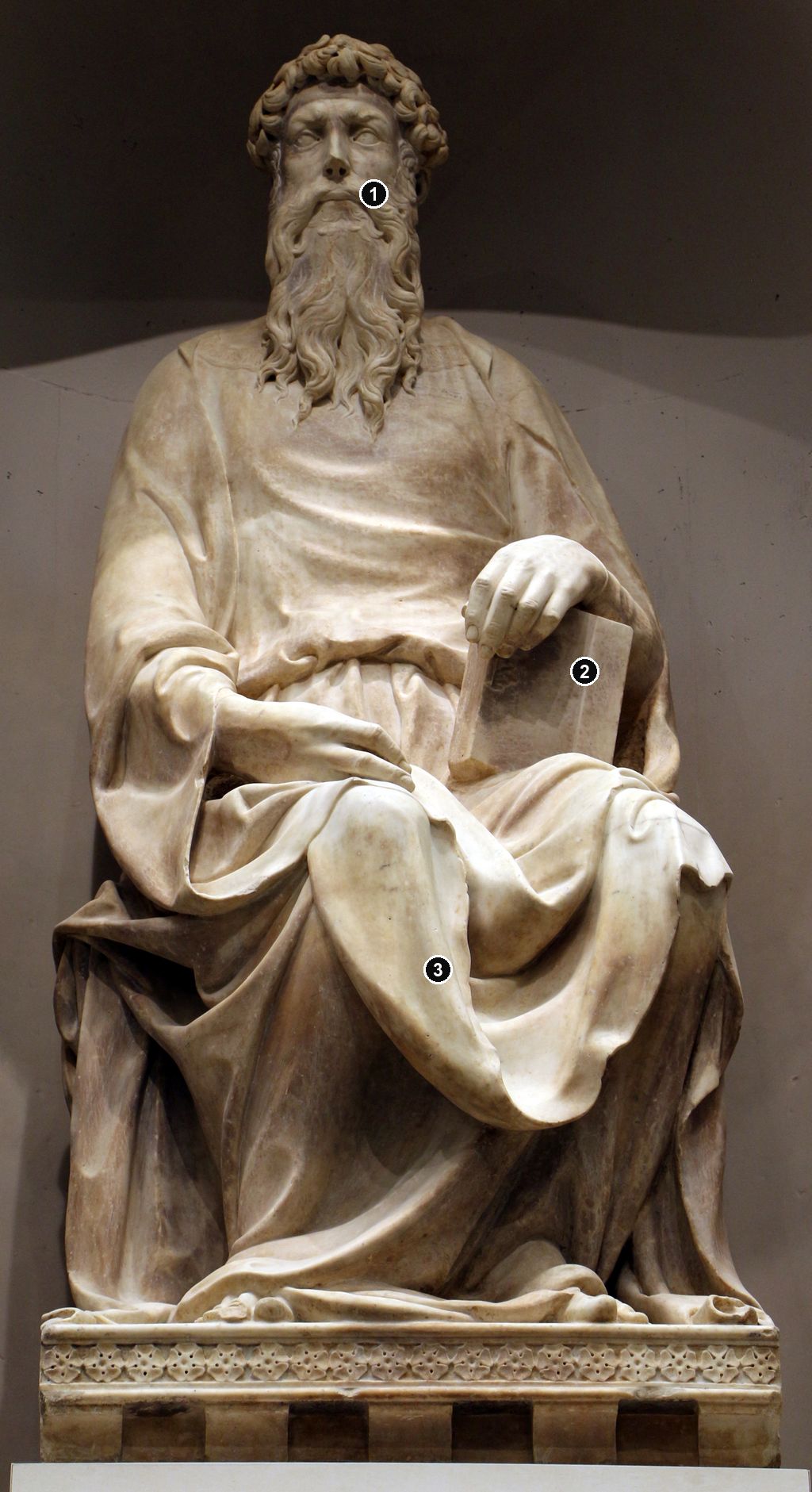
Details from SAINT JOHN THE EVANGELIST
Open a detail image to examine the surface more closely.
Head above the torso
The strong brows and carved beard gather shadow. They make a clear point of attention for a viewer below the seated figure.
Hand and book
The fingers curve over the edge of the book. The form of the book helps mark the bend between the upper body and bent leg.
Folds over the knees
Broad scoops of cloth connect the knees without flattening their different depths. Below, deeper cuts continue towards the feet.
Annotated photograph and detail crops. Sailko. Image source. CC BY 3.0. Resized, annotated and cropped from the original photograph.
The book and the distant gaze
Christian tradition identifies the Evangelist with the apostle John and credits him with the fourth Gospel. It also associates him with the Book of Revelation. In this statue, the turned head and pause over an open book have led the Opera del Duomo to suggest that Donatello might have imagined the older saint receiving his vision on Patmos. The book has no visible title to settle the question. The setting beside the other Gospel authors gives it a public meaning even without a particular episode. Seen from the square, the open volume is the attribute of a writer and the slight turn of his head brings the figure into relation with the doorway and the people passing below it. [1] [2] [7]
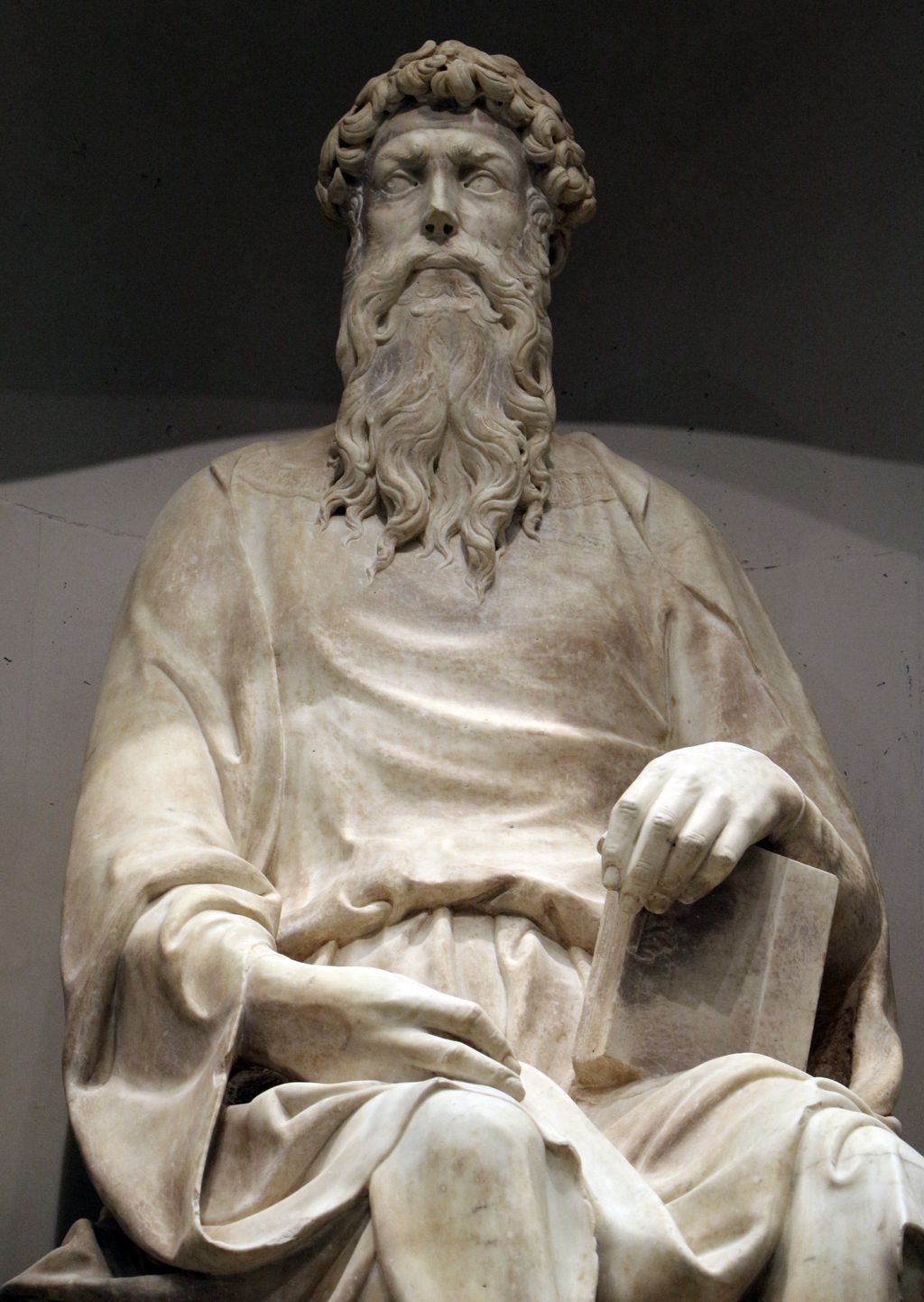
A closer view of the face, book and heavy folds across the lap. Sailko. Image source. CC BY 3.0. Resized for the web.
The eagle, a familiar emblem of the Evangelist, is absent here. In the Old Sacristy of San Lorenzo, a chapel dedicated to the Evangelist, Donatello's coloured stucco reliefs make John's identity and story explicit. An eagle accompanies him in the Evangelist roundel, and another roundel depicts his vision on Patmos. The dedication matters in a city where visitors also meet images of John the Baptist, Florence's patron saint. That is the John whose death is the subject of Donatello's Feast of Herod on the baptismal font in Siena. Florence also has a standing Saint John the Evangelist by Baccio da Montelupo, a later bronze commissioned for Orsanmichele. [2] [9] [10] [15]
From the façade to the museum
The dismantling of the old front in 1587 took John away from the doorway for which he had been made. The Evangelists were installed in the cathedral's central tribune of San Zanobi. Their later removal in 1904 to the nave exposed fragments of wall paintings that had been hidden behind them. Before the move, the Alinari firm had photographed John in the tribune. Geraldine A. Johnson traces how the photograph stayed in circulation for decades, sometimes with the chapel setting edited out. Readers of those books saw the front of the statue clearly, but a head-on photograph gave little sense of how a person crossing the square would have looked up and seen it turn. [2] [11] [12]
The Istituto Nazionale di Studi sul Rinascimento records John on display at the museum in 1936. Johnson records a museum installation after the statue had been put into storage during the Second World War. [12] [16]
The Sala del Paradiso gave the group an architectural setting again in 2015. A full-scale resin reconstruction based on Poccetti's drawing sets original sculptures into an approximation of the lost front. Across the room stand the Baptistery's original bronze doors, evoking their relation to the cathedral across the piazza. Find John to the right of the Madonna and Child and look at him first from farther back, where the four men can be seen together. Moving nearer and looking up brings out the projection of the knees and the shadows beneath the beard. The display lets the architectural setting do much of the work that has to be supplied by the imagination in a cropped photograph. [3] [5]
Looking ahead to Michelangelo's Moses
The Opera del Duomo connects Saint John with Michelangelo's Moses, made about a century later for the monument to Pope Julius II. The similarity is especially striking in the way a seated, bearded figure can dominate the space around it. In both works one can trace an outward turn from the stable weight of the seat up towards the head. Michelangelo gathers more of the movement around the beard and the arm it falls against, and takes the weight of the legs and the forward movement of the body further. The stone tablets name the lawgiver just as the book, in its company of three other writers, identifies Donatello's Evangelist. [1] [13]
John was still on the façade in Michelangelo's lifetime, so there was ample opportunity to see him in this setting. The visual kinship explains why the comparison has lasted, though the record of John's commission tells us little about how Michelangelo arrived at his own pose. His statue was part of a papal tomb project that changed repeatedly before it took its present form in San Pietro in Vincoli in Rome. At the Florentine doorway, Donatello was working with the small depth of an inherited niche and the upward gaze of people in motion. Much of what gives John his force is particular to that encounter. [1] [2] [7] [13]
Donatello sculpture directory
| Name | Date | Medium and record |
|---|---|---|
| Marble David | 1408–09, adapted 1416 | Carved Carrara marble Catalogue. |
| Saint John the Evangelist | c. 1409–15 | Carved marble Catalogue. |
| Saint Mark | 1411–13 | Carved Carrara marble Catalogue. |
| Saint George and its dragon relief | c. 1415–17 | Marble statue and marble relief Catalogue. |
| Marzocco | c. 1417–20 | Carved sandstone Catalogue. |
| Saint Louis of Toulouse, Florence | 1418–25 | Gilt bronze and mixed media Catalogue. |
| Pazzi Madonna | c. 1420s | Marble relief Catalogue. |
| Reliquary Bust of Saint Rossore | c. 1420s | Gilt bronze Catalogue. |
| The Prophet Jeremiah | 1420s–30s, disputed | Marble Catalogue. |
| Zuccone | c. 1420s–30s | Marble Catalogue. |
| Feast of Herod, Siena | 1420s | Gilded bronze relief Catalogue. |
| Ascension with Christ Giving the Keys to Saint Peter | c. 1428–30 | Marble relief Catalogue. |
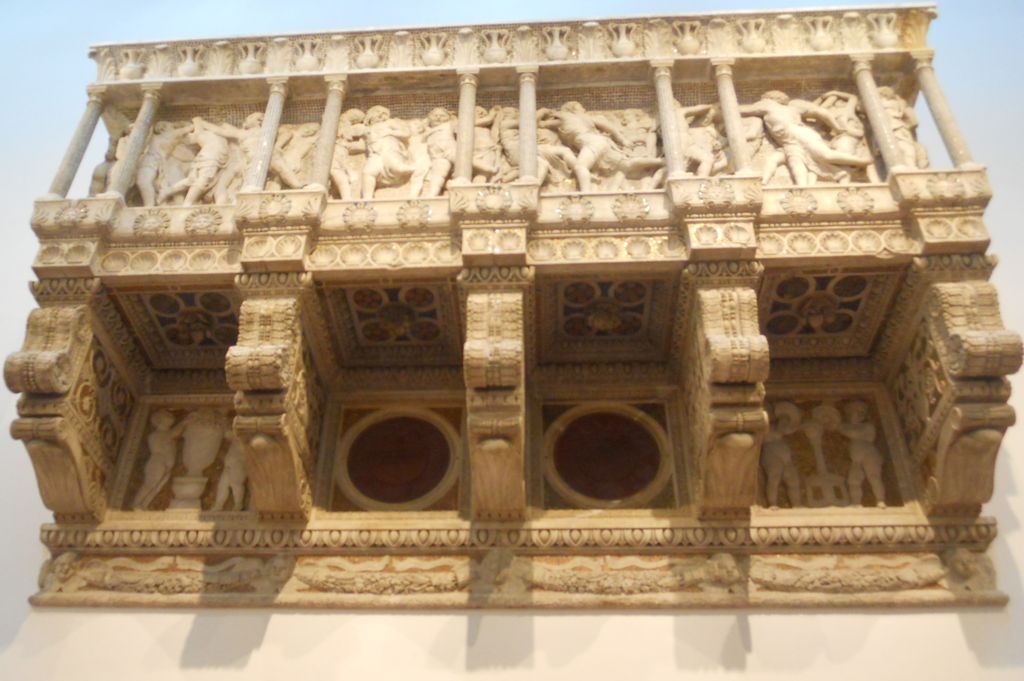
| Cantoria | 1433–39 | Marble and mosaic Catalogue. |
| Amor-Atys | c. 1435–40 | Partly gilded bronze Catalogue. |
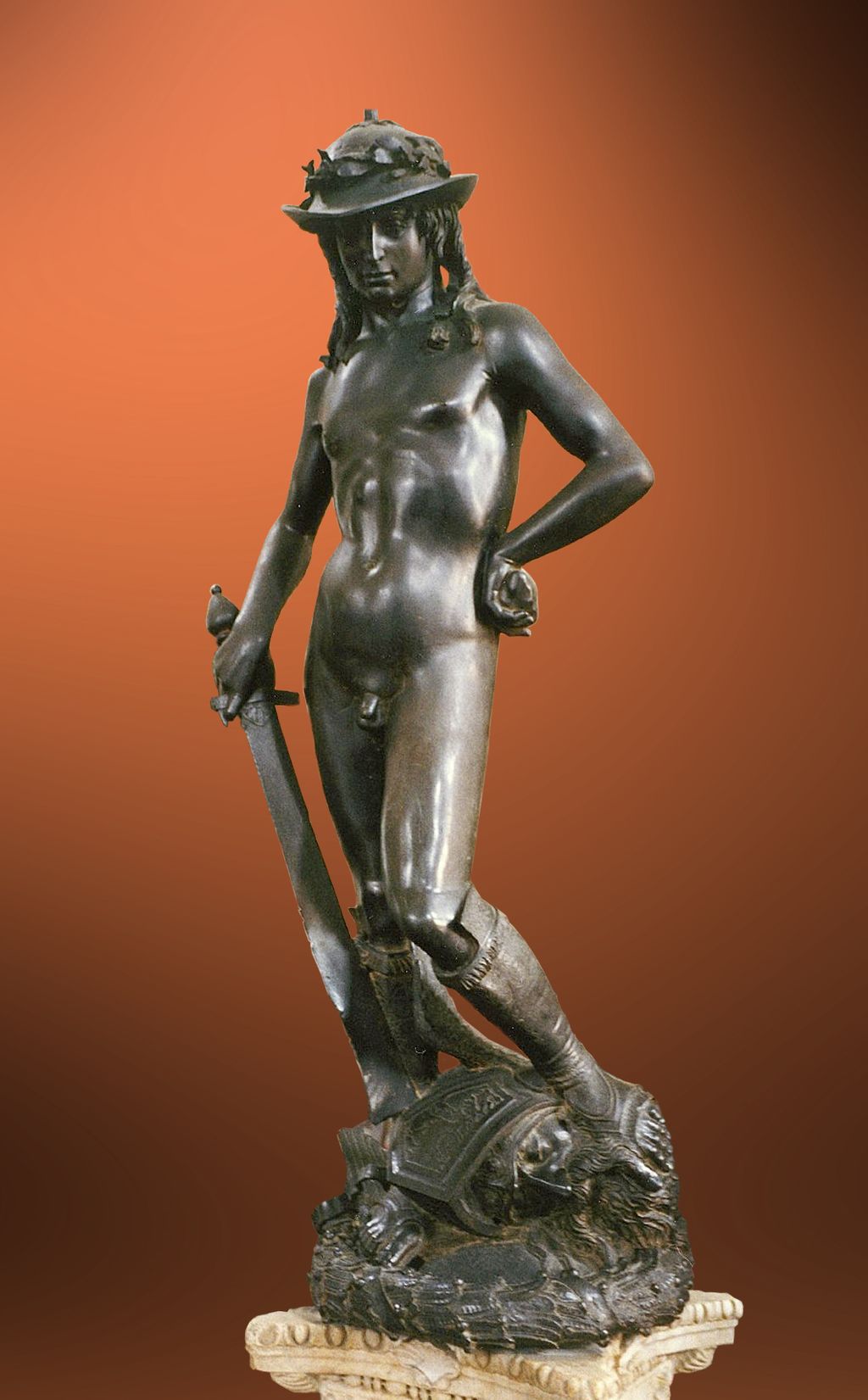
| Bronze David | c. 1435–40, disputed | Partly gilded bronze Catalogue. |
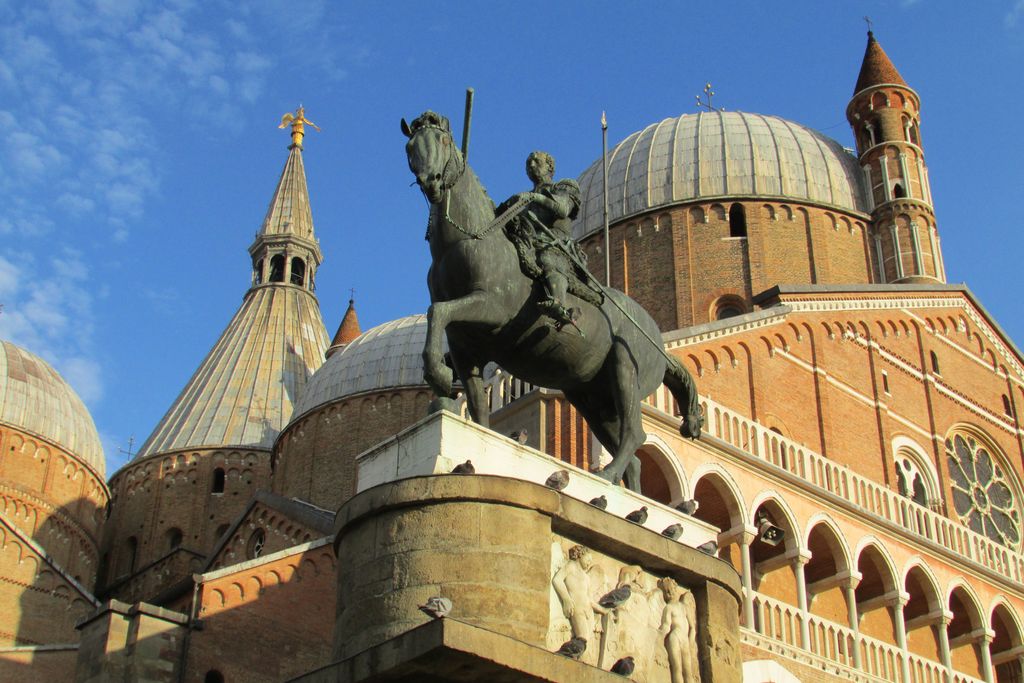
| Gattamelata | Installation agreement, 1453 | Bronze and stone Catalogue. |
| Santo altar | Mid-fifteenth century | Bronze and limestone ensemble Catalogue. |
| Chellini Madonna | Given in 1456 | Partly gilded bronze tondo Catalogue. |
| Penitent Magdalene | c. 1453–55 (Opera) | Poplar, stucco, pigments and gold Catalogue. |
| Judith and Holofernes | Late 1450s–early 1460s | Bronze with surviving gilding Catalogue. |
| Pulpit of the Passion | Late work and later assembly | Bronze reliefs, Donatello and collaborators Catalogue. |
| Bust traditionally called Niccolò da Uzzano | Fifteenth century | Painted terracotta, attribution disputed Catalogue. |
| Prato Cathedral exterior pulpit | Commissioned 1428; carved 1430s | Marble reliefs, Donatello and Michelozzo Catalogue. |
| Cavalcanti Annunciation | c. 1433–35 | Gilded sandstone and terracotta Catalogue. |
| Crucifix at Santa Croce | Early fifteenth century | Painted wood Catalogue. |
| Madonna of the Clouds | c. 1425–35 | Marble relief Catalogue. |
| Old Sacristy Doors | Fifteenth century | Two paired bronze doors Catalogue. |
| Resurrection Pulpit | Late work and later assembly | Bronze reliefs, Donatello and collaborators Catalogue. |
| Brancaccio tomb | 1420s | Donatello, Michelozzo and assistants, mixed materials Catalogue. |
| Saint John the Baptist, Venice | 1438 | Polychromed and gilded wood Catalogue. |
| Sacrifice of Isaac | Early fifteenth century | Donatello and Nanni di Bartolo, marble Catalogue. |
| Madonna of Via Pietrapiana | Mid-fifteenth century | Terracotta Catalogue. |
| Miracle of the Mule | Mid-fifteenth century | Gilded bronze panel for the Santo altar Catalogue. |
| Padua Crucifix | Mid-fifteenth century | Cast bronze Catalogue. |
| Dancing Spiritello, Bargello | Fifteenth century | Bronze Catalogue. |
| Young Prophet from the Porta della Mandorla | c. 1404–09 | White marble, attributed to Donatello Catalogue. |
| Prophet or Apostle from the Duomo north tribune | Early fifteenth century | White marble, possibly Donatello Catalogue. |
| Beardless Prophet | 1415–18 | White marble Catalogue. |
| Sibyl and Prophet of the Porta della Mandorla | 1422 | Carved marble heads for the portal Catalogue. |
| Faith, Siena baptismal font | 1420s | Gilded bronze figure Catalogue. |
| Hope, Siena baptismal font | 1420s | Gilded bronze figure Catalogue. |
| Feast of Herod, Lille | c. 1430 | Carrara marble relief Catalogue. |
| Piot Madonna | c. 1440–60 | Polychrome terracotta with glass and wax inlays Catalogue. |
| Carafa Horse Head | c. 1456–58 | Cast bronze Catalogue. |
| Pazzi Madonna workshop version, Louvre | c. 1450 | Polychrome gesso, Donatello’s workshop Catalogue. |
| Pazzi Madonna tondo, Rijksmuseum | c. 1425–50 | Plaster and stucco, after Donatello Catalogue. |
| Sprite | c. 1430–40 | Bronze, sculptor or metalsmith close to Donatello Catalogue. |
Discussion
Look again at the images and ideas explored in Saint John the Evangelist. These editorial prompts invite your observations.
Reader Insights
Which features of the face and lap stay clear when you imagine looking up at the statue from the doorway?
What would you notice about John if all four Evangelists were above you together?
Join the Conversation
Share a detail, comparison or question about Saint John the Evangelist below.
References
- Opera di Santa Maria del Fiore, Donatello, Saint John the Evangelist. Museum object entry, including dimensions, iconography and the proposed comparison with Moses. View source.
- Opera di Santa Maria del Fiore, San Giovanni Evangelista di Donatello. Collection catalogue, inv. 113, including material, placement, documentary commentary and photographic views. View source.
- Francesco Caglioti, Donatello e l’Opera di Santa Maria del Fiore: il maestro, i colleghi, i seguaci. In Timothy Verdon and Rita Filardi, eds., Catalogo del Museo dell’Opera del Duomo, vol. 2, Mandragora, 2026, pp. 90–139, especially pp. 105–12. View source.
- Opera di Santa Maria del Fiore, Arnolfo di Cambio, Madonna dagli occhi di vetro. Museum object entry. View source.
- Opera di Santa Maria del Fiore, Storie dalla facciata di Arnolfo. Account of Poccetti's drawing and the 2015 reconstruction, with views of the hall. View source.
- Volker Herzner, Regesti donatelliani. Rivista dell’Istituto Nazionale d’Archeologia e Storia dell’Arte 2, 1979, pp. 169–228, especially records 10, 30, 32 and 34–39. View source.
- Daniel M. Zolli, Donatello’s Visions: The Sculptor at Florence Cathedral. In Timothy Verdon and Daniel M. Zolli, eds., Sculpture in the Age of Donatello: Renaissance Masterpieces from Florence Cathedral, 2015, especially pp. 52–61, including fig. 22. View source.
- Opera di Santa Maria del Fiore, San Luca Evangelista. Collection catalogue entry for Nanni di Banco's statue. View source.
- Fondazione Palazzo Strozzi, Basilica e Museo del Tesoro di San Lorenzo. Account of the Old Sacristy and Donatello's decorations. View source.
- Opera della Metropolitana di Siena, Fonte di Vita Nuova. Catalogue of the baptismal font's narrative programme. View source.
- Ministero della Cultura, Tribuna di San Zanobi, national catalogue, historical and critical notes on the frescoes and the Evangelists' placement. View source.
- Geraldine A. Johnson, Using the Photographic Archive: On the Life (and Death) of Images. In Costanza Caraffa, ed., Photo Archives and the Photographic Memory of Art History, 2011, pp. 145–56, especially pp. 153–55 and figs. 8–9. View source.
- Soprintendenza Speciale Archeologia, Belle Arti e Paesaggio di Roma, Basilica di San Pietro in Vincoli. Account of the site and the monument for Julius II. View source.
- Francesco Caglioti, Laura Cavazzini, Aldo Galli and Neville Rowley, Reconsidering the Young Donatello. Jahrbuch der Berliner Museen 57, 2015 (published 2018), pp. 15–45, especially the chronological account of the commission. View source.
- Musei del Bargello, Chiesa e Museo di Orsanmichele. Collection inventory identifying Baccio da Montelupo’s Evangelist. View source.
- Istituto Nazionale di Studi sul Rinascimento, San Giovanni Evangelista. Fototeca subject record for a Brogi photograph, inv. 919, with historical notes on the move to the nave and later museum display. View source.
- Victoria and Albert Museum, Donatello’s David. View source
- Opera del Duomo, Donatello and the Opera del Duomo. View source
- Ministero della Cultura, David with the Head of Goliath, Bargello bronze. View source
- Save Venice, Donatello’s Equestrian Monument to Gattamelata. View source
- Opificio delle Pietre Dure, L’ultimo Donatello. View source
More DONATELLO Sculptures
Marble David
Armin Kleiner. Image source. CC BY-SA 4.0. Resized for the web.
Bronze David
Patrick A. Rodgers. Image source. CC BY-SA 2.0. Resized for the web.
Cantoria
Erik Drost. Image source. CC BY 2.0. Resized for the web.
Gattamelata
Chris Light. Image source. CC BY-SA 4.0. Resized for the web.
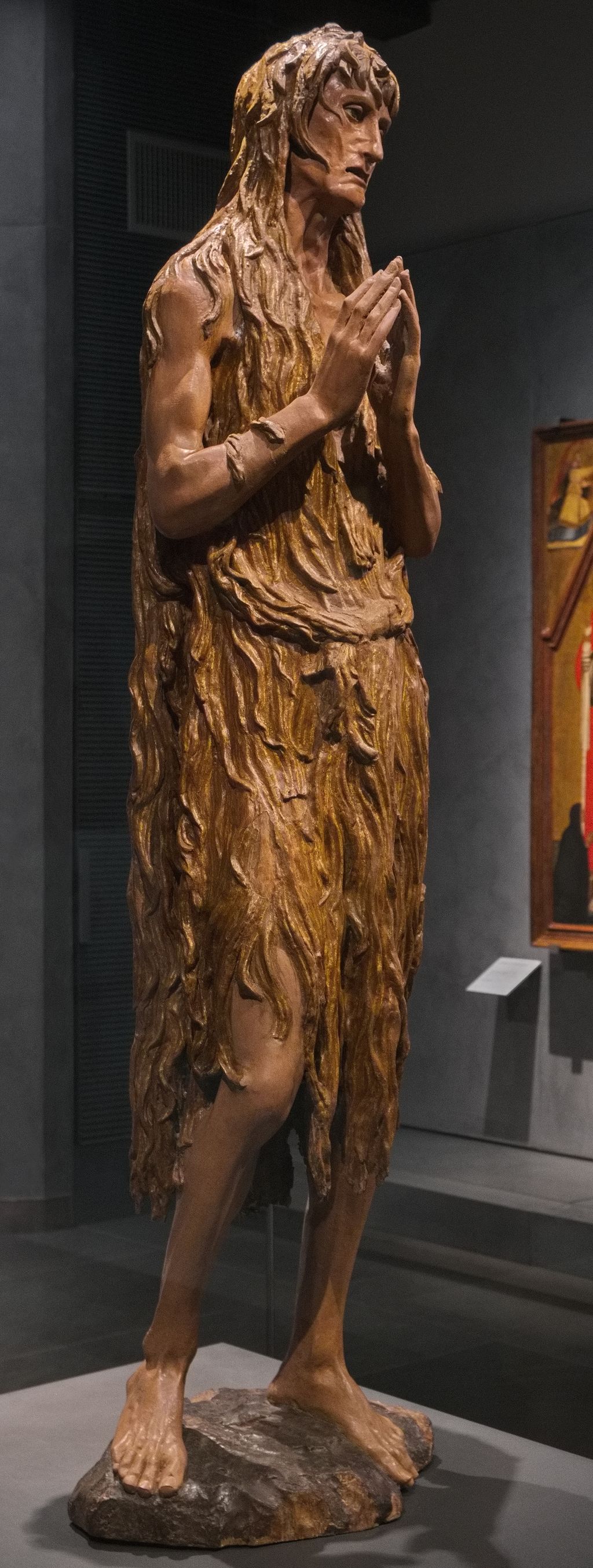
Penitent Magdalene
Armin Kleiner. Image source. CC BY-SA 4.0. Resized for the web.
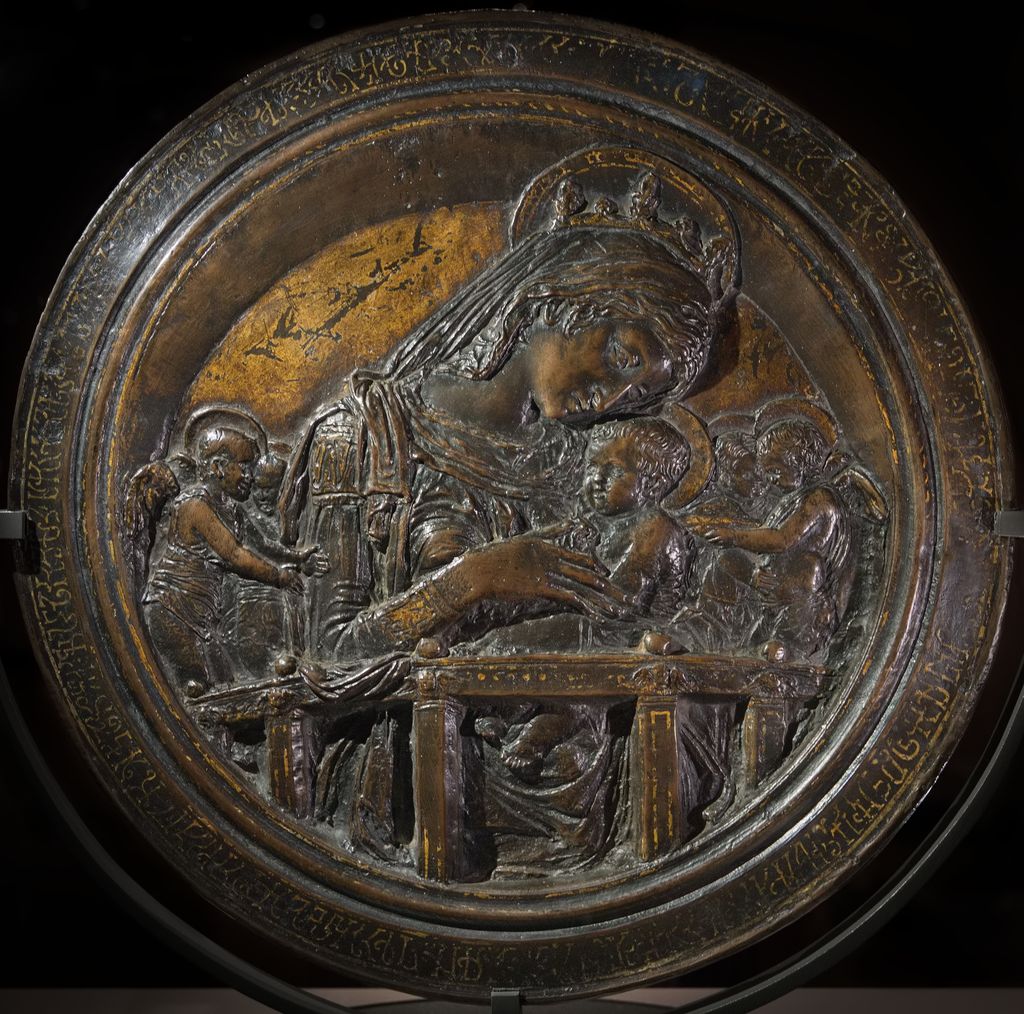
Chellini Madonna
Armin Kleiner. Image source. CC BY-SA 4.0. Resized for the web.
