


 by Tom Gurney
Tom Gurney BSc (Hons) is an art history expert with over 20 years experience
Published on June 19, 2020 / Updated on November 29, 2026
Email: tomgurney1@gmail.com / Phone: +44 7429 011000
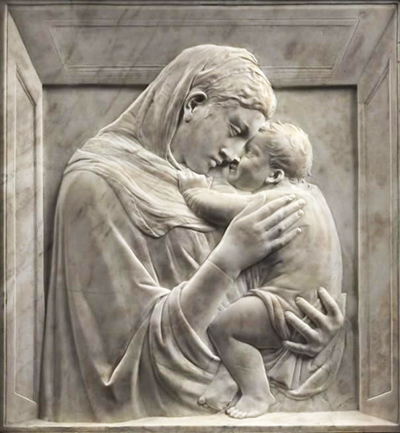
The Virgin bends towards her child until the bridge of her nose overlaps his. One of his arms reaches across her chest and catches her veil. Her hand spreads across his back. Their faces come so close that, in the pale marble, it takes a moment to see where one profile ends and the other begins. Around them, the sides and ceiling of a narrow opening lead the eye into depth. At the bottom, a small bare foot rests against the sill. The embrace is perfectly still, yet the child seems within reach. [1]
Donatello carved the Pazzi Madonna in the early 1420s. The relief belongs to the Staatliche Museen zu Berlin and is displayed at the Bode-Museum, inventory 51. The marble measures 74.5 by 73 centimetres and is 6.5 centimetres deep as an object. Its later frame brings the ensemble to 91 by 87 by 10 centimetres. The architectural opening inside that frame is part of the carving itself. That distinction helps explain both how Donatello made the image work and why sculptors who copied it could change so much around the figures while keeping their gesture instantly recognisable. [1] [2]
How the marble makes room
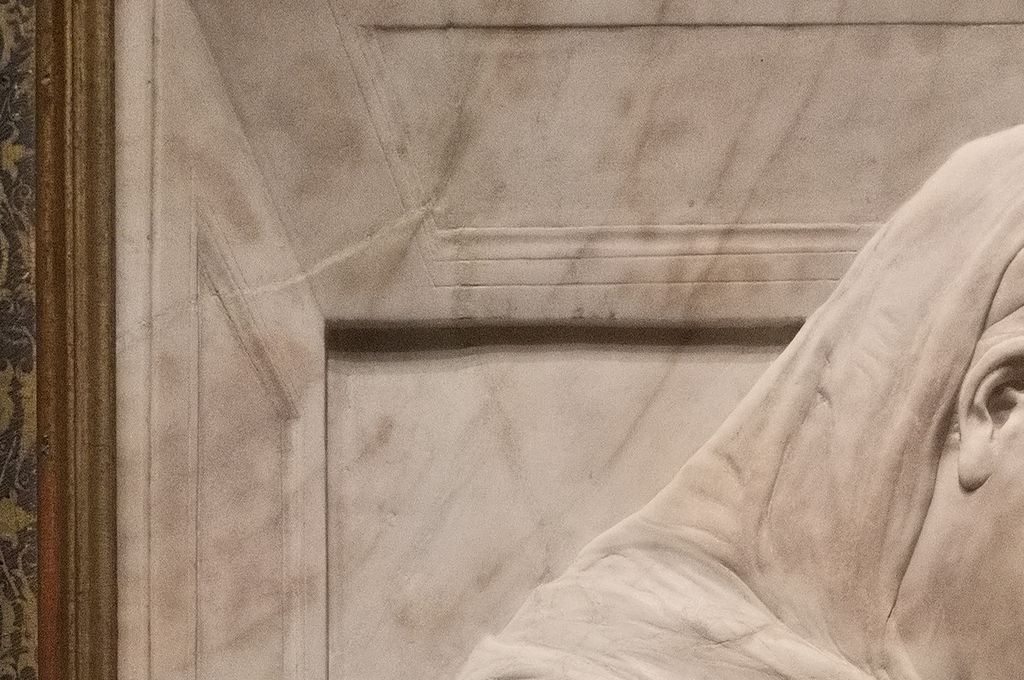
Follow the diagonal at either end of the upper opening. Each line leads from the outer edge towards the enclosed space occupied by Mary and Jesus. The nearer uprights and sill suggest a window through which we see them. The receding edges across the top and sides work together as a single perspective construction. The lower edge feels more ambiguous. Mary’s mantle fills the opening down to the sill, and the child reaches it with his foot. It is hard to decide exactly where the cloth ends and the imagined architecture begins. That uncertainty makes the pair seem close to the boundary of our own space. [1] [2]
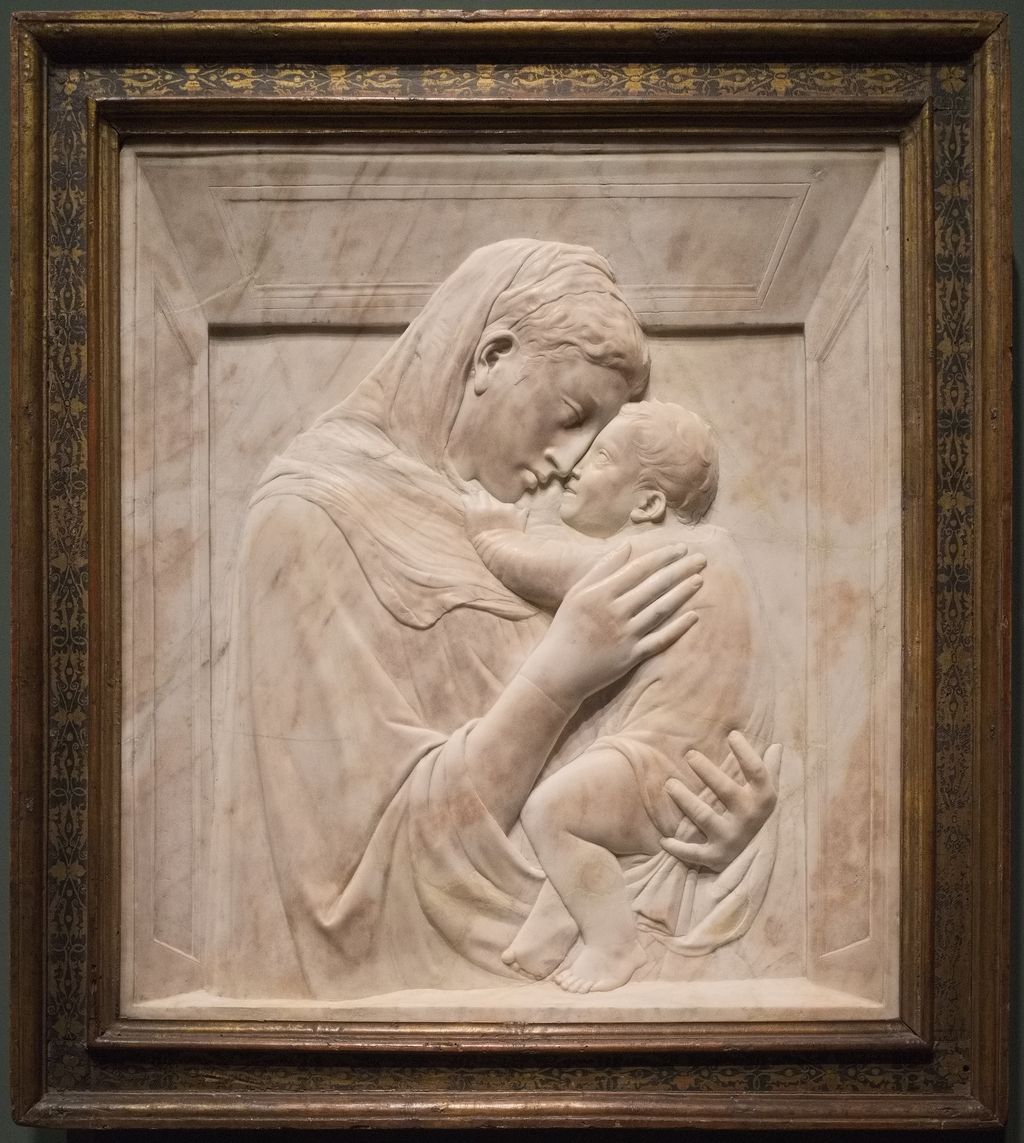
The Berlin marble and its carved recess, photographed with its outer display frame. Armin Kleiner. Image source. CC BY-SA 4.0. Resized for the web.
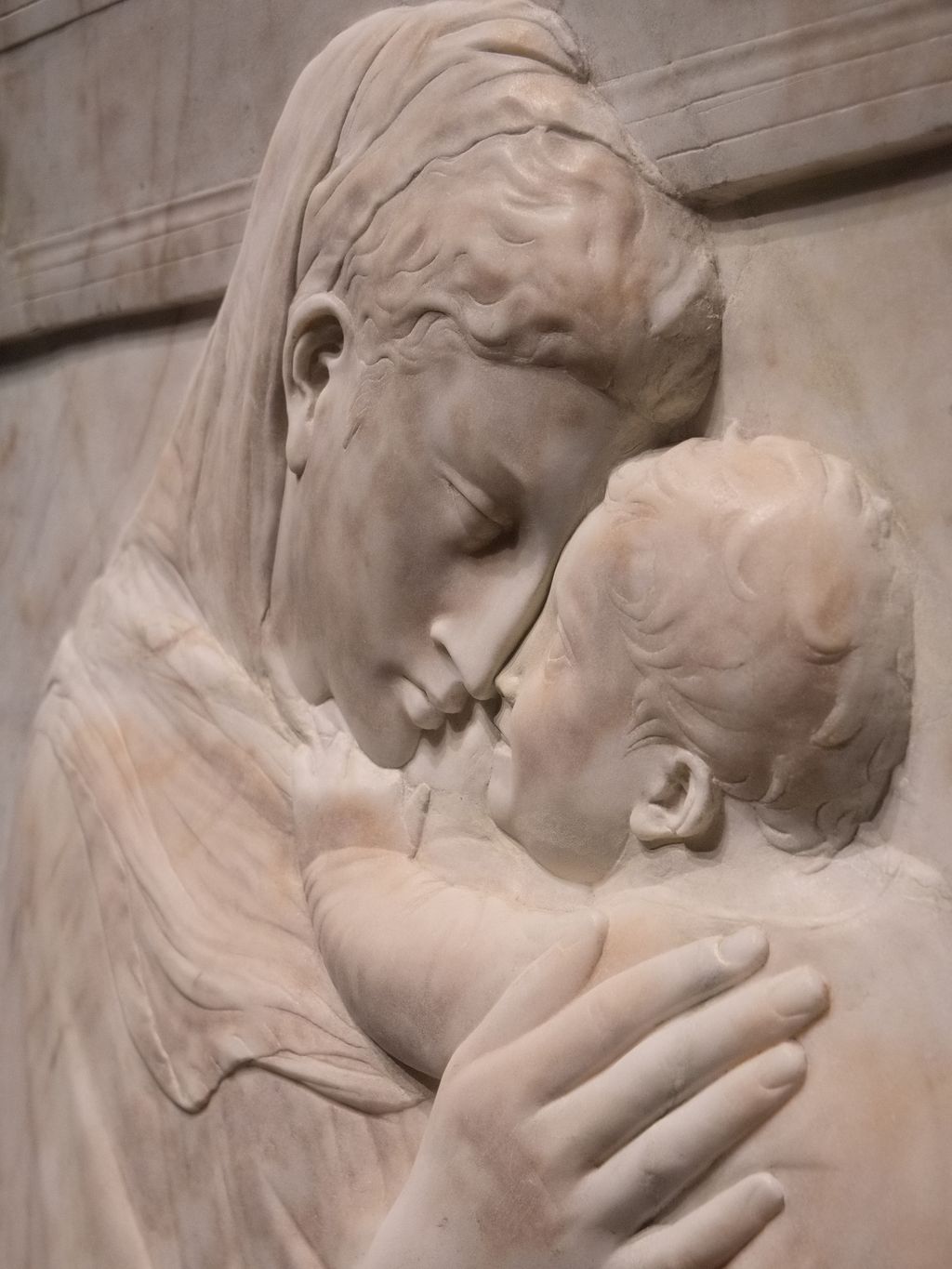
A lateral view makes the variation in projection across the faces and hand easier to see. Armin Kleiner. Image source. CC BY-SA 4.0. Resized for the web.
Donatello had already used receding architecture under his Saint George at Orsanmichele. There, it helps the eye follow a scene that stretches from an encounter with a dragon into a landscape. In the Berlin marble the architectural lines lead back to a single, nearly motionless group. The upper recess creates enough room for the heads to seem to turn inside it. The empty stone to the right of the child sets off the back of his head and gives the tightly joined profiles space around them. The perspective does much of its work before the eye even reaches the figures. [1] [3]
Rilievo schiacciato, sometimes spelled stiacciato, is the Italian term generally applied to Donatello’s exceptionally shallow relief. The full thickness of the slab tells us little about how far any one fold or lock of hair stands out. Under a light coming from one side, subtle changes of level gather shadow. On Mary’s veil a thin raised edge can read as cloth folded back over itself. Her broad shoulder, carved with long, gently descending folds, feels substantial even where those ridges barely rise from the surface. The child’s head has a more rounded outline and stands proud of the field behind him. A side view makes the economy of the carving easier to see. From the front, the same few differences of height are enough to suggest a head moving forward, cloth falling back and space opening behind them. [1] [3] [4]
This also helps explain why people have wondered where the relief originally hung. The strong foreshortening of the recess, especially its visible underside at the top, makes a position above the viewer plausible. The museum catalogue records a suggestion that it came from a street tabernacle, while pointing out how little abrasion the surface shows. Looking up at a sculpture today can help test how its shapes fall into place. The best-looking angle still leaves the original wall, height and conditions of light unknown. [1]
Annotated Details from the Pazzi Madonna
Select a number to jump to a detail of the sculpture.
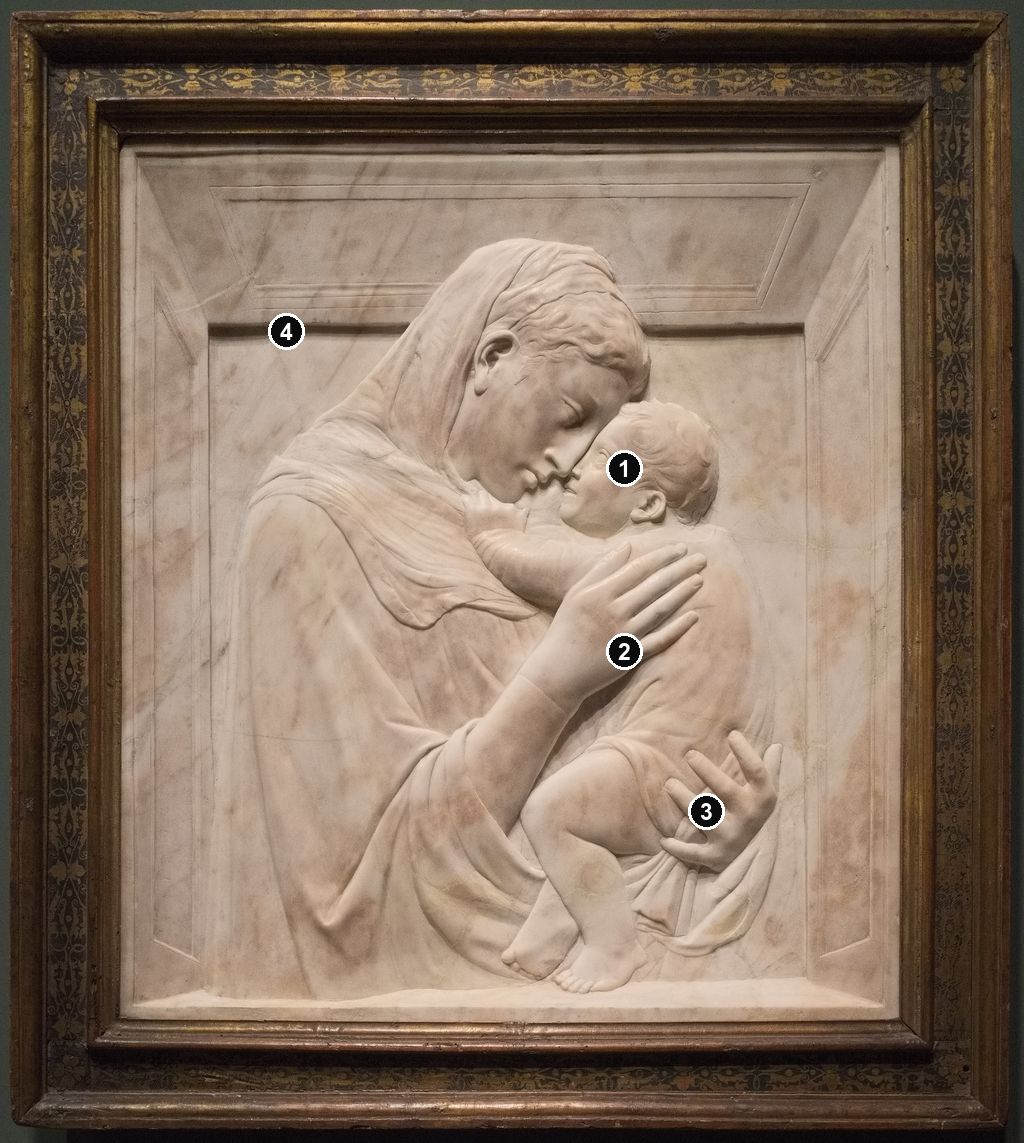
Details from THE PAZZI MADONNA
Open a detail image to examine the surface more closely.
The two faces
The noses and lips register in profile where the faces come together. Subtle shadow separates the shared outline into two distinct heads.
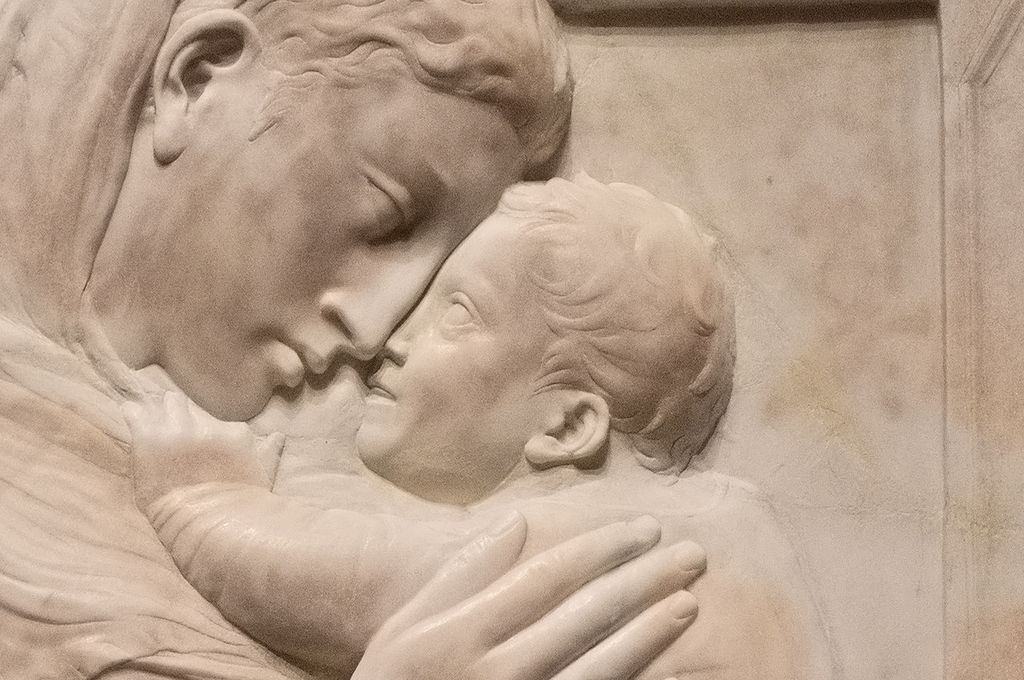
The hand at the child’s shoulder
Long fingers cross the child’s back. The fingertips disappear against the marble surface as the hand comes around the body.
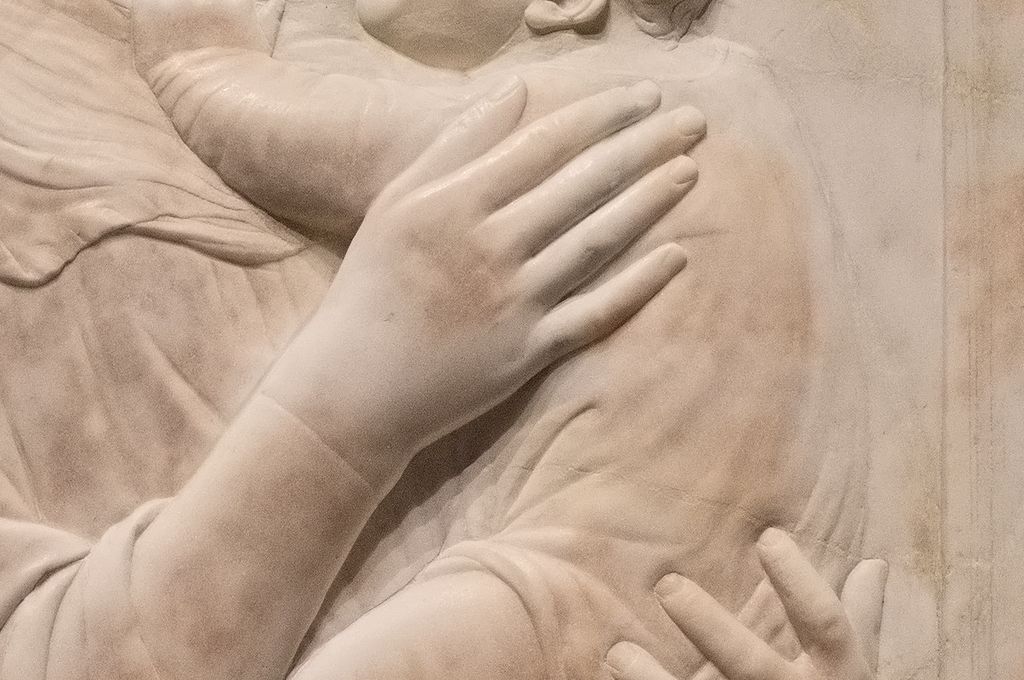
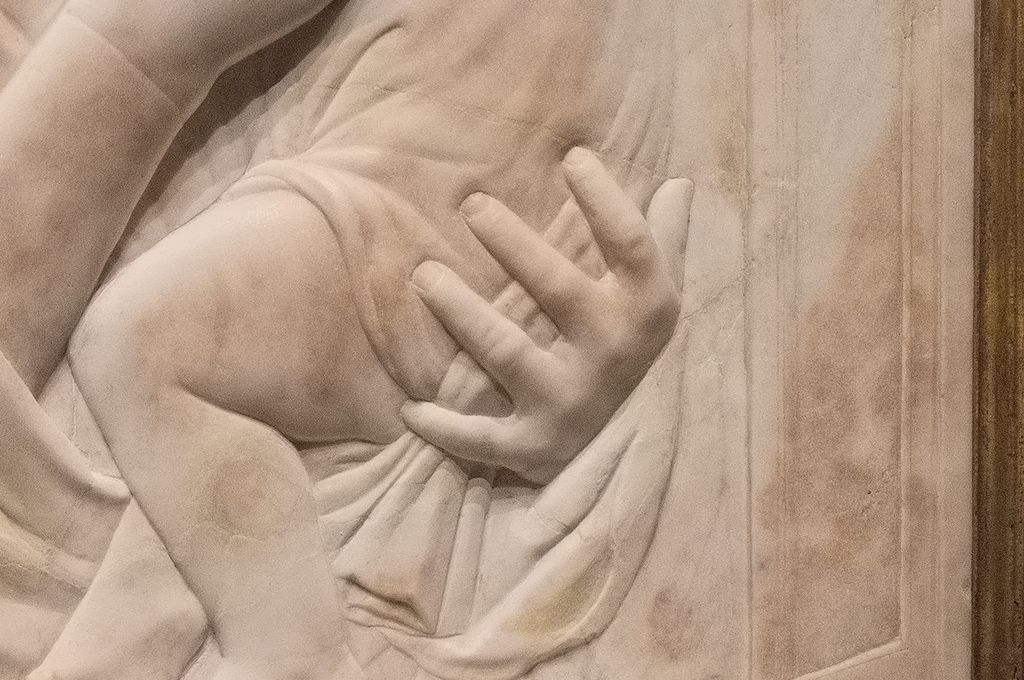
The child’s weight
The lower hand supports the child’s bent body. The more projecting marble gives the hand, leg and surrounding cloth separate edges.
The carved inner frame
The edge cut into the marble creates the impression of an opening behind the figures. Its thin lines are distinct from the outer display frame.
Annotated photograph and detail crops. Armin Kleiner. Image source. CC BY-SA 4.0. Resized, annotated and cropped from the original photograph.
The weight of a child
Mary holds Jesus with both hands. The open hand laid across his upper back has long fingers with small spaces between them. The hand beneath him is compressed by the angle and crowded by his bent leg. It seems to take the full weight of a child who has pulled himself close. Art historian Frank Fehrenbach draws attention to the pressure at these points of contact, where the child rests against his mother’s hand and where the two faces press together. The shallow relief makes a palm pushing into a thigh or a forehead meeting another forehead feel like an event in its own right. [1] [3]
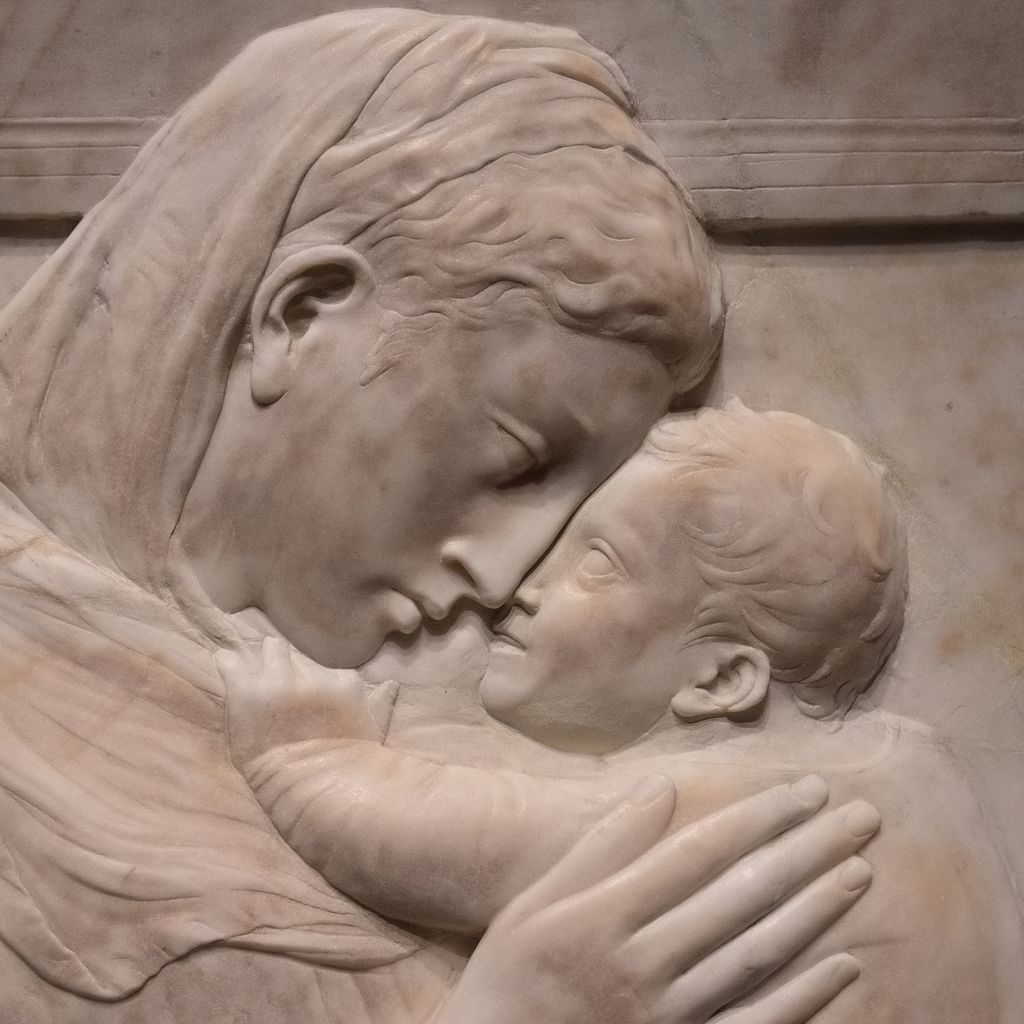
The Madonna’s fingers curve around the child’s upper body where the faces come together. Armin Kleiner. Image source. CC BY-SA 4.0. Resized for the web.
The child’s arm almost disappears at the far end of his reach, where the veil comes down from Mary’s head. In the other direction his bent leg and turned foot bring the body back into view. The Berlin catalogue connects the visible sole with a motif from Byzantine art. Other scholars have compared the figures with Greek grave reliefs or pointed to the precedents offered by Trecento painting, including Ambrogio Lorenzetti’s Maestà at Massa Marittima. No single model accounts for the whole image. The turned foot, the weight held in the hands and the intersecting profiles belong to a composition carefully adjusted around the act of holding a child. [1]
Mary looks down. The child looks up. The lack of haloes in the marble leaves a clear line around their heads, and the contact between the faces carries much of the meaning that other devotional images express through attributes or an answering gaze. A viewer who sees apprehension in Mary’s lowered eyelid might read the closeness of the embrace as an anticipation of Christ’s death. Another might first notice the child’s insistence on getting closer, fingers in cloth and a foot at the sill. The religious reading takes its force from the ordinary physical details. [1] [3]
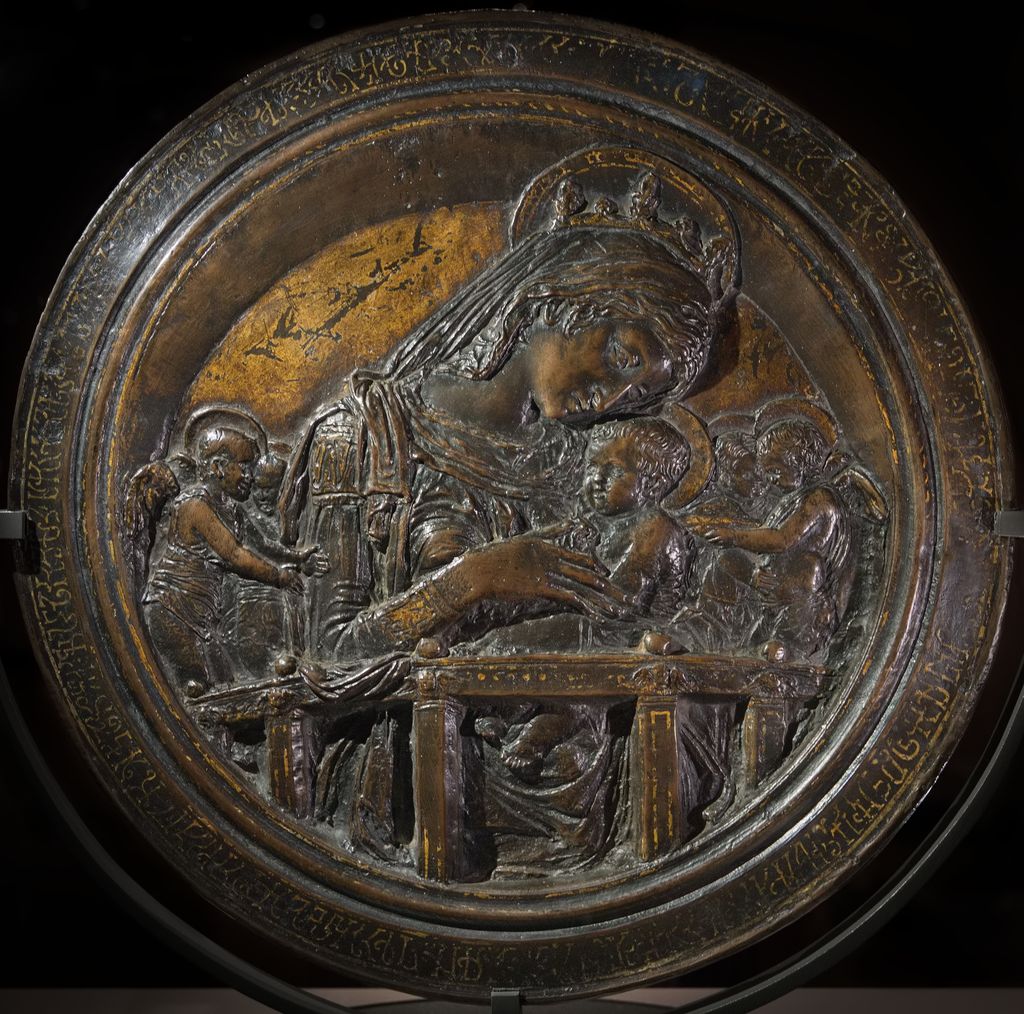
Donatello was able to change the emotional temperature of the subject by changing the space around it. In his Madonna of the Clouds in Boston, the seated Mary and child are surrounded by clouds, with angels in the shifting layers of the background. The relief makes the space feel light even as Mary supports the child. The Pazzi Madonna gives the figures the firm boundaries of a window. A different experiment with setting appears in the bronze Chellini Madonna, where four angels share a circular field with the mother and child. [3] [5] [6]
Dating the relief
Berlin’s collection catalogue dates the work to around 1420. Its 2022 exhibition used about 1422, also the date given by the Florence organisers when the relief was shown there. These estimates reflect comparisons with works Donatello was making in the same few years. The collection record points to the profile of Isaac in the group of Abraham and Isaac made for Florence Cathedral’s bell tower in 1421. The foreshortened hand under the child has been compared with the hand of a Sibyl documented in 1422 for the cathedral’s Porta della Mandorla and with a hand in The Feast of Herod, the bronze relief Donatello made for Siena’s baptismal font in the following years. [1] [2] [7]
A hand can be a clue to when a sculptor was working through a particular problem. It can also look very different when the hand is blessed, raised in alarm, or wrapped around a child. The grouping of comparisons makes the early 1420s convincing, while leaving room for the slightly different catalogue dates. The signed agreement or payment that would place the Pazzi Madonna in a specific year has yet to emerge. [1] [2] [7]
What the Pazzi name tells us
In 1677 Giovanni Cinelli described a marble Virgin and Child attributed to Donatello in the house of Francesco Pazzi. When Camillo Jacopo Cavallucci published the Berlin relief in his 1886 book on the sculptor, he connected it with that account. His illustration was a wood engraving made after a photograph of the marble. The picture helped establish the relief in print, and it also made the gaps in the identification plain. Cinelli described the child seated on a cushion and singled out Mary’s right hand as supporting him. The Berlin child is held against Mary, with drapery beneath him and both hands involved. Those discrepancies led some scholars to doubt the link to the Pazzi household. [1] [8]
In 2025 Fabio Gaffo returned to the family’s inventories and the history of its properties. He traced records of a relief of the Virgin in marble attributed to Donatello from a 1653 agreement between two Pazzi brothers through later inventories. A 1773 entry places a damaged white marble Madonna and Child in the family chapel. An 1821 inventory describes a repaired marble relief with several breaks. The Berlin slab has multiple fractures. For Gaffo, the damage, subject and succession of owners together support an identification that had previously rested heavily on the guide and on what the nineteenth-century dealer said. He also placed this branch of the family in the property on Borgo degli Albizi later demolished for the Banca Nazionale, a different building from the surviving Palazzo Pazzi Quaratesi. The case for later Pazzi ownership is stronger as a result. The fifteenth-century commission and the object’s first location remain open. [8]
The sale can be dated precisely. The relief was with the Florentine collector Raffaele Lamponi-Leopardi before it passed through Stefano Bardini to Wilhelm Bode for the Royal Museums in Berlin. Bardini’s invoice, dated 14 February 1886, describes it as a Madonna from the Pazzi house and gives a price of 25,000 lire. At the Kaiser-Friedrich-Museum, which opened in 1904, it was displayed alongside the Orlandini Madonna, a related marble relief now attributed to Michelozzo. A photograph from the late 1910s shows the Pazzi Madonna nearer the window, where it received more daylight. The pair was part of a wider installation in which early Florentine sculpture could be compared with painting on the same wall. During the Second World War the Pazzi Madonna was moved into storage and eventually to Merkers. It later went to the Central Collecting Point at Wiesbaden and was displayed in West Berlin at Dahlem before returning to Museum Island. [1] [8] [9] [10]
The embrace in plaster and paint
Bardini also sold the Louvre its Madonna of the Pazzi in 1886. Paris and Berlin thus acquired two objects with the same subject and the same dealer in the same year. The Louvre’s relief, RF 744, is polychrome gesso, or painted plaster, and is catalogued as a replica from Donatello’s workshop, made about 1450. Its panel is taller than it is wide. Its surrounding tabernacle presents the couple within a distinct devotional frame. The original Berlin carving gains much of its effect from the passage between one pale plane and the next, while the Louvre version can use colour to define the garments and set them apart from the surrounding ornament. [1] [11]
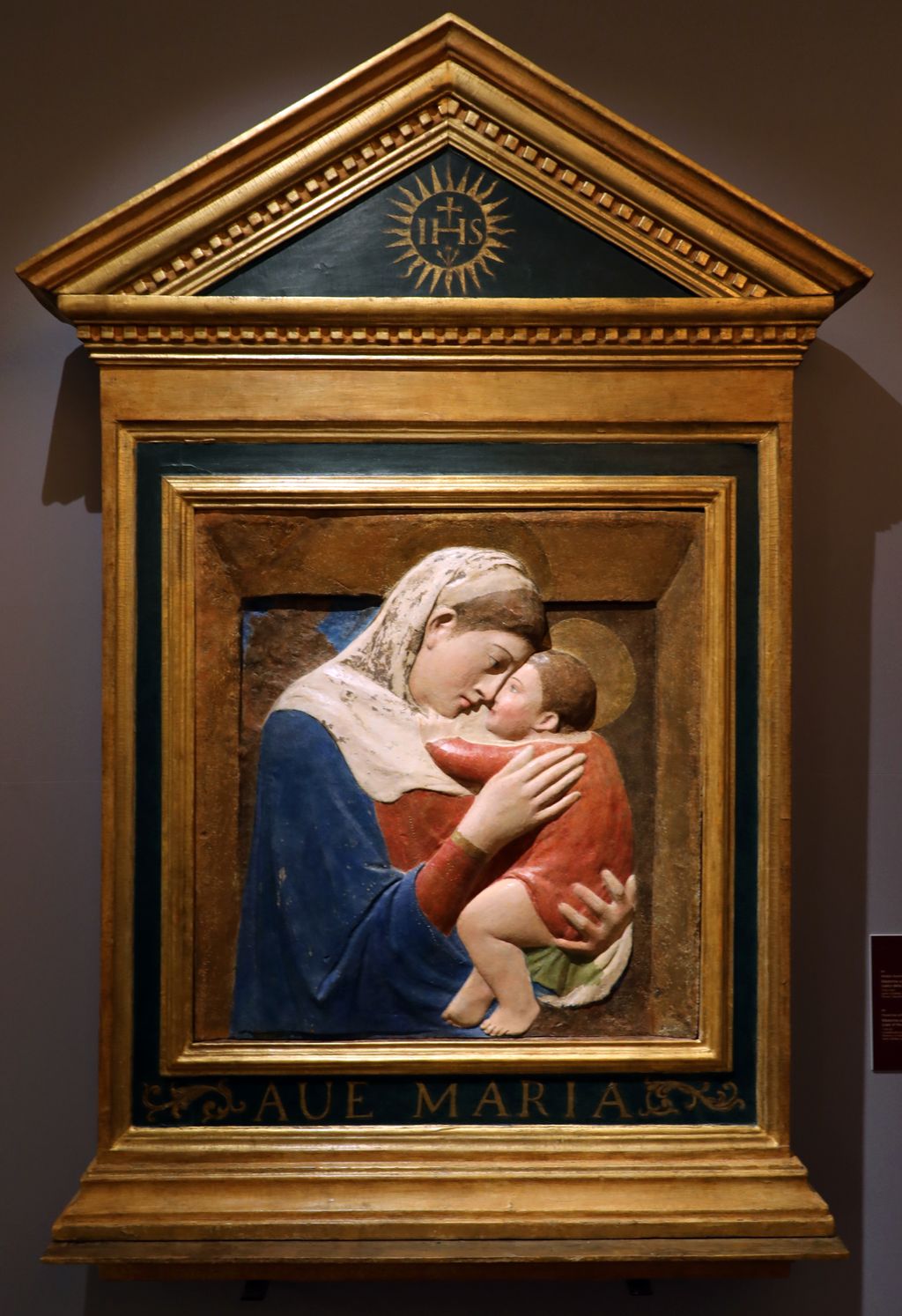
A polychrome Florentine version after the Pazzi Madonna. Its colour and architectural frame change the presentation of the same embrace. Francesco Bini. Image source. CC BY-SA 4.0. Resized for the web.
Plaster and stucco gave makers a way to repeat a relief using a mould. Once a form was available, the basic pose could be reproduced, and painting and framing could give each version a different character. An object like the Louvre relief is evidence of that wider practice, although the route from Donatello’s marble to any individual repetition can be hard to reconstruct. [4] [11]
The Rijksmuseum holds another version of the design, BK-NM-11935, a Florentine stucco relief with old paint that the museum dates to about 1425–50. It is a tondo, or round relief, with a diameter of 70 centimetres before the surround according to the Berlin catalogue. The circle brings the eye back to the inward curving line of the group. A painted example in the diocesan collection at Santo Stefano al Ponte in Florence uses a triangular pediment over a rectangular opening and carries the words Ave Maria along the base. The veil, cloak and the child’s clothing stand out in different colours. In a variant in the Metropolitan Museum of Art, probably made in Verona, a Gothic arch frames the group and coloured glass supplies flashes of light in the halo. The surround of each version changes how the figures address the viewer. The grip and the meeting of the heads endure across very different formats. [1] [12] [13] [14]
The embrace also travelled into print. In Jan Gossart’s 1522 engraving The Virgin and Child Seated at the Foot of a Tree, the eye contact and placement of Mary’s hands recall Donatello’s relief. The Metropolitan Museum of Art identifies those details alongside the engraver’s borrowings from Albrecht Dürer and Michelangelo. Gossart has put the figures outdoors. The tree and its foliage take the place of Donatello’s window, yet the hands and the angle between the two heads still draw the eye to the same moment of contact. [15]
Donatello sculpture directory
| Name | Date | Medium and record |
|---|---|---|
| Marble David | 1408–09, adapted 1416 | Carved Carrara marble Catalogue. |
| Saint John the Evangelist | c. 1409–15 | Carved marble Catalogue. |
| Saint Mark | 1411–13 | Carved Carrara marble Catalogue. |
| Saint George and its dragon relief | c. 1415–17 | Marble statue and marble relief Catalogue. |
| Marzocco | c. 1417–20 | Carved sandstone Catalogue. |
| Saint Louis of Toulouse, Florence | 1418–25 | Gilt bronze and mixed media Catalogue. |
| Pazzi Madonna | c. 1420s | Marble relief Catalogue. |
| Reliquary Bust of Saint Rossore | c. 1420s | Gilt bronze Catalogue. |
| The Prophet Jeremiah | 1420s–30s, disputed | Marble Catalogue. |
| Zuccone | c. 1420s–30s | Marble Catalogue. |
| Feast of Herod, Siena | 1420s | Gilded bronze relief Catalogue. |
| Ascension with Christ Giving the Keys to Saint Peter | c. 1428–30 | Marble relief Catalogue. |
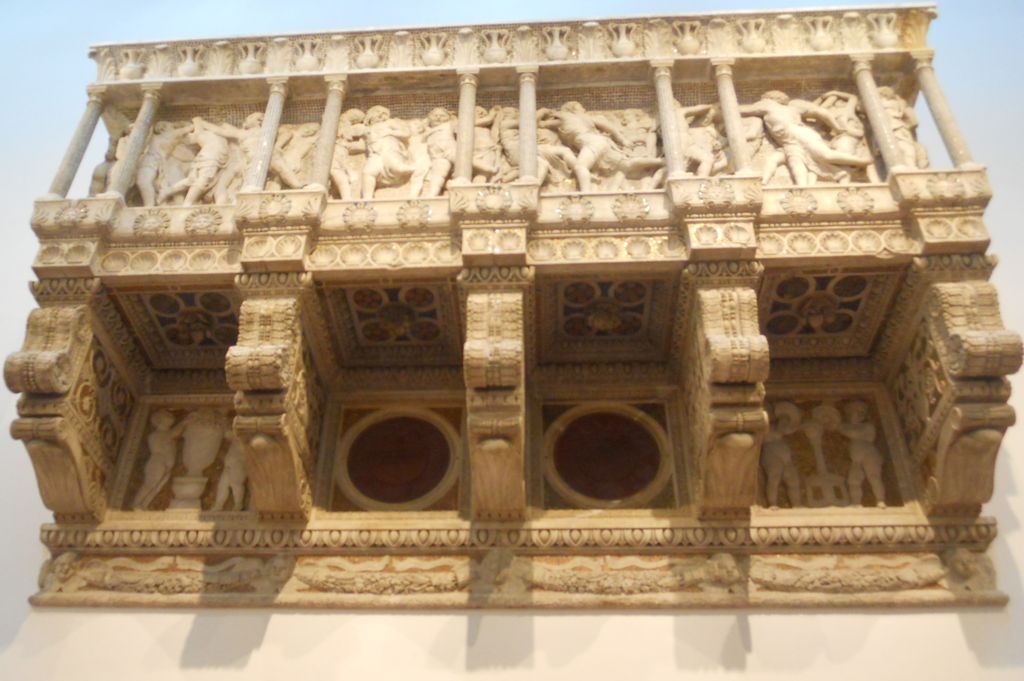
| Cantoria | 1433–39 | Marble and mosaic Catalogue. |
| Amor-Atys | c. 1435–40 | Partly gilded bronze Catalogue. |
| Bronze David | c. 1435–40, disputed | Partly gilded bronze Catalogue. |
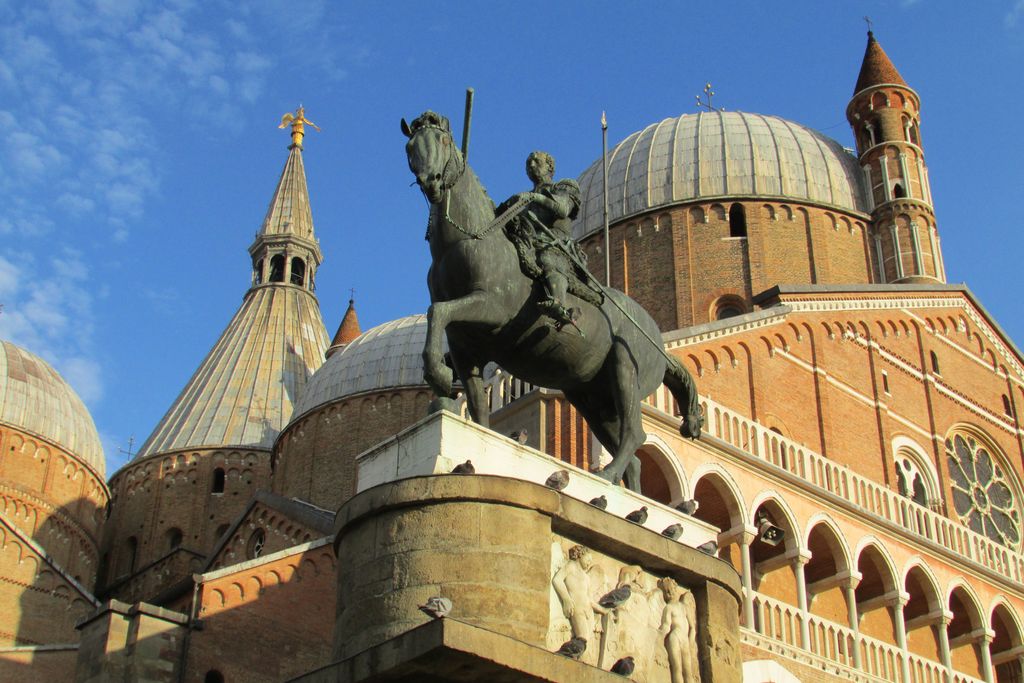
| Gattamelata | Installation agreement, 1453 | Bronze and stone Catalogue. |
| Santo altar | Mid-fifteenth century | Bronze and limestone ensemble Catalogue. |
| Chellini Madonna | Given in 1456 | Partly gilded bronze tondo Catalogue. |
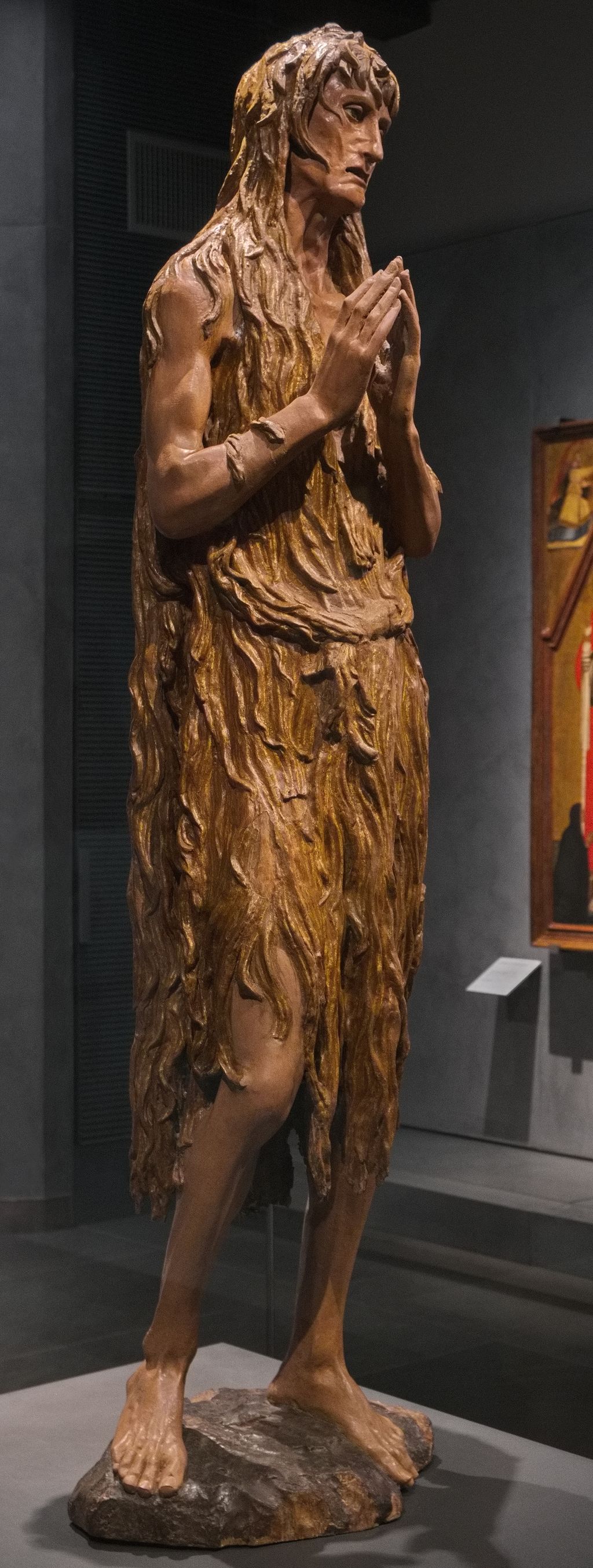
| Penitent Magdalene | c. 1453–55 (Opera) | Poplar, stucco, pigments and gold Catalogue. |
| Judith and Holofernes | Late 1450s–early 1460s | Bronze with surviving gilding Catalogue. |
| Pulpit of the Passion | Late work and later assembly | Bronze reliefs, Donatello and collaborators Catalogue. |
| Bust traditionally called Niccolò da Uzzano | Fifteenth century | Painted terracotta, attribution disputed Catalogue. |
| Prato Cathedral exterior pulpit | Commissioned 1428; carved 1430s | Marble reliefs, Donatello and Michelozzo Catalogue. |
| Cavalcanti Annunciation | c. 1433–35 | Gilded sandstone and terracotta Catalogue. |
| Crucifix at Santa Croce | Early fifteenth century | Painted wood Catalogue. |
| Madonna of the Clouds | c. 1425–35 | Marble relief Catalogue. |
| Old Sacristy Doors | Fifteenth century | Two paired bronze doors Catalogue. |
| Resurrection Pulpit | Late work and later assembly | Bronze reliefs, Donatello and collaborators Catalogue. |
| Brancaccio tomb | 1420s | Donatello, Michelozzo and assistants, mixed materials Catalogue. |
| Saint John the Baptist, Venice | 1438 | Polychromed and gilded wood Catalogue. |
| Sacrifice of Isaac | Early fifteenth century | Donatello and Nanni di Bartolo, marble Catalogue. |
| Madonna of Via Pietrapiana | Mid-fifteenth century | Terracotta Catalogue. |
| Miracle of the Mule | Mid-fifteenth century | Gilded bronze panel for the Santo altar Catalogue. |
| Padua Crucifix | Mid-fifteenth century | Cast bronze Catalogue. |
| Dancing Spiritello, Bargello | Fifteenth century | Bronze Catalogue. |
| Young Prophet from the Porta della Mandorla | c. 1404–09 | White marble, attributed to Donatello Catalogue. |
| Prophet or Apostle from the Duomo north tribune | Early fifteenth century | White marble, possibly Donatello Catalogue. |
| Beardless Prophet | 1415–18 | White marble Catalogue. |
| Sibyl and Prophet of the Porta della Mandorla | 1422 | Carved marble heads for the portal Catalogue. |
| Faith, Siena baptismal font | 1420s | Gilded bronze figure Catalogue. |
| Hope, Siena baptismal font | 1420s | Gilded bronze figure Catalogue. |
| Feast of Herod, Lille | c. 1430 | Carrara marble relief Catalogue. |
| Piot Madonna | c. 1440–60 | Polychrome terracotta with glass and wax inlays Catalogue. |
| Carafa Horse Head | c. 1456–58 | Cast bronze Catalogue. |
| Pazzi Madonna workshop version, Louvre | c. 1450 | Polychrome gesso, Donatello’s workshop Catalogue. |
| Pazzi Madonna tondo, Rijksmuseum | c. 1425–50 | Plaster and stucco, after Donatello Catalogue. |
| Sprite | c. 1430–40 | Bronze, sculptor or metalsmith close to Donatello Catalogue. |
Discussion
Look again at the images and ideas explored in Pazzi Madonna. These editorial prompts invite your observations.
Reader Insights
Which lines make you feel that the figures occupy a space behind the face of the marble?
How does the polychrome gesso version change the way you notice the contact between the two heads?
Join the Conversation
Share a detail, comparison or question about Pazzi Madonna below.
References
- Staatliche Museen zu Berlin, Madonna und Kind (Die Pazzi Madonna), inventory 51. View source.
- Fondazione Palazzo Strozzi and Museo Nazionale del Bargello, Donatello, il Rinascimento, 2022 exhibition dossier, section 4, no. 4.1. View source.
- Frank Fehrenbach, “Rilievo schiacciato: Donatello and the Forces of Sculpture,” in Neville Rowley, ed., Donatello: Inventor of the Renaissance, 2022, pp. 59–67. View source.
- Victoria and Albert Museum, Donatello – a master at work. View source.
- Marietta Cambareri, Museum of Fine Arts, Boston, Madonna of the Clouds. View source.
- Art Fund, Madonna and Child with Four Angels (The Chellini Madonna), acquisition record for the V&A roundel. View source.
- Staatliche Museen zu Berlin, Donatello: Inventor of the Renaissance, 2022 exhibition. View source.
- Fabio Gaffo, “Tra mobili e immobili: la Madonna Pazzi e altre opere di famiglia,” Studi di Memofonte 34, 2025, pp. 26–58. View source.
- Neville Rowley, “Donatello and the Two Madonnas: A Short History of the Berlin Museums’ Sculpture Collection,” in Igor Borodin, ed., Twice Saved, 2020. View source.
- Staatliche Museen zu Berlin, Madonna und Kind (Die Orlandini Madonna), inventory 55. View source.
- Musée du Louvre, La Vierge et l’Enfant, dite la Madone des Pazzi, RF 744. View source.
- Rijksmuseum, Maria met kind, type ‘Madonna dei pazzi’, tondo, BK-NM-11935. View source.
- Ministero della Cultura, Madonna con Bambino, Deposito diocesano di Santo Stefano al Ponte, catalogue 0900006173. View source.
- The Metropolitan Museum of Art, Virgin and Child, after an original by Donatello, 22.16.3. View source.
- The Metropolitan Museum of Art, Man, Myth, and Sensual Pleasures: Jan Gossart’s Renaissance, exhibition photo gallery, entry for The Virgin and Child Seated at the Foot of a Tree. View source.
- Victoria and Albert Museum, Donatello’s David. View source
- Opera del Duomo, Donatello and the Opera del Duomo. View source
- Ministero della Cultura, David with the Head of Goliath, Bargello bronze. View source
- Save Venice, Donatello’s Equestrian Monument to Gattamelata. View source
- Opificio delle Pietre Dure, L’ultimo Donatello. View source
More DONATELLO Sculptures
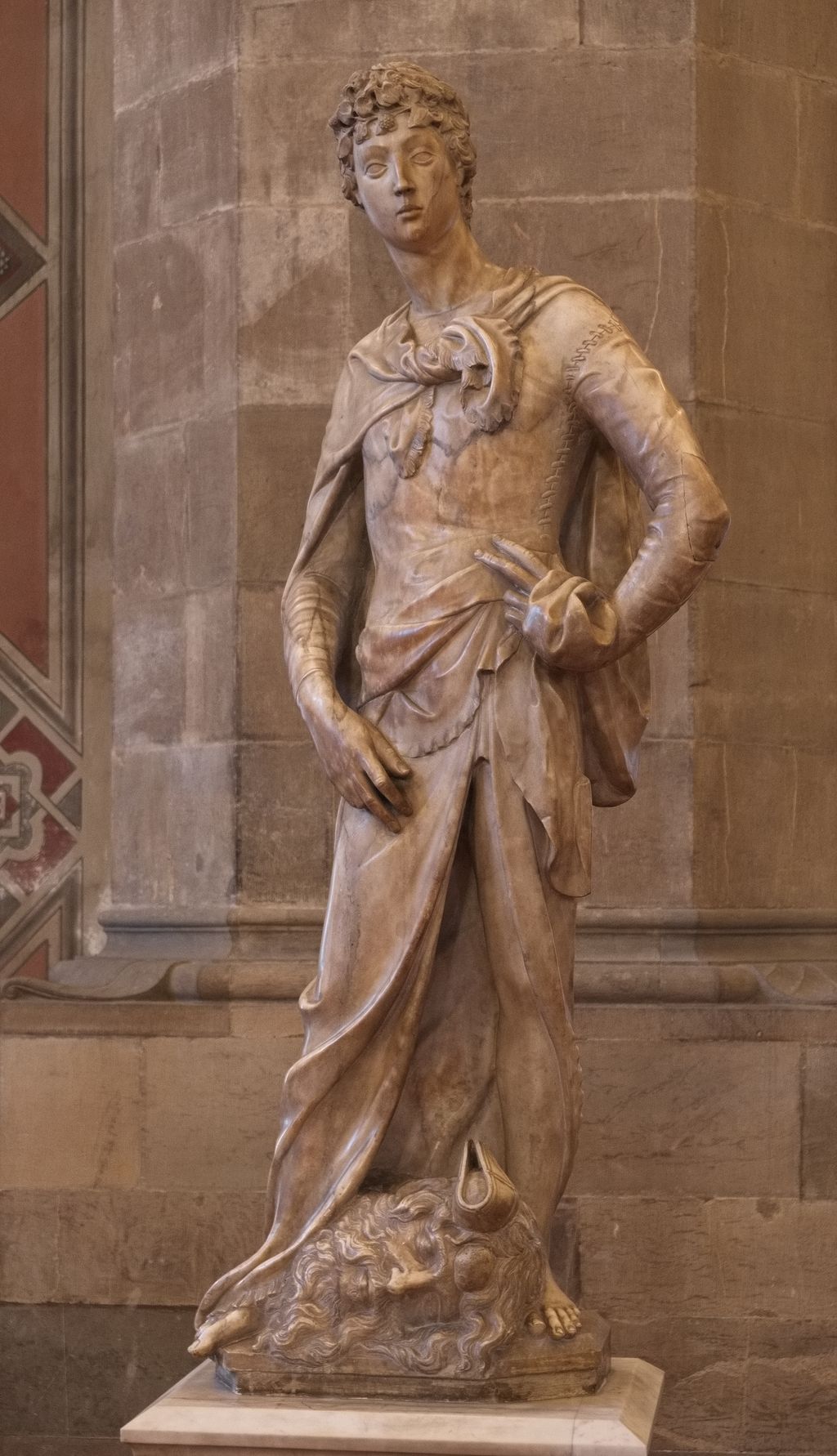
Marble David
Armin Kleiner. Image source. CC BY-SA 4.0. Resized for the web.
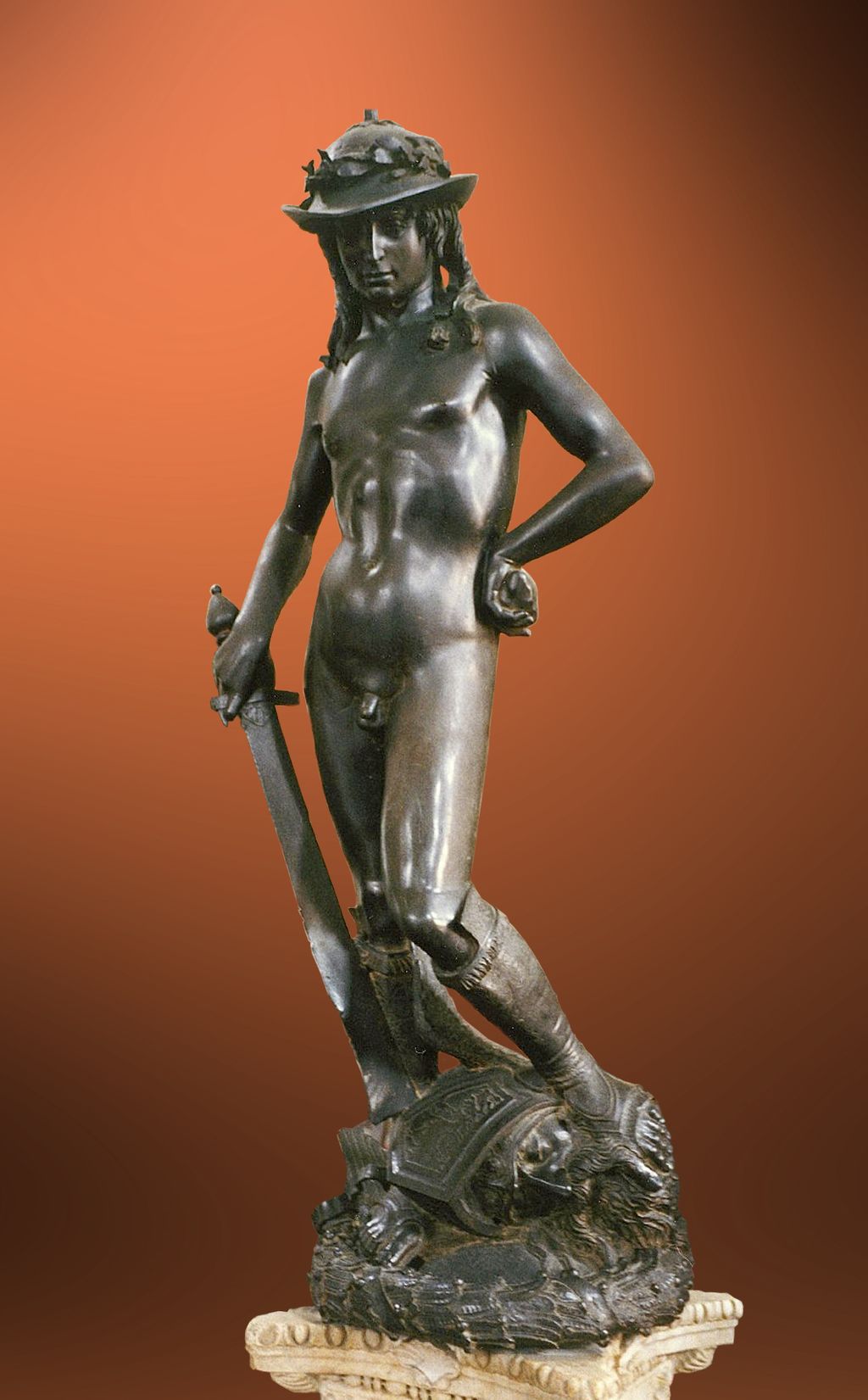
Bronze David
Patrick A. Rodgers. Image source. CC BY-SA 2.0. Resized for the web.
Cantoria
Erik Drost. Image source. CC BY 2.0. Resized for the web.
Gattamelata
Chris Light. Image source. CC BY-SA 4.0. Resized for the web.
Penitent Magdalene
Armin Kleiner. Image source. CC BY-SA 4.0. Resized for the web.
Chellini Madonna
Armin Kleiner. Image source. CC BY-SA 4.0. Resized for the web.
